Randi was in full “make stuff up” mode today, making the video above all the more welcome. After a few paragraphs of feverish conspiracy mongering regarding charter schools being a “coordinated national effort to decimate public schools” (er, Randi, charters are public schools…) Randi stated “To make matters worse, many charters cherry-pick their students, leaving cash-strapped public schools with higher populations of students with special or high needs, further tipping the scales.”
Evidence? She don’t need no stinking evidence!
In addition to the points made by the video about magnet schools and charter school admission lotteries, it is worth noting that district schools routinely “cherry pick” by family income through attendance boundaries encompassing high-priced real estate.
Watch the break that Max Ashton, one of the first generation of ESA students, Brophy Prep graduate and now Loyola Marymount student gets on this first pitch at the Diamondbacks game! This video has gone viral over the last week.
For a video showing Max in action in the ESA program, our friends at Heritage have you covered:
Forsooth Carolinia- the Bureau of Census doth foretell of the advance to your shores of vast throngs of the young and the aged! Bestow yourself with speed: These hordes are bravely in their battles set, And will with all expedience charge on us!
(Guest Post by Matthew Ladner)
So North Carolina is one of the age demographic “Big Trouble” states according to the Census Bureau projections:
North Carolina’s age dependency ratio will be going up do to a projected increase of over 550,000 school age residents and over a million residents age 65 and over.
If you look at recent trends in the NC state budget, you already see evidence of Medicaid increases (which the elderly play a large roll in driving) putting a pinch on other types of spending:
The Urban Institute has demonstrated that the D.C. private school sector is in deep decline, despite the existence of the Opportunity Scholarship Program. Studies have established that charter schools impact private school enrollment most heavily of all sectors.
From an equity standpoint, it’s difficult to justify the District’s school finance system. The system routinely provides $29,000 for high-income students attending regular public schools. It provides $14,000 for high-income students attending charter schools but only a maximum of $8,381 for some low-income students who would like to attend a private school system that improves the chances for graduation by approximately 21 percentage points.
Clearly, the K-12 status-quo gives the most to the kids starting with the most. This pattern is clear, whether discussing academic gains or dollars invested. We have clear success in the charter school and Opportunity Scholarship programs, but these programs receive substantially fewer dollars per pupil. D.C. has most certainly been better off with them, but they alone have not been enough. Tentative steps and half measures will not address the deeply disparate opportunities awaiting the District’s students.
Instead of attempting to restructure or “reform” DCPS, policymakers should free District parents to reform education from the bottom up. To that end, Congress, which has jurisdiction over D.C., should reconfigure all education funding in the District of Columbia and establish an all-Education Savings Account district.
If you like a system that gives the most to those starting with the most, stand pat. If six years worth of average progress between White and Black students doesn’t bother you overly much, look the other way. If you can somehow justify giving half the money per pupil to charter school kids despite the better results they produce for low-income kids, steady as she goes. If you have no problem in shorting low-income kids going to a quickly dying sector of private schools by an even wider margin despite the fact that these students graduate at a much higher rate, don’t rock the boat.
Otherwise schooling in the District needs a complete reboot from today’s morally indefensible and financially unsustainable system.
So I have not been keeping track this year, and election years are not usually the best for big reforms. The over under is 7 new or expanded programs. It wasn’t looking good in the early rounds, but slowly but surely Greg just might float like a butterfly and sting like a bee his way to (yet another) win.
Florida expanded their ESA, Mississippi seems poised to do the same. South Dakota’s governor signed a small tax credit program, and today comes word of a small voucher program that may pass in Maryland as the result of a budget deal. Am I missing anything so far?
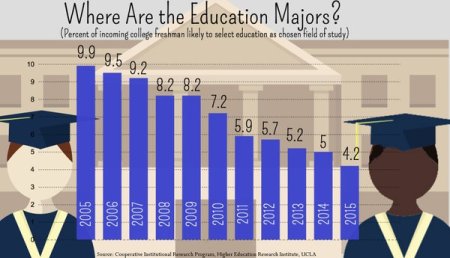
So college students have lost interest in Education Majors:
Several states face very large increases in their youth populations projected by the Census Bureau:
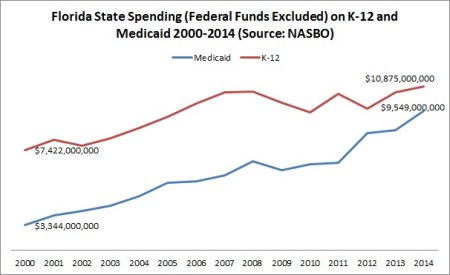
Some states are already experiencing growing teacher shortages, and some traditionally minded folks dream of spending our way out of this, but absent some awesome spurt of sustained economic growth this seems implausible given things like this that come with an aging population:
So student populations project to grow even while the traditional pipeline for teachers shows increasing spare capacity and Baby Boomer teachers retire and states face increasing fiscal strains. Did I miss anything? No? Good- that’s already gratuitous.
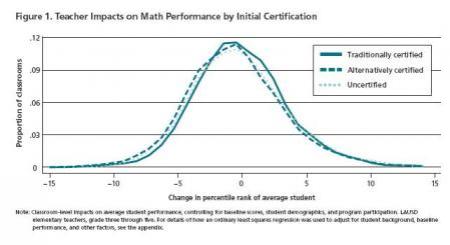
So rather than worry about this, perhaps it is best to view it as an opportunity. It’s not like the old-fashioned way of training teachers had much good to say for itself after all:
College students losing interest in ed majors hints at a broader need to re-imagine the teaching profession more broadly. The status quo is sinking, but a future of a smaller number of higher paid teachers leveraging technology to teach a greater number of students to higher average levels may be possible.
Keeping things the way they are now is neither desirable or possible.
Previous issues of the BCR presented models to classify states by their implementation of CCSS. States that are not followers of CCSS have been reluctant to embrace the changes in curriculum and instruction that are encouraged in those standards. The models also show that CCSS implementation is associated with a change of less than a single NAEP scale score point in both fourth grade reading and eighth grade math. Critics blamed Common Core for disappointing NAEP scores in 2015. The good news for Common Core supporters is that nothing in the analysis supports that charge. The bad news is that there also is no evidence that CCSS has made much of a difference during a six-year period of stagnant NAEP scores.
Of course the Brown Center could be mistaken somehow. Maybe this was somehow worth either fighting for, or else getting bent around the axle over against. If you would like to make an opposing case either way the Jayblog comment section awaits! Otherwise Brown Center gets the benefit of my doubt and I am filing this entire subject away in the part of my wee little brain with all the other stuff that is:
Remember when I told you about Clark County (LV) Nevada packing thousands of kids into trailers with long-term substitute teachers some of whom even had BA degrees? Hmmm….well, in addition to explosive population growth and the ongoing retirement of the Baby Boom generation, this might have something to do with it as well:
So apparently college freshmen have started to listen to the large number of people who have been through an Ed School and found the experience profoundly unsatisfying. Or perhaps they are looking past that at a public school system that treats you like a 19th Century factory worker rather than a professional. Maybe both things are true. In any case, especially for states with booming K-12 populations, it is time for fresh thinking not on how we train teachers, but also about the deeper issues surrounding undesirability of the profession which goes well beyond compensation issues.
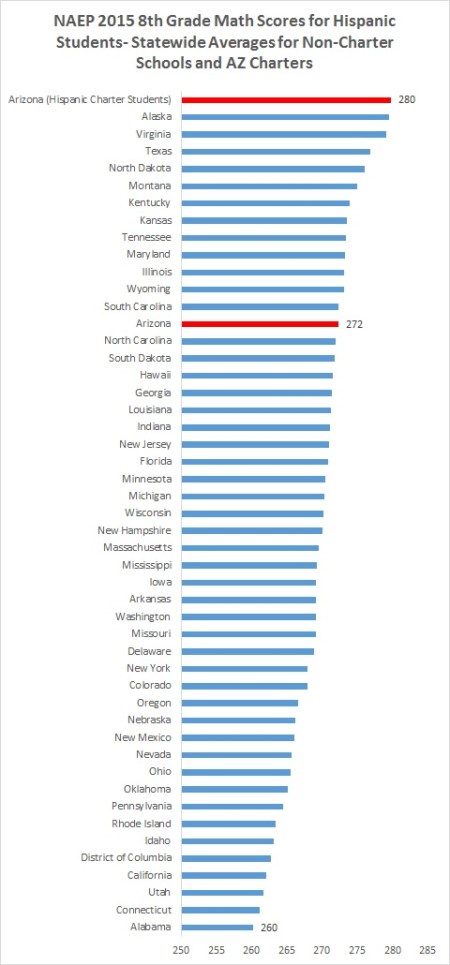
So I was looking at the National Alliance for Public Charter Schools Dashboard on state charter school sectors trying to figure out how the Arizona Charter sector managed to put it all together to rock the 2015 NAEP like a rock star on an epic hotel room thrashing bender. Just as a reminder, Arizona has long been known as a Wild West of charter schooling- liberal authorizing, relatively light-touch state oversight, etc. Just the sort of thing that a central planner hates. In addition, the sector is not generously funded by national standards, pulling in about $8k per student from all sources, and educates a majority-minority student body. Moreover the Credo analysis from a few years ago held its nose at AZ charter results. And yet, the 2015 NAEP comes in and shows AZ charter students scoring like a New England state in all four exams and these results are backed up by the state AZ Merit exam. What gives?
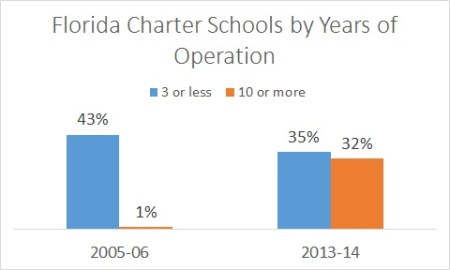
One possible factor- maturation:
Paul Peterson noted years ago that the Credo analysis of charter test scores had not controlled for two potentially important factors- let’s call them shakedown cruise and transfer effects. Like any social enterprise, a school is unlikely to be at peak effectiveness in the early going. In 2005-06 Arizona charter schools in years 1-3 outnumbered those that had been operating for 10 or more years three to one. Let the clock run a bit however and by 2013-14 old timers outnumber newbies by more than two to one. As far as transfer effects go, some brand new schools will have nothing but transfers, whereas established schools will typically be breaking in a new class of their youngest grade covered and some transfers. So we waited things out in Arizona and eventually we were rewarded with results like:
Well AZ charters- you are growns up, you’re growns up and you’re growns up!
Next factor: churn.
The National Alliance for Public Charter Schools notes that between 2010-11 and 2014-15, 215 new charter schools opened. During the 2010-11 to 2013-14 period 96 Arizona charter schools closed. So factoring in life cycle performance, those 215 that opened may have looked pretty meh when Credo checked in on them as youngsters, but perhaps they were just out having an ale with Falstaff and the gang figuring a few things out getting their sea-legs under them as young organizations.
Let’s assume further that those 96 schools that closed actually were worse than meh on average. Arizona grants 15 year charters, so the oldest of the lot did not start coming up for renewal from the Arizona State Charter School Board until 2010. Charters of course sometimes close due to factors other than state action as well, and academically fantastic schools will be greatly under-represented in this subset. So you open about twice as many schools as you close over the last few years but the ones you open are sorting things out and getting better, while the ones you closed just couldn’t cut it results in:
Florida’s charter sector also rocked the 2015 NAEP. How much did they rock the 2015 NAEP you ask? Well this much:
Florida charters seem to be doing something right. Possible maturation factor here as well? I’ll take “Sure Looks that Way to Me” for a thousand Alex:
The National Alliance shows about 300 new charters opening and 101 closing in Florida in recent years. You let parents pick schools that are good fits for their kids, open a new bunch of schools on their way to improving, and close sub-meh, guess what your majority minority sector can rock the NAEP like a New England state.
Now not every charter sector, even among the long-standing ones, sees these kind of results. Many factors can and will influence such scores besides those discussed here. For instance, Michigan charter schools look pretty bad at first blush, but a concentration in Detroit may have something to do with that. The ability to slice and dice the NAEP data has definite limits and multiple factors can be simultaneously at play. Minnesota however has the nation’s oldest charter law and seems to notably lack the sort of grand-slam ability of the Arizona, Colorado and Florida sectors. A lack of dynamism may be contributing while the average age of Minnesota charter schools has increased, very few new schools have been opening, and very few established schools closing- almost as though charters have their little niche but have been safely contained.
Last month Neerav asked “Is School Supply F***ing Everything?” Maybe so. Keep those new schools coming, let parents sort them out, and if parents don’t torpedo the low-performers don’t renew their charters. Otherwise sit back and enjoy!


 Posted by matthewladner
















 Jay P. Greene's Blog