Leo Moracchiloli for the “Al”

October 8, 2018

(Guest Post by Matthew Ladner)

The shape of things to come is discernable on the youtube channel of a delightfully crazed heavy metal guy’s every growing catalogue of cover songs made from a home-based studio in Norway. Leo Moracchiloli, a former member of multiple obscure Nordic thrash bands, has created music that has been viewed over 400,000,000 times and counting. As Voicecouncil explained:

Every week for the past two years, Leo Moracchioli has been posting a fully-produced recording and music video to his wildly popular YouTube channel, Frog Leap Studios, which has reached a remarkable 1,050,000 subscribers.

This one-man-show has found a new brand of genre-crossing that is hitting the spot for multitudes of hungry fans: heavy metal covers of hit songs.He sings the vocals, plays all the instruments, creates the arrangements, edits, mixes and produces every song, right down to shooting and starring in the videos (occasionally enlisting his young daughter as an apt co-star).

It is almost unheard of for an artist to single-handedly produce musical content at the rate and volume he does.

It is not just metal covers that he creates. He also puts out instructional videos and acoustic covers, reaching up to a dozen videos per month.

He says he has had fans telling him he should take a break once in a while, but he can’t bring himself to skip a week.

“You wouldn’t do this if you didn’t have the burn to do it,” he says regarding the insane pace of his work.

Leo is a fantastic example of disintermediation which is a fancy term for “cutting out the middle man.” Years ago I read an interview with the members the Austin band Fastball about record labels. You remember Fastball:

Anyway after The Way became a huge hit the interviewer asked the band members what it was like to be rich and famous. You could feel them shrugging as they explained they were not rich. One of the members said that he had redone his kitchen, but otherwise life had not changed much. The upshot of the article was that record labels basically profit like mad while artists not so much. If you are now thinking of the scene in Bill and Ted’s Excellent Adventure where Billy the Kid says “Here’s the deal-what I win, I keep. What you win, I keep!” give yourself a gold star as it pretty much sums up record labels.


Oh brave new world where you don’t need a record label!

The Jayblog was also a bit of disintermediation when it launched in 2008. I think Jay, Greg and I were all working at think tanks at the time, but just in case you wanted more edu-nerdy goodness, Jayblog was dishing it out, automatic for the people. Like the Prime Directive that guides the JPGB, Leo is obviously primarily doing the videos to entertain himself, which is a large part of their charm. Just imagine Leo trying to sign a record label contract in the 19XXs. Not happening, but lo and behold people get a huge kick out of him. In fact, if I recall correctly, the plot of Bill and Ted involved some unexplained technological change that allowed their band to become a cultural phenomenon. Leo is not quite to the level of Wyld Stallions as a cultural phenomenon, but he is doing pretty good so far and he can actually play his instruments. I’m therefore pleased to nominate Leo Moracchiloli for the Al Copeland Humanitarian Award.


Nominations Solicited for the 2018 Al Copeland Humanitarian Award

October 5, 2018

Image result for al copeland

It is time once again for us to solicit nominations for the Al Copeland Humanitarian Award.  The criteria of the Al Copeland Humanitarian Award can be summarized by quoting our original blog post in which we sang the praises of Al Copeland and all that he did for humanity:

Al Copeland may not have done the most to benefit humanity, but he certainly did more than many people who receive such awards.  Chicago gave Bill Ayers their Citizen of the Year award in 1997.  And the Nobel Peace Prize has too often gone to a motley crew including unrepentant terrorist, Yassir Arafat, and fictional autobiography writer, Rigoberta Menchu.   Local humanitarian awards tend to go to hack politicians or community activists.  From all these award recipients you might think that a humanitarian was someone who stopped throwing bombs… or who you hoped would picket, tax, regulate, or imprison someone else.

Al Copeland never threatened to bomb, picket, tax, regulate, or imprison anyone.  By that standard alone he would be much more of a humanitarian.  But Al Copeland did even more — he gave us spicy chicken.

Last year’s winner of “The Al” was Stanislav Petrov, who literally saved the world from nuclear destruction by refusing to follow Soviet orders to retaliate against what he suspected (and was later confirmed) was a false warning of a US strike.  It’s not quite spicy chicken but it’s close. Petrov was selected from an excellent set of nominees, including Whittaker ChambersJustin Roiland and Dan Harmon, and Russ Roberts.

The previous year’s winner of “The Al” was Master Sergeant Roddie Edmonds, who prevailed over a very competitive field of nominees, including Tim and Karrie LeagueRemy Munasifi, and Yair Rosenberg.  Edmonds stood up against fascists at considerable risk to himself by declaring that he and all of his fellow prisoners of war were Jews to foil the Nazis’ effort to separate Jewish prisoners.  It is this type of courage in the face of illiberalism that we need more of in these times.

The 2015 winner of “The Al” was the internet humorist, Ken M.  Ken M did more to improve the human condition than just make us laugh by making idiotic comments on social media (although that would have been enough).  His humor reveals the ridiculousness of people trying to change the world by arguing with people on the internet.  Given how much time ed reformers waste on social media, especially Twitter, Ken M’s humor is a useful reminder that many of the people reading your posts are probably not much swifter or influential than the Ken M persona.  Ken M beat a set of strong nominees, including Malcolm McLeanGary Gygax, and John Lasseter.

The 2014 winner was Peter DeComo, the inventor of the Hemolung Respiratory Assist System.  To save a life DeComo had to trick border control officials to bring a model of his artificial lung machine into the US from Canada because the device had not yet been fully approved by the FDA.  DeComo won over a worthy field, including Marcus Persson, the inventor of Minecraft, Ira Goldman, the developer of the “Knee Defender,”  Thomas J. Barratt, the father of modern advertising, and Thibaut Scholasch and Sébastien Payen, wine-makers who improved irrigation methods.

The 2013 winner of “The Al” was Weird Al Yankovic.  Weird Al beat an impressive set of nominees, including Penn and TellerKickstarter, and Bill Knudsen.

The 2012 winner of “The Al” was George P. Mitchell, a pioneer in the use of fracking to obtain more, cheap and clean natural gas. Mitchell won over a group of other worthy nominees:  BanksyRansom E. OldsStan Honey, and Alfred Fielding and Marc Chavannes.

In 2011 “The Al” went to Earle Haas, the inventor of the modern tampon.  Thanks to Anna for nominating him and recognizing that advances in equal opportunity for women had as much or more to do with entrepreneurs than government mandates.  Haas beat his fellow nominees:  Charles Montesquieu, the political philosopher, David Einhorn, the short-seller, and Steve Wynn, the casino mogul.

The 2010  winner of  “The Al” was Wim Nottroth, the man who resisted Rotterdam police efforts to destroy a mural that read “Thou Shall Not Kill” following the murder of Theo van Gogh by an Islamic extremist.  He beat out  The Most Interesting Man in the World, the fictional spokesman for Dos Equis and model of masculine virtue, Stan Honey, the inventor of the yellow first down line in TV football broadcasts, Herbert Dow, the founder of Dow Chemical and subverter of a German chemicals cartel, and Marion Donovan and Victor Mills, the developers of the disposable diaper.

And the 2009 winner of “The Al” was  Debrilla M. Ratchford, who significantly improved the human condition by inventing the rollerbag.  She won over Steve Henson, who gave us ranch dressing,  Fasi Zaka, who ridiculed the Taliban,  Ralph Teetor, who invented cruise control, and Mary Quant, who popularized the miniskirt.

Nominations can be submitted by emailing a draft of a blog post advocating for your nominee.  If I like it, I will post it with your name attached.  Remember that the basic criteria is that we are looking for someone who significantly improved the human condition even if they made a profit in doing so.  Helping yourself does not nullify helping others.  And, like Al Copeland, nominees need not be perfect or widely recognized people.


New Field Trip Study

October 1, 2018

The National Art Education Association and the Association of Art Museum Directors just released a new study examining the effects of student field trips to art museums.  The study looked at outcomes for students who went on a single field trip to one of six different art museums around the country.  Instead of going to the museum, some students received an art museum intervention typically presented by museum staff in their classroom.  And a third group of students received neither the field trip or the classroom experience and served as the control group.

This new study is a helpful follow-up to the Crystal Bridges study that my colleagues Dan Bowen, Brian Kisida, and I conducted.  We found that students randomly assigned to a single field trip to the Crystal Bridges Museum of American Art outperformed those randomly assigned to a control group on measures of tolerance, empathy, content knowledge and critical thinking about art, as well as their desire to frequent museums in the future.  This new NAEA/AAMD study was designed to see if similar results could be produced by single field trips to other museums or if our findings were somehow particular to Crystal Bridges.

Importantly, the new NAEA/AAMD study does not randomly assign students across their two treatment and one control condition, unlike our previous Crystal Bridges study which did employ a random assignment research design.  This undermines our ability to draw causal conclusions with confidence since any differences we observe between treatment and control students may be caused by un-observed, pre-existing differences between the types of students who were non-randomly assigned to treatment and control conditions rather than caused by the treatment itself.

Despite this limitation, the NAEA/AAMD study is an impressive accomplishment and gives us information about a broader picture of museum field trip programs than we could get by examining just one museum.  And this new study yields some results that are consistent with our earlier experimental work.  In particular, it finds that students who go on field trips to the museum are significantly less likely to agree with the statement: “All people should understand a work of art in the same way.”  Students who received the classroom experience were also less likely to agree with this statement than the control group, but not by as much as those who actually went to the museum.  So there seems to be something about field trips to art museums that make students more willing to accept different perspectives.

This result is consistent with the tolerance and social perspective effects we observed in both the Crystal Bridges and the live theater studies we have conducted. And it is very similar to one of the items we used in those studies as well as our current Woodruff Arts Center study that asks students whether they agree or disagree with the statement “I think people can have different opinions about the same thing.”  While we are still collecting and analyzing results from Atlanta, I can report that we are finding students who receive three field trips in a single year — one each to the art museum, symphony, and theater — are significantly more likely to agree with this statement than students randomly assigned to a control group.  And amazingly, if students receive a second year of three more field trips, they agree with this statement even more.  It appears that this tolerance benefit of field trips to arts institutions endures and compounds with additional field trip experiences.

Another interesting finding from the new NAEA/AAMD study is that classroom experiences appear to be implemented with much less fidelity than field trip experiences.  It appears that museum educators have better ability to control conditions and do what they intended if the students are at museums rather than in classrooms.  This makes sense and may help explain why the classroom experiences, even when conducted by the same museum staff, have less of an impact.

Lastly, the new NAEA/AAMD study is inconsistent with our previous Crystal Bridges results in that it does not appear that students who go to the museum score significantly higher on a variety of measures that capture their interest in art and museums.  In the Crystal Bridges study we not only found that students expressed a stronger interest in visiting museums in the future, but we were able to track coded coupons that were given to all treatment and control students to observe that treatment students and their families were significantly more likely to attend the museum in the future.  On the other hand, in our live theater study, we only observed a weak effect of going on a field trip to see live theater on student interest in attending theater in the future.  And in the ongoing Woodruff experiment, field trips seem to produce positive consumption effects for some art forms right away but require additional exposure before becoming positive for others. It appears that whether field trips spur future interest in frequenting the arts is complicated and contingent on a variety of factors that we do not yet fully understand.

I applaud the NAEA and AAMD for conducting this research.  Only with repeated examination and attempted replication will we really gain confidence in our understanding of how cultural activity affects students.

(Update — This has been edited to describe the assignment of students to treatment and control conditions in the NAEA/AAMD study more accurately.)


American Families Rebel Against K-12 Standardization with their Pocketbooks

September 27, 2018

(Guest Post by Matthew Ladner)

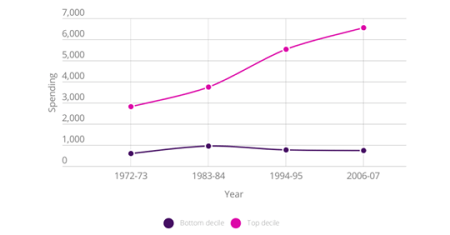
Research from Sabrino Kornrich and Frank Furstenberg tracks enrichment spending by family decile income. The above chart tracks trends in enrichment spending by the top and bottom deciles of income over time. As you can see, upper income families are enriching with increasing gusto, while lower-income families have flat enrichment expenditures.

Enrichment- coming in various forms such as tutors, club sports, Kumon, Mathnasium etc. has become increasingly ubiquitous among the posh. It seems entirely normal, but we should recognize the significance of this trend. In addition to the equity issue staring back at you in this chart, there is also something else worth noting in the data: upper-income America continues to put their children into public schools in high numbers but they are solely relying upon those schools less and less. It’s always been the case that all American families should know better than to entirely rely upon any school to provide the totality of the education of their child. Upper income families have the ability and increasing willingness to act. Jay refers to this trend as hybrid homeschooling. I think of it as a better American version of Japanese cram schools.

In places like Japan and South Korea university admission is highly selective and competitive, and families routinely send their children to what are called “cram schools” after their regular school to prepare for admission exams. Andrew Coulson made a convincing case in Market Education that these private after school programs were more responsible for Japan and Korea’s high PISA scores than their public school systems.

To which America says “I see your obsessive preoccupation with standardized test prep mania and raise you a hackerspace for kids!”


If that’s not your child’s cup of tea don’t worry because there are many other options. On the academic side you can get Advanced Placement coursework and textbooks for free, and take the AP exams for a shot at college credit for approximately $85 per course. That however is just academic stuff, albeit academic stuff that can earn you college credit at an amazingly low price- how about something fun like animation camp? Or museum programs? If you go to Cottageclass.com you can find all kinds of stuff- from art, music, wood shop to ethics classes.

The trend towards enrichment may in fact be in part fueled by the overreaching of standardization in public education. Jack Coons and Stephen Sugarman for instance noted in Education by Choice:

To the extent that schools of choice must conform to state imposed curriculum requirements, the principle of family control is compromised. Each centrally imposed curriculum prescription or prohibition tends to shrink the proportion of families that can be satisfied. If the state demands too much the effect will go beyond simply adding or eliminating certain courses; entire schools will be excluded. For example some preexisting private institutions would refuse to participate if sex education were required, others would refuse if it were forbidden. It seems sensible for us for the state to impose very few restrictions or mandates. In general schools should be free to please themselves and their customers.

Coons and Sugarman go on to say that in a choice system we should allow individual public school campuses to decide upon their curriculum as well. Such freedom is far more plausible in a liberal system of choice, and in the absence of that freedom local control was largely abandoned in a largely futile effort to improve outcomes through centralization. In many ways Coons and Sugarman arrived a place similar to John Stuart Mill, who had warned presciently:

All that has been said of the importance of individuality of character, and diversity in opinions and modes of conduct, involves, as of the same unspeakable importance, diversity of education. A general State education is a mere contrivance for moulding people to be exactly like one another: and as the mould in which it casts them is that which pleases the predominant power in the government, whether this be a monarch, a priesthood, an aristocracy, or the majority of the existing generation, in proportion as it is efficient and successful, it establishes a despotism over the mind, leading by natural tendency to one over the body. An education established and controlled by the State should only exist, if it exist at all, as one among many competing experiments, carried on for the purpose of example and stimulus, to keep the others up to a certain standard of excellence.

American families have deep misgivings about the conduct of public schooling, especially the modern practice of standardized testing. We should aspire to a schooling system that is a good deal more than providing test-prep custodial care for the advantaged before they move on to more genuine educational experiences after school. Likewise, the equity issue in the above chart deserves to be addressed but realistically must be addressed within a context of increasingly constrained resources. The trend towards top-down standardization in K-12 has predominated in recent decades and produced too little at too great a cost despite good intentions. It’s time for a more liberal approach that gives opportunities to educators to create schools and educational experiences, and families the opportunity to select among them. The last 40 years has gone mostly wrong, some bold states should see if Mills, Coons and Sugarman had it right.


Sending a Message

September 20, 2018

JOKER_burning_money_3_0600

(Guest post by Greg Forster)

As of FY15, school choice had already saved state and local taxpayers a cumulative total of $3.2 billion.

While improving educational outcomes across all metrics.

Pictured above: Marty Lueken, contemplating the government school monopoly.


Is the Charter School Movement Dead or Mostly Dead?

September 19, 2018

(Guest Post by Matthew Ladner)

So what should we make of this:

The above chart comes from Robin Lake’s Education Next piece on the slowdown in charter school growth in the Bay Area. This article focused on three culprits: facility challenges, internal challenges and political backlash. There were several interesting nuggets in the “internal challenges” section, for instance:

Charter advocates in the Bay Area seem to subscribe to a “survival of the fittest” ethic, which holds that because running a successful charter school requires so much capacity, if potential operators are scared off from pursuing an application without a lot of handholding, it’s probably for the best. This was a reasonable strategy in the early days when the supply of savvy entrepreneurs was plentiful and charters were booming, but it may be time to look deeper for quality operators and provide more support.

Translation: I had my legal department cut and paste from their last 700 page charter application, if you don’t have a legal department too bad.

Then:

Meanwhile, the funding community is not sufficiently supporting these smaller players to make it worth their while. In interviews, many leaders told us they believe that the Bay Area’s supply of effective schools is limited today by the philanthropic funding strategies used in the past. In particular, there is a consistent perception that single-site schools and school leaders of color who are not tied into local funder networks have historically not been connected to dominant funding channels.

Translation: It’s easier for large philanthropic foundations to write big checks to other big organizations than to seed mom and pop operations.

Further hampering growth, the charter leaders we interviewed said that start-up dollars are the hardest to come by in the communities they consider most viable for charter school expansion. Operators are finding it easy to access philanthropic funding in urban Oakland and San Francisco, but see those places as “over-saturated” and gentrifying. By contrast, in the less urban area of western Contra Costa County, there are more available facilities and a growing population of students that match most charter schools’ target populations—but fewer opportunities to access philanthropic dollars to start up new schools.

As one charter-school operator said, “People are moving farther and farther away from cities [because they can’t afford to live there] and into poor-performing school districts. An organization like KIPP—if they want to double in the next five years—they’ll need to go in these areas. But charters are not going there because there is no funding there.”

Translation: America is morphing into Paris, France whereby the wealthy people live in the city and the not-wealthy in the suburbs or exurbs. Philanthropists have yet to appreciate just how quickly this is happening.

Like any complex phenomenon, the charter school slow down certainly has more than one explanation. None of these factors would seem to explain why the last few states to pass charter laws have opened few to no charter schools, why the highly ranked Indiana law that passed in 2001 still hadn’t met the minimum subgroup reporting requirements for NAEP in 2017 (you can often get scores for male Asian students as a point of reference) etc. In other words Lake’s look into the SF area was informative, but perhaps not fully revealing.

As a determined optimist, I’m going to say that the charter movement is only mostly dead, which means it is partially alive. Let’s get him to Miracle Max quickly however because it doesn’t look good…


Teachers Value More than Money

September 18, 2018

classroom-2787754_640

(Guest post by Greg Forster)

I have a new blog post at OCPA reflecting on the fact that private school teachers are more satisfied than public school teachers, even though they get paid less, because on almost every other metric their jobs are better:

There’s a lesson in this for how we improve education. Unionization has raised teacher salaries, benefits, and job protections. But, in schools as in factories, unionization seriously hinders organic cooperation in the workplace, not only between the line workers and their supervisors but also between the line workers themselves. Workplaces begin to run much more by arbitrary rules than by what gets the job done. I remember being in a state legislative committee hearing once where a principal was asked why she quit running a district school to run a charter school. “Because I can hold a meeting” was her reply—union rules had prevented her from asking teachers to attend meetings when needed in her district school.

However, there’s also a lesson for school choice. The choice movement has historically invested far too much in the rhetoric of markets, competition, and material incentives. People are not money-maximizing robots. They care about getting their job done for the sake of the job, not just for the sake of the paycheck or to grow the size of their organization. School choice works because it sets parents, and teachers, free to focus on working together to get the job of education done in the way that works best for them. Yes, incentives matter, and we can say so. But let’s put the emphasis on cooperation, community, and freedom.

Let me know what you think!


But…his intentions were good!

September 18, 2018

(Guest Post by Matthew Ladner)

Reason hosted a debate between Stiglitz and Easterly on the role of markets in reducing poverty. A questioner from the audience asks Professor Stiglitz to address his endorsement of Hugo Chavez in 2006 and 2007 in a respectful but direct fashion around minute 51. Eventually after a fumbling attempt to claim that some aspects of the Chavez program were good, Stiglitz admits that in the end while Chavez rhetorically embraced higher and more inclusive rates of economic growth, in the end “he didn’t know how to do it.”

Venezuela sits atop the world’s largest proven oil reserves but production is in free-fall along with the overall economy. Starvation and hyper-inflation run rampant, and the country’s economy dives ever deeper into a humanitarian crisis. Meanwhile, a group of Texas wildcatters have a single region outproducing the country with the largest proven reserves despite the fact that we’ve been drilling in that region for a century. Friedman once said that if you put the federal government in charge of the Sahara they would produce a shortage of sand. This was not alas much of an exaggeration.


Want More Art Ed? Decentralize School Control

September 14, 2018

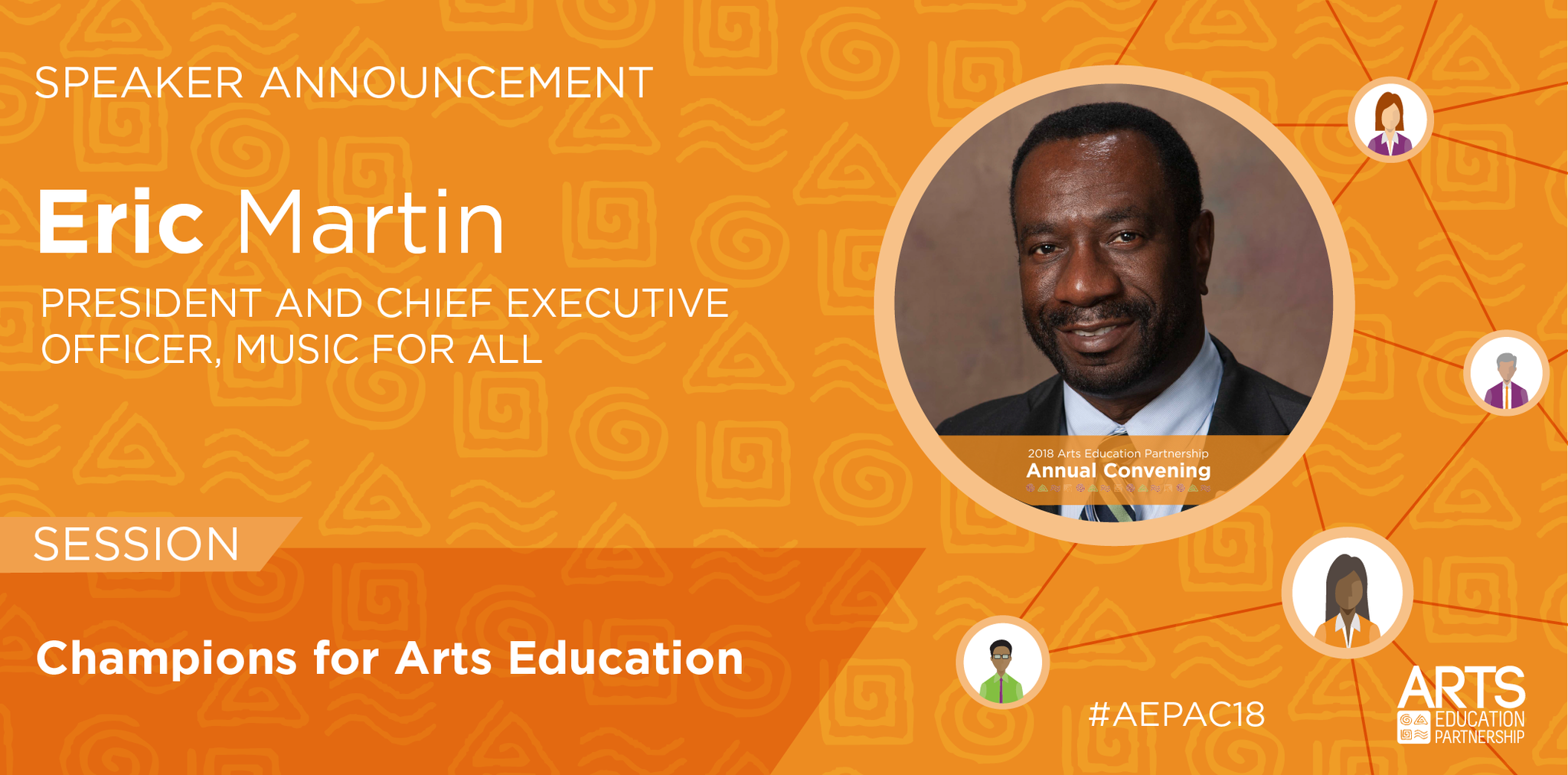
I just came back from the National Convening of the Arts Education Partnership.  It was a fantastic gathering of arts advocates, researchers, and practitioners.  I was particularly struck by the comments during the opening session made by Eric Martin, who leads Music for All .  He noted that parents and communities tend to want more arts education than their schools often provide.  I suspect he’s right about that, but that raises a puzzle: if parents and communities want more art, why are their schools not providing what they want?

You might think the answer is a lack of funds, but that can’t really explain it.  The arts are not that expensive and if schools were more responsive to parental and community preferences, they would give greater priority to the arts in their budgets and schedules.  And then it dawned on me… schools are not more responsive to parent and community preferences regarding the arts because parents and communities no longer really control their schools.  Schools are increasingly answerable to distant bureaucrats in state or federal departments of education rather than to the parents and communities they serve.

This situation is a disaster for the arts.  Even if distant bureaucrats valued the arts as much as many parents and communities do, bureaucrats cannot give priority to the arts because that is not the basis by which the success or failure of their distant management is judged.  The only systematic, easily available information we have on schools is math and reading test scores.  Narrowing the focus of schools on math and reading test performance is inherent in the effort to manage those schools from a distance.  Parents and communities do not have to rely on math and reading test scores to judge school performance because they are close enough to gather a large amount of contextual information.  By contrast, the state superintendent has no access to this information about quality and is inevitably judged completely on the few bits of test score data we do have about all of the schools in their charge.

If this is correct, the most promising strategy for arts advocates to pursue to expand arts offerings in school would be to favor decentralization of control over schools to parents and communities.  If we want more art, let’s get out of the way of parents and communities that want more art.

The irony is that most of the people at this week’s Arts Education Partnership meeting are very focused on lobbying for policies at the state and federal level that they hope would advance the arts.  There was a lot of discussion of the importance of states adopting a set of national standards regarding arts education.  There were pleas for more funding and support from state departments of education.

All of these measures are sincere efforts by good people working hard on behalf of the arts.  But I suspect that the more arts advocates strengthen centralized control over schools, even if in the name of advancing the arts, the less likely we are to see priority given to the arts in education.  Centralized control requires evaluation by centrally collected metrics, which means an emphasis on math and reading test scores.  This is true no matter how many arts standards are adopted, how many state arts initiatives are adopted, or how many speeches in favor of the arts state officials give.

Arts advocates may want to shift their attention toward strengthening parent and community control over their own schools so those schools are more likely to deliver the arts education that folks really want.


Grand Canyon Institute Makes Vast Decisions Based on Half-Vast Data and Analysis

September 10, 2018

(Guest Post by Matthew Ladner)

The double-plus good propaganda generators are at it again here in the Cactus Patch- in the latest edition of the two-minute hate, the Grand Canyon Institute claims each private choice student is costing the state general fund more money than the public school students. In the instant-classic turn of phrase by Robert Pondiscio however, it is important not to make vast decisions based on half-vast data.

You can watch a public affairs show interview with the author here. In the author states that the analysis supports abolishing private choice programs. Just how half-vast is the Grand Canyon Institute analysis? Well they’ve basically done a two variable regression analysis with private school enrollment as the dependent variable, and they’ve hung their entire estimate on one of the two regression coefficients. The first problem, which sinks the entire analysis by itself, is that their dependent variable for Arizona private school attendance is unreliable.

GCI uses a federal source for private school attendance by state. That source however does not have anything like a 100% response rate (see the appendix) and lists 320 private schools in Arizona. If one however goes to the Arizona Department of Revenue report on private school tax credits, you find tax credit scholarship tax credits going to 362 different private schools. The list of 362 may or may not be exhaustive. So CGI has a flawed dependent variable on their hands- the reality is that we don’t know the number of students attending Arizona private schools- we don’t even know the number of schools.

Second off a regression analysis with two independent variables (% of students attending charters and private choice dollars, respectively) would likely a grade of incomplete in an Introduction to Statistics class-if the instructor wanted to encourage the student and was feeling generous. The universe of other factors which influence private school attendance. A quick google search for instance revealed an analysis testing 14 separate variables– many of which were statistically significant. Arizona’s economy crashed during the period examined in the CGI analysis for instance, and the above analysis finds family income explains variance in private school attendance. Considering that the entire GCI analysis rests on a regression coefficient, failure to control for more than two variable would be deeply suspicious even if they had a valid dependent variable, which they don’t.

In short, the Grand Canyon Institute’s elephant went in search of a way to claim that Arizona’s private school choice programs were bad, and sure enough they (predictably) found it. The analysis reveals much more about CGI than private choice programs in the end.