For The Al: The Rock of Chickamauga, George Henry Thomas

October 25, 2018

450px-GHThomas

(Guest post by Greg Forster)

As the prospect of civil war loomed in 1860, southern partisans in the U.S. Army began shuffling commands around, to put all the southern-born officers together. That way, they could work and train together, forming relationships, cohesion and teamwork that they could take with them together in the event of secession. And when the break did come, half those southern-born officers did in fact leave together.

Among those who did not was the man with three first names: George Henry Thomas.

Here’s a Civil War story you don’t know and need to: Over 100,000 white southerners, known as Southern Unionists or Southern Loyalists (as well as Yankees, Scalawags and Tories among their detractors, alongside less printable names) served in the Union army during the Civil War. Every southern state except South Carolina contributed at least a full battalion to the Union. Tennessee alone produced 42,000 loyal men to fight for the Stars and Stripes.

If there is ever going to be healing for the still-festering wounds of the Civil War, it will come when we who hail from the South are ready to admit that the Cause was wrong. That will be a hard pill to swallow; clearly we are not yet ready to swallow it. One thing that will make it much easier will be if we learn to tell the stories of the many thousands of southerners who knew better than to be taken in by the Cause.

If you asked the Southern Unionists why they were fighting for the North, they’d have told you they weren’t fighting for the North. They were fighting for the Union.

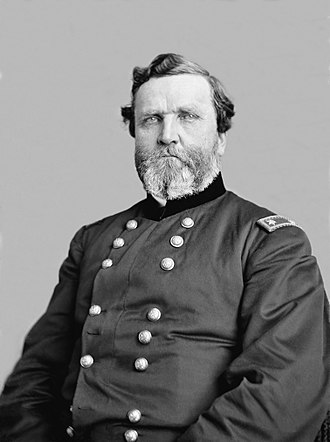
Among that roll of honor, Major General George Henry Thomas – son of Virginia – stands head and shoulders above the rest. “Old George H. Thomas is in command of the cavalry of the enemy,” wrote J.E.B. Stuart to his wife. “I would like to hang, hang him as a traitor to his native state.” The two had studied together at West Point.
330px-George_Henry_Thomas_-_Brady-Handy

Why does Thomas deserve The Al? Let me count the ways:

1. Thomas brought the Union’s disastrous early losing streak to a close by winning its first strategically significant victory, at Mill Springs, Ky. on January 18, 1862. He was in a position to do so because his prowess and natural leadership (his men identified with him as a fellow “soldier’s soldier” yet also looked up to him as “Pap Thomas”) were so much in evidence that between April and August of 1861 he had been promoted to lieutenant colonel, then colonel, then brigadier general. At Mill Springs, he broke the Confederate hold on Kentucky, and – probably even more important in the long run – delivered a much-needed morale boost. It’s hard to overstate how shocking the loss at First Bull Run and the series of subsequent defeats were for the Union. It became an open question whether the Union might make terms and quit. Mill Springs shored up political support to see the war through.

2. At the Battle of Chickamauga, September 18-20, 1863, commanding Union general William Rosecrans – whose commission had been backdated so he could fake seniority and get promoted to that command ahead of Thomas – committed a major tactical blunder, and Union lines collapsed. Confederate troops charged in, and the defeat threatened to turn into a rout from which the campaign might not recover. Thomas held his ground, inspiring his troops to stay and bear the brunt of the attack, in order to provide cover for the rest of the Union forces at Chickamauga to organize a retreat. A message runner (future U.S. President James Garfield) informed Rosecrans that Thomas was “standing like a rock.” The Army of the Cumberland was saved, and Rosecrans was removed from command in favor of Thomas. He led the Cumberland to a dramatic reversal of fortunes, culminating in a decisive Union victory in November in the Chattanooga Campaign. (Ironically, the climactic battle was won in part by dumb luck.) The Union gained permanent control of Tennessee and strategic dominance of the entire western theater, as well as the staging point from which Sherman’s Atlanta campaign would be launched and supported the next year. Thomas was known forever after as The Rock of Chickamauga.

3. After the Chattanooga Campaign, a chaplain asked Thomas if the Confederate dead should be buried separately by state. “No, mix ’em up,” said Thomas. “I’m tired of states’ rights.”

US-$5-TN-1891-Fr.365

Special $5 Treasury note honoring Thomas, 1890

4. When John Hood found he could not directly stop Sherman’s march to Atlanta, he turned around what was left of his Army of Tennessee and tried to cut off Sherman’s lines of communication to the Union stronghold in Chattanooga, hoping to draw Sherman off to fight him. But when Hood got to Tennessee, he found The Rock of Chickamauga – who was once his teacher at West Point – waiting for him. Thomas smashed the Army of Tennessee so hard that it ceased to exist; its few remaining men dispersed and joined themselves to other Confederate forces. Thomas earned yet another nickname, The Sledge of Nashville, and a very-long-overdue promotion to major general. (“I suppose it is better late than never,” he commented. “I earned this at Chickamauga.”)

5. After the war, with much of the South in desperate, starvation-level poverty, Thomas sent generous financial assistance to his two sisters living there. They sent the money back, declaring that it must have been sent to them by mistake, as they had no brother.

6. One of the main reasons the wounds of the war have not healed is the vast superiority of southerners as storytellers. Our national memory of the war has been disproportionately shaped by the way the South has told its own story, for the simple reason that northerners, in general, can’t tell a story worth a nickel. Thomas saw what was happening early on; he sounded the alarm in 1868:

The greatest efforts made by the defeated insurgents since the close of the war have been to promulgate the idea that the cause of liberty, justice, humanity, equality and all the calendar of the virtues of freedom, suffered violence and wrong when the effort for southern independence failed. This is, of course, intended as a species of political cant, whereby the crime of treason might be covered with a counterfeit varnish of patriotism, so that the precipitators of the rebellion might go down in history hand in hand with the defenders of the government, thus wiping out with their own hands their own stains; a species of self-forgiveness amazing in its effrontery, when it is considered that life and property—justly forfeited by the laws of the country, of war and of nations—through the magnanimity of the government and people was not exacted from them.

Alas, that was one battle with the Confederacy he was destined to lose.

7. Thomas spent the postwar years overseeing the military government of various regions of the South under Reconstruction, and in particular suppressing the Klan. He set up military courts that would enforce labor contracts for black citizens who couldn’t get redress in civilian courts.

8. He retired to upstate New York and was buried there. None of his blood relatives attended his funeral.

For the honor of the Union and the South: The Rock of Chickamauga for The Al.

Image HTs – color, b/w, T-note


For The Al: Adam Butler and Autumn Thomasson

October 24, 2018

(Guest post by Greg Forster)

Those of us interested in markets often use the childhood experience of running a lemonade stand to illustrate how business can be a school of virtue. In recent years, unfortunately, we have been more likely to point to the shutting down of lemonade stands as an example of how overbearing regulation is stifling the entrepreneurial spirit in our culture, destroying this and other traditional rites of passage like teenage summer jobs.

This summer, though, we got a delightful surprise. Under the leadership of Adam Butler, general manager of beverages and nuts for Kraft Heinz, Country Time Lemonade introduced the awesomeness of “Legal-Ade.” It’s a system of financial and legal support, covering permits and fines up to $300, to help kids like Autumn Thomasson keep their lemonade stands open over the summer. They also donated to Alex’s Lemonade Stand Foundation, which helps kids and families run lemonade stands to raise money for cancer research.

It’s also the rockingest advertisement I have seen in a long time. “TASTES LIKE JUSTICE!” Wish I knew that actor’s name, I’d add him to the nomination.

Is it even legal for corporations to get this creative and take a risk standing up to the regulatory state for their customers? Aren’t they required to run to the corner and cower in fear, promising to do whatever the state demands?

Because if they’re not . . . our big corporations are run by cowards.

And they’re probably leaving a lot of money on the table, too. You think this aid program paid for itself in increased sales for Country Time? I’d bet you more than a glass of lemonade it did.

Why do I think so? Here’s one reason. Adam Butler says: “Legal-Ade will be back next year, helping support kids’ rights to run lemonade stands! We look forward to kicking off year two of the program and helping more kids next year.”

Watch out, lemon protection rackets. Autumn has backup.

For bringing lemonade to the world, having a ton of fun mocking PLDD lemon thugs, and making an honest buck doing it all, I nominate Adam Butler and Autumn Thomasson for The Al.


For The Al: Eric Lundgren

October 23, 2018

eric-lundgren__31896

(Guest post by Greg Forster)

Since June 15, Eric Lundgren has been in prison. His crime: Downloading software onto computer disks for his customers instead of making them do it themselves – which many of them couldn’t do, leading to unnecessary abandonment of perfectly good computers (filled with delightful chemicals) into our landfills. His sentence: 15 months in prison.

In the spirit of honoring noble scofflaws like Al winner Wim Nottroth and UX (who played Valjean to Higgy winner Pascal Monnet’s Javert), I nominate Eric Lundgren for The Al.

This is not Lundgren’s first run-in with the powers. His first arrest was at age 14, when he panicked and fled from a police cruiser trying to pull him over for driving a not-entirely-street-legal go kart he had made with a lawn mower motor and a boombox.

Since then he’s put his ability to repurpose parts to more productive use. He became a millionaire tech entrepreneur finding a variety of ways to reuse electronic devices and components rather than let them rot. Some of these have been lucrative, some charitable, and some both at the same time. He launched the first “electronic hybrid recycling” facility in the United States, turning old cell phones and stuff back into useable devices. This serves the poor (who can get devices cheaper), saves the environment (chemicals in phone batteries are nothing to mess with) and, hey, put a buck into Lundgren’s pocket, too.

He once built an electronic car out of discarded parts that out-distanced Tesla’s car on a single charge. And don’t forget the troops – his company once donated 14,000 cell phones to military personnel deployed overseas, where I bet they were grateful to be able to make a call home.

His trouble with the law – this time – springs from his having manufactured a “restore disk” that you could use to restore your software after a crash. One thing he provided on the disk was a copy of Microsoft software to re-install. He found that many customers either were, or felt (which amounts to the same thing) unable to restore this software themselves, and perfectly restorable computers were being thrown out in favor of new purchases because customers couldn’t get their old ones to work.

Now, let’s be clear about four indisputable facts:

  1. Lundgren was not authorized to download the software, so he did break the law – as he admitted by pleading guilty (though he appealed the jail sentence as excessive).
  2. The disks could not be used on a computer that did not already have a paid-up license for the software, and anyone with a paid-up license is allowed to re-download the software for free, so Lundgren didn’t cost Microsoft a single thin dime that it was ethically entitled to.
  3. Microsoft wanted this case prosecuted because they wanted to collect sales revenue by getting people to dump perfectly good computers in our landfills so they’d have to buy new computers with new software.
  4. Only a coward or idiot of a prosecutor would charge a case like this.

There’s nothing wrong with making a buck as you do good for the world. But there is something wrong with making a buck by not doing good for the world. And there is a whole lot wrong with sending a man to jail for 15 months so a company can make a buck off actively harming its own customers.

I’m proud to nominate Eric Lundgren for The Al.

Image HT


Baby Baby DARLING You’re the WEST!

October 22, 2018

(Guest Post by Matthew Ladner)


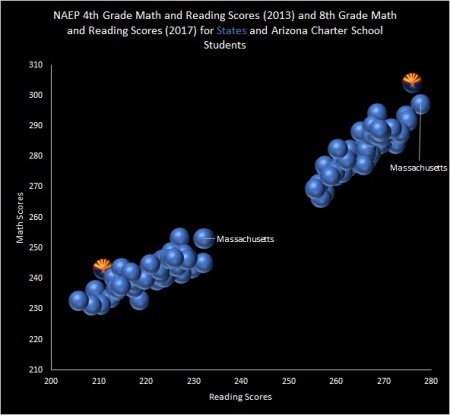
So I decided to see how the charter sectors of the Top 10 rated charter laws in the National Alliance for Public Charter Schools would look in a cohort gain chart compared to the Cactus Patch. The top ten (in order) are Indiana, Colorado, Washington, Minnesota, Alabama, Mississippi, Maine, DC, Florida and Kentucky. The above chart shows 4th grade math and reading scores from 2013, and then 8th grade math and reading scores from 2017-when the 4th grade cohort from 2013 were 8th graders.

Sadly of these states NAEP only reports charter student scores for Colorado, DC, Florida and Minnesota. You have to have a minimum number of students before the NAEP will report scores, and mind you that you can find male Asian scores in some states. It’s a mixed bag with the non-reporting states- some of the laws are old and just not very active in producing “charter schools” (Indiana) and others are young and not very active at producing charter schools (Washington, Alabama, Mississippi, Maine and especially Kentucky). When they do open schools they are going to be AMAZING– as in I’ll have to extend the axis scales on these charts. For now I’ve included them clearly in the above charts as very dark dots. What? Can’t see them? Not to worry just squint hard and use your imagination.

I’m fond of the charter sectors in all of the remaining top 10 states (i.e. the four with actual schools) in different ways. Colorado is a fellow member of the Wild West, Florida is an honorary member, DC charters clearly do better than DC districts despite getting about half of the funding and few of the families with both parents having law degrees, and Minnesota kicked off the charter school movement.

I think that all of these charter sectors have majority minority student populations with the exception of Colorado. I’ll let you decide whether Colorado’s higher 4th grade scores or Arizona larger gains and higher 8th grade scores qualifies as most impressive, but either way darlings you’re the west best!


Nominated for the Al Copeland Humanitarian Award: Elizabeth Vandiver

October 22, 2018

Image result for elizabeth vandiver

Two of our children attended and later worked at a summer camp in northern Georgia. Getting to and from camp from Northwest Arkansas was particularly costly and inconvenient by airplane, so for more than a decade we drove more than 13 hours each way.

All of this driving, year after year, may sound like a giant pain but actually it was quite wonderful.  Criss-crossing the US reminded us of what a big and beautiful country we live in.  And the forced togetherness provided plenty of opportunity for us to talk and really get to know each other.  I loved it.

But one of the most special things about spending dozens of hours in the car together was being able to listen to Elizabeth Vandiver’s lectures on Classical Mythology.  Before we left for each trip we’d go to Fayetteville’s wonderful public library and check out a bunch of audio books.  I happened to stumble upon Prof. Vandiver’s lectures, which are part of the Great Courses series.  I think the first one we heard was her course on the Odyssey, which consists of two dozen 30 minute talks.  We later listened to her courses on the Iliad, Greek Tragedy, the Aeneid, and her overview of Classical Mythology.  In total that is about 60 hours of Vandiver’s lectures.  Mind you, this was spread over a decade in which we drove for more than 260 hours, but listening to Elizabeth Vandiver was a big part of our annual road trips.

I didn’t force these lectures on our kids.  I didn’t have to.  They were captivated by her extremely well-organized and clear discussion of Greek and Roman Mythology.  These are really great stories and Vandiver describes and explains them wonderfully.  Our youngest loved the lectures so much that he jokingly called Vandiver his “girlfriend,” never having seen a photo of her and just from the sound of her voice. Not surprisingly, he is now double-majoring in Classics and Drama, having just completed reading the Aeneid in Latin.

Elizabeth Vandiver is worthy of “The Al” for much more than contributing to our beloved family memories.  Vandiver has made a significant improvement to the human condition by giving lectures that help us understand that condition.  The fact that these stories remain completely recognizable and relevant to us despite the passage of nearly 3,000 years, teaches us something about the enduring qualities of human experience.

We are not, as some of my Progressive colleagues imagine, simply able to use reason and science to re-construct our world with each new generation.  Human beings are not perfectly malleable clay waiting to be shaped by forward-thinking educators and social engineers.  Humans have a certain nature, which classical mythology shows us has remained unchanged.  We would be wise to understand and consider that nature when thinking about building and sustaining the institutions that steer people for good or for ill.  Rather than telling us who they think we should be, as modern educators and pundits seem inclined to do, Vandiver teaches us who we are.  And she does so with a crispness and clarity that makes even young children want to seek out the original materials to learn from them directly.

Of course, Vandiver has been recognized for her excellence as a teacher.  She has won awards from Northwestern and University of Georgia, where she has previously taught, as well as Whitman College, where she is currently a professor.  But those university teaching awards do not have the status and broad recognition that The Al does.  So, for all that Elizabeth Vandiver has done to improve the human condition by teaching countless people about the human condition, I nominate her for the Al Copeland Humanitarian Award.

If you’d like to see some of her fantastic lectures, I’ve found her entire Classical Mythology course on YouTube,  Here is one segment:


Richard Garfield for the “Al”

October 19, 2018

(Guest Post by Ben Ladner)

Editors note: Ben Ladner is a Senior at the Arizona School for the Arts in Phoenix.

Tell me if you’ve heard this one before: a nerdy, socially confused teenager looking for a place he can fit in discovers community in a game and the fellow people who are obsessed with it.  I suspect you all know the story – more than one of the regulars here grew up on Dungeons and Dragons.  But while I’ve raided a few bandit hideouts in my time, my story is about a different but no less revolutionary game: Magic: the Gathering.

In the early 1990s, Richard Garfield was an unkempt mathematics post-grad who designed games in his spare time.  He and a friend pitched a board game to Peter Adkison, CEO of Wizards of the Coast, a small gaming company looking for an innovation to sell, but it was too complex for Adkison’s scrappy firm to handle.   Adkison wanted something smaller and simpler, that could be played quickly between rounds at larger conventions.  Garfield told Adkison that he might have something, what he returned with was nothing short of a revolution.

Magic: the Gathering, released in 1993, is a combination of baseball cards and chess.  Cards representing various high-fantasy monsters, arcane spells, and powerful magic items can be collected and traded, but each has play value in a strategic, intellect-based game that pits players and their decks of cards against each other.  Players use their collections to fine-tune their decks in a game world that is ever-changing as regular expansions add new cards to the mix.

Magic was the first game to combine the two previously unrelated concepts, and it has become no less of a paradigm shift in the gaming world than D&D was a generation earlier.  Trading card games are everywhere now, and Magic is still going strong with over 20 million fans.  Its rise coincided with that of the internet, leading to a strong presence there among the players.  Some have become celebrities of sorts, leading the way in the world of e-sports as they compete in professional-level, livestreamed tournaments.  I, for one, care much more about the Magic: the Gathering Pro Tour than I do about any mainstream sport.

I am a nerd.  I lead a robotics club at my school, unabashedly cosplay for no reason, and have a map of the Klingon Empire pinned up in my bedroom.  For most teens, this would be a social death sentence, but Magic saved me.  I play in local tournaments whenever I can, and the community of people I have met at these events is no less nerdy or obsessed that I am.  I feel comfortable being me when I’m there.  Among the older players are people I would look up to as mentors and examples.  I, and millions of others, owe Magic an unpayable debt.  It has given us an outlet for our creative energy, a community, and a common bond.

As for Garfield, he pocketed 100 million dollars when the wildly successful Wizards of the Coast was bought by toy giant Hasbro, and moved on with his life.  While he continues to design games, he understands and accepts that he will forever exist in the shadow of his creation.  In his words; “Pretty early on, I realized that trying to make the next Magic only going to make me unhappy.”  Garfield’s later projects, which have seen some success, are made with the same obsessive passion that brought forth Magic, not in some futile attempt to measure up.  That’s not to say Garfield is above continuing to tinker with Magic.  He returns to the game from time to time, and the expansions he helps create, such as 2005’s Ravnica: City of Guilds, the gothic-horror themed Innistrad, released in 2011, and most recently Dominaria this year, are among the most innovative and best-loved by players.

Richard Garfield created something that has made life better for millions of nerds like me.  And he did it because he is just as much a nerd as we are.  He wasn’t in it for money or recognition, though he has received much of both.  He just wanted to make something cool.  For that, he is worthy of the title “humanitarian of the year.”


Arizona Charter Students Aren’t Left Handed Either Part Deux

October 18, 2018

(Guest Post by Matthew Ladner)

So out riding my bike on the canal this morning I had the idea for a new visualization for cohort NAEP gains. Here’s what it looks like:

So a bit of explanation: the shotgun blast at the lower left part of the chart are 4th grade math and reading scores for states in 2013, with Arizona charter school students included. Arizona charter school students didn’t blow anyone away with their math and reading scores as 4th graders in 2013, but this is in the range of what many would expect from a majority minority school system operating with very modest funding.

Fast forward the clock to 2017 and those kids were 8th graders, which are the shot gun blast of dots on the upper right. Lo and behold, that majority minority student population is **ahem** outscoring states that spend more than twice as much per pupil and have the advantaged end of the achievement gap stick. Arizona charter students pulled this off despite spotting such states a head start in the form of higher 4th grade scores.

Wait…I’m picking up a disturbance in the Force. I can feel you thinking “Ok but students come and go from charter schools and this must explain some of those gains.”

Actually kids do come and go from charters, but to the extent this is happening Arizona charters are sending out kids with higher levels of academic achievement and bringing in kids with lower levels of achievement. From the Center for Student Achievement:

So if numeracy and literacy are an important part of what you are looking for in a school for your child, you might want to move to Arizona. Once here you can consider enrolling your child in one of our pluralistic charter school offerings which focus on everything from the arts to equestrianism to the classics. As far as I can tell, it’s the finest system of public education in the country, and it is available to you free of charge delightfully without a crushing level of taxation. Plus…bring your golf clubs:


Rats Bite Children at Mismanaged Arizona District School

October 16, 2018

(Guest Post by Jason Bedrick)

Here’s a story you probably haven’t seen before:

The rodent problem was so bad at Alfred F. Garcia Elementary School in Phoenix, rats bit two students during the last school year.

As horrifying as that was, pest control takes up just one paragraph in a 26-page report detailing a laundry list of troubles in the Murphy Elementary School District.

In an unusual move, the Arizona State Board of Education took over the beleaguered Phoenix district in June because of serious financial issues, primarily a $2.2 million spending deficit. In March, class sizes swelled to more than 40 students in some district classrooms, prompting outrage from parents.

In Arizona, the average district school expenditure per student is nearly $10,000, and the Murphy district serves about 1,500 students. So where did all the money go?

The receiver also found “numerous” instances of wasteful spending, detailed in the report.

In one case, materials for a $500,000 curriculum sat unused in a classroom while Murphy spent $173,000 on a different curriculum. A curriculum details what students study day to day and how those lessons are taught. They often come with teaching materials to assist educators.

The unused curriculum at Murphy included textbooks, workbooks and other materials like science lab kits, Anderson wrote.

The classroom holding the materials also sat unused, save for as a storage space for the half-million dollar curriculum. The receiver sold some of the curriculum to recoup some of the lost money and opened up the classroom for future teaching uses.

“What I was most alarmed at was the degree of how mismanaged the district was,” Donofrio said after reading the receiver’s report. “I know a lot of people are kind of upset by the report.”

Other instances of financial mismanagement detailed in the report include:

  • Arizona Cardinals staff suspected that tickets left at district offices for Cardinals and Diamondbacks games were sold online by staffers instead of actually being used by students and educators to attend games, Anderson wrote.
  • Twelve district employees were issued a $4,500 stipend for “official use of their personal vehicles, whether or not travel between schools is required for their jobs.” It’s unclear if the stipend was annual.
  • The report notes a $12,000 performance bonus that then-superintendent Jose Diaz was awarded “in spite of declining student performance, decreased enrollment, and overspending at the district level.” Diaz retired from Murphy in February. 
  • The district spent thousands every month on cell phone plans.
  • Murphy didn’t reduce the number of administrative staffers even as student enrollment declined.
  • A company charged with maintaining the district’s HVAC system was not actually doing basic monthly maintenance checks under an $85,000 contract. The receiver terminated the contract after an investigation.

I highly suggest reading the full article. The district was spending $800 more per pupil in administrative costs than the state average. When confronted by angry teachers and parents, how much do you want to bet that the incompetent (and possibly corrupt) administrators pointing fingers at the state for supposedly not giving them enough money?

Clearly, a quality education requires a significant investment. But more money won’t solve the problems of districts like Murphy.


Narrow STEM Focus In Schools May Hurt Long-Term

October 16, 2018

Image result for charlie chaplin modern times

Education policy leaders have been obsessed with STEM for many years now.  They note the relatively high salaries of students who complete school with STEM skills.  And industry leaders repeatedly complain about the chronic shortages of skilled workers in technical fields.  If only our schools could produce more graduates with these technical skills, we could help address industry’s needs as well as launch students into lucrative careers.

Huge investments have been made to steer students into STEM fields.  Philanthropists have backed coding camps and embraced STEM-focused charters.  And policymakers have poured millions into expanding STEM programs in public schools and universities.  Arkansas has gone as far as requiring that every public and charter high school offer a computer science course so that all students can learn to code.

A fascinating recent paper by David Deming and Kadeem Noray, however, suggests that the payoff to students for pursuing STEM may be short-lived.  STEM workers initially experience elevated salaries and rates of employment, but the skills their occupations require change so rapidly that their training quickly becomes obsolete.  While most workers in other occupations tend to experience a significant rise in earnings as experience enhances their skills, STEM workers tend to have flatter career earning trajectories. As Deming and Noray put it:

We show that the economic payoff to majoring in applied STEM fields such as engineering and computer science is initially very high, but declines by more than 50 percent in the first decade after college. STEM majors have flatter age-earnings profiles than college graduates who major in other subjects, even after controlling for cognitive ability and other important determinants of earnings.

Like professional athletes or movie stars, STEM workers may make a lot of money right out of the gate, but their prospects fade quickly.  If they don’t have non-technical skills to make the transition into management or other occupations, they may suffer the fate of former athletes who couldn’t get an analyst gig or aging actresses who aren’t Meryl Streep.  It’s ironic that the same kinds of education pundits who cluck about how irresponsible it is to offer sports and theater opportunities to students for fear of encouraging them into such high-risk and short-lived careers remain blissfully unaware of the similar (albeit much less severe) career dynamics in many STEM fields.

And as to those severe labor shortages that the tech industry complains about, Deming and Noray say: “Faster technological progress creates a greater sense of shortage, but it is the new STEM skills that are scarce, not the workers themselves.” Tech companies are laying off older workers with slightly older skill sets at the same time that they are starving for new workers with the latest training.  If tech companies want to solve their shortage problem they may need to look in the mirror rather than expect the education system to fix this entirely for them.  They may need to invest more in retraining older workers to keep their skills current.  Or they may need to increase the pay premium for starting workers enough to entice more to take the risks of having a short-lived lucrative career.

While schools still need to do much to improve their efforts in math and science, they should avoid narrowing their focus too much on STEM.  Doing so may serve industry’s insatiable appetite for new, skilled workers, but it may do a long-term dis-service to their students who need a broader set of skills to prosper over their entire working careers (let alone cheating them of the broader education they need to be more enlightened human beings).


Scottsdale Unified Needs an Appetite for Disruption

October 16, 2018

(Guest Post by Matthew Ladner)

Update from the Arizona Republic on Scottsdale Unified enrollment trends. I am a SUSD taxpayer and have taken a look at SUSD from time to time as a microcosm of how school choice programs interact. Scottsdale faces a good deal of competition from charters and to a lesser degree private schools, and also has been unusually open to open enrollment transfers for a fancy district.

So first the good news: SUSD academic performance continued to improve with the release of the 2018 AZMerit scores:

A previous district sponsored study found that the top issue identified by families living in the Scottsdale district but sending their students elsewhere was “academic rigor.” This seems to be trending in the right direction.

Now for the not so good news: as touched upon in the Republic story: looking past scandals, investigations and resignations the district has a very large amount of empty space and declining enrollment. The district also has up to $229,000,000 to spend on facilities, a source of said scandals, investigations and resignations. District enrollment is down 4,800 from the peak in 2002 and trending down. A 2012 Auditor General report found the district utilizing only 65% of capacity and the projections are for still lower enrollment. $229m is a lot of money to spend on a 22,000 and falling enrollment count and district leaders should ponder long and hard the factors that influence enrollment decisions, such as those revealed by their previous survey (“lack of academic rigor” is not easily mistranslated into “building not spiffy.”)

The Republic article details an agonizing set of choices facing the Scottsdale Unified board- spending money on facilities with declining enrollment runs the risk of needing to close the facility regardless at some future point. Without increased enrollment, closures will become inevitable. Communities don’t react well to school closures, but Scottsdale parents have been voting with their feet. A potential best strategy going forward was reported on in the Republic story:

Board member Kim Hartmann challenged the board to think about ways schools can improve to make them more desirable.

Hartmann called attention to Cheyenne Traditional School, with 955 students, which has high AzMERIT scores and has captured students from outside the district through open enrollment.

Scottsdale Unified has enough empty space to open a dozen or more Cheyenne Traditional Schools, or (better yet) a mix of other specialized programs. Who should decide which Scottsdale Unified campuses should remain open? Why not leave the decision up to parents? If the district can give more parents what they are looking for, fewer campuses will need to close-expand rather than shrink the pie. Why not give the opportunity for declining enrollment SUSD schools to specialize? Why not co-locate micro-school concepts in half empty campuses? Why not lease empty space to charter school operators to generate revenue?

The best Arizona districts are not sweating competition-they are beating it with a club. There will always be a Scottsdale Unified, however it do well to adapt to a new era and seize the opportunities afforded by it. SUSD has the potential to produce higher levels of parental satisfaction and student achievement by increasing the diversity of approaches to education. If the SUSD board would like to avoid endless hours of painful and emotional hearings on school closures (and who wouldn’t?) they would do well to delegate the decision on which campuses to close to Scottsdale parents and educators, who just might choose “none of the above.” The board should imo give educators the opportunity to specialize their schools and seek new enrollment, and create a minimum enrollment/space standard for closure. Let parents sort out the rest.