That’s no moon, that’s a Death Star Bill!

December 11, 2018

(Guest Post by Matthew Ladner)

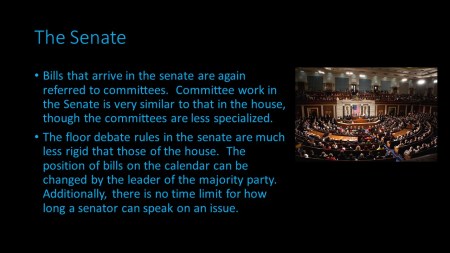
So my son Ben had an social studies assignment to explain the legislative process. He had to build a powerpoint and then this happened. Yes it went down the y-chromosome. I got a kick out of it, figured some of you might as well.

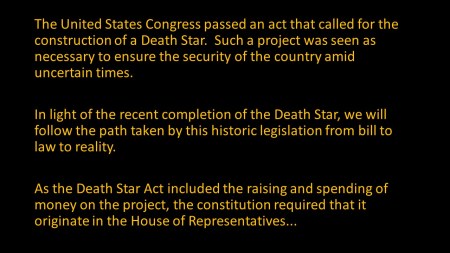
Slide1

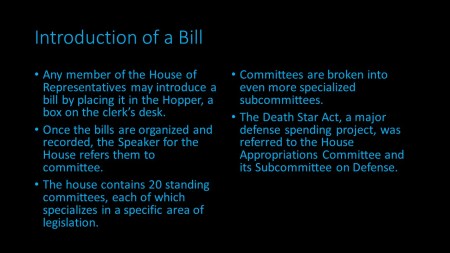
Slide2

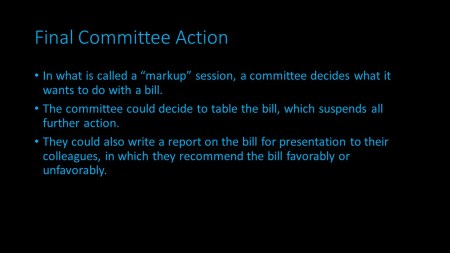
Slide3

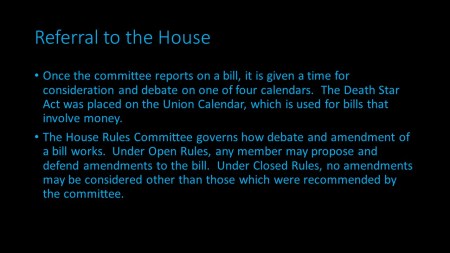
Slide4

Slide5

Slide6

Slide7

Slide9

Slide10

Slide11

Slide12


The Prodigal Nerd Returns to Florida

December 3, 2018

(Guest Post by Matthew Ladner)

A bit of personal news- I’ve taken a new gig at the Arizona Chamber of Commerce and Industry and as editor at RedefinED. Over at RedefinED online I offer an introductory post re-introducing myself to my friends in Florida:

Florida is a grandly innovative state with a record in policy implementation that is far greater than average. It’s very hard to appreciate this when you are close to your own inevitable policy and political messiness, but trust me, it is very clear from over here. I’m proud, for instance, that Arizona originated both scholarship tax credits and education savings accounts. Both innovations have been successfully taken to greater scale, however, in Florida – in no small part due to the relentless attention paid to the details of implementation.

You’ve taken crucial first steps towards equalizing opportunity in schooling. The sky not only did not open with a rain of frogs or locusts, you’ve seen real tangible progress. Florida public education, despite much protestation from traditionalists, is not only still there, it is substantially improved.

Funding for public education is guaranteed in the Florida Constitution and is as close to a permanent institution as you get in American society. It’s here to stay. Florida, however, has the chance not just to practice the form of public education, but to fulfill its actual promise. Much divides our society, but Americans still unite on crucial issues, including education. We desperately want an education system that gives students the knowledge, skills and habits needed for success and to responsibly exercise democratic citizenship. We – left, right and center – commonly and fiercely desire a system of schooling which serves as an engine of class mobility. Florida has moved the needle in this direction by setting families free to pursue opportunities that would otherwise be denied to them. More of this is needed and the next step will be to develop a consensus around setting educators free as well.


Racism in Public Schools

November 28, 2018

ednext_20111_figlio_open

(Guest post by Greg Forster)

OCPA carries my article on racism in public schools:

Robinson’s case attracted wider attention, threatening to make the system look bad. So, Robinson was able to get permission from the guardians of the government school monopoly to transfer her grandchildren out of Edmond North.

But most cases of racism, harassment, and bullying don’t make media headlines. Those families are stuck. They have to keep sending their children to school to be preyed upon, day after day.

Don’t listen to me, listen to Robinson: “The students still there, they feel helpless, they feel like their hands are tied and they just have to tough this out,” she told KFOR. “No kid should have to tough it out.”

This is just one of many reasons all parents ought to have school choice:

America continues the struggle to build a genuinely pluralistic society. That means overthrowing the continuing power of racism, our great national original sin. To pursue the American principles of equality and freedom, we must labor diligently to dismantle the structures of racial oppression.

The government school monopoly was created in the 19th century to consolidate the power of social elites. They wanted to homogenize what was, in their eyes, an unacceptably diverse population. A society where differences are valued can only emerge when the monopoly they built is broken.

Let me know what you think!


Miscellaneous post holiday links

November 26, 2018

(Guest Post by Matthew Ladner)

Paul Peterson interviews Justice Clint Bolick on the 2018 elections and school choice,Brett Kavanaugh and other topics. Quick note on the AZ Prop 305 vote: we have something called Voter Protection in Arizona, which means that the legislature has a severely limited ability to alter something passed at the ballot. As Clint explained, it was the ESA eligibility expansion rather than the program that was on the ballot in November. Because the expansion contained a statewide cap (30k students statewide) many pro-choice groups chose not to engage in support of the expansion as it would have voter protected a cap that would have been practically impossible to alter. We had wildly conflicting polls up until the end but Arizona voters decisively chose not to expand eligibility, which means that the program continues with the current eligibility pool (Students with Disabilities, foster care children, children attending D/F rated public schools, military dependents and orphans and siblings of eligible students) and (given this result) no participation cap starting in 2019, but with the more limited eligibilty pool described earlier. Efforts now should focus on improving the administration of the program.

Yours truly teamed up with David Lujan, former state lawmakers and Director of the Arizona Center for Economic Progress in support of ASU Prep charter school., a high performing charter in downtown Phoenix threatened by a demand for a large increase in rent from the Phoenix Elementary School District. In combination the district and charter schools of the area scored at the 99th percentile of academic growth, which as both righties and lefties like Mr. Lujan and I both agree is something well worth preserving, so hopefully the grownups work something out.

Lots of interesting discussion going on about standardized testing. I remain in favor of lighter footprint testing but man oh man we’d better be coming up with ways to lower the perceived costs and increase the perceived benefits.


Best Songs You’ve Probably Never Heard

November 23, 2018

The blog has been a little empty lately and your shopping carts may be too full, so I thought I would share some songs you might like that you’ve probably never heard before.  Consider it my gift to you.

First up, we have this beautiful song by the Vulgar Boatmen.  I wrote a blog post before about how great this band is (was), but I didn’t mention this gem.  It’s called There’s a Family.  Here is the studio version:

Here is a live version from a club concert in the early 90s.  I’m not sure which version I enjoy more.

Next we have the “Twee” band Allo Darlin’.  It’s probably that I’m getting old, but I don’t mind a sweet pop song, especially these vulnerable and heartfelt pieces:

You’ve probably heard the Kinks’ song, Strangers, but I bet you haven’t heard this cover by Lucius before:

This Tiny Desk Concert by Lucius is also pretty amazing.  I especially enjoy around the 12 minute mark when they are asked if they would play one more song and they then scavenge through the desks to find items to use for percussion while playing Genevieve.

These aren’t quite Matt’s punk or heavy metal covers, but I hope you enjoy them anyway.


And the Winner of the 2018 “Al” is… Joy Morton

November 1, 2018

It was a very crowded field of excellent nominees for this year’s Al Copeland Humanitarian Award. In total there were 8 nominees (two of whom shared the honor): Leo MoracchioliRichard GarfieldElizabeth VandiverEric LundgrenAdam Butler and Autumn Thomasson, George Henry Thomas, and Joy Morton.

Of all of these worthy individuals, Joy Morton best exemplifies the way in which Al Copeland improved the human condition.  Morton, like Copeland, promoted good by doing well.  As Collin noted in his post, Morton sought a competitive advantage for his salt company by adding iodine and advertising the health benefits of doing so.  It was known at the time that small amounts of iodine could prevent goiters, which were a widespread and damaging problem throughout America’s heartland. But no one was doing anything about this until Morton saw a way to make money from adding iodine to people’s diet.

It was later learned that iodine is crucial to healthy brain development.  By adding iodine to salt, Morton reduced cognitive disabilities among those with the lowest access to iodine in their diet, raising IQs by one full standard deviation in that population. Collin emphasized how much good Morton achieved through his profit-seeking enterprise relative to what has been achieved by billions in non-profit expenditures:

One. Standard. Deviation. Countless foundations have invested countless dollars to achieve impacts a fraction of that size in [a] tiny fraction of the population – and most have failed. Morton accomplished it all with table salt.

Al Copeland similarly improved the human condition through a profit-seeking enterprise.  Rather than prevent goiters and raise IQs, Copeland satisfied our desire for spicy chicken.  And both efforts have in common a significant reliance on salt.

Leo Moracchioli shares with Morton and Copeland the fact that he makes money from his humanitarian activities.  Making heavy metal covers on Youtube brings plenty of joy to his followers as well as money to his pocket.  And Matt was right to note the importance of “disintermediation” in producing this and other positive developments.  But it is hard for fun music to compare with preventing goiters and raising IQs let alone to providing spicy chicken.

Ben Ladner’s personal and well-written nomination of Magic: The Gathering’s creator, Richard Garfield  was also compelling.  But like my previous nomination of D&D promoter, Gary Gygax, Garfield falls short.  As much as I identify with and root for the Geek tribe, their amusement and acts of solidarity do not rise to the level of improving the human condition like spicy chicken does.

My nomination of Elizabeth Vandiver also falls short.  Promoting awareness of human nature through understanding of Classical Mythology is enormously important work, but Vandiver reaches too few people to make enough of a difference.  If only our schools thought this was an important part of their job and made use of Vandiver’s materials, it might be a different story.

Greg had several nominees.  We may have to consider a rule regarding whether an individual can have multiple nominees in a single year and whether multiple people can share a nomination.  In any event, Greg’s nomination of Eric Lundgren was excellent but it felt more like a Higgy nomination for Bill Gates. Making use of old computer parts is indeed noble, but the way Microsoft sought to block it shows that profit-seeking enterprises can also promote bad while doing well.  The nomination of Adam Butler and Autumn Thomasson for providing legal assistance to lemonade stands while also making a profit selling lemonade also sounds like a Higgy nomination for the PLDDs who seek to shut those stands down. Lastly, George Henry Thomas is also a very worthy nominee for his demonstration of true patriotism and understanding that victory can only be achieved when one’s opponent admits defeat.  Thomas’ example is actually in keeping with Daniel Pipes’ more recent promotion of the Israel Victory Project.  While victory can only be achieved by the admission of defeat by one’s opponent, Thomas actually failed at achieving that, as Greg concedes.  Some Southerners continue “The Cause” to this day, so it is now our responsibility to complete what Thomas started.

Fortunately, because we are goiter-free and enjoy elevated IQs we are now positioned to pursue the total defeat of The Cause, rocking on YouTube, playing games with other Geeks, understanding human nature, and fighting PLDDers of all sorts.  For this we owe a debt of gratitude to Joy Morton and award him the 2018 Al Copleand Humanitarian Award.


Stop the Clock! The Al Will be Announced Tomorrow

October 31, 2018

Image result for stop the clock

We had so many excellent nominees for The Al this year that I need some extra time to select the winner.

Our nominees include Leo MoracchioliRichard Garfield, Elizabeth Vandiver, Eric LundgrenAdam Butler and Autumn Thomasson, George Henry Thomas, and Joy Morton.

As you enjoy your candy you can review all of these nominees and await the announced winner tomorrow.


Nominated for the Al Copeland Humanitarian Award: Joy Morton

October 30, 2018

Image result for iodized morton salt

(Guest Post by Collin Hitt)

Has any charity done more good in America than Joy Morton did as an entrepreneur? He was the founder of Morton Salt Company in Chicago.  One simple innovation – iodized salt – positioned his company to be the dominant salt brand in America for a century. And that very same product changed the destinies of millions upon millions of people.

Joy Morton was a Midwest businessman. By all accounts he was a decent, upstanding member of his community, an honest man. He was a philanthropist. But his greatest contribution to mankind is in the millions of tons of salt he sold.

Morton was an entrepreneur, a money maker. He didn’t give away his salt. His job was to sell it. And like all entrepreneurs, he needed an edge, a way to stay ahead of the competition. Plenty of other companies were making cheap table salt. And of all things, a goiter epidemic and emerging medical science gave Morton the edge he was looking for.

Rewind to 1920. Morton Salt Company was based in Chicago – squarely in the middle of a region plagued by goiters. If you don’t know what a goiter is, check out a few images on Google. “An enlargement of the thyroid gland,” the medical definition doesn’t do goiters justice. They can be nasty, painful, even debilitating. There’s a chance you’ve never seen a goiter with your bare eyes. But in the early 20th century goiters were so common in the American heartland that the region was called the “goiter belt.”

We know now that the cause was iodine deficiency. In the early 1920s the people of the Midwest fed mainly on iodine-poor food. In coastal regions, where fish and other iodine-rich foods formed core parts of the diet, goiters were extremely rare. A person travelling west from Boston to Chicago needn’t have been a doctor to notice the sudden and widespread appearance of goiters on children.  From an excellent, short article published in Nutrition, “History of U.S. Iodine Fortification and Supplementation.”

Prior to the 1920s, endemic iodine deficiency was prevalent in the Great Lakes, Appalachians, and Northwestern regions of the U.S., a geographic area known as the “goiter belt”, where 26%–70% of children had clinically apparent goiter. During the draft for World War I, a Michigan physician, Simon Levin, observed that 30.3% of 583 registrants had thyromegaly (including both toxic and nontoxic goiters), many of which were large enough to disqualify them from the military, in accordance with U.S. Selective Service regulations

Joy Morton solved the problem. By the 1920s, fifty years of science had slowly established the connection between iodine deficiency and goiters. Experiments were showing that iodine treatments could effectively eliminate the condition. The research on iodine was there for the world to see. But aside from a few scientists and physicians, next to no one read it or understood it – almost no one. The Morton Salt Company saw it and saw profit.

In 1924 Morton Salt began selling iodized salt. A massive marketing campaign followed. “Keep Your Family Goiter Free!” Can you imagine? Morton sold tons of salt and made tons of money at it, and in the process improved millions of lives. The goiter epidemic disappeared seemingly overnight and Morton Salt has been America’s favorite salt brand ever since. This accomplishment alone is worthy of the Al, but it turned out the effect of iodine intake reached far beyond curing goiters.

Iodine is vital for brain development. The World Health Organization today states plainly, “Iodine deficiency is the main cause of brain damage in childhood.” This was not known during Joy Morton’s time.

The impact of Morton’s Iodized Salt strains the imagination. The sudden, widespread introduction of iodine into the diets of millions of Americans created a natural research experiment. From a 2013 paper released by the National Bureau of Economic Research:

Salt was iodized over a very short period of time beginning in 1924. We use military data collected during WWI and WWII to compare outcomes of cohorts born before and after iodization, in localities that were naturally poor and rich in iodine. We find that for the one quarter of the population most deficient in iodine this intervention raised IQ by approximately one standard deviation. Our results can explain roughly one decade’s worth of the upward trend in IQ in the US (the Flynn Effect).

One. Standard. Deviation. Countless foundations have invested countless dollars to achieve impacts a fraction of that size in [a] tiny fraction of the population – and most have failed. Morton accomplished it all with table salt.

The benefits of Morton’s salt extended even to children in the womb. From another excellent paper from NBER, released earlier this year:

In 1924, The Morton Salt Company began nationwide distribution of iodine-fortified salt. Access to iodine, a key determinant of cognitive ability, rose sharply. We compare outcomes for cohorts exposed in utero with those of slightly older, unexposed cohorts, across states with high versus low baseline iodine deficiency. Income increased by 11%; labor force participation rose 0.68 percentage points; and full-time work went up 0.9 percentage points due to increased iodine availability. These impacts were largely driven by changes in the economic outcomes of young women. In later adulthood, both men and women had higher family incomes due to iodization.

As a philanthropist, Joy Morton went on to do wonderful things with his fortune. But none of those things were as wonderful as what he did for people when he started selling iodized salt. And that’s why he deserves the Al.

Collin Hitt is an assistant professor in the department of medical education at Southern Illinois University School of Medicine.


Proposition 305 Delayed the Modernization of the Arizona Empowerment Scholarship Program

October 30, 2018

(Guest Post by Matthew Ladner)

The Arizona Auditor General has performed an update on their review of the Arizona Department of Education’s administration of the Empowerment Scholarship Account program. Back in 2016, the Auditor General found a number of deficiencies in the Department’s oversight of the program. Two years later, they find…many of the same shortcomings. Given the proximity of a public vote on ESA eligibility and administrative modernization, this is basically like pouring a bucket of chum in shark infested waters. Overreaction is guaranteed, despite the fact that the funds discussed represent less than 1% of the total. The greatest irony here is that the bill that the Save Our Schools group placed on the ballot (thus either delaying or killing depending upon the will of the voters) took robust steps to improve the administration of the program.

ESAs are complex programs to administer, and bless their hearts the Arizona Department of Education volunteered to be the first to try. The Arizona Republic’s story on the Auditor General update includes push-back from the outgoing Superintendent of Public Instruction Diane Douglas on the Auditor General update:

State schools Superintendent, Diane Douglas said the misspending of the voucher money is the result of decisions by the Republican-controlled Legislature to deny her department money needed to properly administer the program. Douglas said lawmakers resist properly funding oversight because they want a private entity to oversee it.

“If you’re not willing to put the resources into the oversight, then it doesn’t happen appropriately,” Douglas told The Arizona Republic on Monday. 

She said her staff has “done a phenomenal job with the lack of resources.”

She criticized the audit for glossing over the Legislature’s failure to properly fund oversight.

That’s a story but not a credible one. From the outset, the Arizona Empowerment Scholarship Program has included fees for management companies as an allowable expense for accounts. While the Arizona Department of Education had no experience in managing multi-vendor accounts, there are in fact multiple private firms which have gone up and down the learning curve of managing (for instance) health savings accounts. Other states with ESA programs have contracted with these firms in order to build digital platforms so that both administrators and parents can view accounts and account transactions in real-time. They’ve also developed methodologies to prevent misspending of account funds from occurring. They do this for a very modest fee. These platforms also collect user reviews to help inform the decisions of other parents- which is the only plausible way to hold, for instance, an occupational therapist or online education provider accountable for performance.

What was requested of the department repeatedly and I know this because I myself personally all but begged them to do this on multiple occasions- was to have them hire one of these firms so as to radically improve the administration of the program. The parents would have received superior program that was easier to use, misuse of funds could be dramatically curtailed, and transparency improved. Everyone wins, and you can see this underway in Florida, where the main Gardiner Scholarship administrator (Step Up for Students) has contracted with SAP Ariba to create such a platform.

I interpreted the feedback I received as “Nah man- hold my beer! We’ve GOT THIS!” No wait I think what I was actually told was “the Superintendent is suspicious of outside vendors” which translated in practice to approximately the same outcome. In any case since then the Department’s administration of the program has looked something like:

Notice that this is not a bureaucratic turf issue. The avenue allowed left the Department of Education in charge of the program. Any outside vendor would have reported directly to them, and they could tell them what to do and hire/fire them at will within the normal confines of state contracting. The great advantage here is that these firms have decades of experience in navigating these waters and there are multiple players in the space that could compete if the state created an RFP.

The complaint about under funding of administration also rings hollow because as previous reporting from the Republic established the Department failed to spend the resources allocated for program administration by leaving funded FTE spots open. If you don’t spend the funds appropriated for you, then you don’t get to complain that you needed more funds. And by the way, the private firms with plentiful experience in managing account based program could have been funded for a very modest fee by the account holders, and would have not needed to subtract from the funds the department didn’t in any case fully spend.

Oh but it gets better.

Arizona SB 1431 from the 2017 session included a large number of items to improve the administration of the program and to increase transparency. You can read a list of these items here. In evident despair of the Department modernizing the program administration, the legislature (wisely imo) included these provisions:

Directs ADE to post on its website information and data that are updated monthly regarding ESAs that includes the following:

a)info on all purchases and expenditures made with ESA monies that does not violate the personal privacy of any student or family and that includes only aggregate date;

b)the number of enrolled students disaggregated by eligibility; and

c)any other information or data that may be pertinent to promoting transparency and accountability of the ESA program.

and…

Requires, rather than allows, the Treasurer to contract with private financial management firms to manage ESAs and directs ADE to cooperate with the Treasurer and the contracted firm.

The collection of signatures against SB 1431 by the Save Our Schools group at minimum delayed the modernization of the program in the form of Prop. 305. If the yes vote prevails, SB 1431 will take effect, whereas if no prevails it’s back to the drawing board. The polls on this provision have been mixed, and at the time of this writing it seems the proposition could go either way. Regardless of what happens at the ballot, it remains abundantly clear that program administration must be modernized.

Just as a reminder, this is the same Arizona Department of Education which mis-allocated $85,000,000 in federal title I and IDEA funds, giving some schools too much while short-changing other schools. The “blame the legislature” trick also doesn’t work here as the positions that allocate funding are funded by Uncle Sam (like every other state) but one doesn’t read stories about Montana, Oregon or (fill in the blank here) managing to make a mess of these sorts of things.

Note that the response to this has never been nor should it be “If the Department can’t administer Title I we should just get rid of it!!!!” but I’m fairly confident that I could go on to twitter right now to find this argument being made with hypocritical gusto. In fact I fear I could find this double standard being applied by the very people who delayed the modernization of the program. It’s a neat trick to prevent the implementation of solutions while continuing to complain about the problems. Let’s see what happens next.



Religious Schools and Science

October 30, 2018

imagesF6CRZCR6

(Guest post by Greg Forster)

We interrupt this deluge of Al nominees to bring you . . . something about education! Namely this post at OCPA about why religious private schools can teach science so well. The main reason is that religious people’s beliefs about science are not very different from everyone else’s:

This is partly because the extent to which less-religious people “believe in science” is overrated. Consult your daily horoscope for guidance on whether secular reason and revealed religion are the only belief systems in modern America. Don’t worry, if you can still find a newspaper, you’ll have no trouble finding a horoscope—nearly every U.S. paper has printed them for generations, in spite of unanimous opposition to astrology from the world religions. If you’re a Libra, you can weigh the evidence and find that secular Americans are imperfectly rational. If you’re an Aquarius, you can pour cold water on the illusions of secular rationality. If you’re a Gemini, you can pour it twice.

The more important factor, however, is that ignorant people have vastly understated the extent to which religious people and institutions in the modern world “believe in science.” None of the foundational commitments of science—that nature works regularly, that the human mind is capable of discovering and describing that regularity—are in conflict with religion. That is why all the world religions have embraced modern science; indeed, the Christian assumption that nature and the human mind were made by a rational God was, historically, an essential precondition for the emergence of modern science.

Belief that miracles have sometimes occurred is no hindrance to science. On the contrary, you can’t believe in miracles as exceptions to the ordinary course of nature until you believe that the ordinary course of nature is rational and regular. And you can’t believe miracles serve to demonstrate visibly to their observers that nature is being disrupted—which is what miracles are for in the first place—unless you believe that the human mind is capable of knowing the regularity of nature (and hence knowing when it has been disrupted). Belief in miracles, far from contradicting the view that nature is regular and that we can know its regularity, presuppose this view.

The underlying problem for the way we think about this, unsurprisingly, is that people are more concerned with advancing their view of religion than with getting their facts straight:

These observations force us to recognize that we have to do better at distinguishing two questions. One is whether people ought to “believe in science” given their worldview, and the other is whether those people do in fact “believe in science.” Whatever you think about what people ought to believe, as a point of empirical fact the relationship between people’s beliefs about religion and their beliefs about science simply does not justify the confident assertions made about these beliefs.

Let me know what you think!