Arizona Props 127 and 305: a fine pair of misfits

September 7, 2018

(Guest Post by Matthew Ladner)

Fall has arrived in an even-numbered year, which means that in addition to football there are also elections. Here in the Cactus Patch our political conversation has been even more boisterous than usual. Back in 2016 an individual deep in the council of left-of-center Arizona politics told me that the plan was to make the 2018 election about K-12 education and to run David Garcia for Governor. Garcia did indeed win the Democratic Party’s nomination (the Arizona Education Association announced their endorsement for Garcia at a RedforED rally last spring) and K-12 does indeed look to be the major election issue, so mission accomplished on both fronts. Ballot propositions may however have a much larger impact on school funding than the officeholder races, but not in the way commonly supposed.

Hysteria reigns supreme in the K-12 discussion. A steady stream of reports from the ACLU, the Grand Canyon Institute and the Arizona Republic’s ongoing Two-Minute Hate series on charters and choice programs appear to have been coordinated with impressive precision. Each of these things deserve to be addressed on their own merits (or lack thereof-it’s a mixed bag on substance imo with a spectrum ranging from good points to shallow propaganda) but as far as multi-organizational timed to an electoral calendar efforts go:

In the midst of all this political mosh-pit I saw something that struck me the other day- a Twitter avatar that said “No on 305/Yes on 127.” These reference two ballot propositions on the November ballot-Proposition 127 would require the state to generate half of it’s energy from renewable sources by 2030, while Prop. 305 will ask voters to either confirm or reject the expansion of the ESA program that passed in 2017.

The No on 305/Yes on 127 combo struck me because it seems extremely likely that Prop. 127 would take more money out of Arizona district classrooms than 305, and by a very wide margin. I claim no expertise on energy policy, but I found the take of the Washington Post and of Peter Zeihan in the Accidental Superpower on the subject to be compelling. So first off, some good news:

Things are headed in the right direction and it is mostly because natural gas is cheap, cleaner and is replacing the use of coal in generating electricity.

The Washington Post, not of anthropomorphic climate change denial fame, rightly celebrated this trend. Noting that natural gas reduces emissions by half the Post editorial board noted:

True, half the emissions does not mean no emissions. But the United States does not have to eliminate its carbon footprint all at once, nor should it. Doing so would cost far too much. Instead, natural gas can play a big role in transitioning to cleaner energy cheaply.

When something is far too expensive for the Washington Post editorial board’s tastes, it is a good idea to pay close attention. Peter Zeihan also addressed this topic in the Accidental Superpower. He generally buys the notion of anthropomorphic climate change, but noted that the next generation of power generation plants were being built to use natural gas due to market forces, that this was considerably cleaner than coal burning, and that the life span of these new plants would be about 30 years. Sometime in the next 30 years Zeihan reckons that one or more of the many possibilities for alternative energy will pencil out in terms of economic viability-we just don’t know which one(s) yet.

Google around a bit and you will read about experiments in everything from artificial leaves to fuel producing microbes to crystal encased nuclear waste fueled batteries to clean coal fuels. Which of these-or something else- becomes economically viable is anyone’s guess, but it is not likely to happen on a deadline adopted by Arizona voters in 2018. How much sense does it make to make a massive investment in alternative energy technologies before any of them pencil out, especially when some of them eventually will?

So back to Arizona, Prop. 127 and education. The conversion from coal to natural gas is already happening in Arizona. This is good because right now the Texas oil fields are simply flaring off natural gas as a waste product until the pipeline infrastructure is built to collect and sell it. In fact you can see the flaring from outer space:

The Wall Street Journal recently wrote that there was enough natural gas being flared off to power a small state-one million dollars worth per day. I volunteer Arizona to be that state rather just have them burn it off without generating any power and having us burn coal to generate our electricity. The transition from coal to natural gas has already begun in Arizona, and happily it is being driven by market forces rather than mandates.

Prop. 127 however will force the renewable issue and the companies that generate the state’s power have detailed the enormous costs to such a move. Consumer rates are estimated to double in price. Since the initiative does not define nuclear power as “renewable” so opponents claim Prop. 127 would necessitate the closure of the nation’s largest nuclear power plant which produces **ahem** zero carbon emissions and probably (I’m guessing) cost the GDP of a small country to build.

Given what would be a mad scramble to create renewable energy, one additionally suspects that it would damage the ongoing conversion of coal burning plants to natural gas. Converting coal burning plants to natural gas can be done but it takes time and money-but there is a payoff in the form of low natural gas prices-it pencils out, and is cleaner.  Natural gas capacity would not help meet the mandate so the time and effort to convert to natural gas seems very likely to be diverted on a snipe-hunt of utility scale alternative energy sources ready for prime-time.

Between the increased cost of electricity and the foregone taxes from plant closures, the Arizona Public Service Electric Company estimates a loss of $670,000,000 to Arizona education providers in their service area by 2030. The expensive rates would not stop in 2030. That’s a big hit to education budgets and is not a statewide figure, with APS serves only part of the state.

So let’s compare Prop. 127 to Prop. 305. The ESA expansion under voter consideration contains a cap on the total number of participants of 30,000. Arizona has about 1,200,000 students and often gains 30,000 kids annually. We’ve also learned in recent years that the number of district open enrollment students is approximately twice as high as charter school students, and charter school students outnumber private choice students ~3 to 1. So from the perspective of an individual district campus with enrollment loss, other district schools are the primary competition, charter schools a secondary source of competition, and private schools a distant third. Centrist Arizona Republic columnist Joanna Allhands pointed this out in a column shortly after the ESA expansion passed. Allhands is not a fan of the ESA program but she sees through boogy-man stories:

Arizona’s voucher-expansion bill isn’t going to ruin public education as we know it.

But first, before you start trolling me on Twitter:

Yes, public schools need more resources. Senate Bill 1431 does nothing to help them find it.

And no, I wouldn’t actually call this meaningful reform. It doesn’t address student achievement gaps or fund district, charter and private schools more equitably.

But it won’t be the death knell to your neighborhood district school. In fact, I’m not sure many will even notice a difference.

Allhands went on to posit that charter schools were already scratching much of the Arizona school choice scratch itch, and that there was no reason to expect a mad rush to private schools even with broadened ESA eligibility. She could have added by the way that while there are 4,500 ESA students statewide, Scottsdale Unified has 4,000 open enrollment students from out of district, and it is only one of Arizona’s 230 school districts. “Scottsdale is DRAINING MONEY from nearby school districts-we’ve got to STOP THIS!!!!” said no one, ever, oddly enough. The ESA expansion can serve as an important tool for families looking for the right-fit education for their child, but the program is nothing near the threat to school budgets as doubling their utility costs.

So my friends on the Arizona left are actively supporting a massive drain of funding out of Arizona classrooms (what you spend on air-conditioning cannot be spent on teacher salaries). Meanwhile they have also invested a large effort in putting another ballot measure up because in large part they fear that it will have a large impact on district finances but it won’t. Churchill told us that democracy is the worst form of government except for all the other ones that have been tried. I remain hopeful that voters will exercise good sense in all of this, but…


Schooling is Starting to Catch Up to Coons and Sugarman (finally)

September 6, 2018

(Guest Post by Matthew Ladner)

Over at RedefinED Jack Coons reflects on the 40th anniversary of the publication of the book Education by Choice with his coauthor Stephen Sugarman.  Dr. Coons in some ways too modest, saying that he and his co-author “did not anticipate” Education Savings Accounts, but in effect I believe that they did. Coons and Sugarman envisioned parents, including low-income parents, having the power to create “personally tailored education” for their children, using “divisible educational experiences.” This sounds very close to education savings accounts/multi-provider education to my ears:

To us, a more attractive idea is matching up a child and a series of individual instructors who operate independently from one another. Studying reading in the morning at Ms. Kay’s house, spending two afternoons a week learning a foreign language in Mr. Buxbaum’s electronic laboratory, and going on nature walks and playing tennis the other afternoons under the direction of Mr. Phillips could be a rich package for a ten-year-old. Aside from the educational broker or clearing house which, for a small fee (payable out of the grant to the family), would link these teachers and children, Kay, Buxbaum, and Phillips need have no organizational ties with one another. Nor would all children studying with Kay need to spend time with Buxbaum and Phillips; instead some would do math with Mr. Feller or animal care with Mr. Vetter.

Coons and Sugarman were talking about education, not just schools, in a way that is today becoming increasingly practiced. They wanted parents in the driver’s seat. In “Education by Choice,” they suggest “living-room schools,” “minischools” and “schools without buildings at all.” They describe “educational parks” where small providers could congregate and “have the advantage of some economies of scale without the disadvantages of organizational hierarchy.” They even float the idea of a “mobile school.” Their prescience is remarkable, given that these are among the models ESA supporters envision today.

If you would like to see how parents are already doing this with their own money- see here. If you want an overview of how it is being done in the context of an ESA program-see here. If you would like to see ESAs in action, see here:

Multi-vendor education has been growing in different forms for decades-with families enrolling in after-school/summer programs of various sorts on one end of the spectrum to full blown homeschooling with multiple service providers on the other. Coons and Sugarman were way ahead of their time, and this is just getting started.


New School Holiday: Special Interest Day

August 27, 2018

(Guest post by Greg Forster)

While we’re on the subject of poor political judgment, the Oklahoman just ran my op-ed on schools closing on Election Day for the official, publicly identified purpose of increasing the Blob’s political clout:

Running the schools themselves with institutional policies designed — explicitly — to maximize school employees’ political power at everyone else’s expense is another matter. Now they’re using our tax dollars to create a political machine designed to extract ever-more tax dollars for themselves. The rest of us are allowed to notice this. If you want to create a big and vicious political backlash in an already polarized environment, this is one way to do it.

Let me know what you think!


Ed Reform Political Judgment Often Wrong

August 21, 2018

The Ed Reform Establishment tends to favor more highly regulated and targeted school choice programs.  When challenged on the merits of those preferences, they sometimes acknowledge that regulating and targeting choice may not produce better outcomes but they assert that such approaches have political advantages over less regulated and more universal programs.

The string of political failures, from Question 2 in Massachusetts to the inability of portfolio management to catch on (or even sustain itself in New Orleans), suggests that the Ed Reform Establishment seems to lack sensible political judgment.  But if we need more evidence that Ed Reformers are out of sync with political sentiment, just look at the findings of the new Ed Next Poll (co-authored by our new faculty member, Albert Cheng).

Of course, the way people answer poll questions does not directly translate into what is likely to be politically successful or not given how important political organization and strength of sentiment are in mobilizing opinion into policy.  But opinion polls give us some idea of what sentiment is out there for organizations to try to mobilize.  And political sentiment very clearly goes against the political calculations of the Ed Reform Establishment.

For example, Ed Reform experts tell us charters are more likely to be political winners than private school choice.  But if we look at the polling, vouchers are polling 10 points ahead of charters, with universal vouchers favored by 54% compared to charters favored by 44%. Tax credit private school choice programs are even more heavily supported, despite drawing little interest from the Ed Reform Establishment.

Ed Reform experts tell us that vouchers targeted toward the disadvantaged are more likely to be politically successful than universal programs.  But if we look at the polling, universal vouchers have a 11 percentage point advantage over targeted vouchers, which are only supported by 43% of the sample.

Other darlings of the Ed Reform Establishment also do not poll well.  The establishment bet heavily that general sympathy for standards could be channeled into supporting the specific proposal of Common Core standards.  But once the abstract idea of standards becomes the concrete proposal of Common Core, support drops from 61% to 45%, which is below the Mendoza line of 50% to overcome organized political resistance.

Heavily restricting local autonomy over disciplinary policy to ensure racial equity is also strongly favored by the Ed Reform Establishment, but it is deeply unpopular with the public, including teachers.  Only 27% of the public and 28% of teachers support “federal policies that prevent schools from expelling or suspending black and Hispanic students at higher rates than other students.”  Support for this is barely higher among Hispanic (35%) and African American (42%) respondents.

Lastly, the Ed Reform Establishment is very keen on “managed” enrollment systems that consider race and income in assigning students to schools.  The public does not share this enthusiasm.  Only 18% of the public, 27% of teachers, 24% of Hispanics, and 31% of African Americans think “public school districts [should] be allowed to take the racial background of students into account when assigning students to schools”  There is even less support for considering income when assigning students to schools.

Why does the Ed Reform Establishment so badly lack an accurate read on what has political support?  I suspect that Ed Reform has increasingly become a vanity project — a way to signal virtue to each other   — rather than a movement to make realistic and beneficial changes in policy.  This poor political judgment is exacerbated by a lack of consequences for ed reformers who regularly have poor political judgment and fail.  We seem to favor accountability for teachers but don’t seem to have much of it within the reform movement.

(Note: I’ve corrected the spelling of judgment.  Judgement is accepted in British English, but is not standard usage.)


AZ Charters CeleNAEP Good Times Despite District Creaming

August 20, 2018

(Guest Post by Matthew Ladner)

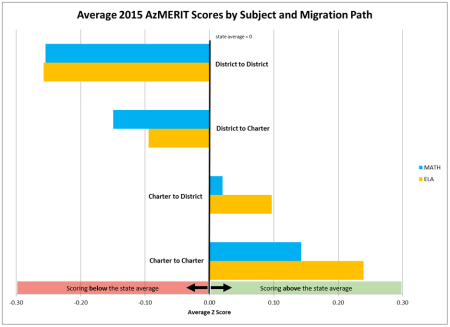
The full implications of this new analysis from the Arizona Charter School Association showing that Arizona charter schools receive district transfers who are below statewide averages on AZMerit, and send students to districts who are on average above the statewide average, can only be fully appreciated in the context of additional data.


Quick play by play on the above chart: 85,000 students transferred between public schools between the 2014-15 school year and the 2015-16 school year. The AZMerit tests were given in the spring of 2015, before the students transferred to a new school in the Fall of 2015 for the 2015-16 school year. The sending sector in other words owns the score.

A huge part of the ongoing Two-Minute Hate against Arizona charter schools has been the notion that they are engaging in systematic creaming. The problem with this story is that the above chart reveals it to not only be false in aggregate, it also reveals it to be the exact opposite of the truth. On net the districts are sending out below average students to charters, and receiving above average students in return. The districts, in short, are guilty of precisely the charge hurled (without evidence) against charters. This is not to say that there aren’t individual schools, district and charter, doing bad things, but the net of everything everyone is doing appears to be district not charter creaming.

The part about charters sending above average performing students to districts deserves a special mention. A part of the litany against charters involves an obsession over high-school attrition rates in BASIS. This has always been off base, as only a small percentage of Arizona charter students attend BASIS, and BASIS is basically the Green Berets of academics. The Green Berets have an attrition rate as well, but the people who complete the training are deadly military professionals. Arizona students are very active (85,000 total transfers in a single year in a ~1.2m student system) and do so for a large variety of reasons- social, athletic, academic etc. I’ve always thought that the students who don’t complete BASIS were likely to have been better off for the experience, and lo and behold that seems to be the case statewide across charters. In other words, when the 8th grade BASIS student chooses to attend a comprehensive school to play football as a 9th grader and brings above average academics with him, the proper response from the district should be one of gratitude rather than condemnation. When the statewide scores show districts to be sending away low-performers in droves (to both charters and other districts btw) the complaint positively reeks of hypocrisy.

But I digress…

Another part of the two-minute hate litany would have us believe that a child with disabilities has never crossed the threshold of an Arizona charter school. If however one goes to the state’s AZMerit data file, you find the statewide percentage of district children with disabilities stood at 11.1% and at 9.73% in charters on statewide ELA exams. The percentages are similar in the math exams. In a similar fashion there is a difference in rates of limited English proficiency, but nothing like what the blaring telescreen would have us believe: 6.3% for districts and 4.4% for charters.

What about the part when the double-plus good duckspeaker screams through the telescreen to tell us that charters are bastions of White segregation? Try again: 55% of charter students are non-Anglos compared to 63% of Arizona district students. There is a difference, but both sectors are majority-minority, and neither looks like either Vermont (or North Scottsdale).

Some of the difference between charter and district performance is certainly explained by differences in student demographics but here is the next shoe to drop in the AZMerit data: every single subgroup available scores higher in charters than they do in districts. Native Americans, Latinos, African-Americans, Asians, Whites, ELL, SPED, FRL etc. students all score higher in AZ charters than in AZ districts. Some of the difference is certainly owing to demographic differences, but nothing close to all of it.

So turning our attention to the above chart and pairing it with NAEP, it makes the NAEP data seem even more impressive when you consider the fact that Arizona districts are sending below average performers to charters, and charters are sending out above average performers. Despite that, NAEP shows us things like this:

So for those scoring at home, Arizona charter schools educate a majority-minority student body, receive only about $8500 per pupil in public funding, receive low-performing students on average from districts, and send higher than average performing students to districts and…scored higher than Massachusetts on the 2017 8th grade NAEP exam plus demonstrated the best 2009-2017 improvement in the country.

I fully expect our friends in the Arizona charter school skeptic community to doubt the AZMerit analysis. My recommendation to them is to file an open-records request with the Arizona Department of Education for the same data file. Crucial findings such as this deserve scrutiny and replication. The evidence currently available leads to only one conclusion: Arizona charters are working extremely for the students fortunate enough to attend them.


Another Myth Bites the Dust

August 17, 2018

(Guest Post by Matthew Ladner)

The Arizona Charter School Association analyzed public school migration patterns for 85,000 kids who switched among public schools by their prior AZMerit scores. And well this is what it looks like:

So kids transferring from Arizona districts to Arizona charters have below average AZMerit scores. Those transferring from charters to districts have above average AZMerit scores. This is to put things mildly not consistent with the litany against charters that claims that Arizona charters are engaging in massive creaming of students. If anything, this data suggests the opposite: that if there is creaming occurring, it seems to be in the direction of districts creaming charters.

Mind you the creaming thesis already had huge problems, the first of which being math. When you see scores improving in both district and charter schools, it makes it very difficult indeed to argue that charters have circumvented lottery requirements (which districts don’t have) to only get the high flying academic kids. If this were the case it would have been a really neat trick to see Arizona districts showing better gains than the national average despite some of the nation’s largest Great Recession funding cuts, despite a continuing trend into deeper majority-minority states and despite losing tens of thousands of their top performing students.

The average transfer from district to charter having below average scores in fact might in part explain the district gains we see, but then you get back to those charter gains…looks like they are having a lot of success getting kids who were off track back on it.

I would be very interested to see the average grade level by transfer group in this data. My guess would be the average district to charter transfer student is an elementary student, and that the average charter to district student is more of a middle school student. In any case, when you are taking in lower than average kids and sending back higher than average performing kids as a sector, this myth is…


On Taking Ignorance Seriously

August 16, 2018

IMG_1529

(Guest post by Greg Forster)

I have a post at OCPA on taking ignorance seriously:

Some states managed to have success in some cases—Massachusetts’ standards reforms and Florida’s mix of school choice, exit exams, and incentives to raise test scores across demographic groups are notable examples. But the overall story was failure. We just couldn’t take these good ideas to scale…

Why was school choice the only winner? Because it takes our ignorance seriously. It doesn’t try to generalize the content of education across millions of unique children.

Throwback to my review of the evidence on Pre-K included at no extra charge!


Masters in Someone Else’s Home is No Way to Go Through Life

August 15, 2018

(Guest Post by Matthew Ladner)

In the film Gandhi a crucial scene involves a meeting with British colonial overlords. At one point a British official plays what seems to be an ultimate trump card- in essence that His Majesty has millions of Muslim subjects in India, and without British administration a civil war would break out. Gandhi’s response: yes this is a problem, but it is our problem, not yours.

This scene came to mind when I read this Houston Chronicle article detailing the Houston Independent School District narrowly avoiding a state takeover of the district. Money quote from the article:

HISD and civic leaders are expected to gather for a celebration Wednesday at Worthing High School, which has suffered dramatic academic declines in recent years amid constant leadership turnover, persistent concerns about safety and a drain of students to school choice options.

One could spend a long time just unpacking that sentence, but I for one am happy that students at this school had the opportunity to seek a different setting, making the “drain of students” frame simply mind-blowing. There is also something deeply perverse about “celebrating” at Worthing given the state of affairs there. We get to keep things the same- hoorah!?

But in the end, kind of, yes in a sad but important way.

The Texas legislature should feel no small degree of wariness about a statute they passed that might find the Texas Education Agency taking over districts and/or closing schools. I’ve seen K-12 focus groups address the closure issue and people came across as uniformly and passionately against the entire notion of government led closures based on test scores.

On district takeovers, if not for the manifest flaws of school district democracy, we could all be doing something else with our time. School district elections are low-turnout/information affairs that sadly lend themselves readily to regulatory capture by organized employee/contractor interests. The word on the street for instance is that the AFT swept the last round of HISD school board elections.

There may be ways to improve the quality of school district democracy that could be implemented from the state level. I don’t however believe that suspending democracy, even a deeply flawed one, is one of those better ideas. No not even if it is “temporary” nor even if it is “for their own good.” Winston Churchill noted “Many forms of Government have been tried, and will be tried in this world of sin and woe. No one pretends that democracy is perfect or all-wise. Indeed it has been said that democracy is the worst form of Government except for all those other forms that have been tried from time to time.”

Churchill, an old-school imperialist, probably did not have many notions in common with Gandhi but when the Venn diagrams between them overlap it is probably best to pay attention. In the end it gets back to build new, don’t reform old. A district takeover is like a nuclear artillery piece- which used to be a thing– overpowered and a danger to the person those firing it.


Political Bias in Education Policy Research

August 13, 2018

Image result for political bias in academia

Education policy research is not really a scientific enterprise.  If it were, the field would be equally open to accepting research of equal rigor regardless of the findings.  That is simply not the case.  Research with preferred findings is more easily published in leading journals and embraced by scholars than research supporting less favored results.

There are countless examples of this, but here is one to illustrate the point…

The Journal of Policy Analysis and Management, a top journal in our field, has just published an analysis of vouchers in Indiana based on a matching research design.  Despite the fact that matching is normally intended to produce treatment and comparison groups that are nearly identical on observed characteristics, in this study the treatment group differed significantly from the control group in their pre-treatment measure of math performance.  Specifically, the treatment group has significantly higher scores on math tests.  And the one negative effect observed by the study was on math test scores, which was roughly comparable in magnitude to the amount by which the treatment group was higher on math scores pre-treatment.  So, basically the treatment group reverted to having about the same math scores as the control group once treatment began.  This negative effect, which was really the equalizing of the matched groups, was detected the first time students enrolled in a private school and did not grow in magnitude as students persisted in private school.  One might think that if private schools really harmed math scores, that harm might compound over time, but that did not occur.

These results certainly deserve publication and ought to inform the school choice policy debate despite the obvious limitations of the matching design that failed to make the groups comparable on the one outcome measure for which a negative outcome was observed.  While worthy of publication and discussion, it is questionable whether this article deserves publication in one of the field’s top journals and even more doubtful that it should be given as much credence as some folks in the field seem willing to give it.

Corey DeAngelis and Pat Wolf have a similar school choice study based on a matching research design with similar imperfections.  It examines whether students enrolled in the Milwaukee voucher program were more likely to be accused or convicted of a crime in later years than comparable students who had attended Milwaukee’s public schools.  Students in the treatment group were matched to public school students on a number of observable characteristics, including the neighborhood in which they lived.  Despite that matching effort,  the treatment and control groups were significantly different, with the treatment group having higher reading scores and more likely to be female.  Unlike the JPAM study, neither of these variables were the same as the outcome for which they observed effects.  Controlling for observable student and parental characteristics, students who had enrolled in Milwaukee’s voucher program were significantly less likely to be accused of a crime in later years.

The defects of Corey and Pat’s study are similar to those of the JPAM study.  It also uses a matching research design, and as I have said many times before, I don’t think we should have much confidence in matching designs to produce causal inferences.  And like the other study, Corey and Pat’s matching fails to produce treatment and control groups that are similar on all observed characteristics.  But unlike the other study, Corey and Pat’s research is not being published in JPAM.  In fact, JPAM desk rejected Corey and Pat’s study, deeming it unworthy even of being sent out for review.  A number of other journals did the same and they are now struggling to get it published in any journal.  I’m convinced that if only they had found that vouchers increased criminal behavior, their piece would already be in print in a respected journal.  But because they found a positive result for vouchers, the bar is higher and editors and reviewers can rightly note the defects in the study to justify rejection.

All research has limitations that might be invoked to support rejection or overlooked to support publication.  The double-standard used when judging voucher studies with favorable or unfavorable findings is a function of political bias and is an indication that our field is much less scientific than we would like to imagine.

It’s a shame that education policy researchers are largely uninterested in this problem of political bias.  Despite considerable energy devoted to promoting many dimensions of diversity within our field, there is virtually no effort to promote ideological diversity.  My department has a few researchers who would describe themselves as conservatives (while we also have had two faculty members who describe themselves as socialists), but I suspect most departments don’t have any self-described conservatives while others have no more than one or two.

It is interesting to note that despite having a department with six endowed chair holders, half of whom have Harvard doctorates, and all of whom have impressive research records, none of us have ever been asked to serve on the editorial boards of any journals (excluding the Journal of School Choice that my colleague, Bob Maranto, edits).  We’ve tried to play a part in governing our profession, but because we are branded (sometimes incorrectly) as conservatives we have been shunned.  The composition of editorial boards shapes who reviews submissions, which shapes what is published in those journals, which shapes what people in the field imagine the research consensus to be on various issues.

There are consequences to this political bias in our field.  First, the scientific quality of research is harmed by an increasing groupthink that fails to critically examine the key assumptions, methods, and implications of much of the work being produced.  Second, research in the field has diminished credibility and policy influence because others increasingly look at the field as more ideological and less scientific.  Some of the leading people in our field regularly take to Twitter to deride policymakers and the public for failing to heed what they believe research has to say. But why should policymakers obey “science” when it is being produced by an increasingly insular group of researchers who may confuse their political agenda for science? Third, frustrated conservatives are likely to give up trying to be accepted by the dominant professional associations and journals and instead build their own parallel institutions.  The Bar Association drove out conservatives who built the Federalist Society, which now seems to be thriving more than the “mainstream” organization at exercising policy influence.

I don’t expect this piece to alter this state of affairs.  Leading scholars in our field seem quite adept at defending their prior convictions, sometimes in remarkably unscholarly ways on social media, rather than critically examining their own beliefs and behaviors.  As far as I’m concerned they can rail away, but they will be left with the kind of nasty, unscientific, and irrelevant field they seem determined to build.


AZMerit 2018 release and Johnny Rotten says RELAX (80s Extended Dance Mix)

August 8, 2018

(Guest Post by Matthew Ladner)

Another hope feeds another dream 

Another truth installed by the machine.

A secret wish, a marrying of lies

Today comes true what common sense denies.

-Propaganda

Some predictions of doom age better than others. The “Arizona Public Schools are heading for destruction” mantra falls squarely in the post-Pistols Johnny Rotten odd rap/disco experiment quality side of things imo. Since 2016 the not-so-secret wish of some in Arizona has been to make the 2018 elections all about K-12 and its terrible failure. And well…

…the election year ain’t over yet so expect more double-plus good destructo speak. Sigh.

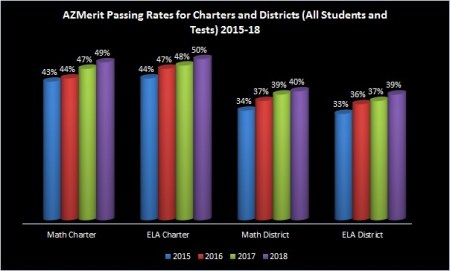
Meanwhile, back in mere reality the reports of Arizona public education’s demise appear to have been greatly exaggerated, given that the academic results continue to rise. Recently the Arizona Department of Education has released the 2018 AZMerit exam results. Both district and charter scores continued to improve.

The Arizona Republic greeted the news glumly:

Many Arizona schools kicked off the new school year this week with some bleak news: The majority of their students last year failed the state AzMERIT test. 

State testing data shows the same trend lines in students’ performance that schools have seen every year since the AzMERIT test debuted four years ago. There was incremental growth in overall reading and math scores, but the majority of kids failed.

This is a bit much. The passing bar on AZMerit is set high. Only half the kids in Massachusetts score proficient on NAEP, but you don’t see them wringing their hands over it, and with good reason. Massachusetts has Japan like scores in a NAEP/PISA equating study:

Arizona charter schools have Massachusetts-like NAEP scores, so let’s call it in Japan’s neighborhood. Plus the districts are getting better as well. Must….resist…urge…to…include…more….bad…80s…music…resistance….futile!

That 2011 study had Arizona as a whole between Latvia and Greece and alas in the real world you don’t leap over Latvia one day and put South Korea to shame the next. Put me in the “keep the incremental progress coming and let’s count our blessings” camp si vous plait.

My advice is to ignore the propaganda and relax, the election year silly season won’t last forever, it will only seem that way.