Now Would be the Time to Add That Position

August 2, 2018

(Guest Post by Matthew Ladner)

As longtime JPBG blog readers may or may not be aware, one of my hobbies is college football, specifically Longhorn football. One of my favorite posters on the Orangebloods site goes by the handle Orbea and focuses on financial information in his posts, and this recent post in particular struck me:

This is a post about sentiment. This is a post of how frequently it is the case that when investment management companies close funds, fire managers, and change strategies it marks the end of a trend and the start of a new trend in the other direction. 

But first some prior examples. These are done from memory. Because of that I likely have some of the details a little off, which in no way is a detraction as the gist of the story is basically correct. 

Tom Jackson
Tom Jackson was a deep value equity manager with an impeccable track record. In the late 80’s or early 90’s he was hired by Prudential Mutual Funds to manage their flagship equity mutual fund, the Prudential Equity Fund. He went on a tear for the first half of the 1990’s, won a couple of awards, and was on the cover of investment magazines (that in and of itself is a sign that a trend is over). Then in 1996 Technology stocks took off and Jackson started to lag badly. By 1998/99 Jackson was holding a third of the fund in cash because there were no deep value stocks to buy. In early 2000 Prudential fired Jackson and revamped the strategy of the fund to be a large cap growth fund. 

Of course, Prudential fired Jackson at the wrong time. Large cap growth tanked over the next three years while deep value went up.

Michael Metz
Michael Metz was the Chief Investment Officer for Oppenheimer (the brokerage firm, not the mutual fund company). In the first half of 1998 Metz recommended selling stocks because valuations were ridiculous and buying the 10 year Treasury. The official investment position of the firm was not to own equities but to own the 10 year. Unfortunately, stocks went on a tear to the upside for the next two years and bonds went down in value. In the early 2000 Oppenheimer sacked Metz and recommended selling bonds and buying stocks.

Of course, Metz was ultimately correct. Over the 5 year period from 1998 to 2003 the 10 year Treasury handily outperformed the S&P 500

Third Avenue Focused Credit Fund
Third Avenue management company was found in 1986 by Martin Whitman. Whitman was often called a revolutionary deep value manager with a speciality in small cap stocks. Often times deep value involved buying bankrupt bonds or distressed bonds. In order to expand their mutual fund offerings, sometime after the last recession, Third Avenue decided to open a junk bond fund. Since the bias of the company was in deep value and distressed securities the fund was chock full of the worst bonds imaginable. The fund did well for a few years, and then credit spread started to widen. Credit spread really widened on low tier debt (which was basically all the fund held). From the summer of 2014 through December 2015 the fund cratered. In December 2015 Third Avenue, in a surprise move, decided to close the fund and liquidate the holdings.

Of course, the decision by Third Avenue to close the fund came within 45 days of the bottom in junk bonds. 

A tip of the hat to @mm1966 who pointed out to me that the name of the fund was the Third Avenue Focused Credit Fund and not the Third Avenue High Yield Fund. 

Andy Hall
Hall was referred to as the God of the energy and oil markets. He rose to fame when he earned a $100 million bonus in 2008 as an energy trader at Citi. He went on to start his own hedge fund. For a number of years Hall racked up huge gains in the energy markets. Then the 2014 oil price collapse happened. Hall looked to be recovering from the collapse until the 2017 decline in oil prices happened and his fund lost 30% of its value in the first half of 2017. In July 2017 Hall shut down his primary hedge fund stating that $50 a barrel oil was the new normal.

Of course, the fund was shut down within weeks of the 2017 bottom and oil is now at $70.

Vanguard Changes The Strategy Of Its Precious Metals Fund
Vanguard just announced that it is changing the investment direction of its Precious Metal Fund. The new name of the fund is Global Capital Cycles Fund (whatever that is). The rationale for this change was to (and I quote) “to broaden the fund’s mandate and diversify the portfolio”.

Over the last seven years the fund has lost 60% of its value, which was right in line with the GDX (the gold miners ETF). 

This a recurring story with investment manage firms. By the time an investment firm throws in the towel on an asset class, then the bottom in that asset class is not far away. 

So, if you don’t have a small position in precious metals and miners – now would be the time to add that position.

Why post this on an education policy blog? I’m not sure but I’ll just leave this here in case anyone wants to consider the possibility that they sold their “Let a Thousand Flowers Bloom” stock prematurely:

The Way of the Future: Self-Reliance (with equity?)

August 1, 2018

(Guest Post by Matthew Ladner)

In a previous post I basically made the case that a majority of American states failed to show much academic progress between 2003 and 2017 and that the nation’s fiscal problems are closing in fast. While state constitutions guarantee K-12 funding, making it about as close to a permanent institution as you get in American life, the looming crunch in state budgets between K-12 and Medicaid/Pension shortfalls does not look to be pretty. For instance, consider these projections from the Texas Comptroller’s Office:

I won’t bother to dig up the likely increased size of the Texas K-12 population that they will be attempting to educate with a smaller percentage of the budget, but you get the point: austerity is a safe assumption, and there aren’t any other states that would sit as the world’s third largest oil producer if ranked as an independent country. Things may be generally bigger in Texas, but the problems may be even bigger elsewhere, making austerity a safe bet. Austerity isn’t necessarily bad for student outcomes but the same can’t be said for politics:

Nevertheless, state funding austerity seems very likely. So where does this leave the future? Jay used the phrase “hybrid homeschooling” years ago to describe practices by upper-income families to supplement the educate of their children. These parents enroll their children in schools, but then pay out of pocket for a variety of tutors, Mathnasium, Kumon, club sports and various other educational/cultural enrichment activities. The United States certainly does not have the after-school-school culture of East Asia, but the well to do have been using a multi-provider approach to education for a long time, and in fact it is ubiquitous to the point of seeming unremarkable.

Then let’s revisit the 2015 article from Wired documenting the rise of home-schooling in Silicon Valley Money quote:

“There is a way of thinking within the tech and startup community where you look at the world and go, ‘Is the way we do things now really the best way to do it?’” de Pedro says. “If you look at schools with this mentality, really the only possible conclusion is ‘Heck, I could do this better myself out of my garage!’”

Check out Cottageclass.com. Cottage class will help you find anything from a summer camp to a nanny-share to a private tutor or a micro-school. It’s well worth some of your time to click on various options. I’ve heard it described as Airbnb for education, and it is fascinating. Crucially, it includes user reviews to help parents navigate what is a growing universe of options. If all of this sounds reminiscent of ESAs, it is only because it is. For instance, Adam Peshek wrote in a Fordham Wonkathon:

An ESA doesn’t require committee hearings to decide where funds should be sent. It doesn’t require a school board meeting to vote on whether or not to cut the music program. Feel like your child isn’t exposed to enough music education? Pay for it. Little Stevie is falling behind in math? Get a tutor. If you’re in high school, use an ESA to pay for Advanced Placement courses to get a leg up in college, or use it to earn an industry certification so that you can graduate high school with an employable skill. An education savings account allows personalized learning to move from catch-word to reality.

That’s why we cannot implement these programs with the mindset of standardization. The ESA program needs to be seen as an innovative way to bring new options to K–12 parents—one designed to allow parents to maximize each child’s unique learning abilities by offering the educational path that suits them best.

Increasing numbers of families seem to be taking the a la carte approach, and like the Silicon Valley feature, they are doing it with their own money.

North Carolina for instance is an interesting place to keep an eye on. North Carolina has adopted both large charter and private choice programs, but thus far they can’t keep up. North Carolina keeps statistics on homeschooling, and it is interesting that other choice options can’t keep up with it. In 2007 there were 71,566 home-schooling students. In 2017-18, the figure was 135,749. This increase came despite the state taking a cap off of charter schools in 2010, and a doubling of charter enrollment. North Carolina lawmakers also created a statewide voucher program and (very recently) an ESA program for special needs students in the intervening years, but homeschooling is more prevalent than either charter or private school attendance in the state. Charters and private choice programs are growing, but they alone are not scratching the itch. District enrollment meanwhile has been flat for years despite rapid population growth.

The most interesting space these days lies within the space between a home-school co-op and a micro-school private school. The rumblings about the demand for micro-schools grow increasingly audible. Justin Cohen quoted Andy Calkins of the Next Generation Learning Challenges:

“It wouldn’t surprise me if, 5 to 10 years from now, everyone looks at this and thinks, ‘That grew a whole lot faster than I thought it could,’” he said. “There is a slice of the market that is not being served by public education. They’re saying, ‘The public schools don’t work, [and] I can’t get into the charter schools.’”

Predictions are tough, especially when they are about the future. The last decade and a half has broadly disappointed in improving public school outcomes, and the next decade and a half looks tougher rather than easier. A broad trend towards self-reliance and multiple service providers rather than one stop shopping in K-12 is already underway. Parents are not waiting on policy innovation, but policy innovation will be necessary to address equity concerns. Micro-schools often cost less than traditional private schools, and offer more options, but they do cost money.

States like North Carolina, with a statewide voucher program for low-income students and two different private choice programs to help students with disabilities, are ahead of the curve on the equity front. Florida likewise has a tax-credit program for low-income children and two programs for children with disabilities. States with these policy mixes create the possibility of economically integrated private schools options. States without them, not so much.

Let’s see what happens next.


Education Reform 2003 to 2017: Modest Success/Epic Failure so What’s Next?

July 23, 2018

(Guest Post by Matthew Ladner)

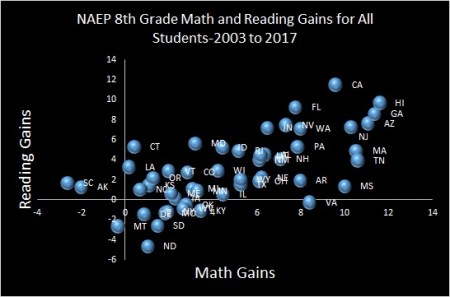
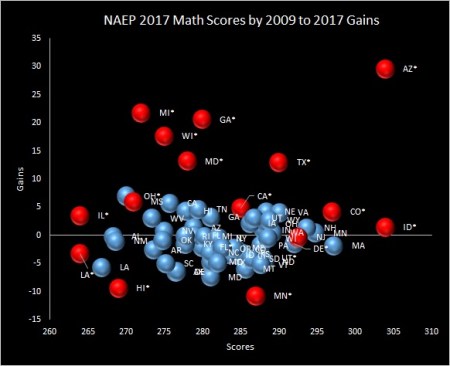
Having had some time to reflect upon the 2017 NAEP, let’s take stock of things. In this we should keep in mind our broad ignorance between policy changes and state NAEP trends- and the same goes for average school quality. NAEP gives regular 4th and 8th grade scores in math and reading, and all 50 states have participated since 2003. 8th grade scores are more likely to reflect school quality than 4th grade scores in my opinion, as the students have more years of schooling. I’m not sure what to make of positive 4th grade score trends that do not result in higher 8th grade scores for instance. So this in essence a window into what we have to show for American K-12 reform 2003 to 2017 in 8th grade math and reading by state:

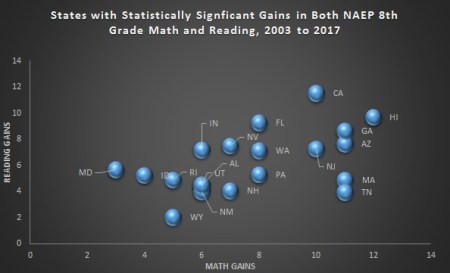
So what to make of the above chart? The below chart eliminates a lot of clutter by only including the states with statistically significant gains in both math and reading 2003-2017:


So 19 out of 50 states demonstrate statistically significant gains in both 8th grade math and reading. Notice also the absence in the second chart of mega-states Illinois, New York and Texas (although it is good to see California and Florida making it in). Texas has as many K-12 students as the 20 smallest states combined and annually adds approximately a Wyoming public school system sized number of new students. Florida has half as many students as Texas and California is still larger than Texas.

Since we don’t know the relationship between policy and academic trends, we are limited in the conclusions we can draw with confidence. Having said that, policies that have been broadly applied across all 50 states apparently suffer from severe limitations in their ability to move the needle academically. All 50 states for instance have adopted state academic standards and accountability exams, but most states have failed to move the needle on 8th grade scores. Even if we were feeling incredibly generous and made the wild assumption that none of the second chart gains would have happened in the absence of testing, a failure rate of 62% after 14 years is a far cry from leaving no child behind.

Mike Petrilli and Peter Cunningham recently offered up “where do we go from here” think pieces. I think Mike has some interesting ideas, but Peter’s call for a vast increase in spending is broadly unrealistic imo given the nation’s trillions of dollars in unfunded pension and entitlement liabilities, 10k Baby Boomers per day reaching the age of 65, etc. In normal times, Mike’s incremental adjustments might make a lot of sense, but we don’t live in either normal times, or in times that are going to allow some Great Society on Steroids increase in K-12 spending.

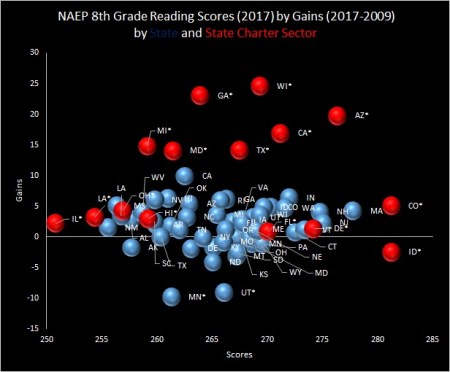
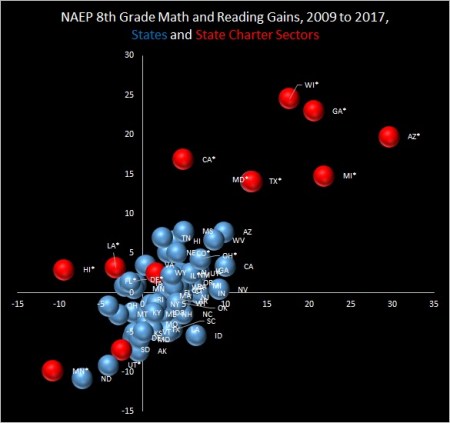
A much more difficult scenario may loom whereby the district system continues to resist reform, reformers continue to push reforms the public does not care for, and severe funding needs for increased health care spending leads to a broad reduction in per pupil spending.  State constitutions guarantee K-12 funding, but whether or not they will be creating schools that the vast majority of parents will continue to entrust with their children, I don’t feel as confident about. There are hopeful signs in the NAEP from state charter sectors:

…but the rate of charter growth has slowed substantially nationwide. Of particular disappointment are the last several state charter laws to pass that produce very few charter schools. Even states with relatively fast growing sectors have large wait lists. There are alas limits to what we can realistically hope for from a charter movement that has to a large degree lost its way by prioritizing cartel behavior over the interests of children on wait lists imo.

The private choice movement enjoyed a strong run earlier in the decade, but has since ran into political headwinds. Many private choice programs exist, but most remain modest in scale. The case for private choice remains as strong as ever, and the need will continue to grow, but the looming state funding crisis is coming fast. In four years, half of the Baby Boom generation will have reached the age of 65, and by 2030 all of them will be there. They have called dibs in advance on all plausible funding increases and a whole lot more.

So what is next? An increasingly likely scenario in my mind is that state district systems retain their flaws but loses a significant part of their funding and that choice systems continue to fail to meet existing much less expanded demand. In such a scenario an increasing percentage of families may decide to fend for themselves. Call them home-schools, home-school co-ops or micro-schools, my spidey-sense tells me that we should expect to see a great many more of them in the years ahead. I’ll write more about this in a follow-up post.


Pre-K Helps Test Scores in Short Run But Hurts Them Later

July 16, 2018

Image result for jerry lewis professor

The Arnold Foundation’s Straight Talk On Evidence web site provides a very useful summary of a recently published large RCT on a state-funded pre-K program in Tennessee.  Consistent with a previous, nationally representative RCT of Head Start, this study found that students given access to government-funded pre-school by lottery initially score higher than those who lose the lottery on standardized test scores but then fare worse later.

In the TN study, treatment students score higher at the end of pre-K.  But, as the Arnold summary puts it:

At the end of third grade, the study found statistically-significant adverse effects on student math and science achievement. In math, the VPK group scored 0.12 standard deviations lower than the control group, which equates to roughly 13 percent less growth in math achievement than would be expected in the third grade year.[ii] In science, the VPK group scored 0.09 standard deviations lower than the control group, which equates to roughly 23 percent less growth in science achievement than would be expected in the third grade year.[iii]

In an effort to explain the negative longer-term result, the authors suggest that special education may be to blame.  Students admitted to the government-funded pre-K program were more likely to be labeled as needing special education services and that designation may have lowered academic expectations.  But this explanation is inconsistent with Hanushek, Kain, and Rivkin’s finding that special education tends to improve test score results.  Straight Talk at least considers the possibility that children being with family or in a non-government-funded pre-school may just be academically superior.

The hard reality is that the process of human development is complex and highly varied, so we just don’t know the optimal arrangements for all children.  Andy Smarick has an excellent piece along these lines in the Weekly Standard, suggesting that education policy experts suffer from a Hayekian information problem.  And this was also the subtext of my post last week on how parents are smarter than Technocrats.  Even when Technocrats are armed with the best science, they generally do not have enough information to centrally plan the lives of others.  This doesn’t mean that we never regulate anything.  It just means that if we do regulate we should do so with great caution and large dollops of humility because the experts are typically missing a lot of important information that the individuals they are regulating are more likely to posses.

But caution and humility are no fun, so the Arnold Foundation’s Straight Talk chooses instead to double-down on Technocracy by suggesting that the disappointing results of pre-school as shown in RCTs of both Head Start and the TN program be remedied by identifying which subset of pre-schools seem to be more effective and regulating programs toward imitating those schools:

The above findings and observations, we believe, underscore the need to reform programs such as VPK and Head Start by incorporating (i) rigorous evaluations aimed at identifying the subset of local approaches that are effective, and (ii) once such approaches are identified, strong incentives or requirements for other local program sites to adopt and faithfully implement them on a larger scale.

Keep in mind that the TN program already has regulations in place meant to ensure quality, including requiring at least 5.5 hours of instructional time per day, a cap of 20 students per classroom, a licensed teacher in each classroom, and the requirement that schools choose among a state approved set of curricula.  Also keep in mind that short-term test scores, which are the most common tool by which regulators monitor quality, showed positive results.

If these regulatory practices are insufficient to avoid harming students over the medium term, why would Straight Talk believe that doubling down on the Technocratic approach would make things better?  It would be nice if they at least considered the possibility that we are suffering from a Hayekian information problem and may be unable to devise optimal arrangements for education.


Parents are Smart. Technocrats are Dumb

July 12, 2018

Image result for jerry lewis professor

The technocratic brand of ed reform that is currently dominant is based on the premise that policy elites, guided by science, need to ensure school quality.  Parents should have choices, but they should only choose among quality options.  Mostly using test scores, technocrats believe they can identify quality schools and quality-promoting educational practices, which should over-ride parental preferences about which schools and practices offer a quality education.

A new study by Diether W. Beuermann and C. Kirabo Jackson suggests that parents may be better at detecting which schools promote long-term positive outcomes for their children than technocrats guided by short-term test scores.  They examine the school system in the Barbados in which parents seek admission for their children into schools they prefer, but those schools use test-score cut-offs to determine which students gain admissions.  The cut-offs create a discontinuity that allows for a rigorous causal identification of whether students who barely gain admission to a desired school have different outcomes than those with barely lower lower test scores who are denied admission.

They find that test score gains are no greater for students who were admitted to the schools their parents preferred than those not admitted.  For boys there are some signs that the effect on test score gains may actually be negative.  But when they look at longer-term outcomes, including educational attainment, employment, and earnings, they find significant benefits for students who were admitted to the schools the parents preferred.  These positive effects were driven mostly by gains for girls.  When they explore mechanisms for why these gains occurred, they find a significant reduction in teen motherhood for girls admitted to preferred schools, which contributed to their educational attainment and later employment and earnings.  They also found that both boys and girls experienced significant long-term health benefits as measured by a healthy BMI, regular exercise, and dental check-ups if they gained admission to the schools their parents preferred.  The researchers conclude: “This suggests that preferred schools may promote productive habits and attitudes that are not measured by test scores but contribute to overall well-being. This may represent a significant, previously undocumented, return to school quality.”

So, parents, on average, could detect important aspects of school quality that technocrats guided by test scores would get wrong.  Technocrats would conclude that the schools that parents prefer do nothing to improve student outcomes because test scores don’t rise or even go down when students get into the school their parents want.  But parents are smarter than the technocrats.  They prefer schools that improve long-term outcomes for their children.  Specifically parents seem to be able to choose schools that are more effective in developing the “character” of their children, making the students less likely to get pregnant as teens and more likely to be engaged in positive health behaviors later.  For boys this may not make a big difference in the labor market (although it does not harm those outcomes), but for girls these health improvements seem to drive higher educational attainment, employment, and earnings.

This study is consistent with a long line of research that finds a disconnect between short-term test score outcomes and long-term life outcomes, as described in a recent meta-analysis by my colleagues, Mike McShane, Pat Wolf, and Collin Hitt.  It’s amazing to me how champions of the technocratic approach continue to have faith that they have access to scientific tools to identify school quality that less well-informed parents lack despite the growing body of scientific evidence that demonstrates the very real defects of the technocratic approach.  Despite their daily hymns of praise to science, the technocrats don’t seem very scientific at all.


Craig Harris Throws His Other Shoe at the Charter Telescreen

July 12, 2018

(Guest Post by Matthew Ladner)

GOLDSTEIN! Er CHARTER SCHOOLS!

In our last two-minute hate, the Arizona Republic’s Craig Harris fretted about the founders of Basis buying a condo in NYC. In this exciting episode, Harris throws his shoe at charter school facility procurement.

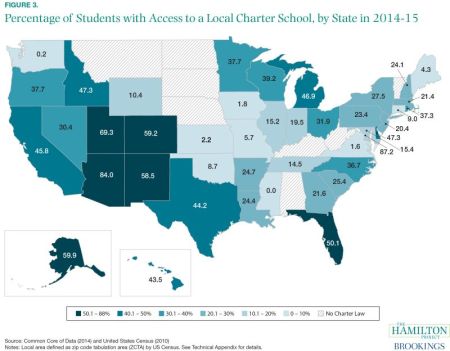
So let me start by saying I’m not sure how other states handle charter school facility procurement laws, and I am curious about it. It is however worth noting that Arizona provides the best access to charter schools by zip code, per this Hamilton Project map from Brookings:

Hmm, maybe other states should be doing what Arizona is doing. Also worth noting is the fact that Arizona charters are not only more proximate than other states, they are also crushing the ball academically (statewide averages in blue, statewide charter averages where available in red):

Arizona just might be doing something right in this space, so my elephant says “Careful about ‘fixing’ something that is not broken.”

Here is the missing context from this article- construction firms make profit from both the construction of charter and district schools. In recent years districts in the state of Arizona have been spending at a half-billion per year annual clip on facilities despite having relatively flat enrollment growth in aggregate.

Let’s put it on the table from the outset that this number could never be zero (air-conditioners die, roofs leak etc.) Moreover, some of this spending involves the districts who are big winners in open enrollment making seats to meet demand. I can’t make any complaint about this portion of the building spree-I like it.

Having said that, $500,000,000 per year is a lot of money (enough to pay every teacher in the state $10,000 per year more) and there are hundreds of thousands of empty seats in Arizona districts, which were badly overbuilt during the boom. The Arizona School Facilities Board lists 1.4m square feet of vacant district space (approximately 35% of the total) and strangely enough almost none of this space is suitable for a charter school (in the estimation of district officials).

The word on the street here in PHX is that a handful of the big construction firms find that $500,000,000 profitable enough to invest in bond and override campaigns. So…we continue building space, including in districts with declining enrollment like Scottsdale. Maybe a reporter should look into that…

Now back to the current Harris piece. It is lacking in context, giving no information about the relative profit margins in charter versus district construction. There are no non-profits building schools in Arizona to my knowledge. Moreover, the profits in this case only come about because of the demand for the school model. Without demand, the CMO in question would lack the funds to buy the buildings-ergo no profit. Contrast this with a district system with 1.4 million empty seats but continuing to build more of them despite flat aggregate demand and at an enormous annual cost despite huge spare capacity and the costs for vacant buildings drawing money out of the classroom.

So all in all, where does charter school construction profits rank in a list of school facility issues in your opinion?


Religious Left Baptizes the Blob

July 5, 2018

classroom-2787754_640

(Guest post by Greg Forster)

In my latest for OCPA, I look at how Oklahoma’s religious left is baptizing the blob, including support for the teacher strike.

It’s not my position that religious leaders should have nothing to say about education policy:

It’s true that America’s great experiment in religious freedom implies our public policy can be based on shared moral commitments even if we disagree about the ultimate cosmic basis of those commitments. But as George Washington rightly pointed out in his farewell address, we can’t talk only about the morals of public policy and ignore the religious foundations of the morality upon which we draw. For if the foundations are neglected, the building collapses.

But if religious leaders are going to speak about education policy, they should make a serious theological argument and not just parrot the political talking points of secular special-interest groups. Otherwise they end up captive to political manipulators. This is exactly what happened to the religious right:

As a matter of fact, I’ve spent almost 10 years speaking out against the ideological captivity of the religious right. I appreciate that the fight for the sanctity of human life and other issues has accomplished some good. But the larger effect of the religious right movement was to push churches to become voter registration offices of the Republican Party. As it became clear what was going on, this did incalculable damage to the religious credibility of the churches involved. We are still living in the disastrous aftermath, as huge portions of our culture have disconnected themselves from faith entirely.

So I’m only playing fair when I say that I see the same dangerous sellout in the efforts of Oklahoma’s religious left to baptize the blob. The pronouncements of Oklahoma’s religious left on education don’t bring any theological light to the public policy questions. They’re not saying anything the secular left isn’t saying. They’re just pasting Bible verses on self-interested interest group politics. Organizing events and statements to support a secular special interest’s demand for money, parroting its secular talking points, doesn’t become a spiritual discipline because you do it with a clerical collar on—quite the reverse.

There are, in fact, serious theological arguments to be made on education policy. I’ve participated in some of them, including my response to theological arguments from the religious left as well as theological arguments from the religious right. So I welcome – though I often disagree on the merits – real theological arguments from the religious left and right. What’s alarming is when religious leaders make themselves tools of secular selfishness in the name of, yet to the detriment of, better schools for kids.


The Michigan Charter Lion Sleeps Happily Tonight with a Belly Full of Unjust Criticisms

July 3, 2018

(Guest Post by Matthew Ladner)

The world has a funny way of not behaving according to expectations. Michigan charters came under withering fire last year despite the fact that basically every bit of formal research available found that they produce better learning gains. Never you mind that whole “outcomes” business, Michigan charters were “Wild West” in nature and thus not to be trusted. Louisiana charters have been touted as a national model- properly gardened and/or quarterbacked etc. Some but certainly not all fans of Louisiana charter policies were also critics of Michigan charter policies.

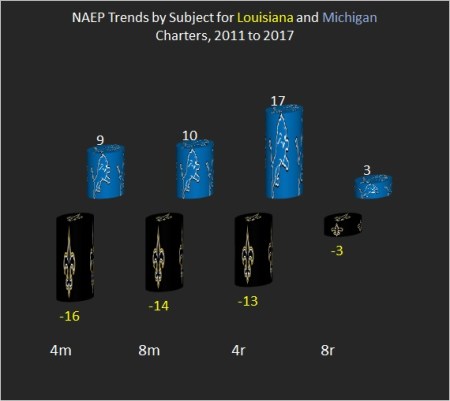
The chart below constitutes the longest period that NAEP has data for LA charters on all four tests. Instead of the customary state flags, we’ll use the NFL logos of the Detroit Lions and New Orleans Saints:

Back in 2011 Louisiana charters tied Michigan charters on one of the four tests and had higher scores on the other three. The 2017 scores for MI charters on 4m, 8m, 4r and 8r were: 232, 272, 218 and 259 respectively. The 2017 scores for LA charters on the same exams for Louisiana: 214, 264, 197 and 254. Whether based upon scores or over time improvement, it seems odd indeed to hold that Michigan has awful policies to avoid at all cost while simultaneously holding that the rest of the country should drop what they are doing to emulate Louisiana.

The NAPCS dashboard that keeps track of such things is currently down but last I checked both LA and MI charters had tough student demographic profiles. We cannot know what role average school quality plays in these trends, so it is barely possible that statistical noise is consistently bouncing the way of Michigan charters over and over again (the 2015 exams also favor them) and consistently bounce against Louisiana charters repeatedly (the 2015 results were also trending down). Multiple formal studies of state scores in Michigan showing positive results leans heavily against such an already unlikely conclusion, as do similar negative trends in state charter scores in Louisiana.

I’m open to the fact that the world is complex. Perhaps there is some complicated reason why Michigan charters appear to be improving steadily, and some equally complex reason why Louisiana charter scores appear have declined. Just maybe Michigan charters deserved some of the criticisms they received, and perhaps Louisiana charter policies are not quite as terrible as the state and NAEP scores would seem to indicate. Occam’s razor may cut against such explanations, but no one is making an effort to offer them at all.

Using the Jonathan Haidt framework, my elephant is inclined to believe that “Wild West” is under-rated, and technocratic gardening is over-rated. My elephant believes that like the Dauphin of Shakespeare’s Henry V, opponents of relatively free-wheeling charter sectors “come over us with our wilder days, not measuring what use we made of them.” The rider of my elephant continues to bring me further reasons to believe this. He’s good at that. He’s also pretty good at finding flaws in the arguments of opponents, but Haidt has persuaded me that he is not to be fully trusted.

I could be wrong, but if so it will require the hate Michigan/love Louisiana tribe to poke holes in my theory/evidence as solid reasoning is a communal activity, not to be left to mere individuals.


Pass the Popcorn: That’s My Girl

July 2, 2018

Incredibles-2-sneak-peek-still-Helen-Bob-and-Lucius

(Guest post by Greg Forster)

This post contains mega major spoilers. I mean it. You have been warned.

Okay, let’s get the tiresome part out of the way first. Pass the Popcorn hereby presents:

EVERYTHING WRONG WITH INCREDIBLES II

  • Ridiculously patronizing fan service: A visit to Edna, with the conveyor belt and everything, is shoehorned in; Frozone gets yelled at by Honey
  • Act I totally undermines the psychological climax of the first movie: They put on their masks to fight the Underminer – they are now supers again, and proud of it! But then we needed to make another movie, so suddenly they’re not.
  • The visual look of this movie is just different enough from the original that you constantly notice it – especially Dash, did no one go back and review what he looked like in the first movie? – but not so different that your brain accepts it as different. It’s the animation version of the uncanny valley.
  • The villain’s back story is insultingly contrived: It would have been sufficient if she’d just hated supers for the reasons given in the big Screenslaver speech, which would have made her a really interesting political/ideological villain with a megalomaniacal vision of reshaping the world by force; but no, it all had to go back to a ham-handed story about a personal trauma, because we’re all babies now.
  • Mind control is always bad: It negates the only part of any story that’s really interesting: the characters’ choices and struggles.

What bugs me is not that these are huge problems, because they aren’t, but that they would have been so easy to fix if the studio had respected our intelligence just a wee bit more. I think these issues collectively made the difference between I2 being a really good movie (which it is) and a really great movie, on par with the original (which it isn’t, alas).

Whew! Now let’s get to the fun part.

16incredibles-2-1-articleLarge

I2 continues the Pixar/New Disney tradition of goring our cultural sacred cows, but doing it in just the right way so people will take it. In this case, as in some others (see: Frozen) it’s done by giving us a real encounter with the reason people believe in those sacred cows – the other side gets a full airing of its case before the movie pulls the rug out.

The Incredibles franchise, here as in the first movie, takes on two big cultural dimensions at once. Which is what would have made I2 a really great movie if they hadn’t fumbled too much of the small stuff, since taking on just one is tough enough.

The first dimension is the male ego. In the first movie this was simply (simply!) the conflict between Mr. Incredible’s longing for the glory days and the prosaic task of being a father. He must learn that parenting is heroic. “You are my greatest adventure, and I almost missed it!”

That theme is echoed in I2 by having Mr. Incredible become a full-time dad to three unruly kids with superpowers, the comedic value of which is expertly milked. And it leads, halfway or so through the movie, to the same conclusion – parents are the real heroes.

But now there is a new twist. The male ego comes up against the female ego.

cycle

Mr. Incredible is not just invested in his own professional success – his glory days. Now he’s also deeply threatened by the possibility that his wife might outshine him.

All civilizations always needed to mortify the male ego sufficiently to make men into good fathers. But in the new social order that is emerging after feminism, the male ego must be further mortified to make room for female competition in the workplace – without the compensatory satisfaction of the paternal role being valued in the same way the maternal role is valued. Whether that is sustainable is an open question, but if it is, it will only be so if men learn heroic virtue similar to the heroic female virtue Tocqueville praised as the foundation of the American regime. Tocqueville said (in substance) that the American experiment in constitutional democracy avoids degeneration into atomistic indiviudalism only because its women had not demanded the equal rights to which they were clearly entitled under the governing principles of the regime; if they ever did demand those rights, he warned, the regime could not deny them, but the result would be the collapse of the traditions by which the family rather than the atomized indiviudal is the basic unit of society. That, in its way, is one of the lessons of I2 – only men of heroic moral virtue can sustain the new social order feminism has catalyzed.

You see what I mean about goring sacred cows? But we’re not done yet.

The female ego comes in for a subtle but no less sharp skewering in I2. From the moment they meet, Evelyn begins stroking Helen’s female ego – her sense of resentment and exclusion in a man’s world – in order to get under her defenses and take advantage of her. And Helen falls for it hook, line and sinker. The two of them spend half the movie just stroking each other’s female egos, right up to the point where Evelyn plunges in the knife. Like Iago worming his way into Othello’s trust by flattering his male ego and then twisting that very ego to his own purposes, Evelyn has used Helen’s feminist pride to destroy her.

The other big social topic is of course the role of superheroes.

INCREDIBLES 2

In the first movie, Syndrome spoke for the envy and resentment of all those who hate heroes – and they have been a prominent and influential voice throughout the modern period of history. So pervasive is this resentment that Helen herself parrots it without really thinking – “Everyone is special, Dash.” The modern period could almost be defined as the period during which it became plausible to say that it is evil to admire heroes.

I2 tries to pick that thread back up. In the Screenslaver speech, the critique of superheroes is even broadened into a critique of the Big Media and Internet culture for which superhero franchises are a sort of proxy. “You don’t talk, you watch talk shows; you don’t play games, you watch game shows.”

The makers of I2 have seen that under the surface of the standard-issue snobbery about mass media we constantly hear is an aristocratic (or worse) contempt for democracy and egalitarianism. Evelyn’s attack on bourgeois society strikes the note of every totalitarian ideology: You’re all SHALLOW and WEAK and LAZY. That’s why mass media is nothing but a tool of social control – you’re all so easily controlled because you’re pathetic and worthless. WAKE UP, SHEEPLE!

This is all botched, however, because it does not remain at the center of the villain’s character and motivation. The contrast with Syndrome is instructive. Syndrome has a personal trauma to provide resentment and a motive for megalomania, yes. But Syndrome’s revenge consists of remaking the world according to a new political vision, a vision whose principles he understands and articulates as a coherent ideology. This is precisely what makes him interesting. “When everyone is super, no one will be!” If Evelyn’s big “monologuing” scene with Helen in the frozen chamber had been a further elaboration of that political vision and not the recitation of a mind-numbingly boring series of convolutions designed to give her a stronger personal trauma, she could have ranked with the best of the Bond villains.

incredibles2_1

But in spite of this misfire, I2 does remember to pull the rug out from under Evelyn’s ideology. And the character who does it is Violet.

Let’s face it, there’s a great deal to be said for the critique of bourgeois society as shallow and morally undeveloped. But the bourgeois society is a little like Winston Churchill’s democracy – it’s the worst kind of society, except for all the others that have been tried from time to time.

The self-appointed superiors who look down upon the shallow complacency of bourgeois society never actually rise to moral heights. Time after time, in arrogance and contempt, they sink to moral depths.

Who is it that learns real humility? The supers, who – precisely because they have so much power – must learn to use it rightly or face catastrophe.

Violet spends the whole movie wanting to be a superhero. Even when she says she doesn’t, she only says it because she really does – and the sacrifices are so painful. And then, in the climactic moment, she chooses to stay out of the fray in order to protect her baby brother rather than seek glory and adventure.

And her father says, “that’s my girl.”


More Fake Statistics Hide Prevalence of Bullying in District Schools

June 27, 2018

(Guest Post by Jason Bedrick)

One of the many issues surfaced in Max Eden’s recent exposé on a New York City high school was how city officials’ insistence on keeping suspension rates down created incentives for lower-level bureaucrats to hide problems rather than address them. In an earlier report, he noted that under the DeBlasio’s administration’s new discipline policies, the NYC School Survey showed that “teachers report less order and discipline, and students report less mutual respect among their peers, as well as more violence, drug and alcohol use, and gang activity.” Despite this, DeBlasio declared that the city’s district schools experienced “the safest [year] on record.” What accounts for the disparity? The answer appears to be juked statistics.

In the wake of Eden’s exposé, many questioned how widespread this problem is. That’s a question researchers should set out promptly to address, but evidence from New Hampshire suggests that New York is far from an anomaly:

As told by schools’ self-reported statistics, the story of bullying in New Hampshire’s public schools is one of great progress. Since the signing of a landmark anti-bullying law, the number of incidents recorded by schools has dropped by more than half, from 5,561 in the 2010-2011 school year to 2,233 in 2016-2017, according to Department of Education data.

But advocates and state officials say those numbers belie the reality for Skylar and other students. More than a fifth of Granite State high-schoolers, for example, reported in a 2017 survey that they were bullied on school property during the previous year.

The Youth Risk Behavior Survey is administered annually to students across the country. Since 2009, the rate at which New Hampshire high school students say they have been bullied has stayed the same – between 21 and 22 percent – even as schools report more than 50 percent reductions in claims of bullying.

Yet again, it appears that school officials are working harder to hide incidents of bullying than address them:

The rate at which schools investigate students’ claims and find actual incidents of bullying has also dropped dramatically at the high school level. In 2010-2011, high schools confirmed bullying in 58 percent of reported incidents. Seven years later, it has dropped to 29 percent.

Some schools have put a lot of effort into stopping bullying, advocates say, but they believe the discrepancies in the data are evidence that some schools are exploiting weaknesses in the state’s law to under-report and underinvestigate claims of bullying.

The new spotlight on juked bullying statistics comes in response to two cases of student suicides over bullying in a state that has a smaller population than many cities. In both cases, parents argued that the schools didn’t do enough to protect their children from bullying.

Education officials in New Hampshire should work swiftly to correct perverse incentives and produce more accurate accounts of the level of bullying in the district school system, and schools should step up their efforts to combat bullying. In the meantime, bullied students should get access to educational choice options to provide an escape hatch from their tormentors.