Jacqueline Keeler and Sam Dean for The Al

October 30, 2023

(Guest post by Greg Forster)

As world events are reminding us right now, nothing is more appealing to us – to all of us – than a really compelling story. The stories we tell ourselves shape the inner world that we mentally live in, and in doing so, ultimately shape not only who we are as individuals but the social world we live in together. No service is more valuable to the world than that of getting our stories straight.

A while back I stumbled across the amazing story of Richard Montañez. The moment I read it, I immediately put him down on my list of future Al nominees. And pretty high on the list, too. How could I not nominate for The Al a man who, while working as a janitor for Frito-Lay, noticed that he and his Hispanic co-workers did not themselves tend to buy Frito-Lay products because none appealed to their tastes, and came into work with his own home-brewed recipe for a new super-spicy Cheeto and sold it to the corporate execs, bringing the world what would become Flamin’ Hot Cheetos?

I mean, if the story of how Al became Al is that he brought the world spicy chicken, how much more Al is story of the man who brought the world spicy Cheetos?

Part of what was so compelling about Montañez’s story was simply that he is so good at telling it. He was raking in speaking fees of up to $50,000 and writing multiple bestselling memoirs, recounting his janitorial days when he would come into work with little sandwich bags filled with Cheetos he had doctored in his home kitchen/laboratory; how word began getting around and he unexpectedly landed an audience with the bigshots; how some at Frito-Lay weren’t happy that a Hispanic janitor was getting out of line and disrupting the corporate suite with his ideas.

Image from Montañez’s page at a swanky speaker’s agency

I wasn’t the only one who noticed Montañez’s story. The professional storytellers in Hollywood did, too. They sunk millions into a full-dress movie, with stars and everything, to tell Montañez’s story.

But a funny thing happened to Montañez’s story. This year, the movie Flamin’ Hot was released, not in theaters, but on streaming. And it got no buzz, disappearing quickly into the bottomless miasma of the streaming library.

Why? Because the publicity for Flamin’ Hot declares that Montañez’s story is “a true story.”

And it isn’t.

We know this thanks to one of the other people who was impressed when he first heard Montañez’s story: Sam Dean. A journalist for the Los Angeles Times, Dean had even promoted Montañez when writing about Hispanics in the world of food. But Dean is cut from the same cloth as Al winner Hunter Scott and nominee Ryan Petersen, and actually did what reporters are supposed to do: shoe-leather reporting.

Late last year, as Flamin’ Hot was making its way toward what would have been a blockbuster debut, Dean published a blockbuster of his own – a profile of Montañez with a title that doesn’t beat around the bush: “The Man Who Didn’t Invent Flamin’ Hot Cheetos.”

Interviewing former Frito-Lay employees and checking public records, Dean pieced together the true story: “Flamin’ Hots were created by a team of hotshot snack food professionals starting in 1989, in the corporate offices of Frito-Lay’s headquarters in Plano, Texas. The new product was designed to compete with spicy snacks sold in the inner-city mini-marts of the Midwest. A junior employee with a freshly minted MBA named Lynne Greenfeld got the assignment to develop the brand – she came up with the Flamin’ Hot name and shepherded the line into existence.”

Montañez’s story was an elaborate self-promoting grift, much like that of the “fictional autobiography writer Rigoberta Menchu” whose Nobel peace prize helped launch The Al.

Frito-Lay, for obvious reasons, had not been eager to publicly contradict Montañez’s story. But when Dean showed up with the receipts, they finally issued a statement: “None of our records show that Richard was involved in any capacity in the Flamin’ Hot test market….We have interviewed multiple personnel who were involved in the test market, and all of them indicate that Richard was not involved in any capacity in the test market….That doesn’t mean we don’t celebrate Richard, but the facts do not support the urban legend.”

Frito-Lay could take a lesson in how to stand by your people and your products from Al nominee Adam Butler at Kraft-Heinz, but that’s for another day.

While Dean’s story is the one that has unfolded this year, I simply couldn’t give him the nomination without also honoring another journalist, Jacqueline Keeler of the San Francisco Chronicle, who a year earlier took down an even more important fraud. The title of her profile is as subtle and circumlocuitous as that of Dean’s: “Sacheen Littlefeather Was a Native American Icon; Her Sisters Say She Was an Ethnic Fraud.”

In 1973, the founder of NAMBLA won an Academy Award for his performance as Vito Corleone in The Godfather. He refused to receive the award himself, and sent “Sacheen Littlefeather” to accept it on his behalf. As Keeler writes: “Claiming Apache heritage, she spoke eloquently, to a backdrop of boos, of the mistreatment of Native Americans by the film industry and beyond.” She spent the rest of her life speaking in this role on the abuse of Native Americans by Hollywood.

And apparently she was well qualified to lecture Hollywood about misrepresenting Native Americans! Keeler put in the shoe leather to prove that Marie Louise Cruz – “Sacheen Littlefeather” – had no Native American ancestry. Keeler’s extensive research traces Cruz’s invention of her false identity and shows that her specific claims are contradicted by tribal records.

Frazer Harrison/Getty Images

Her biological sisters, Rosalind Cruz and Trudy Orlandi, confirmed this to Keeler, expressing anger at their sister’s betrayal of her Mexican ancestry: “I mean, you’re not gonna be a Mexican American princess,” Orlandi said to Keeler. “You’re gonna be an American Indian princess. It was more prestigious to be an American Indian than it was to be Hispanic in her mind.”

The problem with the new world being created by wokeness is not the desire to reexamine the world we have inherited with a critical eye. The problem is not even the radical commitment to overturn existing institutions where justice requires it. The problem is that the elite class who have gained power through the rhetoric of wokeness are firmly committed to the view that facts don’t matter – that there is no “truth” other than the stories we tell ourselves (“narratives,” if you want to sound hifalutin) and that the only test of whether a story is true is whether it serves our moral purposes.

Ultimately, this reduces to: “If acting on a belief produces the kind of world you want, the belief is true.”

Truth and falsehood are thus determined solely by our wishes – ultimately, by the barrel of a gun.

And the thing that the woke have, almost without exception, refused to realize is that once we get rid of the old idea that “truth” involves correspondence to objective reality, this lowering of the epistemic guardrails will not weaken – it will greatly strengthen – the atavistic darkness of the far Right. There is nothing at all stopping racists, misogynists, nationalists, etc. from building a world based on brutally enforced conformity to “narrative” in exactly the same way the woke do. That has always been the nature of their enterprise. How thoughtful of the woke to roll out the red carpet for them.

Commitment to truth as correspondence to objective reality was never a mask for reactionary power. It was in fact revolutionary – the only true wokeness, the only revolutionary spirit worthy of the name – and that not by happenstance but by logical necessity. Commitment to truth as correspondence to reality cannot be reactionary; it must always inspire revolution, and only it can inspire a revolution worth having.

The signal service Keeler and Dean provide by their willingness to stand firm against fashionable narratives that everyone in their social world wants to be true is to help rebuild the guardrails that protect the humane things – the good, the true and the beautiful, which constitute the ultimate revolutionary agenda – from the nihilistic abyss.


For the Al: Ali Ahmed Aslam

October 28, 2023

(Guest post by Greg Forster)

The delight of good food and the justice of political liberalism – what could be more Al-worthy? Ali Ahmed Aslam’s achievement reminds us why the two are connected.

The Al has a long relationship with good food. From the original Al himself to Steve Henson, Thibaut Scholasch & Sébastien PayenTim & Carrie League, Adam Butler & Autumn Thomasson, Mildred DayJoseph Friedman and John and Justine Glaser, people who create food and make it more widely available to all are among the most frequent Al nominees.

It’s not hard to see why! When Ali passed away last year, the Times of India waxed poetic in its obituary:

Food is like life. It is a work in progress and has uncountable versions. Over 4 lakh [hundred thousand] years of collective knowledge and experience have gone into figuring out the basics of human culinary experience, not to talk of gourmet cooking, which is another level of a nuanced approach to food.

Food has other life-like attributes, too. It has no known beginning, no discernible end, has no finality of perfection or nadir of banality. It belongs to all, with no possible claims to a patent for a sense of ownership.

Now, folks, I do have to admit, when I eat one of Mildred Day’s Rice Krispie treats, I do have my doubts about whether the Times is right about food having “no finality of perfection.” And I have definitely eaten a meal or two in my time that could call into question the assertion that food has no “nadir of banality.”

But the Times got one thing right – food belongs to all. You’ve heard all the quips: Egg rolls were invented in America. Hawaiian pizza was invented in Canada. French Fries are Belgian. Swedish meatballs are Turkish.

And chicken tikka masala is Scottish, thanks to Ali Ahmed Aslam, known to all as “Mr. Ali.” Born in what is now Pakistan in 1945, he came to Glasgow as a young boy. His father opened the first Indian restaurant in Glasgow in 1959, and he followed suit, opening the delightfully named Shish Mahal restaurant in 1964.

Legend has it that Ali invented chicken tikka masala in the 1970s after a customer complained his chicken was too dry. As with most legends, the particulars are disputed. The muse of history has delicately draped a veil of uncertainty over the exact origins of the dish. But there is no question that Ali popularized it through decades of hard work and sacrificial service to his community through his successful business. It was Ali who made chicken tikka masala, as his obituaries unanimously proclaim, the national dish of Great Britain.

How was it possible for chicken tikka masala rather than, say, shepherd’s pie to become Britain’s national dish? And how can people maintain any stable sense of identity and belonging in a world where such fluidity is possible?

Food belongs to all, as the Times so beautifully puts it, because beauty itself in all its forms – like the good and the true in all their forms – belongs to all. We experience beauty, including a beautiful meal, first and foremost not as British or Brazilians or Bhutanese, not as men or women, not as moderns or ancients, but as human beings.

Of course the experience is always filtered through our particularities. I don’t experience chicken tikka masala in exactly the same way as a Scottish or Chinese person does. That’s why humans are social creatures, and need one another. None of us sees the whole picture, and we grow as we appreciate one another’s different experiences within and across community. Those who are not humble enough to learn something from other cultures do not understand even their own, for they lack a frame of reference.

But however varied our particular experiences, our collective participation in a shared human nature and the essential sameness of the good, the true and the beautiful for all of us must come first. Without that, no growth from any exchange of different experiences, no justice and no community, is even possible. If we are not all humans together, experiencing in our different ways the same basic human things, the gap between cultures, and even the gap between individuals, can never really be bridged.

There is only power – a boot stamping on a human face, forever.

I’d rather have chicken tikka masala.

Hence Ali brings us not only to Mildred Day, but to Fasi Zaka, Wim NottrothCharles MontesquieuMaster Sergeant Roddie EdmondsWhittaker ChambersGeorge Henry Thomas, Bob Fletcher, Hans Christian HegNazar Mohammad Khasha and George Washington. When I nominated Khasha, I wrote: “For all our morbid obsession with the supposedly insuperable bounds of cultural particularity, I suspect Khasha and Taiwan’s magnificent President Tsai Ing-Wen would have understood each other quite well.”

But I think Washington said it best, in a context we would do well to remember:

The Citizens of the United States of America have a right to applaud themselves for having given to mankind examples of an enlarged and liberal policy: a policy worthy of imitation. All possess alike liberty of conscience and immunities of citizenship It is now no more that toleration is spoken of, as if it was by the indulgence of one class of people, that another enjoyed the exercise of their inherent natural rights. For happily the Government of the United States, which gives to bigotry no sanction, to persecution no assistance, requires only that they who live under its protection should demean themselves as good citizens, in giving it on all occasions their effectual support.

After he passed, Ali’s son posted on social media:

Dad came to the UK in the late 1950s, about 1958 or 1959 and they were from a very, very, very poor background. He made Glasgow and Scotland his home, he did not look back.

He was Glaswegian and Scottish first. He was very, very proud of being Glaswegian, very very proud of being Scottish, and it was very important to him. He set up a lot of charities and he donated a lot of money because he was from such humble beginnings.

The liberal political order replaces the strict cultural homogeneity of ancient societies with complexity, ambiguity and fragmentation. People look at their neighbors and don’t immediately recognize themselves in those very different faces and very different lives.

We have not yet figured out how to maintain social solidarity under these conditions. The humaneness and generosity of a Mr. Ali will always find its dark mirror image in the depravity of those who, for whatever reason, simply cannot find their way to the place where a man born in Pakistan can be proud to be “Glaswegian and Scottish first.” And where others can genuinely see him that way as well.

But let us make no mistake about our alternatives, of which we have only two. We can press forward into the unknown, into the fog of liberal ambiguity, or we can attempt to lift the fog by the application of violence. And not just any violence, but a special kind of violence: Violence that is not restrained by any recognition of our shared humanity, not restrained by any awareness that the good, the true and the beautiful are in the end binding on all of us together.

Like I said, I’d rather have chicken tikka masala.

Image HTs: AFP via Getty; Shish Mahal via Yahoo


The Al Is Driving, and Is the Only One Not Driving Us Off a Cliff

October 6, 2023

(Guest post by Greg Forster)

Well, this year we will hand out our sixteenth annual Al Copeland Humanitarian of the Year Award. It’s an honor that’s old enough to drive! And it’s the only thing not driving us insane these days.

Don’t like the choices the world is offering you? Turn to The Al for uplifting alternatives!

Yes, it’s time for The Al – and just to be completely clear, that’s not “Al” as in AI, it’s “Al” as in Al!

That’s right, the Nobel Peace Prize has been awarded, so it is time once again to honor those who have bettered the human condition with the Al Copeland Humanitarian of the Year award! Nominations can be submitted by emailing a draft of a blog post advocating for your nominee. If Jay likes it, he will post it with your name attached. A winner will be announced after Halloween.

The criteria of the Al Copeland Humanitarian Award can be summarized by quoting our original blog post in which we sang the praises of Al Copeland and all that he did for humanity:

Al Copeland may not have done the most to benefit humanity, but he certainly did more than many people who receive such awards.  Chicago gave Bill Ayers their Citizen of the Year award in 1997.  And the Nobel Peace Prize has too often gone to a motley crew including unrepentant terrorist, Yassir Arafat, and fictional autobiography writer, Rigoberta Menchu.   Local humanitarian awards tend to go to hack politicians or community activists.  From all these award recipients you might think that a humanitarian was someone who stopped throwing bombs… or who you hoped would picket, tax, regulate, or imprison someone else.

Al Copeland never threatened to bomb, picket, tax, regulate, or imprison anyone.  By that standard alone he would be much more of a humanitarian.  But Al Copeland did even more — he gave us spicy chicken.

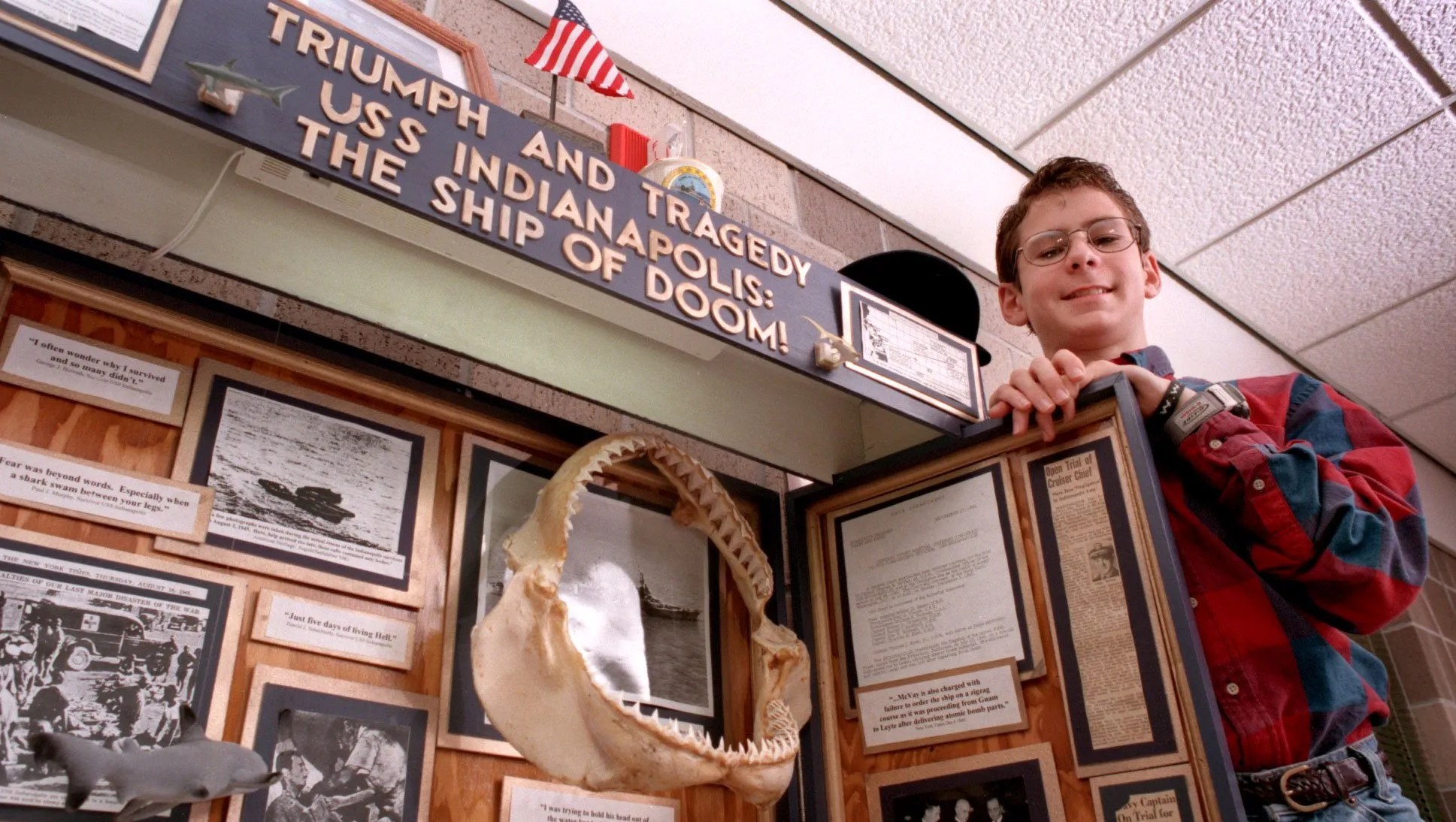
The 2022 winner of The Al was Hunter Scott, who at age 12, after doing a school project on the 1945 sinking of the U.S.S. Indianapolis, began a campaign to posthumously vindicate its captain, Charles McVay III. As Scott’s evidence amply demonstrated, McVay had wrongly taken the blame for the death of most of his crew in shark-infested waters because of the petty vindictiveness and cowardice of an even worse species of shark: ass-covering bureaucrats. Scott hunted and devoured his prey ahead of a small but especially fearsome frenzy of nominees, including FedEx founder Fred Smith and United States founder George Washington.

The 2021 winner of The Al was Ken “Heinie the Tank Buster” Adam, a German Jew expatriate who dropped bombs for the RAF and then helped Hollywood studios avoid bombs, especially by inventing the Bond villain volcano lair. Adam burst forth at the apex of a mountain of excellent nominees, including Nazar Mohammad Khasha, who gave his life for his right to mock the Taliban; Christopher Lee, real-life embodiment of The Most Interesting Man in the WorldRyan Peterson, who actually did shoe-leather reporting on the supply chain crisis instead of just bloviating about it; Joseph Friedman, inventor of the bendy straw; and John and Justine Glaser, integrationist inventors of the black and white cookie.

The 2020 winner of The Al was Nat Love, who overcame enormous adversity and injustice to live a magnificent American life: “I think you will agree with me that this grand country of ours is the peer of any in the world, and that volumes cannot begin to tell of the wonders of it.” Love conquered all amid a field including Nick Steinsberger, who helped pioneer fracking; Charles Hull, who invented 3D printing; and Hans Christian Heg, an immigrant abolitionist hero whose statue had been torn down by a “justice” mob.

The 2019 winner of The Al was Mildred Day, who brought parents and children together over delicious goodness by inventing the Rice Krispie Treat – following in the fine tradition of Al Copeland himself, improving the human condition by bringing us great food. Day came out of the Al oven ahead of political pranksters Chad Kroeger and JT Parr; and Bob Fletcher, who helped three Japanese-American families in California keep their farms after WWII-era internment.

The 2018 winner of The Al was Joy Morton, who was the first to find a way to effectively induce lots of people to consume iodine and thus prevent goiters – by marketing it, turning it into a profitable comparative advantage for his salt company. Morton was saltier than a whole shaker’s worth of salty nominees, including Great Course lecturer Elizabeth Vandiver, musical disintermediator Leo MoracchiloliMagic: The Gathering inventor Richard Garfield, scofflaw tech recycler Eric Lundgren, lemonade-stand paladins Adam Butler and Autumn Thomasson, and Virginian general in the Union Army George Henry Thomas.

The 2017 winner of The Al was Stanislav Petrov, who literally saved the world from nuclear destruction by refusing to follow Soviet orders to retaliate against what he suspected (as was later confirmed) was a false warning of a US strike. It’s not quite as important as bringing the world spicy chicken, but it’s pretty close! Petrov nuked an impressive set of runners-up, including Whittaker Chambers, witness against communism; Justin Roiland and Dan Harmon, creators of Rick and Morty; and Russ Roberts, author and host of EconTalk.

The 2016 winner of The Al was Master Sergeant Roddie Edmonds, who ordered all the POWs under his command to identify themselves as Jews, foiling a Nazi attempt to separate Jewish prisoners and kill them, and refused to back down even with a gun to his head. Edmonds held firm among a very competitive field of nominees, including Tim and Karrie League, founders of Alamo Drafthouse movie theaters; political humorist Remy Munasifi; and humorous political journalist Yair Rosenberg.

The 2015 winner of The Al was internet humorist Ken M. He not only made us laugh by making idiotic comments on social media (which would have been enough), he revealed with his humor the ridiculousness of trying to change the world by arguing on the internet. Ken M laughed off a strong field of nominees, including Malcolm McLean, inventor of shipping containers; Gary Gygax, creator of Dungeons and Dragons; and John Lasseter, founder of Pixar.

The 2014 winner was Peter DeComo, the inventor of the Hemolung Respiratory Assist System. To save a life, DeComo drove all night to retrieve a lung machine from Canada, then demonstrated incredible quick wits when border control tried to block its entry into the US because it had not yet been approved by the FDA. DeComo smuggled his win past a worthy field, including Marcus Persson, the inventor of Minecraft; Ira Goldman, the developer of the “Knee Defender”; Thomas J. Barratt, the father of modern advertising; and Thibaut Scholasch and Sébastien Payen, wine-makers who improved irrigation methods.

The 2013 winner of The Al was musical satirist Weird Al Yankovic. Weird Al brings joy to people of all ages, while puncturing the pretensions of puffed-up celebrity entertainers. He lampooned an impressive set of nominees, including performer/skeptics Penn and Teller, crowdfunding website Kickstarter, and WWII industrialist Bill Knudsen.

The 2012 winner of The Al was George P. Mitchell, a pioneer in the use of fracking to obtain more, cheaper and cleaner natural gas. Mitchell stuck oil in a field of worthy nominees: artist Banksy, car creator Ransom E. Olds, first-down-line inventor and two-time Al nominee Stan Honey, and bubble-wrap inventors Alfred Fielding and Marc Chavannes.

In 2011, The Al went to Earle Haas, the inventor of the modern tampon, proving that advances in equal opportunity for women come from entrepreneurs more than government mandates. Haas cycled to the front of the pack amid a strong flow of nominees: Charles Montesquieu, the political philosopher; David Einhorn, the short-seller; and Steve Wynn, the casino mogul.

The 2010 winner of The Al was Wim Nottroth, who peacefully resisted Rotterdam police efforts to destroy a mural that read “Thou Shall Not Kill” following the murder of Theo van Gogh by an Islamic extremist. His voice was heard over the din of The Most Interesting Man in the World, model of masculine virtue; Stan Honey, inventor of TV’s yellow first down line; Herbert Dow, subverter of chemical cartels; and Marion Donovan and Victor Mills, developers of the disposable diaper.

The 2009 winner of The Al – in the first year the award bore that name – was Debrilla M. Ratchford, who significantly improved the human condition by inventing the rollerbag. She rolled to victory over Steve Henson, who gave us ranch dressing; Fasi Zaka, who ridiculed the Taliban; Ralph Teetor, who invented cruise control; and Mary Quant, who popularized the miniskirt.

Also noteworthy from 2009: History’s greatest monster, William Higinbotham, was declared permanently ineligible to receive The Al. He remains the only individual thus disqualified. In (dis)honor of Higinbotham, The Higgy award has been bestowed on (un)worthy candidates annually since 2012.

Al Copeland himself was honored in 2008 as the official humanitarian of the year of Jay P. Greene’s Blog. The award was renamed in his honor the following year.

Send in your nominees, and we’ll see you at Halloween with the winner!


From Passing the Policy to Parent Participation

June 19, 2023

(Guest post by Greg Forster)

OCPA carries my article on how it isn’t enough to pass a school choice policy; it’s imperative to help parents and schools get enrolled in the program quickly:

It’s essential to take this problem seriously. Getting participation rates up quickly is essential to the political survival of school choice programs. These programs strike right at the heart of a coalition of special interests that profit by exploiting the education monopoly. These interests will do whatever it takes to kill newly created programs.

Fortunately, the movement has a lot of experience with this and has a knowledge base to draw upon. And it will be needed:

The most difficult problem is that the families that need these programs most have the greatest difficulty accessing them. In general, the further up you go on the socioeconomic scale, the more plugged in to information systems people are (so they hear about the program) and the more time and ability they have for navigating bureaucracy (so they can use the program). The further down you go, the harder it is both to spread the word and to get people signed up.

Let me know what you think!


Peter Daznak for the Higgy

April 17, 2023

(Guest post by Matthew Ladner)

On February 19, 2020 a group of 27 public health officials published a joint letter in the medical journal Lancet that read in part:

The rapid, open, and transparent sharing of data on this outbreak is now being threatened by rumours and misinformation around its origins. We stand together to strongly condemn conspiracy theories suggesting that COVID-19 does not have a natural origin. Scientists from multiple countries have published and analysed genomes of the causative agent, severe acute respiratory syndrome coronavirus 2 (SARS-CoV-2), and they overwhelmingly conclude that this coronavirus originated in wildlife, as have so many other emerging pathogens.

This is further supported by a letter from the presidents of the US National Academies of Science, Engineering, and Medicine and by the scientific communities they represent. Conspiracy theories do nothing but create fear, rumours, and prejudice that jeopardise our global collaboration in the fight against this virus. We support the call from the Director-General of WHO to promote scientific evidence and unity over misinformation and conjecture.  We want you, the science and health professionals of China, to know that we stand with you in your fight against this virus.

We invite others to join us in supporting the scientists, public health professionals, and medical professionals of Wuhan and across China. Stand with our colleagues on the frontline

We speak in one voice. To add your support for this statement, sign our letter online. LM is editor of ProMED-mail. We declare no competing interests.

Competing interests were not declared, rather they were concealed.

I should note from the outset that I do not know whether COVID-19 originated in wildlife or in a lab. Neither do those who signed on to the letter, either today or back in 2020. Wuhan has both a wet-market and a laboratory that conducted experiments on bat viruses, and one of these two things is far more common in Chinese cities than the other and the pandemic started in (checks notes) Wuhan. Only someone deep in the throes of delusion inspired by self-interest or an utterly unsophisticated dupe would not want to explore the possibility of a lab leak.

Peter Daznak drafted the first draft of this letter, and an analysis found that 26 of the 27 original signatories had ties to the EcoHealth Alliance. After the publication of this letter, Daznak was appointed to a commission to explore the virus origins by Lancet and on another organized by the World Health Organization. Later he was removed from both. Sleuthing revealed that EcoHealth had made grants to the Wuhan Institute of Virology for experiments on bat viruses, that EcoHealth had engaged in some heavily criticized lobbying of the National Institute of Health officials in order to skirt rules specifically designed to prevent a pandemic, and that multiple safety concerns had been raised by Chinese officials regarding the security of the Wuhan Institute of Virology.

Some of the signatories later said that it had been their intention to push back on the notion that Chinese officials had released the COVID-19 virus on purpose. You’d have to be a Roger Moore era Bond Villain to do such a thing and you’d be needing an incredibly reliable vaccine to create your post-pandemic utopia on the ashes of the old world, which China shows no sign of having. Allegedly Daznak himself insisted on keeping the statement “broad” in denouncing a lab origin.

The first paragraph in the above quote is really a piece of work- a true masterpiece of licking the boot stomping of a human face forever. Chinese officials were anything but “rapid, open, and transparent sharing of data.” For instance as Annie Sparrow related in Foreign Policy:

Instead of notifying the World Health Organization (WHO) about the outbreak of atypical pneumonia and evidence of human spread, the authorities censored information, concealed the virus, and silenced doctors who tried to warn their colleagues. Hospital leaders refused to authorize masks or other personal protective equipment (PPE) on the grounds that it would cause panic. As patients infected health care workers and health care workers infected one another, hospital leaders insisted that spread among humans was impossible—that no staff members were infected—even altering diagnoses that suggested otherwise.

Beijing’s official line through Jan. 19, 2020 was that the outbreak began in late December 2019, that all cases had been infected by an unidentified animal source at the Huanan Seafood Wholesale Market, and that no health care workers were infected. But even when the government conceded human spread on Jan. 20, it reported only a fraction of the real numbers.

Instead authorities engaged in a pattern of demonstrable lying and covering up, threatening doctors involved in early warnings and restricting information. On Jan. 3, 2020, when China formally acknowledged the pneumonia outbreak, authorities told the WHO they had no idea what was causing it. In fact, by then, the new coronavirus had been sequenced several times—beginning with Vision Medicals on Dec. 27, 2019; BGI Genomics on Dec. 29, 2019; Wuhan Institute of Virology on Jan. 2, 2020; and China’s CDC on Jan. 3, 2020. On Jan. 5, a consortium led by professor Zhang Yongzhen at Fudan University in Shanghai sequenced it, deposited it in GenBank, the U.S. public database of DNA sequences, submitted it to Nature, and shared it with China’s National Health Commission (NHC).

This letter is Exhibit A of the abuse of scientific “authority” and why many of us have drawn the unavoidable conclusion that grandees and technocrats are not to be trusted. Oh, and in addition his sketchy grant-making and lobbying may have been a single step upstream from causing a global pandemic that killed millions of people and damaged the lives of millions more. I am not certain about that last part, just that there was an obvious effort to cover up the investigation of the possibility of a lab leak through the abuse of authority. It is therefore my distinct pleasure to nominate Peter Daznak for the Higgy.


For the Higgy: Jennifer Dorow

April 11, 2023
Christie had his M&M box, Dorow has her binder

(Guest post by Greg Forster)

Some are born PLDD, some achieve PLDD, and some have PLDD thrust upon them.

As 2022 dawned, Jennifer Dorow was an obscure Wisconsin judge. Then she had the good luck, and the rest of us had the bad luck, to have a sensational, nationally watched mass-murder trial of a black nationalist who said Hitler was right to kill Jews and sympathized with the extremist “Black Hebrew Israelites” land in her courtroom.

Dorow clearly loved the spotlight, but her conduct of the trial was incompetent, as she repeatedly made irresponsible statements about the defendant’s courtroom conduct. While the defendant’s conduct in court was indeed outrageous – refusing to answer to his own name and regularly interrupting the judge, for example – Dorow’s unguarded comments attacking him went well beyond what was necessary to maintain decorum in her court.

Dorow’s inability to control herself could have opened up the defendant’s eventual criminal conviction to complications in the public eye, not to mention the appeals courts.

It seems Dorow just could not do her job, which was to maintain her composure and follow proper judicial procedure when deeply evil and unhinged people break the court’s rules. She seems not to have been able to prioritize the integrity of the court above her own sense of wounded pride in the face of her inability to control others.

Fortunately for Dorow, and for the criminal justice system, the defendant was so obviously guilty, and his courtroom conduct was so offensive to the jurors, that he was convicted in spite of Dorow’s incompetence.

But Dorow had tasted the spotlight, and wanted more.

The mass-murder trial had given her huge quantities of what is unfortunately called “earned” media. She began looking around for a way to leverage the trial publicity to advance herself.

So when Wisconsin had an election for a seat on the state supreme court this year, Dorow jumped into the race. Her conduct in the campaign continued to show both her incompetence and her growing signs of PLDD.

You will think I’m making this up, or at least exaggerating, but this is the stone-cold fact: At her first debate in the election, Dorow showed up with a binder full of answers.

Throughout the debate, whenever she was asked a question, she turned to the appropriate page and read her answer verbatim out of her binder.

Unfortunately, in spite of her constantly demonstrated incompetence, her much larger “earned” media profile allowed her to take the endorsements and the donations of many short-sighted, media-chasing political constituencies away from her main opponent on the Right, distinguished jurist Dan Kelly (a former professional colleague of mine).

Kelly, because he was the superior candidate on every metric other than who had presided over a national media-sensation murder trial, beat Dorow in the first phase of the two-phase election. But it was a long and bruising fight, and with massive pro-abortion money pouring into the state to fuel his general-election opponent, Kelly couldn’t come back.

Dorow’s PLDD appears to have cost the Right the most expensive judicial election in history.

But 2023 isn’t over. We can still give Dorow the victory she craves.

I nominate Jennifer Dorow for the 2023 William Higinbotham Inhumanitarian of the Year Award.

Image HT PBS Wisconsin


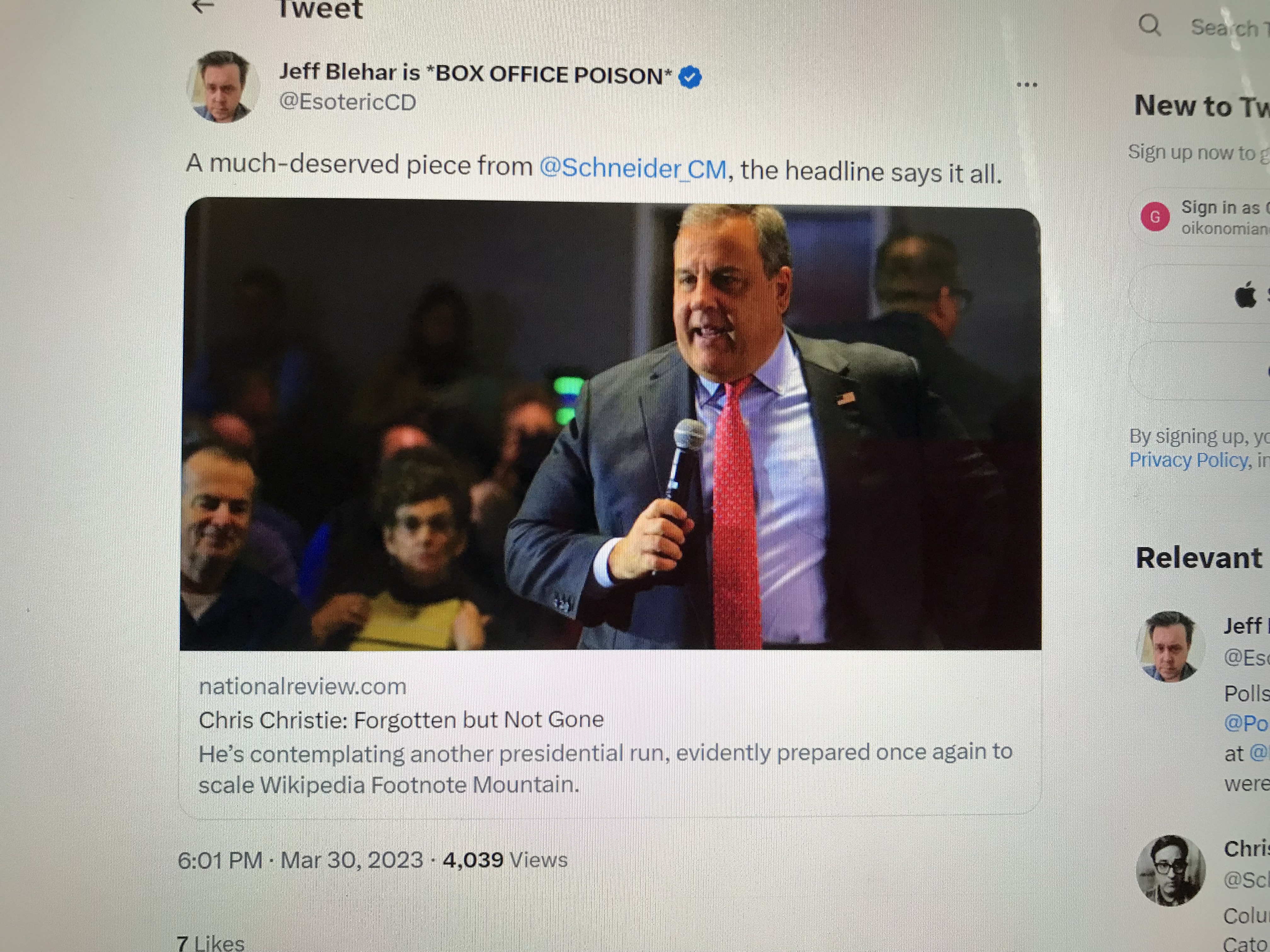
Nominate a “Forgotten But Not Gone” Fool for the Higgy!

April 1, 2023

(Guest post by Greg Forster)

The Higgy, like its recipients – including 2016 honoree Chris Christie, whom no one would blame you for not remembering – has a long tradition of existence. But while we’re glad The Higgy exists, we’re not glad its recipients do – in fact, we’re glad The Higgy exists because we’re not glad its recipients do.

Alas, Higgy winners, who seem to exist solely to plague us with their costly and frustrating PLDD nonsense, just go on and on, existing. And so do people who deserve The Higgy and have not yet received it. Thus, The Higgy marches on, never lacking for worthy contenders.

Yes, with the arrival of April Fool’s Day, it’s time once again for the William Higinbotham Inhumanitarian of the Year Award – “The Higgy.” Each year, we (dis)honor the most (un)worthy candidate from your nominations of people afflicted with PLDD (not BSDD, note the difference).

Past “winners” of The Higgy include Abraham Flexner, Alison Collins, Mark DiRoccoKosoko JacksonJohn Wiley BryantPlatoChris ChristieJonathan Gruber, Paul G. Kirk and the incomparably petty inaugural winner, Pascal Monnet.

The award is named for history’s greatest monster, William Higinbotham; as a special way of (dis)honoring Higinbotham, we have not even given him The Higgy.

Get your nominations in by April 15, Tax Day – definitely a day to discountenance petty little dictators!

To inspire you to greatness in discerning pettiness, we carry on immemorial Higgy tradition and reproduce below the text of Jay’s original post launching The Higgy. Good hunting!

********************

As someone who was recognized in 2006 as Time Magazine’s Man of the Year, I know a lot about the importance of awards highlighting people of significant accomplishment. Here on JPGB we have the Al Copeland Humanitarian Award, but I’ve noticed that “The Al” only recognizes people of positive accomplishment.  As Time Magazine has understood in naming Adolf Hitler, Joseph Stalin, and Ayatullah Khomeini as Persons of the Year, accomplishments can be negative as well as positive.

(Then again, Time has also recognized some amazing individuals as Person of the Year, including Endangered Earth, The Computer, Twenty-Five and Under, and The Peacemakers, so I’m not sure we should be paying so much attention to what a soon-to-be-defunct magazine does.  But that’s a topic for another day when we want to talk about how schools are more likely to be named after manatees than George Washington.)

Where were we?  Oh yes.  It is important to recognize negative as well as positive accomplishment.  So I introduce “The Higgy,” an award named after William Higinbotham, as the mirror award to our well-established “Al.”

Just as Al Copeland was not without serious flaws as a person, William Higinbotham was not without his virtues.  Higinbotham did, after all  develop the first video game.  But Higinbotham dismissed the importance of that accomplishment and instead chose to be an arrogant jerk by claiming that his true accomplishment was in helping found the Federation of American Scientists and working for the nonproliferation of nuclear weapons.  I highly doubt that the Federation or Higinbotham did a single thing that actually advanced nonproliferation, but they sure were smug about it…

I suspect that Al Copeland, by contrast, understood that he was a royal jerk.  And he also understood that developing a chain of spicy chicken restaurants really does improve the human condition.  Higinbotham’s failing was in mistaking self-righteous proclamations for actually making people’s lives better in a way that video games really do improve the human condition.

So, “The Higgy” will not identify the worst person in the world, just as “The Al” does not recognize the best.  Instead, “The Higgy” will highlight individuals whose arrogant delusions of shaping the world to meet their own will outweigh the positive qualities they possess.

We will invite nominations for “The Higgy” in late March and will announce the winner, appropriately enough, on April 15. Thanks to Greg for his suggestions in developing “The Higgy.”


Churches against Education

November 8, 2022

(Guest post by Greg Forster)

OCPA carries my latest, on pastors who measure the kingdom of God by the size of government budgets:

Alas, the good Babylonians of the Oklahoma Conference of Churches aren’t interested in prophecy but in profits for their government friends. Check out their “Areas of Focus” page to see all the different domains in which they demand justice in the form of bigger government budgets. From the environment to health care to poverty, they’ve got one bell and they keep ringing it: more money for government bureaucracies, no matter whether it does any good.

Under “Education” they demand, without asking how much we already spend or whether it’s effective, that “funding should be increased across the board” for government schools. And they opine that “public school teachers should be recognized as professionals who deserve to be paid as professionals.” When they say “paid as professionals” they don’t mean paid based on how well they get the job done in the judgment of those for whom they’re supposed to work, which is how professionals actually get paid in every profession not dominated by government cronyism.

It sure would be nice to think that the disastrous NAEP results would awaken some inkling of a prophetic instinct from these pastors, but they remain mired in captivity to special interests:

If you want to know why their vision of the kingdom of God only includes government-controlled schools and doesn’t support any other schools, you won’t find out from them. They don’t explain. But you might find out by consulting their good friends at Pastors for Oklahoma Kids, whose social media feed is a sewer of falsehoods about the evils of school choice programs.

Much is at stake in whether pastors represent the kingdom of God to the powerful, or represent the powerful to the kingdom of God:

Obviously the reason I want churches to dump this left-wing pabulum is not because I want them to preach right-wing pabulum. Nor would I want them to go silent, and leave the kingdom of God without a public witness for justice and mercy in the world. But would it be expecting too much if we asked them to give a damn whether or not the ever-bigger budgets they have spent decades demanding are having any positive impact on students?

Let me know what you think!


For the Al: Hunter Scott

October 30, 2022
“The Ship of Doom!”

(Guest post by Greg Forster)

Charles McVay III had a lot to live up to. His father was a U.S. Navy admiral during WWI and commanded the Pacific fleet in the 1930s. The younger McVay graduated Annapolis in 1920 and had a stellar career in military intelligence, rising to chair of the Joint Intelligence Committee of the Combined Chiefs.

He took command of the USS Indianapolis – “The Ship of Doom!” – in 1944.

Under McVay’s command, the Indianapolis came through Iwo Jima and Okinawa, and even survived a direct hit from a kamikaze aircraft that penetrated the hull. Then it got a new job: transporting nuclear material and parts to be used in the construction of Fat Man and Little Boy.

But in the early morning of July 30, 1945, after dropping off a top-secret nuclear delivery, the Indianapolis was surprised by a ruthlessly efficient submarine attack. She sank in 12 minutes. Of her 1,195 men, 879 perished.

Only about 300 died in the initial attack. The remainder died while awaiting rescue, which didn’t come until four days later, because the Indianapolis had not been reported missing. The crew was finally rescued only because a pilot spotted them, stranded without provisions in shark-infested waters and unable even to fit everyone into the lifeboats.

The failure of those at her intended destination port to report that the Indianapolis was overdue was at first attributed in the Navy’s records to a “misunderstanding” of the protocols for communication about secret missions.

But McVay, who survived (though wounded) was never told this. His demands for an explanation went unanswered. But at least they did tell him one thing. They told him that his SOS signals had not been received.

As it turns out, there was definitely a signal that got lost in the noise, but it wasn’t McVay’s.

We now know that three separate Navy radios had received the SOS signals sent out by the Indianapolis as it sank:

  • One did nothing because the commanding officer was drunk.
  • Another did nothing because the operator decided it must be a Japanese ruse.
  • The third did nothing because the commanding officer had given orders that he was not to be disturbed.

That is how over 500 sailors get “misunderstood” right out of this vale of sorrows.

Covering up this information was apparently not enough. The Navy felt it needed a fall guy for this catastrophic confluence of incompetence. While Admiral Chester Nimitz argued for leniency, he was overruled by a sterling sample of American manhood in the person of one Admiral Ernest King, who had a long memory. Years earlier, King had been the subject of a letter of reprimand by McVay’s father, when King was caught sneaking women onto a ship. (“King never forgot a grudge” testified the elder McVay.)

So King decided to court-martial McVay for the loss of the Indianapolis.

McVay remains to this day the only captain in the history of the U.S. Navy to be court-martialed for the loss of his ship by act of war.

McVay pointed out that he had requested a destroyer escort and had been denied, even though the Indianapolis lacked the submarine-detecting equipment that destroyers would have had. And McVay had not been informed of recent submarine attacks in the area because the intelligence was classified.

Alas, to no avail. McVay was convicted.

Although Navy Secretary James Forrestal overturned the conviction, McVay’s career was over. He was promoted to rear admiral when he left the service, but that was cold comfort to a man who knew he had been destroyed unjustly.

For the remainder of his life, as a result of his false conviction, McVay was hounded by vicious phone calls and letters from relatives of the sailors who died under his command.

He died by suicide in 1968. In his hand they found a toy sailor he had been given as a boy.

And that’s where his story would have ended, if not for another boy.

Personally, I wouldn’t stand with my head actually in the shark’s mouth, but that’s just me.

In 1997, 12-year-old Hunter Scott did something vitally important that all patriotic Americans who love truth, justice and the American Way should do on a regular basis: He saw a really well-made middlebrow pop-entertainment movie.

Specifically, he saw the classic Spielberg shark thriller Jaws, which includes a speech about the sinking of the Indianapolis. Fascinated, young Scott decided to do his sixth-grade National History Day project on the topic – and ended up launching a campaign to exonerate McVay.

Scott was far from the first to tilt at this particular windmill. McVay’s son, other survivors of the sinking, historians and others had been at it for years.

But it was the plucky lad from Pensacola who finally found the attack pattern that would sink the Navy’s injustice. He personally interviewed over 150 Indianapolis survivors and reviewed over 800 documents for his little school project – including declassified records establishing the sequence of Navy failures.

And this time, the signal didn’t get lost in the noise.

Scott contacted his congressman, who did his best impersonation of another Scott – Scott Glenn – and arranged for hearings. In October 2000, the United States Congress sent President Clinton a resolution exonerating McVay, which he signed.

Much as we honor McVay’s service, Scott is the hero to be emulated in this story. Here at JPGB, we’d rather have our mate cry on our shoulder than go to his funeral. If you have thoughts of harming yourself, reach out for help – text or call 988, or just click here.

As for the rest of us, we should all do what Scott did: Go see more really well-made middlebrow pop-entertainment movies.

And keep fighting for truth, justice and the American Way no matter how far gone they may seem to be.

Images HT Pensacola New Journal (top) and Timetoast


For the Al: Fred Smith

October 27, 2022

(Guest post by Greg Forster)

Do you enjoy being able to click on a product in Amazon and have it delivered to your door the same day?

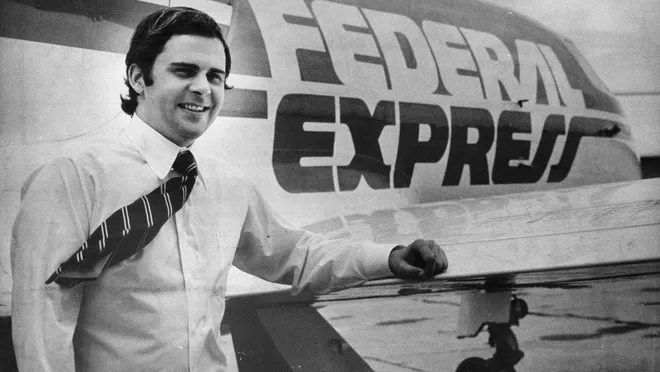
Thank Fred Smith, who founded FedEx in 1971 and stepped down from the CEO chair this year.

The benefits Smith’s work have brought to the whole world are far, far greater than what we experience simply by virtue of being able to click on a knickknack and then have it in hand before the Earth has finished a rotation. The explosive economic growth of the modern world, which powers everything from longer lifespans and new medical inventions to the drive toward greater political and social equality at the heart of commercial republics, depends essentially upon transportation. The modern economy does not grow because modern science invents new stuff; people have been inventing new stuff since they were people. The modern economy grows in part because it gives people (at least in principle) enforceable legal rights to property and contract, which gives them social space to unleash their constructive potential. But it also grows because the scope and extent of economic exchange has expanded radically, and we realize huge gains from trade. Better transportation means more trade, which means more growth, and while economic growth does create major new social challenges we didn’t have before, it is on balance one of the best things the world has ever known.

But don’t discount the value of being able to click on a knickknack and then have it in hand before the Earth has finished a rotation! The ability to manage our time more efficiently – to have more flexible and adaptable access to the resources and opportunities we acquire through exchange – is of tremendous value to every one of us. Time is not money, time is value, and value is the only thing that ultimately matters to economic life.

Smith outlined his bold vision in a term paper he wrote for an economics class in college. Tremendous value was being lost because shipping services were not coordinated. The trucker drops it off at the dock and then it sits there until the boat leaves; the boat drops it off on the dock and then it sits there until the other trucker comes to pick it up. An integrated global transportation network could eliminate this colossal waste by tightly coordinating transportation schedules. It might not work for shipments that need special treatment, but for the average home or office sending an average package, it would be a huge improvement.

His professor gave his paper a “C.”

After two tours as a Marine in Vietnam (including the Bronze Star, the Silver Star and two Purple Hearts), Smith came home to realize his dream. In 1971 he incorporated “Federal Express,” partly because he thought the word “Federal” would make customers feel like their shipment was an important part of the national economy (which of course it was), and partly because he hoped to lure the Federal Reserve Bank as a customer. In 1973 the company began operations in Memphis – centrally located, good weather and friendly local airport officials who were willing to make improvements to attract Smith’s business.

But the big opportunity came in 1977, when Congress “deregulated” the airline industry. “Denationalized,” while not technically correct, would be at least somewhat closer to the truth. The upraised hand of cronyism and special favor that had stood in the airport door since humanity first defeated gravity at Kitty Hawk was at last removed.

Smith had, of course, been among those who fought hard for years to get Congress to take this vitally important step. So we owe him that, too.

FedEx snapped up seven jumbo jets of its own, beginning the process by which they would take full ownership of their transportation network, unlocking further efficiencies.

They were listed on NYSE the following year.

Whereupon they launched one of the greatest ad campaigns of all time: “When it absolutely, positively has to be there overnight.”

And the pièce de résistance:

That last one is Al-worthy just by itself.

A 2015 Harvard Business School article on FedEx’s system is titled “The World’s Largest Continuous-Flow Process.” That characterization, as applied to FedEx, may no longer be technically correct. But while Jeff Bezos runs away with all the publicity, it was Fred Smith who really invented the global commercial chain we rely on today.

Giving Fred Smith the Al Copeland Humanitarian of the Year Award is so simple, even Jay Greene can do it!