Kaya Henderson Steps Down in DC

June 30, 2016

(Guest Post by Matthew Ladner)

Kaya Henderson has announced her resignation after a five year run at the helm of DCPS.  I have never met Henderson but she has a very good reputation and served in a very difficult job with dignity. The WaPo notes the improvement in DCPS, but also the large achievement gaps in student performance.  This is only part way to understanding what is going on DCPS in my view, as what is most disturbing about DCPS trends is not just the achievement gaps, which are stunning in scope, but rather the relative stagnation in scores among disadvantaged district students.

This is in stark contrast with the trends in DC charters, where low-income students have been making gains far above the national average despite receiving far less funding per pupil than DCPS. It certainly is not Kaya Henderson’s fault that gentrification has taken off in the District, but we should understand clearly that the improvement in DCPS is overwhelming seen among already advantaged students.

Addressing the needs of the District students not born on third base should constitute the top priority of the entire DC community.  At the moment this is an area in which charters are making enviable progress and where DCPS continues to flounder. Every system is perfectly designed to achieve its results, and this goes well beyond any individual.


DC Schooling: Start Over

April 5, 2016

(Guest Post by Matthew Ladner)

Lindsey Burke and I hit the pages of the Washington Times today to argue that school finance in the District puts the least amount of resources into the mechanisms that produce the best results:

The Urban Institute has demonstrated that the D.C. private school sector is in deep decline, despite the existence of the Opportunity Scholarship Program. Studies have established that charter schools impact private school enrollment most heavily of all sectors.

From an equity standpoint, it’s difficult to justify the District’s school finance system. The system routinely provides $29,000 for high-income students attending regular public schools. It provides $14,000 for high-income students attending charter schools but only a maximum of $8,381 for some low-income students who would like to attend a private school system that improves the chances for graduation by approximately 21 percentage points.

Clearly, the K-12 status-quo gives the most to the kids starting with the most. This pattern is clear, whether discussing academic gains or dollars invested. We have clear success in the charter school and Opportunity Scholarship programs, but these programs receive substantially fewer dollars per pupil. D.C. has most certainly been better off with them, but they alone have not been enough. Tentative steps and half measures will not address the deeply disparate opportunities awaiting the District’s students.

Instead of attempting to restructure or “reform” DCPS, policymakers should free District parents to reform education from the bottom up. To that end, Congress, which has jurisdiction over D.C., should reconfigure all education funding in the District of Columbia and establish an all-Education Savings Account district.

Jayblog readers of a certain regularity will recall that gentrification has been driving NAEP improvement in DC, that the main thing that the DCPS has seemed to figure out how to do with their $29,000 per pupil revenue has been to educate very advantaged children to very high levels and that only  charter schools show the only impressive NAEP gains for low-income children. Despite gentrification and the attendant improvement, DC ranks a single point above the lowest rated district in comparisons in the Trial Urban District NAEP. As a result of all of this Washington DC shows truly stunning achievement gaps. Oh and by the way along the way private schools are dying off under the proliferation of charter schools. DC charter schools are a universal choice program-open to all students- while Opportunity Scholarships only apply to a small number of low-income children.

If you like a system that gives the most to those starting with the most, stand pat. If six years worth of average progress between White and Black students doesn’t bother you overly much, look the other way. If you can somehow justify giving half the money per pupil to charter school kids despite the better results they produce for low-income kids, steady as she goes. If you have no problem in shorting low-income kids going to a quickly dying sector of private schools by an even wider margin despite the fact that these students graduate at a much higher rate, don’t rock the boat.

Otherwise schooling in the District needs a complete reboot from today’s morally indefensible and financially unsustainable system.


Why Relinquishment Would be a Good but Insufficient Idea for DCPS

March 7, 2016

(Guest Post by Matthew Ladner)

Andy Smarick has written about the next phase of reform for DC, calling for a relinquishment model. Given that DC charters receive a lot less revenue per pupil than DCPS and get substantially better results, this idea has merit.

Ladner DC 4

So scoring about a grade level worth of average progress higher for considerably less money constitutes an impressive accomplishment. However when we rank both DCPS and DC charters against the other urban districts in TUDA (for students with parents having similar education backgrounds) we find:

Ladner DC 5

The same pattern appears if you slice by family income etc. Not only to DC charters have a clear advantage over DCPS- they also demonstrate the only impressive gains for free and reduced lunch eligible students to be found in the NAEP data. Don’t go diving too far into the punch bowl however because those overall scores, even for charter students, are still trying to catch up to Mississippi:

Ladner DC 6

So- I agree with Andy that DC policymakers should consider pursuing an achievement district type strategy. DC policymakers and students should not turn their noses up at any strategy with a clear theory of action for improving outcomes at a lower cost. It’s not as if $29k per child in revenue will last a lifetime, but these terrible DCPS results will.

The data however seem to strongly suggest the approximate limits of such a strategy. We have no evidence as yet for instance suggesting that DC charter schools can produce a 20 percent boost in graduation rates the way DC OSP managed. Moreover, the status quo in DC is heading straight towards the extinction of private schools rather than utilizing their potential as partners. An achievement district approach would not have to finish this sad job as it looks likely to be finished long before.

DCPS has lost half of its students. It receives an unsustainable amount of revenue per pupil and does very little with it.  The appearance of improvement in the first figure above is mostly a mirage driven by gentrification. That same gentrification has helped to make DC the achievement gap capital of the nation as the one thing that DCPS has seemed to master is educating kids born on third base. Even if one mistakenly takes DC gains at face value, it still leaves DC ranked near the bottom as seen in the second figure and chart above.

As a resident of a distant patch of cactus, I don’t get a vote on any of this. DC residents will ultimately work this out for themselves. Call me crazy-it’s been too long since anyone has- but I would not be looking for incremental change.


DCPS Black Students need six years to reach where DCPS White students stood in 4th grade

February 15, 2016

“DC achievement gaps now, DC achievement gaps tomorrow, DC achievement gaps FOREVER!”

(Guest Post by Matthew Ladner)

Last week I told you that White DC 4th grade students were outscoring the average achievement of Black 8th graders on math by a wide margin. The below chart presents data from the 2011 4th grade math NAEP along with 8th grade scores from 2015. Data for White and Black students from the DCPS and Black students from DC charters are presented.

DC gap trend 1

I’ve looked at the both the main NAEP and the Trial Urban District Assessment and you simply cannot find another spot that matches DC for achievement gaps. As you can see, by 4th grade DC White students have already demonstrated  a level of mastery of mathematics that 8th grade Black students come nowhere close to matching by 8th grade. At fourth grade a sixty point gap between the achievement of White and Black students yawns (272 to 212). Meanwhile DCPS Black students have not come close to catching up to the 4th grade White score 4 years later. In fact at the rate of progress shown by DCPS Black students we would expect them to catch up to the 4th grade scores of DCPS White students somewhere around their sophomore or junior year of high-school.

No one should view the closing of these gaps as easy. Notice that DC Black students attending charter schools started 8 points ahead of their district counterparts in 2011 and then gained more between 2011 and 2015 (46 points for charter students, 36 for District). This left DC Black students within striking distance of the 4th grade score of DC White students (272 to 266) but still far behind DCPS 8th grade White students (314 to 266). Still DC’s Black charter school students made the largest overall gains (46 points) and did so for about half of the average revenue per pupil in DCPS.

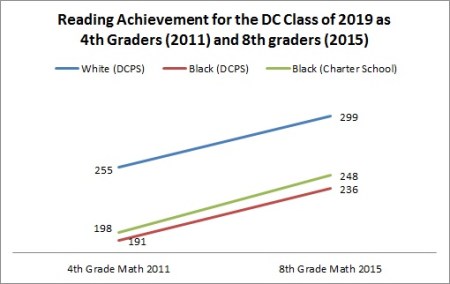
Sick to your stomach yet? Can’t believe it? Well let’s check the tape for the NAEP reading exam.

DC gap trend 2


We see precisely the same pattern- by 4th grade DC White students demonstrate a level of mastery of reading that Black students will not equal by 8th grade. A huge gap between DCPS White and Black students (64 points) yawns out in the 2011 4th grade scores and does not meaningfully narrow by the time the cohort reaches 8th grade in 2015 (63 points). DC Black students attending charter schools demonstrated a smaller gap in 2011 (57 points) and had narrowed it a bit further by 2015 (51 points) but had still not caught up to the score of DCPS White students in 2011.

Before you reach for your demographic fatalism pistol let me just note that FRL eligible Black students attending district schools in Boston scored 24 points higher than FRL Black students attending district schools in DC. New York City and Houston clobbered DCPS by 16 points in the same comparison. None of these districts receive $29,000 per student in revenue. Houston didn’t sniff half of that figure. We cannot disentangle the effect of schooling and family with these data, but other systems seem to do much more for similar students with much less.

Getting back to the Heritage study– someone take a look at this data and tell me why oh why would we want to shower $29,000 per student on the system that produces such catastrophic results for disadvantaged kids. Charters receive only $14k per student that and get better results. Congress provides a constantly politically imperiled $8k per child on a small voucher program for low-income DC kids that merely gets them over the high-school graduation finish line at a 20% higher rate. This system of finance has been in place for decades now. Piling money on a system proficient only at serving the needs of the already advantaged while starving systems serving the disadvantaged for funds makes sense to someone.

It just doesn’t make sense to me. It shouldn’t make sense to you either.


Urban but No Longer Poor in DC

February 11, 2016

(Guest Post by Matthew Ladner)

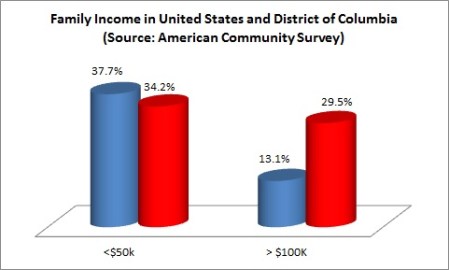
DC has a long-standing spot in our thoughts as a poor urban district. While there certainly low-income folks with kids attending DC public schools, this image is in need of an update. Here is some data from the United States Census Bureau American Community Survey from 2014, DC is red:

DC family income

So the percentage of families with incomes over $100k is comfortably above twice the national average, while the percent below $50k is slightly below the national average. Mean family income:

Mean family income

Whatever statistic you want to examine- median income, mean income, workforce participation, etc. it all looks better in DC. Once upon a time you could say this doesn’t necessarily reflect upon public school scores because the affluent sent their children to private schools. Ah, but recall that private school attendance has been collapsing in the district despite the presence of a private scholarship program:

So between private school enrollment declining and overall public (district and charter combined) enrollment increasing and average family incomes well above the national average, the socio-economics of DC public education have likely never looked more favorable than now.


Gentrification is the primary driver of District of Columbia Academic Gains

February 9, 2016

The Capital is playing games with some limited success but low-income kids still hunger for academic gains.

(Guest Post by Matthew Ladner)

New study out today from the Heritage Foundation authored by yours truly on education in the District of Columbia. I will serialize the study a bit with a chart or two per post. The view I had of K-12 in the nation’s capital going into the project did not survive my investigation. My initial view going into the project is summarized in this chart:


Ladner DC 4

Moving your 8th grade math scores from 230 in 1990 to 263 (combined district and charter) in 2015 is a lot of progress- by far the largest gains in the nation. While things are somewhat worse if we look at District of Columbia Public Schools (DCPS) scores alone (258) they still are far above the earliest measure. Better yet- when you examine charter scores in isolation from DCPS scores, the scores are higher still. Any actual education going on in DCPS back in 1990 looks to have been mostly accidental- I’m not sure what you would score on the NAEP math test if you just answered “B” every time, but with 3% of DC students scoring proficient and 83% scored “Below Basic” on the NAEP 8th grade math exam in 1990, it could not have been much lower. In 2015 19% of DC students scored proficient and only 49% scored Below Basic. The improvement is undeniable: time to CeleNAEP? Those gains dwarf anything seen out in the states, and the charter school sector getting close to half of the students is clearly a major driver of improvement. Twirl for me, girl on fire!

Alas while this story is true it is far from complete. What is going on in DC is both complex, partially encouraging and in the end very disturbing.

Overall enrollment in DC (district and charter) had been growing in recent years along with average incomes. A complex phenomenon is underway in which sophisticated young parents have figured out that they don’t need to move to Maryland or Virginia if they can find a spot in the right district or charter school in the District. In the end your kid doesn’t get educated by a district or a CMO but rather by a school. DC is the champion for NAEP gains, but it is also the champion for achievement gaps.

You can see the gentrification going on both in DC’s statistics and with the naked eye walking around town. Somebody keeps buying those million plus dollar brown stones and some of them are parents. This begs the question: how much of DC’s apparent academic gains owes to gentrification?

Sadly the answer is- affluent children have banked the vast majority of DC NAEP gains over the last decade.

Ladner DC 7

There is a lot going on in this chart so pay close attention. These are again NAEP 8th grade math gains by family income (FRL status) over the last decade. First look at the light blue columns- gains for FRL eligible kids. DCPS district equals an 8 point gain, which is indistinguishable from the national average of 7 points. The 17 point gain for free and reduced lunch kids attending DC charter schools is the only real bright spot for disadvantaged kids in the public school system despite decades of reform. We used 8th grade math for purposes of illustration but you see a similar pattern across the NAEP exams.

Now observe the dark blue columns- DC kids whose incomes are too high for a Free or Reduced price lunch under federal guidelines. Here the gains are truly extraordinary- a 28 point gain for non-FRL kids attending charter schools and a 39 point gain for middle to high income district students. I’m placing my bet now that this isn’t solely due to schools in Georgetown doing an ever-better job educating kids with law-firm names, but also to the fact that people who once fled to Va and MD finding a spot that suited them in DC.

So in 1990 let’s estimate that the number of DCPS FRL kids scoring proficient on 8th grade math as effectively zero. Twenty five years later, that figure is up to 8 percent for district kids (charters excluded). DCPS in other words remains largely what it has always been- an organization far better at employing adults than meeting the needs of disadvantaged children. As we will see in a future post, the academic results of DCPS continue to disappoint even in comparisons against other urban districts despite 15 years of strong progress and gentrification.

I am Ozymandias-Queen of Queens! Look upon the ineffectiveness of my broom ye mighty and despair!

Overall the situation in DC K-12 is very complex- with both positive trends and heartbreaking stagnation. Regardless of where you are coming from on the political/philosophical side of things, if you are a DC taxpayer you should not stand for this state of affairs as it touches upon economically disadvantaged children. The above chart shows is that despite a truly shocking amount of tax effort and a decade and a half of reform, what DCPS has figured out how to do is to give the most academically to the kids born on third base. Mind you this is much better than giving approximately nothing to anyone a la DCPS circa 1990, but that is in the big picture a cold comfort. In the end it is very positive for the fiscal health of the District of Columbia that third base parents can in fact get a quality education for their children it in the right bits of DCPS. Moreover, those third base parents are paying a mind-numbing level of tax and they deserve a quality education for their children.

So does everyone else.


Burke: 44% of DC Students attend charter schools, DC officals are knocking on doors

July 14, 2014

8028f-faye_morningafter

(Guest Post by Matthew Ladner)

Lindsey Burke on the lay of the land in the District of Columbia Public Schools, which inches ever closer to having a majority of charter school students and which is leading the nation by a wide margin in academic gains, led by charter schools. Oh and where district school principals have taken to the streets to sell their schools to parents in search of students.

What do you make of all of this Chewie?


Yeah, me too.


District or Charter Schools in the District of Columbia?

May 18, 2012

(Guest Post by Matthew Ladner)

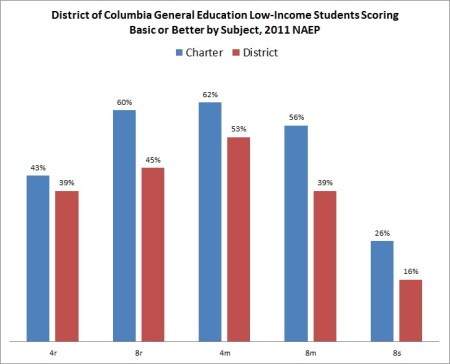
DC’s NAEP numbers allowed for some additional controls to be introduced when comparing charter and district schools than I was able to do with the Milwaukee comparison. The following chart shows the percentage of general education program students who qualify for a free or reduced lunch scoring “Basic or Better” on the 2011 NAEP exams. Special education students, ELL students and middle/high income students are not included in order to get a quick closer to apples to apples comparison.

Now of course for a real apples to apples you need a random assignment study, but those have been done and find results favorable to charter schools. This chart doesn’t address the topic of valid stastical significance, but rather whether the differences are meaningful.

Considering that charters get far less money that DCPS per pupil and show higher levels of academic achievement, this looks to be a success, albeit both the blue and the red columns leave much to be desired. The red columns leave much more to desired however, especially when you consider that that they are wallowing in money.


Rhee Looks to Clean Up the DC Special Ed Barn with vouchers

July 23, 2010

(Guest Post by Matthew Ladner)

There is a new contender in the race to enact the next McKay Scholarship-like voucher program for children with special needs: DCPS, led by the reigning Queen of the Cool Kids Michelle Rhee.

The Washington Times has the story.

This makes sooooo much sense. Special needs parents have been successfully suing their way to Cadillac Ferrari judgements and six-figure per year private school placements for years. Before you start to feel sorry for DCPS, it is worth noting their historical abysmal performance in fundamental tasks such as teaching children reading and math. We have almost zero reason to think that DCPS did anything better than catastrophically bad on average in dealing with the needs of special needs children. 

Also note, as Jay does on an as-needed-basis, that the horror stories of such placements routinely fail to note that the amounts involved typically constitute a rounding error of the total public school budget. DCPS does suffer from an unusual combination of its own historically high level of incompetence (they seem to lose early and often in court) and a group of sophisticated special needs attorneys who have become quite skilled at shooting fish in the DCPS barrell.

At times in the past, I have seen rather intellectually sloppy attempts to use the DCPS as a cautionary tale to warn people off of the idea of enacting a voucher program for special needs children. Well, let’s wipe this bug off the bottom of our boot again: a McKay program allows parents to leave for another public or private school only with (at maximum) the allegedly inadequate funding provided for the child’s education.

For decades, the claim made by the public school establishment in lobbying for higher special education funding has been that they have had no choice but to transfer endless billions of dollars out of general education budgets to fund special education.

Back in 2004, my friends at the Texas Public Policy Foundation and I caught Texas districts red-handed quantifying the amounts transfered from general to special education. Usually such claims are made by lobbyists in private conversations, or as unsupported legislative testimony, but TPPF found someone who had written it down:

…Figures presented to the Texas Legislature by officials from Regional Education Service Center 20. Public school officials in Texas relate that the state and federal government inadequately fund special education in Texas. Representatives of Education Regional Service Center 20 recently presented information before the House Select Committee on Public School Finance regarding the disparity between special education funding and special education spending in the San Antonio, Northside, Northeast, Alamo Heights and Floresville Independent School Districts.

In each district, representatives provided figures showing that districts spent hundreds of thousands to millions of dollars more on special education services than the funding they received from state and federal sources. While school district expenditures exceeded government funding for special education, the decision to spend monies above and beyond government funds was a decision made by the districts. The exact nature of excess expenditure is unknown. Whether additional monies were necessary or simply elective spending was not identified. Nor is it known if these expenditures were required to underwrite the cost of delivering government-mandated services.

In San Antonio ISD, Education Regional Service Center 20 figures show a disparity of $8,163 more spent than received per full time equivalent special education student. The disparity figures for the Northside, North East, Alamo Heights and Floresville districts were $3,536, $4,521, $7,992 and $2,949 respectively.

Any disparity between special education funding and special education spending must come at the expense of general education spending. Because education dollars are limited, money is diverted away from regular classroom instruction when districts decide to spend additional funds above and beyond government funding for special education.

The Education Regional Service Center 20 figures, for example, show that the San Antonio ISD spent over $17 million more on special education services than received from the state. Under HB 2465, every special needs student departing from San Antonio ISD with a Freedom Scholarship, despite having special education funding included, would lift a substantial funding burden from the district, freeing resources to either focus more on the remaining special education students, or for general education programs, or for some combination thereof.

So in other words, a voucher program allowing kids to leave with their normal allotment of general education funding and their special education funding would save the district money with each transfer.

So a McKay Program in DCPS would democratize access to private schools for all children with special needs from those who can access specialized attorneys to everyone. No one gets a Ferrari plan from McKay, just to opportunity to walk away with the money allotted for your child. The District spares itself a Ferrari payment and reduces the need to transfer general education funds.

Oh, and by the way, such a program would vastly increase the satisfaction of parents across a whole array of school measures.


DC NAEP Scores-Where is the Death Spiral?

May 13, 2010


(Guest Post by Matthew Ladner)

No one seems to be taking much note of it, but some Washington DC has some very favorable trends in their NAEP scores.

To be sure, the District’s scores still reflect widespread academic failure on an inexcusable level for a district blowing through $20k per child per year. The positive trend predates Michelle Rhee’s tenure, which is good, as I think we are likely to see further (badly needed) progress. It is still too early to judge whether Rhee will accelerate this rate of progress, but I’d be willing to bet she will.

If you go to the NAEP page for DC and look at the 4th grade reading scores, you will find that the catastrophically low score of 188 in 1992 fell to an even more pathetic 179 in 1994.   That’s almost a grade level drop from an already low base. A score of 179 makes me wonder what the score would be if we simply gave every child in DC a library card and hoped for the best. Mind you, that wouldn’t work well either, but it couldn’t work that much worse than DCPS circa 1994. Since 1994, however, scores have climbed 23 points. The percentage scoring basic or better increased from 24% in 1994 to 44% in 2009. Math improvement has also been impressive and shows the same trend- progress after the mid 1990s.

One blindingly obvious cause for the improvement: the 100 charter schools operating in the district educating over 30,000 children. DC’s charter law passed in 1996 (near the bottom of DC performance) and the opening of schools has been very strong. In 1996-7, DCPS had 78,648 students enrolled. In 2007-08 it had dropped to 58,191.

This is no doubt why DCPS spending per pupil has spiralled to such absurdly high levels. No on apparently thought that it might be appropriate to cut the budget for a district that is 20,000 fewer students, but I digress. DC’s scores still stink, but in the progress department they have clobbered all states other than Delaware and Florida.

I’m not willing to celebrate a district that spends over $20k per student per year and has 56% of 4th graders illiterate. I am however willing to celebrate progress, and DC has momentum. If they would like to accelerate that progress, parental choice policies that would be helpful would be to reverse the shameful decision of the NEA robots majority of the Democratic caucus to kill the DC Opportunity Scholarship Program. The program merits not only renewal but a large expansion.

In addition, DC should institute a McKay Scholarship program with children with disabilities, if they would like to stop paying for the 5th homes and country club memberships of the attorneys endlessly battering DCPS on failure to provide FAPE under IDEA. Both the kids and the district budget would win big from such a program.

The enemies of parental choice have always painted the nightmare scenario of an academic death spiral for the children “left behind” in the district. Perhaps these same folks would like to explain to us now how it is that DCPS lost a quarter of their students since the mid 1990s and watched their reading scores improve by 23 points. Where is the death spiral? Oh, I mean in DCPS scores.  The death spiral for the credibility of choice opponents is impossible to miss.