The Arizona Republic ran a quote from my state Senator, Kate Brophy McGee, that scores high on the unintentionally hilarious meter. A left of center organization issued a report complaining about procurement rules governing Arizona charters. Senator Brophy McGee stated:
State Sen. Kate Brophy McGee, a Republican from Phoenix, said charter schools should be held to the same standards as public schools because both deal with public money.
“We’ve given district schools more and more regulation, while not requiring the same of these very nimble charters, and we wonder why the public schools aren’t as successful,” McGee said.
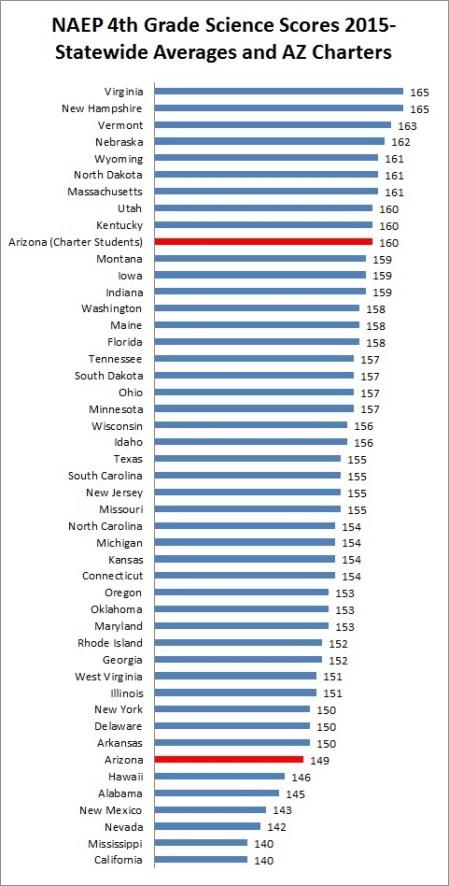
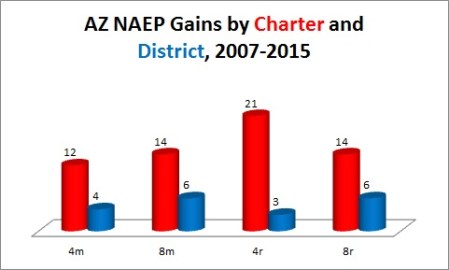
I have what I think is a better idea- one of these two sectors should become more like the other, but based on what we see in the academic data it is the districts who should become more like the charters, rather than the other way around. Last session for instance Governor Ducey called for districts to have similar freedom in hiring to charters. It, ah, seems to be working out really well for charters. This makes all the sense in the world, but reactionary elements of the district establishment acted like it was some sort of ghastly mistake. As the Prime Minister of the UK might say “I refer the honourable gentlemen to the red columns in the above chart.”
If the Grand Canyon Institute or anyone else has evidence of lawbreaking, they should refer these to the appropriate authorities. The State Board for Charter Schools is for instance empowered to investigate complaints. More importantly, Arizona parents are absolutely brutal in punishing schools that fail to deliver- they have other options and can vote with their feet. This is real accountability as opposed to the faux bureaucratic variety.
Lisa Graham Keegan takes to the pages of Fordham to talk about lessons learned out here in the Wild West in When Regulating Charter Schools Proceed with Caution. Lisa raises the point that other policies, including A-F school grading, may have contributed to our success. I suspect that she is entirely right about that, but to me this is the money quote:
Moreover, Arizona’s “wild” charter journey led to many low-income, highly performing charter management organizations that can only be found in the Grand Canyon State. Many are community-focused and community-developed, which we all say that we want, but their first priority was on stabilizing the communities they grew from. In other words, they weren’t very good academically to start—but they did transform their neighborhoods, and parents trusted these new schools with their precious children over many other options that went out of business due to lack of enrollment. Years later, many of them, like Academies of Math and Science, Mexicayotl Academy, and Espiritu Schools, are now among the top performing schools in not just the state, but in the country, and were highlighted in last week’s Education Equality Index. The thing is, it took a decade to do that. And we Arizonans let it happen.
Translating this into Ladnerese- if Arizona had five year charters and default closures we might have arbitrarily closed some schools which blossomed into very high performing operations that now do a great job with disadvantaged kids. I use the word might because even if the Arizona Charter School Board had gone hillbilly nuts technocrat (Hey man- hold my beer while I close this school- this gonna be AWESOME!) the schools in question would have got their parents riled up, hired lawyers to engage in delaying actions, etc. I for one am happy that the schools LGK mentions could focus their energies on improving academics rather than fighting a bureaucratic guerrilla war.
Meanwhile these schools faced a much harsher form of accountability- from Arizona parents. Hundreds of Arizona charter schools have closed, and their average length of existence is 4 years, with an average of only 62 students in the final year of operation. If you live to see year 5 as an Arizona charter school, you are probably doing something right because everyone wants your students- your home district, fancy school districts like Scottsdale, Madison and Chandler are playing the open enrollment game, the other charter schools, and the private schools with the assistance of choice programs.
Frontier justice does not allow for parents to appear at a hearing to vent their anger, or for lawyers to file motions, or allies to lobby their political contacts for reprieve. The parents simply never enroll and/or walk away, there are private efforts to explain the reality of the situation to those institutions needing hospice care to wind down, and meh and sub-meh bleeds out on a dusty street full of hot lead. Some of you don’t believe this. Some of you don’t want to believe this. Well…just maybe…
Important new study from the Fordham Institute on open enrollment in Ohio. The map above shows dark blue show districts not participating in open enrollment, and they just happen to be leafy suburban districts who are both higher income with student bodies that tend to be pale complected that also happen to be near large urban districts with many students who are neither of these things. Feel free to reference this map the next time someone claims that public schools “take everyone.”
Many moons ago I wrote a study for the Mackinac Center about the interaction between charter schools and open enrollment in Michigan. I found a very clear pattern among some of the suburban districts whereby charter schools provided the incentive for early open enrollment participants to opt-in. After one district began taking open enrollment transfers, and some additional charters opened, it created an incentive for additional nearby districts to opt in- they were now losing students to both charters and the opted in district. Through this mechanism, the highly economically and racially segregated walled-off district system began to:
Not every domino fell however. I interviewed a superintendent of a fancy inner ring suburb who related that they saw their competitors as elite private schools, not charter schools. When I asked him why his district chose not to participate in open enrollment, he told me something very close to “I think historically the feeling around here is that we have a good thing going, so they want to keep the unwashed masses out.”
Contrast this as well with Scottsdale Unified in Arizona, which is built for 38,000 students, educates 25,000 students, 4,000 of whom transferred into a Scottsdale Unified school through open enrollment. 4,000 transfer students would rank Scottsdale Unified as the 9th largest CMO in Arizona, and they are far from the only district participating in open enrollment in a big way. Why is Scottsdale willing to participate unlike those fancy Ohio districts? They have 9,000 kids living within their boundaries attending charter and private schools.
Why haven’t choice programs torn down the Berlin walls around suburban districts? Sadly because they have been overly focused on urban areas. The National Alliance for Public Charter Schools Dashboard shows that 72.6% of Ohio charter schools operated in urban areas. The voucher programs likewise started in Cleveland, and then expanded out to include failing schools (and children with disabilities statewide). More recently a broader voucher program has begun the process of phasing in slowly on a means-tested basis, but the combination of adding a single grade per year and means testing promises to unlock a very modest number of walled off suburban seats.
These programs have benefits, but they will not provide an incentive for fancy suburban districts to participate in open enrollment any time soon. Informal conversations I have had with Ohio folks related to me that Ohio suburban and rural dwellers- aka the people who elect the legislative majorities-tend to look at charter schools as a bit of a “Brand Ech” thing for inner city kids. Rest assured that the thousands of Scottsdale moms sitting on BASIS and Great Hearts charter school wait lists do not view charters as “Brand Ech.” Likewise these folks probably see themselves as paying most of the state of Ohio’s bills through their taxes and just might come to wonder why the state’s voucher programs seem so determined to do so little for their kids and communities.
A serious strategic error of the opening act of the parental choice movement was to look out to places like Lakewood Ohio or Scottsdale Arizona and say “those people already have choice.” This point of view is both seriously self-defeating in terms of developing sustaining coalitions, it also fails to appreciate the dynamic interactions between choice programs. Arizona’s choice policies include everyone and have created a virtuous cycle whereby fancy districts compete with charter and private school options for enrollment. This leads to a brutal crucible for new charter schools in Arizona whereby parents quickly shut many down because they have plenty of other options. Educators open lots of schools and parents close lots of schools-leading to world-class Arizona charter scores. Arizona’s charter NAEP score triumph was more or less mathematically inevitable once this process got rolling. Did I mention the part about Arizona leading the nation in statewide cohort NAEP gains since 2009? That too but Ohio not so much.
I’m open to challenge in the comment section from any of my Ohio friends or anyone else, but by contrast to these eyes Ohio’s choice programs look to be mired in an urban quagmire and they need the leafy suburbs to play in order to win. Current policies not only have not unlocked Ohio’s Scottsdale Unified equivalents, they likely never will. NACSA put Ohio’s revised charter school law in their top ten, but allow me to pull up a couch and heat up some popcorn for the next few years as charters lawyer up and parents resist arbitrary bureaucratic closures, and the rate of new schools opening goes glacial.
Competition is by far the best method of quality control and bringing the leafy suburban districts into the melee is crucial if you are in the urban fight to win. The districts currently largely untouched by charters and private choice overlap with those not participating in open enrollment. Regulating urban charters is not going to make your suburban districts into defacto CMOs. This.isn’t.hard.to.figure.out. While counter-intuitive to many if you want to secure improved education options for the poor, you need to include everyone.
I, ah, have yet to receive anything approaching a coherent response. So I thought I would create a little visual on seat creation. The below chart shows charter schools opening in NACSA’s second rated state (NV) and also Arizona (which had a 9/33 score for most of this period) for the period Nevada has had charter schools (Arizona got a five-year head start). Just to practice my chart making skills, I inserted the flags of each state as the chart filler.
What is that you say? No Nevada is in there– it is just a little hard to spot. See that slightly different color blue smidge at the bottom of the Arizona flag? That is the Nevada flag. Here-let me give you a better look:
I think you have a good idea of what the Arizona flag looks like. This is similar to the NAEP data explorer not being able to give us academic scores for charter school students in Nevada because, well, like the visual the sector is just too small. In fact, when you examine NACSA’s top 10 ranked charter school laws, the list correlates strongly with small sectors, weakly with impressive results.
I want to make sure that my friends in the Silver State understand that I do not want to be understood to be critical of their efforts-I want nothing but the best for Nevada charters. Rather I want to not set the bar too low on defining charter school success, nor to misunderstand what actual success in charter schooling looks like. Hint: success looks a lot like Arizona and Colorado.
The comment section as always remains open if someone would like to explain why a rational person would score Nevada’s charter law three times higher than Arizona and Colorado. And by “any rational person” I mean “any rational person who supports charter schools” as obviously lots of people who do not support charters would have ample reason to rank Nevada’s law three times higher than Arizona or Colorado’s- as from that perspective delightfully contained.
So hidden deep in the NAEP data explorer is a variable for school enrollment. Yesterday we saw how Arizona charter schools crushed the ball on the 2015 NAEP science exams, but I was curious- would there be evidence suggesting that small schools of choice perform especially well? NAEP provides such a number in a crosstab for Arizona charter/district by school enrollment. Small district schools in Arizona performance is nothing to write home about, and are probably mostly rural. Arizona’s small charter schools-schools of choice-however, well, that is a different story. These are the 8th grade science NAEP scores for Arizona charter schools with 399 or fewer students compared to statewide averages for all students:
I thought that was interesting, so I checked to see how this would look in the 2015 NAEP Reading exam for 8th graders. Well-
Well but the whole thing would fall apart in the math test. Except, it didn’t:
Obviously this evidence is only suggestive, but do keep in mind that we have a large number of formal studies finding positive outcomes associated with attendance at small high schools. So perhaps high quality education involves authentic community with a shared vision of what constitutes high quality learning, and this process is facilitated by the ability of a child and parent to choose. It certainly appears to be the case out here in the Cactus Patch. Let’s call it the “Cheers theory of learning” in that you want to go where everybody knows your name. If that is you want to learn to read, figure some math, and understand science. If you prefer to fade into the background and then drop out of school- we’ve got plenty of Big Box schools to choose from as well.
So you see dare Normy dare used to be this big Foundation that had a great idea but then…
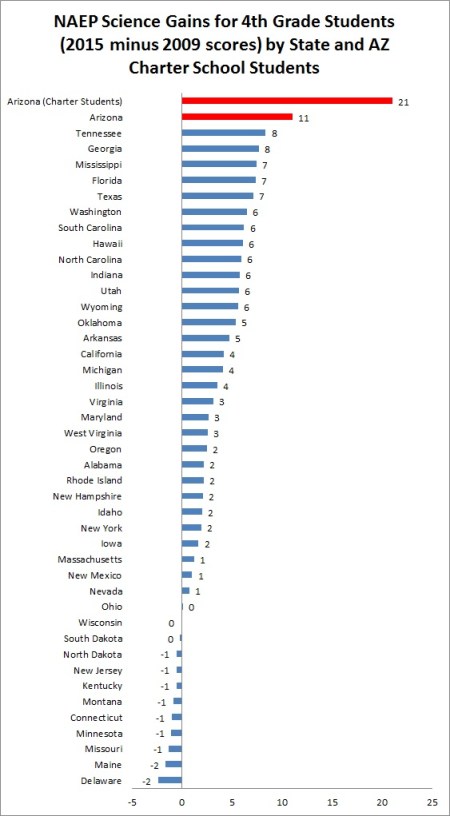
Ok sports fans, I know you are all chomping at the bit, wanting to know “but Ladner, how do Arizona charter school science gains compare to statewide averages?!?” Oh I am glad you asked, here it is for 4th grade:
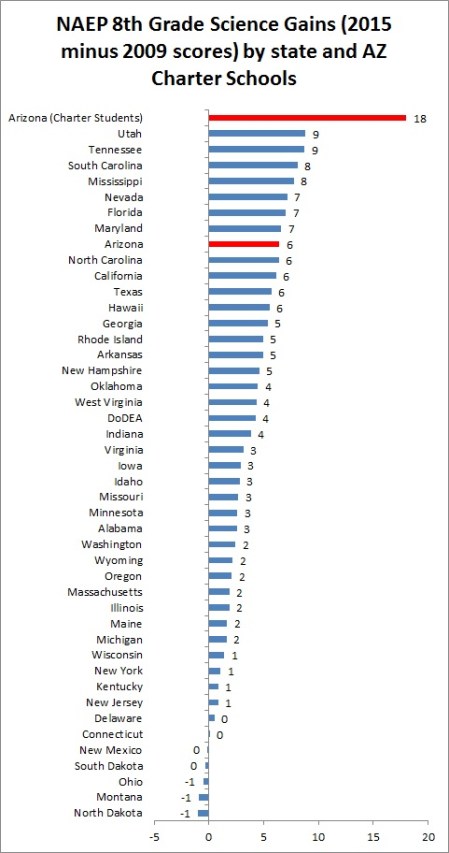
Hmmm…almost twice the gain as top ranking Arizona as a whole. Would it be running up the score to note that Arizona would not have done nearly as well without charters? I’ll just skip that part for now. Here are the NAEP 8th grade science gains:
Well, would you look at that-twice as large as the largest state gain. I’m crunching these out on a Prescott Library computer after taking a mountain bike ride on a “day off” but feel free to run the numbers for yourself here. I’ll breakdown subgroups later when I have more than 16 minutes left on my public computer use.
In the meantime I’m just going to go out on a limb here and say that there just might be something to this whole parental choice thing. Just maybe.
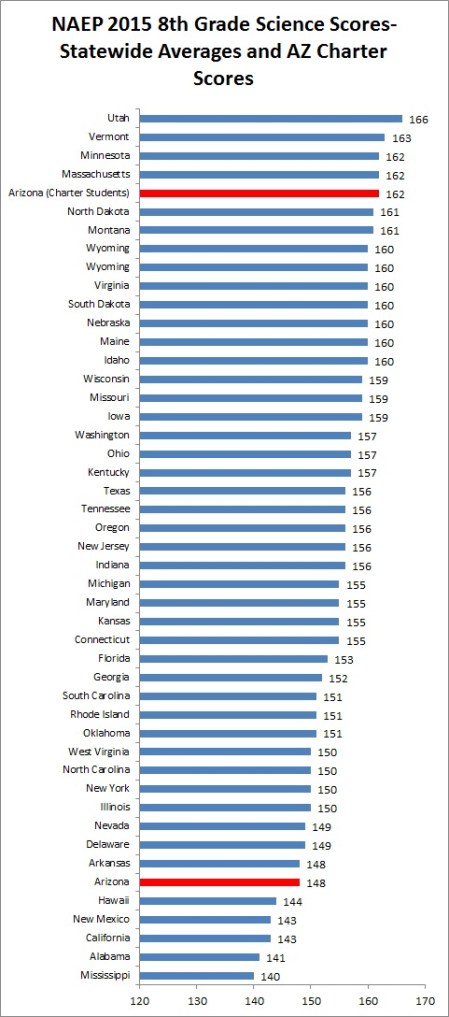
NAEP released 2015 Science results today. More results to come (I am crunching from the public library in Prescott AZ) but for both of you Arizona charter school skeptics out there, take a gander at the above chart. Just as a friendly reminder, AZ charter schools educate a majority minority student population, have very modest levels of funding compared to school systems around the country, and each NAEP exam is an entirely new sample of students, and Arizona charter students rocked all four of them (4r, 4m, 8r, 8m) so far. Now we have two more 2015 measures, and the CeleNAEP just keeps the smooth jam rolling!
Still skeptical? Well let’s check the 4th grade rankings:
I was examining data on charter school closures in Arizona between the years 2000 and 2013, and noticed a pattern in the data. The vast majority of schools on the closure list did not operate very long and tended to be very light on enrollment in the last year they operated. I averaged the available data and found that the average closed school had operated four years, and had an average of 62 students enrolled in their final year of operation.
Mind you that Arizona’s charter law grants 15 year charters, and that something unusual would need to occur in order to have authorities intervene before such time.
So a couple of notes before discussing the main implication since Arizona grants 15 year charters, the first of them would not have come up for renewal until 2010 or so, and it would have been a bit of a trickle at first. Currently however you’ll have a group of schools up for 15 year renewals every year. The data examined above end around 2013, and has missing data.
The state publishes a list of school closures, and if you examine it, you’ll see a large number of “voluntarily surrendered” or “problems with facility” type explanations, very few “charter revoked.” This leaves a lot of grey area whereby schools give up the ghost perhaps to save themselves the embarrassment of not being renewed- like this charter set up by the University of Arizona College of Education that closed in 2013- but with it also being possible that other factors were going to sink them regardless. The official “charter revoked” explanation almost certainly understates the current role of the authorizing board imo.
Now, back to the heart of things- Arizona parents seem extremely adept at putting down charter schools with extreme prejudice. Arizona parents detonate far more schools on the launching pad compared to the number we see bumbling ineffectively through the term of their charter to be shut by authorities (or to give up the ghost in year 14 in an ambiguous fashion). Both of these things happen, but the former happens with much greater regularity than the latter. Having a vibrant system of open enrollment, charter schools and some private school choice means that Arizona parents can take the view that life is too short have your child enrolled in an ineffective institution.
States have different circumstances and different political cultures. The circumstances in Arizona when the charter law passed in 1994 involved a crushing level of enrollment growth and a district system with a very low level of average performance. No one was going to want to adopt hyper-cautious authorizing when the state was bankrupting itself to build new (usually low performing) district facilities. “Educators are willing to open new K-12 spaces without facility funding and they shut down if they don’t cut it? Hand me the dice!” said everyone in Arizona with any sense in 1994.
By the way- Darwinian competition can work wonders academically over time:
Open lots of new schools, let parents put them down, if and when a school you think is a stinker survives the wrath of the parents you can not renew the charter if you have that sort of confidence in your own judgement being superior to that of the parents (careful with that). If you feel a compulsion to intervene best to do it on the back-end in my view, as it seems like getting large numbers of new schools to start represents a key to success. I fully agree with Jay’s reasons for trepidation on such a substitution, but also can’t embrace throwing renewals (which are for 20 years in Arizona) around like:
I’ll try to look at the success and/or failure of the parents in other states in closing charters in the future.
Barry Manilow’s classic song Copacabana is a very catchy upbeat tune with a sad underlying story about a person living in the past:
Her name is Lola, she was a showgirl But that was thirty years ago, when they used to have a show Now it’s a disco, but not for Lola Still in dress she used to wear Faded feathers in her hair She sits there so refined, and drinks herself half-blind She lost her youth and she lost her Tony Now she’s lost her mind
For reasons that may become apparent if you read it, this column responding to one published by myself and Lisa Graham Keegan in the Arizona Republic brought the unfortunate image of Lola to mind. Our opponent’s column is a pretty standard recitation of anti-choice talking points, but there is an underlying sadness to it in my opinion.
Arizona lawmakers passed charter schools in 1994 and the first private choice program in 1997. So thirty years ago districts were effectively Arizona’s only show. We had parental choice back in those days, but it was the old-fashioned kind. If you could afford to buy a house in Scottsdale etc. or to pay for the tuition at Brophy Prep, you had choice in the lost near monopoly era of Arizona K-12. Otherwise, it was unfortunate to be you.
I’ve written on this blog previously just how awful the results were from this era. The NAEP gave us state level data from 1992 and 1994 before our policymakers began any effort to broaden the ability to exercise choice. Only 28% of Anglo 4th graders read proficiently in, er, English in 1992. Arizona still has a lot of work to do, but at least has been trending in the right direction.
I’m not going to bother to point by point this column, but rather to simply focus on a few faded feathers in its hair. Approximately 3,000 children participate in the Arizona Empowerment Scholarship Account program, and the majority of them are children with disabilities. Arizona has a great many individual high schools with more than 3,000 students, and yet in the fever dreams of opponents these kids should be made into scapegoats for all the problems of public education. It’s sad.
Arizona has been leading the nation in 4th to 8th cohort gains on NAEP, but rather than celebrate this fact and seek more, some would rather wallow in learned helplessness, convinced that they can’t do better unless they receive money that the state does not have. It’s sad.
Part and parcel of this complaint is to claim that districts take “all comers” while charter do not. Arizona charters however must conduct admission lotteries while district open enrollment decisions are left entirely to the schools. Fancy district schools are open to “all comers” if you can afford to purchase housing in their attendance zones, otherwise they all to often resemble Aspen vacations or shiny new German sports sedans- wonderful things if you can afford them. We started the process to democratize the opportunity to choose, but some prefer to keep choice as a privilege for the few rather than the birthright of all. It’s sad.
Some (not all by a longshot!) spend their efforts yearning for a near monopoly era that is never coming back. In my youth growing up in the South I can remember a few old people who would babble about the “War of Northern Aggression” and whatnot. It’s a bad look to live in the past. There are real and very deep issues to debate when fashioning choice policy but to engage in them seriously one must broaden beyond stale talking points. Quite frankly Arizona districts deserve better advocacy strategies than complaining about the disco ball while yearning for what was more of a stone than a golden age. This “strategy” is unworthy of the dignity of the great many outstanding educators working very hard in Arizona’s improving district school system.


 Posted by matthewladner










 Jay P. Greene's Blog