Fordham vs. Fordham on Private Choice Transparency

January 14, 2014

(Guest Post by Matthew Ladner)

The Fordham Institute has a new white paper out on accountability in private choice programs.  The headline will be that Fordham supports requiring students participating in voucher and tax-credit programs to participate in state accountability testing.  Adam Emerson, the author of the study and the new charter school chief in Florida (congrats btw Adam) wrote:

Surely there are risks associated with drawing private schools into public accountability systems, but empirical evidence shows that
downsides can be mitigated if policymakers are smart about how they design results-based accountability in choice programs of this kind.

The two key words in this sentence: risk and if.

Emerson believes that the risk of self-defeating homogenization of the school offerings available to parents can be managed by state officials being smart. Even the most insulated policymakers on the planet (say the Federal Reserve Board, which can more or less print its own budget) make decisions on far more than a technocratic basis. Even to the extent they do stick to their best judgement, they sometimes get things wrong in a spectacular fashion. Democratically elected lawmakers drift in and out of what Edmund Burke described as delegate and trustee roles of representation. The results, far from smart, are sometimes very messy and even counterproductive.

To gain an appreciation of the limited influence of technocrats in K-12 testing policy, I would suggest reading some of the Fordham Institute’s voluminous work making the case of what a complete hash a great many states have made of their testing systems for public schools. Here is a useful quote from the Proficiency Illusion:

Standards-based education reform is in deeper trouble than we knew, both the Washington-driven, No Child Left Behind version and the older versions that most states undertook for themselves in the years since A Nation at Risk (1983) and the Charlottesville education summit (1989). It’s in trouble for multiple reasons. Foremost among these: on the whole, states do a bad job of setting (and maintaining) the standards that matter most—those that define student proficiency for purposes of NCLB and states’ own results-based accountability systems.

Something far more than the I.Q. of policymakers seems to be at work here. The theme goes on in another brilliant Fordham report, the Accountability Illusion (emphasis added by yours truly):

As currently implemented, NCLB is not a discriminating system. A tremendous amount of money and energy has been spent to create the impression that there is accountability, and there are large numbers of schools throughout the United States that are in some phase of sanctions. But the accountability is not coherent. We found states where most schools failed to make AYP and others where nearly every school made it. We found demonstrably good schools that failed to make AYP far too often, and some pretty mediocre ones that slide by in some states.Thus what seems like accountability is an illusion. Good schools get sanctioned, bad schools get off, and ultimately students get shafted, since maintaining this illusion has a cost. When good schools get sanctioned, resources are wasted and we risk causing quick-fix, panic driven, counterproductive change in schools that may ultimately hurt students. When bad schools get off, their students are denied opportunities (what we unfortunately now call “sanctions”) that might lead to a better education, including the chance to attend a different school, or receive supplemental services, or simply obtain assurance that the workings of a perennially dysfunctional school will be addressed and corrected.

If those policymakers had been “smart” then thing may not have turned out this way. Many of the state testing systems that Fordham is now anxious to impose on private choice students have been previously described as costly frauds by, well, Fordham itself.

I don’t have a problem with private schools choosing to take the state test if it is done voluntarily.  Personally I wouldn’t want anything to do with a private school that lacked the self-confidence to have their own curriculum, but to each their own.  I like national norm reference testing as a light-touch method of providing transparency while leaving curricular choices up to schools.  If policymakers are so inclined, using such data to exit bottom-feeder schools could be undertaken without imposing state tests.

The whole idea of creating a parental choice program however is to provide parents with the broadest possible array of meaningfully varying options so that they can choose a great fit for the needs of their child. Accordingly, we should never make the mistake of viewing the job of a private school participating in a choice program as teaching the state’s curriculum or giving their tests. Rather their job is to satisfy the individual needs of the student to the satisfaction of parents. Parents will find schools following the state’s curriculum and giving the state’s test in abundant supply.  The whole purpose of private choice options is to create a diversity in the menu of choices available to parents and students.

It isn’t the lack of I.Q. that created the mess in state testing systems, rather the natural limitations of technocrats operating within a pluralistic democracy.   We would be wise to recognize these limits and to craft our choice programs accordingly.


The Way of the Future: Southern New Hampshire University

January 3, 2014

(Guest Post by Matthew Ladner)

What happens when a small, struggling university puts Clay Christensen on their board? Slate provides the answer: you go from almost folding to an online learning juggernaut.  We should keep an eye on the Open America project in particular. I imagine that this and similar projects might be especially attractive to home-school students, especially given the likelihood that Associates Degree > High School Diploma in the eyes of both the job market and college admissions officials.

Will the success of SNHU and similar ventures prompt one or more of the complacent players with a serious academic brand to move into this space?  The Slate article links to a report that says that a third of American universities have declining financial situations, so stay tuned…


Use the Force MOOC! A 2013 retrospective

December 26, 2013

(Guest Post by Matthew Ladner)

The after-Christmas but before New Year period is always dominated by “Year in Review” retrospectives, so why not join in on the fun? Here at the Jayblog we dig new options for students and parents, so let’s take a look back at 2013.

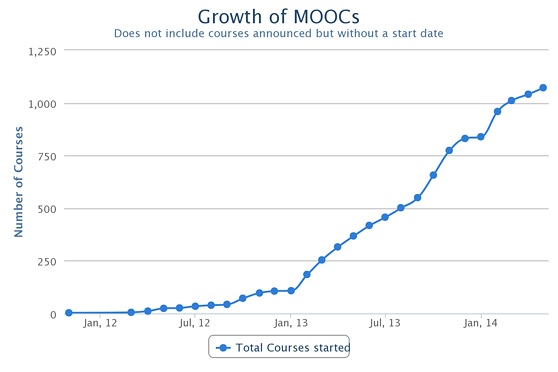
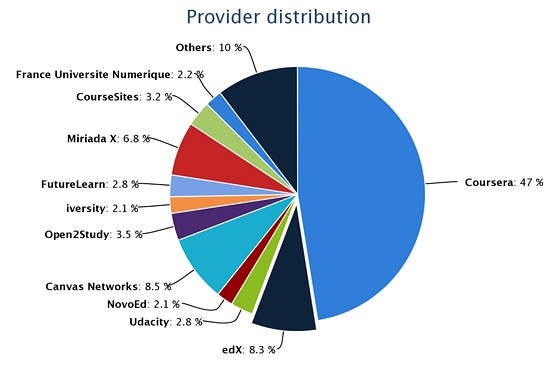
Digital learning continues to surge. No one has yet established the free online degree that some nutball predicted in 2009, but events are moving in that direction. Dhawal Shah of EdSurge leads us off with a review of the progress of Massive Open Online Courses (MOOCs) in 2013. Shah includes MOOCilicous charts like:

MOOC 1


and…

MOOC 2and…

MOOC 3

All of this is quite impressive given the first MOOC rolled out in 2011. Shah provides analysis and 2014 predictions, so go read the article. Events seem to be conspiring to take a very sharp pin to a higher education tuition bubble. One cannot help but wonder how long we will go on debating public funding for online high-school courses when, ahhh, Stanford is giving them away for free and you can, well, get college credit for them.  The logical side of Kevin Carey’s brain (the one that writes about higher education) turned in a useful refutation of the hand-wringing over MOOC completion rates.

Remember where you heard it first- the day is coming when more people will be watching university lectures online than Baywatch reruns.

Please note: I did not say it would be any time soon…

On the K-12 front, the National Alliance for Public Charter Schools published an evaluation of state charter school laws finding widespread improvement between 2010 and 2013. Bottom line: break out the bubbly. Thirty-five states improved their laws, only one law regressed. Seven states “essentially overhauled” their laws with major improvements-Hawaii, Rhode Island, New Mexico, Indiana, South Carolina, Louisiana, and Colorado. Ten more states-Florida, Illinois, Massachusetts, Michigan, Missouri, Nevada, New Jersey, New York, North Carolina, and Ohio made “notable improvements” in their charter law.

Here at Jayblog we have our annual measure of success in the private choice movement the Forster vs. Mathews school choice dinner bet. Greg either doubled or tripled the standard in 2011, and followed up by easily surmounting it once more in 2012.

In 2013, ooops Greg did it again!  Three-peat!  Two new states (Alabama and South Carolina) joined the school choice ranks, North Carolina went BIG on reform, including two new voucher programs, Ohio and Wisconsin passed new statewide programs, Arizona, Georgia, Iowa, Indiana and Utah improved existing programs.

So 2013 was a fine year overall for choice, grading on the curve of comparing it to past years. Compared to the needs of the country, this is all still painfully slow, so…


Jay’s Music Video Career Gets Off to a Bit of a Rocky Start

December 20, 2013

(Guest Post by Matthew Ladner)

Next time Jay, make sure they include more cowbell.


Random Pop Culture: Brian Setzer

December 17, 2013

(Guest Post by Matthew Ladner)

I caught Brian Setzer’s Christmas show last year, and I liked it so much that I am going to see it again this year.  Setzer’s big band and guitar setup reminds me of a brief, cool era of music like this:

I have previously confessed my admiration for Setzer as a genre bender, but seeing him in person deepened my appreciation. Keeping an orchestra on the road is an expensive proposition, which probably kept this performance format as a short lived niche, but a delight to see nevertheless. During last year’s show, Setzer spent an interlude with a three-man drum/base/guitar Stray Cats setup.  Once he built the crowd up to a frenzy, he stopped everything, smiled and announced:

“I get to play music with these guys EVERY NIGHT!  It’s my JOB!!!”

Which of course reminded me of my favorite Zen quote:

The Master in the Art of Living makes little distinction between his work and his play, his labor and his leisure, his mind and his body, his education and his recreation, his love and his religion.  He hardly knows which is which. He simply pursues his vision of excellence at whatever he does, leaving others to decide whether he is working or playing. To him he’s always doing both.

It’s Bryan Setzer’s world folks- we are just living in it.


More on Florida Age Demographapocalypse

December 6, 2013


(Guest Post by Matthew Ladner)

New guest post on RedefinED about Florida’s killer combo of surging youth and elderly population.  I recently did a podcast with the Heartland Institute on the same subject.

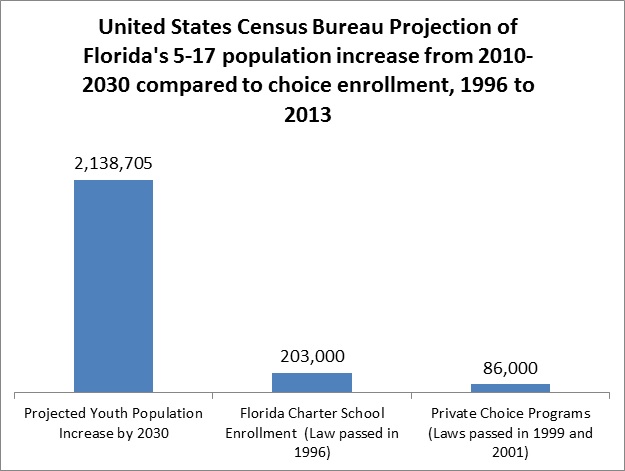
Like Arizona, Florida’s current choice programs are simply too small to absorb more than a small portion of the coming youth population increase.

Florida census choice chart


Pop Quiz Hot Shot- What do you do with Arizona’s high school mess?

November 21, 2013

(Guest Post by Matthew Ladner)

Amid the gloom of the Arizona Board of Regents putting a sawed off shotgun into the mouth of the public high schools of the state and pulling the trigger release of a report tracking the college completion rates of Arizona public high-school students were a few items of note. First, just eyeballing of the top 10 schools reveals that 6 of them are either charter or magnet schools. The top rated school, University High in Tucson, is a magnet that requires an entry exam and minimum GPA. The school that served as the origin for the Great Hearts network of schools comes in 2nd place, narrowly behind University High, BASIS Tucson makes the list, as does the Arizona School for the Arts, Foothills Academy and the Arizona Academy of Science and Technology.

Ok, so that is about it on the good news front.

If you rank the schools from the bottom up, sure enough you find charters down there too. I’m happy to have the State Board nuke these schools when they come up for renewal, or potentially even earlier if some sort of transparent process is used and the river runs both ways for charter and district schools. Where pray tell do you put these kids? It is not like there are an abundance of high-quality public options here in the cactus patch.

So what should a state do when it has a grim future staring it in the face? HALF of the high-schools in the state had 5% or fewer kids earn 4 year college degrees. Yes I agree that not everyone wants or needs to go to college and that Bill Gates, Michael Dell and Steve Jobs all dropped out of college, etc. etc. etc. but let’s get real- 5% or fewer represents catastrophic failure.  It’s hard to become a Gates/Dell/Jobs impatient super-genius entrepreneur if you, um, can’t read at grade level or do a some math. The NAEP reveals that only about a third of Arizona 8th graders are achieving at those levels.

I doubt there is any one solution. I however remain open to suggestions and no, pack up the kids and flee in panic is not an option. At least, not yet.

I’m starting to think about a Recovery School District should be a part of the solution. Many of those 230 high-schools with 5% or fewer of their kids earning college degrees after six years were paid for by the Arizona School Facilities Board. These were state dollars spent for the purpose of educating students. A great many of those schools seem to have not gotten around to that part yet. Perhaps the state of Arizona should take them back and lease them out at very favorable rates to anyone with a good plan and a good track record of educating students.  Perhaps lease to own contracts could be formulated to give the buildings to operators who meet academic growth goals.

The new schools could be constituted with charters with shorter renewal time horizons (say five years) and the current group of students could have a guaranteed spot in the new school if they desire it.  Obviously not all will succeed, but what do we have to lose? You can’t get much worse than 5% or lower, and like the Louisiana Recovery School District, it gives you the opportunity to replace failed teams on a regular basis.  I would be happy to follow New Zealand’s example and have the schools run as non-profits with elected boards of parents with children enrolled in the school.

In other words, why not leverage educational assets in order to conduct a global talent search for people with a track record of successfully educating children and running schools? At this point I would trade away the Grand Canyon for a couple of hundred high-quality schools.  Why not give people the chance to earn school buildings that are currently being horribly mismanaged to the detriment of children and the broad public interest?


Arizonapocalypse

November 19, 2013

(Guest Post by Matthew Ladner)

Last week the Arizona Board of Regents released a report detailing the catastrophic failure of Arizona high-schools in preparing students for higher education.  Specifically the report traced the high school class of 2006, finding that half of the high-schools had five percent or less of students finishing higher education degrees or certificates within six years.  A mere 40 of the almost 460 schools produced 61% of Bachelor degrees in the AZ Class of 2006.

So, the news could have been much better. Here is the next shoe to drop- things are going to be getting increasingly more difficult in the years ahead.

The United States Census has produced population projections by state. Let’s see what the future has in store for Arizona. First a little context. Arizona’s current population is was about 6.5 million in 2012.

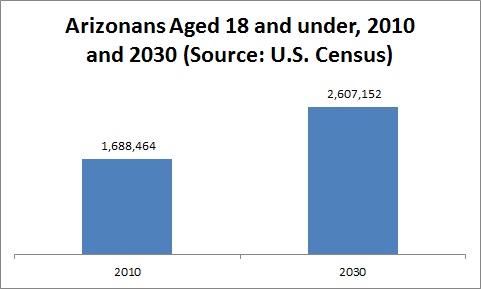
First challenge- a very large increase in the youth population.

Arizona Under 18

The Census Bureau projects a large year by year increase in young people.  The Census has projections for the 18 and under population, and also for the 5-17 population.  The 0-3 population is generally outside of the pre-school and K-12 system, meaning that the 18 and under population overstates the impact that the increase in the youth population will have on the state budget in 2030.  The 5-17 year old figure understates the situation due to 4 and 18-year-old students who will receive either preschool or K-12 assistance.

The next chart uses the Census Bureau’s projection for the increase in the 5-17 year old Arizona population, and puts it into context by comparing it to the size of the charter school and private choice populations of Arizona.  Arizona’s charter school law passed in 1994, and the scholarship tax credit program passed in 1997. The time between then and now is roughly comparable with the time span between now and 2030.

Arizona 5-17

Arizona school district enrollment is set to expand regardless of what we do on the parental choice front, just as it has for the last two decades. In the last two decades, the charter school law has produced a large number of those 40 schools that produced 61% of the BA degrees. In combination with the scholarship tax credit programs and the still nascent ESA program, they have taken the edge off of district enrollment growth in the aggregate.

Arizona does have high-quality charter operators who will continue to slowly but sure increase the islands of quality.  If the ESA program survives court challenge it may allow for a quicker pace of private choice expansion than the tax credit program. Creative destruction of the sort that might actually close dysfunctional schools, other than charters that fail to launch, is simply not in the cards.  The districts full of those 5% and under high schools will be going into the debt markets to build more dropout factories.

Or perhaps they will be running double shifts at the current dropout factories, as it will become increasingly difficult to finance new construction.

At precisely the same time Arizona will be dealing with a surge in the youth population, an even larger problem looms the growth in the elderly population. Again from the Census projections:

Arizona Elderly

For those of you squinting to read the numbers, that is an increase from 922,000 65+ year olds in 2010 to almost 2.4 million in 2030.

So let’s sum up the story so far- Arizona’s K-12 system currently does a very poor job in educating anything more than a thin slice of students.  Arizona has a vast increase in students on the way to coincide with an even larger increase in the elderly population.  Still with me? Okay, let’s keep going.

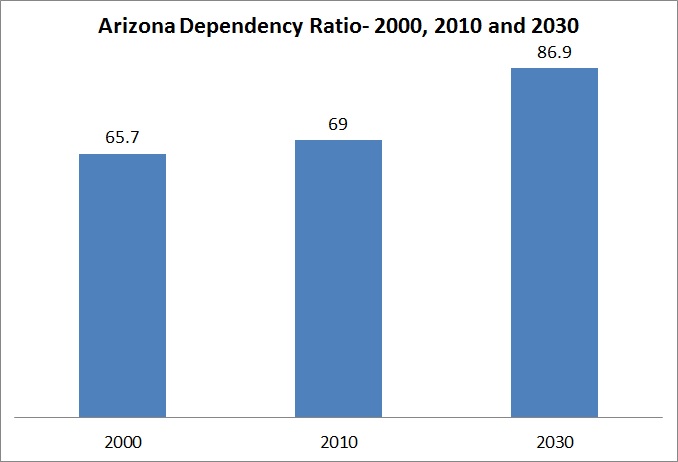
Demographers calculate age dependency ratios, and economists have found that they predict rates of economic growth. An age dependency ratio essentially compares the number of young and elderly people in a population to the number of working age residents. The logic behind the notion is that young people require a heavy investment in social services (primarily education) while the old also require a heavy investment (primarily in the form of health care and social insurance retirement benefits).  From the perspective of a state budgeting agency, young people don’t work, don’t pay taxes, and go to school. Older people are out of the prime earning years, often heavily use Medicaid. An age dependency ratio basically tells reveals the number of people in the young/old categories compared the number of people in neither category (i.e. people of typical working age).

The United States Census Bureau calculates an Age Dependency Ratio by adding the number of people aged 18 and under to the number of 65 and older and dividing it by the number of people aged 19 to 64. They then multiply the figure by 100 just to make things tidy. The formula looks like:

Age Dependency Ratio = ((Young + Old)/(Working Age)) * 100

Many people continue to work and pay taxes past the age of 65, making it inappropriate to view them as “dependent.” It is also the case however that many people above the age of 19 are still in school and thus are not yet working and/or paying much in the way of taxes. We all probably know hyper-productive 70 year olds and people in their 20s engaged in a six-year taxpayer subsidized odyssey of self-discovery that will not number “graduation” among an otherwise wonderful set of experiences. During periods of prolonged economic difficulties, moreover, it is obviously the case that lower rates of working age people will in fact be working, and thus making taxes.

Notwithstanding these important caveats, the broad idea behind age dependency ratios is to roughly assess the number of people riding in the cart compared to the number pulling the cart at any given time. People of course both benefit and pay into these programs at different stages of life, but the current ratios serve as a measure of societal strain.  What does the age dependency ratio for Arizona look like?

Arizona Age Dependency Ratio

Note that Arizona’s age dependency ratio in 2010 was already among the highest in the country. A social welfare state with 86 people riding in the cart for every 100 pushing it will not compute. In 2030, the Class of 2006 will be squarely among those expected to push the cart of the Arizona social welfare state.  How alarming and unfortunate then that many of them dropped out of high-school, and many more of them dropped out of college. The most immediate way Arizona can help address the looming crisis of 2030 is to get more students educated now.

I’m not sure how this plays out. I am certain that we have been thinking too small given the size of our challenges.


Epic Fail in Arizona

November 14, 2013

(Guest Post by Matthew Ladner)

The Arizona Board of Regents put out a tracking study on the High School Class of 2006.  Arizona Republic reporter Ann Ryman lays out the relevant data in the first couple of paragraphs:

Half of the state’s public high schools saw 5 percent or fewer of their graduates from 2006 earn bachelor’s degrees, a new study finds.

And 62 percent of the college degrees earned by the high-school Class of 2006 went to students from just 40 of the state’s 460 high schools.

The report out today from the Arizona Board of Regents is the first in the state to provide a snapshot of college-completion rates for individual high schools. For six years, the regents tracked 53,392 Arizona students who graduated from high school in the 2005-06 school year, regardless of whether they moved or attended college out of state.

Using data from colleges nationwide, the report found that 57 percent of the Arizona students who graduated from high school in 2005-06 went on to college, but only 19 percent graduated from a four-year institution within six years.

An additional 6 percent graduated from a two-year college or trade school.

So after six-years we are looking at 25% getting some sort of credential. Half of Arizona high-schools get 5% or fewer of their graduates to earn a BA.  These results, while shocking, are actually consistent with the very low reported completion rates at Arizona’s three universities and the even lower rates reported by community colleges.

Where does one even start with this?

Perhaps with higher-education itself. This study takes aim at Arizona’s incredibly dysfunctional K-12 system, and rightly so. Let’s not however divert our attention from the role that higher-ed plays in all of this. The universities do not require the use of a college admissions exam for students graduating in the top quarter of, oh yes, those Arizona high-schools they just so effectively bashed.  Community colleges have even lower admission standards, some exercising an “open door” policy that don’t even require trivial little things like a high-school graduation.

This sets the tone for K-12 and in so doing sets up many Arizona children to fail. The universities and colleges have no problem taking money from unprepared kids and flunking them out in droves, but (call me crazy) it might serve them better by setting some minimum standards for entry and communicating those standards forcefully down to the K-12 system.

As you might expect in a state with half of the high-schools getting 5% or fewer of their kids to graduate from college after six-years, the K-12 system is just a mess. Most of the few bright spots are among schools of choice in the state, but on the whole we are looking at a catastrophe.  Defenders of the system will be quick to claim that it is Arizona’s relatively low spending per pupil that is to blame, but this won’t do for two broad reasons. First Arizona schools spend beyond the dreams of avarice of their predecessors from previous decades.  Second the state is relatively poor with wealth concentrated among retirees who came here from somewhere else with housing standing as the state’s main industry. You can guess where that winds up in terms of residential property tax rates for a state whose main industry is keeping retirees out of the cold.  Finally the state has a large number of old people and a large number of young people- translating to one of the highest age dependency ratios in the country. More than is normally the case around the country, Arizona taxpayers are either not working age yet, or past their prime earning years.

Finally even if the state had a huge amount of money burning a hole in its pocket (it doesn’t) it isn’t remotely clear that Arizona’s districts deserve anyone’s confidence in doing good things with the money. Better to create incentives for improvement and deliver additional funding upon the documentation of that improvement, which is the path that Arizona Governor Jan Brewer has endorsed.

The state’s accountability system jumped the shark a decade ago.   The initial AIMS test was a rigorous exam that told Arizonans information that they didn’t want to hear, especially those working in the system. This brought on to the biggest dummy down in cut scores in the recorded history of the United States.  The testing system devolved into a bad joke- rampant item exposure and drilling to individual test items.  Our kids got better and better at taking a dummy downed AIMS exam while our NAEP scores flat-lined and very few students make it through college.

This is what is so sad about Arizona activists spending their time fighting Common Core. Um, guys, Arizona is not Massachusetts.  I have no idea how Common Core will turn out or even if it will stick around but it would boggle my mind if it somehow turned out worse than the status-quo here in our patch of cactus.  Arizona has a huge problem regardless of what happens next on standards, and btw, our current set of tests and standards did approximately nothing to prevent this problem.  Simply being against Common Core without any thought about what should be done to replace AIMS is a luxury that Arizona cannot afford.

Arizona adopted A-F school grading a few years ago, but in 2012-13 61 percent of schools received an A or a B grade.  Some cruel person could have a great deal of fun cross listing the Arizona Republic’s data base on college graduates with the school grades, but let’s resist such temptation for now. I will simply note that the NAEP exam shows very low percentages of Arizona students reading with full grade level proficiency and the Arizona Board of Regents has now found catastrophically low college completion rates. We would do well therefore to set challenging standards for school grades rather than throwing around A and B grades like beads at a Mardi Gras parade.

In short, I believe that Arizona needs a coordinated effort at the K-12 and higher education levels to toughen up what is an incredibly soft system.  Arizona’s educators policymakers are not bad people, and it was not wicked motivations that got us in to this mess. It seems nice not to require high-school students to do much of anything to graduate from high-school. It feels egalitarian and democratic to have open door policies in higher education. We can hope against hope that the handful of Arizona schools getting C grades will strive to get A/B grades, but it feels kinder and gentler to rig the game in such a way that profoundly mediocre results can get you a good grade. The road to hell-in this case backwater status- is paved with good intentions.

The problem with the delicate approach is that it systematically puts a higher priority on the comfort level of adults rather than the needs of Arizona’s children.  You can’t paper over illiteracy and the consequences of all this softness is a system that is failing to prepare students for the future.


What’s So Funny ‘Bout Peace, Rawls and Understanding Update on RedefinED

November 11, 2013

(Guest Post by Matthew Ladner)

I updated the “forced reincarnation with the chance to pick your state” thought experiment with NAEP 2013 data over at RedefinED.

Bonus Elvis C: