The Way of the Future: Nanodegrees

May 3, 2017

(Guest Post by Matthew Ladner

Udacity has bypassed universities to develop partnerships directly with employers to develop markets for nano-degrees earned online. I **ahem** can’t see why a student with an ESA could not earn a couple of these as a high-school student, you know, if it struck their fancy.


The Slow-Motion Agonizing Death of DC OSP

May 2, 2017

(Guest Post by Matthew Ladner)

David Leonhardt delivers what I suspect will soon become standard talking points on the left: vouchers have failed but the more heavily regulated charters have succeeded with the latest DC Opportunity Scholarship Program evaluation serving as the launch point.

Mind you it takes a severe case of recency bias in order to reach this conclusion. Previous evaluations of DCOSP found a very large high-school graduation rate advantage at a fraction of the overall cost per pupil, but never mind that the more recent evaluation found lower math scores after year one-FAIL! Get more charter schools in here stat!

The thinking in the piece is both flawed and shallow, but private schooling in the District of Columbia is in fact in a death spiral, and one of our tribe’s own making. The Urban Institute has been tracking private school enrollment in DC, and it has been in steep decline despite the existence of OSP. OSP in short is far too weak of a policy to compete against DC’s charter school law.

The Opportunity Scholarship Program lacks crucial features that would give it a chance to compete. First and foremost DC charter schools have higher and far more reliable per pupil funding. The reliable part in the long run outranks the amounts in importance. DC OSP budgets have been a political football over the years. You would not only be nuts to start a private school in preference to a charter in DC, the finances have given hard nudges for many private schools to convert into charters-which has in fact happened.

Second charter and district school funding in DC is universal. Donald Trump can send his son to a district or charter school in DC and no one would blink. For some reason however DC OSP is limited to only a small number of low-income families on the basis of a continually imperiled appropriation. Stare long and hard at the above chart if you’d like to see how this strategy works out politically over time, but self-marginalization looks pretty accurate term to these eyes.

Let’s imagine a counter-factual in which a wiser Congress had created a DC Opportunity Scholarship program with a dedicated funding stream, had equalized funding per pupil across schooling sectors, and had reflected equity concerns with larger scholarships for low-income families rather than a self-marginalizing means test. I’m willing to guess that the trends would look a bit different than:

If we had this wiser Congress, DC parents would be in charge of what sort of schools survived and thrived in the District. If parents chose to shutter private schools under such a set of circumstances, you would hear no complaint from me. With our current set of policies, it should be obvious that a charter sector with more secure, more generous and universal funding has been and will continue to crush a sector with politically insecure, less generous and very limited funding. Meanwhile back at DCPS, the district continues to produce Detroit-like results for low-income kids despite enormous resources.

Now some of our Congressional Olympians would like to bring their wise and benevolent private choice policy making to the rest of the country. Pay no attention to the complete hash Congress has made of DC OSP for the last decade-this time it is going to work out swell. Congress has unwittingly presided over the extinction of the private school sector in their own city and either did not care or did not notice. Call me a cynic, but skepticism seems abundantly warranted regarding wide-ranging federal adventures into private choice policy.

Congressional supporters of parental choice who want to !do something!  should start by fixing OSP before it is too late. Show some success in crawling before you attempt to run a marathon, please.


The Origin of Arizona’s Nation Leading NAEP gains

May 1, 2017

(Guest Post by Matthew Ladner)

It’s been interesting for me to watch different columnists at the Arizona Republic react differently to the news that Arizona is the only state that has been the only state with statistically significant gains on all six NAEP exams. Bob Robb stated in a recent column that he supports choice but thinks it is limited strategy for improving outcomes. His colleague Joanna Allhands noted the fact that Arizona has lead the nation in NAEP gains, but said we have no idea of why that was the case.

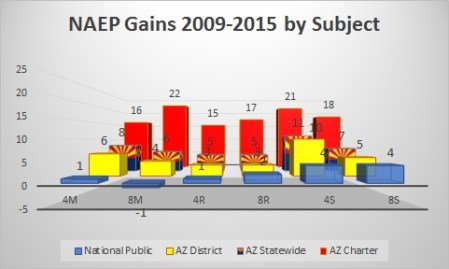
I hope the above chart explains why I think even Robb is selling choice short, why Allhands should reconsider K-12 agnosticism. Formally Allhands is correct that we do not know why Arizona has been leading the nation in gains, but I hope a close examination of the above chart will be fairly persuasive that Arizona’s choice policies had a great deal to do with it.

So let’s peel the above chart like an onion. The first layer- blue columns- are the national public school gains across all six NAEP subjects (4th and 8th grade Math, Reading and Science). These are across time gains rather than cohort gains, calculated by subtracting the 2009 NAEP score from the 2015 score. Looking at the blue columns shows that the national progress falls into the strictly meh: 1 point on 4th grade math, -1 point on 8th grade math, one point on 4th grade reading, 2 points on 8th grade reading, four points on 4th and 8th grade science. Nothing much to celebrate nationally.

Next look at the yellow columns- these are the 2009 to 2015 gains for Arizona school districts (no charters). As you can see, these gains are consistently larger than the blue national public numbers, especially in math and science.

Third, look at the total statewide gains (Arizona flag columns). These are the gains for the combined district and charter schools between 2009 and 2015. As you can see, these gains are consistently larger than the district gains alone (yellow columns) and far, far larger than the national public averages (blue columns). Arizona was the only state to have statistically significant gains on all six NAEP exams between 2009 and 2015.

Finally, in the back in red tower the gains for Arizona charter schools between 2009 and 2015. The over/under for percentage of Arizona students attending charters in 2015 was around 15%, so although these gains are huge, they directly move the statewide needle by the differences between the yellow district columns and the flag columns. *See boring stat nerd note below.

The above gains represent the 2015 minus the 2009 scores-for example Arizona’s 8th grade math score minus Arizona’s 2009 8th grade math scores. A different method for calculating NAEP gains is to follow the progress of a single cohort of students across time. The NAEP math and reading tests have been timed and scaled to allow such comparisons- 4th graders took for instance the 4th grade NAEP math in 2011 and the NAEP 8th grade math exam in 2015. So…which state’s students learned the most about math between their 4th grade test in 2011 and and the 8th grade test in 2015?

Nationally American students gained 41 points between the 2011 4th grade exam and the 2015 8th grade exam-so nationally about 10 points per year. Arizona lead the nation with a 48 point gain. So how did Arizona charter schools fare in this comparison? **See second nerdy statistical note.

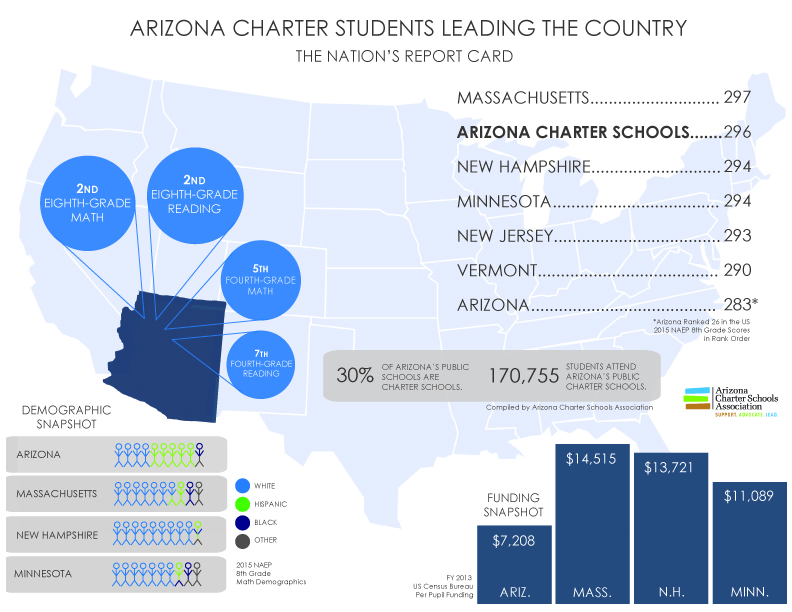
Note that the gap between Arizona charters and districts in cohort gains (12 points) is almost as large as the gap between gain leading Arizona and the lowest rated state (Alabama). So what does this mean in practical terms? The faster rate of improvement meant that Arizona charter school students got to do this on the 2015 NAEP, which is pretty cool if you like majority-minority schooling sectors that show globally competitive levels of academic achievement:
Finally, we have a rich set of empirical studies that suggest that parental choice leads to academic gains in traditional district school systems. Going back to the first slide, we have reason to suspect that some of the differences between the yellow and the blue columns relates to parental choice. If you suspect that budget cuts lead to academic gains (I don’t) then okay maybe, or if you can come up with a reason why new standards would have a very unusually large positive impact in Arizona when they flopped around the country, I’m willing to entertain a story to that effect, but it sounds like an implausibly complicated story.

On the choice side, round about 2007, the economy collapsed in a way that made a lot of property available, and Arizona’s charter sector put the peddle to the metal. Arizona charter school sector rose by a rousing 43,000 students in 2013 for example. The number of students exercising private choice also increased during this period, and statewide enrollment growth slowed, but that increase pales next to that of Arizona charters, which increased from 95,000ish students in 2008-09 to 188,000ish students in 2013-14.

We can feel confident that some of the difference between the statewide numbers and the blue columns relates to parental choice. We can feel very confident indeed that some of the difference between the red columns and the blue columns is related to parental choice. I’m open to other interpretations-and the comment section is open-but Occam’s Razor leads me to believe that a huge increase in the prevalence of parental choice that occurred during the Great Recession lead to direct benefits (high charter school scores) and powerful competitive effects (attract students or suffer real consequences- real accountability as opposed to the phony slap on the hand sort).

*The 2009 NAEP Arizona charter school estimates had large standard errors of estimates, owing to the considerably smaller size of the sector at the time. Unless Arizona charter school sleeper agents have infiltrated the NAEP there is little reason to suspect that random error will consistently advantage charter schools across six NAEP exams. Random error in both the 2015 and 2009 estimates means that the red columns in the first chart could be either smaller or bigger if we had actually tested everyone, but I’m at a loss for a reason to think of a reason why the errors across twelve different testing samples (six in 2009 and another six in 2015) would consistently line up to produce a mirage of Arizona charter school academic conquest, again absent sleeper agent infiltration.

** Standard error plays into the calculation of cohort gains as well on both ends of the calculation (in this case 2011 and 2015 scores) such that either could have been higher or lower if we had tested the entire population. Standard errors are larger for sub-population estimates than statewide averages, but again could play either way. For example if the population score for 2011 charter school students was higher than the NAEP estimate, the cohort gain will be overestimated, and if the true population score in 2011 was actually lower, then the cohort gain reported here would be an underestimate. All NAEP scores are estimates based on samples. Arizona’s charter school students displayed larger than any state cohort gains than any other state in both math and reading, but we cannot have the same level of confidence in these estimates as in statewide averages. Again, assuming random error and a lack of Arizona charter school sleeper agents in NAEP, we would not expect random error to consistently advantage Arizona charter schools.

Finally, the state’s AZ Merit exam also shows large advantages for Arizona charter school students vis a vis district students. Sampling is not an issue in AZ Merit, and these results lend reinforcement to the NAEP results. Unless…AZ charter school sleeper agents infiltrated the state’s testing system as well…


AEI releases Education Savings Accounts the New Frontier in School Choice

April 26, 2017

(Guest Post by Matthew Ladner)

Get your copy-all the really cool kids are reading it! Great collaborative project to address the promise, practicalities and pitfalls of an account based system of parental choice. Here is a chapter summary written by some of your favorite edu-nerdsthinkers! RUN don’t walk to order your copy!

“Introduction”
Adam Peshek and Gerard Robinson

“You Say You Want an Evolution? The History, Promise, and Challenges of Education Savings Accounts”
Matthew Ladner

“The Constitutional Case for ESAs”
Tim Keller

“Education Savings Accounts: The Great Unbundling of K–12 Education”
Adam Peshek

“Public and Policymaker Perceptions of Education Savings Accounts: The Road to Real Reform?”
Robert C. Enlow and Michael Chartier

“The ESA Administrator’s Dilemma: Tackling Quality Control”
John Bailey

“State Education Agencies, Regulatory Models, and ESAs”
Gerard Robinson

“Parents and Providers Speak Up”
Allysia Finley

“Hubs and Spokes: The Supply Side Response to Deregulated Education Funding”
Michael Q. McShane

“Settling on Education Savings Accounts”
Nat Malkus

“Conclusion”
Nat Malkus


It’s Too Much Winning Arizona!

April 25, 2017

(Guest Post by Matthew Ladner)

The Arizona winning just does not stop-BASIS scores five of the top 10 US News and World Report’s Top 10 high schools.

You other 49 states are cordially invited to join in the winning. We’ve yet to find any point of diminishing marginal returns here in the Cactus Patch.


#TooMuchWinningAZ

April 24, 2017

(Guest Post by Matthew Ladner)

This weekend, the Arizona Republic editorial board cited a forthcoming report from the Morrison Institute to note that Arizona was the only state to achieve statistically significant increases on all six NAEP exams between 2009 and 2015. I decided to check it out.

The 2009 to 2015 period was not chosen arbitrarily, and has a good deal of historical significance. We can begin to track science achievement under the new framework starting in 2009. It is highly desirable to include science, as it is a “non-tested” subject for state accountability purposes. Starting the clock in 2009 is also useful historically as it tells us which states coped best with the Great Recession.

The chart above is a net of statistically significant gains minus statistically significant declines by test for the 2009 to 2015 period for 4th and 8th grade Math, Reading and Science. Only Arizona hit the maximum of six statistically significant improvements with zero statistically significant declines so got a score of six. South Dakota apparently had the worst overall performance with a minus three. Boring but necessary note: a few states (AK, CO,KS,NE,LA, PA and VT) did not participate in the Science exams, so their scores could only range between -4 and 4.

I think the President may have been referencing AZ NAEP scores when he said:


A Society that Puts Freedom before Equality will get a high degree of both

April 20, 2017

(Guest Post by Matthew Ladner)

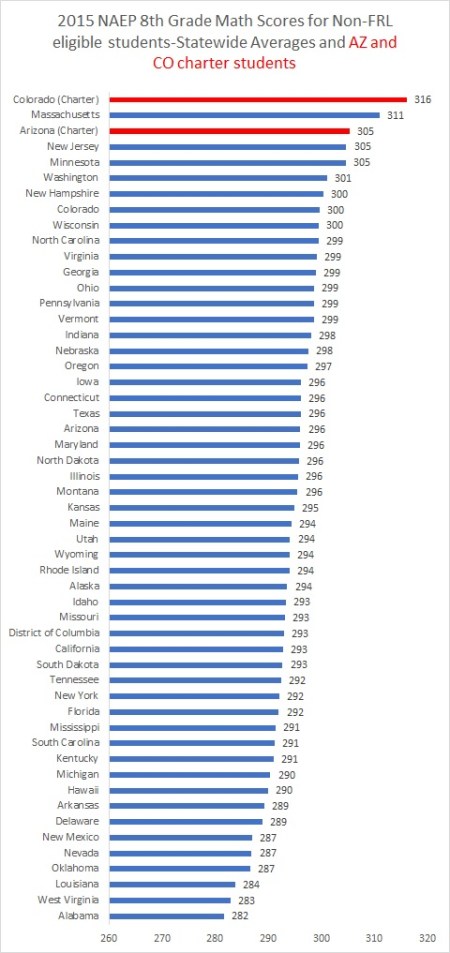
Want proof- here is how “9/33” charter sectors did on the 2015 NAEP 8th grade math test. First let’s look at middle and high income kids in Arizona and Colorado charters compared to the statewide averages for middle and high income kids:

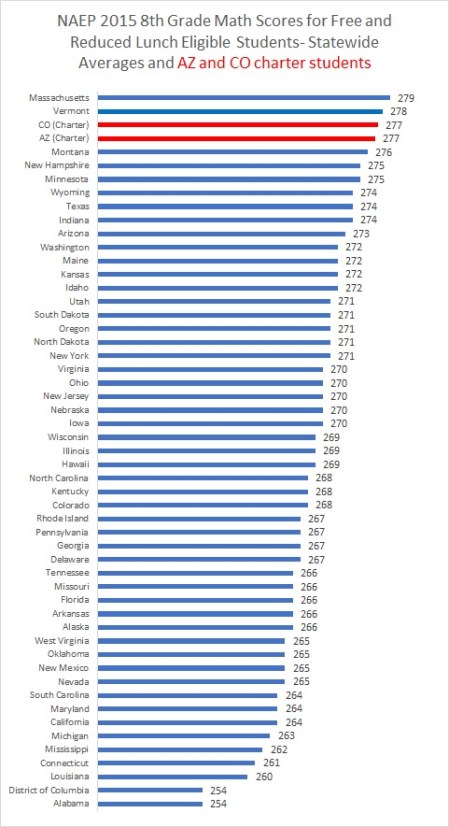
Whew- would you look at that? I wonder if those AZ and CO charter school kids are getting half the funding per pupil of Massachusetts or not. Yes, right, so back on track here, those above kids are all middle and high-income, so how did low-income students far in these awful, horrible, no-good Wild West anarchist charter schools perform? I’m glad you asked:


Robb: Free Your Mind

April 17, 2017

(Guest Post by Matthew Ladner)

Arizona Republic columnist Bob Robb provided an insightful summary of the choice debate overall while commenting on the ESA expansion fight here in the Cactus Patch, but with broad applicability:

….the debate about vouchers isn’t really about money. The argument that vouchers drain district schools of resources has always been a diversion.

Instead, the debate is rooted in different views of the role of government in educating children.

The government, through the coercive power of taxation, establishes a central pool of resources for the education of students.

Voucher supporters believe that the pool should be used to provide the best educational opportunity for each child as determined by their parents. A proportionate share of the common pool should be available irrespective of whether that choice is a district, charter or private school. The focus should be on what is best for each child individually.

Voucher opponents believe that some children should be used by the government as sociological chess pieces. Their access to the common pool should be limited to the schools voucher opponents believe they should be attending, even if their parents believe it is suboptimal.

As Morpheus put it “What is the Matrix? Control.”

In other words, some people view children primarily as funding units for a system that employs a large number of adults. The other side views students as human beings with a huge diversity of needs and aspirations, a large number of which will not be met in a 19th Century Prussian factory model of service provision with a monopoly on the common pool funds. We have very helpfully moved away from this in Arizona, but each new step seems to elicit a fresh burst of misguided outrage. Robb used the term chess pieces, I prefer “funding units” but “copper tops” might be the most apt term:


Plato for the Higgy

April 12, 2017

(Guest Post by Matthew Ladner)

I’ve been reading a few books about Athens over the last few years, which lead to the thought that Plato would be a worthy nominee for the Higgy as the ur-Bossy Mcbossytoga in serving as the inspiration for technocrats for thousands of years.

The fact that we still read Plato would give a sane person pause in questioning a founder of western thought. No one will be reading Ladner 2300 years from now after all. Sanity is overrated however, and so too is Plato. It has been decades since I read the Republic but I recall being of the firm opinion that it was utter nonsense. Philosopher Kings? Shadows on cave walls? Guardian class? What a lot of rubbish…hey look my new copy of the Avengers arrived!

Republic..misguided…make..it…STOP!

I’ll give this much to Plato- Athens did not exactly have the democracy thing sorted out. Sure there were golden ages, but they tended to be surrounded by demagogues leading the city into catastrophic wars, plagues, periodic oligarchies etc. People who lead Athens through incredible peril- including Themistocles and Cimon- later found themselves exiled from the city through democratic ostracism. Ungrateful Brits threw Churchill out of office at the end of World War II, but at least they didn’t force him out of the country he saved for a decade. The faults of Athenian democracy were too numerous to summarize adequately. Socrates for instance was chosen randomly to preside over the trial of six victorious Athenian admirals who were prevented from recovering the remains of fallen sailors by a storm. The obvious thing to do of course would be to execute the people who just won a decisive victory due to circumstances beyond their control. Socrates was unable to prevent it. Mysteriously wealthy Athenians who had previously borne the expense of paying for warships found non-military related hobbies occupy their time. The later execution of Socrates on the basis of vague nonsense obviously did nothing to endear Athenian democracy to Plato as well.

Plato was borne into Athenian aristocracy, and in fact his father had been a member of an oligarchy that temporarily overthrew Athenian democracy. Given the pandemonium of Athenian politics, one can hardly fault Plato for attempting to dream up improvements. Having said that, the idea of philosopher kings is utterly absurd. A group of materially disinterested ascetics spend decades in study to prepare themselves to govern the rabble with little compensation other than satisfying their benevolence after earning the acceptance of a self-perpetuating ruling class.

Riiiight

Fortunately no one actually tried to run Plato’s society, but there have been some fairly close parallels from time to time. The dead hand of medieval clericalism and various communist parties for instance come to mind as self-perpetuating elites admitting members based upon decades of training in a world view. I don’t know how one gets admitted into, say, Iranian theocracy, but that might more than vaguely resemble a guardian class. If these examples sound like recipes for stagnation and corruption it is only because, well it is in fact a recipe for stagnation and corruption.

Milton Friedman happily set Phil Donahue straight on this back in the 1970s:

Where in the world are you going to find these angels indeed. Athenian democracy was too often a pig’s breakfast of mob rule chaos, but I would take my chances with it over Plato’s benevolent ruling class fantasy.

The part of American democracy that most closely resembles the Plato’s philosopher kings would be the United States Supreme Court. You may have heard of them, they have been in the news a bit lately. Ross Douhat in fact makes an interesting case laying the blame for much of American political dysfunction in recent years at the feet of…wait for it….David Souter:

Had Souter simply voted like a typical Republican appointee — not in lock step with Antonin Scalia, but as an institutionalist, incrementalist conservative, in line with the current chief justice, John Roberts — then it’s likely that Roe v. Wade would have been mostly overturned in the 1990s, returning much of abortion law to the states, and that the gay rights movement would have subsequently advanced through referendums and legislation rather than a sweeping constitutionalization of cultural debate.

This, in turn, would have dramatically lowered the stakes of judicial politics for many Republican voters, making an untimely event like Scalia’s death less of a crisis moment, a response like the Garland pocket veto less of a necessity and the candidacy of Donald Trump something more easily rejected.

Indeed, I strongly suspect that in a world without the Souter own goal — a world where the Supreme Court had sided with cultural conservatives to the extent one would have expected given the number of recent Republican appointees — a nominee like Merrick Garland could still have been confirmed with Republican votes, and the filibuster could still persist, reserved for the unqualified, corrupt and genuinely extreme. Oh, and into the bargain, Donald Trump might well not be president.

Read the whole piece and see what you think. I largely buy the argument. American democracy is designed to force compromises that no one necessarily loves but most can live with. However tempting it may seem to bypass what can be a very frustrating democratic process, it is a very bad idea. Rule by executive, administrative or judicial fiat by “our betters” that Plato longed for at this point has a storied history of backfiring in fashions ranging from the humorous to the absolutely horrific. In the case of Souter, acceptance at Georgetown cocktail parties must have been swell but things may have indeed worked out better if he had felt some sense of democratic duty to the people who elected George HW Bush over Michael Dukakis in a complete rout of an election. Why let a little thing like a mere election get in the way of acceptance into grandee society?

We must empower authorities, but keeping the ability to turn them out of office seems to work better than anything else we have come up with, even if they hadn’t quite figured it out entirely in ancient Athens. For interrupting my vitally important early 1980s activities like Robotron 2084  robot killing and Magnum PI rerun viewing with turgid and misguided baloney and worse still for inspiring would be technocratic ruling classes for well over two millennia, I nominate Plato for the Higgy, it is a shame he wasn’t James Madison.


Community Inclusiveness by State Charter Sector

April 12, 2017

(Guest Post by Matthew Ladner)

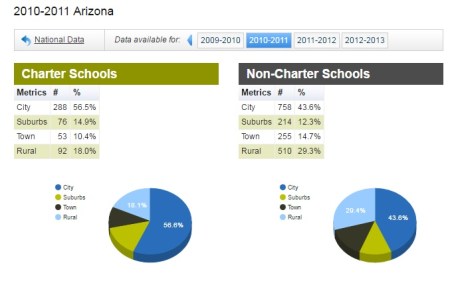
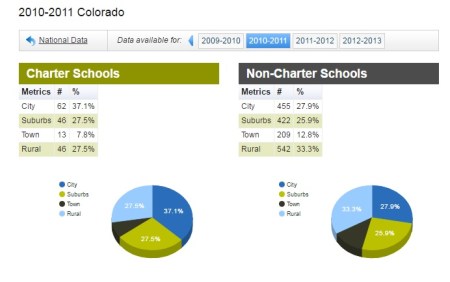
The National Alliance for Public Charter Schools dashboard has lots of cool data on state charter school sectors. I decided to take a look at the geography data by state to see how some of my favorites do on community inclusiveness. I don’t believe that we are likely to find charter sectors that precisely match the districts for a number of reasons, but large imbalances carry substantial drawbacks imo.

Bad:


Better:

Best:

Note that all three states over-represent in cities and there are practical (population density) and morally compelling (lower average performing district school options) reasons to do so. Texas however has focused on urban areas to such an extent that in communities that elect most of the state’s dominant political party (urban Texas is deep blue, with “urban” trumping “Texas” in voting preferences) schooling remains mostly a take it over leave it proposition from the districts. I heard from a CMO that operates charters in both Arizona and Texas that suburban demand for charters was even stronger than in Arizona in terms of generating wait-lists. In Arizona charter school competition is everywhere and even Scottsdale Unified needs and wants out of district transfers. Texas suburban districts meanwhile surround their new schools with trailers and keep increasing property taxes, and have limited interest in out of boundary transfers.

The “Size Does Matter” mantra again comes into play as the share of Arizona city children attending charter schools is likely considerably higher than the same share in Texas despite the fact that Arizona is more inclusive of towns, suburbs and rural areas (Texas has more urban charter schools than Arizona in absolute terms, but a much larger urban student population as well.) Thanks you again 9/33 NACSA scored charter law!