Pass the Popcorn: WW84 Is the Right Kind of Silly

December 26, 2020

(Guest post by Greg Forster)

Movie theaters are safe, especially because everyone sits facing the same way, and WW84 is the right kind of silly movie to go see and remind yourself why we go see movies on big screens with big popcorns and lots of other humans.

Silly is not stupid. That’s an important mistake to avoid if you want to like movies. And as WW84 itself emphasizes, wanting in the right way is the key. It’s surprising, at least until you really get to know the deep parts of human nature, how many people who spend a lot of their time and money on movies don’t want to like them. Just like Anton Ego’s whole dysfunction was that he refused to “like” food. As C.S. Lewis said, “the world is divided not only into the happy and the unhappy, but into those who like happiness and those who, surprising as it may seem, really don’t.” That is WW84 in a nutshell, give or take an invisible jet.

As I wrote in my first-ever movie post, reviewing another movie that is very silly but not at all stupid – a movie should know exactly what it is, and signal to the audience up front what it is. “Here is the movie you have elected to see today,” is the ideal subtext for every opening scene. “If this is not what you want, get up right now and go see some other movie.”

WW84 makes it clear up front that it is a very silly movie. If that is not what you want, see some other movie.

But you’ll be missing out. In spite of its imperfect narrative structure, WW84 delivers exactly what it promises. A standard-issue superhero movie, including superhero-adjacent movies like James Bond, needs ten things to succeed. Here they are, ranked in descending order of importance:

1-7. A compelling villain.

8. Dialogue that isn’t stupid.

9. A hero who represents, magnified, some aspect of our Best Selves but is also at least reasonably relatable as a person.

10. A distinct moral perspective of the universe.
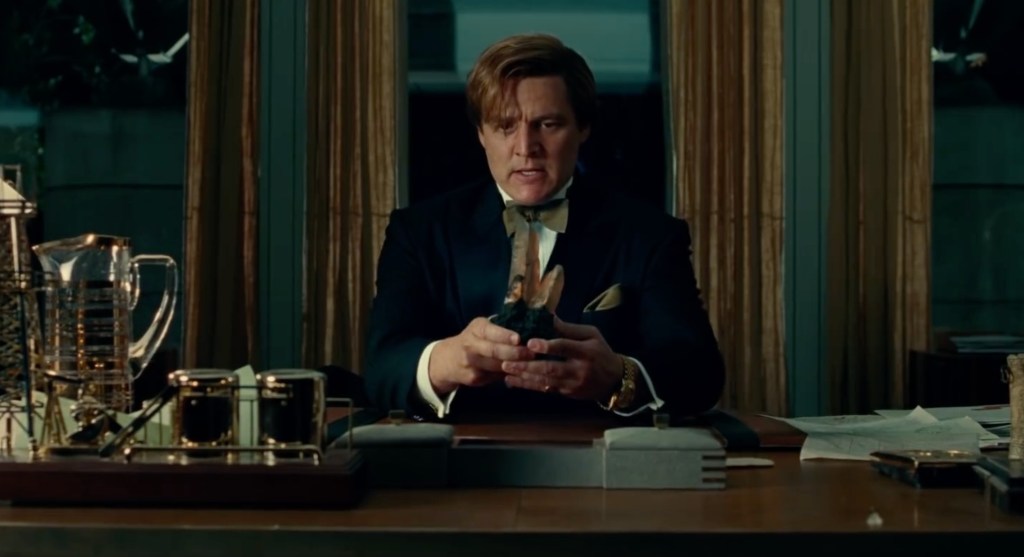
WW84’s villain carries the whole movie, and why shouldn’t he? That’s how superhero movies work.

“All you have to do is want it,” promises Maxwell Lord, who will destroy your life by granting you your fondest wish. As more and more people succumb to the seductive promise that you can have what you want, civilization itself collapses under the weight of ruined lives and incompatible visions. A world that defines reality based on what people want is a world where nothing is real, and above all nothing is fixed. Form dissolves into chaos, making both justice and beauty impossible, and mere absurdity reigns. In the final hour, when one man gains all power, there is nothing left for him to possess, for by the very act of gaining all power he removes all restraints, and thereby destroys the world.

All Lord’s power is in deception, for no one would take his deal if they understood what they were doing. But that’s the power of desire – the more powerfully we want, the less we understand our own desire. At last, the tyranny of desire destroys even our ability to enjoy the thing we desire, because we no longer really understand what it is we actually want. The more we tighten our grip on the thing we desire, the more we lose our true selves, and thus lose even the original form of the desire itself. In the end we lose even our humanity.

Anton Ego doesn’t like food, he loves it, and his love is more horrible than hatred.

It’s important to realize that this happens with good and right desires, not just wrong ones. Diana speaks for all of us when she cries out in desperation, “I give my all, every day, and I’m glad to do it. This is the only thing I’ve ever wanted, the only thing I would ever ask for. Why can’t I have this one thing?” Alas, that’s the trap.

The good news is that any of us can escape the trap at any time. No one is enslaved to Max Lord by anything except their own choice. You can have your life – your true self – back at any time. All you have to do is renounce your wish and choose to live in the truth. We can have the happiness that living in the truth affords, if only we abandon the desire to be happy on our own terms instead of happy on the terms life actually offers us.

And those who do choose to make the sacrifice will suddenly discover that they have new power that they never suspected, that they never dreamed they could have. The love that surrenders to death returns, in a new and glorious but completely unexpected form.

But this good news is bad news, because to renounce the wish is death to the natural self. We prefer to live a lie. Only a higher power (“the truth is greater than all of us”) can intervene to save mankind from itself, from its own evil and folly. And even that intervention doesn’t remove the need to choose truth over desire, to choose the death of the natural self; it only makes the choice possible for us.

But you knew all that already, because you saw the original Wonder Woman movie, where Diana learned that even Steve Trevor doesn’t deserve to be saved. That movie asked the question, “why kill yourself saving the world, when people are no damn good and they don’t deserve it?” The answer was “love.” What that movie did at the level of Homeric epic – titanic gods fighting each other for the fate of mankind – this movie does up close and personal, intimately.

And when people are intimate, it’s okay to be silly.


The Perfect Gift for Your Country

December 23, 2020

(Guest post by Greg Forster)

Did you wait till the last minute to go holiday shopping for your country?

Are you desperately searching for the perfect gift for that special nation you love, and it’s too late for Amazon delivery?

Why not get that special country in your life a free, dynamic, entrepreneurial economy?

OCPA carries my latest, part 1 of 2, in which I defend the open economy against socialists and economic nationalists alike:

Witness, for example, the outrageous new law in California that strips the citizens of that state of their right to do more than minimal amounts of work in the “gig economy.” Designed to pay off corrupt taxi cartels and other special interests by arbitrarily shutting down superior competitors such as Uber and Lyft, the law crippled thousands of freelance drivers, writers, musicians, designers, and other workers.

Uber and Lyft just got themselves exempted from the law by backing a statewide referendum on Election Day, but everyone else is stuck under its thumb. Now, the state is making exceptions for some types of workers, piecemeal, based on who has enough political power or connections to move the whims of the iron-fisted political rulers. Musicians got themselves exempted by buttering up the egos of legislators with celebrity prestige—an industry group sent a personalized gold record to the law’s lead sponsor. But as far as the political ruling class care, writers might as well just give up and die, and reduce the surplus population. How this arbitrary privilege differs from, say, Julius Caesar’s rule over the Roman plebs is a question we can leave to the philosophers.

This is not about whether we can have reasonable regulations and welfare programs, etc. This is about whether the basic foundation of our system is human rights and equality under the rule of law, or the privilege of the powerful – whether of the Left or Right:

The basic issue here is whether we’re going to begin with a robust moral commitment to equal respect for human rights under the rule of law—rights to work, property, contract, and exchange—and then negotiate at the margins over such issues as taxes, public safety, welfare, and social stability. Or if we’re going to let politicians arbitrarily strip people of their rights, on a whim, like they’re Roman emperors sitting on their gold thrones (or California legislators hanging gold records on their office walls). Whether the justification is nationalism or socialism, that’s not right, and it’s not hard to see the social and humanitarian disaster it would create.

Coming after the holidays, part 2, in which I take up the more specific claim that the open economy is delegitimized by the legacy of slavery and segregation – that all the 18th-century rhetoric about property and contract rights is really just a mask for white supremacy.

Catch you on the flip side, and until then, enjoy the holidays and Happy New Year!


An ESA in Oklahoma?

October 30, 2020
An Easy Button path to universal ESAs? Make it so!

(Guest post by Greg Forster)

We interrupt the exciting conclusion of Race to the Al 2020 to bring you my latest from OCPA, on how Oklahoma has a small program that could easily be “blown up” into a statewide universal ESA:

Governor Kevin Stitt has used funds from the Governor’s Emergency Education Relief program to create a program called Digital Wallet. It provides, well, a digital wallet for up to 5,000 families with K-12 students whose income is at or below the federal poverty line. Each family gets $1,500 to spend on educational supplies of their choice from 30 providers. Funds are deposited in a special account parents can log in and use.

This is almost an ESA. States with ESA programs also deposit funds in special digital accounts that parents can log in and use to further their children’s education. The common principle is recognizing that parents ought to be in control of their children’s education. The difference is, an ESA isn’t limited to school supplies. It can also be used to pay for education services. That includes tutoring and other supplemental support, but it also includes tuition for attending a private school.

There’s no reason to trust parents to buy educational products and not trust them to buy educational services:

Education is not supposed to serve the interests of employers and politicians. To educate a child means preparing a whole person for a whole life. Far from being something that’s too important to leave to parents, it’s something that’s too important not to leave to parents! If education isn’t controlled by the family, it will be controlled by business and the state—as we see under the current government monopoly on education. Today’s pedagogy is largely geared toward crushing independent spirits, teaching children to sit quietly and learn to be obedient employees and subjects.

Let me know what you think!


For the Al: Hans Christian Heg

October 29, 2020

(Guest post by Greg Forster)

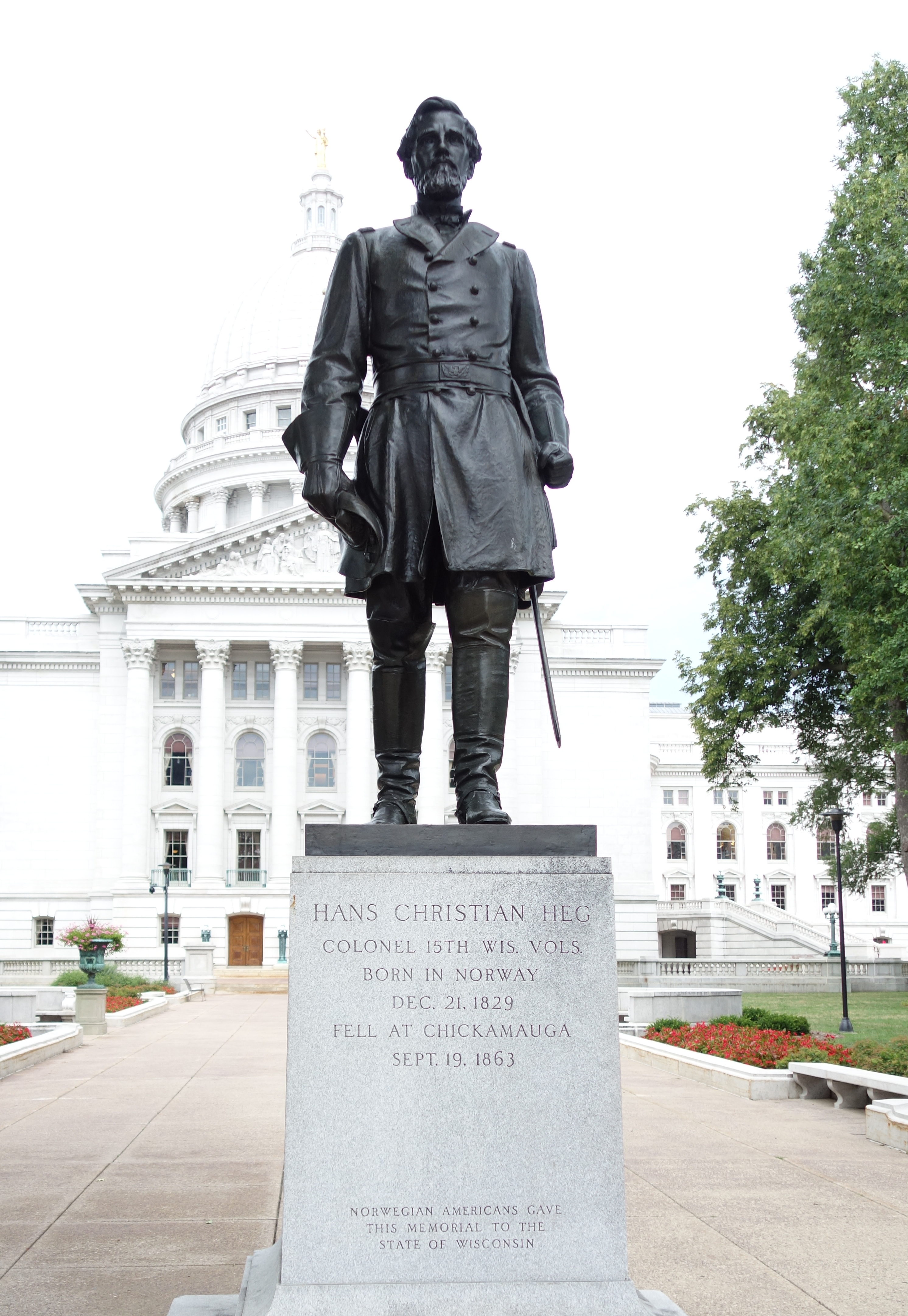
Here in Wisconsin the more recent rioting in Kenosha, five miles from my house, has supplanted memories of this year’s earlier rioting in Madison. But The Al has a long memory, and it’s worth harking back to that earlier moment. For while the overall damage was not as great, the Madison rioters did distinguish themselves by committing the single dumbest act in all that season of high stupidity. In the name of racial justice, they tore down a statue, erected not by taxpayers but by an immigrant community, of Hans Christian Heg, a heroic enemy of slavery and racial oppression – an immigrant who labored long and hard to destroy injustice, and finally gave his life to the cause.

Down he must come, because he doesn’t look like us. Or rather – because the violent mobs nationwide have been noticeably pale, and that trend was not defied here in Wisconsin of all places – he does not look like the people on whose behalf we have, with no warrant but our arrogance, set ourselves up to speak and act as public champions.

As I wrote after the riots in my community, there are many continuing legacies of injustice – racial and otherwise – worth protesting. But at the same time, our only hope to fight injustice is to preserve the patrimony passed down to us by heroic forefathers who stood in their time for justice, freedom, human rights, equality under the rule of law and constitutional democracy. These commitments are not “conservative” in the sense of creating a stable and static social world. But they are “preservative,” both in the sense that they are our only real safeguard against the abyss of endless violence and in the sense that they do not just spring up of themselves either from pure reason or spontaneous sentiment, like Athena from the head of Zeus. We must preserve them if we want them to preserve us.

Our failure to pass on our moral patrimony has created a culture in which history began yesterday, and people are not supposed to have heroes who don’t look like them. I am shocked by the near-total ignorance about Martin Luther King that prevails among people under 35 who are of European descent. He was a black man, and apparently that means knowing about him is for black people. A young pastor of pale pigmentation once shamefacedly confessed to me: “The only thing I know about Martin Luther King is that my father told me he had bad theology.” In some ways he did, but that is hardly the Fun Fact to Know and Tell about him.

A world in which history began yesterday and nobody is supposed to have heroes who don’t look like them will not be friendly to justice, freedom, human rights, equality under the rule of law and constitutional democracy. The desirability of these things is, of course, provable by natural reason and satisfactory to humane sentiment, and thus potentially discoverable in any age. But a social commitment to them that is strong enough to induce people to sacrifice individual happiness for them cannot be either argued or felt into existence. It is, as Lord Acton said, “the delicate flower of a mature civilization.”

Who was Hans Christian Heg?

In 1840 he and his Norwegian-immigrant parents moved to America and settled in Muskego – not all that far from Kenosha, as it happens. He lived there his whole life, except for a year of gold-digging in the Sacramento Valley during the California Gold Rush. In 1859 he was put in charge of the local state prison, “earning a reputation as a pragmatic reformer” by working toward rehabilitation of the offenders, according to the Wisconsin Historical Society.

A dogged enemy of slavery, Heg supported the Free Soil Party and later the Republicans. He was the statewide leader of the Wide Awakes, a youth organization that served – not to put too fine a point on it – as the paramilitary wing of the Republican Party. Officially, the Wide Awakes organized torchlight marches and provided security for anti-slavery speakers. Unofficially, they gave the bum’s rush to “slave catchers,” heartless men who hunted down escaped slaves under the Fugitive Slave Act. Heg put his position as head of the prison at political risk by sheltering Sherman Booth, a federal fugitive who had incited a crowd to attempt to rescue an escaped slave from forced repatriation.

When the war came, Wisconsin’s governor appointed Heg to lead the 15th Wisconsin Volunteer Regiment, known as the “Scandinavian Regiment” because almost all its members were immigrants from Norway, Denmark and Sweden. Heg raised donations and spent his own money to organize the immigrant unit, advertising for “Norsemen” willing to come to the aid of their country, and freedom.

Heg was wounded at the Battle of Perryville, but because of his excellent leadership, his unit suffered few other casualties while under heavy enemy fire. Heg was put in command of a brigade, and was being eyed for promotion to brigadier general. But he was summoned to the last full measure of devotion at the Battle of Chickamauga, where he died fighting for the adopted country and the freedom he loved.

(Does the Battle of Chickamauga ring a bell, Al fans? It should!)

As you can see in the photo above, Norwegian-Americans raised their own money to commemorate Heg. The statue was unveiled in front of Madison’s statehouse in 1926, where it stood until 2020.

The report of Heg’s death in the Madison State Journal of September 29, 1863 reads like the preserved breath of a lost civilization, because that is what it is:

The State has sent no braver soldier, and no truer patriot to aid in this mighty struggle for national unity, than Hans Christian Heg. The valorous blood of the old Vikings ran in his veins, united with the gentler virtues of a Christian and a gentleman.

Right reasoning and just sentiment were necessary for the new birth of freedom, but not sufficient. Emancipation was effected because the valorous blood of the Vikings had been refined through the centuries by high religion and cultured aspiration – “the delicate flower of a mature civilization.”

What could be more rational and fitting than to nominate this Viking Christian Gentleman for The Al?


For the Al: Charles Hull

October 21, 2020
L to R: New Chuck Hull, Diet Chuck Hull, Classic Chuck Hull

(Guest post by Greg Forster)

Just think about this: 3D printing is revolutionizing all kinds of things, and is going to revolutionize them far more in the coming generation. It’s literally the replicator from Star Trek TNG, just not quite as fast and versatile yet. And you have no idea who invented it.

Or you didn’t, until you read this post!

Technically it’s “stereolithography.” Did I mention that it’s literally the replicator from Star Trek? People keep saying things like, “it’s 2020, where are my hovercars?” But this is better.

Chuck Hull produced the first-ever 3D printed part (above) in 1983. He got the idea while using UV light to harden the coating on tabletops. If you can harden plastic quickly with high precision using a concentrated beam of UV light, all you have to do is aim the light at a vat of liquid plastic and then use it to “draw” the object you want. He had a patent on the process by 1984, founding his company, 3D Systems – which he still co-runs – in 1986. Publicly disclosed salary information suggests that, like Al Copeland, he’s doing okay.

And rightly so! Check out some of the applications that have already emerged:

  • Rapid replication of drones to deliver supplies to disaster areas
  • Affordable housing: a 600-800 foot house can be 3D-printed in less than 24 hours for $4,000
  • Prosthetic limbs just got super cheap
  • Optimized aircraft parts save fuel and pollution
  • Replenishing coral reefs
  • Bioprinted” human organs
  • Restoring/rebuilding priceless cultural artifacts and architecture
A rapidly replicated drone for disaster relief
A $4,000 house
No need to lend this guy a hand

The early days of the pandemic were filled with 3D printing stories:

Maybe Hull can team up with Al winner Pete DeComo to make sure there won’t have to be any more midnight runs across the border for lung machines!

That’s just the first fruits. The long term will be much bigger. Even though scholarly articles lag real-time production of knowledge, a search in Google Scholar for “impact of 3D printing” produces 758,000 hits. Page one includes these titles:

  • The Impact of 3D Printing Technologies on Business Model Innovation
  • The Impact of 3D Printing Technology on Society and the Economy
  • Current and Future Impact of 3D Printing on the Separation Sciences
  • The Impact of 3D Printing Technology on the Supply Chain
  • The Impact of 3D Printing on Transport and Society
  • Evaluation of 3D Printing and Its Potential Impact on Biotechnology and the Chemical Sciences
  • Impact of 3D Printing on Spare Parts Logistics

That’s page one.

And…as for the even longer term…did I mention….?

In 2011 I wrote, “this finding’s been replicated more often than Picard’s Earl Grey,” and it’s still one of my favorite gags in 12 long years of gag-heavy JPGBing.

Thanks for inventing the Star Trek future, Chuck.

Image HTs: Top, 1st printed part, drone, house, arm


We’ve Got the Time Machine Under Control, So Post Your 2020 Al Copeland Humanitarian Nominations

October 9, 2020

(Guest post by Greg Forster)

Well, the winner of the Nobel Peace Prize was announced this morning, so you know what time it is – time once again to post your nominations for the only prize anyone anywhere really covets, the Al Copeland Humanitarian of the Year Award.

The Al Committee would like to extend its thanks to the Nobel Committee for upholding the cherished tradition of making a silly award – giving the prize to a titanic UN anti-hunger bureaucracy – so the authentic value of The Al will stand out by comparison. We look forward to many future years, and generations, of continued cooperation in the shared work of building up more and more PLDDers through the Nobel, so that the absurdity of the PLDDers can be exposed through The Al.

(No more of that nonsense like in 1970 when the award went to the real enemy of hunger. But that was before The Al.)

The Al Committee would also like to apologize for the glitch in our secret time machine that caused one of the nomination posts to go up before the nominations were open. We’ve got our totally nonexistent time machine under control now, and are going to fix the timeline quickly so that post appears at the correct time and becomes eligible.

Hopefully it will also stop raining.

Nominations can be submitted by emailing a draft of a blog post advocating for your nominee. If Jay likes it, he will post it with your name attached. A winner will be announced after Halloween.

The criteria of the Al Copeland Humanitarian Award can be summarized by quoting our original blog post in which we sang the praises of Al Copeland and all that he did for humanity:

Al Copeland may not have done the most to benefit humanity, but he certainly did more than many people who receive such awards.  Chicago gave Bill Ayers their Citizen of the Year award in 1997.  And the Nobel Peace Prize has too often gone to a motley crew including unrepentant terrorist, Yassir Arafat, and fictional autobiography writer, Rigoberta Menchu.   Local humanitarian awards tend to go to hack politicians or community activists.  From all these award recipients you might think that a humanitarian was someone who stopped throwing bombs… or who you hoped would picket, tax, regulate, or imprison someone else.

Al Copeland never threatened to bomb, picket, tax, regulate, or imprison anyone.  By that standard alone he would be much more of a humanitarian.  But Al Copeland did even more — he gave us spicy chicken.

The 2019 winner of The Al was Mildred Day, inventor of the Rice Krispie Treat. In the fine tradition of Al Copeland himself, Day made the human condition better by bringing us great food. Her treats are not only delicious, they’re easy to make, so they are often among the first cooking projects that parents do with their children. Parents connecting with their children over something yummy is just about the best thing there could be. Day was favored over political pranksters Chad Kroeger and JT Parr, and Bob Fletcher, who helped three Japanese-American families in California keep their farms after WWII-era internment.

The 2018 winner of The Al was Joy Morton. Like Al Copeland, Morton promoted the good by doing well. It was known that small amounts of iodine could prevent goiters, but no one was doing anything about this until Morton saw a way to gain a competitive advantage for his salt company: adding iodine to salt, and advertising its health benefits. The bumper crop of nominees in 2018 also included Great Course lecturer Elizabeth Vandiver, musical disintermediator Leo MoracchiloliMagic: The Gathering inventor Richard Garfield, scofflaw tech recycler Eric Lundgren, lemonade-stand paladins Adam Butler and Autumn Thomasson, and George Henry Thomas, a Virginian general in the Union army.

The 2017 winner of The Al was Stanislav Petrov, who literally saved the world from nuclear destruction by refusing to follow Soviet orders to retaliate against what he suspected (as was later confirmed) was a false warning of a US strike. It’s not quite spicy chicken, but it’s close! Petrov was selected from an excellent set of nominees, including Whittaker Chambers, witness against communism, Justin Roiland and Dan Harmon, creators of Rick and Morty, and Russ Roberts, author and host of EconTalk.

The 2016 winner of The Al was Master Sergeant Roddie Edmonds, who prevailed over a very competitive field of nominees, including Tim and Karrie League, founders of Alamo Drafthouse movie theaters, political humorist Remy Munasifi, and humorous political journalist Yair Rosenberg. Edmonds stood up against fascists at considerable risk to himself by declaring that he and all of his fellow prisoners of war were Jews, to foil the Nazis’ effort to separate Jewish prisoners. It is this type of courage in the face of illiberalism that we need more of in these times.

The 2015 winner of The Al was internet humorist Ken M.  Ken M did more to improve the human condition than just make us laugh by making idiotic comments on social media (although that would have been enough). His humor reveals the ridiculousness of people trying to change the world by arguing with people on the internet. Given how much time education reformers waste on social media, especially Twitter, Ken M’s humor is a useful reminder that many of the people reading your posts are probably not much swifter or influential than the Ken M persona. Ken M beat a set of strong nominees, including Malcolm McLean, inventor of shipping containers, Gary Gygax, creator of Dungeons and Dragons, and John Lasseter, founder of Pixar.

The 2014 winner was Peter DeComo, the inventor of the Hemolung Respiratory Assist System. To save a life, DeComo drove all night to retrieve a lung machine from Canada, then thought quickly when border control officials at first denied him permission to bring it home because the device had not yet been fully approved by the FDA. DeComo won over a worthy field, including Marcus Persson, the inventor of Minecraft, Ira Goldman, the developer of the “Knee Defender,” Thomas J. Barratt, the father of modern advertising, and Thibaut Scholasch and Sébastien Payen, wine-makers who improved irrigation methods.

The 2013 winner of The Al was musical satirist Weird Al Yankovic. Weird Al brings joy to people of all ages, while puncturing the pretensions of puffed-up celebrity entertainers. He beat an impressive set of nominees, including performer/skeptics Penn and Teller, crowdfunding website Kickstarter, and WWII industrialist Bill Knudsen.

The 2012 winner of The Al was George P. Mitchell, a pioneer in the use of fracking to obtain more, cheaper and cleaner natural gas. Mitchell won over a group of other worthy nominees: artist Banksy, car creator Ransom E. Olds, first-down-line inventor and two-time Al nominee Stan Honey, and Alfred Fielding and Marc Chavannes, the inventors of bubble wrap.

In 2011, The Al went to Earle Haas, the inventor of the modern tampon. Thanks to Anna for nominating him and recognizing that advances in equal opportunity for women had as much or more to do with entrepreneurs than government mandates. Haas beat his fellow nominees: Charles Montesquieu, the political philosopher, David Einhorn, the short-seller, and Steve Wynn, the casino mogul.

The 2010 winner of The Al was Wim Nottroth, the man who resisted Rotterdam police efforts to destroy a mural that read “Thou Shall Not Kill” following the murder of Theo van Gogh by an Islamic extremist. He beat out The Most Interesting Man in the World, the fictional spokesman for Dos Equis and model of masculine virtue, Stan Honey, the inventor of the yellow first down line in TV football broadcasts, Herbert Dow, the founder of Dow Chemical and subverter of a German chemicals cartel, and Marion Donovan and Victor Mills, the developers of the disposable diaper.

The 2009 winner of The Al – in the first year the award bore that name – was Debrilla M. Ratchford, who significantly improved the human condition by inventing the rollerbag. She won over Steve Henson, who gave us ranch dressing, Fasi Zaka, who ridiculed the Taliban, Ralph Teetor, who invented cruise control, and Mary Quant, who popularized the miniskirt.

Also noteworthy from 2009: History’s greatest monster, William Higinbotham, was declared permanently ineligible to receive The Al. He remains the only individual thus disqualified. In (dis)honor of Higinbotham, The Higgy award has been bestowed on (un)worthy candidates annually since 2012.

Al Copeland himself was honored in 2008 as the official humanitarian of the year of Jay P. Greene’s Blog. The award was renamed in his honor the following year.

Happy nominating, watch out for time bandits, and whatever you do, don’t touch the pure evil!


On Violence and Education

October 7, 2020
Photo of what was done to my community from the Kenosha News

(Guest post by Greg Forster)

Not gonna beat around the bush, folks, my latest column at OCPA is personal:

I live about five miles from the area of Kenosha, Wisconsin, that was recently devastated by rioting. The human cost of unjust and unlawful violence in our community, which has come from radical rioters and from abusive police and vigilantes, simply won’t go into words. What will go into words is the long-term educational problem represented by a society that has failed for generations to reproduce in its young people a commitment to even its most basic civilizational ideals: equality under the law, and respect for other people’s rights.

Functionally, the deepest roots of the culture war that has crowded out community and moral imagination are in educational failure:

What the two sides have in common is not simply that they fail to apply our shared moral rules to their own side, but that they do not speak in terms of shared moral rules at all. That is, unless you count the law of the jungle as a moral rule. The moral patrimony is no longer a patrimony, for we have failed to pass it on.

We employ millions of people and spend many billions of dollars a year on K-12 schools and higher education, but the most important lessons aren’t being learned. They haven’t been for generations.

But right-wing assaults on left-wing agitprop in schools could not solve the problem – not merely because they will continue to fail, for the same reasons they have failed consistently for fifty years, although it would profit us to think about that as well – but because they would only deal with the symptom, not the cause, of the problem:

Our schools were ripe for capture by ideology because they were first civilizationally bankrupted by a great narrowing of their purpose. In the late 19th and early 20th centuries, we stopped thinking of schools as extensions of the family, cultivating human beings for a life that would be whole and meaningful. Instead, we began thinking of schools primarily as extensions of the economy, training workers, and of the state, indoctrinating citizens into values chosen for them by their rulers. Quackery and claptrap rushed in to fill the educational vacuum created by this impoverished notion of what education is.

At the K-12 level, the great narrowing came when a big left/right coalition came together for government monopolization of schooling…

Reforms like school choice are a step in the direction of restoring the older, family-centered model of education, which is a necessary precondition of any moral restoration in education, which is in turn a necessary precondition of sustaining any alternative to the Nietzschean nightmare of mobs and vigilantes stamping on each other forever.

Happy reading!


Universal Choice or Bust!

September 23, 2020

(Guest post by Greg Forster)

OCPA carries my column on why the school choice movement should make a clear commitment to universal choice:

The choice movement has gained a great deal. A supermajority of U.S. states—30 of them—have school choice programs, plus two territories as well (the District of Columbia and Puerto Rico). Eighteen states, including Oklahoma, have two or more programs! As a result, over half a million students attend private schools using public funds. That’s a long way from the tiny voucher program in Milwaukee that launched the modern school choice movement in 1990.

The question is, what is the choice movement going to do with that success? Keep racking up programs that are limited in the number of students they can serve, and in the schools those students are allowed to choose? Or think about what it would mean to take things to the next level? There are almost 51 million K-12 students in public schools; while I have no doubt that a lot of them are in the right place, and wouldn’t exercise choice if they had it, it seems like the time has come to aim higher.

Universal choice isn’t just the right thing on the merits. It’s also politically expedient:

One of the great ironies of life is that the least pragmatic thing to be is a pure pragmatist. “Forget about high ideals and just do what works” may get you by in the short run. In the long run, however, the only thing that actually “works” is high ideals. Without them, cynicism and distrust erode social cooperation, and there is no basis on which to settle disputes about what is permitted.

We see that principle illustrated in the history of the modern choice movement. The more we’ve compromised the ideal of universal choice, the more headaches we’ve ended up with. Bigger and broader programs are more stable and thrive better.

Exercise your universal choice of free speech to let me know what you think!


CC Broke the Law, So Does Defunding Schools Using 1619

September 6, 2020

(Guest post by Greg Forster)

When some Republicans pushed a federal school choice law recently, I wrote that I was “looking forward to the retractions and apologies from all the right-wingers who opposed Common Core on federalism grounds. Including – gosh, will you look at that! – one of this bill’s primary sponsors.“

Now the president has announced he will have the DOE withhold funds from schools that use the 1619 Project. Which is different from Common Core how, exactly?

Federal law unambiguously forbids the DOE from attempting to influence curriculum. The text of the law does not empower the department to make exceptions in cases where the curriculum in question is [insert the various defects of the 1619 Project here].

We’re either a nation of laws or we ain’t, folks.

Want to clean up curricula? Get your lazy asses out and hustle the issues in those school boards and state legislatures. If you come crying to Momma Fed instead, what you’re asking Momma to do is spelled C-O-M-M-O-N C-O-R-E.


School Choice Could Resolve the Reopening Crisis

September 2, 2020

(Guest post by Greg Forster)

OCPA carries my column on why school choice is the way to handle the school reopening crisis. My school board decided to give me the perfect hook for the piece by . . . well, just read:

In my community, our public school board reversed itself twice, in August, on the question of whether schools would reopen for in-person learning in September. The start date was also delayed by two weeks, throwing parents’ plans into further confusion. And as I write these words, the board has planned an emergency meeting to consider whether or not to reverse itself a third time.

Who knows how many more positions they’ll have staked out by the time you read this article? Perhaps we’ll turn over management of our public schools to Erwin Schrödinger. Then they can be both open and closed at the same time.

Got to admit, I’m proud of that line. 🙂

This isn’t such a tough problem because school boards are stupid and evil, it’s because the government school monopoly forces us into a one-policy-fits-all nightmare:

If everyone has to go the same way on every issue, you will have constant battles over which way everyone should go. Sometimes you can resolve those battles with a compromise that people can live with (although no one will be very satisfied with it). But sometimes you just can’t. Life doesn’t always offer you splittable differences; sometimes it offers you hard choices.

And it’s important to notice how the monopoly makes education hostage to an adversarial system. The immediate problem on any given day is the crisis over how to resolve issue X (whatever “issue X” happens to be today—the pandemic, reading pedagogy, race and American history, etc.). But the ongoing problem is that every day is a crisis because all big decisions about all important issues are made through conflict. They have to be, when you’re trapped in a monopoly.

Let me know what you think!