OCPA carries my article on secularization and schooling:
Our schools produce secularization because they are forced to educate students in a pluralistic society without allowing those students to integrate their education with the reality that human beings are religious creatures. We have a government school monopoly, which means one size has to fit all. But one size can’t fit all when it comes to the things that matter most.
Educating children without reference to religion produces secularization in multiple ways. Children learn from an early age that their own religion, whatever it is, is a private hobby, because it’s not part of what we teach them about in school. Children also learn that the parts of life that don’t actually happen in a religious setting should be organized without reference to religion, because the knowledge base upon which our social and cultural systems are based was taught to them in exactly that way.
Worst of all, while schools make major efforts to teach moral character to students, they can’t ground virtues like honesty, generosity and self-control in any adequate source. This leaves them either indoctrinating children in an essentially selfish morality (teaching students that “you’ll be happier in the long run if you don’t lie” also teaches them that “what makes you personally happy is the standard for judging what is morally good”), or just wagging their fingers and telling students to be good without telling them how or why. Neither approach actually forms students with the character and virtues that a free society needs.
Exercise your right to bring your whole self into the public square by letting me know what you think!
OCPA carries my article on a truly boring and esoteric topic, sure to put everyone straight to sleep – “critical race theory” in education:
Although it has been widely described as banning Oklahoma schools from teaching CRT, the text of the bill—which is very brief and easy to read, fortunately for those happy few who elect to read it before talking about it—does not even mention CRT. It prohibits schools from teaching that one race is inherently superior to others, that anyone ought to feel anguish or distress because of their own race, that anyone is inherently racist solely because of their race, that “meritocracy” as an idea is inherently racist, etc.
Now, it’s true that the ideas Oklahoma schools are prohibited to teach are core features of CRT as some important advocates of CRT define CRT. But the emphasis in that sentence is on “some.” Other advocates of CRT strenuously deny that CRT involves the view that white people should be ashamed to be white, or that all white people are racist, or that meritocracy is racist.
Rather than bicker about the definition of a term, why not step back and do some genuinely critical theorizing by asking which ideas are actually good and which are bad?
Academic subjects don’t grow on trees. They are disciplines of learning, created by human effort. Therefore they inevitably have blind spots – sometimes “a whole Seurat mural’s worth of blind spots” (yes, I’m proud of that line) – due to the prejudices of our ancestors. Discovering and exposing those blind spots is not just good, it’s essential. In the article, I mention some research I’ve been doing for a book on how our inherited understanding of 4th-century Christianity has been distorted in important ways by centuries of scholars who operated on the assumption that nothing intellectually or culturally important could possibly have happened in Africa.
The key question is whether we are really seeking to overcome error and get to the truth, or if we have given up on the idea of truth altogether. The more radical versions of CRT argue that the inherited blind spots in our academic disciplines prove that there is no truth, only socially constructed systems of power. At the end of that hallway is Room 101:
This means—necessarily, unavoidably—that there can be no common ground, no compromise and no reconciliation. There can only be endless war between power factions that have competing identity claims. On this view, we actually need to have an eternal war between factions competing for power, because the conflict between their identity claims is the only way we can know who we are. If there is no truth, our identities must depend on systems of power, and systems of power can’t be exercised without conflict.
As Orwell saw with such agonizing clarity, if there is no truth, the future is a boot stamping on a human face forever.
On that cheerful note, I will open the floor to hear your critical theory about my critical theory!
There has never been a time in American history when the government school monopoly did voc-ed well. In the 19th century, when the system was created, the strategy was to provide everyone a very basic “three Rs” education in K-8 schools, then turn the kids over to various forms of apprenticeship and on-the-job training. (High school was only for the tiny minority who were destined for college.) So the actual vocational education was being handled by employers and others, not the government system.
It’s true that one of the justifications for creating the government monopoly in the first place was to prepare students better for the new careers of modern industry. Traditional schooling by tutors and church schools was thought to be insufficient for the modern world. But the contribution of the government schools was not to do the actual job training; that was for industry. The government schools were there to break the students’ spirits by subjecting them to rigorous regimes of rote monotony and obedience to tyrannical authority, which was thought to prepare the students well for the lives that the factory owners envisioned for them. (Whether something is good for the people it is imposed upon, as opposed to good for the rich and powerful who wish to exploit those people, is not a question Big Government typically asks.)
A series of 20th-century reforms aimed at doing better only did worse, especially because the government school monopoly used voc-ed programs as dumping grounds for children it viewed as too brown or too foreign to be worth actually educating. Now, parents and reformers distrust efforts to grow voc-ed programs, correctly fearing that both the programs and the students in them will be viewed as “second best” by the rulers of the government monopoly. “What would a good, solid high-school curriculum for a kid who wants a career in the trades look like?” is a question education reformers no longer ask.
But new programs in Oklahoma and West Virginia show there is a path to putting that question back on the agenda. It is flexibility and choice, putting adult students (in Oklahoma) and parents (in the new W.V. choice program, an ESA that includes industrial training as an eligible type of expense) back in the driver’s seat:
With parents and students in charge, it becomes possible to integrate the educational essentials everyone needs with real industrial training. Nobody is chained to some monopoly’s second-rate idea of what those people need. And of course, this flexibility not only ensures the individual student gets the training that is most needed and the best fit for that student, it also ensures the content of vocational education keeps up with the rapidly changing economy. No need to expect a sluggish government bureaucracy to constantly revise its central command-and-control curriculum to make sure it stays up to date!
We interrupt this year’s Higgyfest to let you know that OCPA carries my new article on school choice and the biblical summons to do justice:
Some pastors in Oklahoma are insisting that Christian faithfulness requires us to oppose school choice policies. As the state considers expanding school choice, it’s worth exploring why some people come to think this way. Theology can’t actually settle granular policy questions—the Bible doesn’t tell you what the tax rate should be—but a moral understanding of the social landscape, in light of what we believe is ultimately true and good, is a necessary part of anyone’s thinking about public policy…
The question we must ask is: Who are really the powerful in our educational system, and who are the oppressed?
The government monopoly is backed by literally the most powerful human institution ever created—the government of the United States. That institution is endlessly subservient to special-interest lobbyists, and as a result, its pet school system runs purely on power. Its lavishly paid administrative bosses prioritize not a good education for students, but delivering the goods to educational interests. This has become much more obvious to everyone during the pandemic, as the special interests have become increasingly isolated from the rest of society in terms of what they demand from education policy. But there has been no substantial change in the essential injustice of the system; we just see it more clearly now.
When strictly secular (and therefore circular and groundless) theories of “justice” from either the Right or Left become a substitute for authentically transcendent standards of what is just, we get endless dysfunction in both religious and civil communities. We won’t have our heads on straight until we ask what is just in light of some standard that is higher than the fickle and deceitful standards of human desire:
Biblically, justice centers on treating people with the dignity and respect due to them as creatures made in the image of God, both individually and in natural, authentic community relationships such as the family and the neighborhood. And although “love” is a much larger category than “justice,” given its role in the triune nature of God himself, nonetheless justice cannot rightly be done apart from a universal goodwill that orients our hearts toward what is good for others. Over the last thousand years, and especially in the last five hundred years, most Christians (not all) have increasingly found that the idea of human rights expresses most concisely both the requirements of respecting human dignity and the universal summons to do this impartially for all people.
If parents don’t have a human right to control the education of their children, the idea of rights is nonsense. The whole Christian ethical tradition makes no sense if parents are not the first and final authority over education. Even the United Nations recognizes parental control of education as a fundamental, prepolitical right in its Universal Declaration of Human Rights; shame on the church if it actually falls behind the world in recognizing and respecting human rights.
There have been a lot of crazy vibes radiating out of the San Francisco school board lately, but no one on that board is more radioactive than the board’s vice president, Alison Collins. After years of pushing the board’s most PLDDist tendencies, she recently revealed a little too much of the inhumane hatred that always lies behind such impulses – and after being faced with surprisingly mild consequences for her outrageous behavior, she has now turned on the board itself in a vain (in every sense) effort to extract $87 million for herself.
JPGBers will recall that in 2019, the Frisco school board paid $600,000 to destroy a mural, painted by a communist, depicting George Washington as a cruel slaveowner and oppressor. The school board did this not because it misunderstood or disagreed with the artist’s desire to destroy liberal democracy by equating it with slavery, but because portraying uncomfortable history is now considered a form of violence. Of the $600,000 spent to destroy the mural, $500,000 went to pay for an environmental impact statement (no, really).
In the past year, the big joke about the Frisco school board has been the board’s determination – in the midst of a system-shattering pandemic that might have been expected to secure the board’s attention and energies – to rename 44 of their schools (over a third of all their schools) in order to usher in a glorious Year Zero, removing any semblance of a trace of a notion of a hint that the United States has anything resembling a history. Never mind debates about George Washington! Even debates about Abraham Lincoln are so yesterday – of course Lincoln has to go. The school board went far beyond these woefully inadequate measures, removing such names as Robert Louis Stevenson (who among other things bore witness against colonial mistreatment of Pacific Islanders), John Muir and Diane Feinstein.
As that notorious right-wing propaganda rag The Atlantic documents, the renaming process represented the sheer bull-headed stupidity of PLDDism at its worst:
The decision process was a joke. The committee’s research seems to have consisted mostly of cursory Google searches, and the sources cited were primarily Wikipedia entries or similar. Historians were not consulted. Embarrassing errors of interpretation were made, as well as rudimentary factual errors. Robert Louis Stevenson, perhaps the most beloved literary figure in the city’s history, was canceled because in a poem titled “Foreign Children” in his famous collection A Child’s Garden of Verses, he used the rhyming word Japanee for Japanese. Paul Revere Elementary School ended up on the renaming list because, during the discussion, a committee member misread a History.com article as claiming that Revere had taken part in an expedition that stole the lands of the Penobscot Indians. In fact, the article described Revere’s role in the Penobscot Expedition, a disastrous American military campaign against the British during the Revolutionary War. (That expedition was named after a bay in Maine.) But no one bothered to check, the committee voted to rename the school, and by order of the San Francisco school board Paul Revere will now ride into oblivion.
The committee also failed to consistently apply its one-strike-and-you’re-out rule. When one member questioned whether Malcolm X Academy should be renamed in light of the fact that Malcolm was once a pimp, and therefore subjugated women, the committee decided that his later career redeemed his earlier missteps. Yet no such exceptions were made for Lincoln, Jefferson, and others on the list.
But this modern version of the Ride of Paul Revere came to an abrupt end for Collins recently, when 2016 tweets surfaced in which, referring to “most” Asian-Americans, she said they were “house n—–s” who had joined themselves to “white supremacy” because they embraced high academic standards. This revelation came after the recent highly-publicized murders targeting Asian-Americans. Of course, such conduct would be unacceptable anywhere, but it is especially inconsistent with leadership in a district that serves a huge population of Asian-American students.
Collins issued a weasel-worded non-apology (“whether my tweets are being taken out of context or not…”). She was not fired and did not lose her six-figure salary on the board. But she was stripped of her committee assignments.
And now the story gets really interesting!
Collins has sued – that’s right, sued – not only the board as a whole but five of its members as individuals, for a grand total of $87 million. The rambling, shoddily-written lawsuit (so shoddily-written that at first there was widespread confusion over exactly how much she was suing for) states that the five members must personally pay Collins millions each “to protect the public from the gross misuse of governmental power,” and because a mere $12 million damages from the board itself “will only tip the scale in the direction of injustice.”
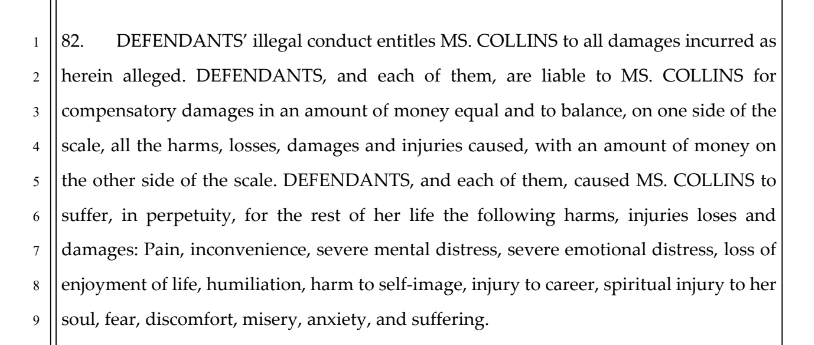
And what, exactly, is she suing over, given that she did not lose her job, nor a penny of her salary? Buckle up: Relieving her of her committee assignments is “illegal” and has caused Collins “spiritual injury to her soul” that will haunt her “in perpetuity, for the rest of her life.”
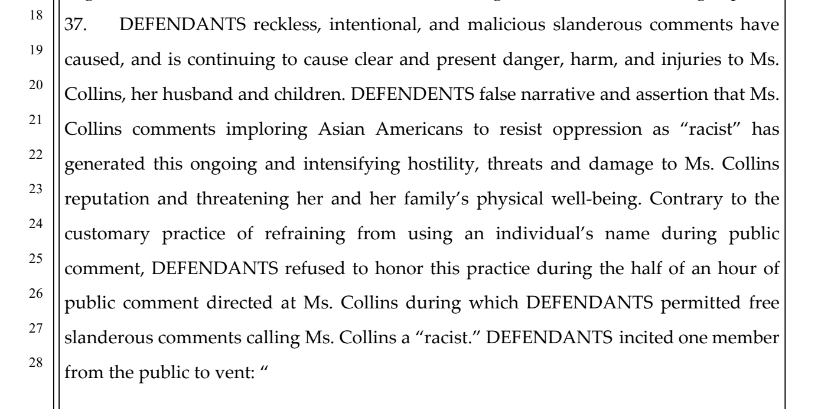
Also, allowing a 30-minute public comment period during a board meeting, in which some members of the public called Collins “racist,” caused Collins “clear and present danger, harm, and injuries.”
As Mason Hartman put it succinctly: “The complaint is essentially arguing that Alison Collins had a constitutionally-protected right to tweet racial slurs without (nonmonetary) impact to her employment, but that her fellow board members should have to compensate her for merely allowing the public to comment on them…I think Alison Collins might genuinely believe that it’s illegal to call her a racist.”
The suit also seeks additional damages from fifty unidentified defendants to be named later, for reasons to be determined later. No, really! It does! Gape at this amazing paragraph for yourself:
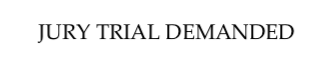
The suit dispassionately comments, in all caps: “JURY TRIAL DEMANDED.”
Have I mentioned that Collins, this tribune of the downtrodden seeking $87 million, is married to a wealthy real-estate developer who does tons of luxury condo and office development work in Frisco – work that requires approval from the same city government that employs her? Because she totally is.
Filing a crazy-eyed, off-the-wall lawsuit for $87 million against your own longtime partners in pernicious PLDDery, just because they refuse to let your bigoted tweets take them down with you?
I have only one thing to say to that: HIGGY DEMANDED.
Got my jab this week – Johnson and Johnson, one and done, and thank you to Grace Welcome Center of Kenosha! Please consider joining me in supporting the vital charitable work GWC does here in a community that’s still recovering from last year’s riots.
I can already feel the superpowers developing. I hope I get super speed. I could sure use the extra time for all my important, world-changing tasks, like mocking PLDDs on the internet.
As we approach the end of a pandemic that would never have affected most of the world in the first place if a bloodthirsty communist regime hadn’t covered it up with lies and murder, what better way to celebrate our impending return to freedom than by mocking those afflicted with Petty Little Dictator Disorder? The world over, they look at tyrannical oppressors and wistfully ask, “why not me?” – but never stop to consider that in their case, the question might have a really good answer.
Yes, it’s April Fool’s Day, so it’s time once again for the William Higinbotham Inhumanitarian of the Year Award – “The Higgy.” Each year, we (dis)honor the most (un)worthy candidate from your nominations of people afflicted with PLDD (not BSDD, note the difference).
Get your nominations in by April 15, Tax Day – definitely a day to discountenance petty little dictators!
To inspire you to greatness in discerning pettiness, we carry on immemorial Higgy tradition and reproduce below the text of Jay’s original post launching The Higgy. Good hunting!
********************
As someone who was recognized in 2006 as Time Magazine’s Man of the Year, I know a lot about the importance of awards highlighting people of significant accomplishment. Here on JPGB we have the Al Copeland Humanitarian Award, but I’ve noticed that “The Al” only recognizes people of positive accomplishment. As Time Magazine has understood in naming Adolf Hitler, Joseph Stalin, and Ayatullah Khomeini as Persons of the Year, accomplishments can be negative as well as positive.
Where were we? Oh yes. It is important to recognize negative as well as positive accomplishment. So I introduce “The Higgy,” an award named after William Higinbotham, as the mirror award to our well-established “Al.”
Just as Al Copeland was not without serious flaws as a person, William Higinbotham was not without his virtues. Higinbotham did, after all develop the first video game. But Higinbotham dismissed the importance of that accomplishment and instead chose to be an arrogant jerk by claiming that his true accomplishment was in helping found the Federation of American Scientists and working for the nonproliferation of nuclear weapons. I highly doubt that the Federation or Higinbotham did a single thing that actually advanced nonproliferation, but they sure were smug about it…
I suspect that Al Copeland, by contrast, understood that he was a royal jerk. And he also understood that developing a chain of spicy chicken restaurants really does improve the human condition. Higinbotham’s failing was in mistaking self-righteous proclamations for actually making people’s lives better in a way that video games really do improve the human condition.
So, “The Higgy” will not identify the worst person in the world, just as “The Al” does not recognize the best. Instead, “The Higgy” will highlight individuals whose arrogant delusions of shaping the world to meet their own will outweigh the positive qualities they possess.
We will invite nominations for “The Higgy” in late March and will announce the winner, appropriately enough, on April 15. Thanks to Greg for his suggestions in developing “The Higgy.”
OCPA carries my article making the case for universal ESAs, based on this question: what is education for?
Human nature points to a clear answer: education is child-rearing, and it belongs to parents. Human beings are not generic units, interchangeable and automatically functional, like the dollars in a teacher union’s bank account or the bubbles on a standardized test or the ones and zeros in a computer program. Human beings are unique creatures with unruly minds, hearts, and wills that are made to become mature, responsible, and free in a just community of equals. And it is obvious to anyone who knows the natural “facts of life” that the process of preparing a human being for mature freedom rests with families, since that is where human beings originally come from (the exact processes involved being a subject outside our current scope). To say that schools exist to educate is to say that they exist to help families rear their children.
Putting parents in charge of education is also the approach that aligns with the historic self-understanding of the American people. Our nation is dedicated to the proposition that we can live together, free and equal, through justice under the law based on human rights, rather than having to ground social order in the illiberal imposition of one person’s or one group’s way upon others. Only parental control of education can align our education system with this aspiration, allowing each family an equal right to raise its own children in accordance with its own beliefs, thus creating a just community in which all people are respected. A government school monopoly necessarily imposes conformity upon dissenters, unjustly relegating some citizens to an unequal position in the community. And since we all know this to be true, as long as the monopoly exists we will continue to see cultural groups mobilizing to fight culture wars for control of what views the government monopoly will teach. Thus the monopoly not only undermines justice by creating inequality and unfreedom, it keeps us whipped up in a state of hostility toward those who are different from us, undermining the universal goodwill for the dignity and rights of all people that the American experiment presupposes.
Come for the big vision of how education policy can be reconnected to these first principles, stay for the wonky discussion of why universal ESAs are the best way to do it.
OCPA carries my article on why school choice is the best criminal justice reform:
Six rigorous empirical studies have found that school choice policies reduce crime, and no studies find the opposite. Some of them study charter schools, which don’t empower parents as much as private-school choice does, but the principle is the same. Two studies of the private-school voucher program in Milwaukee, not far from where I live, found that graduates of the program were less likely to be convicted of crimes in their twenties. And don’t say that’s because the program attracts the less vulnerable students—in Milwaukee, as in most cities, school choice serves mostly poor and minority students. In any event, the studies compared matched student populations with similar backgrounds.
It’s not hard to see why school choice is proven to reduce crime. Putting parents back in charge of education is the key to educating children as if they were human beings, not economic widgets or political footballs. Education is preparing a whole person for a whole life—that’s just what the word means. Only parents can rightly control the process of preparing a whole person for a whole life, because childrearing is a parental function. Schools can carry out that function, but they can only do it rightly if they answer to the people who are supposed to be in charge of it.
When parents aren’t in charge, schools can’t treat students as human beings. The monopoly system turns schools into industrialized machines. That’s not because the teachers and principals are bad. It’s just the way the system has to work as long as it’s a government monopoly, no matter how well-meaning the people inside that system might be.
School choice is the only education policy proven to break the “school-to-prison pipeline.” Time to put up or shut up.
However, don’t shut up until you’ve let me know what you think!
OCPA carries Part 2 of my two-parter on the moral and pragmatic case for the free, open, growing, entrepreneurial economy. In this part, I address the delicate question of whether the American founders’ complicity in white supremacy, including the outright theft of massive amounts of economic value from black Americans, discredits the open economy:
For the sake of clarity, we need to differentiate three questions that are often lumped together as if they were the same question: Did America steal massive amounts of wealth from African-Americans in the form of forced labor? Was slavery a cause of America’s economic growth and success? And was the idea of equal rights and freedoms under the rule of law really an ideology of white supremacy?
The answer to the first question is an unambiguous yes….And the sheer quantity of economic value stolen is sufficient to stagger even the most powerful imagination. Lincoln wasn’t kidding around when he said that God would have been perfectly just to let the war rage on until every drop of blood spilled by slavers’ whips had been taken right back out of America’s hide with bullets and bayonets. Contemplating the horror of, say, Shiloh—in which almost 100,000 men spent two full days in what is essentially a big, flat, empty space doing nothing but slaughtering each other nonstop—we might well conclude that God really must be merciful if he let us off the hook that easily.
But the fact that America is guilty of having stolen massive wealth from African-Americans does not mean that the growth and success of the American economy was caused by that theft:
That slavery impeded rather than contributed to America’s economic growth and success has been established by the diligent labor of scholars like Phillip Magness, Nathan Nunn, and Stanley Engerman. But really, you only have to know the barest outline of the real history to see this. That the North was rich and the South poor because the former had rights and laws while the latter had whips and chains was always known (though not always frankly acknowledged) by everybody on both sides. The Union won the war precisely because its industrialized manufacturing economy could grind the Confederacy’s atavistic agrarianism—enslaved by slavery—into the ground. Enormous academic obfuscation has been necessary to produce a generation of Americans ignorant of these basic facts.
At a more fundamental level, to understand the actual history of America as it has really happened, in fact and not in the ideological fancies of racialists on the left and right, you have to grasp that our ideals of freedom and equality under the rule of law are in perennial conflict with the ongoing legacy of our historic racial injustices. The former is not a cover story for the latter that needs to be debunked and stripped away. The idea of freedom at the heart of the American experiment is the vital force that has always provided inspiration and focus to all who would destroy racial injustice:
It is true that America professed the principle of equal rights while practicing the perfidy of white supremacy. It does not follow that the former was simply a cover for the latter. On the contrary, the founders’ liberal principles were actually the deadliest enemy of their licentious practice. It has been precisely a dedication to our nation’s founding principles that has inspired good people in every generation of Americans to rise up against white supremacy in all the forms it has taken in this country.
The executive order issued yesterday by the president, whose headline suggests it creates a federal school choice program for students whose schools have gone all-remote, is vaporware. It creates no program, and what it does do would require about a year of sustained bureaucracy-wrangling and lawsuit-fending-off effort by the White House and the HHS secretary before it would produce any real effect. As you may have heard, the present administration has just a wee bit less than that amount of time before it’s replaced by an incoming administration that will kill the effort before it’s even mature enough to be described as embryonic.
And especially if it came from the current president.
The order directs the secretary of Health and Human Services to “take steps, consistent with law, to allow funds available through the Community Services Block Grant program to be used by grantees and eligible entities to provide emergency learning scholarships to disadvantaged families for use by any child without access to in-person learning.”
If you know anything about how government actually works, you can see the problems immediately:
1) The program is supposed to be created by HHS, which, like all federal departments, is staffed by career civil servants who are, on a good day, just barely responsive enough to the existence of their nominal superiors to engage in minimal efforts to pretend to comply with their orders. Actually getting a federal department to do something big and difficult – as this would be – requires tons of riding herd with a strong hand. Alex Azar could not just whip this off himself in his spare time even if he were an education policy expert, as opposed to a career pharmaceutical executive with no experience in education policy. (The need to rely on the bureaucracy is the obvious reason this assignment was not given to Betsy DeVos in the Education Department.)
PS At least the president timed this to arrive just at the moment when HHS is drowning in vaccine-rollout challenges!
2) Because this is a flagrantly unconstitutional usurpation of congressional appropriations powers, the federal “program” here is not an actual school choice program, it is a set of federal regulations (those are always quick and simple to write!) governing how recipients of block grants under an existing program are allowed to use their grant money. In other words, Azar is not being directed to create a school choice program (hard enough, see point #1), he is being directed to rewrite federal regulations in a way that will in theory induce federal block grant recipients to do so. It’s like the difference between trying to build a steel refinery out of empty cereal boxes and glue in an hour, and trying to get fifty other people to each build their own steel refinery out of empty cereal boxes and glue in an hour.
3) The above assumes an actual effort to wrangle the bureaucracy would be made. Given that Azar is not champing at the bit to do this, such an effort would require the president to drive it personally. The current president neither could nor would drive any such effort, for so many reasons that it sets a new standard for “overdetermined.”
4) Did I mention “flagrantly unconstitutional usurpation of congressional appropriations powers”? Wow, sure is a good thing the school unions don’t have any friends on Capitol Hill. Or know any lawyers. (When Arne Duncan dabbled in these shenanigans, Rick Hess and I both warned that he was creating a precedent the other party could use to justify its own abuses.)
School choice belongs in the states. If the feds want to get in on the action, they have tons of legitimate options – make the DC voucher universal, create choice on military bases, provide an ESA as an employee benefit for federal civil servants.
Instead we get this, which will only create a PR headache for the movement while helping no kids.
Since I recently mentioned my first-ever movie post, in which I correctly argued that Speed Racer was a better movie than Iron Man, I think I’ll close with Speed’s immortal words to the cheating Cannonball Taylor: “Get that weak shit off my track.”


 Posted by Greg Forster







 Jay P. Greene's Blog