Set Your Proton Packs to Ridicule: The First Four Years of Jayblog

April 9, 2012

(Guest Post by Matthew Ladner)

I remember a few years ago Dan Lips asked me if I would ever consider blogging. My reaction was something along the lines of “Naaaah, why would I want to do that?”

Four years in now, it is hard to imagine doing policy work without blogging. Blogging is a great way to test-drive ideas, get feedback, and have fun doing it. Nothing else moves with the speed of the modern conversation.

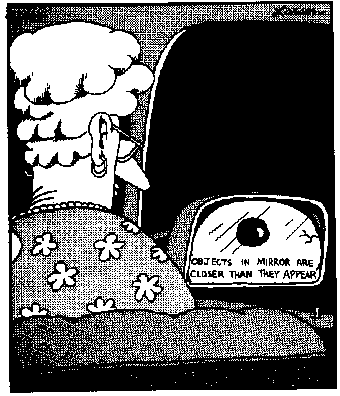
The story of this blog can be told using images as guideposts. Some images are associated not with a single post but rather a series of posts, starting with this one:

Blogs of course are the media equivalent of a pea-shooter, but with a careful aim you can put out an eye here and there.

The finest hour of the JPGB, in my opinion, came when Senator Durbin accepted marching orders from the NEA and attempted to pillow smother the DC Opportunity Scholarship Program. The strategy was to not reauthorize the law, and not to allow new students to enter the program, killing it by attrition. Similar to the British strategy to give arms to bloodthirsty loyalist hillbillies in the American South during the Revolutionary War, this strategy seemed shrewd at the time but backfired badly.

Once the dirty work was (temporarily) done, the Department of Education made a clumsy attempt to deep six the Congressionally mandated program evaluation by releasing it on a Friday with a spin doctored press release. That probably seemed like a great idea at the time as well.

One problem- the study itself was written in English and available online, and Jay reads English and blogs. Jay read the study and leapt into the fray, dubbing the incident “the Friday Night Massacre.” The Wall Street Journal and the Denver Post made inquiries regarding the handling of the study and let’s just say that the administration’s reaction subtracted from their already waning credibility on the matter.

From there, things just kind of got better and better. The Washington Post and the Wall Street Journal editorial pages administered regular beat-downs from both the left and the right. NRO’s Jim Geraghty summed up the Obama’s new position on D.C. vouchers:

We know our stance is indefensible; please make this issue go away.”

Eventually President Obama made the issue go away by reauthorizing the program in a budget deal, the best strategic course after bumbling into a sideshow that is costing more than it was worth. Many people deserve credit for saving the program, and Jay is one of them.

In the end, the underdogs won the debate in resounding fashion, kind of like this:

The next image is this one:

Greg’s bet with Washington Post columnist Jay Mathews proved to be great fun. Mathews wrote a piece opining that private choice was simply too politically difficult so he was sticking to charter schools.

Greg bet Mathews dinner that ten legislative chambers would pass either expansions or new choice programs in 2011.

Being a good sport, Greg raised the bar for himself to 7 enactments rather than legislative chambers when he blasted past 10 chambers in 3.6 seconds or so.

Greg ran up the score like John Heisman in 2011. I’m not sure whether he tripled up on Mathews in the end or not. He probably narrowly missed doing so, but the momentum carried over to 2012. So far we have a new tax credit program in Virginia, a tax-credit expansion in Arizona, a tax-credit expansion in Florida, and a major new voucher program in Louisiana. Greg’s original 2011 bet has already been exceeded in 2012, and even his higher bar bet of 7 enactments isn’t inconceivable this year. I now think of Greg’s original bet as the over/under for a good/bad year for the parental choice movement.

No word yet on where Mathews took Greg for dinner nor how much effort it took not to gloat.

Big Think Pieces

I like Greg’s listing of favorite Big-Think pieces, and there are some common threads between them. Greg for instance did an outstanding job laying out why most education reform efforts tend to go nowhere under the current system.

My favorite Jay Big Thinker came when Goldstein-Gone-Wild asked Jay what he would do if he ran the Gates Foundation in the comments section. Jay replied: build new, don’t reform old. If someone appointed me King, I’d make that post required reading for philanthropists as my first official act.

My second official act would probably involve a redirected asteroid and College Station Texas. If they promised to stop the belly aching about the Longhorn Network, I could be persuaded to allow an evacuation.

The Big Thinkers I had the most fun writing both came early in the blog: The Way of the Future in American Schooling and Indiana Jones and the Teacher Quality Crusade. Reasoning by pop-culture analogy got to be a fun habit, which leads us to…

Parodies

A friend of mine once asked me if I had ever noticed that people tend to think of people just to the left of them as communists, and people just to the right of them as fascists. Only the self stands in exactly the correct spot of thoughtful perfection.

I’ve always kept this jest in mind as a pretty powerful argument in favor of being broad-minded and open to the possibility of needing to perform an occassional mental update.

Nevertheless, the opportunity to unleash a good parody now and then certainly can liven up an otherwise dry discussion.

For instance, the desirable degree of state oversight of a private school choice program is an important topic, but usually a bit on the dry side. Okay, more than a bit.

Despite the fact that I have more than a little sympathy for the point of view parodied, I never laughed so hard at a blog post as I did with with Greg’s AWWWW FREAKOUT!!!  post regarding attacks from the Cato Institute on the new Indiana voucher program.

No, I take it back-Greg’s post on the UFT Card Check, while not a parody itself (more like the documentary of the UFT performing an unintentional self-parody) was the inspiration of so many lampoons that it has to stand as the funniest post of the first four years. Jay’s Fordham Drinking is up there as well.

Of the lampoons I have written, Little Ramona’s Gone Hillbilly Nuts, AFT suggests LBO for Public Schools and JK Rowling: The Jeb Bush of NEPC’s Florida Fantasy were the most fun to write.

What’s Next?

Facing a cannon barrage from a gigantic Turkish army, Baron Munchausen declared to his bedraggled henchmen “They are inviting us to defeat them! We must oblige them!”

No one knows what will happen around the next bend, but my advice is to grab your pea-shooter and take aim. It’s been a blast for us so far, and it isn’t like the bad guys show any sign of slowing the rate of demonstrably false claims.


Favorites from Four Years in the Rearview

April 9, 2012

(Guest post by Greg Forster)

Jay P. Greene’s Blog turns four years old on April 19. To mark the occasion, Jay, Matt and I are each going to pick our favorites from one another’s posts. I’m glad Jay decided that where there are three major contributors to an accomplishment, all three should be honored – unlike some people I could mention.

It has been a real joy and a huge privilege to be part of all we’ve accomplished in the past four years. And it has been as fun as just about anything I’ve ever been part of.

Picking only these posts out of the dozens I wanted to include was tough. I’m still so, so close to reopening this and adding a couple more. But no – here are my picks.

Greg’s Favorite Jay Posts

Gates Foundation Follies, Part 1 and Part 2, July 25-26, 2011

The fight over national standards has consistently brought out the very best of Jay, both on the intellectual side and the humor side. To me, though, this two-parter is the keystone. More or less all the important issues are touched on here, and in a form that shows the broader applications of these insights for education reform generally. My favorite of my own “bigthink” posts (see below), which ended up bringing together the intellectual strands I had been strugling to integrate over numerous previous posts, was basically just my philosophical ruminations in response to Gates Foundation Follies.

The Dead End of Scientific Progressivism, January 18, 2011

Though occasioned by the fight over national standards (see above re “brought out the very best of Jay”) this post has much wider relevance. The nature of science and how it relates to policy is an issue of perennial importance for those in our line of work.

Al Copeland: Humanitarian of the Year, December 15, 2008

The post that started it all! One of the best things about JPGB has to be the annual Al Copeland award, and all of that got rolling because Jay did such a great job with this initial post. I can’t wait for the fall – I’m already working on my nominees for this year!

We Won!, September 29, 2010

When you get way down into the weeds, it can be hard to see the forest for the trees. (Hey, that’s not even a mixed metaphor!) At a moment when many in the movement were starting to lose confidence, Jay saw the big picture. Subsequent events have only vindicated his predictions.

Build New Don’t Reform Old, August 2, 2011

A great statement of an important point. Smart policies and quality personnel are not all that matters – institutions themselves have their own importance. And they’re really, really, really hard to change. I predict this point is only going to become more relevant to the ed reform discussion in the years ahead.

Gimme! Gimme! Gimme!, February 17, 2011

“It’s over for the little guy.”

Greg’s Favorite Matt Posts

The Way of the Future in American Schooling, May 12, 2008

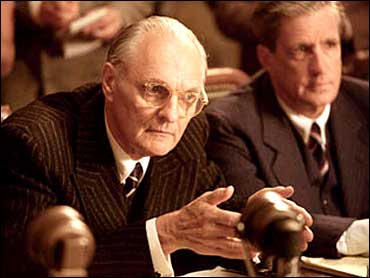
Matt has given this blog almost all of its most powerful images: Meg Ryan and “I’ll have what Florida is having”; Jack Black and “Rock star pay for rock star teachers”; Kenneth Branagh and “The Democratic Party of story, myth, and song.” But no image has been more powerful than Leo DiCaprio’s Howard Hughes pointing us toward “the way of the future in American schooling.” The thing that has always come back to my mind, even four years later, is Matt’s edu-appropriation of Alan Alda’s sneering senator: “It’s not me, Howard. It’s the United States government. We just beat Germany and Japan. Who the hell are you?” He’s an entrepreneur. He makes this country. People like you just live in it.

AFT Suggests LBO for Public Schools, December 11, 2008

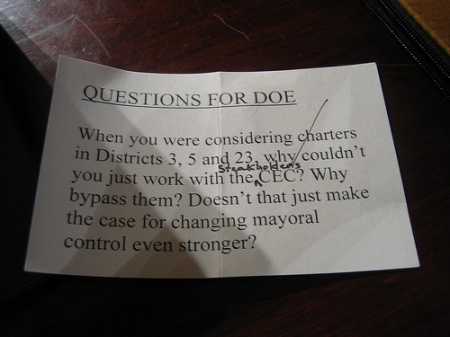
Matt has also given us some of our most powerful well-deserved mockeries. He dubbed Diane Ravitch “Little Ramona” and kicked off the notorious “Questions for Leo” and “Famous Steakholders” series. But no mockery has ever shamed its target more delightfully than Matt’s appointing of this blog’s first and only Sith apprentice, Darth Leo.

Checker Says RELAX!, July 29, 2010 and The Gates Foundation and the Rise of the Cool Kids, October 28, 2011

As great as Jay’s skewerings of Fordham have been, and as much as I’ve enjoyed my own forrays into that genre, Matt’s “Don’t Worry, Be Happy” themed post still sticks out in my mind as the leading entry. But Matt also brought some much-needed balance and perspective to the discussion of national standards in his wise reflections on the good work Gates has done and the deeper sources of our anxieties about their role. The final sentence of “Gates and the Rise” took guts and was very well said.

Al Copeland Humanitarian Nominee: Herbert Dow, October 8, 2010

Inspiring tale of a man who stuck his neck out to destroy an exploitative system and make the world a better place for everyone – except the leeches. Goosebumps!

Clousseau vs. Cato (Institute) and Cateaux!, April 22, 2011

Sometimes a pop culture reference fits so perfectly in every way that it’s hard to view it as anything but divinely ordained. “I rescind zee ordeur! CATEAUX?!?!?”

Greg’s Favorite Greg Posts

Command v. Choice, Part 1 and Part 2, July 26-27, 2011

When you get past all the details to look at the big picture, this is the best summary of what I want to say about education reform, nicely wrapped up in a two-part post. It feels good to finally get it off my chest! In my earlier four-part series on “Academics v. the Practical” I was struggling to integrate a lot of intellectual strands that had been developing over four years of writing for JPGB. Then I read Gates Foundation Follies (see above) and pieces began falling into place.


“No, I’m Not Going to Stand Somewhere Else,” October 14, 2010.

What Wim Nottroth did just blows me away. I’m honored to think that I’ve helped introduce more people to his story. And I still hold out hope that somewhere, Molly Norris (who left a comment on my “Nobody Draw Mohommad” post) read it and felt challenged by it. I’m also honored to have submitted a winning entry in the legendary Al Copeland competition! My most important contribution to “The Al” before that was another post I’m really proud of, but one that couldn’t have won because I was explaining why the inventor of the video game, William Higginbotham, was unworthy of the award.

City of the Dark Knight, Issue 0, Issue 1, Issue 2, Issue 3, Issue 4 and Issue 5, July 25-September 5, 2008

Of all the stuff I’ve done on JPGB, my favorites are heavily clustered in my pop culture coverage. Going all the way back to Speed Racer Is Better than Iron Man and including the James Bond posts, Ponyo, All Time Great Summer Movies, and Favorites of the Aughts. Good times! But the Dark Knight series remains my top pick of the lot.

The UFT’s “Cue Card Check,” April 15, 2009

The post that launched a thousand richly deserved mockeries. We’re still getting mileage out of it.

Vouchers: Evidence and Ideology, May 8, 2008

My first “bigthink” post, and emblematic of what would become a major theme here at JPGB – getting into protracted fights with purveyors of nonsense.

Here’s to the next four years of data, logic, deep thoughts, Al Copeland awards, pop culture apocalypses and general hilarity!

“Four more years! Four more years!”


Ed Week on Distorted Special Ed Counts

March 15, 2012

(Guest post by Greg Forster)

Ed Week dives into details on the difficult issue of how special education counts get distorted by a variety of factors. The article gets into a lot of interesting issues that make it difficult to get a clear picture of how many disabled students are served by the program. See also here for the researchers’ take on the issue.

One factor not canvassed in the Ed Week story – unsurprisingly – is the role of financial incentives in public school special education programs. Public schools are incentivized to label studnets as disabled in order to access additional funding. Study after study after study after study has confirmed the empirical relationship between the presence and strength of these incentives and rising rates of special education diagnosis in public schools. Private schools have no such distorting incentive and will thus report lower numbers of disabled students. (All this is true regardless of whether you think the true rate of disabilities is higher, as in the public system, or somewhat lower, as in the private system.)


Here’s Why Victory Looks Like This

March 7, 2012

(Guest post by Greg Forster)

Jay points to the way Democrats and progressives are now saying all the same things we’ve been saying for a decade, but acting like they thought of them, and remarks that this is What Victory Looks Like.

He’s right, and here’s why. To large extent, you have to let people “steal” your ideas in order to get victory. It’s not just a price we need to be willing to pay if necessary. It’s always necessary.

Major reform of a cultural system has to start with ideas and practices germinating outside the core institutions of that system. If major reform were welcome inside the core institutions, it wouldn’t be necessary in the first place. The incubators of reform can’t be seen as fringe groups – this is why organized libertarianism has had much less influence than its intellectual seriousness and devotion of financial resources might lead you to expect. But the reform incubators are never going to be inside the core, either. You need something that’s a happy medium between credibility and independence.

Now, for a long time in America, the Democratic party and the progressive ideological movement have been the “core” institutions governing education. When you ask the American people whom they trust to do the right thing about education, they overwhelmingly say Democrats and progressives. That makes them the core.

The key to victory is to get the core groups to adopt the ideas that incubated in institutions outside the core. The greatest challenge is that the core groups want to defend their “core” turf against outsiders. They want to keep control of the core, and they can’t do that if they admit that outsiders have superior ideas. The solution is to get the core groups to co-opt (i.e. steal) the ideas and pretend they thought of them.

So you’re never going to get (very many) Democrats and progressives saying, “Why, yes, as a matter of fact the conservatives were right about education all along!” Admitting that would require them to sacrifice their status as the cultural core institutions of American education. Instead they’re going to say, “What American schools need are good, liberal, progressive ideas like choice, competition, and accountability.”

That’s what victory looks like.


This Deal Is Getting Worse All the Time

February 23, 2012

(Guest post by Greg Forster)

Shorter Arne Duncan: The U.S. Department of Education is not pressuring states to adopt Common Core. However, any state that takes action to resist Common Core will be immediately singled out by the Education Secretary for an extremely harsh public denunciation of its education system – which will obviously make it effectively impossible for the Department to look favorably upon that state when doling out grants and waivers for the foreseeable future.


School Choice Researchers Unite in Ed Week

February 22, 2012

Pictured (L to R): Rick Hess, Jay Greene, Greg Forster, Mike Petrilli and Matt Ladner

(Guest post by Greg Forster)

Today, Education Week carries a joint editorial signed by nine scholars and analysists. We came together to agree that Mom and apple pie are good, Nazis and Commies are bad, and the empirical research supports the expansion of school choice:

Choice’s track record so far is promising and provides support for continuing expansion of school choice policies…Among voucher programs, random-assignment studies generally find modest improvements in reading or math scores, or both. Achievement gains are typically small in each year, but cumulative over time. Graduation rates have been studied less often, but the available evidence indicates a substantial positive impact. None of these studies has found a negative impact…Other research questions regarding voucher program participants have included student safety, parent satisfaction, racial integration, services for students with disabilities, and outcomes related to civic participation and values. Results from these studies are consistently positive…

In addition to effects on participating students, another major topic of research has been the impact of school choice on academic outcomes in the public school system…Among voucher programs, these studies consistently find that vouchers are associated with improved test scores in the affected public schools. The size of the effect in these studies varies from modest to large. No study has found a negative impact.

We have diverse viewpoints on many issues, but we share a common commitment to helping inform public decisions with such evidence as science is legitimately able to provide. We do not offer false certainty about a future none of us knows. But the early evidence is promising, and the grounds for concern have been shown to be largely baseless. The case for expanding our ongoing national experiment with school choice is strong.

This may well be the most important part:

The most important limitation on all of this evidence is that it only studies the programs we now have; it does not study the programs that we could have some day. Existing school choice programs are severely limited, providing educational options only to a targeted population of students, and those available options are highly constrained.

These limitations need to be taken seriously if policymakers wish to consider how these studies might inform their deliberations. The impact of current school choice programs does not exhaust the potential of school choice.

On the other hand, the goal of school choice should be not simply to move students from existing public schools into existing private schools, but to facilitate the emergence of new school entrants; i.e., entrepreneurs creating more effective solutions to educational challenges. This requires better-designed choice policies and the alignment of many other factors—such as human capital, private funding, and consumer-information sources—that extend beyond public policy. Public policy by itself will not fulfill the full potential of school choice.

Although I also feel particularly strongly about this:

Finally, we fear that political pressure is leading people on both sides of the issue to demand things from “science” that science is not, by its nature, able to provide. The temptation of technocracy—the idea that scientists can provide authoritative answers to public questions—is dangerous to democracy and science itself. Public debates should be based on norms, logic, and evidence drawn from beyond just the scientific sphere.

Signatories:

Kenneth Campbell is the president of the Black Alliance for Educational Options, in Washington.

Paul Diperna is the research director for the Friedman Foundation for Educational Choice, in Indianapolis.

Robert C. Enlow is the president and chief executive officer of the Friedman Foundation for Educational Choice.

Greg Forster is a senior fellow at the Friedman Foundation for Educational Choice.

Jay P. Greene is the department head and holder of the 21st-century endowed chair in education reform at the University of Arkansas, at Fayetteville, and a fellow in education policy at the George W. Bush Institute, in Dallas.

Frederick M. Hess is a resident scholar and the director of education policy studies at the American Enterprise Institute, in Washington, as well as a blogger for Education Week.

Matthew Ladner is a senior adviser for policy and research at the Foundation for Excellence in Education, in Tallahassee, Fla.

Michael J. Petrilli is the executive vice president of the Thomas B. Fordham Institute, in Washington.

Patrick J. Wolf is a professor and holder of the 21st-century endowed chair in school choice at the University of Arkansas, at Fayetteville.

Our color-coordinated mechanical lion battle chariots that join together into a giant robot are still under construction.

Defender of the empirical research universe!


Captain Hammer’s National Standards Will Save Us!

February 6, 2012

(Guest post by Greg Forster)

Michael Winerip had a doozy of a column over the weekend, exposing what look like some really seriously dumbed down state standards in New York. But don’t worry! Just like Captain Hammer, national standards are here to save us.

There’s no doubt Winerip has what looks like a pretty damning indictment of the NY English Regents exam. Here are some actual student responses that the state grading guide says should get middling or even higher scores:

  • These two Charater have very different mind Sets because they are creative in away that no one would imagen just put clay together and using leaves to create Art.
  • In the poem, the poets use of language was very depth into it.
  • Even though their is no physical conflict withen each other. Their are jealousy problems between each other that each one wish could have.
  • In life, “no two people regard the world in exactly the same way,” as J. W. von Goethe says. Everyone sees and reacts to things in different ways. Even though they may see the world in similar ways, no two people’s views will ever be exactly the same. This statement is true since everyone sees things through different viewpoints.

Bear in mind that these are not just examples pulled from student exams that actually got middling or higher scores. These are examples held up in the state scoring guide as examples of answers that should get middling or higher scores. In effect, the state is mandating low standards from the top.

But don’t worry!

They are also counting on a new set of national learning standards, known as the common core, which are currently being developed in more than 40 states. The hope is that more sophisticated standards detailing what children should know, coupled with more sophisticated curriculums and exams, will result in a more rigorous public education system.

“The D.O.E./Board of Regents position on the passing score for this exam, with attention to college and career readiness, will be re-examined in conjunction with administering a revised exam in this subject area aligned to the Common Core State Standards,” a spokesman for [New York State education commissioner] Dr. [John] King wrote.

Thank heaven! The exact same people who produced the current mandatory dumbing down are now going to produce a new set of standards. Surely that will result in a lifting of standards!


At Last, a Good Failing-Schools Voucher

February 1, 2012

(Guest post by Greg Forster)

Louisiana Governor Bobby Jindal is pushing a very ambitious education reform plan that includes a big failing-schools voucher. In general, I’m a skeptic of failing schools vouchers. This one, though, really has the potential to be transformative. It would still fall short of a universal voucher in important ways, of course, but it would fall a lot less short than previous failing schools vouchers.

The first failing schools voucher was Florida’s A+ program. It was a good program that created a lot of improvement in public schools in its first yeras. But few people appreciate what a nightmare it was on the administrative side, partly as an inevitable result of its failing-schools design, and partly because the state DOE took advantage of the opportunities that design created for mischief. That almost certainly contributed to the fall-off in its impact on public schools in later years.

I discussed these issues at length in my last study of the Florida program:

There were a number of unusual obstacles, not present in most voucher programs, that kept participation rates for A+ vouchers unusually low. A certain amount of this kind of diffi culty is inherent in the “failing schools” model of vouchers, where students’ eligibility for vouchers is determined by the academic performance of their public schools. Every year, a new set of parents need to be reached with the message of what vouchers are and that they are eligible for them; there can be no gradual building up of information about the program among a fi xed population that is always eligible. However, in the A+ program the worst obstacles were not inherent in the program design, but were imposed by the Florida Department of Education as part of its implementation…

School grades were (and still are) announced in the summer. The timing of the announcement does not follow a set schedule every year and thus is unpredictable. Once the state announced school grades, determining which schools were eligible for vouchers, parents had only two weeks to apply for the program. If they missed this fleeting application window, they could not apply later.

The extremely short two-week eligibility window was a major obstacle to participation. This difficulty was greatly compounded because parents did not know whether they were eligible until school grades came out, at which point the two-week clock began ticking. Moreover, parents did not even know when the announcement of the grades might be coming.

This combination of factors made it extremely difficult to keep parents informed. Nobody knew in advance of the application window which parents would be eligible, and nobody knew in advance when the announcement would come. And once the announcement came, there were only two weeks to get from a starting point of zero information to an ending point of parents submitting their applications for vouchers. Many—possibly even most—parents probably would not even have known that their children were eligible for the program until it was too late to apply.

Another disadvantage is the dynamic of media coverage, which is where most parents get their information about programs of this type, especially when there is no opportunity for a long-term building of knowledge in a fi xed population by word of mouth. When two schools were designated as eligible for vouchers in 1999-2000, naturally media attention focused on those two schools. This would have helped parents in those neighborhoods find out about the program. Or again, in 2002-03, when a substantial number of schools became eligible for vouchers after two straight years with no schools eligible, that was a big news story.

These two years are both instances of how a failing schools voucher program can create “shock value,” but thing about shock value is that it doesn’t stay shocking forever. In years after 2002-03, A+ vouchers were no longer the news story they were in that year. This would have made it less likely that parents would hear that they were eligible for vouchers…

These obstacles help explain why, as a previous analysis has found, the A+ voucher program is the only voucher program ever to see long-term declines in its participation rate…Since the A+ program is the only voucher program ever to see a long-term decline in participation rates, it is reasonable to attribute this decline to the unique obstacles to participation that were imposed on the program by the Florida Department of Education.

Then there’s the Ohio EdChoice program, which, like Florida’s A+, only serves a small population of schools and has a positive impact on public school performance but a modest one.

The Jindal plan, by contrast, would give a voucher to all students below a certain income in schools that get a C, D or F. That adds up to almost 400,000 eligible students, over half the state population. While changing eligibility from year to year would still be present, it would be greatly mitigated both by the lower performance bar for school eligibility (schools that change grades within the A-B range or C-F range won’t change eligibility) and also by the large amount of attention generated by such a large eligibility pool. When more than half the state’s students are eligible for choice, people will know that choice exists!

I continue to think that only universal choice will really get education out of the rut it’s in. But this would be a huge step in that direction.


Friedman Foundation Releases 2012 ABCs

January 24, 2012

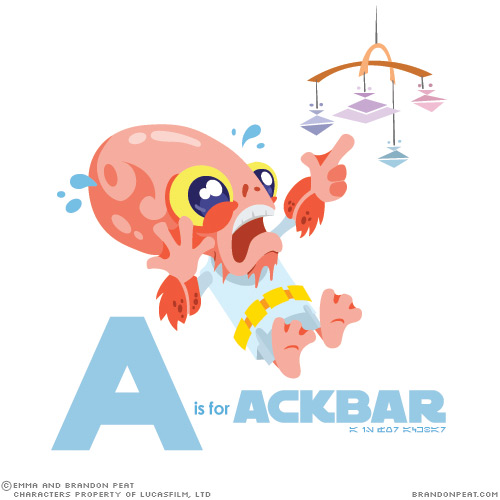
HT Brandon Peat Design

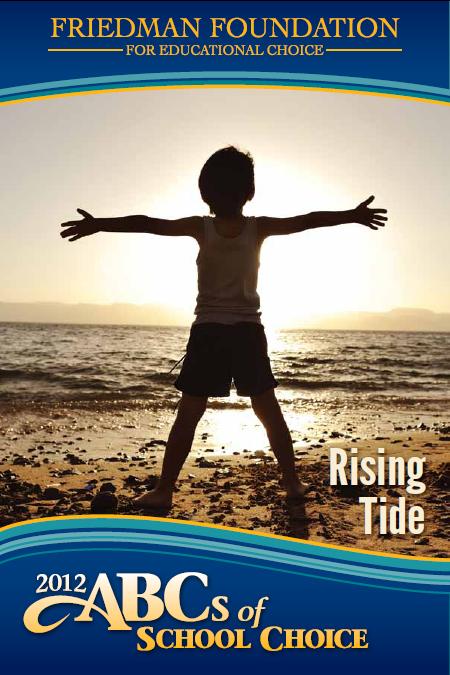
The Friedman Foundation has just released the 2012 edition of its annual publication ABCs of School Choice. It’s a busy week for releases!

There’s much to celebrate this year:

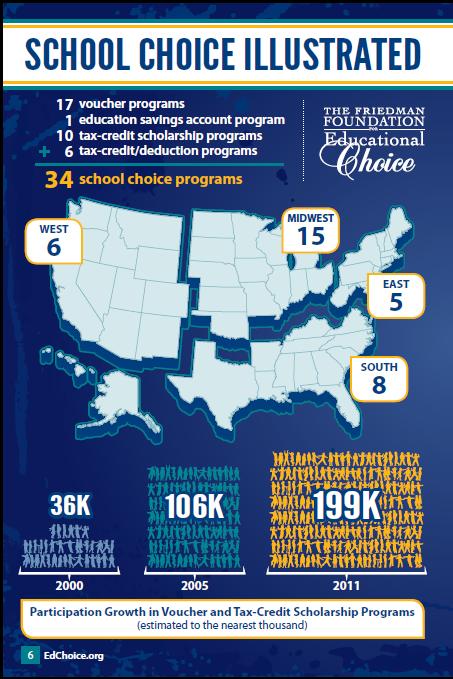
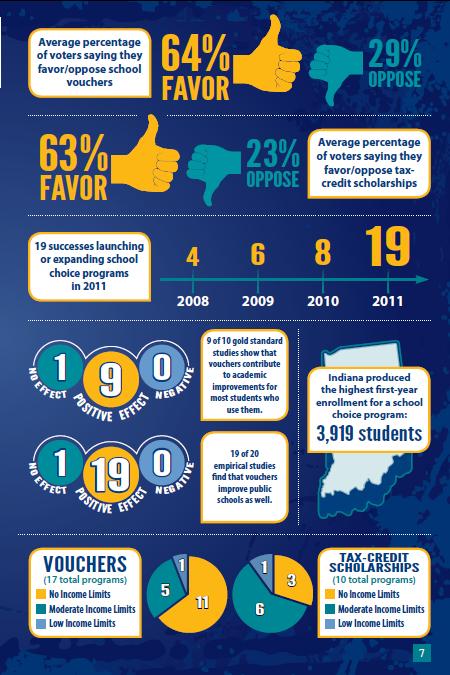
Milton and Rose D. Friedman envisioned a true revolution in American education. Their ideal was simple but powerful: give every parent the power and freedom to choose their children’s education. Unquestionably, 2011 was a breakthrough year in the quest to see that vision achieved in the United States. Thirteen states enacted school choice programs (this includes Washington, D.C., and Douglas County, Colorado). A total of 19 programs were enacted or improved—including the creation of eight new programs and the expansion of 11 existing ones.

Appropriately, this year’s report is subtitled Rising Tide. Check it out!

That’s a pretty big improvement over the plain text and little silhouettes of states it used to consist of when I edited it. Kudos!


The Value-Add Map Is Not the Teaching Territory, But You’ll Still Get Lost without It

January 11, 2012

(Guest post by Greg Forster)

Since we’re so deep into the subject of value-added testing and the political pressures surrounding it, I thought I’d point out this recently published study tracking two and a half million students from a major urban district all the way to adulthood. (HT Whitney Tilson)

They compare teacher-specific value added on math and English scores with eventual life outcomes, and apply tests to determine whether the results are biased either by student sorting on observable variables (the life outcomes of their parents, obtained from the same life-outcome data) or unobserved variables (they use teacher switches to create a quasi-experimental approach).

Finding?

Students assigned to high-VA teachers [i.e. teachers who produce high “value added” on test scores] are more likely to attend college, attend higher- ranked colleges, earn higher salaries, live in higher SES neighborhoods, and save more for retirement. They are also less likely to have children as teenagers. Teachers have large impacts in all grades from 4 to 8.

Let’s bring that down to reality:

Replacing a teacher whose VA is in the bottom 5% with an average teacher would increase students’ lifetime income by more than $250,000 for the average classroom in our sample.

But here’s what I want to pay the most attention to. Note the careful wording of the conclusion:

We conclude that good teachers create substantial economic value and that test score impacts are helpful in identifying such teachers.

Note what they don’t say. They don’t say that increasing math and English test scores by itself leads to improved life outcomes. They say good teachers lead to improved life outcomes, and value-add is one relatively good way to identify good teachers.

You’ve heard the saying that the map is not the territory? (If not, that means you haven’t seen Ronin, in which case shame on you.) Well, it’s true. What raises life outcomes is good teaching, and good teaching can’t be reduced to test scores. (See here, here, here, here, here, here, here and here.)

But if you want to find your way around the territory, you need a map. If you want to help those kids stuck with lousy teachers who are out a quarter million, you’re going to need a tool that identifies them. Value added analysis is the best tool we’ve come up with yet – other than parental choice, of course.

And where the tests are freely selected and voluntarily adopted by schools, the tests provide helpful data for parents, so parent choice is strengthened by voluntary testing. That’s why over 90% of private schools use testing in some form. On the other hand, forcing teachers to use a test they don’t believe in is a self-defeating proposal.

But how do you get schools to want to use a test? Parent choice, of course! Choice is what creates the external standard of performance that makes assessment tools seem legitimate rather than illegitimate. So testing and choice are like chocholate and peanut butter – they’re two great tastes that taste great together.