Choice Remarks carries my article on OU President David Boren’s proposal to solve our education problems by throwing money at them – and doing so totally indiscriminately. Here’s one part of the proposal:
Another $125 million would go to higher education to keep down tuition and fees.
I’ve been taking a close look at DC education, and I must say I’ve learned a lot- both good and bad. One of the bad things would be these charts from the Urban Institute showing that private schools are going the way of the Dodo in the District of Columbia. K-5 is above and grades 6-8 below:
A couple of notes: we’ve known for some time that charter schools hit private schools harder than districts- and well here you have it again. Also note that the collapse comes in spite of the DC Opportunity Scholarship Program starting in 2004. DC’s charter school law effectively operates as a universal school choice program that reliably delivers more than $14k in funding to all comers, but limits the universe of schools to young and/or startup schools.
The DC Opportunity Scholarship program meanwhile only offers a maximum of $8,381 per child for students in K-8, and unless it is both reauthorized and redesigned one cannot help but wonder if there will be many private schools for these students to attend in the years ahead. Please someone explain to me how it makes sense for a charter school law to operate as a defacto universal choice program at $14k per child, while the private choice program offers substantially less per child and only to poor children. The Urban Institute data clearly indicates that this is a recipe for extinction of the private school sector outside of elite institutions. To put matters bluntly- who in their right mind would seek to open a private school in preference to a charter school in DC under this system of finance? Did you miss the part where private schools have been dropping like flies while charter schools proliferate? The funding for charters is large, universally available and reliable. The funding for DC Opportunity Scholarships is small, restricted and uncertain.
It’s little wonder why a number of D.C. Catholic schools gave up the ghost a few years ago and converted into charter schools. The school financing system practically clubbed them over the head. I’d like to invite my friends from the pro-means testing wing of the private choice movement to reflect upon the viability of supporting DC style scholarship programs when those programs must compete with defacto universal choice programs with far greater funding. Who wins that battle? Sadly the universal program restricts eligibility to young/startup schools with limited curricular diversity- how does this make sense? If parents decide to extinguish private schools as a result of a remotely equitable competition, you won’t see me shedding any tears. Our currently policies however make it look like we are out to quash private schools kind of like, well, this:
The historical role of anti-Catholic bigotry in fueling opposition to school choice is well known. Justice Clarence Thomas recounted it in Mitchell v. Helms(2000):
[H]ostility to aid to pervasively sectarian schools has a shameful pedigree that we do not hesitate to disavow. […] Opposition to aid to “sectarian” schools acquired prominence in the 1870’s with Congress’s consideration (and near passage) of the Blaine Amendment, which would have amended the Constitution to bar any aid to sectarian institutions. Consideration of the amendment arose at a time of pervasive hostility to the Catholic Church and to Catholics in general, and it was an open secret that “sectarian” was code for “Catholic.” […] Notwithstanding its history, of course, “sectarian” could, on its face, describe the school of any religious sect, but the Court eliminated this possibility of confusion when […] it coined the term “pervasively sectarian”–a term which, at that time, could be applied almost exclusively to Catholic parochial schools and which even today’s dissent exemplifies chiefly by reference to such schools. […]
In short, nothing in the Establishment Clause requires the exclusion of pervasively sectarian schools from otherwise permissible aid programs, and other doctrines of this Court bar it. This doctrine, born of bigotry, should be buried now.
Sadly, it is far from buried. Some opponents of greater parental choice in education still find religious bigotry to be a useful tool in pushing their agenda. Consider the following excerpt from this (factually challenged) letter to the editor from Charles Sumner, president of the Nashville chapter of Americans United for Separation of Church and State:
After the Memorial and Remonstrance against Religious Assessments was circulated in Virginia by Madison and Jefferson, our nation decided we would never again send tax money to religious groups.
When I asked the principal of a Nashville Muslim school, I was told they would accept vouchers. However, most mainline religious groups are not known for having schools.
What an interesting choice of religious affiliation to cite as an example. Perhaps Donald Trump suggested it? And how helpful of Mr. Sumner to note that Islam is not “mainline”! [wink wink, nudge nudge] Apparently neither are the Catholics, since “mainline” religious groups apparently send their kids to the government-run schools, like they’re supposed to.
Although we disagree over school choice, Americans United has admirably defended religious minorities like Muslims when they experience persecution. Do the higher ups at Americans United know that a chapter president is not-so-subtly exploiting anti-Muslim bigotry for political ends? And what do they intend to do about it?
I highly doubt that the Americans United executives are themselves bigoted, but it’s worth noting that their reasons for opposing school choice today closely resemble those of the anti-Catholic bigots a century ago. When Catholics asked for public funding of their schools just as the Protestants received for theirs (i.e., the supposedly “public” schools), the Protestant establishment responded that the Catholics certainly had the right to open their own schools, but that they shouldn’t expect public funding because their schools were “sectarian” whereas the public schools were open to everyone.
Of course, that was true only in theory. In practice, the public schools reflected the views of the, shall we say, mainline religious groups, so Catholics had to choose between sending their children to schools that taught beliefs contrary to their own or opening their own schools.
When what is taught is schools is decided through a political process, there will be winners and losers. Politics is a zero-sum game. At best, the majority will have their views reflected in the schools and minorities will not. At worst, a well-organized minority will impose its will over even the majority. But even in the best case scenario, minorities like Catholics, Muslims, Jedi, etc. lose out:
Let’s consider an imaginary “public” school district where there are three groups of people: Hobbits, Ewoks, and Terrans. Each groups has very different and passionately held views about what should be taught in school and how it should be taught. All three groups are required to pay taxes to support the district school, which is ostensibly nonpartisan, nondenominational, and open to all. However, the majority of the district is Terran so the school reflects the Terran preferences. When the Hobbits and Ewoks open their own schools and seek equal per-pupil support from the local government, the indignant Terrans respond that the district school is meant for everyone. “It’s your right to open your own schools,” explain the Terrans, “but it’s your responsibility to pay for them.” Thus the majority brazenly forces minority groups either to abandon their values or to pay for two school systems. And lower-income minorities may have no choice at all.
A system of school choice, by contrast, enables minority groups to enroll their children in schools that align with their values without placing upon them the burden of supporting two school systems.
At the very least, Americans United should repudiate Mr. Sumner’s comments and take appropriate disciplinary action. Better yet, they should rethink their approach to education in a pluralistic society.
Recently I made an off-hand comment about Arizona NAEP gains being like the problem with the orbit of Mercury. I decided that it would profit from some further explanation. Newtonian mechanics seemed to have everything figured out, with that nagging problem of the orbit of Mercury doing something it shouldn’t. The “problem” with the orbit of Mercury of course wasn’t really a problem at all. It turned out to be a problem with our incomplete understanding of how the universe works- as illustrated in the above video.
So just how do Arizona NAEP scores resemble the orbit of Mercury? The 2015 NAEP shows that Arizona charter school students scoring in the range of New England states. Arizona charter schools serve a majority minority student population and spend only $8,041 per student- about a thousand less per student than Arizona districts and far less than the average spending in New England states.
Arizona’s AZ Merit exam demonstrated even larger gaps between charter and district scores than the NAEP, providing external validation for the NAEP scores.
Look at those guys! Their NAEP scores are going to collapse!
A little before the release of the 2015 NAEP, Mike Petrilli offered a friendly bet of a beer to me and Lisa Graham Keegan that Arizona’s NAEP scores would go down between 2013 and 2015 based on economic difficulties. We both instinctively thought they would go up, and they did. We are thirsty Mike! Taking a longer term view of the entire Great Recession period however proves more revealing.
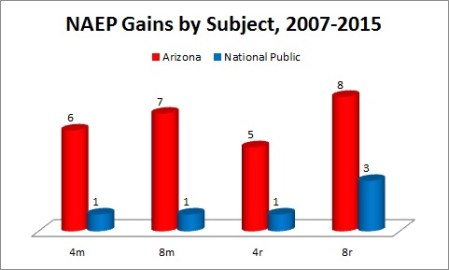
Arizona scores have improved at six times the national rate on 4th grade math, 7 times the national rate on 8th grade math, five times the rate on 4th grade reading and 2.67 times the rate on 8th grade reading. How did a state that saw a decline in inflation adjusted spending per pupil drop from $9,438 in 2007 to $7,828 in 2014 (see JLBC doc link above) manage to outpace the nation in progress by such a wide margin? District interests here have a non-stop mantra about Arizona’s relevantly low ranking in per pupils funding but, er, why are we outpacing the nation by such a wide margin even as our funding declines?
Whoa- that’s unpossible!
Something is wrong here- but it is not Arizona’s positive score trends. What is wrong is some very common assumptions about K-12. I’ll get to that below.
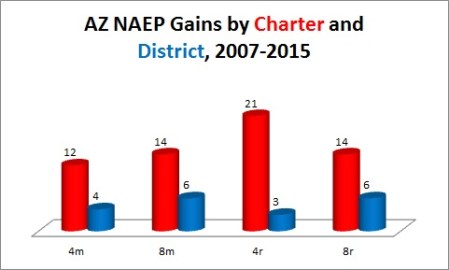
The reality of Arizona K-12 improvement is of course complicated and defies any single explanation, with big changes going on at the same time. One factor that obviously contributed and that we can quantify charter schools. The next figure shows the NAEP gains by subject/grade for Arizona students for districts and charters (2015 scores minus 2007 scores).
Some may attempt to dismiss the difference between charters and districts as a product of differences in student populations. Only a random assignment study could definitively test this assumption, but a large amount of evidence suggests which way such a (sadly non-existent) study would fall. Arizona charter students rank well when compared to statewide averages when compared to a wide variety of subgroups (general ed, White, Hispanic, etc.) While differences in student populations could explain some of the differences between Arizona charters and Arizona districts, they can’t be put to similar use in explaining why Arizona students outscore similar students in New Hampshire. Arizona law also require random lottery admissions, serve a majority-minority student population and the improvement we see in the district scores does not exactly sit comfortably with a massive brain drain to charters story. If all of Arizona’s brightest students were fleeing to charters, it would put a substantial drag on district scores. Instead we see district scores improving.
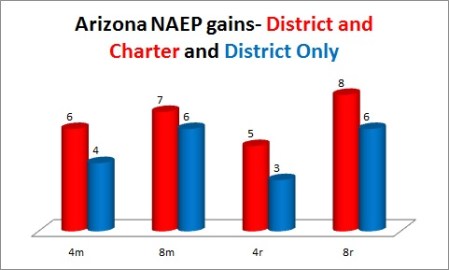
Arizona has a higher percentage of students attending charters than any other states, but that still only falls in the teens– 13.9% in 2012-13. Even so these gains are large enough to make a noticeable difference the aggregates:
The reason I was willing to take Mike’s friendly bet on 2015 NAEP scores- I believe that by far the greatest opportunity to improve K-12 lies in making more efficient use of existing resources. In the opening pages of his 2004 book Hard America Soft America: Competition vs. Coddling and the Battle for the Nation’s Future the astute observer Michael Barone noted the following:
Public schools for example may be the most notable example of a predominantly Soft institution-which helps explain why American children are confined mostly to Soft America. But as we will see, our schools have not always been so Soft; they have contained corners of Hardness, and there are signs they are getting Harder now.
“Coddling” is not a term one would use to describe Arizona public education during the 2007-2015 period. Declining spending forced both district and charter leaders to seek efficiency. The state passed a law forbidding schools from making reduction in force decisions exclusively on length of service- this was very wise. Ineffective/expensive workers should be the first to go in a reduction in force- the alternative being to RIF a much larger number of young employees regardless of their effectiveness. Federal stimulus and a temporary sales tax increase delayed the need for these adjustments-but only temporarily. During this period Arizona lawmakers began grading schools A-F, and the combination of (mostly) recession related slow population growth and expanded competition halted what had been a non-stop process of student population growth for districts. Charters continue to gain market share against districts- and now both a more rigorous state test and NAEP show a substantial academic advantage for charter students.
None of this is easy for district leaders. It’s not exactly the cold howling wind of market competition, but it is a much higher level of competition and transparency than that to which the K-12 folks feel accustomed. Their world has become less stable and more competitive-Harder to use Barone’s phrase. To their credit, many district leaders have embraced the challenge.
It’s very difficult. It’s also very good for children.
I came across this video and am convinced that the world is a better place knowing that it exists.
This is not an odd-couple duet, like David Bowie and Bing Crosby singing Peace on Earth/Little Drummer Boy. Dylan and Cash were actually mutual admirers and there is significant overlap in their musical styles. So, I am not posting this for its ironic humor. Instead, I think this is a particularly touching rendition of a beautiful song. And for anyone who thinks Bob Dylan can’t sing, listen to him harmonize with Johnny Cash at the end.
It’s not a particularly polished performance. But it sounds very different from Dylan’s solo version and has an air of authenticity around it. Unlike the artificial feel of the Bowie and Crosby duet and most other TV variety show performances, this actually feels like two friends picking up the guitar and just playing a song together. Enjoy.
So half way through reading Matthew Ridley’s new book The Evolution of Everything I come across a perfect distillation of the background meta-narrative of the JPGB in the last paragraph of Chapter 13:
The elite gets things wrong, says Douglas Carswell in The End of Politics and the Birth of iDemocracy, ‘because they endlessly seek to govern by design in a world that is best organized spontaneously from below.’ Public policy failures stem from planners excessive faith in deliberate design. ‘They constantly underrate the merits of spontaneous, organic arrangement, and fail to recognize that the best plan is often not to have one.’
Out here in AZ- a central planner’s K-12 nightmare of Wild West chaos-since the bust of 2007 we’ve had NAEP gains between 2.5 to 7 times greater than the national average. What passes for a consensus on Newtonian mechanics back east will struggle to explain this- something is wrong with the orbit of Mercury! Best perhaps to ignore outcomes entirely- as the New York Times did in an article this summer about AZ K-12:
Arizona in particular has been crippled by several years of targeted cuts at the state level and local voters’ repeated refusals to raise property taxes to offset these shortfalls.
Thank you for your touching concern NYT, but I’m feeling pretty handi-capable about right now. I know states with budget cuts and dysfunction in central command are not supposed to make nationally enviable academic progress during a very trying period. We alas didn’t get the memo out here in the patch so we went and did it anyway.
In a recent piece on his web site Mike Petrilli, the president of the Fordham Institute, makes a rather strange case arguing that Common Core is alive (and well?). He quotes multiple blogs that argued the recent Massachusetts decision to abandon PARCC and replace it with MCAS 2.0 (Massachusetts’s own test) is a blow to Common Core and PARCC, but instead he argues that the replacement of PARCC by MCAS 2.0 “is no repudiation of PARCC.” His reasoning?
[T]here’s every reason to believe that MCAS 2.0 is going to look much the same as PARCC 1.0. This is akin to a state dropping the “Common Core” label but keeping nearly all of the standards. It’s essentially a rebranding exercise undertaken for political reasons.
Now, we don’t know whether Petrilli is right or wrong about MCAS 2.0, and we are quite willing to believe his sources are better than ours. So what Petrilli is actually saying is that PARCC has been saved in Massachusetts by its own elected officials deceiving their constituents and spending millions of extra dollars to create a fakely different MCAS 2.0. If he is right, this is in line with similar rebranding efforts elsewhere across the nation intended to confuse the parents and keep them in the dark. Yet even if true, one wonders why he brags about deceiving parents, and one wonders how Massachusetts will react to being deceived, given that a statewide ballot to repeal Common Core has just been submitted to the Secretary of State there.
Petrilli then goes on to “prove” that Common Core has been successful and hence is healthy. First, he argues that, with Common Core, standards are “dramatically improved” when compared to the prior state standards. Opinions vary on this point, yet what nobody disagrees with is that nationwide student achievement on the NAEP took a sharp dive across the board this year for the first time ever, precisely five years after Common Core’s “dramatically improved” standards were adopted by most states.
Petrilli continues and praises the “quality of the reading, writing, and math tests in use throughout the country” under Common Core, and their alignment “with college and career readiness,” arguing a “huge improvement” in what he calls the “honesty gap” between what test say and true college readiness. It seems Mr. Petrilli is unaware of the “honesty” of Common Core test results from California. For many years California assessed college readiness of high school students, and the results were slowly but steadily improving until last year. Suddenly, with the new Common Core “college-readiness” Smarter Balanced test, 20% more students this year are suddenly “college ready” in English and more than twice (110% more, to be precise) are “college ready” for math. If these clearly-fake results seems to suffer from Petrilli’s honesty gap, the number of conditionally college ready in English almost tripled(!) from less than 50 thousand to almost 140 thousand students overnight. Perhaps we should rename it Common Core’s “college readiness illusion” instead.
He goes on to acknowledge we have little evidence that Common Core improved instruction in the classroom, yet he argues that “we do know is that higher-quality curricular programs have been developed, and at least one—Eureka Math—is being widely used all across the country.” Actually, we do not know that higher quality programs are in effect, as the recent NAEP collapse indicates. Were truly higher-quality programs being used, we would expect the NAEP scores to rise rather than fall. Moreover, we would expect not to have hundreds of exemplars of math instructional idiocy propagated across the nation and on the Internet, all clearly labelled “Common Core Aligned.”
Finally, Petrilli turns to the comparability among states that Common Core supposedly allows. He somehow forgets to mention states like Washington, or Ohio, or Arkansas, which “re-defined” Proficiency on Common Core test results to suit their own needs rather than to aid comparability.
Based on all that, Petrilli declares that the Common Core standards “are still very much alive” and that cut-scores “are dramatically higher than ever.” We agree that Common Core is still – albeit barely – alive and that millions of students are going to be harmed before it is finally and completely dead. But we also observe that the federally-sponsored consortia are already almost dead and that their college-ready cut-scores are — how to put it politely? — fake.
As more North Carolina families are using school vouchers, enrolling their children in charter schools, or homeschooling, some traditional district schools are experiencing slower growth in enrollment than anticipated. The News & Observerreports:
Preliminary numbers for this school year show that charter, private and home schools added more students over the past two years than the Wake school system did. Though the school system has added 3,880 students over the past two years, the growth has been 1,000 students fewer than projected for each of those years.
This growth at alternatives to traditional public schools has accelerated in the past few years since the General Assembly lifted a cap on the number of charter schools and provided vouchers under the Opportunity Scholarship program for families to attend private schools.
Opponents of school choice policies often claim that they harm traditional district schools. Earlier this year, the News & Observer ran an op-ed comparing choice policies to a “Trojan horse” and quoting a union official claiming that “public schools will be less able to provide a quality education than they have in the past” because they’re “going to be losing funds” and “going to be losing a great many of the students who are upper middle-class… [who] receive the most home support.”
Setting aside the benefits to the students who receive vouchers or scholarships (and the fact that North Carolina’s vouchers are limited to low-income students and students with special needs), proponents of school choice argue that the students who remain in their assigned district schools benefit from the increased competition. Monopolies don’t have to be responsive to a captive audience, but when parents have other alternatives, district schools must improve if they want to retain their students. But don’t take their word for it. Here’s what a North Carolina public school administrator had to say about the impact of increased competition:
New Wake County school board Chairman Tom Benton said the district needs to be innovative to remain competitive in recruiting and keeping families in North Carolina’s largest school system. At a time when people like choice, he said Wake must provide options to families.
“In the past, public schools could assign students to wherever they wanted to because parents couldn’t make a choice to leave the public schools,” Benton said. “Now we’re trying to make every school a choice of high quality so that parents don’t want to leave
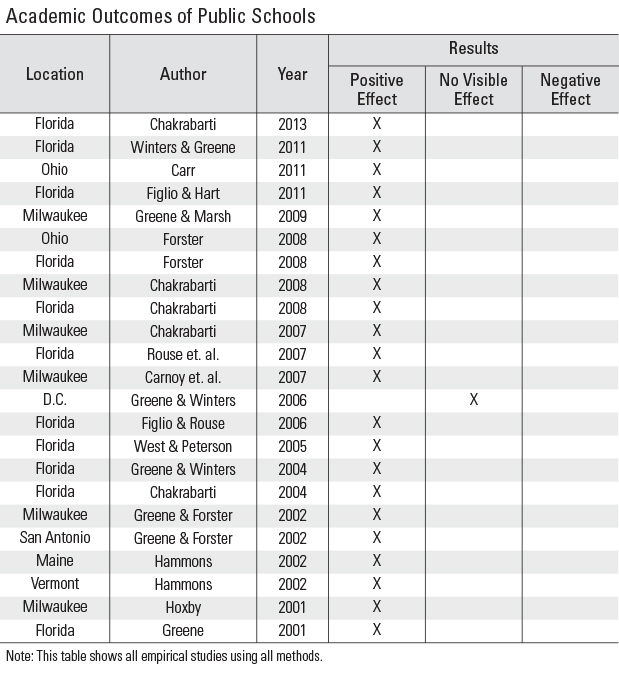
Wake County is not unique in this regard. As readers of this blog surely know (and as I’ve written elsewhere), there have been 23 empirical studies investigating the impact of school choice laws on the students at district schools. As shown in the chart below, 22 of those studies found that the performance of students at district schools improved after a school choice law was enacted. One study found no statistically significant difference and none found any harm.
Beating district schools over the head with more and more top-down regulations has done little to improve quality. A better approach is bottom-up: empower parents with alternatives and give district schools the freedom to figure out how to provide a quality education that will persuade parents to choose them.
[A version of this post was originally published at Cato-at-Liberty. Hat tip to Dr. Terry Stoops of the John Locke Foundation for the story from New Wake County. Thanks to Bob Bowdon of Choice Media for the image.]



 Posted by Greg Forster









 Jay P. Greene's Blog