(Guest Post by Matthew Ladner)
Many of us feel like part of our childhood just vanished. Rest in Peace.
(Guest Post by Matthew Ladner)
Many of us feel like part of our childhood just vanished. Rest in Peace.
 4 Comments |
  random pop culture | Tagged: david bowie |
  Permalink
 Posted by matthewladner

[Guest Post by Jason Bedrick]
Earlier this week, NBER released the first random-assignment study ever to find a negative impact from a school voucher program. Previous gold standard studies had almost unanimously found modest positive effects from school choice, which raises the obvious question: what makes the Louisiana Scholarship Program (LSP) so different?
In an article for Education Next, I argued that, “although not conclusive, there is considerable evidence that the problem stemmed from poor program design.” The LSP is one of the most heavily regulated school choice programs in the nation, and that burden has led to a very low rate of private school participation. Only about one-third of Louisiana private schools accept voucher students, a considerably lower rate than in most other states. From a survey of private school leaders conducted by Brian Kisida, Patrick J. Wolf, and Evan Rhinesmith for the American Enterprise Institute, we know that the primary reason private schools opted out of the voucher program was their concerns over the regulatory burden, particularly those regulations that threatened their character and identity. For example, voucher-accepting schools in Louisiana may not set their own admissions criteria, cannot charge families more than the value of the voucher (a meager $5,311 on average in 2012), and must administer the state test.
We also know from the NBER study that the participating and non-participating private schools differ in at least one important respect. Whereas the non-participating schools experienced modest growth over the decade before the voucher program was expanded statewide (about 3 percent, on average), the participating schools had been experiencing a significant decline in enrollment (about 13 percent, on average). In other words, schools that were able to attract students tended to reject the vouchers while voucher schools tended to be those where enrollment had been dropping.*
The difference in enrollment trends suggests that the LSP’s regulatory burden had the opposite of its intended effect: discouraging higher-performing schools from participating, leaving only the lower-performing schools that were so desperate to reverse their declining enrollment and increase their funding that they were willing to do whatever the voucher program required.
Several other researchers and education reform advocates reached similar conclusions, including Matthew Ladner, Adam Peshek, Michael McShane, Lindsey Burke, and Jonathan Butcher. However, others expressed skepticism about what I shall call the Overregulation Theory, and proposed alternative explanations for the LSP’s poor results.
Writing at Education Week, Douglas Harris of the Education Research Alliance for New Orleans concedes that “regulation probably does reduce the number of private schools, especially the number of higher-performing private schools,” but he still believes the Overregulation Theory is “premature.” Harris instead offers two potential alternatives: 1) the improved public/charter school performance in New Orleans made the performance of the private sector look relatively worse; and 2) the curriculum at most private schools may not have been aligned to the state test, so the poor performance merely reflects that lack of alignment rather than poor performance.
Harris’s first theory is explicitly rejected by the NBER study. On the third page of the study, the authors write: “Negative voucher effects are not explained by the quality of public fallback options for LSP applicants: achievement levels at public schools attended by students lotteried out of the program are below the Louisiana average and comparable to scores in low- performing districts like New Orleans.” In other words, the public school alternatives are not so great and the performance of the participating private schools is considerably worse.
That said, Harris’s second theory, which Jason Richwine also suggested, is plausible as a contributing factor. However, it is no more plausible than the Overregulation Theory. Indeed, whereas the differences in enrollment trends between voucher and non-voucher private schools provide some suggestive evidence for the Overregulation Theory, Harris provides no evidence to support the Nonaligned Test Theory. How many voucher schools were already aligned with the state curriculum and/or administered the state test? At this point, we do not know. Moreover, to the extent that testing nonalignment explains some of the very large 0.4 standard deviation difference in math scores, it is unlikely that it explains all or even most of that difference. Then again, Harris stated that he will be releasing the results of his own research on the LSP, so it’s likely he knows something that I do not.
Harris also notes that the NBER study only examined the results of one year of one program. He is certainly correct that we need more data over time to draw firmer conclusions, which is one reason I presented my interpretation as “not conclusive” and wrote that “the regulationsmay have had the opposite of their intended effect” (emphasis added). And, indeed, there is some evidence that voucher schools improved slightly in the third year since the statewide expansion (although if the voucher schools were their own district, they’d still be the fifth-worst of 76 in the state).
Nevertheless, such strongly negative results should give reform advocates great pause about the regulatory strategies employed in Louisiana. We know the regulatory burden chased away most private schools, and we have evidence that the voucher-accepting schools had been struggling with declining enrollment. If we want to better understand the LSP’s atypically disastrous performance, its program design is the logical place to start.
*UPDATE: Prof. Josh Goodman of Harvard University points out that the NBER study’s “estimates show consistent negative impacts irrespective of previous enrollment trends.” If there had been wide variation in enrollment trends among the participating schools, that would count as evidence against the Overregulation Theory. However, if the enrollment trends among participating schools were consistently negative, with the variation mostly limited to how fast the participating schools had been losing students, then it would still be consistent with the Overregulation Theory.
[Originally posted at Cato-at-Liberty.]
5 Comments | Uncategorized, vouchers | Permalink
Posted by Jason Bedrick

(Guest Post by Matthew Ladner)
My friends at the Arizona Charter School Association put together this rocking graphic on Cactus Patch charter students RAWKING the 2015 NAEP. Make sure to check out the two mini-graphs at the bottom showing just how much more diverse AZ charters are than the states in their neighborhood of scores and how how the per pupil funding stacks up. Stare at them long and hard, and think about the times you’ve heard people say things like the following. Maybe you said them yourself:
Oh but it’s the Wild West out here. Oh they really should not have let so many charter schools open, they should be more cautious about authorizing like right thinking people back East. Tut-tut, KIPP won’t open a school there at that funding level.
Line forms to the left to either update your flawed thinking and/or offer your heartfelt apology. There’s still room on the bandwagon for those who follow the evidence where it leads.
1 Comment | charter schools | Tagged: Arizona Charter School Association, Arizona charter school NAEP scores | Permalink
Posted by matthewladner
(Guest Post by Jason Richwine)
The new experimental evaluation of the Louisiana voucher program poses a challenge to school-choice advocates such as myself. How do we explain the voucher students’ negative test outcomes – including a massive 0.4 SD drop in math scores – when evaluations in other cities showed neutral to mildly positive effects? Supporters have quickly coalesced around the explanation that Louisiana imposed regulations so suffocating that only the worst private schools participated in the voucher program.
I find that explanation unsatisfactory for a few reasons. First, it feels like a post-hoc excuse. Yes, choice advocates have been warning about burdensome regulation for years, including in Louisiana, but how many predicted that the state’s voucher system would go down in flames because of it? The magnitude of the score declines must surprise even the most vociferous critics of regulation.
More importantly, if the participating private schools are so bad – and other people apparently knew they were bad, given the declining enrollments – then why did the voucher recipients choose them? Did the parents fail to research their options? Do they not value academics much at all? Blaming the results on an unusually bad set of private schools is tempting, but it creates the new problem of having to explain why parents made such dubious choices.
Personally, I do not find it plausible that school quality alone could have so much impact, especially in one year. The traits that students bring with them to school – natural abilities, resilience, family support networks – generally explain much more of the variance in student achievement than school quality. Only the absolute worst schools could have such deleterious effects, but there is no indication that the Louisiana voucher schools were the bottom of the barrel. Even if the one third of private schools that participated really were the worst third in the state, we are still talking about schools that are below average – not uniformly awful.
In trying to reconcile Louisiana with the successful experiments in DC, Milwaukee, Charlotte, etc., I suggest exploring other explanations. In particular, how well did the private schools align their curricula with the demands of the state tests? Maybe the private schools were simply teaching different material rather than teaching the state’s curriculum badly. Also worth examining is whether the randomization process, which was done within a complicated set of priority levels for admission, was conducted appropriately. Another issue is how schools adapt after the first year of statewide implementation. And, remember, it is not uncommon for studies to change significantly from the working paper phase to publication. So let’s be patient. Explaining this anomalous study will require more research.
10 Comments | Uncategorized | Permalink
Posted by Jay P. Greene

(Guest Post by Matthew Ladner)
Outstanding choice by Governor Ducey, and it is exciting that Clint will get the chance to serve in this capacity. I had the chance to work for Clint at the Alliance for School Choice and with him at the Goldwater Institute and on the board of the Arizona School Choice Trust for over a decade. While I fear we may miss him in courts around the country, as an Arizonan I couldn’t be more thrilled to have someone of his caliber on our Supreme Court. Video here. With the recent retirement announcement by Chip, one may infer that the torch is being passed to a new generation of constitutional litigators.
I think they are ready.
Congratulations Clint!
2 Comments | tributes | Tagged: Arizona Governor Doug Ducey, Arizona Supreme Court, Clint Bolick | Permalink
Posted by matthewladner
[Guest Post by Jason Bedrick]
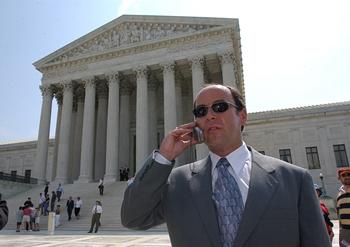
Yes, you read that headline correctly. This morning, Arizona Governor Doug Ducey announced that he was appointing famed school choice litigator and champion of liberty, justice, and the American way, Clint Bolick, to the Arizona Supreme Court.
Clint was one of the lawyers involved in defending Ohio’s school choice law before the U.S. Supreme Court in the landmark Zelman v. Simmons-Harris case, which the good guys won. His impact on the school choice movement cannot be overstated. He co-founded the Institute for Justice, which continues to defend school choice laws around the country, he was president of the Alliance for School Choice, and he has served for the last eight years as the head of litigation at the Goldwater Institute (where he is known for repeatedly suing the pants off the government), among many other important positions and accomplishments. Just a little over a year ago, he successfully defended Florida’s education savings account law.
You can get a taste of Clint’s style from this NYT profile:
Clint Bolick looks like any other high-powered lawyer, for the most part. But glance down at his index finger, which sports a scorpion tattoo, for first-hand evidence of his unconventional streak.
Mr. Bolick has fought for the right of Arizonans to have their toes nibbled. After successfully defending a tattoo artist, he celebrated by having himself inked. From his perch here at the Goldwater Institute, a high-powered libertarian think tank, Mr. Bolick has even picked a fight with an entire professional hockey team.
From a conservative point of view, there is no end to the government interference in individual liberties going on around the country. Some emanates from Washington, but much of it, in the opinion of Mr. Bolick, bubbles up from the bottom, whether from a small-town school board or the Arizona Board of Cosmetology, which Mr. Bolick has sued twice. […]
“There are lots of cozy deals in Arizona, just like everywhere else,” Mr. Bolick said. “The last thing you want is for us to find out. It’s like a skunk coming to a picnic. We ruin everything.” […]
Local governments in Arizona now consult experts at Goldwater before embarking on financing schemes. Their goal is to avoid receiving a legal brief in the mail typed out with Mr. Bolick’s fierce right finger.
The only question is this: Is this a great appointment or the greatest appointment?
UPDATE: It’s only been a few hours since the announcement and statists are already wetting their pants.
4 Comments | tributes, Uncategorized | Permalink
Posted by Jason Bedrick

[Guest Post by Jason Bedrick]
Yesterday, Matt addressed the “very bitter lesson” of the recent NBER study’s first-ever finding of a negative impact from school choice. I concurred with Matt over at Education Next today. It’s also worth noting that the results should not have been surprising. Jay, Matt, Greg, Andrew Coulson, Robert Enlow, Rick Hess, and others warned that a rigid test-based accountability system could have serious unintended consequences. Indeed, here is a recap of this very debate two years ago:
For years, factions within the school choice movement have argued over the effectiveness and wisdom of numerous regulations. For example, when the Fordham Institute released a “policy toolkit” praising Louisiana for mandating the state test, among other regulations, it launched a vigorous debate. Andrew Coulson and I argued that, while well-intentioned, uniform testing mandates would stifle diversity and innovation. Matt Ladner warned that Fordham failed to recognize the “natural limitations of technocrats” in their overconfidence about the ability of policymakers to guard against the “risk of self-defeating homogenization of the school offerings available.” Robert Enlow of the Friedman Foundation for Educational Choice cautioned that governments are “prone to politicial decisions and special interests,” and that accountability should be primarily to parents, not bureaucrats. Jay Greene noted that “testing requirements hurt choice because test results fail to capture most of the benefits produced by choice schools,” and that “highlighting a measure that severely under-states performance puts those programs in jeopardy.” AEI’s Rick Hess expressed skepticism that “policymakers have a Goldilocks-like ability to find the ‘just right’ solution” and called the Fordham report “surprisingly naïve about the realities of the legislative process and regulatory creep.”
Ultimately, the Fordhamites dismissed these concerns. Future Fordham president Michael Petrilli waved them away as mere “hypotheticals” whereas his concerns—such as parents making bad decisions and the long-term impact of crummy schools on kids—were “all playing out, right now, in the real world.” Noting that “we have to work hard to get the policy design right,” Petrilli “applaud[ed] Louisiana and Indiana policymakers for doing a darn good job on this front with their statewide voucher programs.” Then-president of Fordham Chester Finn, went further, arguing that “it’s insane to expect [the] marketplace to yield quality control, efficiency, and accountability for educational outcomes.”
(Ironically, Petrilli also expressed his fear that “bad private schools will get lots of media attention, which will drive down public support for school choice and strengthen the hand of those who opposed such programs in the first place.” Sadly, the negative findings in the NBER study stemming from Petrilli’s preferred policies are likely to do more damage to the public support for school choice than any one bad school could ever do.)
Petrilli’s concerns about crummy schools are perfectly reasonable. Indeed, all his interlocutors share them. In this debate among friends, everyone wants what is best for children. Where they differ is over the best means to improve educational quality. Given that there is no perfect system, the question is what sort of system is most likely to produce the best outcomes.
Leave a Comment » | Uncategorized | Permalink
Posted by Jason Bedrick

(Guest post by Greg Forster)
My spoiler-laden meditations on Star Wars are fully armed and operational over on Hang Together:
Millennials are destroying the world because narcissistic Boomers broke up the family. That’s The Force Awakens in a nutshell.
Shockingly, I approve of this message! Would love to hear your thoughts, whatever they are, as always.
7 Comments | Pass the Popcorn | Permalink
Posted by Greg Forster

(Guest Post by Matthew Ladner)
Almost a decade ago I posed a Moynihan Challenge to choice opponents: I could produce a pile of random assignment voucher studies with significant positive results, but if you could produce two random assignment studies with statistically significant and negative results I’d buy you a steak dinner. I started here with skeptics in Arizona and when I got cricket noises extended it nationwide and got more cricket noises. Before your gut gets too greedy, yes it had a time limit. If you keep doing these studies long enough you will eventually get false negatives by random chance.
What we have now does not look like a false negative but rather a very poorly designed program in Louisiana with the release of a new study on the first year results. They look **ahem** decidedly negative.
We’ve covered this ground before on JPGB so I will avoid beating the equine corpse, but over the years there have always been concerns that voucher programs would become overly regulated. The response has always been that if this were to occur, that private schools would choose not to participate. Well lo and behold Louisiana’s heavily regulated voucher program comes along, 70% of private schools choose to sit it out, including a large majority of Catholic schools in Orleans Parish. Catholic schools have a long history of putting up with a lot of red tape around the country and around the world, so their choice to pass on the Louisiana Scholarship Program speaks volumes about the program.
What do we know about the 30% of private schools who did participate? Well now we know that their students had a very rough first year and we also know from the study:
Survey data show that LSP-eligible private schools experience rapid enrollment declines prior to entering the program, indicating that the LSP may attract private schools struggling to maintain enrollment. These results suggest caution in the design of voucher systems aimed at expanding school choice for disadvantaged students.
So…..many of the desperate on their way to folding schools decided to grit their teeth and participate in the program. We can also infer from the contrast between this evaluation and all the others that a disproportionate number of stable and successful Louisiana private schools read over the red-tape of the program and decided “thanks but no thanks.”
The ironic dagger cutting deep here- this program was designed to help some of the most disadvantaged students in the country. If you are a low-income student attending low-rated schools in one of the lowest performing states, you got the short end of the stick in life. The very good people who designed this program had every intention of this program being a path out. Tragically in designing to keep bad schools out, they ironically kept the good schools out and invited the bad schools in. The road to this hell was built out of the cobblestones of good intentions, but it still led straight to this debacle.
Those students, among the lowest of the low academically, have been victimized by the design of this program. The high quality private schools among the non-participating schools stand every bit as out of their reach as they had been before the creation of the program. In theory it could have worked out differently, but now we must rid ourselves of all illusions: every system is perfectly designed to produce the results associated with it.
You live and learn. This is a very bitter lesson but one we choice supporters need to take to heart in order to correct our mistake and to prevent future missteps.
8 Comments | vouchers | Tagged: Atila Abdulkadiroglu, Christopher R. Walters, Louisiana Scholarship Program, Louisiana vouchers, Parag A. Pathak, School Vouchers and Student Achievement: First-Year Evidence from the Louisiana Scholarship Program | Permalink
Posted by matthewladner
(Guest Post by Matthew Ladner)
In the great tradition of Marvel’s No-Prize and our own Al Copeland Humanitarian Award, I am very pleased to have received a 2015 Hammer Award from the Arizona Chamber of Commerce!
Mr. Education: Matt Ladner. Dr. Ladner’s blogs on NAEP scores and the outstanding performance of Arizona’s charter schools, which put us in a statistical dead heat with top-performer Massachusetts, were must-reads for education wonks and those of us tired of reading only the bad news about Arizona’s K-12 system. Dr. Ladner offers readers a welcome and needed national perspective. We are lucky he is based here in Arizona. He’s the Paul Goldschmidt of education policy: he’s a gentleman, generous with his time, and produces the equivalent of quality at bats every game.
I have not felt so honored since being awarded the first (and as far as I know only!) Lifetime Bunkum from NEPC, and after that Mrs. Ladner had to my post bail and then drive me to the hospital. I mean who could have possibly suspected that Caesar’s Palace suites could catch fire? Jay and Greg tend to point fingers at each other. Or maybe it was Holly Madison and those tigers that are really to blame. Enlow just had to invite them back to the suite. In the end we all know that all roads of suspicion ultimately lead back to the Barbarian.


In any case it was a heck of a week until that happened.
But I digress…any time someone who could not jump rope to save his life gets compared to the great Paul Goldschmidt it’s time to celebrate, or better yet to CeleNAEP, just a little calmer this time! My sincere thanks to my great partners in reform at the Arizona Chamber of Commerce and A for Arizona.

3 Comments | Uncategorized | Tagged: Arizona Chamber of Commerce, Arizona Chamber of Commerce Hammer Awards, Glenn Hamer, Lisa Graham Keegan, Paul Goldschmidt | Permalink
Posted by matthewladner

 Jay P. Greene's Blog