Ensuring Scholarship Continuity

December 8, 2015

[Guest Post by Jason Bedrick]

In a recent Friedman Foundation blog post I coauthored with Lindsey Burke of the Heritage Foundation and Friedman’s own Robert Enlow, we argued that the government should not prohibit mission-specific (e.g. – Catholic or Montessori) scholarship-granting organizations from participating in tax-credit scholarship programs. We offered both principled and pragmatic reasons for opposing such a policy.

Simply put, private organizations should have the right to set their own institutional mission and donors should be free to choose to support those that align with their values. Moreover, prohibiting mission-specific scholarship organizations could reduce the overall level of scholarship funding because some donors would prefer to support only certain types of education to the exclusion of others. And, as it happens, the largest scholarship-granting organization (SGO) operating in each state with a scholarship tax credit law tends to be the type that grants scholarships to any eligible student to attend any qualifying school.

However, proponents of the universal model offer a strong objection. We all want to ensure that every child has access to the school that best meets his or her needs, but where there is a cap on the total amount of tax credits offered, students might lose their scholarships if the SGO upon which they relied fails to claim the requisite amount of tax credits before other SGOs do. When SGOs in Georgia hit the total tax-credit cap almost immediately after the fundraising period commenced, some SGOs were unable to continue providing scholarships for many of the low-income students that they had been funding previously. Wouldn’t it be better to require that SGOs fund students attending any school of their choice?

I have several responses to this challenge:

  1. The main problem here is that the tax-credit cap is too low. One reason competition in a free market is healthy is that it can expand the size of the economic pie. Unfortunately, tax-credit caps create a zero-sum game. If the cap is not high enough, the growth of one SGO comes at the expense of others. In Georgia and several other states, there is much greater demand for scholarships than there is funding for those scholarships. Raising the cap, therefore, should be the primary goal of school choice groups in Georgia and in other states that might be facing similar issues. But assuming the cap cannot be raised sufficiently…
  2. The market can solve this problem, although it is not guaranteed. A similar issue arose in Arizona when a new and well-funded SGO entered the state, thereby depriving other SGOs of credits upon which they were depending. I am told that the new SGO gave priority to students that had previously received tax-credit scholarships but who were unable to obtain funding that year. That said, there is no guarantee that SGOs will work together like this, and it seems that some low-income students in Georgia lost their scholarships, so perhaps a policy solution is necessary to address such situations.
  3. The universal model doesn’t necessarily solve this problem. In a state with multiple SGOs that all fund students attending any school their family chooses, it would still be possible for one SGO to experience a drop in funding that causes them to grant smaller and/or fewer scholarships. Again, it’s possible the other SGOs would step in and prioritize students who lost their scholarships, but it’s also possible that they would fund students on their waiting lists first, and some students would still lose their scholarships. This is one reason that some groups would prefer to have a single SGO in each state, but the monopoly model is fraught with other dangers, and even there, the lone SGO might see a decrease in fundraising one year, which would mean granting smaller and/or fewer scholarships.
  4. There are other ways to address this problem that don’t entail the government excluding mission-specific SGOs. As noted above, tax-credit caps create a zero-sum game. Fortunately, there are ways to design a scholarship tax credit program to mitigate the problems that tax-credit caps create. One approach would be to “grandfather” credits to existing SGOs for a certain period of time before opening them up to other SGOs to claim. For example, an SGO that raised $500,000 in tax-credit-eligible donations one year would have six months in the following year to raise an equal amount. After that point, any credits their donors did not claim would be open for other SGOs, along with any new credits available if the credit cap increased. The “grandfathering” approach would prevent SGOs from losing funding to competition due to the credit cap, though if the SGO was unable to raise funds for another reason (e.g. – a large donor went out of business, there was a scandal, etc.), it’s still possible that some students could lose their scholarships. (Then again, the same things could happen in a state with the universal model.)

In a perfect world, every child would have access to the education that best meets his or her needs. Sadly, the world we live in is far from that ideal and even the best educational choice policies have not yet attained it. For the foreseeable future, it’s trade-offs as far as the third eye can see.

When attempts to solve problems that arise put two ideals in tension (e.g. – universal access vs. the autonomy of private organizations), education reformers should strive as much as possible to find a solution that preserves both. There is no way to guarantee that no student will ever lose his or her tax-credit scholarship, but I believe the approach I outlined above in Point 4 mitigates that risk as much as possible. It also preserves the autonomy of SGOs while education reformers work toward lifting the tax-credit caps and ensuring universal access to a quality education.


The School Choice Information Problem

December 8, 2015

puzzle-pieces-1-1426443

(Guest post by Greg Forster)

OCPA’s Perspective carries my article on the school choice information problem:

“I support school choice,” some education policymakers say, “but we need to make sure parents choose good schools!” In order for parents to choose good schools, of course, they need good information. Not information from government bureaucracies—which have a long track record of measuring the wrong things and deceiving parents—but from emerging resources such as Great Schools, Global Report Card, School Grades, and more. Better information, not tighter regulation, is the best way to let parents improve school quality.

I note a remarkable reversal – the blob used to heap contempt on parents but is now rushing to position itself as allies of beleagured parents against reforms run amok; reformers, meanwhile, who used to champion parents have suddenly begun heaping contempt on parents’ capacities to make good choices for their own children:

There are several reasons for these changes. One is the collapse of the school monopoly’s credibility…

A more important reason is the greatly increased political success and attractiveness of school choice itself…This has brought school choice new allies—allies who aren’t yet completely comfortable with the idea…

It has also meant that the limitations of school choice in its current form are becoming more visible…

Parents need good information to make good choices, and the school choice movement is going to have to take an interest in pushing the existing information structures to the next level if it hopes to make more people comfortable with the idea of parents as the locus of school accountability.

As always, your thoughts and responses are welcome!


AZ Charter Scores are Real and They’re Spectacular!

December 8, 2015

(Guest Post by Matthew Ladner)

AZ charter vs. district

Let’s the speculation shift from “are those AZ charter NAEP scores real?” to “did the NAEP underestimate the scores?” As the lovely Teri Hatcher once said:


Shadow Secretary Hilary Benn Makes the Case for British Airstrikes in Syria

December 4, 2015

(Guest Post by Matthew Ladner)

Watch this…like right now! All the way to the end.

The resolution passed. Within four hours of the vote ISIS positions in Syria endured their first strike by British forces.


CeleNAEP for AZ Charters continues in AZ Merit Scores

December 4, 2015

(Guest Post by Matthew Ladner)

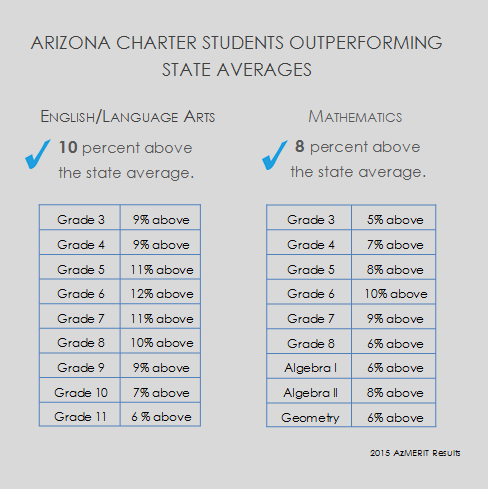
Laissez le bon temps rouler! The AZ Department of Education released results of the new AZ Merit test, and the Arizona Charter School Association released a breakdown of the scores showing that AZ charter school students scored 5%-12% higher scores depending upon the grade level/subject (see below).

Sadly the AZ Merit data comes in the form of an excel spreadsheet rather than a NAEP-like data slicer, so a control for differences in student demographics, program status, etc. cannot be readily performed. Some of the differences in scores between AZ charters and districts are likely to be explained by student differences. When you examine the NAEP, it is also the case that some of the differences between New England states and a state like Arizona will also be explained by student differences. No one I know however doubts that the average public school in MA outscores the average public school in AZ.

AZ Merit aligns much more closely to NAEP in terms of student results than the jumped the shark over a decade ago AIMS test. The differences observed in raw scores are generally larger than those existing between the top NAEP state (MA) and Arizona. The AZ Merit scores therefore reinforce the NAEP data’s finding that Arizona charter schools have something special cooking out in the cactus patch.

Korea- your scores are next!


The New Education Philanthropy

December 2, 2015

The New Education Philanthropy

Yesterday, Harvard Education Press officially released The New Education Philanthropy, a volume edited by Rick Hess and Jeff Henig.  The book is a follow-up to one Rick edited a decade earlier, With the Best of Intentions.

Empirical analysis and constructive criticism of the role of foundations in education is hard to come by.  There are few professional rewards and significant risks in trying to analyze foundations and offer suggestions for improvement.  Foundations are accustomed to criticism, but much of it comes from people opposed to the idea that foundations should influence the education system, so foundations tend to classify all criticism as hostile and tune it out.  Folks not opposed to the mission of foundations tend to want funding from them and so tend to censor themselves when they might have analysis and criticism to offer.  In addition, foundations generally limit channels of communication from their friends for fear of being unduly lobbied by them for funding.

The ironic result is that foundations seeking to improve learning have virtually no mechanisms for learning about themselves and making their own improvements.  They generally don’t want to know.  They don’t want to hear the rantings of those who hate them and they don’t want to be influenced by the flattery and manipulations of those who love them.  But there is a third type of person that they have difficulty recognizing — someone who wants to help them by offering independent analysis and criticism.

This is why books like The New Education Philanthropy and With the Best of Intentions only come along every decade or so.  Few foundations will provide any support for independent empirical and critical examination of their efforts and few scholars are willing to engage in this type of work.  Even if someone else pays, few foundations are willing to engage in conferences, panel discussions, and written exchanges about their own efforts.  They tend to be as defensive and insular as presidential campaigns and are often operated as if that is what they are rather than learning organizations.

This is why books like The New Education Philanthropy and With the Best of Intentions are so important.  There is much that education philanthropies and others could learn from these volumes.  My chapter in the first book, “Buckets into the Sea,” examined the extent of philanthropic activity in education relative to public funding.  I found that all private giving to public K-12 schools, from the bake sale to the Gates Foundation, amounted to less than one-third of 1% of annual spending.  It’s basically rounding error.  A billion dollars feels like a lot of money to you, me, and the folks at foundations, but to a public school system spending over $600 billion annually it is not nearly enough to get them to do things that they don’t already want to do nor enough to purchase things that they can’t already buy.

So, foundations lack the resources to purchase education reform through the sheer force of their money.  In the chapter I wrote a decade ago, I suggested that if foundations wanted to change the education system they would have to engage in policy change to re-direct how the much larger pool of public resources is spent.

Around the same time that my chapter was published in With the Best of Intentions, many large foundations started to change their strategy to focus on policy advocacy.  Unfortunately, just as foundations failed to grasp the limitations of their fiscal resources, they also failed to understand how limited their political resources are as well.  This prompted my new chapter, “Buckets into Another Sea,” in The New Education Philanthropy.

Foundations have enough money to dominate the conversation of a few hundred people engaged in policy research and advocacy, but they don’t have enough resources to achieve enduring policy change without backing policies that generate their own constituency.

If expanding school choice creates tens of thousands of beneficiaries who are willing to rally on the steps of the capitol, they can create self-sustaining policy change.  But if foundations back policies that generate few natural constituents, then those policies are difficult to get adopted and even harder to keep over time.  There are no rallies for using test scores to evaluate teachers.  There are no rallies for common standards, assessments, and the “instructional shifts” they require.  Whatever the merit of these policies, foundations lack the political resources to achieve them without genuine constituents who will fight for them independent of foundation funding.

Check out The New Education Philanthropy and With the Best of Intentions to see what other insights folks have to offer.  We may not be right, but an honest and open discussion about effective strategies for foundations is sorely needed.


Non-Cog Measures Not Ready for Accountability

December 1, 2015

Anna Egalite, Jonathan Mills, and I have a new study in the journal, Improving Schools, in which we administer multiple measures of “non-cognitive” skills to the same sample of students to see if we get consistent results.  We didn’t.

How students performed on a self-reported grit scale was uncorrelated with behavioral measures of character skills, like delayed gratification, time devoted to solving a challenging task, and item non-response.  These are all meant to capture related (although not identical) concepts, so they should correlate with each other.  The fact that they don’t suggests that we still have a lot of work to do to refine our understanding of character skills and how best to measure them.

Angela Duckworth, who developed the self-reported grit scale, and David Scott Yeager, who is a pioneer in measuring growth-mindset, have been trying to warn the field that these measures are still in their infancy.  They have an article in Educational Researcher and have been giving interviews emphasizing that while non-cog skills appear to be a very important part of later life success, our methods of measuring these concepts are still not very strong — certainly not strong enough to include in school accountability systems.

Our research showing the lack of relationship between behavioral and self-reported measures of character skills adds to the case for caution in using these measures for evaluation or accountability purposes.  Remember, it took decades of research and practice to develop reliable standardized tests.  A similar effort and patience will be required to develop reliable measures of character skills.  And I suspect that even improved measures may be useful for research purposes but never robust enough to use for accountability.

Ed reformers can be dangerous if they are too much in a hurry.  We unfortunately want to apply every new insight right away and lack patience for the careful development of policies and practices for long-term benefit.  We also invest few resources in basic research that is essential for long-term gains.  According to my analysis in a chapter in a new book edited by Rick Hess and Jeff Henig on education philanthropy, the largest education foundations only devote 6% of their funding toward research.  And most of that research may really be short-term policy advocacy masquerading as research.  The federal government is little better at making funds available for basic research.

Non-cog or character skills are incredibly important but if we are going to use these and other ideas to improve education, we are going to need a significant shift toward funding research and greater patience to bring those ideas to fruition.


FL Hispanic Students Attending Charters Do Math like Connecticut, AZ Hispanic Charter Students like Delaware

November 23, 2015

FLAZ 8m

(Guest Post by Matthew Ladner)

Hispanic students attending charter schools in Florida and Arizona both scored about a grade level ahead of Hispanic students attending district schools. Figure 1 shows where this lands them in terms of statewide averages for all students. Notice that Hispanic students attending charter schools in Florida are almost a grade level ahead of the statewide average for all students in Florida.

Nationwide all students in public schools scored 281 on 8th grade math in 2015. This means that AZ and FL Hispanic students ended in a statistical dead head with the average.  Hispanic students in charter schools have gained 20 points in Arizona and 19 points in Florida over the 2005 averages. This reflects several things- including a lot of hard work by the students and teachers- but also perhaps maturing charter sectors with startups full of kids just transferring into the startup school impacting scores less than in the past.


Anti-Semitism and Religious Schools

November 18, 2015

Yesterday AEI hosted an event at which I presented a new paper by Cari A. Bogulski and me examining the relationship between the type of school people attended when they were children and their attitudes toward Jews as adults.  We find that the more people attended religious private schools as children, the less anti-Semitic they are.  Secular private schools resemble public schools in the average level of anti-Semitism among their former students.

Of course, we were not able to randomly assign people to different types of school, so we cannot be confident that this relationship is causal.  But the relationship holds true after controlling for a variety of background characteristics.  It is still possible that adults who attended religious schools have more favorable attitudes toward Jews because of unobserved advantages but this seems unlikely given that the generally more advantaged families who send children to non-religious private schools do not appear to yield lower anti-Semitism.  And we do not typically think of families who choose to send their children to mostly Christian religious schools as doing so because of a particular affinity toward Jews .

Why might religious schooling be associated with lower anti-Semitism?  Prior research has found a general link between private education and higher tolerance, so this may just be consistent with that.  But the fact that the effect is restricted to religious schools is somewhat unexpected.  Perhaps religious institutions that operate schools, most of which are Christian, have adopted a much more favorable orientation toward Jews than is widely appreciated.

Many Jewish organizations have been slow to recognize that historically hostile groups may now be allies (and some traditional allies may be turning more hostile). Perhaps these findings may motivate several Jewish organizations to reconsider their opposition to private school choice programs.

For more details be sure to read the paper and watch the video above.


Slice and Dice the Data but Arizona Charters Continue to CeleNAEP Good Times

November 16, 2015

(Guest Post by Matthew Ladner)

So I’ve still been digging into the AZ NAEP data. When something seems too good to be true, it is best to assume it isn’t true. I decided to investigate the possibility that something goofy was going on with the free and reduced lunch variable. Not all  Arizona charters choose not to participate in the program, and the eligibility criteria for the program has changed over time.

Parental education may be a good stand-in for what may be a suspect income variable. At the 8th grade level, the NAEP data slicer has an a variable for parental education. The below figure presents the 8th grade math scores for students with college graduate parents. In order to account for possible differences in special program participation, the figure is only for general education students with college graduate parents (the ranking results don’t change much if you look at all students). I will again stress that these comparisons do not substitute for a proper random assignment study-only that they tell us more than an examination of aggregate scores for all students.

NAEP AZ charter 8m parent educ

Watch out New England…Arizona charter schools are coming to get you!

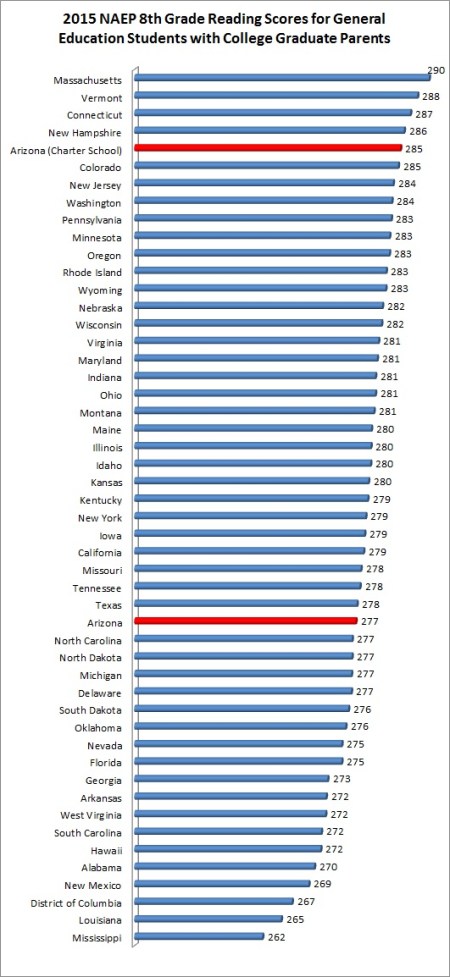
For you incurable skeptics, the below figure presents the same comparison using 8th grade reading, and bear in mind that each NAEP test involves a different sample of students.

NAEP AZ charter 8r parent educ

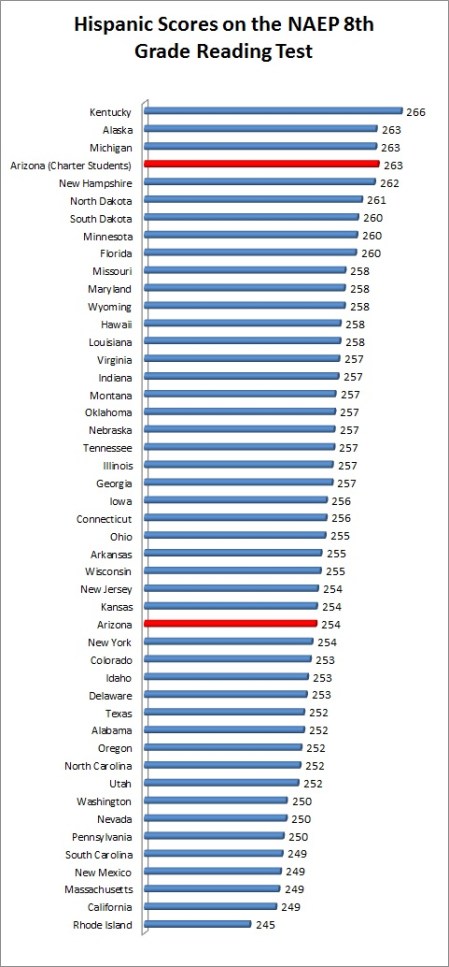
We can also look at these numbers by race/ethnicity. NAEP provides subset numbers for Anglos and Hispanics attending charter schools in Arizona. Here is the NAEP 8th grade reading test for Hispanic students:

AZ Charter 8r Hispanic

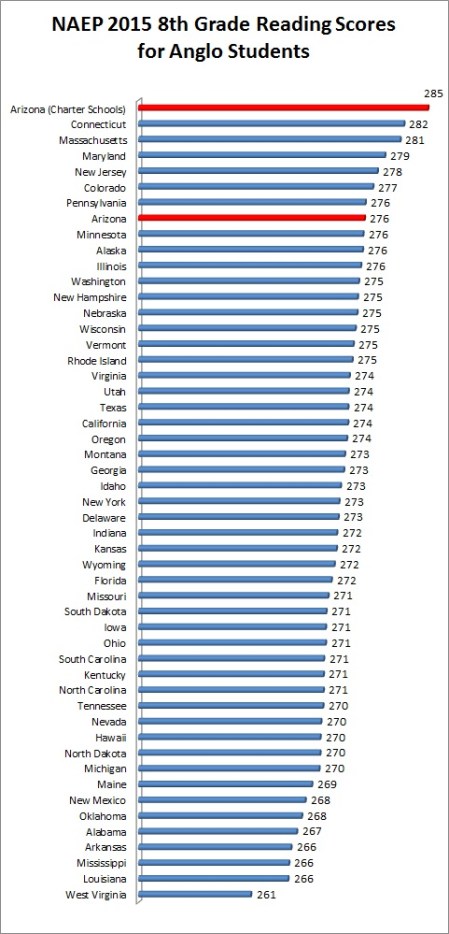
And here it is for Anglo students:

AZ Charter 2015 NAEP 8r Anglo

Okay but what if those Arizona charter schools are chock full of Anglo kids whose parents graduated college? Now the National Alliance of Public Charter Schools reports that Arizona charter schools have a majority-minority student body, so this is not the case- but what if a large portion of the Anglo kids attending charter schools have parents with college degrees? Ok, well, let’s compare Anglo kids whose parents graduated from college:

AZ Charter 2015 NAEP 8r Anglo college

Did I mention the part where Arizona charter schools did this with $8,041 per kid in public funding? Better results at a lower cost is what America is going to need very soon- and well here it is. Massachusetts NAEP scores taste like chicken btw, only gamier, could use a little salt.