OCPA’s Perspective carries my article on religious support for school choice:
The government school monopoly promotes a stereotype that school choice is promoted by religious fanatics, but in fact religious leaders have been underrepresented in the school choice coalition. The most likely reason is a fear of compromising the independence of religious schools – but experience doesn’t support those fears, and I hope the time has come to get past them.
Obviously some religious leaders have been very important to the school choice cause – and in many cases they were among the first to sign on, when others stayed on the sidelines. That said, compared to the numbers and importance of religious leaders in society at large, it’s surprising how secular the school choice movement tends to be.
The big missing link here, the dog that isn’t barking, is evangelicals. The general scope of their political beliefs – from religious freedom to concern for the poor – points to school choice. And they would benefit from school choice programs. Yet they’ve been mostly absent from the fight….
Evangelicals have a long history of social activism – dating all the way back to the national controversy over mail delivery on Sunday in 1811, and their widespread opposition to Andrew Jackson’s genocidal “Indian removal” in 1830….There have been two glaring exceptions. White evangelicals mostly missed the boat on the civil rights movement; fifty years later, they regretted it. Today they’re missing the boat on a movment that many of us think will be looked back on fifty or a hundred years from now the same way.
Some fool at an edu-blog in Oklahoma took a swing at criticizing my Win-Win report, summarizing the research on school choice. How did it go for them? Here’s a choice portion of my reply, now posted in full at Choice Remarks:
The most damning charge in their post is that I “cherry pick” the evidence, leaving out studies I don’t like. That would indeed be grievous, if it were true. They back up this charge by saying that I did not include in my review the official study of the D.C. voucher program, headed by Pat Wolf.
The accusation is clear, emphatic, and misspelled: “Patrick Wolfe’s official (and dismal) report (Wolfe et al 2010) on the program in Washington D.C. is not cited, a serious omission.”
Unfortunately, the charge is also false. I cite Wolf’s 2010 report on pages 8, 29, and 31. Oops!
OERC claims Wolf’s report (excuse me, “Wolfe’s” report) is “dismal” for the voucher program, crowing that “Wolfe” found negatively for the program even though he supports vouchers. But while Wolf found no change in test scores, he also found the following:
The Program significantly improved students’ chances of graduating from high school, according to parent reports. Overall, 82 percent of students offered scholarships received a high school diploma, compared to 70 percent of those who applied but were not offered scholarships. This graduation rate improvement also held for the subgroup of OSP students who came from “schools in need of improvement.”
So the study they characterize as “dismal” actually found that the program dramatically reduces high school dropout rates without any corresponding reduction in standards of academic achievement.
Oops again!
Fun fact: Greene’s Law of Conservation of Es states that every time someone adds an E to the end of Pat’s name, somewhere, somehow, someone drops the E from the end of Jay’s name.
Can any of y’all help me? I’m trying to figure out what emotional response is appropriate to this level of foolishness…
So I have not been keeping track this year, and election years are not usually the best for big reforms. The over under is 7 new or expanded programs. It wasn’t looking good in the early rounds, but slowly but surely Greg just might float like a butterfly and sting like a bee his way to (yet another) win.
Florida expanded their ESA, Mississippi seems poised to do the same. South Dakota’s governor signed a small tax credit program, and today comes word of a small voucher program that may pass in Maryland as the result of a budget deal. Am I missing anything so far?
A gang of the usual suspects has released yet another retread report providing information we already have, dressing it up in shocking language, and using it to play the race card against school choice.
As the Washington Post relates, the study finds – surprise! – private schools are disproportionately white. Obviously this must mean they’re racist and school choice is therefore dangerous.
The Post did quote one sensible fellow who saw through the racket:
Private schools generally want to serve as many students as possible, but they can only serve those who are able to pay….School choice levels the playing field by helping those with lower incomes have access to the choices that others now have and even take for granted. It is not a scandal that those who are able to access better schools choose to do so; it is a scandal that because of the government school monopoly, only some are able to access better schools.
He also pointed out a number of methodological flaws in their work, and cited the body of evidence showing school choice moves students from more-segregated public schools to less-segregated private schools.
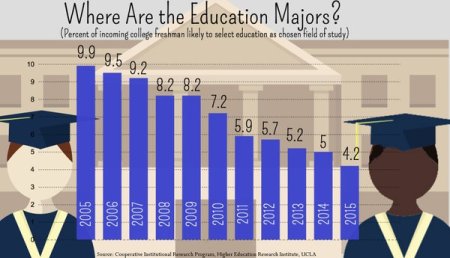
So college students have lost interest in Education Majors:
Several states face very large increases in their youth populations projected by the Census Bureau:
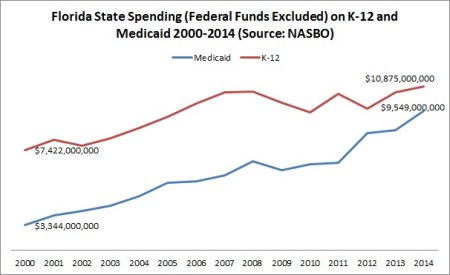
Some states are already experiencing growing teacher shortages, and some traditionally minded folks dream of spending our way out of this, but absent some awesome spurt of sustained economic growth this seems implausible given things like this that come with an aging population:
So student populations project to grow even while the traditional pipeline for teachers shows increasing spare capacity and Baby Boomer teachers retire and states face increasing fiscal strains. Did I miss anything? No? Good- that’s already gratuitous.
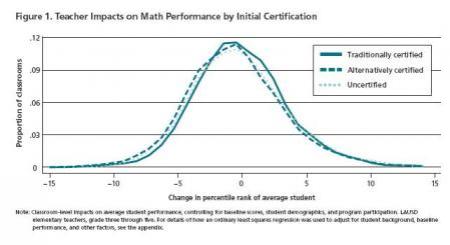
So rather than worry about this, perhaps it is best to view it as an opportunity. It’s not like the old-fashioned way of training teachers had much good to say for itself after all:
College students losing interest in ed majors hints at a broader need to re-imagine the teaching profession more broadly. The status quo is sinking, but a future of a smaller number of higher paid teachers leveraging technology to teach a greater number of students to higher average levels may be possible.
Keeping things the way they are now is neither desirable or possible.
Previous issues of the BCR presented models to classify states by their implementation of CCSS. States that are not followers of CCSS have been reluctant to embrace the changes in curriculum and instruction that are encouraged in those standards. The models also show that CCSS implementation is associated with a change of less than a single NAEP scale score point in both fourth grade reading and eighth grade math. Critics blamed Common Core for disappointing NAEP scores in 2015. The good news for Common Core supporters is that nothing in the analysis supports that charge. The bad news is that there also is no evidence that CCSS has made much of a difference during a six-year period of stagnant NAEP scores.
Of course the Brown Center could be mistaken somehow. Maybe this was somehow worth either fighting for, or else getting bent around the axle over against. If you would like to make an opposing case either way the Jayblog comment section awaits! Otherwise Brown Center gets the benefit of my doubt and I am filing this entire subject away in the part of my wee little brain with all the other stuff that is:
Remember when I told you about Clark County (LV) Nevada packing thousands of kids into trailers with long-term substitute teachers some of whom even had BA degrees? Hmmm….well, in addition to explosive population growth and the ongoing retirement of the Baby Boom generation, this might have something to do with it as well:
So apparently college freshmen have started to listen to the large number of people who have been through an Ed School and found the experience profoundly unsatisfying. Or perhaps they are looking past that at a public school system that treats you like a 19th Century factory worker rather than a professional. Maybe both things are true. In any case, especially for states with booming K-12 populations, it is time for fresh thinking not on how we train teachers, but also about the deeper issues surrounding undesirability of the profession which goes well beyond compensation issues.
So I was looking at the National Alliance for Public Charter Schools Dashboard on state charter school sectors trying to figure out how the Arizona Charter sector managed to put it all together to rock the 2015 NAEP like a rock star on an epic hotel room thrashing bender. Just as a reminder, Arizona has long been known as a Wild West of charter schooling- liberal authorizing, relatively light-touch state oversight, etc. Just the sort of thing that a central planner hates. In addition, the sector is not generously funded by national standards, pulling in about $8k per student from all sources, and educates a majority-minority student body. Moreover the Credo analysis from a few years ago held its nose at AZ charter results. And yet, the 2015 NAEP comes in and shows AZ charter students scoring like a New England state in all four exams and these results are backed up by the state AZ Merit exam. What gives?
One possible factor- maturation:
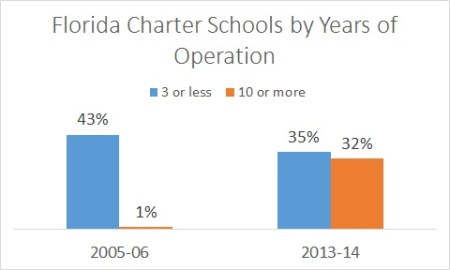
Paul Peterson noted years ago that the Credo analysis of charter test scores had not controlled for two potentially important factors- let’s call them shakedown cruise and transfer effects. Like any social enterprise, a school is unlikely to be at peak effectiveness in the early going. In 2005-06 Arizona charter schools in years 1-3 outnumbered those that had been operating for 10 or more years three to one. Let the clock run a bit however and by 2013-14 old timers outnumber newbies by more than two to one. As far as transfer effects go, some brand new schools will have nothing but transfers, whereas established schools will typically be breaking in a new class of their youngest grade covered and some transfers. So we waited things out in Arizona and eventually we were rewarded with results like:
Well AZ charters- you are growns up, you’re growns up and you’re growns up!
Next factor: churn.
The National Alliance for Public Charter Schools notes that between 2010-11 and 2014-15, 215 new charter schools opened. During the 2010-11 to 2013-14 period 96 Arizona charter schools closed. So factoring in life cycle performance, those 215 that opened may have looked pretty meh when Credo checked in on them as youngsters, but perhaps they were just out having an ale with Falstaff and the gang figuring a few things out getting their sea-legs under them as young organizations.
Let’s assume further that those 96 schools that closed actually were worse than meh on average. Arizona grants 15 year charters, so the oldest of the lot did not start coming up for renewal from the Arizona State Charter School Board until 2010. Charters of course sometimes close due to factors other than state action as well, and academically fantastic schools will be greatly under-represented in this subset. So you open about twice as many schools as you close over the last few years but the ones you open are sorting things out and getting better, while the ones you closed just couldn’t cut it results in:
Florida’s charter sector also rocked the 2015 NAEP. How much did they rock the 2015 NAEP you ask? Well this much:
Florida charters seem to be doing something right. Possible maturation factor here as well? I’ll take “Sure Looks that Way to Me” for a thousand Alex:
The National Alliance shows about 300 new charters opening and 101 closing in Florida in recent years. You let parents pick schools that are good fits for their kids, open a new bunch of schools on their way to improving, and close sub-meh, guess what your majority minority sector can rock the NAEP like a New England state.
Now not every charter sector, even among the long-standing ones, sees these kind of results. Many factors can and will influence such scores besides those discussed here. For instance, Michigan charter schools look pretty bad at first blush, but a concentration in Detroit may have something to do with that. The ability to slice and dice the NAEP data has definite limits and multiple factors can be simultaneously at play. Minnesota however has the nation’s oldest charter law and seems to notably lack the sort of grand-slam ability of the Arizona, Colorado and Florida sectors. A lack of dynamism may be contributing while the average age of Minnesota charter schools has increased, very few new schools have been opening, and very few established schools closing- almost as though charters have their little niche but have been safely contained.
Last month Neerav asked “Is School Supply F***ing Everything?” Maybe so. Keep those new schools coming, let parents sort them out, and if parents don’t torpedo the low-performers don’t renew their charters. Otherwise sit back and enjoy!
The Arizona Republic ran the following LTE from your favorite bearded wonk today. Okay, okay…fourth or fifth favorite…geez…
Linda Valdez (“How school choice sabotages Latino kids“) asserted that Arizona’s school choice options have been undermining the education of Hispanic students attending district schools.
This assertion cannot, however, withstand scrutiny. The National Assessment of Educational Progress shows that Arizona Hispanic students have made large academic gains.
Since all states began participating in NAEP in 2003, Arizona Hispanic students tied for first for the highest Hispanic on eighth-grade math, third among states in eighth-grade reading gains. Arizona Hispanic students tied for 6th in fourth-grade math and reading gains.
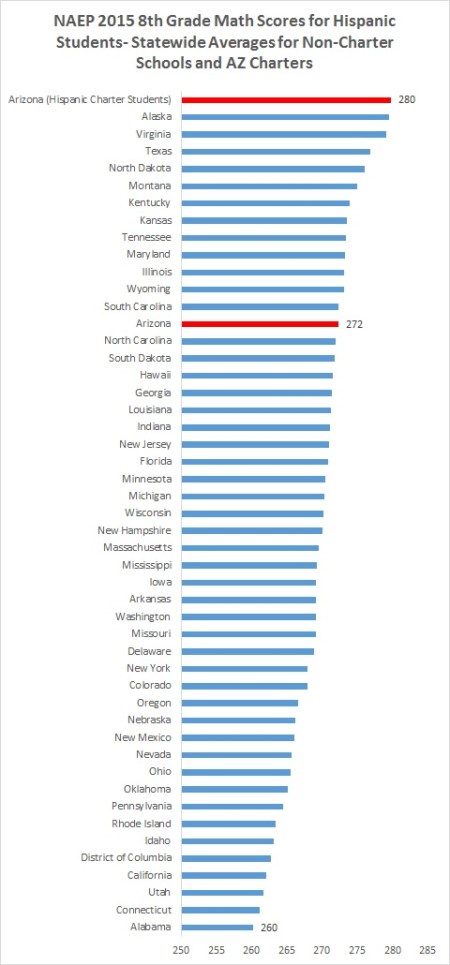
Arizona charter schools have more than done their part with a majority-minority student population and gains above and beyond the statewide average. Arizona Hispanic students attending charter schools, for instance, tied the statewide average for Delaware on eighth-grade math in 2015 on NAEP.
We have ample reason to desire a faster rate of progress, and I agree with Valdez that Arizona’s future rests heavily upon the success of Hispanic students. District schools, however, remain the most generously funded of Arizona’s school options by a wide margin and outcomes for Hispanic students have been trending in a positive direction.
Senator John McCain took to the pages of the Arizona Republic today to describe how a giant, corrupt and bureaucratic organization has attempted to actively thwart a reform known as the Choice Card. The Choice Card allows beneficiaries the option of seeking services from outside of the indifferent/corrupt/self-serving system.
McCain is describing the Veteran’s Administration, but the song has a familiar tune. Very familiar in fact.



 Posted by Greg Forster















 Jay P. Greene's Blog