Nominations Solicited for the 2016 Al Copeland Humanitarian Award

October 6, 2016

It is time once again for us to solicit nominations for the Al Copeland Humanitarian Award.  The criteria of the Al Copeland Humanitarian Award can be summarized by quoting our original blog post in which we sang the praises of Al Copeland and all that he did for humanity:

Al Copeland may not have done the most to benefit humanity, but he certainly did more than many people who receive such awards.  Chicago gave Bill Ayers their Citizen of the Year award in 1997.  And the Nobel Peace Prize has too often gone to a motley crew including unrepentant terrorist, Yassir Arafat, and fictional autobiography writer, Rigoberta Menchu.   Local humanitarian awards tend to go to hack politicians or community activists.  From all these award recipients you might think that a humanitarian was someone who stopped throwing bombs… or who you hoped would picket, tax, regulate, or imprison someone else.

Al Copeland never threatened to bomb, picket, tax, regulate, or imprison anyone.  By that standard alone he would be much more of a humanitarian.  But Al Copeland did even more — he gave us spicy chicken.

Last year’s winner of “The Al” was the internet humorist, Ken M.  Ken M did more to improve the human condition than just make us laugh by making idiotic comments on social media (although that would have been enough).  His humor reveals the ridiculousness of people trying to change the world by arguing with people on the internet.  Given how much time ed reformers waste on social media, especially the soon-to-be-sold Twitter, Ken M’s humor is a useful reminder that many of the people reading your posts are probably not much swifter or influential than the Ken M persona.  Ken M beat a set of strong nominees, including Malcolm McLean, Gary Gygax, and John Lasseter.

The previous year’s winner was Peter DeComo, the inventor of the Hemolung Respiratory Assist System.  To save a life DeComo had to trick border control officials to bring a model of his artificial lung machine into the US from Canada because the device had not yet been fully approved by the FDA.  DeComo won over a worthy field, including Marcus Persson, the inventor of Minecraft, Ira Goldman, the developer of the “Knee Defender,”  Thomas J. Barratt, the father of modern advertising, and Thibaut Scholasch and Sébastien Payen, wine-makers who improved irrigation methods.

The 2013 winner of “The Al” was Weird Al Yankovic.  Weird Al beat an impressive set of nominees, including Penn and Teller, Kickstarter, and Bill Knudsen.

The 2012 winner of “The Al” was George P. Mitchell, a pioneer in the use of fracking to obtain more, cheap and clean natural gas. Mitchell won over a group of other worthy nominees:  Banksy, Ransom E. Olds, Stan Honey, and Alfred Fielding and Marc Chavannes.

In 2011 “The Al” went to Earle Haas, the inventor of the modern tampon.  Thanks to Anna for nominating him and recognizing that advances in equal opportunity for women had as much or more to do with entrepreneurs than government mandates.  Haas beat his fellow nominees:  Charles Montesquieu, the political philosopher, David Einhorn, the short-seller, and Steve Wynn, the casino mogul.

The 2010  winner of  “The Al” was Wim Nottroth, the man who resisted Rotterdam police efforts to destroy a mural that read “Thou Shall Not Kill” following the murder of Theo van Gogh by an Islamic extremist.  He beat out  The Most Interesting Man in the World, the fictional spokesman for Dos Equis and model of masculine virtue, Stan Honey, the inventor of the yellow first down line in TV football broadcasts, Herbert Dow, the founder of Dow Chemical and subverter of a German chemicals cartel, and Marion Donovan and Victor Mills, the developers of the disposable diaper.

And the 2009 winner of “The Al” was  Debrilla M. Ratchford, who significantly improved the human condition by inventing the rollerbag.  She won over Steve Henson, who gave us ranch dressing,  Fasi Zaka, who ridiculed the Taliban,  Ralph Teetor, who invented cruise control, and Mary Quant, who popularized the miniskirt.

Nominations can be submitted by emailing a draft of a blog post advocating for your nominee.  If I like it, I will post it with your name attached.  Remember that the basic criteria is that we are looking for someone who significantly improved the human condition even if they made a profit in doing so.  Helping yourself does not nullify helping others.  And, like Al Copeland, nominees need not be perfect or widely recognized people.


Small Schools 18, Big Box 2

October 4, 2016
Why is this man smiling? Read on MacDuff...

Why is this man smiling? Read on MacDuff…

(Guest Post by Matthew Ladner)

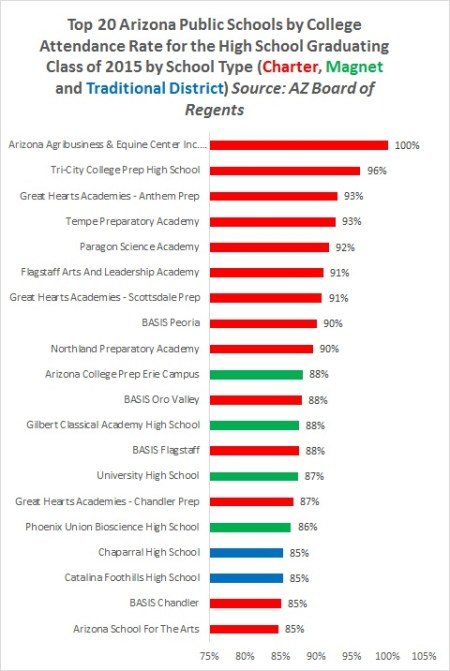
So last week I used an Arizona Board of Regents Report to show you the top AZ high schools year after graduation college attendance:

az-college-attendance

So now let’s take the chart immediately above, and rather than emphasize school type, let’s instead look at the number of high school students. The above chart still ranks the same 20 schools by their 2015 college attendance rates, but simply provides attendance rates.

school-size-az

The two large high-schools that made the list (Chaparral and Catalina Foothills) may be the most leafy of leafy suburban schools in Scottsdale and Tucson respectively. The other 18 schools in the top 20 are small charter and magnet schools. Of course a score of 18 to 2 is merely suggestive, but rigorous evaluations of small schools in New York City point to a similar conclusion: good outcomes come with small schools.


The Agony and the Ecstasy of the Nevada ESA Ruling

September 30, 2016

(Guest Post by Matthew Ladner)

I’ve read a few school choice related Supreme Court decisions over the years, but I’ve never seen anything quite like the ruling that the Nevada Supreme Court made yesterday. To this untrained reader, it appears to be a determined exercise in cutting the baby.

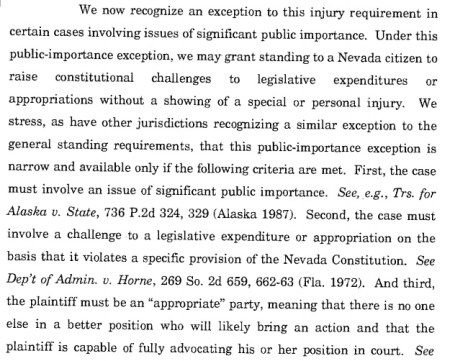
The decision reads very cleanly until the matter of standing arises. Standing involves being able to demonstrate some personal harm, and the Court implicitly acknowledges a lack of harm on the part of the plaintiffs by creating an exception to standing out of whole clothe in the ruling:

nv-ruling-1

So…..I am inferring from this that under the standing requirements that existed for every previous case in the history of the state of Nevada, that the Nevada Supreme Court would have felt compelled to acknowledge the obvious truth that the plaintiffs had claimed harm when in fact none actually existed. I’m no lawyer, and I don’t play one on television, but I’m also astonished that the Court felt free to willy-nilly change standing requirements unilaterally and in the late stages of an important case.  If you can explain to me how this makes the least bit of sense, and it not entirely arbitrary and capricious, please feel free to educate me in the comments.

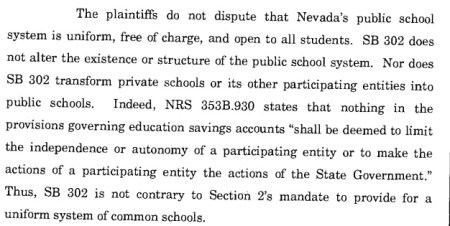
Having performed this incredibly one sided act of mental gymnastics, the court moves on to consideration of constitutional issues. First up, our old friend the “uniformity clause.” Quite rightly, the Court squashes this bug of a claim under their boot:

nv-ruling-2

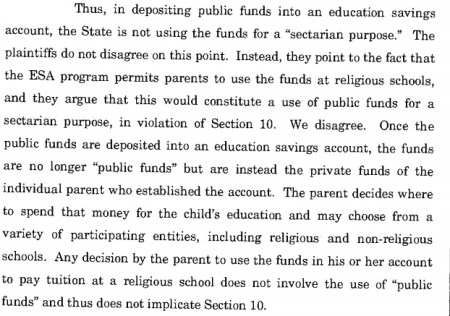
Jolly good, moving on to sectarian purpose Blaine claim. This is where the Court makes a potentially very far-reaching conclusion:

nv-ruling-3

Note that this was an argument that Nick Dranias and I made in our paper for the Goldwater Institute that made the case for the Arizona ESA as a replacement for the voucher program for children with disabilities: that once a set of mutual benefits between a parent and the state had been realized that funds deposited into an account were private rather than public funds. Jason does a great job of expounding on this point in his Cato post on the decision and how this precedent is followed in other policy areas. No one can claim that a state worker cannot use their salary to pay for Catholic school tuition for instance- as the check from the state is exchanged for the labor of the worker and thus becomes private funds. Likewise in an ESA, the state realizes the benefit of paying for a traditional education for the child, and the parent realizes the benefit of flexibility under the rules of the account.

The Arizona ESA decision implicitly recognized this argument, but the Nevada decision explicitly embraces it.

After that we get back into agony, with the court sifting through a complex mess of requirements and dates of bills passing. Basically in the end the court emphatically holds that ESAs are constitutional, but finds that the way the legislature funded the ESA program was itself not constitutional. Basically the program exists but currently has no funding.

So where does this leave things?  It leaves the 7,000+ students who applied for NVESA out in the cold. As the Wall Street Journal noted today, a looming special session on building a football stadium for an out of state billionaire also represents an opportunity to fund the educations of thousands of Nevada children.

Let’s see what happens next.


More on the Failure of Technocracy

September 29, 2016

Education Reform has taken the counter-productive path of focusing narrowly on identifying the “scientifically” validated techniques to maximize  math and reading test scores.  The advocates of this approach imagine themselves as rational people, using the tools of science to improve others’ lives.  In reality, they have failed to grasp the limitations of science and the inability to centrally plan improved outcomes for all.  Rather than truly relying on science, they are abusing the authority of science to exercise control.

This abuse of science to wield power is also known as technocracy, the rule by self-proclaimed experts.  Greg had an excellent piece yesterday describing the problems of technocracy.  In this post I would just like to add two illustrations of the failure of technocracy in education — one from program evaluation and the other from the perspective of the humanities.

The program evaluation illustration comes from the results of a US Department of Education’s National Center for Education Evaluation study of “a 93-hour professional development program focused on deepening math content knowledge.”  Teachers were randomly assigned to receive this intensive math professional development or to a control group that did not receive any additional training.  Measures of math knowledge collected from the teachers show that those who received the professional development learned what the training was attempting to convey.  And independent classroom observations found that the “quality” of classroom instruction was higher for the teachers who received the training.  Again, the professional development intervention appears to have been properly implemented in that it changed the treatment group teachers’ knowledge and their classroom practice.

Despite successful implementation of this professional development based on what many experts believed to be the best practice for improving math instruction, scores on the NWEA and state math tests showed small declines (and the NWEA decline was not statistically significant while the state test decline was).

It is unclear what part of this effort failed.  We can’t simply conclude that this PD, like many before it, was unproductive.  To do so, we’d have to know that the measures of implementation — teacher knowledge and classroom instruction quality — are in fact capturing knowledge and quality.  And we’d have to know that the NWEA and state math test scores are valid predictors of later life outcomes.  So, even with a clear failure we have no idea whether the failure was in the PD, the measures of implementation, or the measures of the outcomes.  Of course, it is also possible (perhaps highly likely) that the math approach deemed the best by math education experts wasn’t actually the best for all.

This illustrates the trap of technocracy in education.  Experts may well be wrong and our tools for scientifically evaluating policies are very imperfect.  And all of this assumes that we do not differ on values and priorities which might lead to legitimate differences about what outcomes should be optimized and for whom.

My second illustration of the failure of technocracy in education comes from the perspective of the humanities.  Scott L. Newstok, who directs the Pearce Shakespeare Endowment at Rhodes College, recently gave the convocation address to the entering class of 2020 at that institution.  His entire remarks were published in the Chronicle of Higher Education, and they are well worth reading in full.  To paraphrase Lincoln, I can do little to add or detract from what he said other than to highlight some of the key passages below:

Your generation is the first to have gone through primary and secondary school knowing no alternative to a national regimen of assessment. And your professors are only now beginning to realize how this unrelenting assessment has stunted your imaginations.

In response to the well-intentioned yet myopic focus on literacy and numeracy, your course offerings in art, drama, music, history, world languages, and the sciences were all too often set aside “to create more time for reading and math instruction.” Even worse, one of the unintended consequences of high-stakes testing is that it narrowed not only what you were taught but how you were taught. The joy of reading was too often reduced to extracting content without context, the joy of mathematics to arbitrary exercises, without the love of pattern-making that generates conjecture in the first place.

You’ve been cheated of your birthright: a complete education. In the words of Martin Luther King Jr. (at your age of 18), a “complete education” gives “not only power of concentration, but worthy objectives upon which to concentrate.”…

The most fascinating concept that Shakespeare’s period revived from classical rhetoric was inventio, which gives us both the word “invention” and the word “inventory.” Cartoon images of inventors usually involve a light bulb flashing above the head of a solitary genius. But nothing can come of nothing. And when rhetoricians spoke of inventio, they meant the first step in constructing an argument: an inventory of your mind’s treasury of knowledge — your database of reading, which you can accumulate only through slow, deliberate study.

People on today’s left and right are misguided on this point, making them strange bedfellows. Progressive educators have long been hostile to what they scorn as a “banking concept” of education, in which teachers deposit knowledge in passive students. Neoliberal reformers — the ones who have been assessing you for the past dozen years — act as if cognitive “skills” can somehow be taught in the abstract, independent of content. And some politicians seem eager to get rid of teachers altogether and just have you watch a video. You, having been born when Google was founded, probably take it for granted that you can always look something up online.

But knowledge matters. Cumulatively, it provides the scaffolding for your further inquiry. In the most extreme example, if you knew no words in a language, having a dictionary wouldn’t help you in the least, since every definition would simply list more words you didn’t know. Likewise, without an inventory of knowledge, it’s frustratingly difficult for you to accumulate, much less create, more knowledge. As the Italian novelist Elena Ferrante said, “There is no work … that is not the fruit of tradition.”

Tradition derives from the Latin traditio — that which is handed down to you for safekeeping. I think part of our innate skepticism of tradition derives from our good democratic impulses: We don’t want someone else telling us what to do; we want to decide for ourselves. In other words, you rightly reject a thoughtless adherence to tradition, just as you rightly reject (I hope) the thoughtlessness that accompanies authoritarianism. However, as the political philosopher Hannah Arendt insisted, education “by its very nature … cannot forgo either authority or tradition, and yet must proceed in a world that is neither structured by authority nor held together by tradition.” Educational authority is not the same thing as political authoritarianism.


Competing Against Non-Consumption

September 28, 2016

(Guest Post by Matthew Ladner)

HT to good Kevin Carey (the entertaining higher ed version) for drawing attention to this Harvard regression discontinuity analysis of the Georgia Tech $7,000 Masters Degree in Computer Science. Making use of a natural experiment the researchers found that the inexpensive Georgia Tech program was competing against…nothing. In other words, those that applied and did not get admitted did not enroll in a different, more traditional program.

It remains to be seen whether a Georgia Tech online students learn as much as their in person peers or how the market views these sort of degrees. On the learning side, it is not terribly hard to teach students more than what they would have learned in their other program (i.e. nothing) and the amount of knowledge gained per tuition dollar will run laps around the in-person program. The in-person program btw only can accomodate 300 students at a time, while the online program has 4,000.

Much more research to be done. Just as the vast legions of the University of Texas at Austin film school eventually lapped the accomplishments of back east finishing schools for global technocrat film schools (albeit some get to claim scoreboard due to a black swan) just maybe…

It's about numbers boys and girls and they have more!

It’s about numbers boys and girls and they have more!


The Next Accountability – Failure of Technocracy

September 28, 2016

Little-sprouts_-Grow-bean-sprouts-in-your-back-garden

(Guest post by Greg Forster)

EdChoice just posted Part 3 of my series on The Next Accountability. Having discussed what we want from education and how schools best deliver it, I now turn to why technocratic accountability systems get in the way – and, by their nature, always must:

The logic of technocracy is simple: Let’s forget about the things that we strongly disagree about, and focus on the things that everyone ought to be able to reach agreement about pretty easily. As a result, technocracy effectively narrows down the agenda for the head to reading and math scores, keeps the agenda for the hands hopelessly vague (“critical thinking”) and keeps silent about the heart. What makes this so tempting is the illusion that we can avoid uncomfortable, potentially divisive questions about what is good and right…

Whatever its intentions or motives, technocracy in practice imposes a vision of the good for education that includes everything that is widely agreed to be good, and effectively excludes—treats as not essential to good education—everything that is subject to serious disagreement.

I also have a word (as I often do) for my friends in the school choice business:

Technocracy can only be countered by a better, truer and more attractive vision of the human good that education can serve. We are a free and diverse country, a community where neighbors live together while disagreeing about what is good, true and beautiful. But that very truth—that we are a free and diverse country, a community where neighbors live together while disagreeing about what is good, true and beautiful—moves us in deep and powerful ways as we contemplate it. Our shared goal for education can be precisely the cultivation of that kind of free community.

This is why, as I emphasized in the introduction to this series, talking points and canned rhetoric about “markets” and “competition” are woefully inadequate to the needs of the present moment. The claims many of us have made about the benefits of markets are true. But we must ground our case in what it means to be human in what the head, the hands and the heart need from education. We need a humane vision of what education is for that is more attractive than the technocratic vision.

Your thoughts, questions, comments and rotten vegetables are (as always) appreciated!


Arizona Charter and Magnet Schools Top the List for College Attendance of 2015 Graduates

September 26, 2016

az-college-attendance

(Guest Post by Matthew Ladner)

‘Nuff said…


Segregationist Neanderthal 1, Florida’s First Integrated School 0

September 22, 2016

(Guest Post by Matthew Ladner)

Make sure to catch this post over at RedefinED by Patrick Gibbons about the racist “founder of Florida public education” and his 18 year jihad to close a racially integrated private school.

You couldn’t make this stuff up, and even if you tried, no one would believe you, which is why Gibbons included a sources appendix at the end of the post. Very worth the read.