(Guest post by Greg Forster)
If you didn’t like my take on Iron Man 2, try this one on for size:
Part of the long-running series.
(Guest post by Greg Forster)
If you didn’t like my take on Iron Man 2, try this one on for size:
Part of the long-running series.
 2 Comments |
  Pass the Popcorn | Tagged: Continuity, Greg Forster, Iron Man, Iron Man 2 |
  Permalink
 Posted by Greg Forster

(Guest post by Greg Forster)
In the Corner, Jim Manzi’s comment on Grover Whitehurst’s proposals for education reform is that it’s really no longer a matter of arguing over what would help; it’s just a question of figuring out how to make it happen in the face of entrenched union opposition. Manzi thinks that’s a good sign:
It is striking how far thoughtful, mainstream liberal wonk opinion has moved on the question of educational reform….When one side of the political divide loses its own ideological belief in a specific position and defends it based purely on interest-group power, this often creates an opportunity for real change.
It seems to me that education reform is ripening as political issue for Republicans, if they are willing to seize it, as they did welfare reform 20 years ago. Like welfare reform, this would probably imply being willing to engage on the policy detail, and to work with Democrats in order to create a bipartisan solution with staying power. It looks to me like there is lots of common ground to be found.
I think that’s right, but it will all hinge on the willingness of enough Democrats to buck the teacher union mafia, just as welfare reform hinged on the willingness of enough Democrats to buck the social-services union mafia twenty years ago. Fortunately, there are reasons to think that could happen. And the best part is, today the people turning against the unions are not just any Dems, they’re the social justice Dems, who bring to the table their unique cultural power to annoint and legitimize things within the Left.
Leave a Comment » | politics | Tagged: Greg Forster, Grover Whitehurst, Jim Manzi | Permalink
Posted by Greg Forster

(Guest Post by Matthew Ladner)
Must read story from the Dallas Morning News. Important piece of context that the DMN failed to mention: DISD has been an academic train wreck for decades, especially for African-Americans. A quick look at Texas Education Agency reports reveals that only 5.1% of DISD African-Americans received a “criterion score” on the SAT or ACT, which if memory serves would qualify the student to attend a moderately selective university.
The story contains multiple hints of battles over patronage, and academically, it is hard for me to think of thousands of African-American children going to school somewhere other than DISD as anything less than a net positive. If the Texas legislature were to improve the state’s charter school law, and to pass measures to create private choice options, it would be the equivalent of sending a rescue flotilla to the Titanic.
1 Comment | charter schools | Tagged: Dallas Independent School District, Dallas Morning News | Permalink
Posted by matthewladner

(Guest Post by Matthew Ladner)
He’s going to stab it with his steely knife, and he just might kill the beast…
52 Comments | teacher union | Tagged: Chris Christie, New Jersey Education Association, New Jersey teacher unions, NJEA | Permalink
Posted by matthewladner

I am shocked – shocked! – to discover that political manipulation of education is going on in here!

Your NCLB and RTTT grants for supporting national standards, monsieur.
(Guest post by Greg Forster)
Over on NRO, Heritage’s Lindsey Burke and Jennifer Marshall warn that the Obama administration is finding even more ways to use federal influence to push “voluntary” national standards on the states.
So much for Checker’s apparently serious assertion that the standards “emerged not from the federal government but from a voluntary coming together of (most) states, and the states’ decision whether or not to adopt them will remain voluntary.” Bwa ha ha!
9 Comments | instructional reform, politics | Tagged: Best of Greg, Checker Finn, Chester Finn, common core, common core standards, Greg Forster, Jennifer Marshall, Lindsey Burke, NRO | Permalink
Posted by Greg Forster

(Guest Post by Matthew Ladner)
A new study by David Figlio links higher gains among Florida public schools with higher levels of competition from the Step Up for Students tax credit program. You can read the St. Pete Times story by Ron Matus here. Matus wrote:
Figlio emphasized the boost was significant, but modest.
“Anybody looking for a silver bullet has to keep looking,” he said. “What we find is certainly positive and statistically strong, but it’s not like public schools are revolutionizing overnight because of this, either.”
So it turns out that the public school gains associated with a state program with an initial statewide cap of $50m in a state with a multi-billion dollar public school budget were statistically significant but modest. Would it be reasonable to expect anything more from such a modest program? I suggest we scale this public school improvement program up to say a cool billion per year and then measure the impact.
My favorite line in the story comes from a hostile academic:
Another researcher remained skeptical. Stanford labor economist Martin Carnoy, who has studied the impact of vouchers and reviewed the latest study, said Figlio and Hart did “an honest job with the data.”
“But here is the real story: even after several years the effect size is TINY,” he wrote in an e-mail. “They are so small that even small downside effects would nullify them, leaving vouchers as mainly an ideological exercise.”
This is one of the more unintentionally hilarious statements I have read in some time. The field of education reform battle is covered with the dead bodies of reforms that show nothing in the way of a statistically significant impact. Increasing per pupil funding, Head Start, teacher certification, almost everything studied by the “What Works” clearinghouse so far, etc. All of these failures cost a great deal of money and deliver nothing in the way of sustained academic gains.
So the state of Florida passes a small law that actually saves the state money and shows a statistically significant and small result of improving public schools, and we are supposed to wring our hands and despair because something bad could come along and nullify the gains? Ummmmm, no.
First of all, nothing bad did come along and nullify the gains- quite the opposite. This program was only a part of the strategy to increase parental choice in Florida. That strategy also includes charter schools, McKay vouchers and virtual schooling- all of which either already are or soon will be much larger programs than Step Up for Students.
Second, the parental choice strategy was itself a part of a larger effort to improve Florida public schools. Parental choice reinforced the central K-12 reform of grading schools A-F. Transparency, rewards for success, consequences for failure formed the core of the Florida strategy.
Did it work?

The Step Up for Students program played a contributing role in Florida’s symphony of success rather than “destroying public education.” This is what Milton Friedman argued all along. Bravo- the obvious conclusion to draw is to push both parental choice and public school reform still further in Florida and elsewhere.
3 Comments | competitive effects, tax-credit scholarships | Tagged: David Figlio, Florida education tax credits, school choice, Step Up for Students | Permalink
Posted by matthewladner

(Guest post by Greg Forster)
David Figlio’s study (with Cassandra Hart) on how the Florida Tax-Credit Scholarship program impacts public schools is finally out. Guess what? His detailed statistical analysis finds that competition from school choice improves public schools. (Here’s some local news coverage.)
But that was no surprise to anyone who’s been following the research. Early last year I counted up the studies and here’s what I got:

Removing the double-count for studies that had findings in multiple locations, that made it 16 studies finding school choice improves public schools to zero finding they hurt public schools. (The one null finding was in DC, where the program pays enormous cash bribes to the public system – apparently on the princple that children are the chattel property of the government school system – in order to deliberately neutralize its effect on public schools.)
After that, Jay came out with yet another study finding that Milwaukee vouchers have improved public schools. That brought it up to 17-0.
Now Figlio and Hart in Florida, adding the first study that looks at tax-credit scholarships rather than vouchers, have made it 18-0.
Oh, and in case you’re wondering, the Florida tax-credit program also dramatically improves education for the students who are using it.
As always, critics are trying to make hay out of the fact that in the Figlio/Hart study, a tiny, population-limited, regulation-cramped choice program produces only moderate-sized benefits. Well, geniuses, if the benefits of a tiny, population-limited, regulation-cramped program are too small for you, can you think of any way you might make the program’s impact bigger?
1 Comment | competitive effects, tax-credit scholarships, vouchers | Tagged: Cassandra Hart, David Figlio, Florida, Florida Tax Credit Scholarship program, Greg Forster | Permalink
Posted by Greg Forster

(Guest Post by Matthew Ladner)
The NAEP released the 2009 Urban District NAEP results recently, which of course was an invitation to go exploring the data. I thought it would be interesting to look at the results for 4th grade reading.
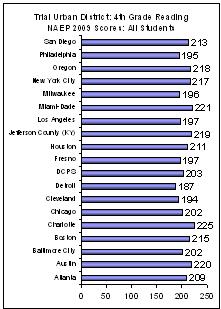
So Charlotte, Miami and Austin come out looking pretty good among urban districts. Oh, and Oregon too. Silly me, I must have accidentally slipped the statewide average for all kids in Oregon into the comparison of urban school districts. When you throw in all the rich kids in Oregon into the mix, they look like a decent urban school district, although not, I will note, the best urban school district.
Perhaps a bit of control for demographic differences between these jurisdictions is in order. After all, some districts like Austin (and I suspect Charlotte) have quite a few affluent kids attending them. So in the next chart, I only look at free and reduced lunch eligible children in the districts for more of an apples to apples comparison.

So Miami wins overall with a score of 215 for FRL kids, followed closely by NYC at 214. Both of these scores exceed several statewide averages for all students- such as California’s. Miami not only was the low-income reading champion for 4th grade, but the both the low-income and the overall reading champion for 8th grade.
Oregon low-income kids perform **ahem** like a mid-tier urban district despite the inclusion of suburban kids, and approximately a grade level behind both Miami and NYC. Some might also find it interesting that the Miami school district is 91% minority, while Oregon is 72% Anglo.
I certainly do. Quite a bit actually.
When I read Bernard Lewis’ book What Went Wrong? about how the Islamic world went from being the premier civilization to an economic backwater, it seemed to me that Lewis had asked the wrong question. Most of the world, after all, is a backwater. The real question is What Went Right? with the West more than what went wrong in the Islamic world.
It behooves us to ask both questions in this case: what in the world is wrong with Oregon, and what is going right in Miami? I have a very good idea of what is going right in Miami. Good standards and testing, transparency, letter grade rankings for schools, parental choice, alternative certification, curtailment of social promotion. I don’t know what Oregon has been doing, but it looks to me like they should make some rather dramatic changes.
Leave a Comment » | competitive effects, instructional reform | Tagged: NAEP Trial Urban District Assessment, The best urban school districts, Urban school district performance | Permalink
Posted by matthewladner

“They teach you to predict the weather at a box company?”
(Guest post by Greg Forster)
Sorry I’m so late to the party. I just saw the finale last night.
First let me gloat that I made (I believe) only one specific, concrete prediction, and after over a year of appearing to be falsified it was at long last fulfilled in the finale. The Axiom conquers all.
(OK, OK, it was only sort of fulfilled. But we all know that “moving on” for Daniel is going to include killing bad guys and winning Charlotte. Right?)
More generally, I feel vindicated in having maintained for so long that the real key to the whole show is the question of whether Locke was right to put his faith in the fundamental goodness of “the island.” I didn’t really get it all articulated at the time, but that was the reason I was struggling near the end to figure out, in retrospect, how Smokey fit in with Locke’s story over the course of the show. I wanted to know why they had chosen to incarnate Smokey in Locke’s body. Why remove Locke from the show when he was the lynchpin holding it all together? Now I see – they did it to set up the confrontation in the end between the spiritual Locke (Jack) and the physical Locke (Smokey). Jack had to finally admit, to himself and everybody else, that Smokey wasn’t Locke because he (Jack) was Locke.
On one level, I got what I wanted out of the finale. What I wanted was 1) a knock-down, drag-out knife fight for the fate of the world on the edge of a slowly crumbling cliff, and 2) a noble death. Check and check. I’m a happy guy.
But I think the ending is satisfying on a deeper level, too. I don’t need to know anything more than I now know about Dharma, Widmore, childbirth, chosen ones, etc. (It still bugs me that Walt appeared to Locke, but I can deal.) Those were all just skins the show shed, one after the other. On a show like this, it’s foolish to expect too much from the skins. What you have to do is follow the snake. Or maybe a better image is the old cups and balls routine – the ball moves from cup to cup, but it’s the ball you need to keep your eye on.
Jay is right that the soap opera stuff can’t hold up the show by itself. You need a larger drama to give the soap opera stuff meaning. Well, the larger drama was whether the island was good or bad, and on that it delivered just fine.
I’m not saying it’s the ending I would have written myself. I happen to think that “rejoining your loved ones” and learning to “move on” from the past, simply by themselves, is a contemptible vision of heaven. Even if that’s just the prelude to whatever “comes next,” what makes the afterlife attractive on this vision is having a chance to start again – a do-over. But what makes you think you won’t just screw it all up again – especially given infinite time – and just end up in the same place? Jacob committed the same folly – he kept bringing people to the island to show Smokey that people are basically good, and the people disappointed him every single time. You aspire to an eternity of endless do-overs? That’s the Buddhist conception of hell. I happen to believe that there’s a hell even worse than that, but the Buddhists are right when they say that if the afterlife is just more of the same forever, with periodic opportunities to start over with a fresh slate, then existence is suffering and annihilation is heaven. (It’s ironic that the show had the symbols of all the world religions in the church window. The world religions don’t really all teach the same thing, but there are some things they do all agree on, and the repudiation of this show’s vision of heaven is one of them. They all, in radically different ways, claim to offer an escape from the hell that is our own broken nature.)
But none of that detracts from my enjoyment of the show, because I don’t watch shows to have my own worldview affirmed. The enjoyment of narrative lies precisely in having the opportunity to explore a universe other than the one we really live in. Achilles is a horrible monster committing barbarism motivated by egocentrism in the service of unjust aggressors, but that doesn’t detract from my enjoyment of the Illiad. (I have gotten much help on this subject from C.S. Lewis’s An Experiment in Criticism.)
And if you don’t like my analysis, here’s my wife’s, which I think may find some agreement. “I figured out the secret ending,” she said to me this morning. “It’s the subliminal messages they put in the finale that say BUY ALL THE EPISODES ON DVD AND YOU CAN FIGURE IT ALL OUT.” She suggests that they put in references to all the world’s religions “not so that they’ll be equally happy but so that they’ll all be equally frustrated.”
12 Comments | Lost | Tagged: Best of Greg, Greg Forster | Permalink
Posted by Greg Forster
(Guest Post by Matthew Ladner)
Leave a Comment » | teacher quality | Tagged: Whitney Tilson | Permalink
Posted by matthewladner

 Jay P. Greene's Blog