It’s Not Just Government, It’s Schools, Too

January 15, 2014

(Guest post by Greg Forster)

Responding to Fordham’s latest straddle, here on JPGB Matt has pointed out that we shouldn’t trust the job of judging school quality to government, and no one knows this better than Fordham (some of the time, anyway). At Cato, Andrew Coulson and Jason Bedrick point out that the existence of school choice programs inevitably crowds out non-choice-participating private schools, so if choice programs become engines of uniformity, we can kiss educational entrepreneurship and innovation goodbye. First Fordham demands state tests must bow to Common Core, then it demands private schools must bow to state tests, all the while insisting Common Core both is and is not a powerful tool for reshaping curriculum!

At the Friedman Foundation’s blog, Robert Enlow points out that Fordham is also playing both sides of the fence on whether the tests will have to be given only to choice students or to all students in the school:

Fordham even implicitly shows how its testing approach will eventually impact non-voucher private school students: “[i]f a private school’s voucher students perform in the two lowest categories of a state’s accountability system for two consecutive years, then that school should be declared ineligible to receive new voucher students until it moves to a higher tier of performance (emphasis added).”

If a private school accepting voucher students loses those students because of their low performance on state tests, how can it rejoin a school choice program without forcing all of its students to take, and perform well, on the state test?

Here’s another issue that I haven’t seen raised yet. Fordham backs up its position by pointing to the results of a survey of private schools that don’t participate in choice programs. State testing requirements came in seventh on the list of reasons why they don’t participate; demand for universal eligibility and higher choice payments were the top answers.

Once again, Fordham is operating out of a top-down, anti-entrepreneurial mindset. Existing private schools are not the voice of entrepreneurial innovation. They are the rump left behind by the crowding out of a real private school marketplace; they are niche providers who have found a way to make a cozy go of it in the nooks and crannies left behind by the state monopoly. They are protecting their turf against innovators just as much as the state monopoly.

Milton once used the analogy of hot dog vendors. If you put a “free” government hot dog vendor on every street corner, the real hot dog vendors will all vanish. The same has happened to private schools. If we extend the analogy, we could say that a few hot dog vendors might survive by catering to niche markets – maybe the government hot dog stands can’t sell kosher hot dogs because that would be entanglement with religion. But the niche vendors would not be representative of all that is possible in the field of hot dog vending.

And the private schools that don’t participate in choice programs are probably the least entrepreneurial. Notice, for example, that their top complaint is that choice isn’t universal. Why would that prevent them from participating in choice programs? Wouldn’t they want to reach out and serve the kids they can serve, even as they advocate for expansion of the programs to serve others? The private schools participating in choice programs are doing so; they may not be paragons of entrepreneurship, but they are at least entrepreneurial enough to want to help as many kids as they can. The demand for bigger choice payments is also not a sign of hungry innovation on their part (even if the choice payments are paltry in may places).

Basically the attitude revealed by the Fordham survey of non-choice-participating private schools is “we want choice, but only if it doesn’t require us to change.” Funny thing; the public monopoly blob gives us pretty much the same line.


Fordham vs. Fordham on Private Choice Transparency

January 14, 2014

(Guest Post by Matthew Ladner)

The Fordham Institute has a new white paper out on accountability in private choice programs.  The headline will be that Fordham supports requiring students participating in voucher and tax-credit programs to participate in state accountability testing.  Adam Emerson, the author of the study and the new charter school chief in Florida (congrats btw Adam) wrote:

Surely there are risks associated with drawing private schools into public accountability systems, but empirical evidence shows that
downsides can be mitigated if policymakers are smart about how they design results-based accountability in choice programs of this kind.

The two key words in this sentence: risk and if.

Emerson believes that the risk of self-defeating homogenization of the school offerings available to parents can be managed by state officials being smart. Even the most insulated policymakers on the planet (say the Federal Reserve Board, which can more or less print its own budget) make decisions on far more than a technocratic basis. Even to the extent they do stick to their best judgement, they sometimes get things wrong in a spectacular fashion. Democratically elected lawmakers drift in and out of what Edmund Burke described as delegate and trustee roles of representation. The results, far from smart, are sometimes very messy and even counterproductive.

To gain an appreciation of the limited influence of technocrats in K-12 testing policy, I would suggest reading some of the Fordham Institute’s voluminous work making the case of what a complete hash a great many states have made of their testing systems for public schools. Here is a useful quote from the Proficiency Illusion:

Standards-based education reform is in deeper trouble than we knew, both the Washington-driven, No Child Left Behind version and the older versions that most states undertook for themselves in the years since A Nation at Risk (1983) and the Charlottesville education summit (1989). It’s in trouble for multiple reasons. Foremost among these: on the whole, states do a bad job of setting (and maintaining) the standards that matter most—those that define student proficiency for purposes of NCLB and states’ own results-based accountability systems.

Something far more than the I.Q. of policymakers seems to be at work here. The theme goes on in another brilliant Fordham report, the Accountability Illusion (emphasis added by yours truly):

As currently implemented, NCLB is not a discriminating system. A tremendous amount of money and energy has been spent to create the impression that there is accountability, and there are large numbers of schools throughout the United States that are in some phase of sanctions. But the accountability is not coherent. We found states where most schools failed to make AYP and others where nearly every school made it. We found demonstrably good schools that failed to make AYP far too often, and some pretty mediocre ones that slide by in some states.Thus what seems like accountability is an illusion. Good schools get sanctioned, bad schools get off, and ultimately students get shafted, since maintaining this illusion has a cost. When good schools get sanctioned, resources are wasted and we risk causing quick-fix, panic driven, counterproductive change in schools that may ultimately hurt students. When bad schools get off, their students are denied opportunities (what we unfortunately now call “sanctions”) that might lead to a better education, including the chance to attend a different school, or receive supplemental services, or simply obtain assurance that the workings of a perennially dysfunctional school will be addressed and corrected.

If those policymakers had been “smart” then thing may not have turned out this way. Many of the state testing systems that Fordham is now anxious to impose on private choice students have been previously described as costly frauds by, well, Fordham itself.

I don’t have a problem with private schools choosing to take the state test if it is done voluntarily.  Personally I wouldn’t want anything to do with a private school that lacked the self-confidence to have their own curriculum, but to each their own.  I like national norm reference testing as a light-touch method of providing transparency while leaving curricular choices up to schools.  If policymakers are so inclined, using such data to exit bottom-feeder schools could be undertaken without imposing state tests.

The whole idea of creating a parental choice program however is to provide parents with the broadest possible array of meaningfully varying options so that they can choose a great fit for the needs of their child. Accordingly, we should never make the mistake of viewing the job of a private school participating in a choice program as teaching the state’s curriculum or giving their tests. Rather their job is to satisfy the individual needs of the student to the satisfaction of parents. Parents will find schools following the state’s curriculum and giving the state’s test in abundant supply.  The whole purpose of private choice options is to create a diversity in the menu of choices available to parents and students.

It isn’t the lack of I.Q. that created the mess in state testing systems, rather the natural limitations of technocrats operating within a pluralistic democracy.   We would be wise to recognize these limits and to craft our choice programs accordingly.


Use the Force MOOC! A 2013 retrospective

December 26, 2013

(Guest Post by Matthew Ladner)

The after-Christmas but before New Year period is always dominated by “Year in Review” retrospectives, so why not join in on the fun? Here at the Jayblog we dig new options for students and parents, so let’s take a look back at 2013.

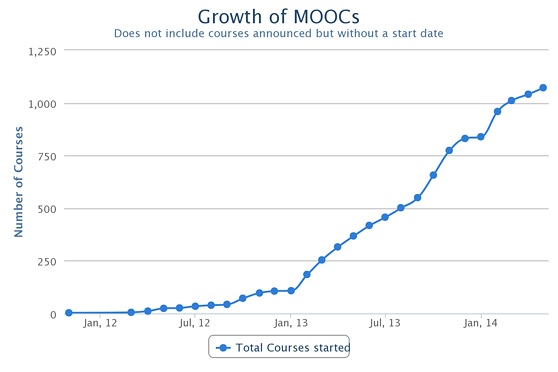
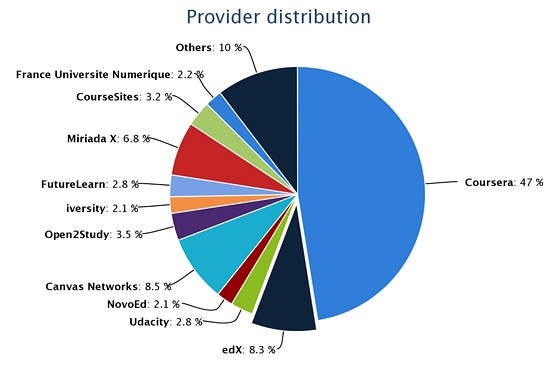
Digital learning continues to surge. No one has yet established the free online degree that some nutball predicted in 2009, but events are moving in that direction. Dhawal Shah of EdSurge leads us off with a review of the progress of Massive Open Online Courses (MOOCs) in 2013. Shah includes MOOCilicous charts like:

MOOC 1


and…

MOOC 2and…

MOOC 3

All of this is quite impressive given the first MOOC rolled out in 2011. Shah provides analysis and 2014 predictions, so go read the article. Events seem to be conspiring to take a very sharp pin to a higher education tuition bubble. One cannot help but wonder how long we will go on debating public funding for online high-school courses when, ahhh, Stanford is giving them away for free and you can, well, get college credit for them.  The logical side of Kevin Carey’s brain (the one that writes about higher education) turned in a useful refutation of the hand-wringing over MOOC completion rates.

Remember where you heard it first- the day is coming when more people will be watching university lectures online than Baywatch reruns.

Please note: I did not say it would be any time soon…

On the K-12 front, the National Alliance for Public Charter Schools published an evaluation of state charter school laws finding widespread improvement between 2010 and 2013. Bottom line: break out the bubbly. Thirty-five states improved their laws, only one law regressed. Seven states “essentially overhauled” their laws with major improvements-Hawaii, Rhode Island, New Mexico, Indiana, South Carolina, Louisiana, and Colorado. Ten more states-Florida, Illinois, Massachusetts, Michigan, Missouri, Nevada, New Jersey, New York, North Carolina, and Ohio made “notable improvements” in their charter law.

Here at Jayblog we have our annual measure of success in the private choice movement the Forster vs. Mathews school choice dinner bet. Greg either doubled or tripled the standard in 2011, and followed up by easily surmounting it once more in 2012.

In 2013, ooops Greg did it again!  Three-peat!  Two new states (Alabama and South Carolina) joined the school choice ranks, North Carolina went BIG on reform, including two new voucher programs, Ohio and Wisconsin passed new statewide programs, Arizona, Georgia, Iowa, Indiana and Utah improved existing programs.

So 2013 was a fine year overall for choice, grading on the curve of comparing it to past years. Compared to the needs of the country, this is all still painfully slow, so…


What’s So Funny ‘Bout Peace, Rawls and Understanding Update on RedefinED

November 11, 2013

(Guest Post by Matthew Ladner)

I updated the “forced reincarnation with the chance to pick your state” thought experiment with NAEP 2013 data over at RedefinED.

Bonus Elvis C:


“You shall not deny the Blogger.”

November 8, 2013

Strongbad using technology

(Guest post by Greg Forster)

T.S. Eliot and I would like to welcome a new blog, launched by my colleagues at the Friedman Foundation. They’ve decided to start out with something relatively simple and uncontroversial: the foundation’s stance on Common Core. Robert “The Barbarian” Enlow lays it out:

School choice is a far more effective way to improve educational outcomes than centralized standards imposed from above. A main concern with Common Core is that it could restrict entrepreneurship in education, so that parents will have fewer and less diverse choices. By contrast, universal school choice can provide a more vibrant system of schooling so that parents will have numerous and more varied high-quality options.

Check the blog next Wednesday for Friedman’s new report on how private schools use standardized tests in response to parental demand: “More Than Scores: An Analysis of Why and How Parents Choose Private Schools.” As Robert comments:

Do we need to ensure our children are competitive in a global economy? Definitely. Do we need to test our children to help parents understand their proficiency and growth? Most parents think so, and that’s why virtually all private schools use privately developed, voluntary standardized tests.

And keep your eyes on the blog for regular updates on the latest data, developments and derring-do. Embarrassing childhood photos are a free bonus.


Jeb Bush Drops School Choice – I Wonder Why

August 19, 2013

(Guest post by Greg Forster)

Jeb Bush’s big speech about education reform has made it onto NRO this morning. He does not include school choice as one of the four key components of education reform. I can’t imagine why Jeb would no longer view school choice as having been an important part of the Florida formula for success. Oh, wait, yes I totally can.

I am for standards. But choice must succeed before standards can succeed. By dropping school choice from his list of must-have reforms, Jeb is undermining the necessary path to success for standards.

Granted, he does turn aside at one point, under his section on digital learning, to tangentially mention school choice. But then, weirdly, he immediately feels the need to insist that “accountability is the cornerstone of reform.” Why is he suddenly going back to the subject of accountability when he’s already discussed that in a previous section? It’s a total non sequitur for him to bring it back up here – unless, that is, he shares my view that school choice is ultimately at odds with the technocratic, “trust us, we’re experts” spirit of Common Core.

He also asserts CC won’t hurt school choice – but his own defensive rush to demand that “accountability is the cornerstone of reform” after merely mentioning school choice undermines confidence in that assertion.

If anyone wants to contest my read of this speech I would request their responses to two questions: Why isn’t school choice one of Jeb’s four must-have reforms? And why does he suddenly rush to insist that “accountability is the cornerstone of reform” right after working in an anodyne mention of school choice?

One last point: We who prioritize school choice did not pick this fight. It was the CC crowd who came out with guns blazing, demanding that all schools must be judged on their yardstick (not parents’ yardsticks) and spitting on anyone who questioned their orthodoxy. We did not pick this fight. But we will not roll over just because the CC folks have all the money and power. A decade ago, the unions had all the money and power. We survived them, and we’ll survive Common Core as well, because we’re right.


Choice First, Standards Second

August 1, 2013

cart-before-the-horse

(Guest post by Greg Forster)

The Miami Herald and Tampa Bay Times are now reporting that Tony Bennett is expected to resign.

As I’ve said all along, this is not about Tony Bennett. This is about whether educational standards should be formulated by politicians and their allies behind closed doors and then presented as the One Best Way to which all schools ought to conform.

Does that mean there can be no standards? Of course not! It means school choice must come first, standards second. Common Core and its allies are putting the cart before the horse.

Creating standards and accountability measures requires judgment. Judgment requires trust. What trust requires is a huge metaphysical subject we don’t have space to get into today, but let’s cut to the chase – people don’t trust the government to do this job by itself, behind closed doors and with no alternatives permitted, and they are right not to do so.

That is not because one particular person or one particular party is corrupt. It is written into nature of things, it is woven into the very fabric of the universe, that human social systems don’t work that way. Not even Denethor, the most virtuous man in Gondor, could be trusted to hold the ring without using it: “If you do not trust me to endure the test, you do not know me yet.” “‘Nonetheless I do not trust you…Nay, stay your wrath! I do not trust myself in this.”

So if that’s not where standards come from, where do they come from? We obviously do have standards, for everything from technical specifications for smart phones to English grammar to the scientific method. Right now we don’t have standards for education. How do we get them?

We get them from the only place standards ever really emerge from: the open, free interaction of civil society, where people are allowed to try whatever makes sense to them and see what works.

Take the scientific method as an example. The early pioneers of modern science – Descartes and Bacon and that crowd – went down all kinds of ridiculous blind alleys. They tried things we would never bother with today. They set down rules for what you’re not allowed to do in science that we would now laugh at. Poor Bacon died from a pneumonia he caught while pursuing a cockamamie experiment, invented on the spur of the moment while travelling during the winter, to test the efficiency of snow as an agent for preserving meat.

So how did we get from there to here? Did the Royal Society convene the smartest smarties in the land and impose order on this chaos? No, we got here by giving scientists the freedom to try what made sense to them and seeing what worked.

They had endless debates. They disagreed about how to do science, about why they did science, about what science could and could not do. The debates were not a part of the chaos, the debates were the method by which order was eventually imposed on the chaos.

That’s what we need today. Instead of cooking up a One Best Way and then demonizing anyone who dissents, we need a forthright admission that we don’t have a consensus about what works, and to give people not only the freedom to experiment, but a social legitimization of their experimentation. Then we can have some really heated debates where we argue with each other over what works. This, and only this, can ultimately create consensus about what works.

I am not saying that government and political power play no role. I am saying government should play its proper role – as a servant of our civilization, not its master. I even think government has more of a job to do than simply forbidding force and fraud. That is why I favor school choice policies on their own merits, not merely as a stepping stone to “the separation of school and state,” as my libertarian friends would prefer.

A thriving marketplace of diverse options, where people are not only empowered to choose but also respected and honored for making their own choices, is the only path to standards. It is the only thing that can make standards legitimate and widely accepted. Of course this means giving up on the desire to impose them on everyone by force, but then, force is wrong and it doesn’t work anyway.

As long as the government runs a school system, it will need to set standards for that system. But it cannot even do that very effectively in the current environment, as we are seeing. A thriving marketplace of options would ultimately create standards with legitimacy and widespread acceptance. Those standards could then be imposed on the government system much more effectively than at present.

People who think standards are everything must choose – is it your goal to have the law tell everyone they must use your standards, and have everyone ignore the law; or to get everyone actually using some standards, even if they’re not yours? You can’t have both.


Greg Runs Up More Style Points in 2013

July 25, 2013

(Guest Post by Matthew Ladner)

This one slipped past me but not the eagle-eyes at School Reform NewsMissouri joins the school choice fraternity with a tax credit for special needs children. If I have the count correct the record for 2013 now looks like:

Alabama new tax credit programs

Arizona ESA expansion

Indiana voucher program expansion

Indiana tax credit program expansion

Iowa tax credit expansion

Missouri special needs tax credit program

North Carolina statewide low/middle-income voucher

North Carolina special needs voucher

Ohio new statewide low-income voucher

South Carolina new tax credit program

Utah special needs voucher program funding increase and formula funding

Wisconsin voucher program expansion

That looks like three new states: Alabama, Missouri and South Carolina along with some important program improvements/new programs and big goings on in North Carolina. Although there could be spirited debate about the best year for school choice before 2011, the top three years ever are clearly 2011, 2012 and 2013 (not necessarily in that order).

UPDATE: J. Bedrick notes in the comments that the Missouri tax credit language did not ultimately pass, but a similarily named piece did pass in a way confusing to both the newspapers and thus me. Sadly, an anti-BOOOOM.


Oops, Sorry, Turns Out Common Core is Anti-Choice

June 28, 2013

octopus

(Guest post by Greg Forster)

Well, folks, I have to recant my recantation from yesterday. Turns out Common Core really does destroy parental options.

At Heritage, Brittany Corona points out that the SAT, ACT and GED are all competing to see who is most “aligned” to Common Core. As the College Board begins a major overhaul of the SAT, prompted by the ACT recently surpassing it as the most-used college exam, the Board is bragging that “in its current form, the SAT is aligned to the Common Core as well as or better than any assessment that has been developed for college admission and placement.” The revisions will seek even stronger “alignment” between the SAT and Common Core. No doubt the SAT feels like it has to play catch-up because the ACT has been boasting for some time that it “pledges to work with other stakeholders to develop strategies and solutions that maximize the coverage of the Common Core State Standards to meet the needs of states, districts, schools, and students.” Meanwhile, the GED cites “the shift to the Common Core standards [that] is happening nationwide” as one reason it has to make major changes to its test.

Corona points out that private schools and homeschoolers are impacted by these changes. Private schools are already under pressure from short-sighted and/or cowardly system leaders to adopt (or pretend to adopt) Common Core, so that they won’t be stigmatized as dissenters from the One Best Way. If college entrance exams are Common-Core-ized, it will be virtually impossible for private schools and homeschoolers to maintain any kind of alternative to the One Best Way. As for the GED, Corona points out that homeschoolers often use it for external validation of their education.

Now, just like everything else associated with Common Core, there is less here than meets the eye. That’s because the claims that these tests are, or will be, “aligned” to Common Core are all meaningless BS (just like so many other claims associated with Common Core). As Jay has pointed out, it’s overwhelmingly unlikely that anybody is ever really going to align anything to Common Core in a meaningful way. You can see that just from what the College Board people are saying. “In its current form, the SAT is aligned to the Common Core as well as or better than any assessment.” What the heck does that even mean? What can that mean? The federal government’s contractors haven’t finished developing their official federal-government-designed assessments “aligned” to Common Core. We don’t even have the standards themselves yet! These people are simply talking out of their bodily orifices (just like…).

Moreover, as Corona points out, the deadening hand of dictatorial control by cynical elites is a constant wellspring of opportunity for entrepreneurial innovators: “Thankfully, tests like the SAT and ACT can be changed or replaced, even though they have begun a transition to Common Core. If a significant number of states pull out of Common Core, these exams can be modified, or there could be an opening in the market for other college entrance exams to take root.”

But although Common Core is unlikely to do the kind of extensive damage to parental control and educational diversity that the bragging of the College Board, ACT and GED would imply, nonetheless it is increasingly clear that Common Core represents the technocratic spirit of the One Best Way, to which all families should (in principle) bow the knee and conform. The inability of the technocrats to achieve their dream of forcing all parents into the One Best Way should not blind us to the fact that this is, in fact, their dream. Or that is what is implied by their behavior, at any rate.

My apologies for the wrong turn yesterday, folks. I was right the first time – Common Core is bad for school choice.

HT Bill Evers and Breitbart


I Recant! Common Core for All!

June 27, 2013

Greg loves CC cropped

(Guest post by Greg Forster)

Just like Jay did a little more than a year ago, I am recanting my opposition to Common Core. I’m all for it! Never mind everything we said about how there’s no one best way to teach children, and even if there were, we don’t know what it is yet; never mind everything we said about how unions would inevitably get control of the standards or how they would reignite the culture wars; never mind everything we said about how the standards are already being set too low, how they’re being put together by people with conflicts of interest, how they’re being illegally pushed from Washington.

Never mind all that. I’m all for Common Core. Why? Because Common Core is good for school choice!

Yes, I just wrote a big post about why Common Core is bad for school choice. I take it all back. Every word of it.

As Matt has just pointed out, 2013 is turning out to be the third big year in a row for school choice. Now here’s the thing. Back when 2011 was a big year for school choice, you heard about it everywhere. I mean every-frikkin-where. And don’t get me wrong, that was sweet. But 2012 and 2013 have been good years for choice, and for some reason, nobody’s noticing.

What gives? Well, for years we’ve been saying that “vouchers make the world safe for charters.” Whenever vouchers get on a roll, the unions have to train all fire on vouchers – leaving charters to slip through with less opposition. Meanwhile, mushy-middle politicians, academics and journalists can triangulate by opposing vouchers but supporting charters. It was Jay’s idea originally, but I wrote about it at some length in the Freedom and School Choice book a while back.

It would appear that just as vouchers make the world safe for charters, Common Core makes the world safe for vouchers. Everyone is so busy running around fighting over Common Core – especially the unions – that voucher supporters seem to have a freer hand. A while back, Jay wrote that one reason Common Core is a problem is “because it is a gigantic distraction from other productive reform strategies….Common Core is consuming the lion’s share of reform oxygen and resources.” But it’s also consuming the anti-reform oxygen and resources!

And when money and muscle cancel out, there’s nothing left to determine the outcome but the merits – a debate we’ve already won.

So lock the government collar around my neck and break out the Gates Foundation checkbook, because starting now I’m all for Common Core.

PS Yes, that is St. Milton watching over me in the background.