
(Guest post by Greg Forster)
Robert Pondiscio: “Our earliest thinkers about education—men like Benjamin Rush, Noah Webster, and Horace Mann…”
(Guest post by Greg Forster)
Robert Pondiscio: “Our earliest thinkers about education—men like Benjamin Rush, Noah Webster, and Horace Mann…”
 Leave a Comment » |
  civic values | Tagged: Greg Forster, Robert Pondiscio |
  Permalink
 Posted by Greg Forster
We control the SAT, ACT, GED and AP. Who the hell are you?
(Guest post by Greg Forster)
Hope Matt doesn’t mind me borrowing his Way of the Future theme, but there’s no better way to point y’all to this fascinating article on people experimenting with ways to measure non-cognitive traits, like “heart” and “grit,” that have a huge impact on education and life outcomes.
While the article focuses on colleges using such measures to predict collegiate success of applicants, the measures are just as badly needed (if not more so) to change the way we measure success in K12. There is really no question that these traits, just like the cognitive outcomes we currently measure with standardized tests, are partly a result of genes and environment but also partly a result of school performance. We need a revolution in thinking about K12 that puts non-cognitive outcomes back at the center of education, where they belong. That isn’t likely to happen until we can measure these outcomes.
The early methods are still riddled with challenges, of course, as you would have to expect at this stage. And the people involved (as well as the reporter) have an unfortunate attachment to some of the usual nonsense about the evils of standardized tests. These may or may not be the people who invent the assessments we need. Often the first people to take on a tough new task are only clearing the way for greater lights to come. But there is no doubt about the need, and every little bit helps.
12 Comments | civic values, higher education | Tagged: Greg Forster | Permalink
Posted by Greg Forster

(Guest post by Greg Forster)
Before things get out of hand, which they will when this hits the rounds, let me say something about this horrifying story.
The Rialto public school district asked eighth graders to write an essay about whether the Holocaust really happened. Students were pointed to several informational documents to help them, including one that argued the Holocaust was a “hoax” invented by nefarious Jewish groups to raise money. The assignment will be changed.
Interim Superintendent Mohammad Islam said he was going to talk to administrators to “assure that any references to the Holocaust ‘not occurring’ will be stricken on any current or future Argumentative Research assignments,” according to KTLA-5.
But this is not just an anti-Semitism story. Common Core has, of course, been invoked. The L.A. chapter of the ADL seems to have originated the CC connection:
ADL does not have any evidence that the assignment was given as part of a larger, insidious, agenda. Rather, the district seems to have given the assignment with an intent, although misguided, to meet Common Core standards relating to critical learning skills.
Uh-huh. However that may be, media reports are already picking up the CC connection from ADL and re-broadcasting it.
Now of course it’s nonsense to attribute this kind of thing to the Common Core as such. This is a locally generated scandal, and no doubt Mr. Islam will not rest until he gets to the bottom of it and makes sure those responsible are held to account.
At the same time, I have never had much sympathy for CC supporters who beat their breasts and wail every time a local scandal (poor exam questions, bad pedagogy, etc.) is labeled a “Common Core” scandal and laid at the feet of CC.
Folks, from the moment you set yourself up as the dictator of the system, you officially own everything that happens in the system. This is not a new phenomenon. This is simply what you get when you announce that you have set a single standard for a huge, sprawling, decentralized system with literally millions of decision-makers, very few of whom have much incentive to do what you want, but very many of whom have some pet project they’d like to push through using your name to do it.
When you undertake a huge reform effort, you have only three options:
What we have with CC is case #3. And the unavoidable reality of case #3 is that everyone at every point in the system will suddenly start doing whatever they wanted to do but were previously forbidden or unable to do, and will call it Reform X. I feel embarrassed that I have to point out these obvious realities.
Common Core did not invent most of the awfulness being done in the name of Common Core, but it opened the back door for all the awfulness to slip in. Simplest solution: close the door.
HT Jim Geraghty
15 Comments | civic values, National Standards | Tagged: Greg Forster, Holocaust, Mohammad Islam, Rialto | Permalink
Posted by Greg Forster

(Guest post by Greg Forster)
Neal McCluskey of Cato has long been a champion of one of my nearest and dearest reasons for favoring school choice: it defuses the culture war. When families with diverse beliefs are all (effectively) forced to send their children to the same schools, it creates a lot of unnecessary conflict.
Today, Neal announces that Cato has released a pretty cool web feature – an interactive national map of public school conflicts over religion, sexual ethics, free speech, and other cultural issues. You can search by state, by large districts (Chicago has six ongoing conflicts, New York City seventeen, Milwaukee four) by type of conflict, or by keyword. I randomly typed in the keyword “balloon” and found the case of a teacher who wasn’t allowed to do a class project on treatment of homosexuality, and held a “funeral” for his project, at which he asked his students to write their feelings down on helium balloons.
Don’t click the link if you want to get work done this afternoon. Kudos to Cato!
4 Comments | civic values | Tagged: Cato, Greg Forster, Neal McCluskey | Permalink
Posted by Greg Forster
(Guest post by Greg Forster)
If you’ve been waiting for the ultimate rejoinder to that ridiculous Slate article arguing that private schooling is evil, your wait is over. Kevin Williamson has a better idea: force rich white do-gooders to move to poor neighborhoods.
3 Comments | civic values | Tagged: Allison Benedikt, Greg Forster, Kevin Williamson, Slate | Permalink
Posted by Greg Forster
(Guest Post by Yehoshua Bedrick)
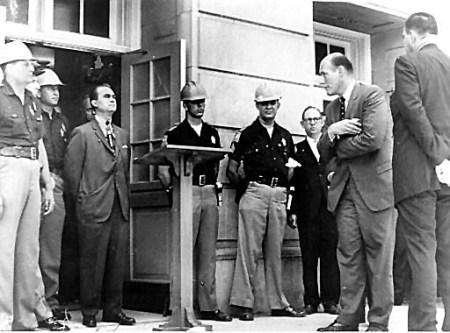
In the name of civil rights, the Department of Justice is trying to prevent black families from exercising school choice.
Following on the heels of the Southern Poverty Law Center’s ridiculous lawsuit against Alabama’s new school choice law, which contends that if a law doesn’t help everyone it can’t help anyone, the U.S. Department of Justice is suing to block the state of Louisiana’s school voucher program for low-income students and students assigned to failing public schools:
The Justice Department’s primary argument is that letting students leave for vouchered private schools can disrupt the racial balance in public school systems that desegregation orders are meant to protect. Those orders almost always set rules for student transfers with the school system.
Federal analysis found that last year’s Louisiana vouchers increased racial imbalance in 34 historically segregated public schools in 13 systems. The Justice Department goes so far as to charge that in some of those schools, “the loss of students through the voucher program reversed much of the progress made toward integration.”
Segregation! That’s a serious charge. What evidence does the Department of Justice cite?
In Tangipahoa Parish, for instance, Independence Elementary School lost five white students to voucher schools, the petition states. The consequent change in the percent of enrolled white students “reinforc(ed) the racial identity of the school as a black school.”
Five students! According to the National Center for Education Statistics, there were 143 white students out of 482 students at Independence Elementary School in 2010-11 (the most recent year for which data is available). Assuming that recent enrollment and racial composition is the same and that no black students received vouchers as well, that’s a shift from 29.6 percent white to 28.9 percent white. Though the students at Independence almost certainly would not have noticed a difference, the racial bean counters at the DOJ see worsening segregation.
But the DOJ is not content merely to prevent white students from exercising school choice. The petition also cites Cecilia Primary School, which in 2012-13 “lost six black students as a result of the voucher program,” thereby “reinforcing the school’s racial identity as a white school in a predominantly black school district.” In the previous school year, the school’s racial composition was 30.1 percent black, which the DOJ notes was 16.4 percentage points lower than the black composition of the district as a whole. According to the NCES, in 2010-11 there were 205 black students out of a total enrollment of 758, so the school was 27 percent black. Assuming a constant total enrollment, the DOJ’s numbers suggest that there were 228 black students in 2011-12. The loss of six black students would mean the school’s racial composition shifted from 30.1 percent black to 29.2 percent black as a result of the voucher program. Again, imperceptible to untrained eye but a grave threat to racial harmony according to the Obama administration’s Department of Justice.
These are the only two schools cited directly in the DOJ’s petition, so presumably they represent the two cases with the largest impact. A footnote reveals that “The net loss ranged up to thirteen students per school.”
Since the vast majority of voucher students are black, it is likely that the DOJ’s lawsuit would disproportionately prevent black students from enrolling in the schools of their choice.
State Education Superintendent John White took issue with the suit’s primary argument and its characterization of the program. Almost all the students using vouchers are black, he said. Given that framework, “it’s a little ridiculous” to argue that students’ departure to voucher schools makes their home school systems less white, he said. He also thought it ironic that rules set up to combat racism were being called on to keep black students in failing schools. […]
White also pointed out that the schools in the voucher program must comply with the terms of 1975 court case, Brumfield v. Dodd, that prohibits the state from giving public money to private schools that uphold segregation or discrimination.
It’s no wonder that just a few months ago, more than one thousand people attended the Black Alliance for Educational Options rally to support the program in the face of another legal challenge.
This isn’t the first time that opponents of school choice have tried to use the specter of segregation to prevent families from exercising choice, but the evidence doesn’t support their claims. According to a literature review from the Friedman Foundation for Educational Choice, school choice programs thus far have had the salutary effect of reducingsegregation:
Eight empirical studies have examined school choice and racial segregation in schools. Of these, seven find that school choice moves students from more segregated schools into less segregated schools. One finds no net effect on segregation from school choice. No empirical study has found that choice increases racial segregation.
One of the problems with much of the discourse over segregation in education stems from the way it is defined. The Department of Justice here assumes that a school is segregated if its racial makeup varies from the population in that district. While most sane people wouldn’t consider a school that is roughly two-thirds white and one-third black or vice versa to be segregated, the Department of Justice does so long as the general population of the district is even more racially imbalanced. As the Friedman literature review notes:
[Professor Jay P.] Greene provides an instructive example that shows how this problem undermines the validity of such measures of segregation. In studies using the prevailing method, a school that is 98 percent white is considered perfectly integrated if it is in a school district that also is 98 percent white. The school receives this perfect score even if the 98-percent-white school district is right next door to another district that is 98 percent minority. Clearly, this should be considered segregation, but the prevailing method masks segregation when it occurs at the district level. Greene issues a concise verdict on what studies like this really are saying: “The schools are well integrated, given that they are horribly segregated.”
The studies included in the aforementioned Friedman Foundation literature review use more valid methods of measuring segregation, such as comparing the racial composition of a school to the racial composition of the wider metropolitan area (not just the school district), or measuring the occurrence of racial homogeneity.
School choice programs benefit most those who previously had the fewest educational options, particularly low-income families. Minority groups that are disproportionately low-income therefore benefit disproportionately from school choice. As the Friedman study notes, Milwaukee’s private schools were 75 percent white in 1994, but by 2008 they were only 35 percent white due to the city’s voucher program.
The Department of Justice’s lawsuit will hurt the very students it is intended to help. If DOJ apparatchiks want to reduce segregation in education, they should support efforts to expand school choice rather than try to block them.
23 Comments | civic values, vouchers | Permalink
Posted by Jay P. Greene
(Guest post by Greg Forster)
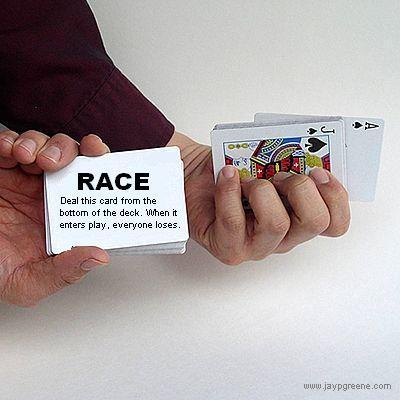
At Brookings, Matthew Chingos looks at a huge swath of CCD data and finds no evidence that charter schools increase racial segregation. No surprise there, as readers of Win-Win already know. It’s been a while since I had occasion to trot out the old race card graphic – my sense is that the segregation talking point has had its day in the sun.
In Education Finance and Policy, Rajashri Chakrabarti looks at Florida school data and contributes the latest in a line of studies showing that schools act in self-interested ways, responding to structural incentives, when classifying students into special programs. Chakrabarti finds that schools threatened with vouchers due to low test scores increased the classification of students as Limited English Proficient, removing them from the pool of tested students; however, schools did not increase classification of students into special education, where they would become eligible for McKay vouchers. The obvious conclusion? All students should be eligible for vouchers – then there’s no system to game.
PS Sorry for the awkward headline – I couldn’t come up with anything snappier or any pop culture references. Uh . . . release the kraken!
2 Comments | charter schools, civic values, special ed, vouchers | Tagged: Greg Forster, Matthew Chingos, Rajashri Chakrabarti | Permalink
Posted by Greg Forster

(Guest post by Greg Forster)
In a major news development, today the Heartland Institute described JPGB as a “widely read education reform-pop culture blog.” After all these years of struggling for recognition as a major voice in the pop culture world, at long last our toil and struggle has been vindicated.
Oh, and they have this podcast I did on the Win-Win report showing that the research consistently supports school choice. If you’re, you know, into that kind of thing.
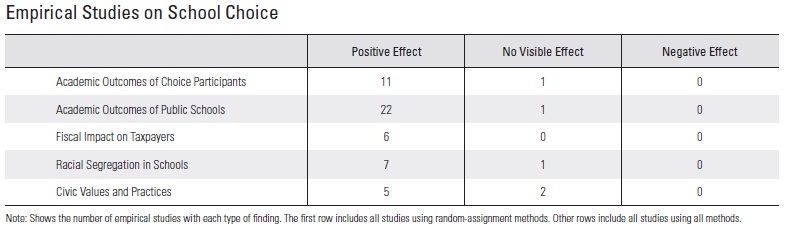
In case you forgot what that column of zeros on the right looks like, here it is again.
Leave a Comment » | civic values, competitive effects, methodology, random pop culture, research reports, tax-credit scholarships, vouchers | Tagged: Greg Forster, Heartland Institute, Win-Win | Permalink
Posted by Greg Forster

(Guest post by Greg Forster)
This morning, the Friedman Foundation releases the third edition of my biannual report summarizing the empirical research on school choice. As in previous years, I survey all the available studies on academic effects – both for students who use school choice and for public schools. Hence the title “A Win-Win Solution” – school choice is a win for both those who use it and those who don’t.
New in this edition of the report, I also survey the impact of school choice on the democratic polity in three dimensions: fiscal impact on taxpayers, racial segregation and civic values and practices (such as tolerance for the rights of others). Guess what it shows? School choice is not just win-win, it’s actually win-win-win. It not only benefits choosing families and non-choosing families; it also benefits everyone else through fiscal savings and the strengthening of social and civic bonds.
Here’s the most important part of the report – that unbroken column of zeros on the right remains as impressive as it ever was. Do please read the rest if you’d like to know more!

3 Comments | civic values, competitive effects, personal tax credits/deductions, research reports, tax-credit scholarships, vouchers | Tagged: Greg Forster, Win-Win | Permalink
Posted by Greg Forster

The names we give to public schools, parks, and buildings matter. Names provide an opportunity for communities to identify what they hold dear and to remind themselves and teach their children about those values. As Brian Kisida, Jonathan Butcher, and I argued in an analysis we did of trends in school names, school districts nationwide are more and more frequently missing the opportunity to use school names as a means for praising individuals who embody our cherished values. Instead, we are now more likely to give schools vague nature names that sound more like herbal teas or day spas (Whispering Hills, Hawk’s Bluff, etc…), than people who we think could serve as models for our children.
Because names are important and because they should reflect community values, if communities change their values they also need to consider changing public names. There is no doubt that Memphis has changed since it originally named three public parks: Confederate Park, Nathan Bedford Forrest Park, and Jefferson Davis Park. State legislators in Tennessee, however, were considering a law that would prevent certain name changes. According to the USA Today:
The “Tennessee Heritage Protection Act of 2013” bill, already introduced in the state legislature, would prohibit name changes to any “statue, monument, memorial, nameplate, plaque, historic flag display,school, street, bridge,building, park preserve, or reserve which has been erected for, or named or dedicated in honor of, any historical military figure,historical military event, military organization, or military unit” on public property…
To pre-empt that legislation the Memphis City Council voted 9-0 to temporarily rename these three parks as Memphis Park, Health Sciences Park, and Mississippi River Park. They’ve also formed a commission to explore what the new names for these three parks should be. Let’s hope they break the trend and actually identify individuals who embody values that Memphis holds dear after whom they will name the parks. There are certainly a large number of great people associated with Memphis or who come from elsewhere who could fit the bill.
3 Comments | civic values | Permalink
Posted by Jay P. Greene
You are currently browsing the archives for the civic values category.

 Jay P. Greene's Blog