Surowiecki on Teacher Training

November 10, 2014

(Guest Post by Matthew Ladner)

James Surowiecki takes his time getting to the punchline in this sports/education analogy and makes a loose assertion or two of the journalistic sort, but is still worth a look. Cliff Notes version: sports training has vastly improved in the last 40 years, most everything has done the same, but our training of teachers still stinks.

One thought that occurred to me in reading this article. Let’s assume that teacher training is a rotten as this and many other articles assume. The former dean of Columbia Teachers College laid out in painful detail the shortcomings of American teacher training in a series of searing reports, so I can’t see much reason to believe otherwise.

Having said that, I’ve always been a bit mystified by the Finland narrative. If someone brought the Finnish Minister of Education over to the United States to run the show with the imperial power of fiat, it seems to me that the first thing he or she would do would be to close the nation’s Colleges of Education and start over. What am I missing here?

I’m all for attempting to improve teacher training, but the system we send new teachers into has plenty of other problems. It would be great to be able to train people to overcome all to often dysfunctional district systems of schooling marred by low-turnout elections heavily influenced by organized employee interests, but that sort of immunization sounds a bit far-fetched. Best to train teachers well and give them a reasonable system in which to thrive imo.


Reason TV: How Eva Moskowitz Outmuscled the Teachers Union

November 7, 2014

(Guest Post by Matthew Ladner)

Reason TV on Eva vs. AFT in NYC.


Tuthill on the Shape of Things to Come in the K-12 debate

November 7, 2014

(Guest Post by Matthew Ladner)

Generals are always fighting the last war, and in this must read piece by Doug Tuthill over at RedefinED, Tuthill makes the case that many of our current K-12 debates are already sliding towards irrelevance in an emerging multi-provider K-12 landscape.


Forster-Mathews over/under challenge- place your 2015 bets now

November 6, 2014

(Guest Post by Matthew Ladner)

Election coverage inevitably drifts to beltway drama, but I’m at more than a bit of a loss to understand why. It’s kind of like the nation’s bizarre fascination with 32 football teams running the same offense and defense when a far more interesting and gloriously chaotic brand of football rumbles along in the colleges. My memory gets fuzzy trying to remember the last positive and interesting thing to happen in DC. The action in America is out in the states.

Longtime Jayblog readers will doubtlessly recall the world-famous bet between our own Greg and WaPo columnist Jay Mathews regarding whether parental choice programs were just too politically difficult. They eventually decided to put the over/under for new school choice programs or expansions in 2011 at 7, with the loser picking up dinner.

I can’t remember whether the total got to 21 that year or not. If not, it was close. The school choice movement easily cleared the bar again in 2012. Then in 2013, it was time for a three-peat!  Finally in 2014, the pace slowed a bit nationally in an election year and the Forster-Mathews bar proved too high.

And now?

Only time will ultimately tell, but the elections of 2014 must look pretty bleak if you are burdened in life with reactionary K-12 preferences. Scott Walker for instance not only just won his third statewide election in four years, he’s talking about expanding school vouchers into new districts and providing choice to children with disabilities. Arizona Governor-elect Doug Ducey stated in his victory speech “Schools and choices open to some parents should be open to all parents.”

Out in Florida, Republican Governor Rick Scott defeated Republican, Independent Democrat Charlie Crist in an epic battle. It did not escape the notice of some that the tight margin could have been swayed by the parents of the parents of the near 100,000 children participating in Florida’s private choice programs this year.

In Indiana, Republicans added to their already large legislative majorities and the same thing basically happened in Ohio. A few years ago, an observer of Nevada politics told me that the map of Nevada House were drawn such that a Democratic majority would live at least as long as the current map. Well lo and behold, Gov. Sandoval gets reelected with 70% of the vote and the Republicans capture both chambers.

The WaPo produced this handy map:

This same article notes that Republicans hold unified control over both chambers and the chief executive in 24 states compared to 6 for the Democrats.

Don’t ignore Blue states however. Out in New York, easily reelected Gov. Andrew Cuomo expressed public support for tuition tax credits. From the linked story:

Mr. Cuomo echoed the assemblyman’s call for the passage of the Education Investment Tax Credit, which would help parents pay for religious schools–which the governor compared to his expansion of the state’s Tuition Assistance Program to cover yeshivas and his public funding of busing for students of Orthodox Jewish schools. Mr. Cuomo claimed such funding is simply equitable and right.

“It’s not charity, it’s not a favor. It’s justice. TAP. Public transportation and the school buses, that was justice. Education tax credit–this is a matter of justice,” he said as the crowd broke into applause. “I want you to understand that’s the way I see it. On a personal level, this is a very important relationship that I honor. And as governor, I have sworn to do justice. And there have been a number of great injustices that your community has endured for a long, long time. And it is my profound wish that we should work together and we should resolve them and bring justice to the community that we deserve.”

This is welcome news, as the private choice movement has made very limited progress overall in the mega-states of California, Texas, Florida, New York and Illinois aka where a whole bunch of the kids are located. Charter schools however are rolling along in all of those states, and they seem poised to crush private schools at a much higher rate than low-performing district schools. Even Florida’s nearing 100,000 private choice children in private choice programs seems small when viewed in this fashion. The Illinois $500 personal use tax credit comes across as a bit of a cruel joke when put into this context: the state will lavish many thousands of (increasingly hard to come by) dollars on you if you choose to attend a district or charter school, but will give you a $500 tax break if you choose to bear the financial burden of sending your child to a private school if you have a sufficient tax liability.

The Illinois credit may only be a small step in reducing double payment penalty, but it is more than California, New York or Texas has done to date while charters continue to surge. In the end, private schools ought not to be preserved by nostalgic state lawmakers, but rather (if it is going to happen) by the free choice of parents operating on something approaching a level financial playing field. We need both broader and better designed account-based programs.

Finally choice proponents need to be aware that even seemingly shiny legislative majorities spring on you like a bear trap if you mistake them for an actual consensus. Proponents must never forget the need to persuade a broader universe of opinion leaders and the public regarding the justice of their cause.

Okay so with all that said, I will take the over in 2015. What about you?

UPDATE:

The Friedman Foundation has a handy-dandy guide to the governors and how they stand on parental choice.

UPDATE PART DEUX:

WaPo on the teacher unions spending $60m on races and mostly getting crushed. Money quotes:

“We knew this was going to be an uphill battle,” said Lily Eskelsen García, president of the National Education Association, the country’s largest labor union. “But I don’t think anybody on our side, and we’ve got some very savvy people, anticipated going over the falls like this. Tectonic plates have shifted. And we’re going to have to come back with a new way of organizing for these kinds of races.”

and…

“The surprising thing is you now have Democrats who are willing to buck the union,” said Howard Wolfson, an adviser to former New York mayor Michael R. Bloomberg (I), who contributed to Democratic and Republican candidates around the country who want to introduce more choice and competition in public education, and greater accountability for teachers. “You can take reform positions and be successful not only in general elections, but in primaries. It’s a major sea change in the Democratic party that you can now oppose the union and be successful.”


Iron Maiden?!? Excellent!!

October 31, 2014

(Guest Post by Matthew Ladner)


Report Card on American Education Released Today

October 29, 2014

(Guest Post by Matthew Ladner)

The 19th Edition of ALEC’s Report Card on American Education: Ranking State Performance, Progress and Reform coauthored by yours truly and Dave Myslinski hit the presses today. Lots of good stuff in this year’s model, including an update of state rankings, a review of the first decade of universal NAEP participation, and a chapter focused on comparing the results of large urban districts.

So going up to the 30,000 level and back down, international results show that the United States is world-class in spending per pupil, not so much in learning per pupil, and that our results for Black and Hispanic students are closer to those of Mexico than of South Korea, despite the fact that Mexico has a far larger poverty problem and spends a small fraction of American spending.

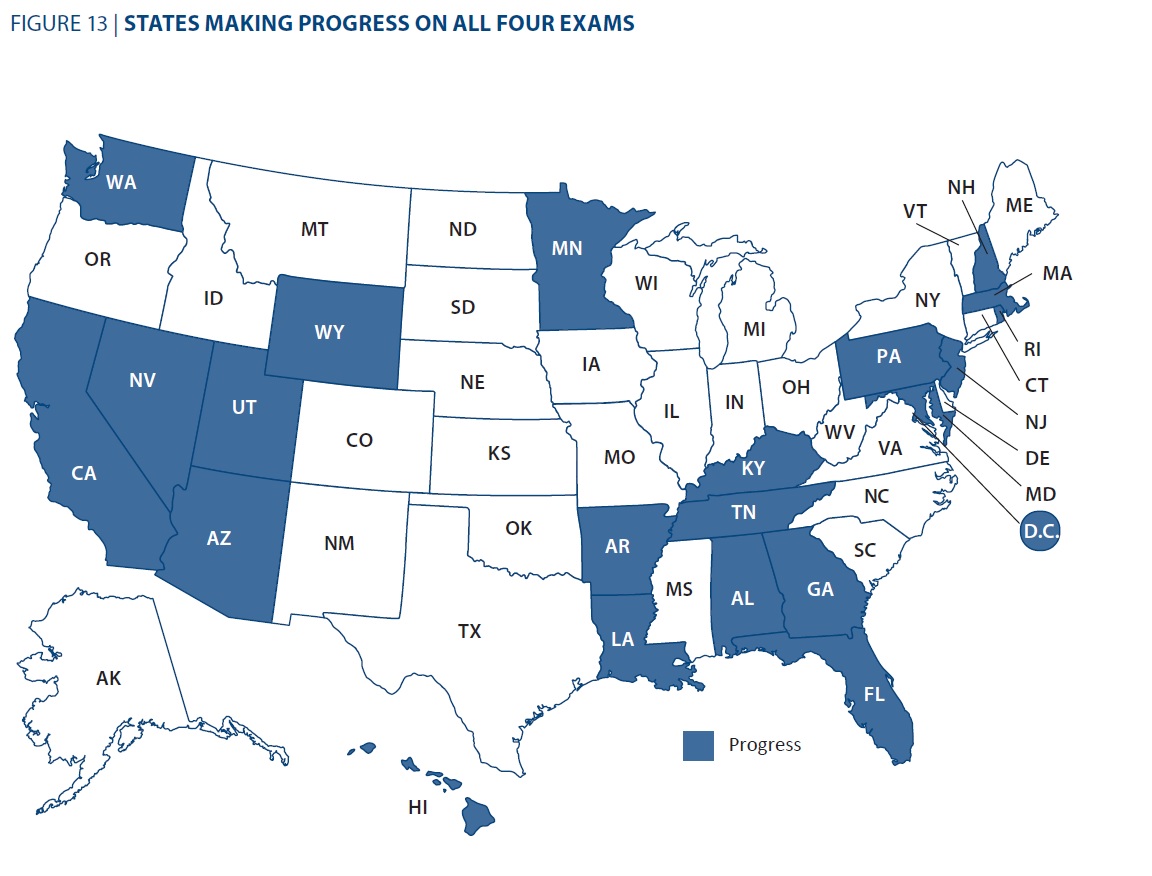
The United States is making progress, but only an average amount of progress so we aren’t going to be catching up  much at the current pace. When you break down American results by state, you find that some states are pushing the national average cart, while others are riding in the cart. Which ones? Glad you asked:

4 NAEP exams


So the states in blue have made statistically significant gains in all four regular NAEP tests (4th and 8th grade reading and math) between 2003 and 2013.  Of the 21 states pulling that feat off, 14 are located in either the West or the South. The Midwest excepting MN, Great Plains, Mid-Atlantic, New York and Texas didn’t carry their weight on improvement (to varying degrees in general math gains were easier to come by than reading, 4th grade improvement easier than 8th grade) during this period. Michigan was the only state to make no significant progress on any of the four regular NAEP exams, a trend I hope they will reverse soon. All other states made progress on one or more of the exams. Note also that this map only shows improvement, few if any of the darkened states have internationally competitive scores, and the few that do tend to hold the good end of the stick on various achievement gaps.

So on the one hand, American education outcomes have never been higher than the 2013 NAEP.  On the other hand, no one yet has any cause for celebration. When we have any states that approach a Asian/European level of bang for the buck in learning outcomes, we’ll let you know about it, but thus far, not so much.

In Chapter 4 of the Report Card we take a close look at the Trial Urban District Assessment (TUDA) NAEP and apply the same “general education low-income” student comparison that we use in the states to improve comparability. Low-income general ed kids were seven times more likely to reach the Proficient level of 4th grade reading in Miami (the top performing district) as in Detroit (the lowest performing). Mind you have only a little better shot at 1 in 3 of scoring Proficient in Miami, so there are many miles to go. Looking at both 4th and 8th grade reading, Miami, New York City, Hillsborough County FL (Tampa) and Boston cluster near the top of the ratings. The District of Columbia does not (yet) rate near the top of the ratings, but their progress over time on NAEP is nothing short of remarkable since the mid 1990s. A large percentage of District students attend charter schools these days, and those charter schools show not only higher scores but also faster improvement than district schools, which are themselves improving.

In any case, slide on down to the following link if you want to see how your state is doing.

Indiana State page


Space-age kid caught in a cave-man system, until now

October 27, 2014

(Guest Post by Matthew Ladner)

The Dayton Beach News Journal has a piece on the new ESA program- Florida’s Personal Learning Scholarship Accounts. We’ve already seen one Arizona ESA parent display a much deeper understanding of the term “accountability” than a number of think-tankers can seem to muster, and this story brings another gem of insight from a participating parent. The News Journal story relates the educational challenges facing a student named Brandon Bremen. Mr. Bremen is working to overcome autism, muscular dystrophy, seizures and an impaired immune system. Brandon had tried everything from public schools, a McKay scholarship voucher to education as a home-bound student with an occasional visit from a teacher. Brandon’s mother Donna sums it up:

Berman stresses she’s not opposed to public schools (she points out her daughter, Bailey, graduated from Atlantic High School in May). She praised the public school staff members’ efforts to help her son, saying she feels they did everything they could within the constraints of state mandates and limited resources. But she felt the schools couldn’t keep up with Brandon.

“It’s unfortunate when you have a space-age child with a caveman system,” Berman said. “His needs out-taxed what the public school is able to give him.”

My reaction to reading this:

LIGHTBULB!!!!!!!!!!!!!


Jules and Ringo on the Week in College Football

October 19, 2014

(Guest Post by Matthew Ladner)

C’mon Yolanda- what is Fonzie like?!?

Cool?

Correcto-mundo! And that’s what we’re gonna be, we’re gonna be cool. Now Ringo, I’m gonna count to three, and when I do, I want you to let go of your gun, lay your palms flat on the table, and then tell me what happened in college football this weekend. But when you do it, do it cool. Ready?

What?

Say what again! I dare you! I spent the weekend detailing a car with a toothbrush, I missed all the college football games and I am NOT IN THE MOOD. One, two, THREE!!!

Alright mate (puts gun down)

Good- now tell me what happened.

So…it breaks down like this- Florida State beat Notre Dame on a controversial late call, but it probably doesn’t matter ’cause the selection committee is going to recognize the fact that the Irish outplayed the Seminoles on their home field. So if the Irish win out, I think they will still make the playoff. IF they do, they might get the chance to play FSU on a neutral field.

I would like to see that! Go on….

Oklahoma got beat by Kansas State, so that’s their second loss and they are out unless things go 2007 levels of weird. Baylor also had their first loss at West Virginia, and they looked bloody sloppy doing it.

Would you say that they are eliminated Ringo?

No I would not say they are eliminated, but they had better get their act figured out quick because TCU and Kansas State will be competing with them for a Big 12 birth, if there is going to be a Big 12 birth. TCU looked really strong beating up on Oklahoma State.

Too bad they blew that huge lead last week. What about the Big 10?

Michigan State, Nebraska and Ohio State all beat middling conference opponents, but that will all sort itself out eventually. They all have lost a game already so no guarantees.

How about the West?

Oregon, Utah and Arizona State are still in the running after victories this weekend. Arizona was off this week but also has only one loss.

What else happened this weekend? Anyone send a message? I mean besides Florida State?

Alabama sent one loud and clear by beating Texas A&M 59-0.

59 to nothing? Just a couple of years ago they were selling t-shirts claiming that A&M was like the moon ’cause they ‘control the Tide.’ Well well well- a’int nobody gonna shepherd them through the valley of SEC West darkness!

They’ve been blown out three weeks in a row…

THREE.WEEKS.IN.A.ROW! That is just inspiring. Now…reach in the bag and hand me my wallet.

How will I know which one it is?

You’ll know it when you see it.

(Finds wallet)


Now this is the situation. Normally both of you would be dead as fried chicken. But you happened to pull this while I’m in a transitional period. I don’t wanna kill ya, I want to help ya.  What’s in my wallet Ringo?

Don’t you mean ‘what’s in your wallet’ mate?

Don’t get cute Ringo- open the wallet!

(Opens wallet)

Two tickets to the college football national championship game in ATT stadium?!?

Correct. Put them in your pocket Ringo-they are yours. Now with the rest of them wallets and the register, that makes this a pretty successful little score. I ain’t just givin’ it to you. I’m buyin’ somethin’ with those tickets. Wanna know what I’m buyin’ Ringo?

What?

I TOLD you NOT to say that!!!!

Sorry!

Your life Ringo. I’m givin’ you those tickets so I don’t have to kill you. You read the Bible?

Not regularly.

There’s a passage I got memorized….nevermind, it’s not a real verse anyway. Take the tickets and get out of here before I change my mind. I’m almost certain that the Tide will be rolling into Jerry-world so you’d best get out of here before I snap out of it.


The Trouble with Baking Achievement Gap Measures into State Accountability Systems

October 17, 2014

(Guest Post by Matthew Ladner)

On March 9, 1974 Yoshimi Taniguchi, a Japanese book merchant and former Major in the Japanese Imperial Army, traveled to the Philippines in order to order a former subordinate, Second Lieutenant Hiroo Onoda to stand down from combat operations. Lieutenant Onoda had received news of Japan’s surrender in World War II, but had concluded that it was mere enemy propaganda. Firm in this misapplied conviction, Onoda carried on a long since concluded war for almost 30 years.

Onoda may have misspent three decades in an island jungle, but on a positive note he at least inspired an episode of Gilligan’s Island (Ginger in fact defeated his doppelganger in a judo battle).  More disturbingly, he may have also passed his die-hard spirit on to NCLB’s last stalwart defenders of achievement gap mania and the dream of mandated perfection.

I should begin by saying that I do believe that achievement gaps are very important. I went back to review a post I wrote a blog post three years ago called In Defense of Achievement Gap Mania and found nothing that I had changed my mind about on this subject.  Getting low-performing American students on a faster academic pace is of the utmost importance.

I am however mystified by the Onoda-style defense of NCLB’s unworkable division of schools into multiple subgroups with targets for narrowing and ultimately closing all achievement gaps on the equivalent of a train schedule. That would have all been enormously beneficial if it had worked, but let’s just say that the trains weren’t showing much sign of arriving on time, sometimes at all. We could discuss various ways states found to escape from the NCLB subgroup noose at length (hello n-size manipulation!) but there are deeper problems to discuss.

Today we find NCLB diehards sprinkled throughout the K-12 reform conversation archipelago. In this recent post on Eduwonk, Anne Hyslop  goes Banzai! corrects factual problems in a recent New York Times story focusing on the flaws of NCLB. My own take on this is that Hyslop is probably completely correct in her assertions. I however believe that they are largely irrelevant to the bigger picture.  When I read a paragraph explaining how technical mumbo jumbo safe harbor confidence intervals actually mean that the mandated 100% proficiency mandate doesn’t actually arrive until 2016 instead of in 2014, it makes me chuckle. Do we imagine that when educators read the fine print they will rush to embrace NCLB’s machine of mandated universal proficiency with open arms? Or would it be more accurate to say that many educators never took AMO schedules seriously in the first place, confident that they would be dropped (they were- through the waiver process).

Ed Trust released a report recently critical of NCLB waivers. I personally don’t like NCLB waivers either given the Secretary’s lack of obvious authority to grant conditional waivers, but that is not what has Ed Trust excited. They think that the Secretary ought to have used his non-existent conditional waiver authority to mandate gap closing measures into state accountability systems.

Stand down Lt. Po…that’s an ORDER!

Ed Trust is careful towards the end of their study to say that they are NOT calling for a return to NCLB’s multiple pathways to failure based on myriad subgroups in pursuit of mandated improvement on a schedule. Hey its 2014 and they aren’t that crazy, you see, they just seem to want Secretary Duncan to work something out with these states that will be the functional equivalent of NCLB’s multiple pathways to failure based on myriad subgroups in pursuit of dramatic improvement by mandate on a schedule. That would do just fine.

Ed Trust (and others) seems sufficiently wedded to NCLB-era mechanics that they dislike an elegant improvement-the super subgroup. Florida policymakers grade schools half on proficiency (the % passing state exams) and half on student progress over time. They double-weighted the importance of the progress of the lowest performing 25% of students from the last year’s test. The students falling behind thus constitute the “super subgroup” and they became the most important students in the building for determining a school’s grade. They count against all three of the main three components of a school grade: overall proficiency, overall growth and the growth of the students who have fallen behind.

The super subgroup doesn’t ask whether you are White, Black, Asian, American Indian, economically disadvantaged, an English Language Learner or a child with a disability, blue-eyed or left-handed. It simply identifies the lowest performing children in the school and puts a special emphasis on their academic gains over time.  It doesn’t create a perverse incentive to ignore an academically struggling child because he or she happens to be White, or because his or her parents make a little more money than this year’s Free and Reduced Lunch standard or because you’ve been reclassified out of SPED. Done properly, super subgroup creates a powerful incentive to identify struggling students regardless of their appearance and/or circumstances and get them making progress.

Oh, and the Ed Trust’s own previous research would lead one to the conclusion that it can help reduce achievement gaps. Not eliminate achievement gaps on a train schedule, mind you, but to make substantial progress on them by creating an incentive for schools to get struggling students to catch up. Who are the kids struggling? Why it is the kids on the short end of the achievement gaps as a matter of fact.  Florida kept A-F school grading up over a good period of time and you see gaps narrow in the best way possible- bottom scoring kids making greater progress than the still progressing top scoring kids.

The Ed Trust report tut-tuts things like Black students in A graded Florida schools scoring lower than White students in C graded schools as evidence that we ought to be including gap closure in state accountability systems.

Should we work ourselves into a froth about this? I personally don’t think so. Ed Trust’s own research has documented Florida’s overall progress in narrowing achievement gaps, but it’s not like they have eliminated achievement gaps. Would anyone be shocked to learn that ELL students at A graded schools score lower than non-ELL students at C schools? What about children with disabilities? Low-income children?  Ed Trust focused only on three states, but you could find similar results in any state.

The super-subgroup mechanism creates an incentive to get all students who have fallen behind to make academic progress. A moment of reflection regarding grading schools based upon various achievement gaps would give any thoughtful person pause. Do we really want to bake perverse incentives to stall the progress of high performing students into state accountability systems? Under the super sub-group, schools have any incentive to get any child that has fallen behind back on track. If states began rating them based on trends in achievement gaps, they could create perverse incentives to ignore their plight if they happened not to have a disability, or if they were a native English speaker, if their family made too much money for a free or reduced lunch, or if they were White.

Against this backdrop, the Ed Trust report seems strategically vague- not in favor the NCLB AYP system, but vaguely in favor of including achievement gaps in state grading systems. The fuzzy nature of these recommendations deftly avoids discussion of how to avoid creating cringe-inducing perverse incentives.

We live in a nation where Black and Hispanic students score closer on PISA to students in Mexico to those in South Korea or their own Anglo classmates. Mexico, btw, has far greater poverty and far lower public school spending than the United States. This is sickening, but we should exercise good judgment in addressing it. Previous Ed Trust research and the NAEP both show that it has achieved commendable gains in narrowing achievement gaps in Florida. In the country as a whole, not so much.

Thinking more broadly, we should recognize the NCLB era as a decentralized learning process. While NCLB created a general accountability rubric, many states had already created accountability systems of their own, creating the opportunity to learn from variations in policy approaches. Florida paid far more attention to school grades than to NCLB’s AYP and achieved greater than average gains among traditionally disadvantaged student groups.  I’m not a fan of conditional waivers, but we need to study and learn from the successes and failures of the diversity of approaches as best we can as well. It is understandable that there are many with a deep investment in NCLB, but we should not allow that attachment to blind us to something more effective at achieving its aims. The importance of achievement gaps should lead us to adopt the most effective methods for reducing them rather than pining for the ones we had hoped would eliminate them in short order.


Thibaut Scholasch and Sébastien Payen for the Al

October 16, 2014

(Guest Post by Matthew Ladner)

So Scholasch and Payen are Frenchmen who are well on their way to revolutionizing the art of making wine, and perhaps agriculture more broadly. They however have faced years of reactionary opposition and general inertia in the wine making community. No good deed goes unpunished in this wicked world, but I for one hope that these two guys become incredibly wealthy and give their skeptics something to cry about through the best sort of revenge- living well.

Wired profiled Scholasch and Payen in 2012 in an article titled the Vine Nerds. Scholasch and Payen are French ex-pats who met in California. Scholasch had worked in vineyards in Napa, France and Chile and came to feel like a scientist trapped in a profession of artists. Scholasch had an unusual desire to improve the process of making wine, which apparently verges on the blasphemous in some circles. Techniques developed in 12th Century France represent the apex of agricultural technology you see, and anyone trying to update them is something of a public menace. A mutual friend introduced Scholasch to Payen, another French ex-pat. Payen holds a Ph.D. in Mechanical Engineering from UC Berkeley. As a graduate student Payen designed a novel micro-biosensor. They teamed up to form the Fruition Sciences company, which installs sap sensors to provide real-time data on crops, in this case grapes. The technology allows wine makers to give their vines just the right amount of water precisely when needed- a substantial improvement over tasting dirt, spitting it out, and irrigating fields early and (too) often.

You can read their bios here and how the process works here. Basically their process allows wine makers to make better wine while using only a fraction of the water typically employed.

Some wine makers gave Scholasch and Payen a shot, and became believers. From the Vine Nerds:

Austin Peterson, is one of Fruition’s most vocal supporters and attests to changes the sensor arrays can produce. ‘Before, irrigation management was basically done by our vineyard foreman looking at next week’s weather forecast and at leaves that were starting to fold or tendrils that were drying,’ Peterson says. ‘But visual cues can be misleading. As we started to see the data, it started to explain some things.’

Before becoming a convert, Peterson needed to see proof. In 2007 he divided Ovid’s 15-acre property in half, using the visual method on one side, sensors on the other. Following traditional visual cues led to a regimen of shallow irrigations, which required more water and resulted in unintended side effects, like shriveled grapes and elevated alcohol levels. It also may have helped slow the ripening process and delay the harvest, which is always risky in Northern California, where early autumn rains can destroy a crop in a matter of days. Meanwhile, data gathered from the sensors dictated a near-opposite approach: fewer, deeper irrigations, primarily later in the season. After two years, the result was substantial water savings and earlier harvests. For Peterson, the experiment shed light on how profoundly irrigation affects fruit quality as well as a wine’s flavors and bouquet. ‘It was like going from having an undergraduate degree in something to a PhD, where you have a deep understanding of why vines behave the way they do’ Peterson says. ‘As a winemaker, you understand different flavors. But now you start to understand why the differences exist.’

So it turns out that wine makers have been over-irrigating their vineyards in Napa for decades and producing lower rated wine as a result. One client interviewed by Wired stated that they had dropped their water use from 36-64 gallons per vine to 0-10 gallons. They reckoned this would save them 5.8 million gallons of water and produce better wine in the process. Project that out across California, and it gets to something like a potential savings of 9.1 billion gallons of water per growing season.

Did I mention that the Southwest United States is experiencing a huge drought? It looks something like this (color = bad, dark = worse):

Agricultural technologies that help you get by with less water might come in handy about now, especially in California. So you make much better use of an increasingly scarce resource to produce a better product. Better still, this technology is branching out beyond wine to increase the productivity of other sectors of agriculture. Scholasch and Payen are just two of the most recent entrepreneurs in a long line that have repeatedly thwarted Malthusians and neo-Malthusians through the driving force of voluntary exchange.

The process of updating agriculture sounds almost as frustrating as education reform. After an enthusiastic embrace of the technology by an expert in rice cultivation, Wired noted Scholasch’s reaction:

Scholasch lowers his eyes and shakes his head. ‘The first sap-flow sensors were tested in the ’80s. What we have in place was usable in the early ’90s—and look, it’s taken 20 years to start using it,’ he says, then gives a quick smile, betraying a glimmer of hope. ‘But it’s very rewarding to get recognition from peers you respect. It’s an accreditation.’

Hang in there guys- and remember the motto of the Economist “to take part in a severe contest between intelligence, which presses forward, and an unworthy, timid ignorance obstructing our progress.” No one ever said it would be easy, but the difficulty of your struggle will only make your eventual triumph all the more flavorful- like your wine, it will get better with age.