 (Guest Post by Matthew Ladner)
NAEP is releasing 4th and 8th Grade Reading and Math results for 2011 on November 1st.
I’ll comb through the data and post the results here.
(Guest Post by Matthew Ladner)
NAEP is releasing 4th and 8th Grade Reading and Math results for 2011 on November 1st.
I’ll comb through the data and post the results here.
 2 Comments |
  research reports | Tagged: 2011 NAEP |
  Permalink
 Posted by matthewladner

It’s long been a goal of mine to be so awful at a job that they have to pay me to leave. Unfortunately, excellence in failure is something that has escaped me — even though I normally seek excellence in all things.
But you’ll be happy to know that football coaches, superintendents, CEOs, and even large corporations have all too often perfected the art of sucking so bad that people pay them for that failure.
These large severance packages are generally a problem when the people offering the package are doing so with OPM — Other People’s Money. Athletic directors, school boards, boards of directors, and the government find it so much easier to be generous when the money they are offering to their failed coaches, superintendents, CEOs, and large corporations is not their own money.
The Occupy Wall Street folks have (rightly) highlighted the sweet deals offered to failed CEOs and corporations from tax funds, but they tend not to mention the frequency with which superintendents are given large severance packages with OPM. Yes, the average size of the superintendent packages tends to be much smaller, but there are so many more of them that it adds up to real money.
A Chicago Tribune analysis last summer found:
The newspaper’s review of more than 100 superintendent contracts, financial records and severance agreements over a decade revealed that boards have handed out six-figure separation checks; district-paid health care; cash or retirement credit for hundreds of sick days; and, in one case, a Mercedes — all to be rid of superintendents….
“Boards have not been held responsible because they do not care about taxpayers, period. … They do not care about how much money they spend,” said Kenneth Williams, board president in Thornton Township High School District 205, which recently approved a $350,000-plus severance package for J. Kamala Buckner, a veteran superintendent. Williams tried unsuccessfully to rescind the package in May….
Using available state data, the Tribune tracked the number of superintendents in Illinois school districts from 2000 to 2010, finding nearly half had gone through three or more superintendents. That turnover not only fuels buyout deals but can take a toll on issues ranging from policy to student achievement….
Changeover also means some superintendents get multiple severance payouts.
Rosemary Hendricks got a $132,000 settlement in 2009 after filing a lawsuit against Hoover-Schrum District 157, where she had served as superintendent about a year. Earlier, she had gotten a $75,000 settlement in Bellwood District 88, where she had a short stint as superintendent, records show. She is back as Bellwood superintendent.
Of course, sometimes these generous severance packages are the fault of boards, not the departing executive. Boards sometimes choose to get rid of someone on a whim or simply because the majority composition of the board changes. These reckless changes by boards to get rid of someone under contract or who could justly sue for wrongful termination, force boards to fork over large sums of OPM to avoid litigation.
My point is the irresponsibility that OPM encourages. OPM encourages organizations to write contracts that are excessively long and generous and then require large severance packages to get out of them. OPM encourages changing leadership without cause and at great cost. OPM makes it so much easier to justify the bailout to avoid “systemic risk” or to promote “stability.” And of course OPM facilitates coaches, superintendents, CEOs, and corporations to make unreasonable demands, take unreasonable risks, and fail catastrophically.
OPM encourages excellence in failure.
4 Comments | economics, teacher pay | Permalink
Posted by Jay P. Greene
(Guest Post by Matthew Ladner)
Just returned from the National Summit in SF, where I saw a number of friends and made some new ones. We received some “protestors” this year. Bob Bowdon interviewed one of the protestors, and sometimes it is best to just sit back and let your opponent talk all they want.
CIA, the United Nations, movie star oppression and Harry Potter. What will these guys come up with next?
1 Comment | politics | Tagged: Bob Bowdon, Choice Media.tv | Permalink
Posted by matthewladner

(Guest post by Greg Forster)
The new School Choice Advocate just arrived, and it contains a short interview with Janet Friedman Martel and David Friedman – Milton and Rose’s children.
I thought this was especially well put:
We’ve seen uprecedented strides forward in school choice this year. How does the progress of this year measure up against Milton and Rose Friedman’s vision?
We are still short of the vision of a school system where private schools compete on equal terms with public schools. Measured by the fraction of students with access to vouchers, our achievement is still small. But measured by the rate at which that number is increasing, it has been large. As Churchill put it, this is not the beginning of the end, but it might be the end of the beginning.
1 Comment | politics, vouchers | Tagged: David Friedman, Greg Forster, Janet Friedman Martel, Milton Friedman, Rose Friedman | Permalink
Posted by Greg Forster

The Al Copeland Humanitarian Award is meant to honor unheralded contributions to improving the human condition. Unlike most humanitarian awards, which are given to hack politics, community activists, and others whose contribution to humanity may often be more negative than positive, “The Al” tends to highlight entrepreneurs and inventors. The not-so-implicit argument of “The Al” is that people can often do more to improve the human condition by creating and building something from which they profit than by giving away their profits or (in the case of politicians and activists) trying to take away someone else’s profits in order to give them to others.
With the recent adulation of Steve Jobs, the role of the entrepreneur as humanitarian has received a lot more recognition that it normally does. People acknowledged the extent to which Steve Jobs improved the human condition by creating and promoting products that people enjoy. The fact that he accumulated an enormous amount of wealth for himself, his family, his employees, and his shareholders does not spoil the contribution that he made. And it was not necessary for Steve Jobs to give away that wealth to do good in the world. Steve Jobs was probably better at improving the human condition by creating wealth than he could have been by giving it away.
Given this recent recognition of the importance of people who create and build things, I would like to use this year’s “Al” to highlight the potential humanitarian benefits of those who destroy things. In particular, I would like to highlight the contribution to improving the human condition made by short-sellers.
Short-sellers are people who sell something that they do not own in the hopes of profiting by a decline in the price of that thing. They are betting that prices, usually of particular stocks or bonds, will go down.
What good comes from people who profit when stocks or bonds lose value? Basically, short-sellers do as much good as people who profit from a rise in prices, or those who go “long.” They help insure rational pricing of stocks and bonds so that capital is properly allocated to the places where it can get the highest long-term return (and do the most good for humanity). If prices are irrationally low for something, then an insufficient amount of new capital will be allocated to that thing. Conversely, if prices are too high, then too much capital will be allocated toward that thing, which will waste those resources and deprive it to other endeavors that would be more beneficial.
It’s relatively common to laud people who profit from stocks and bonds going up in price. Warren Buffett has received plenty of positive attention. But remember that Buffett’s enormous profits were made by others selling to him at lower prices and missing out on the increase in value. People tend to revile short-sellers for doing the exact same thing — just in the opposite direction.
The short-seller I would like to nominate for this year’s Al Copeland Humanitarian Award is David Einhorn. Einhorn is most famous for having taken large short positions on Allied Capital and Lehman Brothers. According to Wikipedia:
In May 2002, at the Ira W. Sohn Investment Research Conference, Einhorn made a speech about a mid-cap financial company called Allied Capital, and recommended shorting it. The stock opened down 20 percent the next day.
Einhorn claimed that Allied was involved in lending practices that actively defrauded the Small Business Administration in the US, and therefore, indirectly, the US taxpayer. Allied said that Einhorn was engaged in market manipulation. To prove this, Allied fraudulently accessed his phone records using pretexting.
The U.S. Securities and Exchange Commission (SEC) investigated Einhorn for market manipulation. Eliot Spitzer announced that he intended to start another investigation. In June 2007, the S.E.C. found that Allied broke securities laws relating to the accounting and valuation of illiquid securities it held.[7]
Einhorn has published a book, Fooling Some of the People All of the Time[8] regarding his battle. FoolingSomePeople.com, the website to promote the book, has information on his angle of the dispute, including a press release from Allied in February 2007 admitting that an agent of the company obtained Einhorn’s phone records fraudulently.
His battle against Allied Capital lasted six years in all. Einhorn would come to view Allied as a microcosm of market trends. “What we’ve seen a year later is that Allied was the tip of an iceberg; that this kind of questionable ethic, philosophy and business practice was far more widespread than I recognized at the time,” he said. “Our country, our economy, is paying a huge price for that.”[9]
In late 2008, the Office of the Inspector General of the Securities Exchange Commission announced that it was investigating some of the charges that Einhorn has made about the SEC’s mishandling of this matter, including the possibility that “a former SEC attorney may have taken confidential investigative materials with him when he left the Commission and provided those materials to a company he went to work for as a lobbyist.”
And Wikipedia describes Einhorn’s short position on Lehman Brothers:
Starting July 2007, Einhorn became a short seller in Lehman Brothers stock. He believed that Lehman was under-capitalised, and had massive exposures to CDOs that were not written down properly.[10] He also claimed that they used dubious accounting practices in their financial filings.[2] …
Lehman went bankrupt in September 2008.
Yes, Einhorn profited by the collapse of Lehman Brothers. And yes, that collapse had a “contagion” effect that was part of the economic recession of 2008-09 from which we have yet to recover. But that collapse had to occur. Real estate prices had reached irrational levels, lending practices were grossly irresponsible, and all of this was mis-allocating capital in very harmful ways. Building more and more houses in the Nevada desert was a waste of resources that should have been going to more productive ventures.
Einhorn should be lauded, not condemned, for his role in bursting that bubble. And Einhorn can’t be blamed for the way in which our government has bungled the aftermath of that bubble bursting. Eventually housing prices had to come way down, banks had to recognize their bad loans and recapitalize, and the construction industry had to grind to a halt for a time. Short sellers, like Einhorn, helped us recognize these realities sooner. If the bubble had continued and grown larger, the pop would have been even worse.
The fact that Einhorn is also a competitive poker player, having finished 18th in the World Series of Poker, and the fact that he has given away his poker winnings and half his profits on shorting Allied Capital (in addition to a variety of other high-profile charitable efforts), is only icing on the cake. Einhorn’s contribution to improving the human condition comes from his deriving a profit from exposing fraud and excess in companies. That helped pop financial and real estate bubbles before they grew much worse. By destroying waste and fraud, Einhorn clears the path for others to build.
2 Comments | Al Copeland Humanitarian Award | Tagged: David Einhorn | Permalink
Posted by Jay P. Greene

Coverage of the Global Report Card continues to roll in. Here is a current list:
Global Report Card Results and Article
Op-eds
Interviews
Wall Street Journal (video)
Education Next (video)
Education Next (podcast)
Dallas Morning News (Q&A)
Choice Media.TV (video)
News
Dallas Morning News (subscription required, although a version can be read here)
Arkansas Democrat Gazette (subscription required)
Roll Call (article by Morton Kondracke)
East Valley Tribune (Arizona)
Blogs
Criticism
The last blog post contained some criticisms about whether the assumptions for the analysis were reasonable. Josh McGee replied in the comment section of that post. And NCES Commissioner, Jack Buckley, told Education Week that “The methodology in this report is highly questionable.” This assessment is a little strange because what we did was similar to what the U.S. Department of Education has done in several past reports linking international test results to state NAEP results. (See for example this.) We just bring the results down to the district level. If ours is highly questionable, then the U.S. Department of Education’s own efforts must also be questionable.
(UPDATED 12-19-11)
3 Comments | school accountability | Tagged: Global Report Card | Permalink
Posted by Jay P. Greene
Everyone is talking about Steve Jobs this morning. The acknowledgement of how he improved the human condition while also making billions in profits for himself and others almost makes the Al Copeland Humanitarian Award unnecessary this year. Steve Jobs embodied the entrepreneur as humanitarian — not because he gave away his wealth as if to cleanse himself of the sin of having earned it, but because he created and promoted consumer items that significantly improved our lives while justly generating enormous wealth for himself, his employees, and shareholders.
In addition to embodying the spirit of “The Al,” Jobs had quite a lot of smart things to say about education reform. I’m grateful to Whitney Tilson for reminding me of this. Here are some selected remarks from Steve Jobs on education:
[On Unions]
I’m a very big believer in equal opportunity as opposed to equal outcome. I don’t believe in equal outcome because unfortunately life’s not like that. It would be a pretty boring place if it was. But I really believe in equal opportunity. Equal opportunity to me more than anything means a great education. Maybe even more important than a great family life, but I don’t know how to do that. Nobody knows how to do that. But it pains me because we do know how to provide a great education. We really do. We could make sure that every young child in this country got a great education. We fallfar short of that…. The problem there of course is the unions. The unions are the worst thing that ever happened to education because it’s not a meritocracy. It turns into a bureaucracy, which is exactly what has happened. The teachers can’t teach and administrators run the place and nobody can be fired. It’s terrible.
[On Vouchers]
But in schools people don’t feel that they’re spending their own money. They feel like it’s free, right? No one does any comparison shopping. A matter of fact if you want to put your kid in a private school, you can’t take the forty-four hundred dollars a year out of the public school and use it, you have to come up with five or six thousand of your own money. I believe very strongly that if the country gave each parent a voucher for forty-four hundred dollars that they could only spend at any accredited school several things would happen. Number one schools would start marketing themselves like crazy to get students. Secondly, I think you’d see a lot of new schools starting. I’ve suggested as an example, if you go to Stanford Business School, they have a public policy track; they could start a school administrator track. You could get a bunch of people coming out of college tying up with someone out of the business school, they could be starting their own school. You could have twenty-five year old students out of college, very idealistic, full of energy instead of starting a Silicon Valley company, they’d start a school. I believe that they would do far better than any of our public schools would. The third thing you’d see is I believe, is the quality of schools again, just in a competitive marketplace, start to rise. Some of the schools would go broke. Alot of the public schools would go broke. There’s no question about it. It would be rather painful for the first several years
DM: But deservedly so.
SJ: But far less painful I think than the kids going through the system as it is right now.
[On Digital Learning]
The market competition model seems to indicate that where there is a need there is a lot of providers willing to tailor their products to fit that need and a lot of competition which forces them to get better and better. I used to think when I was in my twenties that technology was the solution to most of the world’s problems, but unfortunately it just ain’t so… We need to attack these things at the root, which is people and how much freedom we give people, the competition that will attract the best people. Unfortunately, there are side effects, like pushing out a lot of 46 year old teachers who lost their spirit fifteen years ago and shouldn’t be teaching anymore. I feel very strongly about this. I wish it was as simple as giving it over to the computer….
As you’ve pointed out I’ve helped with more computers in more schools than anybody else in the world and I absolutely convinced that is by no means the most important thing. The most important thing is a person. A person who incites your curiosity and feeds your curiosity; and machines cannot do that in the same way that people can. The elements of discovery are all around you. You don’t need a computer. Here – why does that fall? You know why? Nobody in the entire world knows why that falls. We can describe it pretty accurately but no one knows why. I don’t need a computer to get a kid interested in that, to spend a week playing with gravity and trying to understand that and come up with reasons why.
DM: But you do need a person.
SJ: You need a person. Especially with computers the way they are now. Computers are very reactive but they’re not proactive; they are not agents, if you will. They are very reactive. What children need is something more proactive. They need a guide. They don’t need an assistant. I think we have all the material in the world to solve this problem; it’s just being deployed in other places. I’ve been a very strong believer in that what we need to do in education is to go to the full voucher system. I know this isn’t what the interview was supposed to be about but it is what I care about a great deal.
The above interview was from 1995, but it is clear that Jobs did not significantly change his mind over time. In 2007 he reiterated that unions and lifetime employment for teachers were at the heart of the problem. This is from PC World:
During a joint appearance with Michael Dell that was sponsored by the Texas Public Education Reform Foundation, Jobs took on the unions by first comparing schools to small businesses, and school principals to CEOs. He then asked rhetorically: “What kind of person could you get to run a small business if you told them that when they came in, they couldn’t get rid of people that they thought weren’t any good? Not really great ones, because if you’re really smart, you go, ‘I can’t win.’ ”
He went on to say that “what is wrong with our schools in this nation is that they have become unionized in the worst possible way. This unionization and lifetime employment of K-12 teachers is off-the-charts crazy.”
After Steve Jobs made these comments I wrote an op-ed for the NY Sun, which stated:
There is a price to be paid for this kind of frank analysis and Steve Jobs knows it. “Apple just lost some business in this state, I’m sure,” Mr. Jobs said. Of course, Apple sells a large portion of its computers to public school systems. By taking a stance against school unionization, Mr. Jobs may lose some school sales for Apple.
Sharing the stage with Mr. Jobs was Michael Dell, the chief executive officer of Dell, a competing computer manufacturer. By comparison, according to the description of the event, Mr. Dell “sat quietly with his hands folded in his lap,” during Mr. Jobs’ speech while the audience at an education reform conference “applauded enthusiastically.”
Mr. Dell followed Mr. Jobs by defending the rise of unions in education: “the employer was treating his employees unfairly and that was not good. … So now you have these enterprises where they take good care of their people. The employees won, they do really well and succeed.”
Whether Mr. Jobs or Mr. Dell is right about the role unions have played in public education, one thing is perfectly clear – attacking the unions is a controversial and potentially costly choice for corporate CEOs.
The safe thing is to make bland declarations about the need to improve the quality of education without getting into any of the messy particulars that might be necessary to produce a better education. Changing the status quo in education almost certainly requires ruffling someone’s feathers, but doing that is almost certainly bad for business.
In part this is why we see highly successful entrepreneurs who survive in a world of ruthless competition abandon these business principles when they turn to education philanthropy. People who would never endorse the idea that businesses should be granted local monopolies, offer workers lifetime tenure, or pay employees based solely on seniority, embrace a status quo public system that has all of these features.
While some CEOs may sincerely believe that education is somehow different from the rest of the world in which they live, others have been cowed into submission. Teachers are a very large, well-organized, and relatively affluent consumer and political bloc….
Steve Jobs has embarked on a perilous path, but with solid evidence and persuasive arguments, he can move all of us toward higher quality schools. He should be applauded for having the courage to say out loud what scores of other business leaders are too sheepish to say.
Unfortunately, Steve Jobs will no longer be with us as we try to advance on this perilous path of education reform.
(Edited somewhat for brevity. See Jobs’ full interview at Smithsonian Institution Oral and Video Histories)
10 Comments | Al Copeland Humanitarian Award, teacher union, vouchers | Tagged: Steve Jobs | Permalink
Posted by Jay P. Greene
 (Guest Post by Matthew Ladner)
The Heritage Foundation has published a new web memo on Education Savings Accounts as a vehicle for parental choice. At this point, Arizona has passed an ESA program for special needs students, a proposal is under consideration in Ohio, Florida lawmakers considered a provision last year, and Utah has a whopper of a proposal on the way.
I had the opportunity to speak to Utah legislator John Dougall about his forthcoming proposal. Rep. Dougall plans to file a bill that would send all education funding into Education Savings Accounts controlled by parents and guardians, but does not intend to make private school tuition a permissable expense for funds in the account. Dougall in essence plans to have a discussion about customized learning rather than a public vs. private school debate.
Being a Longhorn, this of course brings to mind a scene from the master thespian of our era, the great Matthew McConaughey:
 McConaughey: Hey man, you got some private school choice in that ESA proposal?
Passenger: No man, not in this proposal.
McConaughey: Well, it would be alot cooler if you did!
Seriously though, Dougall’s proposal is sufficiently mind-blowing that it doesn’t really bother me that he is choosing to leave private schools out of the mix. If ten years from now Utah is funding district and virtual schooling through an ESA system and the private choice options available were going through tax credit and voucher mechanisms, you won’t hear any complaints from me.
1 Comment | Education Savings Accounts | Tagged: Dazed and Confused, Education Savings Accounts, ESA, Heritage Foundation, Lindsey Burke, Matthew McConaughey, Utah ESA | Permalink
Posted by matthewladner
(Guest post by Greg Forster)
As of last month, it is illegal in the state of Wisconsin to go out to your own barn, milk your own cows, and then drink the milk.
Yes, you read that right. The case arises out of the ongoing controversy here in Wisconsin over unpasteurized or “raw” milk. Some people prefer to drink milk unpasteurized for various reasons – for some it’s a taste preference, for others it’s an “organic health” thing, for others it’s just a longstanding tradition of farm life. Personally, I’ve never tried it and don’t care to, but if it comes down to a choice between the foodies, hippies and agrarians on the one hand, and the Heath and Safety Narcs who want unlimited political control of all aspects of human life on the other – well, sign me up with the hippies. (Yes, Matt, you can link back to this post any time you want.)
Last year, when the tumultuous governorship of Scott Walker was still just a twinkle in the electorate’s eyes, we had a huge nuclear war up here over raw milk. I mean, this was the big controversy of the year last year here in dairy country. (Which is why you don’t normally read about what’s going on in state politics in other states. Back when I lived in Indiana, one year the biggest controversy of the year was over switching the state to daylight savings time. No kidding, it was Ragnarok down there.)
Last year they left it that you’re not allowed to sell raw milk. But the raw milk crowd inexplicably failed to submit to the Dictatorship of Health and Safety, and found numerous ways of continuing to exchange raw milk for economic goods. In some cases, you could come do an hour of farm work and get paid in raw milk. In others, farmers would leave raw milk and a locked box with a slot in the top out in the barn; periodically they’d check and find out that all the raw milk had been stolen, and in a totally unrelated development, people had left money in the box. (Perhaps they’d read Matt’s post about this fellow.)
So now, apparently, between one thing and another, we have a judge ruling that consumption of raw milk is illegal.
Worse, the judge has apparently percieved clearly that this opinion implies you have no right to own anything, and feels perfectly comfortable about it. That this policy, if it were consistently upheld (we will see what happens next) does not merely lead us toward, but directly establishes, unlimited political control over all aspects of human life is apparently no barrier.
“No, Plaintiffs do not have a fundamental right to own and use a dairy cow or a dairy herd,” he thunders in his decision. “No, Plaintiffs do not have a fundamental right to produce and consume the foods of their choice.”
Admirably clear, that!
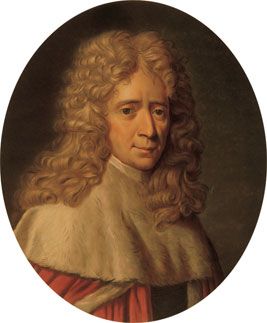
In response, I nominate Charles-Louis de Secondat, baron de La Brède et de Montesquieu, for the Al Copeland Humanitarian of the Year Award. Montesquieu’s systematic collection of observations about modern government, The Spirit of the Laws, was the fruit of decades spent travelling and studying and was tremendously influential on the American Founders. If memory serves, Montesquieu is quoted more than any other source in the Federalist Papers. In fact, so authoritative was Montesquieu over the early Americans that papers 9 and 10 were composed to answer charges from the Anti-Federalists that the Constitution deviated unacceptably from Montesquieu’s views.
Many crucial innovations in what Hamilton called “the science of politics” emerged in the modern era, were systematically observed by Montesquieu, and then perfected by the Founders under Montesquieu’s influence. Representative democracy and greater rights for the accused in criminal trials were among them. Perhaps the most important was the separation of powers, an idea as old as Aristotle but one that didn’t reach maturity until the Glorious Revolution in 1688 and the U.S. Constitution a century later.
As a critical component of the emergence of this system, Montesquieu insisted that a republic cannot maintain its freedom unless judges restrain their influence as tightly as possible. The application of personal wisdom by individuals in authority, rather than clear and stable standards of public law, as a standard for settling disputes is the jurisprudential principle of monarchy. In the context of monarchy (which has other methods of restraining the willfulness of the rulers) it can be exercised in humane ways. It becomes tyrannical when exercised in a republic, where the traditional social restraints on power that prevail in monarchies have been removed, and the willingness of the rulers to rule by the law rather than their own wisdom is the only barrier to unlimited arbitrary exercise of power.
As Franklin famously observed, the Founders gave us a republic if we can keep it. It was Montesquieu who taught them how to create that republic, and if we have enjoyed the last two centuries of republican government we should be grateful to him.
9 Comments | Al Copeland Humanitarian Award | Tagged: Greg Forster, Montesquieu, raw milk | Permalink
Posted by Greg Forster

It is time once again for us to solicit nominations for the Al Copeland Humanitarian Award. The criteria of the Al Copeland Humanitarian Award can be summarized by quoting our original blog post in which we sang the praises of Al Copeland and all that he did for humanity:
“Al Copeland may not have done the most to benefit humanity, but he certainly did more than many people who receive such awards. Chicago gave Bill Ayers their Citizen of the Year award in 1997. And the Nobel Peace Prize has too often gone to a motley crew including unrepentant terrorist, Yassir Arafat, and fictional autobiography writer, Rigoberta Menchu. Local humanitarian awards tend to go to hack politicians or community activists. From all these award recipients you might think that a humanitarian was someone who stopped throwing bombs… or who you hoped would picket, tax, regulate, or imprison someone else.
Al Copeland never threatened to bomb, picket, tax, regulate, or imprison anyone. By that standard alone he would be much more of a humanitarian. But Al Copeland did even more — he gave us spicy chicken.”
Last year the winner of “The Al” was Wim Nottroth, the man who resisted Rotterdam police efforts to destroy a mural that read “Thou Shall Not Kill” following the murder of Theo van Gogh by an Islamic extremist. He beat out The Most Interesting Man in the World, the fictional spokesman for Dos Equis and model of masculine virtue, Stan Honey, the inventor of the yellow first down line in TV football broadcasts, Herbert Dow, the founder of Dow Chemical and subverter of a German chemicals cartel, and Marion Donovan and Victor Mills, the developers of the disposable diaper.
Another past winner of “The Al” was Debrilla M. Ratchford, who significantly improved the human condition by inventing the rollerbag. She beat out Steve Henson, who gave us ranch dressing, Fasi Zaka, who ridiculed the Taliban, Ralp Teetor, who invented cruise control, and Mary Quant, who popularized the miniskirt.
Nominations can be submitted by emailing a draft of a blog post advocating for your nominee. If I like it, I will post it with your name attached. Remember that the basic criteria is that we are looking for someone who significantly improved the human condition even if they made a profit in doing so. Helping yourself does not nullify helping others. And, like Al Copeland, nominees need not be perfect or widely recognized people.
8 Comments | Al Copeland Humanitarian Award | Tagged: Al Copeland Humanitarian Award | Permalink
Posted by Jay P. Greene
You are currently browsing the Jay P. Greene's Blog blog archives for October, 2011.


 Jay P. Greene's Blog