Responding to the President on Choice Media

February 24, 2014

ResponseToObamaVoucher

(Guest post by Greg Forster)

Recently, the president claimed that “every study” shows voucher programs aren’t highly effective. Choice Media has posted a short clip in which a legend in the field (Paul Peterson), the leader of voucher research conducted by the president’s own department of education (Pat Wolf), and a modest chorus in the background (yours truly) contest the president’s claim.


Pass the Popcorn: Do You Want to Be Awesome, or Loved?

February 18, 2014

(Guest post by Greg Forster)

It’s a Pass the Popcorn so big, I couldn’t fit it onto JPGB. Head over to Hang Together for 3,300 words on The Lego Movie and Frozen, which offer the two great moral worldviews of our time.

If you haven’t seen The Lego Movie, go see it. It’s hilarious. The entertainment value is well worth your money. I expect that some of the pop culture gags in this movie will be referenced by nerds around their digital water coolers for some time to come. And the gags are almost all visual, so it’s going to be a lot funnier on the big screen than it will be in your living room.

Don’t go expecting deep wisdom, just go expecting a great time, and you’ll have one.

Now, to business. Do NOT read the rest of this article until after you’ve seen both The Lego Movie and Frozen (subject of my most recent Pass the Popcorn article over at JPGB). Major spoilers lie ahead…

The Lego Movie and Frozen are both examining what may well be the most important question facing our culture. They are not about the culture war as such, but they are about the core question of the meaning and purpose of human life that lies behind the culture war…

Your thoughts and feedback welcomed!


Pass the Popcorn: Frozen

February 13, 2014


Frozen 1

(Guest post by Greg Forster)

While there’s still time, go see Frozen while it’s still in theaters. The Pixar conquest of Disney has been an uneven battle up to now, but this move is an unqualified victory and it may turn the tide of the war. It’s a profound movie on many levels.

The most obvious lesson of Frozen – the one that’s made explicit in the movie – is that love is not about how you feel. It’s about putting other people’s needs ahead of your own. This by itself would make Frozen a profound inversion of the old Disney culture by the Pixar invaders. But Frozen not only makes this point, it traces some wide-ranging consequences. Such as: people invest too much importance in romantic love relative to other kinds of love. The responsible grown-ups who tell you not to burn down everything else in your life for the sake of “true love” (quote unquote) are not your enemies, they’re your friends. They’re the people who really love you.

When Enchanted subverted these same fairy-tale conventions – e.g. getting engaged to someone you just met – it was just going for laughs. Don’t get me wrong, there are a lot of laughs in Frozen. It’s the funniest movie I’ve seen in years. But there are no laughs on this particular subject. Frozen is not subverting the Disney view of marriage for fun. Frozen is playing to win.

That alone would be enough to make Frozen an early contender for the most culturally regenerative movie of the year. But there’s more going on.

Under the surface, Frozen is dealing with two other subjects that are, if anything, even tougher for our culture. One is the corruption of human nature. It used to be that pretty much everyone agreed there was a systematic moral dysfunction in human nature. This is a teaching held by Christians in an especially strong form, of course, but it is by no means a peculiar Christian doctrine. Aristotle believed it, as did Kant. There is a whole song in Frozen about how nobody is what he ought to be: “Everybody’s a Bit of a Fixer-Upper.” While there are villains in Frozen who are willing to kill, the main threat to the heroine’s life comes from the selfish actions of a sympathetic character – someone who loves her. We are explicitly told at one point that the explanation is simple: everyone is like that.

This is, of course, related to the main message. It’s because other people are so disappointing that we prioritize our own feelings rather than other people’s needs. And it is because we are ourselves so disappointing that our lives fall apart when we prioritize our own feelings.

The other theme in Frozen, one buried even deeper, is the tension between social rules and individual freedom. Without giving too much away, I can say that Frozen is the movie Brave was trying to be, but couldn’t be. Brave was trying to deal with the fact that society needs rules, and individuals who are not well served by the rules need to learn to subordinate their own desires to the good of their neighbors as embodied in the rules; at the same time, social authorities need to recognize that the rules must accommodate the needs of individuals – including the needs of those unusual individuals who are not well served by the same rules that serve everyone else.

There was internal conflict over Brave at Disney, and it shows. Frozen pulls off the same angle brilliantly – better, perhaps, than Brave could have. Because in Frozen we are shown what happens to individuals who try to flee from society in order to escape its rules. They fall apart. Their lives become arbitrary and meaningless – and they learn to hate. “The cold never bothered me anyway” sings Queen Elsa as she builds an ice castle for herself at the top of a remote mountain, but she doesn’t realize how the cold is seeping into her heart.

We all need freedom, but we also need each other.


Oregon Wins!

January 28, 2014

OregonDucksMascot(Guest post by Greg Forster)

Ladies and gentlemen, the United States of America is now concluded. The judges have turned in their scores, and the victor has been selected. Oregon wins.

We would like to congratulate all fifty states on their outstanding efforts, and wish them good luck in future competitions.


Taste the ABC Rainbow!

January 23, 2014

2014 ABCs BLUE2014 ABCs GREEN2014 ABCs YELLOW2014 ABCs ORANGE2014 ABCs PINK

(Guest post by Greg Forster)

The new edition of the ABCs of School Choice is out – now available in a rainbow of colors, showing that Friedman provides the full spectrum of data on school choice programs.

No red, though? I’m disappointed.


School Monopoly Culture Wars

January 22, 2014

psychic-octopus-culture-war

(Guest post by Greg Forster)

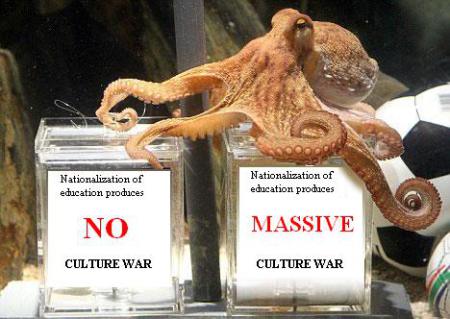
Neal McCluskey of Cato has long been a champion of one of my nearest and dearest reasons for favoring school choice: it defuses the culture war. When families with diverse beliefs are all (effectively) forced to send their children to the same schools, it creates a lot of unnecessary conflict.

Today, Neal announces that Cato has released a pretty cool web feature – an interactive national map of public school conflicts over religion, sexual ethics, free speech, and other cultural issues. You can search by state, by large districts (Chicago has six ongoing conflicts, New York City seventeen, Milwaukee four) by type of conflict, or by keyword. I randomly typed in the keyword “balloon” and found the case of a teacher who wasn’t allowed to do a class project on treatment of homosexuality, and held a “funeral” for his project, at which he asked his students to write their feelings down on helium balloons.

Don’t click the link if you want to get work done this afternoon. Kudos to Cato!


Who’s “We,” Fordham-Sabe?

January 20, 2014

(Guest post by Greg Forster)

Before he had a sitcom, Bill Cosby used to have a series of Lone Ranger jokes in one of his old stand-up acts. In one part of the routine, the Ranger tells Tonto something like, “They outnumber us ten to one, so we’re going to ride down the hill full speed, we’re going to cut across right through their sights, then we’re going to engage them hand to hand. Any questions?”

“Just one, Kemo Sabe.”

“What’s that?”

“Who’s ‘we,’ Kemo Sabe?”

That’s also the right answer to Fordham’s insistence that choice students must take state tests because, as Jay summarizes it, “we’ve got to do something!” That’s an accurate summary of the presupposition coming out of Fordham – you aren’t in favor of reform unless you think that you are the one to dictate what a good education looks like.

Yes, “we” have to do something to invent better ways of educating students. But who’s “we”? Having government standards to measure the government’s school system can be good, even if Common Core is not. However, even when government standards are good, and even when they’re applied only to the government system, they are not the way to reinvent education, because government – by its very nature – is not well designed to 1) innovate effectively, 2) persuade people that the innovations are effective, or 3) build institutions where the institutional culture accepts the innovations as good.

What government does do well is to create the structures of social transaction within which effective innovators and entrepreneurs can operate. The key strategy for education reform should not be to devise the innovations we need but to create structures that enable innovators and entrepreneurs to do so. The more we get caught up in devising the innovations ourselves, the further we move away from creating the conditions necessary for those who really can devise the innovations to do so.

Choice programs today are very poorly designed to support entrepreneurs. They ought to provide universal choice, a generous allotment of funds (though less than what we spend on the behemoth of government schooling) and freedom to innovate with minimal interference. Entrepreneurs need three things to succeed: clients, capital and control. You need a customer base of people who want your service because it makes their lives better. You need those customers to be willing and able to pay you; that’s what sustains the organization that delivers the service. And you need to be free to provide the service according to your own entrepreneurial vision and the needs of your clients, not according to standards devised by politicians and bureaucrats.

See the study I did for Friedman on The Greenfield School Revolution and School Choice for much, much more, including data on the impact choice programs are having (or, more frequently, are not having) on the composition of the private school sector.


“A Sturdy Portion of the Public Is Not”

January 16, 2014

octopus

(Guest post by Greg Forster)

George Will certainly knows how to turn a phrase:

The rise of opposition to the Common Core illustrates three healthy aspects of today’s politics. First, new communication skills and technologies enable energized minorities to force new topics onto the political agenda. Second, this uprising of local communities against state capitals, the nation’s capital and various muscular organizations demonstrates that although the public agenda is malleable, a sturdy portion of the public is not.

Third, political dishonesty has swift, radiating and condign consequences. Opposition to the Common Core is surging because Washington, hoping to mollify opponents, is saying, in effect: “If you like your local control of education, you can keep it. Period.” To which a burgeoning movement is responding: “No. Period.”

Hey, that last part is pretty clever. I wonder where he got it. Hmmmm . . . must have been from Jason! 🙂


It’s Not Just Government, It’s Schools, Too

January 15, 2014

(Guest post by Greg Forster)

Responding to Fordham’s latest straddle, here on JPGB Matt has pointed out that we shouldn’t trust the job of judging school quality to government, and no one knows this better than Fordham (some of the time, anyway). At Cato, Andrew Coulson and Jason Bedrick point out that the existence of school choice programs inevitably crowds out non-choice-participating private schools, so if choice programs become engines of uniformity, we can kiss educational entrepreneurship and innovation goodbye. First Fordham demands state tests must bow to Common Core, then it demands private schools must bow to state tests, all the while insisting Common Core both is and is not a powerful tool for reshaping curriculum!

At the Friedman Foundation’s blog, Robert Enlow points out that Fordham is also playing both sides of the fence on whether the tests will have to be given only to choice students or to all students in the school:

Fordham even implicitly shows how its testing approach will eventually impact non-voucher private school students: “[i]f a private school’s voucher students perform in the two lowest categories of a state’s accountability system for two consecutive years, then that school should be declared ineligible to receive new voucher students until it moves to a higher tier of performance (emphasis added).”

If a private school accepting voucher students loses those students because of their low performance on state tests, how can it rejoin a school choice program without forcing all of its students to take, and perform well, on the state test?

Here’s another issue that I haven’t seen raised yet. Fordham backs up its position by pointing to the results of a survey of private schools that don’t participate in choice programs. State testing requirements came in seventh on the list of reasons why they don’t participate; demand for universal eligibility and higher choice payments were the top answers.

Once again, Fordham is operating out of a top-down, anti-entrepreneurial mindset. Existing private schools are not the voice of entrepreneurial innovation. They are the rump left behind by the crowding out of a real private school marketplace; they are niche providers who have found a way to make a cozy go of it in the nooks and crannies left behind by the state monopoly. They are protecting their turf against innovators just as much as the state monopoly.

Milton once used the analogy of hot dog vendors. If you put a “free” government hot dog vendor on every street corner, the real hot dog vendors will all vanish. The same has happened to private schools. If we extend the analogy, we could say that a few hot dog vendors might survive by catering to niche markets – maybe the government hot dog stands can’t sell kosher hot dogs because that would be entanglement with religion. But the niche vendors would not be representative of all that is possible in the field of hot dog vending.

And the private schools that don’t participate in choice programs are probably the least entrepreneurial. Notice, for example, that their top complaint is that choice isn’t universal. Why would that prevent them from participating in choice programs? Wouldn’t they want to reach out and serve the kids they can serve, even as they advocate for expansion of the programs to serve others? The private schools participating in choice programs are doing so; they may not be paragons of entrepreneurship, but they are at least entrepreneurial enough to want to help as many kids as they can. The demand for bigger choice payments is also not a sign of hungry innovation on their part (even if the choice payments are paltry in may places).

Basically the attitude revealed by the Fordham survey of non-choice-participating private schools is “we want choice, but only if it doesn’t require us to change.” Funny thing; the public monopoly blob gives us pretty much the same line.


Use the Force MOOC! A 2013 retrospective

December 26, 2013

(Guest Post by Matthew Ladner)

The after-Christmas but before New Year period is always dominated by “Year in Review” retrospectives, so why not join in on the fun? Here at the Jayblog we dig new options for students and parents, so let’s take a look back at 2013.

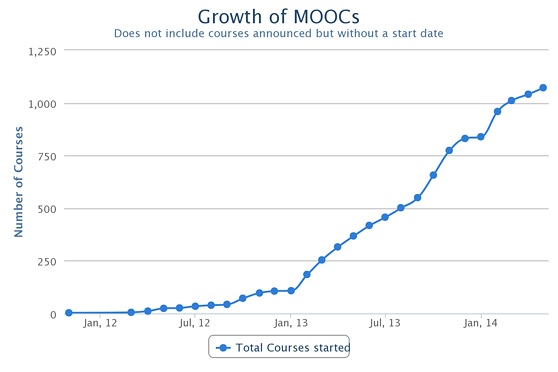
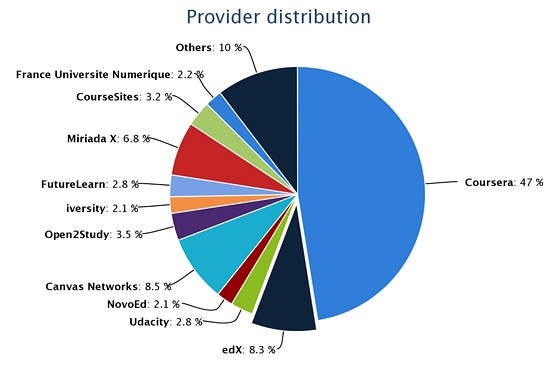
Digital learning continues to surge. No one has yet established the free online degree that some nutball predicted in 2009, but events are moving in that direction. Dhawal Shah of EdSurge leads us off with a review of the progress of Massive Open Online Courses (MOOCs) in 2013. Shah includes MOOCilicous charts like:

MOOC 1


and…

MOOC 2and…

MOOC 3

All of this is quite impressive given the first MOOC rolled out in 2011. Shah provides analysis and 2014 predictions, so go read the article. Events seem to be conspiring to take a very sharp pin to a higher education tuition bubble. One cannot help but wonder how long we will go on debating public funding for online high-school courses when, ahhh, Stanford is giving them away for free and you can, well, get college credit for them.  The logical side of Kevin Carey’s brain (the one that writes about higher education) turned in a useful refutation of the hand-wringing over MOOC completion rates.

Remember where you heard it first- the day is coming when more people will be watching university lectures online than Baywatch reruns.

Please note: I did not say it would be any time soon…

On the K-12 front, the National Alliance for Public Charter Schools published an evaluation of state charter school laws finding widespread improvement between 2010 and 2013. Bottom line: break out the bubbly. Thirty-five states improved their laws, only one law regressed. Seven states “essentially overhauled” their laws with major improvements-Hawaii, Rhode Island, New Mexico, Indiana, South Carolina, Louisiana, and Colorado. Ten more states-Florida, Illinois, Massachusetts, Michigan, Missouri, Nevada, New Jersey, New York, North Carolina, and Ohio made “notable improvements” in their charter law.

Here at Jayblog we have our annual measure of success in the private choice movement the Forster vs. Mathews school choice dinner bet. Greg either doubled or tripled the standard in 2011, and followed up by easily surmounting it once more in 2012.

In 2013, ooops Greg did it again!  Three-peat!  Two new states (Alabama and South Carolina) joined the school choice ranks, North Carolina went BIG on reform, including two new voucher programs, Ohio and Wisconsin passed new statewide programs, Arizona, Georgia, Iowa, Indiana and Utah improved existing programs.

So 2013 was a fine year overall for choice, grading on the curve of comparing it to past years. Compared to the needs of the country, this is all still painfully slow, so…