Welcome to Weimar!

November 14, 2014

minaj11f-2-web

(Guest post by Greg Forster)

It’s been a while since we had a post on union goons shutting down debate by force. It happened again yesterday at AEI.

In other news, the central bank has spent years flooding the economy with cheap money, and fascist imagery is now cool and transgressive.

Willkommen . . . bienvenue . . . welcome!


Forster-Mathews over/under challenge- place your 2015 bets now

November 6, 2014

(Guest Post by Matthew Ladner)

Election coverage inevitably drifts to beltway drama, but I’m at more than a bit of a loss to understand why. It’s kind of like the nation’s bizarre fascination with 32 football teams running the same offense and defense when a far more interesting and gloriously chaotic brand of football rumbles along in the colleges. My memory gets fuzzy trying to remember the last positive and interesting thing to happen in DC. The action in America is out in the states.

Longtime Jayblog readers will doubtlessly recall the world-famous bet between our own Greg and WaPo columnist Jay Mathews regarding whether parental choice programs were just too politically difficult. They eventually decided to put the over/under for new school choice programs or expansions in 2011 at 7, with the loser picking up dinner.

I can’t remember whether the total got to 21 that year or not. If not, it was close. The school choice movement easily cleared the bar again in 2012. Then in 2013, it was time for a three-peat!  Finally in 2014, the pace slowed a bit nationally in an election year and the Forster-Mathews bar proved too high.

And now?

Only time will ultimately tell, but the elections of 2014 must look pretty bleak if you are burdened in life with reactionary K-12 preferences. Scott Walker for instance not only just won his third statewide election in four years, he’s talking about expanding school vouchers into new districts and providing choice to children with disabilities. Arizona Governor-elect Doug Ducey stated in his victory speech “Schools and choices open to some parents should be open to all parents.”

Out in Florida, Republican Governor Rick Scott defeated Republican, Independent Democrat Charlie Crist in an epic battle. It did not escape the notice of some that the tight margin could have been swayed by the parents of the parents of the near 100,000 children participating in Florida’s private choice programs this year.

In Indiana, Republicans added to their already large legislative majorities and the same thing basically happened in Ohio. A few years ago, an observer of Nevada politics told me that the map of Nevada House were drawn such that a Democratic majority would live at least as long as the current map. Well lo and behold, Gov. Sandoval gets reelected with 70% of the vote and the Republicans capture both chambers.

The WaPo produced this handy map:

This same article notes that Republicans hold unified control over both chambers and the chief executive in 24 states compared to 6 for the Democrats.

Don’t ignore Blue states however. Out in New York, easily reelected Gov. Andrew Cuomo expressed public support for tuition tax credits. From the linked story:

Mr. Cuomo echoed the assemblyman’s call for the passage of the Education Investment Tax Credit, which would help parents pay for religious schools–which the governor compared to his expansion of the state’s Tuition Assistance Program to cover yeshivas and his public funding of busing for students of Orthodox Jewish schools. Mr. Cuomo claimed such funding is simply equitable and right.

“It’s not charity, it’s not a favor. It’s justice. TAP. Public transportation and the school buses, that was justice. Education tax credit–this is a matter of justice,” he said as the crowd broke into applause. “I want you to understand that’s the way I see it. On a personal level, this is a very important relationship that I honor. And as governor, I have sworn to do justice. And there have been a number of great injustices that your community has endured for a long, long time. And it is my profound wish that we should work together and we should resolve them and bring justice to the community that we deserve.”

This is welcome news, as the private choice movement has made very limited progress overall in the mega-states of California, Texas, Florida, New York and Illinois aka where a whole bunch of the kids are located. Charter schools however are rolling along in all of those states, and they seem poised to crush private schools at a much higher rate than low-performing district schools. Even Florida’s nearing 100,000 private choice children in private choice programs seems small when viewed in this fashion. The Illinois $500 personal use tax credit comes across as a bit of a cruel joke when put into this context: the state will lavish many thousands of (increasingly hard to come by) dollars on you if you choose to attend a district or charter school, but will give you a $500 tax break if you choose to bear the financial burden of sending your child to a private school if you have a sufficient tax liability.

The Illinois credit may only be a small step in reducing double payment penalty, but it is more than California, New York or Texas has done to date while charters continue to surge. In the end, private schools ought not to be preserved by nostalgic state lawmakers, but rather (if it is going to happen) by the free choice of parents operating on something approaching a level financial playing field. We need both broader and better designed account-based programs.

Finally choice proponents need to be aware that even seemingly shiny legislative majorities spring on you like a bear trap if you mistake them for an actual consensus. Proponents must never forget the need to persuade a broader universe of opinion leaders and the public regarding the justice of their cause.

Okay so with all that said, I will take the over in 2015. What about you?

UPDATE:

The Friedman Foundation has a handy-dandy guide to the governors and how they stand on parental choice.

UPDATE PART DEUX:

WaPo on the teacher unions spending $60m on races and mostly getting crushed. Money quotes:

“We knew this was going to be an uphill battle,” said Lily Eskelsen García, president of the National Education Association, the country’s largest labor union. “But I don’t think anybody on our side, and we’ve got some very savvy people, anticipated going over the falls like this. Tectonic plates have shifted. And we’re going to have to come back with a new way of organizing for these kinds of races.”

and…

“The surprising thing is you now have Democrats who are willing to buck the union,” said Howard Wolfson, an adviser to former New York mayor Michael R. Bloomberg (I), who contributed to Democratic and Republican candidates around the country who want to introduce more choice and competition in public education, and greater accountability for teachers. “You can take reform positions and be successful not only in general elections, but in primaries. It’s a major sea change in the Democratic party that you can now oppose the union and be successful.”



Peter DeComo for Al Copeland Humanitarian

October 30, 2014

DeComo

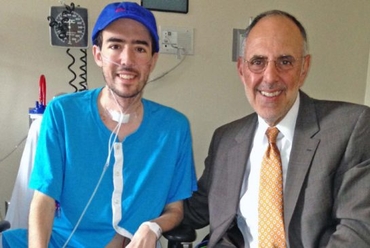
Jon David Sacker and Peter DeComo

(Guest post by Greg Forster)

In the storied tradition of Herbert Dow and the inventors of the heatball, I am proud to nominate Peter DeComo for this year’s Al Copeland Humanitarian of the Year.

DeComo is the chairman and CEO of ALung Technologies, which produces cutting-edge innovative medical technologies that save lives when lungs fail. Get this – ALung makes a gizmo called the Hemolung Respiratory Assist System, which can keep you alive without using your lungs long enough for doctors to perform a double lung transplant, including the time needed for your body to accept the new lungs and start using them.

Pretty awesome, huh? In a perfect world, that alone would be enough to qualify DeComo for public honors.

But we don’t live in a perfect world, and few people have seen that illustrated as starkly as Peter DeComo.

You see, the Hemolung is in active use, saving lives across Europe and Canada – but not in America, the land of its birth. This lifesaving device was invented here, but apparently “for export only,” as Mark Steyn put it. It’s not approved for use in the U.S.

But that didn’t stop Peter DeComo.

This February, Jon David Sacker was rushed to the University of Pittsburgh hospital after his body rejected the transplanted lungs he’d received two years earlier. The Hemolung was his only hope of survival. It was the Hemolung or the hearse for Sacker.

Pittsburgh happens to be the city where ALung manufactures the Hemolung. The University of Pittsburgh is the medical school where the Hemolung was invented. And there were no Hemolungs at the university hospital.

But that didn’t stop Peter DeComo.

The closest Hemolung fit for actual use was in a Canadian town on Lake Ontario. DeComo hopped in the car and personally drove north to the border crossing. He made the trip in the middle of the night, having gotten the first phone call at 11pm. He was met by Murray Beaton from the Canadian hospital, who had popped the device into his car and driven south to meet DeComo. They met and handed off the device in the dark on a tiny dirt road just north of the crossing, and DeComo headed back toward Pittsburgh and the desperately ill Sacker.

Whereupon the border guard informed DeComo that he was not allowed to bring the Hemolung into the U.S., because it was not approved for use there.

DeComo told him that a man’s life was at stake. No dice. Apparently the people who rule our country are perfectly willing to take “someone’s life is at stake” as a reason to actively help terrorists commit more murders and destroy our freedom, but not as a reason to let Jon David Sacker go on breathing.

But that didn’t stop Peter DeComo.

DeComo’s brilliant split-second thinking saved Sacker’s life. The Toronto Star relates the key moment:

Then he changed tactics. He said that he wasn’t really importing the device. Since it was an ALung product and he was ALung CEO, the Hemolung was his property and he was simply retrieving it.

“He closed his little cabin door,” DeComo said. “He made a call and he came out and said, ‘Okay you can go.’”

God bless Peter DeComo.

Are you ready for the kicker? Here it is:

Before they sped off, the border guard shouted out one last comment.

As DeComo recalls, he said: “Hey, let me tell you something. I would recommend that you keep some of that (expletive) on your shelves and next time, you won’t have to make that drive.”

I’m sure he’d love to. In the meantime, since I can’t give him a sane world, I will give him the next best thing: a nomination for Al Copeland Humanitarian of the Year.


School Choice and Religious Freedom

October 30, 2014

Marcher with flag

(Guest post by Greg Forster)

OCPA’s Perspective has published my article on how school choice promotes religious freedom, pluralism, and peace:

It’s folly to be afraid of letting religious institutions participate in public programs on the same terms as everyone else. That kind of oppressive Kemalism has only exacerbated religious hatred when it’s been tried in places like Turkey or France. Americans have historically been more enlightened.

Believe it or not, school choice often helps children learn to respect the rights of those who don’t share their faith, and has never been found to have the opposite effect. A large body of empirical research (reviewed by Patrick Wolf in an article titled “Civics Exam” in the journal Education Next) finds that private school students are more likely to support civil rights for those whose beliefs they find highly unfavorable. Five of these studies have specifically looked at school choice programs; of those, three found the choice students were more tolerant of the rights of others while two found no difference. No empirical study has ever found that school choice makes students less tolerant of the rights of others.

The occasion for the article is an unwise legal decision as an Oklahoma school choice program winds its way through the painfully slow processes of the legal system:

If the church is burning down, don’t call the fire department! That’s using government funds to benefit a church. If someone scrawls swastikas on the synagogue, don’t call the police! And heaven forbid we allow the mosque to use our municipal water and sewer lines. Alas, Judge Jones doesn’t see things that way, and the case will continue its four-year journey through the courts.


Over One Billion Saved

October 1, 2014

McDonalds billions

Watch out, Ronald. We’re catching up!

(Guest post by Greg Forster)

Matt seems to have been a little distracted by the Ramones yesterday, so for those who are still wondering, the new study from the Friedman Foundation is a comprehensive financial audit of modern school choice programs. It finds that choice has already saved $1.7 billion. As Matt notes, Friedman produces some pretty awesome slideshows that let you absorb tons of information in two minutes. Check it out below and let us know what you think!

The School Voucher Audit: Do Publicly Funded Private School Choice Programs Save Money? from The Friedman Foundation for Educational Choice

Stop Nick Cage Before He Kills Again!

September 25, 2014

Spurious Correlations

(Guest post by Greg Forster)

This graph of the correlation between the number of Nicholas Cage films and the number of swimming pool drownings in each year (correlation = 0.666004) and many more await you at Spurious Correlations.

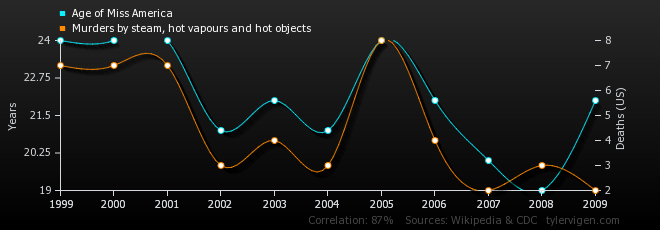
Here’s the graph of the age of Miss America and the number of murders by steam, hot vapors and hot objects (correlation = 0.870127):

Spurious Correlations 2

Perhaps you scoff at such weak correlations. It may interest you to know that the marriage rate in Kentucky and the number of people who drown after falling out of a fishing boat correlate at 0.952407! What on earth are newlyweds doing in Kentucky, and how do we put a stop to it?

HT Michael Strain


Sentences that Aren’t Worth Finishing

September 24, 2014

solomon01Aristotle_Plato  JLocke

(Guest post by Greg Forster)

Robert Pondiscio: “Our earliest thinkers about education—men like Benjamin Rush, Noah Webster, and Horace Mann…”


Long Term Trends in the Fight for Choice

September 22, 2014

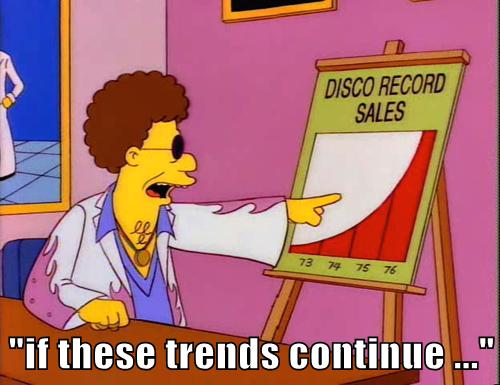
Disco Stu trends

(Guest post by Greg Forster)

Funny Matt should choose this morning to post thoughts about the future of charters and private school choice. My article on long-term trends in the fight for private school choice was just published by OCPA’s Perspectives. [Update: Oops, link added.]

The most important omen for the long term, though, is the war of ideas and moral legitimacy. Nobody takes the school unions and other guardians of the status quo seriously any more. The mask is off; everyone knows they’re all about the gravy train. Moreover, in milder forms like charter schools, the principle of choice has been almost universally accepted on both sides of the political aisle. How long can people go on supporting charters but opposing private choices, especially as it becomes clear charter schools don’t have enough freedom to reinvent education?

As Matt Ladner likes to say, these days the “cool kids” in education are the entrepreneurs who invent radically new kinds of schools. A few years ago, everyone was atwitter about the revolutionary potential of these “greenfield” experiments. Recently, though, the bloom is off the rose. People are beginning to realize that the world of tomorrow isn’t going to be so easy to build. Where will they turn for the tools they need to truly reinvent education? Universal choice is looking better and better.

Pop culture aficionados are invited to submit their judgment on the quality of my references to Doctor Who.

A shorter version of the article was published as an op-ed in the Edmond Sun.


“I’m Practically a Socialist”

September 8, 2014

Hirsch

(Guest post by Greg Forster)

Don’t miss Politico’s thoughtful profile of Common Core godfather E.D. Hirsch, who says of himself:

I’m practically a socialist.

Yes, he is. He understands what is really going on better than most.

Granted, in its current incarnation CC lacks the teeth to put any of its implicitly dictatorial ambitions into effect. But that does not change the nature of the ambitions; it only means CC advocates understand the limits of what is currently possible. If CC is allowed to silently redefine the basic meaning of all educational terms, delegitimize authentic parent choice, and establish the expectation that powerful people can lie and cheat and get away with it, more and more will become possible for them.

P.S. Don’t forget, “practically” can mean “in practice, in effect, de facto.”


Five Answers for Mike Petrilli, Technocratic Progressive

September 5, 2014

Cheating

(Guest post by Greg Forster)

Yesterday I highlighted Rick Hess’ five “half-truths” (really non-truths) of CC advocates. Now, Mike Petrilli has five questions for Rick. I don’t know how Rick would answer, but here’s how I would – consider it a cheat sheet on the nature of technocratic progressivism.

1) You dispute that the Common Core standards are “evidenced based” because “what the Common Core’s authors did falls well short of what ‘evidence-based’ typically means.” By your definition, would any set of standards be considered evidence-based? Such as those previously in place in the states? Or any set of education standards one might develop in the future? (Or, for that matter, in myriad other fields?) If no, then what’s your point? Do you think we should abandon standards-based reform?

No, no set of standards can be evidence based, because we don’t have anything like the level of evidence we would need for that designation to be meaningful. We need at least a generation of robust school choice and educational entrepreneurship before we will have the slightest idea “what works.” Technocratic progressivism always starts from the pretense that we know more than we really do.

2) Relatedly, would you consider elements of the Common Core to be evidence-based? Such as their focus on scientifically-based reading instruction in the early grades, or the demand for fluency in arithmetic, or the admonition to delay calculator use? Would you disagree that those decisions were based on evidence? Do you think states should go back to standards that don’t include these evidence-based expectations?

Designating these policy decisions – for that is what they are – as “evidence based” suggests that they are the One Best Way for all students, and disagreement is illegitimate. The next step for technocratic progressivism, after pretending that we know more than we really do, is to take policy decisions that involve the exercise of a wide-ranging human judgment, upon which wise and well-informed people might therefore be expected to disagree, and reframe them as mere technical questions that have one objectively right answer.

3) You complain that the Common Core standards don’t include calculus. Do you think states should expect all students to learn calculus? If not, where would you set the bar for “college and career ready”?

This question reveals the fundamental bankruptcy of the whole CC enterprise. It requires a single authority to take control of the content of education for all students at a detailed level. Who died and put Rick Hess in charge of when my daughter should learn calculus? And who says the right answer is the same for all students? Technocratic progressivism, having presented policy questions requiring complex human judgment as technical issues that have a single right answer to be determined straightforwardly by evidence, delivers unlimited power to an elite class of politicians posing as scientists.

4) You say that it’s hard to judge the “rigor” of standards. OK. So do you think other standards are more rigorous than the Common Core? Ohio, for example, is having a debate about whether it should repeal the Common Core and deploy the old Massachusetts standards instead. Do you think the old Massachusetts standards were more rigorous than the Common Core? Or is it impossible to know?

I had thought everyone paying attention to the discussion was aware by now that the old Massachusetts standards were more rigorous than CC, but if Mike wants to remind us of this unflattering comparison, who am I to stop him? It is especially helpful because the overthrow of superior standards in Massachusetts demonstrates that CC is not only a floor but also a ceiling (as all “floors” must be by their very nature). Technocratic progressivism, by putting all power in the hands of politicians posing as scientists, undermines the functioning of the very systems it intends to improve.

5) You call us at the Fordham Institute “avidly pro-Common Core.” Do you think it’s possible that we are “avidly pro-Common Core” precisely because we think the standards are so strong? We also support the concept of national standards for science, but we’re not “avidly pro-Next Generation Science Standards.” We’ve recommended that states not adopt those standards because they are mediocre. How would you explain that position?

It’s strange that the observation that Fordham is “avidly pro-Common Core” should set off this defensive and oversensitive reaction. That Fordham is avidly pro-Common Core is obvious to all. Just look at their snide and juvenile piece on Bobby Jindal. And everyone knows Fordham is avidly pro-Common Core because they believe the CC standards are strong; Rick wasn’t suggesting otherwise. Why does Mike feel the need to snap back when people point out that he and his organization are for what they are for? Here we see the first stage of the final development of technocratic progressivism. The first stage (seen here) is guilty conscience. At future stages, the conscience will no longer feel guilty, having become accustomed to living in a false reality and being surrounded by the kind of unscrupulous people power attracts. That is when the really nasty stuff begins to happen.

If you want to move from the crib sheet to the Cliff’s Notes, start here. The primary source text can be found here.

Update: Mike writes in: “I think you missed my point on the Fordham Institute, though it was subtle. I thought Rick implied (unintentionally, as it turns out) that we gave the Common Core high marks because we were avidly pro Common Core. In fact, the reason we are so supportive of the effort is because the standards turned out so well. We would certainly never dispute that we are “avidly pro-Common Core.” We are, and proudly so!”