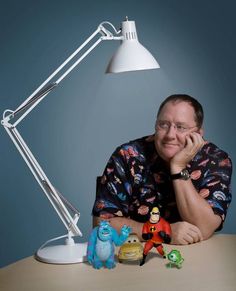
For the Al: John Lasseter

November 1, 2015

9b10d385edb7d9ba4d367ed90c2fac45

(Guest post by Greg Forster)

Deserve the Al Copeland Award? John Lasseter practically is the Al Copeland Award.

Improve the human condition? This man has not only reinvented movie animation technology, not to mention Hollywood’s business model. He has proven the superior power of the transcendent – the good, the true and the beautiful – in the marketplace of culture. He beat the purveyors of schlock, and he did it in the only way that really counts – by putting more asses in seats than they could. He didn’t defeat the schlockmeisters by shaming them, but by selling so many tickets that he ran them out of the marketplace. He proved that edifying culture can sell, which is another way of saying it can survive and sustain itself. He and the circle of people clustered around him are almost the only people left in Hollywood who know how to tell an edifying story, and they are literally the only people left who can tell an edifying story that appeals to everyone across all our cultural boundaries.

As I recently argued at some length, they are in the process of saving American civilization.
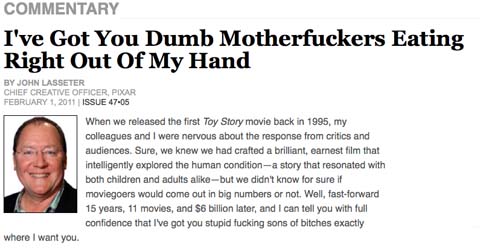
lasseter-onion

Courtesy of the Onion

There are basically two kinds of Al winners – inventor/entrepreneurs and champions of unpopular causes. They’re either David going up against Goliath, or they’re Elijah calling down fire on the lonely altar. Lasseter is both.

Inventor/entrepreneur? Lasseter dreamed for all his boyhood of working for Disney, and by some miracle he got himself chained to a drafting table deep in the bowels of the Disney dungeon, slaving away as the tenth assistant drawer of left pinkies . . . and then promptly got himself fired from his dream job for taking an interest in computer animation just at a moment when (unbeknownst to him) one of his superiors had decided the future lay elsewhere.

Perhaps because computers would eliminate people like him and elevate people like Lasseter? Can’t have that! Just like any good Al winner, John Lasseter saw the future, and he didn’t care whose cushy job was threatened by it.

So, cast out of the only company he ever wanted to work for, Lasseter chased down the future and seized it by the throat, and made it sing so loud and so beautifully that twenty years later, Disney came crawling back to him and begged him not just to come back, but to take over all their animated movie making, oversee design of all their theme park rides, and direct a good chunk of their other stuff to boot.

Disney+Premiere+Incredibles+Arrivals+qQcha6Wgo2ll

Mr. Incredible, second from the right, poses with some less impressive heroes

Now, all that would be Al-worthy if Lasseter’s innovations were merely technical. And it is hard, now, to remember that back in 1995 the thing that everyone thought was revolutionary about Toy Story was the technology.

But Lasseter’s innovation is as much the way his movie studio runs. He has figured out how to run a team of creative people in such a way that it not only produces material that is simultaneously artisitcally and commercially successful, but does so with sufficient regularity and reliability that you can pitch it to investors. He has taken the Muses to the bank.

And they really are the Muses. Lasseter and his people are not just “artistically and commercially successful.” They are bringing the transcendent things – the good, the true and the beautiful – back into the center of American culture.

Lasseter is as much a deserving Al winner as the champion of unpopular causes as he is so as an inventor/entrepreneur.

And what causes they are! If some have won the Al by standing up for this or that cause which is unpopular, but is nonetheless one of the keys to maintaining our justice, virtue and freedom as a people, Lasseter has stood up for just about all of the causes that are unpopular, but necessary for our justice, virtue and freedom:

  • Do not make your own happiness the aim of your life (Inside Out)
  • Love means putting other people’s needs ahead of yours (Frozen)
  • Accept your mortality (Toy Story 2)
  • Honor the superiority of exceptional talent (The Incredibles)
  • Manhood involves fatherhood (UP)
  • Womanhood involves motherhood (Brave)
  • Let your children take risks and grow up (Finding Nemo)
  • Don’t envy your brother (Toy Story)
  • Legitimate government rests on justice and popular consent (Toy Story 3)
  • Those who live for nothing but pleasure are fit for nothing but slavery (WALL-E)
  • Work your ass off, and be content with a family and your daily bread (Princess and the Frog)
  • Beauty transcends both nature and custom (Ratatouille)
  • Technology is for solving problems, not imposing your will on others (Big Hero 6)

No one else teaches these things and is listened to receptively by all sectors of society. Without this man, what hope would there be for these values in the long term? No, seriously, tell me. I’ll wait.

Two more Al-worthy accomplishments:

Lasseter is almost single-handedly responsible for the English language translation of the beautiful works of Hayao Miyazaki, who was practically unknown over here until Lasseter introduced us to him.
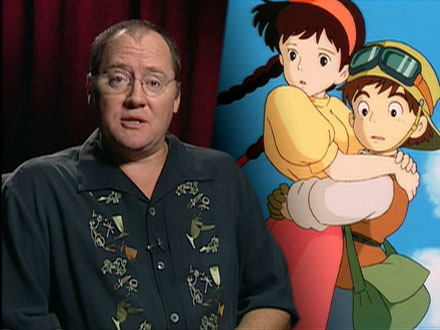
laputa_sm08

And Lasseter would be, if he won, the first Al winner to outdo the award’s illustrious namesake in tasteful shirts.

maxresdefault

Lasseter owns over 1,000 Hawaiian shirts and wears one every day.

You can’t ask for a clearer avatar of the Spirit of Al Copeland!


Choose Families, Choose Choice

September 30, 2015

e49c4073eef9ec6dbe2f553a4b158c56

(Guest post by Greg Forster)

The new OCPA Perspective carries my argument that the government monopoly on schools undermines the institution of the family, and school choice would strengthen the family:

Are schools an extension of the family, helping parents raise their children the way the parents want them raised? Or are schools an autonomous branch of the technocratic state, answering not to parents but to professional experts who know how children ought to be raised better than parents do?

The creation of the government school monopoly was one part of a general inversion of the social order going on in the 19th century:

In the 18th and 19th centuries, the family had been understood as the primary unit of society; larger political and economic structures existed to mediate relations between households, not between individuals as such. Relations between individuals within a household—such as the work of childrearing—were the family’s business, except in extreme cases. All that was now gone. The family was no longer primary; the technocratic state was primary.

The failure of the school monopoly has reoped the question of whom schools work for:

School choice and federal centralization of power are both responses to this failure. Some are seeking to reverse course, hoping that the moribund school system can be revitalized by putting parents back in charge. Others are seeking a stronger technocracy that will be more capable of achieving its goals.

I close with the reflection that social conservatives could bring something important to the school choice coalition not currently provided by the two factions that now dominate it, progressives and libertarians. As always, your comments are most welcome!


Brooklyn’s Dilemma: School District Lines and Racial Segregation

September 24, 2015

brooklyn-racial-map-585x506

Brooklyn by race (one dot = one person)

(Guest post by Greg Forster)

Today on NRO, Reihan Salam writes about a controversy involving school district lines attendance zones [see correction below] in his Brooklyn neighborhood. A nearby public school (P.S. 8) is oversubscribed; another nearby public school (P.S. 307), which is located in another attendance zone, is undersubscribed. Officials are therefore trying to redraw the lines and move an appropriate number of households in the neighborhood – which is, no fooling, called “Dumbo” – from one zone to the other.

Easy peasy, right? Not on your New York life.

P.S. 8 is 59% white and 15% free/reduced lunch; P.S. 307 is 90% black or Hispanic and 90% FRL.

Salam notes:

More than one Dumbo parent has tried to explain to me how they’re totally different from other people who fight against integration. They explain that what they really want is a better world in which we spend far more on our public schools, not mentioning, or perhaps not knowing, that New York city spends $20,331 per pupil, almost twice as much as the national average of $10,700, and that much of this money is spent very inefficiently. Of course they want integration, they’ll tell you, but only if it entails no sacrifice on their part. “It’s more complicated when it’s about your own children,” says one Dumbo parent. Well, yes, it is more complicated, and that is exactly what every parent believes, whether they are in Brooklyn or South Boston or Kansas City.

“Dumbo parents,” indeed.

There is more to this story than a political dilemma in Brooklyn. One of the biggest problems in the research on racial segregation in schools is getting the public – and, too often, the researchers! – to understand how school district lines, attendance zones, etc. are drawn in ways that ensure racial segregation in public schools. Research on racial segregation is often conducted in ways that ignore this, making public schools appear much better integrated than they actually are.

The only really viable solution is school choice. It not only breaks the link between place of residence and place of schooling, thus helping overcome residentail segregation; it entirely circumvents the political (and therefore racially fraught) process of drawing school district lines. Of the eight empirical studies examing the impact of school choice on racial segregation in schools, seven found that choice reduced segregation, and one found no visible effect.

Image: University of Virginia’s Weldon Cooper Center for Public Service (via)


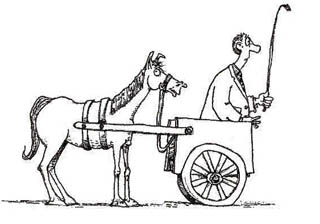
Choice First, Standards Second, Part 8,364

September 21, 2015

cart-before-the-horse

(Guest post by Greg Forster)

Rick Hess has an interesting article on NRO comparing two Common Core surveys. The first of his key takeaways:

Depending on which of the above questions one selects, it’s possible to argue that the public supports the Common Core by more than two to one or that it opposes it by more than two to one.

As I read the responses to the varying questions, the surveys are finding that parents want states to set high standards, but more than that, they want teachers to have autonomy.

Is that a juvenile have-your-cake-and-eat-it contradiction, like demanding high spending and low taxes with a balanced budget? Well, to some extent, no doubt. But there is another sense in which this circle can be squared.

“High standards” arbitrarily imposed by technocrats aren’t credible, and rightly so. School choice would create the necessary environment within which high standards could emerge with credibility.


Collegiate School Choice

September 4, 2015

college_debt

(Guest post by Greg Forster)

OCPA’s Perspective has posted my article about America’s vast, longstanding, and badly broken voucher system in higher education:

The fact that we run higher education on a voucher system is one of America’s best-kept secrets. The only thing the colleges are even more eager to cover up is the fact that they’re gaming this system to line their own pockets. Not even a school choice program can make people stop responding to incentives. That’s all the more reason to make sure the programs are well designed.

I argue that “we need a revolution in higher education vouchers similar to the revolution that is now hitting K-12 vouchers in the form of education savings accounts (ESAs).” Your comments are welcome!


Pass the Popcorn: The Wind Rises

August 4, 2015

yoko_out

(Guest post by Greg Forster)

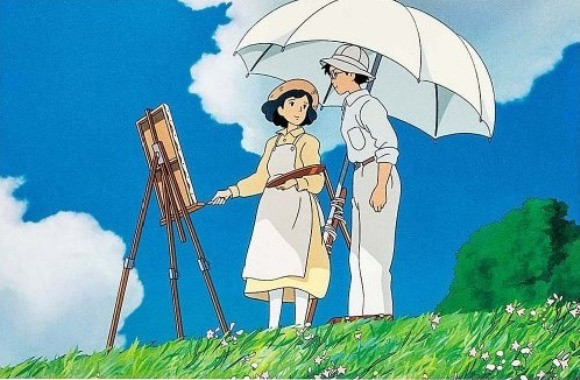
I hadn’t intended to time a review of Hayao Miyazaki’s final film, The Wind Rises, for the 70th anniversary of the dropping of the atomic bomb. But it turns out to be perfect timing.

Every scene of this movie is visually gorgeous, sometimes in a reserved way but often strikingly so. It is a fitting consummation of Miyazaki’s mastery of his medium. But it seems at first a radical break in content. It is the only Miyazaki movie that takes place in the real world – well, more or less the real world. He introduces a few fantastical elements, but they are limited to dreams and visions, and of course the somewhat fantastic aeronautical physics for which Miyazaki is so famous. When the characters are awake, they are living in the real world. The closest Miyazaki has ever come to the real world before was in his first film, Lupin III, and that hardly counts, both because its genre conventions take us well beyond the boundaries of the “real” world and because Miyazaki was forced to work within another author’s established universe. As soon as Miyazaki gained the freedom to make his own movies he leapt into the world of magical fantasy and never looked back – until now.

Update: Just watched Nausicaa with my daughter (her first time) and it made me realize in the paragraph above I forgot about Nausicaa, which is fantastical sci-fi and thus not “realistic,” but contains no magical realism as such. Even the aeronautical physics are not all that far off from reality! Fascinating to reflect upon Miyazaki’s career arc!

This is also his only movie that is concerned with real historical events. It is a heavily fictionalized account of the life of Jiro Horikoshi, who invented the Zero fighter plane and helped transform Japan from a comparatively primitive backwater into a global technology power. After the final scene fades, a title card appears informing us that the movie is a “tribute” to Jiro and to Tatsuo Hori, who wrote a short story from which this movie gets its title and from which it borrows core elements of its love story.

Wind-Rises

On a deeper level, it is almost his only movie where the real drama is in the writ-small world of one person. There are no epic quests here, no dispossessed princesses with magic amulets or gods warring to destroy humanity. Kiki’s Delivery Service comes close to this, but even Kiki discovers the meaning of her gift when she finds that she can use it to intervene in a major event. To find a movie as personal as this one in Miyazaki’s corpus, one in which no great fate rests in the balance of our hero’s actions, we must go all the way back to Totoro. But the Wind Rises goes even further than Totoro; here, our inability to change the really great historical events is actually central to the movie’s message.

Now I’m going to say something that may seem to contradict what I’ve just said. This is, at long last, Miyazaki’s political movie. Many of his works have had political themes; Miyazaki is well known as an environmentalist, a pacifist, and a former Marxist. But none of his previous movies was really a movie about those things. Only the shallow environmentalists think Princess Mononoke or Ponyo is really about environmentalism. Only the shallow pacifists think Howl’s Moving Castle is really about pacifism. Meanwhile, this movie – this highly personal movie that is all about one man, a man who knew he couldn’t stop war and therefore didn’t try – is the really pacifist movie.

And yet – contradiction looping back on contradiction – this pacifist movie actually argues that we can’t avoid politics, can’t avoid being part of our nations and the calling to make them great.

Okay, I’ve made this movie sound like a tangled mess. It isn’t. It’s quiet and still. The point only becomes confused when you attempt to express it in words rather than simply showing it in a story.

The whole point of the movie is to ask the great political question – what role does politics play in the meaning of human life? –  and give an answer that we Americans have always rejected with repugnance but which the whole rest of the world has always taken quite seriously, even when it disagrees with it. It is simply this: that it is a deadly mistake to look to our nations for justice, for they never deliver; but it is possible to look to our nations for identity and for opportunities to serve the world around us.

wind-rises-main_0

It would be flippant to say that the real message of this movie is “the men who built the horrible Japanese war machine were people too!” But that does come close to expressing it.

Our dreams are cursed. If we build our dreams, the things we build will be used for evil and destruction. Should we therefore not build? Give up dreaming? As one character puts it, “would you rather live in a world without pyramids?”

Jiro wants to build airplanes. He dreams of marvelous airplanes, far greater than any that have ever been built before. And the only way to build those dreams is to build warplanes for the military.

But here’s the catch. Jiro doesn’t only want to build better planes because they’re worth building in themselves. He also wants to serve his country – not the war machine, which is unambiguously horrible, but his people. They live in poverty and want. Hungry children are all around him. Japan is so backward that they use oxen to drag the prototype planes from the hangar to the test field.

Jiro knows that he and his team of builders can help catapult Japan out of the economic ghetto. They can feed the hungry children of Japan by building planes – planes that will be used to bomb the children of China.

The idea that Jiro could go build beautiful planes for some other country is not even considered. First, because all countries are viewed as monstrous. How much better would it be to make planes for China, or any other nation? If they’re not the aggressor now, they will be someday. But there is also a sense of duty to one’s own country. Jiro feels responsible to the people of Japan. We cannot escape who we are and where we come from.

The-Wind-Rises-3

The pacifist nationalism of The Wind Rises ultimately fails to persuade; at least, it didn’t persuade this American. Like most Americans, I think the nation must be made to deliver justice. You can’t remove justice from the political sphere; to put it another way, no matter how beautiful your planes are, it matters whom you make them for. Despite this film’s best efforts – and they are impressive – one cannot escape, or at least I cannot escape, the feeling that Jiro is fleeing from responsibility. Refusing to make planes for a war machine is one of the ways we serve our country.

The attempted tragedy of this movie – we must build our dreams even though they’re used for evil – fails because it is trying to escape from an even deeper tragedy: That the demands of justice are uncompromising and inescapable, that we do not have the option of building planes and then sighing with regret that they’re used for a war of aggression.

We cannot have our cake and eat it, too; we cannot hate or regret injustice and at the same time hate or regret politics.

Castorp

The attempt to do so leads in the darkest directions. Thomas Mann’s 1924 novel Magic Mountain is invoked explicitly in this movie. Hans Castorp himself briefly appears and laments the evils that are arising in the world, wistfully declaring that we can sometimes find a “magic mountain” in our lives where we can forget those evils and find healing – but the evils will always remain. Like that book, The Wind Rises confronts the big questions of the 20th century and is ambiguous about the answers.

But we cannot pretend we’re still in 1924. In The Wind Rises, Castorp doesn’t leave the “magic mountain” to march off into the trenches of WWI; he flees town one step ahead of the secret police. Mann could get away with ambiguous mysticism in 1924, but we who know what came next must not leave things where he left them.


Toddler Technocracy

July 27, 2015

B_Clan

(Guest post by Greg Forster)

OCPA’s Perspective carries my article on why the endless expansion of government’s role in childrearing, at the expense of the family, is something we ought to be concerned about:

Rounding up toddlers into the nurseries of the all-providing, all-benevolent state is certainly good for public employee unions, but is it good for the state and its children? Fully 76 percent of Oklahoma’s four-year-olds are in government pre-K. The average U.S. state has only 23 percent….

The whole idea of pre-K, like the idea of Kindergarten before it, is (as the Germanic name suggests) a product of the technocratic European social welfare state….Believing he could use his superior scientific understanding to improve the early development of children, Friedrich Froebel created the world’s first Kindergarten in 1837. He theorized that children would develop better if given more opportunity to socialize with peers rather than with their families and others. American admirers of the European technocratic experiment were quick to follow suit; in 1856, the first U.S. Kindergarten was founded less than an hour’s drive from where I live in Wisconsin.

I argue that the technocratic view of the world that makes endless expansion of pre-K seem like a step forward is dangerous – dangerous not only to social equality but to the moral foundations of the social order. Not that pre-K by itself will destroy these things, but it is a symptom of a deeper problem.

As always, I welcome your thoughts!


Pass the Popcorn: They Came to Help Because of Sadness

July 22, 2015

They came to help

(Guest post by Greg Forster)

For the second time ever, it’s a Pass the Popcorn too big for JPGB. If you liked my 21 word review of Inside Out, you’re going to love the 4,000 word review. Spoiler: Pixar saves American culture.


It Depends on What the Meaning of “Testing” Is

July 9, 2015

Bill wagging finger

(Guest post by Greg Forster)

Lots of really good back and forth about NCLB testing and the federal opt-out over the past few days, in response to Matt’s posts. I just want to step in and point out something that seems to be getting lost in the discussion.

Testing of all students (other than those that get an opt-out) is not the only kind of NCLB-related testing. NCLB also required all states, for the first time, to participate in the Nation’s Report Card. NRC participation created the “academic transparency” Matt is looking for, but without raising any concerns about opt-outs, because it’s given to a representative sample of students rather than to all students. If you want to measure how states are doing at serving subgroups of students, this can be done by testing representative samples of those subgroups via the NRC.

My position is that the feds should not throw huge piles of money at schools, but if they’re going to do so (and it seems nothing can stop them) they can and should require the kind of “transparency” NRC provides without pushing states to test every child – and also without interfering with states’ ability to test every child in public schools if they wish to do so. Testing a representative sample of students provides “transparency” without forcing any particular child to take the test.

Unfortunately, the Common Core people have destroyed the bipartisan consensus for “transparency” of even the NRC kind, because now all testing has become suspect. Well done!


John Maynard Keynes for the Higgy

April 14, 2015


(Guest post by Greg Forster)

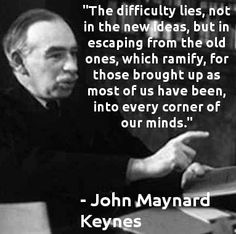
Last year, when commenter Allen nominated John Maynard Keynes for the highest (dis)honor known to man, the Higgy judges expressed skepticism on grounds that politicians corruptly manipulate the economy with or without the convenient excuses provided by Keynesianism. However, the judges reserved final judgment on Keynes’ Higgyworthiness because a full case had not been made.

I hereby offer a full case, on three grounds:

  1. Corrupt political manipulation of the economy has been greatly increased as a direct result of Keynes’ influence.
  2. Keynes did far, far worse things than simply give politicians a convenient excuse to corruptly manipulate the economy. 
  3. On both the above counts, Keynes not only worsened the world, but also met the more specific Higgy qualification of having “arrogant delusions” that “self-righteous proclamations” improve the world. 

Point One: As Paul Johnson documents in Modern Times, in the first half of the 20th century there was an unprecedented shift in the politics of corrupt collaboration between political and business elites. Previously, such collaboration occurred episodically, when some serious crisis arose and it could be justified as an “emergency measure.” Hence the big expansions of corrupt government manipulation of the economy occur in tandem with wars, depressions, and financial panics. After each crisis passed, however, pressure would mount to roll back these manipulations and restore the natural order. These rollbacks were never 100% successful, of couse, but in most cases far more than 50% or even 75% successful. Consider Coolidge’s rollback of Wilson’s autocratic WWI measures. 

But after WWII, everything is different. We have entered a whole new world. Corrupt government manipulation of the economy is now normalized. It is universally expected that political and business elites will get together in smoke-filled rooms and determine our fate for us. This is simply the way we live now. True, the more extreme wartime measures like rationing were recinded, and without the war as a justification the further growth of political control of the economy was greatly slowed. But, however slowly, that growth did continue. The political ground had permanently moved. The old world of merely episodic corrupt manipulation was gone; a new world of permanent, normalized corrupt manipulation had arrived.

This was almost 100% attributable to Keynes, for reasons that will become clear in Point Two.

Point Two: To understand the significance of Keynes, it is necessary to set aside our immediate policy concerns (fighting over the latest stimulus package or “economic plan”) and appreciate his role as a world-historical figure of the first rank. He revolutionized the entire discipline of economics, and by doing so, had a dramatic impact on the social order as a whole.

From classical Greco-Roman philosophy through the Patristic Era, the Middle Ages, early modernity and the Enlightenment, the study of economic phenomena was a subset of moral philosophy. It was always grounded in moral assumptions about human nature. Plato, Aristotle, Augustine, Aquinas, the Salamanca School, the Reformers, Locke, the Physiocrats and Adam Smith, though they had different moral views in some important respects, were agreed that the purpose of studying economics was to help align economic activity with virtue and right purposes – encouraging productive, thrifty, efficient, flourishing behavior, often with a particular interest in extending opportunity to the poor; and opposing greed, sloth, irresponsibility and (above all) injustice. The professional scholar of economics was par excellence the opponent of corruption and abuse of power. 

Over the course of the 19th century, however, this was changing. Especially in England, prominent economists increasingly expressed a desire to get out of the ethics business and abandon the fight against corruption. They wanted to do something that is impossible, and would be irresponsible if it were possible – to describe the world without evaluating it, to be morally neutral, to refrain from calling injustice unjust without being implicated as its accomplices.

Try as they might, however, these would-be neutral technicians could not find a way to extract themselves from the ethics business. A century of efforts to invent a paradigm of economics not beholden to morality bore no fruit.

And then came John Maynard Keynes, and the Keynesian Revolution.

Where before economists had defined the purpose of their discipline as encouraging the ethical production of wealth and well-being, Keynes taught them their purpose was to help people gratify their immediate desires – whatever those happened to be. Where before economists took self-sufficiency (producing more than you consume) as normative, Keynes taught them “the paradox of thrift” and trained them to despise the old rule that households and nations must live within their means. Where before economists took it for granted that our goal was to leave the world better than we found it, Keynes taught them that “in the long run we’re all dead” so we don’t need to worry what kind of world we leave to our grandchildren.

And where before economists thought their policy recommendations were constrained by the limits of justice, which compelled us to be concerned about the problem of corruption, Keynes taught them to treat human beings as merely irrational animals – bundles of appetites – without a transcendent dignity that needed to be respected.

Point Three: At this point you might be tempted to say Keynes isn’t Higgy material in light of the Sarnoff Codicil, which holds that the Higgy should not go to those who intend to make the world worse and succeed. It should go to those who intend to improve the world and fail – or, more specifically, to those who have “arrogant delusions” that “self-righteous proclamations” improve the world.

But Keynes passes this test with flying colors. He intended to improve the world – he had a detailed and well worked out philosophy of utilitarian materialism, and believed he was replacing the reign of superstition and barbarism with a new era of beautiful technocratic progress. He was a constant, nonstop fount of self-righteous proclamations. And all his asperations failed. The new, post-Keynes economics does not work as empirical science. It does not work as a practical guide to policy, either. And it has created sociological conditions that will, in the long run, destroy it. Keynesianism today is in the same state as Marxism in the Soviet Union in about the 1970s or so; it is a politically convenient god to whom all must still bow, but longstanding suppressed doubts about the god’s power to deliver the goods have hardened into permanent cynicism. The downfall may still be 20 years away, but it is coming.

John Maynard Keynes richly deserves the Higgy.

Image HT