Vaclav Havel, Hero of Freedom

December 19, 2011

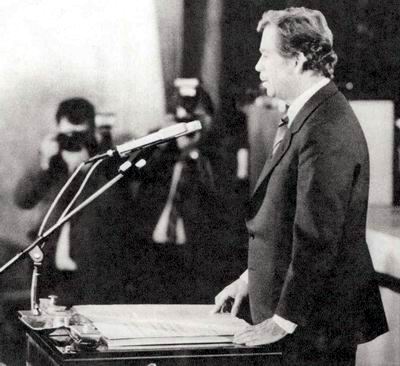
Sworn in as president of Czechoslovakia

(Guest post by Greg Forster)

It’s a busy couple days for death posts. Vaclav Havel is dead at 75.

I’ve already written my tribute to this hero of freedom – and what education reformers can learn from him – here.

If you want a great laugh and also a poinient deconstruction of the absurdity of trying to rule people by force, do yourself a huge favor and read The Memorandum. (Bonus: It’s short!)

Update: A few more links here.


Choice Is Not Chaos

December 14, 2011

(Guest post by Greg Forster)

Commenters on Jay’s outstanding post seem to be under the impression that the only alternative to national standards is chaos. If the national government doesn’t impose standards, there will be no standards at all. I think this is really what lies behind a lot of people’s support for that policy.

But, as we’ve discussed at some length here on JPGB, there are two ways to create order. One is to impose an order by raw power. The other is to allow people to organize their own orders around what they think works best (within just boundaries – your order isn’t allowed to include killing me, for example). Some forms of order need to be imposed – theives need to be locked up, not permitted to construct an alternative theiving order.

But content standards ought to follow the choice model. Currently, schools can’t create any kind of order or standards because they have to accomodate a great number of contituencies who don’t choose to be there. If every school were a school of choice, each school would have not only the freedom, but also the social support, to organize around a clear standard and impose it in every classroom. All the constituencies would be aligned.

Different schools would select different standards, of course. But that is not chaos. That is what ordered freedom looks like. The pretense that there is one clearly correct best approach to education, such that any deviation is illegitimate, looks a lot like religious fundamentalism – and that’s because it is religious fundamentalism. And it has the same dangerous tendency toward political authoriarianism that religious fundamentalism often creates.

To revisit an old post:

People need to be persuaded to adopt reform as part of their truth – something they experience as legitimate, necessary, and empowering.

“But wait!” I hear you cry. “That’s what we’ve been trying for decades, and it hasn’t worked!”

That’s right, so let’s ask why it hasn’t worked. I mean, isn’t it a little odd that 1) the system is so overwhelmingly dysfunctional that it’s destroying millions of children’s lives, 2) the people in the system are normal people, not psychotic or anything, people who by all accounts care about children’s education at least as much as the average person if not, you know, a lot more, and yet 3) the people in the system can’t be brought by any means to see reform as necessary?

What is it about the system as currently constituted that ensures reform is never embraced as something legitimate, necessary and empowering?

The system is moribund because it is a monopoly. When any institution has a captive client base, support for innovation vanishes. Reform requires people and institutions to do uncomfortable new things. Thus it won’t happen unless people are even more uncomfortable with the status quo than they are with change. So we need institutional structures that make the need for change seem plausible and legitimate. A captive client base ensures that such structures never emerge. An urgent need for change never seems really plausibile. An institution with captive clients can – or at least it will always feel like it can – continue to function, more or less as it always has, indefinitely. So why change, when change is uncomfortable, even painful?

This is why even small reforms that seem like they would be easy to implement have consistently failed to scale, and the attempt to impose such reforms through national command structures will fail even more spectacularly. Institutional culture in the existing system is hostile not just to this or that reform, but to reform as such, because it excludes the only institutional basis for making the need for change seem plausible and legitimate: the prospect of losing the client base.

This is what school choice advocates are talking about when they talk about the value of competition. “Competition” does not mean a cutthroat, ethics-free environment where individuals and institutions seek their own good at the expense of the good of others. Rather, competition is the life-giving force that drives institutions to become their best and continuously innovate, because it is the only way to hold institutions accountable for performance in a way that is both productive (because it aligns the measurement of institutional performance with people’s needs) and humane (because it creates accountability in a decentralized way rather than through a command-and-control power structure)…

This is the most important reason school choice has consistently improved educational outcomes for both the students who use it and for students in public schools. Studies of school choice programs consistently find that students using choice have better outcomes, and also that public schools improve in response to the presence of school choice. The explanation is simple: school choice puts parents back in charge of education, freeing the captive client base and creating an institutional environment in schools that makes the need for change seem plausible and legitimate.

Educators experience the urgency of the need for change when families not being served can leave for other schools – and they will never experience it any other way. Discomfort with change is also reduced for parents, because school choice restores their control over their children’s education.

HT People vs State


True to Her Traditions – At Last

November 11, 2011

(Guest post by Greg Forster)

On Veterans Day two years ago I posted a sharp condemnation of my grad school for its contempt of the military, even in defiance of its own traditions. In the comments, I made a promise that I would be prepared to post something more cheerful for Veterans Day “when the Ivies quit spitting on the people who fight and die to preserve their right to spit on them.”

Yale is bringing back ROTC, along with Harvard and Columbia. Princeton refuses to budge. Brown is still considering its position. Cornell, Dartmouth and Penn had already brought it back before this year.

I’m not sure at what point my stated obligation to “post warm fuzzies about mom and apple pie” kicks in, and I’ll admit that I don’t think the series of events leading up to these developments generally augers well for civil/military relations. But that war is over and now is a time for reconciliation. Six of the eight Ivies now offer military training within their for-credit educational curricula. That is progress.


Vouchers and Low-Income: Reality Check

November 10, 2011

(Guest post by Greg Forster)

Have school vouchers moved away from their historic focus on low-income students? The political hacks at the Center on Education Policy think so. And as we know, whenever CEP weighs in, that’s reason enough to check the facts.

Paul DiPerna of the Friedman Foundation did a headcount and found that as of now:

  • 11 of 17 existing voucher programs have no income limits
  • 7 of these are statewide special-needs programs (FL, GA, LA, OHx2, OK & UT), 3 have geographic caps (ME, VT & OH) and one has a numeric cap (CO)
  • Of the 6 programs with income limits, 5 have limits that are above 200% of the poverty line

What do you know? CEP is right!

Of course, other kinds of limitations can be equally problematic. If our goal is to create a thriving marketplace of innovative options, the key is to provide enough students with enough choice to support new entrants – educational entrepreneurs – so we get beyond just moving kids from existing public schools to existing private schools. We don’t really have any existing programs that do that.

On the other hand, even among poorly designed programs there are better and worse forms. The income limitation was worse for educational entrepreneurship than, say, a straight numeric cap or a straight geographic limitaiton. As Milton always said, show me a program for the poor and I’ll show you a poor program. The hard reality is that lower-income people are not the population that throws its support behind truly innovative ventures. They have too much at risk. It’s the well-off, educated parents who are most likely to feel secure trying newer or more specialized schools. (Programs like EdChoice that are not “straight” geographic limitations but shift eligibility areas from year to year based on public school performance are another matter – they’re hugely problematic from this standpoint.)

The quickest way to unlock educational innovation and deliver better education to low-income students is to give vouchers to everyone. That way the innovations will, you know, actually happen.

Since I know you’re wondering, here are the tax-credit scholarship numbers for comparison purposes:

  • 3 of 10 tax-credit scholarship programs have no income limits
  • One of the three (AZ) is a statewide special-needs program
  • 6 of the 7 programs with limits have limits that are above 200% of the poverty line

The End of the Beginning

October 14, 2011

(Guest post by Greg Forster)

The new School Choice Advocate just arrived, and it contains a short interview with Janet Friedman Martel and David Friedman – Milton and Rose’s children.

I thought this was especially well put:

We’ve seen uprecedented strides forward in school choice this year. How does the progress of this year measure up against Milton and Rose Friedman’s vision?

We are still short of the vision of a school system where private schools compete on equal terms with public schools. Measured by the fraction of students with access to vouchers, our achievement is still small. But measured by the rate at which that number is increasing, it has been large. As Churchill put it, this is not the beginning of the end, but it might be the end of the beginning.


Nominated for the Al Copeland Award: Charles Montesquieu

October 5, 2011

(Guest post by Greg Forster)

As of last month, it is illegal in the state of Wisconsin to go out to your own barn, milk your own cows, and then drink the milk.

Yes, you read that right. The case arises out of the ongoing controversy here in Wisconsin over unpasteurized or “raw” milk. Some people prefer to drink milk unpasteurized for various reasons – for some it’s a taste preference, for others it’s an “organic health” thing, for others it’s just a longstanding tradition of farm life. Personally, I’ve never tried it and don’t care to, but if it comes down to a choice between the foodies, hippies and agrarians on the one hand, and the Heath and Safety Narcs who want unlimited political control of all aspects of human life on the other – well, sign me up with the hippies. (Yes, Matt, you can link back to this post any time you want.)

Last year, when the tumultuous governorship of Scott Walker was still just a twinkle in the electorate’s eyes, we had a huge nuclear war up here over raw milk. I mean, this was the big controversy of the year last year here in dairy country. (Which is why you don’t normally read about what’s going on in state politics in other states. Back when I lived in Indiana, one year the biggest controversy of the year was over switching the state to daylight savings time. No kidding, it was Ragnarok down there.)

Last year they left it that you’re not allowed to sell raw milk. But the raw milk crowd inexplicably failed to submit to the Dictatorship of Health and Safety, and found numerous ways of continuing to exchange raw milk for economic goods. In some cases, you could come do an hour of farm work and get paid in raw milk. In others, farmers would leave raw milk and a locked box with a slot in the top out in the barn; periodically they’d check and find out that all the raw milk had been stolen, and in a totally unrelated development, people had left money in the box. (Perhaps they’d read Matt’s post about this fellow.)

So now, apparently, between one thing and another, we have a judge ruling that consumption of raw milk is illegal.

Worse, the judge has apparently percieved clearly that this opinion implies you have no right to own anything,  and feels perfectly comfortable about it. That this policy, if it were consistently upheld (we will see what happens next) does not merely lead us toward, but directly establishes, unlimited political control over all aspects of human life is apparently no barrier.

“No, Plaintiffs do not have a fundamental right to own and use a dairy cow or a dairy herd,” he thunders in his decision. “No, Plaintiffs do not have a fundamental right to produce and consume the foods of their choice.”

Admirably clear, that!

In response, I nominate Charles-Louis de Secondat, baron de La Brède et de Montesquieu, for the Al Copeland Humanitarian of the Year Award. Montesquieu’s systematic collection of observations about modern government, The Spirit of the Laws, was the fruit of decades spent travelling and studying and was tremendously influential on the American Founders. If memory serves, Montesquieu is quoted more than any other source in the Federalist Papers. In fact, so authoritative was Montesquieu over the early Americans that papers 9 and 10 were composed to answer charges from the Anti-Federalists that the Constitution deviated unacceptably from Montesquieu’s views.

Many crucial innovations in what Hamilton called “the science of politics” emerged in the modern era, were systematically observed by Montesquieu, and then perfected by the Founders under Montesquieu’s influence. Representative democracy and greater rights for the accused in criminal trials were among them. Perhaps the most important was the separation of powers, an idea as old as Aristotle but one that didn’t reach maturity until the Glorious Revolution in 1688 and the U.S. Constitution a century later.

As a critical component of the emergence of this system, Montesquieu insisted that a republic cannot maintain its freedom unless judges restrain their influence as tightly as possible. The application of personal wisdom by individuals in authority, rather than clear and stable standards of public law, as a standard for settling disputes is the jurisprudential principle of monarchy. In the context of monarchy (which has other methods of restraining the willfulness of the rulers) it can be exercised in humane ways. It becomes tyrannical when exercised in a republic, where the traditional social restraints on power that prevail in monarchies have been removed, and the willingness of the rulers to rule by the law rather than their own wisdom is the only barrier to unlimited arbitrary exercise of power.

As Franklin famously observed, the Founders gave us a republic if we can keep it. It was Montesquieu who taught them how to create that republic, and if we have enjoyed the last two centuries of republican government we should be grateful to him.

Incomplete Report Is Incomplete

September 12, 2011

Education reform, like highway. Man walk left side of street, okay. Man walk right side of street, okay. Man walk middle of street . . . chhhhhheeerrrrrriiiik! Just like grape.

(Guest post by Greg Forster)

A think tank called Third Way has a new report out, titled “Incomplete,” on the mediocrity of middle class schools. And with a name like Third Way, you know it has to be good!

On the surface, the point of the report is to emphasize that we don’t just have an education crisis in “the inner city” (i.e. in somebody eles’s neighborhood); we have an education crisis in “middle class” schools.

And that’s true! Part of me wants to be positive about this report and say, “okay, people are starting to get that this isn’t just about the 10% of kids in the worst schools.” After all, we’ve always said around here that we won’t get the education reforms we need until white suburbanites see how inadequate their own schools are.

But this report frames everything all wrong. Here are the three “key findings” they list:

  1. Most students are taught in middle class schools (duh)
  2. Middle class schools spend the least per pupil, pay teachers the least, and have the highest enrollment to teacher ratios.
  3. Middle class students are underachieving in test scores and college graduation rates.

The report offers no action items and no conclusions of substance beyond “a second phase of education reform focused on middle-class schools can’t begin soon enough.”

Right! Because the assumption that we don’t need to think about the policy specifics since everything is about mo’ money, mo’ money, mo’ money worked so well in the first phase of education reform!

Normally I wouln’t bother highlighting yet another blob mouthpiece hawking the mo-money line, but I wonder if this is going to be a new trend. A focus on the black/white, urban/suburban achievement gap doesn’t translate to mo-money for them any more, because they’ve gotten mo-money for that for decades and have squat to show for it. Is the mo-money line going to start migrating to other issues now?

Perhpas they’ve discovered a perpetual motion machine. You spend decades complaining that we need to increase spending in the inner city because we spend less there than in the suburbs, then once you can’t say we spend less in the inner city any more, you start saying we need to increase spending in the suburbs – because, of course, we spend less there than in the inner city! Rinse and repeat in perpetuity.


Just Kidding! (Wink, Wink)

August 22, 2011

(Guest post by Greg Forster)

Duncan now triple-dog swears that you don’t have to sign up for Common Core to get a waiver . . .

. . . as long as you can “prove” you have “high standards,” as defined by Duncan.

http://blogs.edweek.org/edweek/campaign-k-12/2011/08/duncan_states_dont_need_to_joi.html

Wow, I never thought of that! Just think how much change we could effect with that method! And why let the government have all the fun? Anyone can play thus game – I hereby personally offer a million dollars cash to any school that can prove it has high standards, as defined by me.

In other news, the Legitimate Businessmen’s Neighborhood Business Protection Program hinted privately that I’d better join or my legs would be broken, but when the police asked them about it in public they said it was all a big misunderstanding. So I guess that proves they’re innocent! After all, what other possible explanation could there be?

More to the point: do you think people will stop fearing them now? A leak followed by a disavowal is a great way to intimidate people into doing what you want without getting called on it.

Like I said last week, now that the self-appointed champions of high standards have foolishly chosen to start a war over nationalization, this won’t really be over until that war has been fought to a clear conclusion. Way to go, guys!


Big Shock! Nationalization Sparks Culture War

August 19, 2011

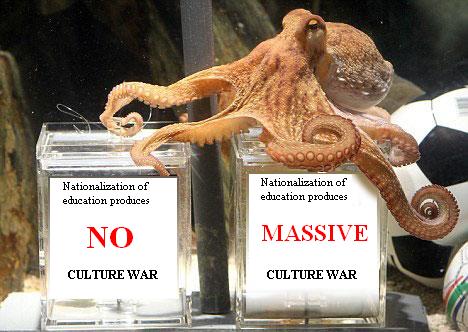
Paul the psychic octopus sez: “Toldja so!”

(Guest post by Greg Forster)

With the shooting war that’s emerging betweeen Arne Duncan and Rick Perry over national control of education, some of the people who helped facilitate the movement toward nationalization are now saddened to see that creating a giant lever in DC that has the power to impact every school in the nation leads directly to a vicious, snarling political war over education policy, such that education can’t be discussed and debated dispassionately because culturally aliented partisans who don’t trust each other are all too busy trying to be the first person to seize the lever.

Surely no one could have predicted this unforeseeable outcome! Oh, wait.

National control over curriculum creates a single lever you can pull to move every school in America. Would conservatives trust progressives, and would progressives trust conservatives, not to try to seize control of that lever to inculcate their religious and moral views among the nation’s youth? And if you don’t trust the other side not to try to seize the lever, is there any reasonable alternative to trying to seize it first?

And this would not be just a single conflict that would happen and then be over. Like the Golden Apple or the One Ring, national curriculum and testing will continuously generate fresh hostility and cultural warfare as long as they exist. And once you forge this ring, there’s no Mount Doom to drop it into.

See also. Plus Neal here. Not to mention Neal’s eternal platonic beauty queens.

The whole idea of “high standards” is now irreversibly associated with nationalization. Now that the standards people – most of them, anyway – have been foolish enough to start it, this war over nationalization is going to have to be fought to its conclusion before we can circle back and talk about “high standards” in any other context.


Carr Makes It 19-0

August 17, 2011

This finding’s been replicated more often than Picard’s Earl Grey.

(Guest post by Greg Forster)

Still clearing the backlog: I haven’t had a chance yet to tout this new empirical study of Ohio’s EdChoice voucher program, by my old colleague Matt Carr, finding that – guess what, you’ll never believe this – vouchers improve outcomes at public schools!

Building on a large body of previous studies, this makes it nineteen (19) high-quality empirical studies finding school choice improves public schools and zero (0) studies finding it harms public schools.

Interestingly, Carr finds the positive impact is concentrated among the highest and lowest performing students. Since EdChoice is a failing schools voucher, you might expect schools to respond by improving service to those “bubble” students who are near the state proficiency cutoff. However, Carr finds the opposite.

Matt hypothesizes – plausibly enough – that schools are responding by improving services to the students who are most likely to use the voucher to leave. Low-performing students have the most obvious motivation to seek better services, while high-performing students are the most likely to have actively involved parents.

I do have one quibble with the study. Matt writes that his study “provides an analysis of a voucher program that has not yet been rigorously studied for its competitive effects on traditional public schools.”

Oh, really?