Raising the Bar on the Forster-Mathews Bet

April 1, 2015

(Guest Post by Matthew Ladner)

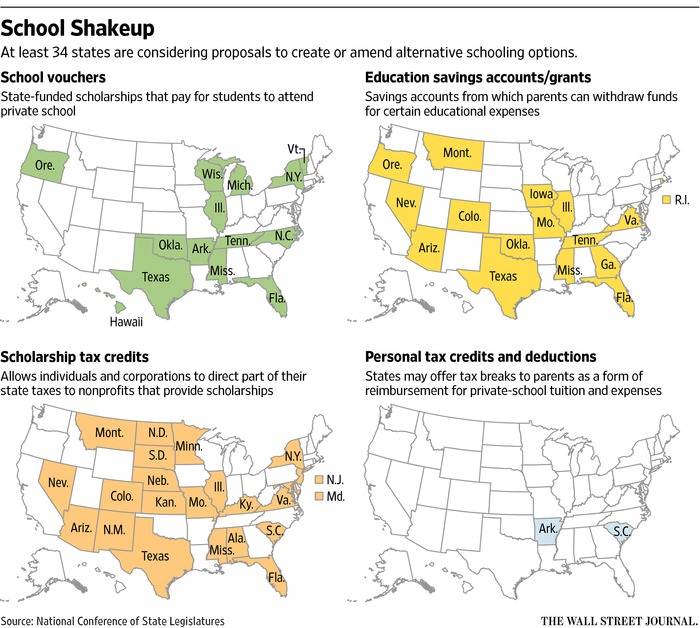
Thus far I am aware of a tax-credit improvements in Alabama and Arizona, new special education scholarship programs in Arkansas and Mississippi, and many other measures pending in many other states. I think it is safe to say that Greg will once again defeat Jay Mathews in the over/under of 7 enactments.
WSJ choice


While we celebrate yet another Greg victory, it may be a good time to pose a different question for ourselves: how many states have enacted a choice program or a combination of choice programs sufficiently robust to see a growth in private education in the face of a strong charter school law? A Rand Corp study found private schools will lose one student for every three gained by charter schools in Michigan.  We would not expect to find an exact match for this nationwide, but charter schools do by definition draw upon the universe of would-be choosers: parents who are looking for alternatives outside of their zoned district school. It makes sense that they would have a larger impact on private education.

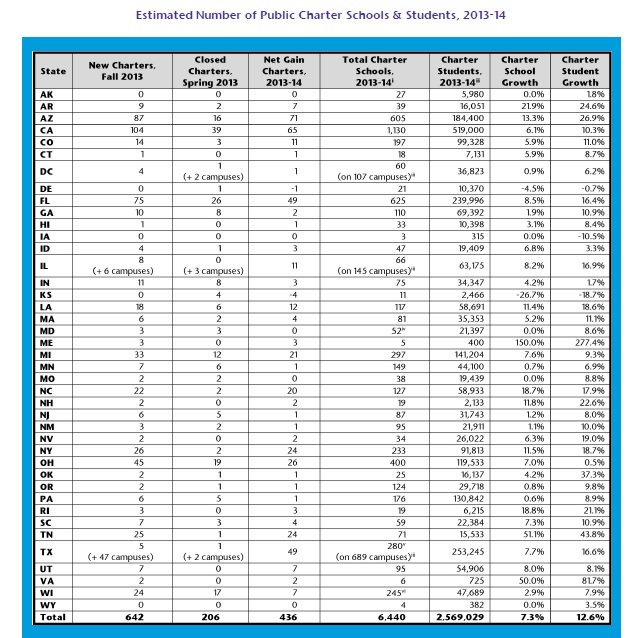
If we assume the Michigan finding to be roughly equivalent to a national average, then we can proceed to check the tape. First charter school enrollment by state:
Charters school enrollment

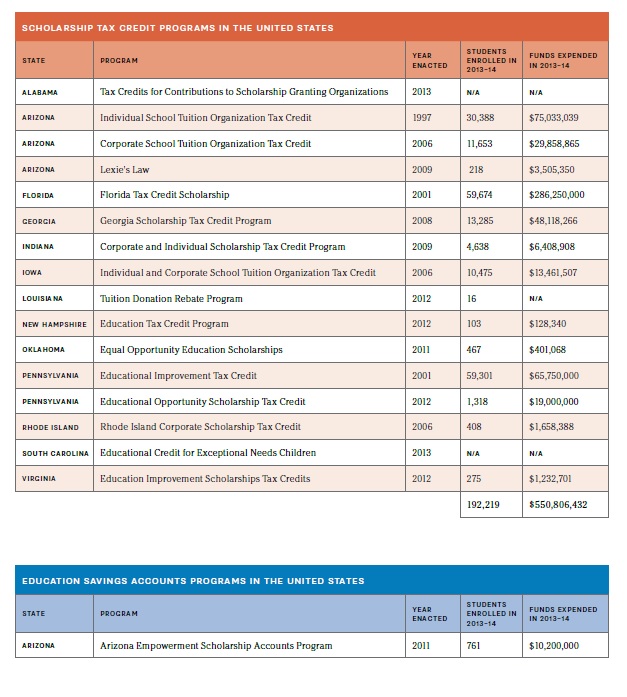
Next private choice program enrollment by state (from the Alliance for School Choice Yearbook):
Private choice students 1


And…

Private choice students 2

So how many states have one-third or more as many private choice students as charter school students? Indiana is matching private choice students with charter school students despite a strong charter law thus far, and so is the leader in the clubhouse. Florida barely met the 1 private choice for 3 charter school students standard between the combination of the corporate tax credit program and the McKay Scholarship program. Without new revenue sources however growth in the Florida tax credit will stall in the next few years even as statewide student growth continues. Moreover Florida charter schools have almost certainly drawn a relatively advantaged group of students from private schools (charter schools have universal eligibility). The private choice programs have been aiding only low-income and children with disabilities and providing significantly fewer resources than those students receive in public schools (smaller tax credit scholarships in the case of low-income children, no local top-up funds in the case of McKay students).

Florida lawmakers have been busy improving the ability for high quality charter operators to open new schools (as they should) but balked last year at providing new tax credit revenue sources. Absent some large policy changes Florida will soon slip below the 1 to 3 ratio.

Iowa met the standard because of a healthy and growing tax credit program and a weak charter school law (3 total schools), so give them an *. Wisconsin meets the bar with the combination of private choice programs and a charter school program that (last I heard) is still bottled up in Milwaukee, so kind of an * too.

The Illinois and PA programs would require some sort of estimate regarding the price elasticity of demand for private schooling, but I’ll just heroically guess that charter schools have the better end of the deal in those states. Arizona and Ohio have more than three charter students for every private choice student. Other states like California, Michigan, New York and Texas seem content to watch their charter school sector batter their private school sectors into gravel.

Bear in mind that this comparison would look even more lopsided if we counted dollars rather than students. For instance the average tax credit scholarship in Arizona runs around $2,000 while the average charter school receives around $7,000 per pupil. Very few of the private choice programs come near to matching the per pupil level of subsidy provided to charter, much less district schools. Emblematic of this failure was the choice of 12 Catholic schools in Washington D.C. to give up the ghost and convert to charter schools after a (poorly designed) voucher bill had passed.

The goal of the private choice movement should not be to preserve a preexisting stock of private schools per se, but rather to allow parental demand to drive the supply of school seats. Those District of Columbia Catholic schools did not convert to charters because the parents were clamoring for it, but rather because the Congress had offered almost twice as much money per pupil to do it. States like Texas invest hundreds of millions of dollars per year into a charter sector that draws disproportionately from private schools while providing parents who would prefer a private education for their child nothing but the prospect of struggling to pay their school taxes and private school costs simultaneously.

Seen in this context, many private choice victories seem worthy but incremental. Incremental change is the equilibrium point of American politics, but the choice movement needs more Indiana style successes. Once more unto the breach dear friends…


Arkansas About to be 25th State with Private School Choice

April 1, 2015

After passing the Arkansas House with a 90 to 0 vote, the state’s Senate approved HB 1552 offering vouchers to students with disabilities to attend a private school of their choice.  Governor Hutchinson is expected to sign the bill into law, making Arkansas the 25th state to offer private school choice.

Just think… We will soon have more states offering private school choice than participating in Common Core assessments.

You can find an excellent summary of the bill and its provisions by Leslie Hiner on the Friedman Foundation web site.


AZ ESA applications close tomorrow

March 31, 2015

ESA

(Guest Post by Matthew Ladner)

The ESA application period for next year ends tomorrow in Arizona. Nice problem to have (image from the AZ Department of Education ESA page). H/T Kim Martinez, American Federation for Children.


The New School Choice

March 31, 2015

schoolchoiceweek

(Guest Post by Greg Forster)

The new issue of OCPA’s Perspective carries my article on how more recent school choice programs are moving us slowly but surely closer to universal school choice:

The huge wave of new school choice programs enacted in 2011-13 went far beyond earlier programs in expanding student eligibility pools, providing larger vouchers, and reducing unnecessary regulations on participating schools. Education savings accounts, probably the best program design yet devised, have been enacted in Arizona and Florida; as I write, new programs have just been approved by legislative chambers in Virginia and Mississippi. These programs, while still limited in eligibility, give parents much more control over education dollars than traditional school choice.

I argue there are both educational and civic reasons to embrace universal choice:

Two of the great pillars of our country are equal rights and freedom for diverse beliefs. Neither of these pillars is consistent with a government school monopoly, nor with the educational oligopoly of limited school choice.

A monopoly or oligopoly exists by stamping out the rights of challengers in order to protect the privileges of the powerful. When educational entrepreneurs are denied the right to start new schools on equal terms with dominant providers, all of us lose. A society where the education of children is controlled by the few is a society that doesn’t respect equal rights.

And the education of our children is at the very heart of how we all live out our most central beliefs about life and the universe. Our country can never fully live up to its commitment to freedom for diversity until we undo the monopolization of education. Part of the reason we created the government school monopoly in the 19th century was bigotry and a childish fear of religious diversity. It’s long past time we, as a nation, grew up. Let’s leave those fears behind us, in the nursery of our national history.


The Death of the Think Tank, R.I.P.

March 28, 2015

Image result for russ whitehurst brookings

The recent firing of Russ Whitehurst as head of the education unit at Brookings marks the demise of the think tank.  Russ is an experimental psychologist who became the founding director of the Institute for Education Sciences in the US Department of Education.  In that role he championed the use of randomized controlled trials (RCTs) to study the effectiveness of educational policies and interventions, which was a huge improvement in rigor for US ED-funded projects.  He then took that rigor to Brookings, where he and his colleagues conducted policy-relevant and rapid research that met high standards of social science.

But Brookings and most other think tanks have lost interest in rigorous social science.  There is relatively little thinking at think tanks these days.  Instead, they have chosen to focus almost exclusively on advocacy efforts, not realizing that effective advocacy requires generating new, high-quality information.  Without rigorous research, think tanks just repeat talking points, trying to be more clever in their phrasing and more persistent in their communication so they can be heard above the din of everyone else doing the same.

It’s a losing strategy, at least for education reformers.  The unions and their allies also know how to  repeat talking points endlessly.  And they have the resources and the numbers to drown out reformers.  Reformers have delusions of influence because of the thousands of followers they have on Twitter and the number of hits to their web sites, failing to realize how much bigger the likes of Diane Ravitch and her Army of Angry Teachers are in social media.  In their insular little world, think tank based education reformers are Kings of the Lilliputians.

The only way to beat the larger and better-resourced education establishment is with superior information.  Reasonable but uncommitted policymakers and influential elites have their doubts about the education status quo, but they are unsure about what the nature of the problems are or how to fix them.  The unions and their allies have explanations.  Schools are plagued by insufficient resources and the social problems of poverty, they say.  The solutions they offer are increased spending and broader, bolder social services in schools as the best way to improve education.  If reformers have different descriptions of the problems and want to offer alternative solutions, they need quality evidence to persuade reasonable but undecided policy elites.  Reformers can’t out-talk or out-spin the ed establishment.  They have to out-think them and that requires rigorous research.

Unfortunately, foundations and other donors are driving the shift in think tanks away from research.  In a recent analysis I did for a forthcoming book on education and philanthropy, I found that the largest 15 education foundations devote only 5.9% of their giving to support research, some of which is actually advocacy disguised as phony research.  These foundations spend nearly 5 times as much on activities that are undisguised advocacy efforts.  And most of this small amount for research funding is going to universities, so the ratio of support for research relative to advocacy at think tanks is completely out of whack.

I understand the need for people who are effective communicators to translate and summarize research for a policy audience.  But when funding for advocacy exceeds rigorous research by more than 5 to 1, there won’t be enough research for all of those communicators to translate and summarize.  They’ll just endlessly spout unsupported blather, which is what many of them are now doing.  And they are doing this because that’s what the donors and foundations have chosen to fund.

Foundations need to restore a balance between supporting quality research and advocacy if they wish to succeed in improving the education system.  They can do this by increasing support for research done at universities.  Many of the factors that drove foundations to support research at think tanks instead of universities have disappeared.  Academics were once too slow in producing work and tended to shun policy relevant topics.  No more.  It is now common and rewarded practice for professors to address current issues and release working papers with results quickly.   And the ideological stranglehold that hindered honest examination of reform efforts has also loosened significantly.  If think tanks are really dead, then long live research at universities… but only if the foundations devote more funding to it.

Perhaps think tanks are only mostly dead.  There are pockets of individuals in think tanks who still do quality empirical work.  If foundations decide to support more of their work and push think tanks to hire more of them (and not fire quality researchers like Russ Whitehurst), perhaps the currently brain-dead think tank can be brought back to life.

The future of quality education research rests in the hands of program officers and trustees at the leading foundations.  Government funding for research is shrinking and is increasingly politicized.  If we want to see more rigorous research and less Twitter drivel, foundations will need to change their funding priorities.


Breakfast of Champions in the Texas Legislature Cafeteria!

March 27, 2015

Nerd Focus

(Guest Post by Matthew Ladner)

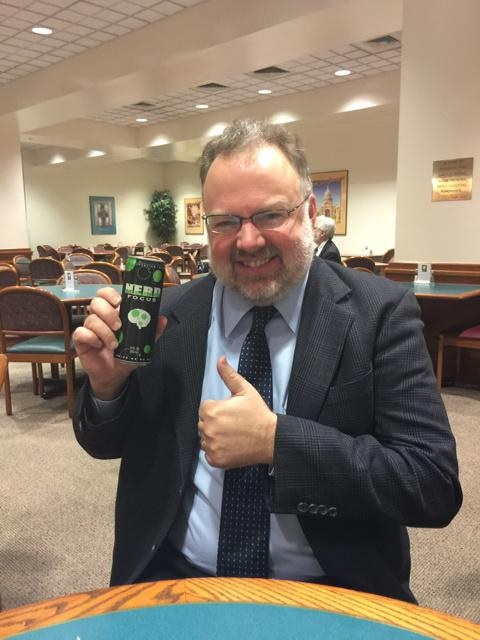
The cafeteria in the Texas Legislature is the only source I know of for NERD FOCUS…the most powerful energy drink on the planet. It’s a good thing they have it, because I needed it during a two hour panel testimony in the Senate Education Committee. Bonus chart from the WSJ on the school choice action:

WSJ choice


Mississippi Legislature Passes Account Based Choice Program for Special Needs Students

March 26, 2015

(Guest Post by Matthew Ladner)

The Mississippi Senate concurred with the House special needs ESA bill today, sending the measure to the Governor, who is a strong supporter. Mississippi thus becomes the nation’s third state with an account based parental choice program. Special congratulations to the bill sponsors and tireless supporters for a successful two-year struggle, the Mississippi Center for Public Policy, Empower Mississippi and especially the parents who fought so hard for this legislation. Awesome team effort that paid off in the end.

!!BOOOOOOOOOOOOOOOM!!

Also today a special needs voucher  bill passed the Arkansas house 90-0.


UT Austin Admissions Scandal

March 26, 2015

The storm of a scandal at the University of Texas at Austin has reached gale force winds. Two internal investigations and reporting by Texas media have revealed that the leadership of the university regularly intervened in the admissions process to ensure the acceptance of unqualified applicants connected to politically powerful figures in the state.  University officials also attempted to mislead investigators to conceal or mis-describe their activities.  And Wallace Hall, a trustee who tried to bring these corrupt practices to light, was threatened for his efforts with criminal indictment by a grand jury and impeachment by state legislators, some of whom were the beneficiaries of preferential admissions.

Charles Miller, a former Chairman of the Board of Regents of the University of Texas Systsem, sent the following letter to the current Regents, Chancellor, and a Review Committee.  I re-print it here with his permission.

—————————————————

To: Committee to Review Admissions Practices at UT Austin

From: Charles Miller, Former Chairman, UT System Board of Regents

This memo is an attempt to offer an independent and informed opinion about the direction of admissions policy at the University of Texas at Austin.

It is patently clear that there should be a strong firewall in the admission function between the office of the president and the operation of the admissions office once broad policies are set in an open and publicly transparent process.

The firewall is not only a sound administrative structure but allows an admissions policy to be implemented with a minimal likelihood of improper influence and with a high degree of public confidence and trust.

There can be no ignoring the fact that the level of confidence and trust in admissions at UT Austin has not only been badly damaged by the recent admissions practices of the Powers administration but by the repeated efforts necessary to uncover what seems to have been going on in admissions. As the Dallas Morning News characterizes it: “Those questionable situations include the admissions scandal that led to Powers planned resignation”

What was going on? Specially tagged candidates based on interventions from ‘powerful’ people; special lists developed by the president outside of any of the official procedures; active and forceful intervention by the president and his staff in admissions decisions; destruction of admissions records; legal and public descriptions of the admissions process which were knowingly incomplete and inaccurate; and the admission of students —some severely unqualified— for purposes of gaining some sort of favor from a special class of privileged people.

The strong resistance from public policy makers and so-called supporters of UT Austin to uncovering what was happening protected an administration engaged in willful misconduct and can only have worsened the public’s perception of a great university.

Considering the practices uncovered [i]t’s difficult to understand why these officials and alums were so loud and derisive to the people trying to uncover the improprieties and why they were so vociferous in their demands for a narrow investigation. That implies it’s not yet clear that everything has surfaced that needs to become public.

Even now, as serious new legal issues are being raised in federal courts and new attempts are being made in the Texas Legislature to limit proper inquiry by regents doing their fiduciary duties, there has still been no one held accountable.

In the federal courts, these improper admissions activities will bring sustained attention, in a negative way, to UT Austin. And it will also bring continued attention to the U.T. System until there is personal accountability attached to these actions.

The leaders of the UT System seem to hope the fallout from these improper activities will go away if they just ignore what transpired. Surprisingly there has been no official response from the Board of Regents regarding the two highly negative reports resulting from investigations by Kroll Associates and the Texas Attorney General.  The UT System administration has not even taken a public position challenging the rationale for this improper admissions behavior which is tantamount to approving of it.

What was the rationale presented for this behavior? ‘Everybody does it.’ ‘There were only a small number of cases.’ ‘It was done only for the long term benefit of the university.’ ‘Only the president is able to make these judgments and these decisions.’

On the face, these are ludicrous arguments, so defensive in nature as to constitute an admission of bad practices.

However, these unanswered excuses create serious issues for designing an appropriate admissions structure and the committee must offer policy proposals which respond strongly to these defenses.

Most serious, the claim that ‘everybody does it’ besmirches the integrity and dedication to duty of the entire academic community. It’s simply a monumental falsehood and deserves the sharpest of reprimands from the committee, the broader academic community and the U.T. System.

The number of cases was not ‘small’. Otherwise, why did they go to so much trouble to engage in these activities and why try so vigorously to conceal them?

If the numbers were so small, how can this be so important for the long term benefit of the university?

If these admissions were so important as to influence powerful parties for the long term benefit of the university, how can this not be improperly trading something of value for something else of value?

The most arrogant of the excuses is that the president is the only one who can make difficult admissions decisions. This is again patently false. For example, there are well defined processes under which the university can receive gifts, describing how those gifts can be used. These decisions are put through an onerous review process, transparent and focused on the mission of the university and maintaining its independence and integrity.

Presidents are neither omniscient nor infallible. Good structures start with those assumptions. A sound admissions process can include the president’s appointing personnel to implement policy developed by the president and the administration with the approval of the Board of Regents and with a firewall in implementation at the point at which prospective students are offered admission.

Under these challenging circumstances where there has been evidence of misconduct, it is imperative that UT Austin put in place a highly transparent system for admissions, visibly removing any possibility of the recent behavior being repeated.

Respect for this great university is continuing to be damaged. Trust can only be restored and maintained by utilizing a strong form admissions firewall and by regular, self critical oversight by the UT System.


Governor Ducey Calls for Arizona Academic Standards in State Board Address

March 23, 2015

(Guest Post by Matthew Ladner)

Consistent with his campaign position, Arizona Governor Ducey called for the creation of Math and Reading standards that are both high and unique to Arizona in a speech to the Arizona Board of Education.


Ed Reformers Fantasize They Are in House of Cards But Are Really in Veep

March 19, 2015

I was slow to warm up to House of Cards.  I’ve grown so tired of the anti-heroes presented in shows like Sopranos, Breaking Bad, and Dexter, that I couldn’t muster much enthusiasm for Frank Underwood.  Even worse, House of Cards is about politics and I study and follow politics for work, do I really need more politics in my entertainment?

But then I realized that House of Cards is not about politics at all.  It doesn’t portray how the political world really operates.  Instead, it indulges a fantasy of how some people wish the world works.  Despite the Machiavellian amorality of the main characters, House of Cards offers the fantasy that someone is actually pulling the levers of power and able to get things done.  People don’t want reporters pushed in front of trains or alcoholic Congressmen asphyxiated in their cars, but they do want to imagine that someone understands what is going on, is able to devise effective plans, and can control events.

During the first season when Frank was championing an education reform bill, I overheard several DC-EduBubble-types express admiration for how Frank Underwood managed to roll over the teachers unions and abolish tenure.  They don’t want to be Frank, but they want to imagine that’s it’s possible to accomplish what Frank can, perhaps without the icky stuff.  Since their centralized, technocratic solutions require the conviction that smart individuals can fully-grasp and control events, House of Cards shows them the world they hope exists.

The reality is that politics looks a lot more like Veep than like House of Cards.  The characters in Veep are smart, but their vanity, pettiness, and the inherent unpredictability of the world stymies their efforts to grasp or control events.  They’re silly little monkeys in power suits pretending to be in charge of the zoo.  And it’s hilarious.

Veep is far more entertaining than House of Cards, especially this 3rd season that was just released.  The 3rd season didn’t even continue to deliver on the fantasy of competence and control.  As Nick Gillespie wrote in a brilliant review in The Daily Beast:

House of Cards is going softer than President Frank Underwood’s gut…. Even more disappointing is the devolution of First Lady Claire Underwood (Robin Wright) from a ruthless operator who puts Agrippina the Younger to shame into a latter-day Lady Macbeth filled with doubts about her and her husband’s patently unredeemable actions. “We’re murderers, Francis,” she says at one point in the new season—as if that’s a bad thing.

But even at its peak, House of Cards is far less appealing than Veep.  House of Cards is to politics as porn is to romance.  There is a certain base appeal, but it is superficial and fleeting.  Veep, on the other hand, is remarkably truthful in its ridiculousness.  My belly hurts with laughter as I watch Veep — much like when I read the similarly ridiculous Twitter feeds of the EduPundits.