Looking Abroad for Hope

November 5, 2008

hope

HT despair.com. Looking for a Christmas idea to suit the new reality? Why not a despair.com gift certificate – “For the person who has everything, but still isn’t happy.”

(Guest post by Greg Forster)

Looking around for something to give me hope this morning, I find the best place to turn (for today, at least) is outside the U.S. Specifically, I turn to the recently released study in Education Next by Martin West and Ludger Woessmann finding that around the world, private school enrollment is associated with improved educational outcomes in both public and private schools, as well as lower costs.

Well-informed education wonks will say, “duh.” A large body of empirical research has long since shown, consistently, that competition improves both public school and private school outcomes here in the U.S., while lowering costs. And the U.S. has long been far, far behind the rest of the world in its largely idiosyncratic, and entirely irrational, belief that there’s somthing magical about a government school monopoly.

And private school enrollment is an imperfect proxy for competition. It’s OK to use it when it’s the best you’ve got. I’ve overseen production of some studies at the Friedman Foundation that used it this way, and I wouldn’t have done that if I didn’t think the method were acceptable. However, that said, it should be remembered that some “private schools” are more private than others. In many countries, private school curricula are controlled – sometimes almost totally so – by government. And the barriers to entry for private schools that aren’t part of a government-favored “private” school system can be extraordinary.

That said, this is yet another piece of important evidence pointing to the value of competition in education, recently affirmed (in the context of charter schools, but still) by Barack Obama. Who I understand is about to resign his Senate seat – I guess all those scandals and embarrasing Chicago machine connections the MSM kept refusing to cover finally caught up with him.


Why I Vote on Election Day

November 4, 2008


A bunch of my friends and family have voted early.  Not me.  I’m voting on election day.  Why?

Look, let’s be clear that it doesn’t make any sense to vote if your goal is to determine the outcome of the election.  The probability that the outcome would be tied in the absence of your vote is so remote as to not be worth your time bothering.  And even in the extremely unlikely event that the margin in a presidential election were 1 vote, the outcome would almost certainly be decided by a handful of unelected judges rather than your vote.  We’ve already seen that even if the margin is a few hundred votes, there is enough imprecision in the casting and counting of votes that the courts will really determine the outcome. 

I know, I know, you can say that if everyone thought that way, no one would vote.  But that’s entirely beside the point.  The self-interested rational thing to do if you are only concerned with determining the outcome is to urge everyone else to vote and save yourself the effort. 

So why vote if it is irrational to expect that your vote will be the deciding one?  Rational people don’t vote to break what they otherwise expect to be a tie.  They vote because it is part of a social, communal experience. 

And that is exactly why I am voting on election day and not early.  I want to go to the polling place, visit with my neighbors, and drink some bad coffee.  Voting is like doing the wave at a football game.  It almost certainly has no effect on the game.  It’s purpose is to participate and enjoy the social feeling of being part of something.  It makes no more sense to vote early than to do the wave while watching the game at home on your TV.  Voting, like doing the wave, is a social experience whose benefits depend upon context.

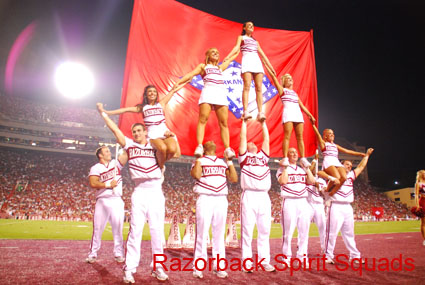
Besides, politics is becoming more like sports everyday.  People choose teams and root for them, even if there is no obvious benefit to them for doing so.  They watch the returns like looking at the boxscore.  So, I want to be at the game when I vote, just like I’m going to be at Bud Walton Arena, the basketball palace of mid-America, to watch the Razorbacks.  I want to call the Hogs with the crowd.  I want to see them raise the Arkansas flag banner behind the pyramid of cheerleaders (it brings a tear to my eye, everytime).


Two Days Later…Pain Still Raw

November 3, 2008

(Guest Post by Matthew Ladner)

The Houston Chronicle called it “one for the ages” and it is hard to disagree. The Texas Tech vs. Texas game was an instant classic- plenty of drama and late game heroics.

I’ve discovered that I like classic games better when my team wins. C’est la vie.

Tech deserves a ton of credit. Their coaches out-coached ours, and their players were lights out. Texas starts three defensive ends on the d-line (all the better to sprint through big spreads on the offensive line and crush the qb) so Tech ditched their line splits and (shocker) ran the football down our throat and controlled the clock. Golf clap for strategery!

It would be nice if the multi-million dollar Texas coaching staff would

A. Teach proper kickoff coverage technique.

B. Not call a slow developing run play from the end zone.

C. Milk as much time off the clock as possible on what is certain to be your last offensive drive.

D. Have your offensive linemen hold when the refs absolutely refuse to enforce the penalty.

E. All of the Above

If you answered “E” give yourself a gold star- not that I’m bitter or anything.

Despite all of that, Texas took the lead with 1:26 to go in the game, and came within a dropped interception and single tackle on the games final second of somehow prevailing. Congrats Raider fans- see you in Austin next year.


PJM on Candidates’ Education Flip-Flops

November 3, 2008

(Guest post by Greg Forster)

Over the weekend Pajamas Media carried my column on how Obama and Palin have flip-flopped on education:

Suppose I told you Candidate A has supported rigorous academic standards, has stood up to the teachers’ unions — even been booed by them at their convention — and proclaimed the free-market principles that schools should compete for students and better teachers should get higher salaries. On the other hand, Candidate B says that competition hurts schools, that kids should be taught a radical left-wing civics curriculum, that we should throw more money at teachers’ unions — excuse me, at schools — and that rigorous academic standards should be replaced with the unions’ old lower-the-bar favorite, “portfolio assessment.”

Candidate A is Barack Obama. So is Candidate B.

Meanwhile, Candidate C has made an alliance with the teachers’ unions, opposed school choice, thrown money at the unions — excuse me, at schools — and even helped undermine a badly needed reform of bloated union pensions. On the other hand, Candidate D has broken with the teachers’ unions, demanded that schools should have to compete for students, and endorsed the most radical federal education reform agenda ever proposed by a national candidate, including a national school choice program for all disabled students.

Candidate C is Sarah Palin. So is Candidate D.

Important disclaimer:

None of this implies anything about the overall merits of any of these candidates. One can love a candidate overall while hating his or her stand on education, and vice versa.


Want to Pass A Local School Tax Increase? Open Charters

November 3, 2008

Here’s a neat piece of research posted at Heny Levin’s National Center for the Study of Privatization in EducationThe study is actually by Arnold Shober and it examines whether the presence of charter schools in a district affects the likelihood that voters will support a local school tax increase. 

It has been getting more and more difficult to obtain local support for school tax increases.  But, Shober wonders, might it be easier to pass a school tax referenda in communities that have more options paid by tax dollars?  Maybe people more satisfied with the quality and diversity of publicly-financed schools, including charter options, are more willing to provide extra tax dollars for all schools.

As it turns out, Shober finds that they do.  He analyzed data from 1,111 school tax referenda in Wisconsin between 1998 and 2005.  He concludes:

“Adding one charter school to the district that has none increases the likelihood of passage 4.1 percent; increasing the number of charter schools from 0 to 8 (the maximum for these data) increases the likelihood of passage 30.2 percent second only to the effect of a college-educated electorate (below). This suggests that charter schools do have some bearing on how votes perceive a school district’s responsiveness to active-parent demands. Indeed, authorizing charter schools is the only variable in this analysis that a school district’s administration could directly manipulate (save the actual ballot request).”

It seems that restricting families’ options and forcing them to attend dirstrict schools whether those schools serve their kids well or not is not the best strategy to get those same families to cough up more dough for the public school system.  People are more likely to be supportive of a public school system that helps them find schools that work for their kids — even if those schools are charters.


States Need Flexibility, Not a Bailout

October 31, 2008

(Guest Post by Dan Lips)

Following Wall Street and Detroit, the nation’s governors have joined the growing line on Capitol Hill—begging Congress to save their states from looming fiscal shortfalls. The National Governors Association sent a letter to Congressional leaders asking states to be included in the next economic stimulus package.

New York Governor David Patterson made the plea in person before the House Ways and Means Committee on Wednesday: “As part of a comprehensive second economic stimulus package, states need direct and immediate fiscal relief.”

But not all governors are looking for a federal handout. South Carolina Gov. Mark Sanford offered Chairman Rangel’s committee a different view—begging Congress not to give states more federal dollars. Instead, he called for greater freedom and flexibility from federal mandates.

In his testimony, Governor Sanford warned that a federal bailout would only fuel further out-of-control state government spending:

Essentially, you’d be transferring taxpayer dollars out of the frying pan – the federal government – and into the fire – the states themselves. I think this stimulus would exacerbate the clearly unsustainable spending trends of states, which has gone up 124 percent over the past 10 years versus federal government spending growth of 83 percent…

…State debt across the country has also increased by 95 percent over the past decade. In fact, on average every American citizen is on the hook for $1,200 more in state debt than we were 10 years ago. There seems to be no consequence, and indeed a reward, for unsustainable spending growth by states. In effect, sending $150 billion more to states would produce another layer of moral hazard – already laid bare at the corporate, individual and federal levels in recent years.

Rather than a bailout, Governor Sanford urged Congress to give state greater freedom and flexibility from government mandates and regulation:

Give us more flexibility. Give us more in the way of control over the dollars we already have and less in the way of costs. Give us more options, not more money with federal strings attached.

Among the costly mandates Governor Sanford referenced was No Child Left Behind. Designed to help improve learning opportunities for students, NCLB comes with a heavy compliance burden. According to the Office of Management and Budget, NCLB increased the annual paperwork required of state and local governments by 6,680,334 hours (or $141 million). That means it would take one person a miserable 762 years to complete just one-year worth of NCLB compliance!

The result of this red tape is that more dollars are consumed by the bureaucracy and less is actually available for use in the classroom.

There is a better approach. Governor Sanford and leaders in other states should call on Congress to adopt policies like the A-PLUS Acts, which would let states opt-out of No Child Left Behind and receive their share of funding in a block grant with less regulation. Doing this would give state and local leaders the freedom and flexibility to use scarce tax dollars on local initiatives to improve opportunities for disadvantaged children.

Giving states more flexibility in how federal funds are used makes more sense than another federal bailout.

Cross posted at The Foundry.

(Edited for typos)


Obama Wins Arkansas!

October 31, 2008

… at least in the mock election held in many Arkansas schools.  According to the Northwest Arkansas Times, “Statewide, Obama won the mock election for Arkansas with 49, 088 votes, compared to 34, 393 for McCain.”  Does this mean anything for Tuesday’s outcome in the state?  I doubt it.  McCain holds a double-digit lead in multiple polls in the state.  But who knows?


Pass the Clicker — Pee Wee’s Playhouse

October 30, 2008

Go ahead and make fun, but the fact is that Pee Wee’s Playhouse was the most imaginative, interesting, and funny program ever to appear on Saturday morning TV (with the obvious exception of Bugs Bunny, which was actually made for movie theaters and only appeared on Saturday morning years later). 

Pee-Wee’s Playhouse (PWP) had a budget per episode that was typical of prime time shows of its era rather than the typical budget of some chintzy, bad-animation 30 minute infomercial for a dumb toy (I’m looking at you, He-Man).  With that budget PWP was able to offer a mix of claymation, animation, puppetry, live-action, and a creative set.  And it had a long list of talented actors.  PWP regulars included Phil Hartman, Laurence Fishburne, and S. Epatha Merkerson (of Law and Order fame).  Special guests included Jimmy Smits and Grace Jones in this so awful it is great Christmas special singling Little Drummer Boy.  You have to see it to believe it:

OK, still don’t believe me that this was the greatest Saturday morning TV show ever?  It won 22 Emmys.  And it had this scene where Cowboy Curtis (Laurence Fishburne) prepares for a date by practicing with Pee Wee pretending to be Miss Yvonne (I know, it’s a stretch):

And who could resist repeat-gags like the secret word, when everyone would have to “scream real loud” whenever it was said.  Like this “time” when the secret word was “time”:

Don’t forget that Tim Burton also launched his directing career with the movie Pee Wee’s Great Adventure and Danny Elfman did the music for both the TV show and movie.

PWP was not bad-good, like the Harlem Globetrotters cartoon or Shazam/Isis.  It was good-good.

(I should add that I had the honor of meeting the actress who played Chairry this summer.  Barrymore never had Chairry on his resume.)


The Upward Surge of Mankind?

October 30, 2008

(Guest Post by Matthew Ladner)

Florida tripled the number of Hispanic and African American students passing one or more AP exams with a program that included a financial incentive for schools and teachers.

Meanwhile, C. Kirabo Jackson finds positive results for a similar Texas pilot program in Education Next:

According to my assessment, the incentives produce meaningful increases in participation in the AP program and improvements in other critical education outcomes. Establishment of APIP results in a 30 percent increase in the number of students scoring above 1100 on the SAT or above 24 on the ACT, and an 8 percent increase in the number of students at a high school who enroll in a college or university in Texas. My evidence suggests that these outcomes are likely the result of stronger encouragement from teachers and guidance counselors to enroll in AP courses, better information provided to students, and changes in teacher and peer norms.

Gordon Gekko for Secretary of Education? I can see the confirmation hearing speech in my head:

The point is, ladies and gentleman, that greed — for lack of a better word — is good.

Greed is right.

Greed works.

Greed clarifies, cuts through, and captures the essence of the evolutionary spirit.

Greed, in all of its forms — greed for life, for money, for love, knowledge — has marked the upward surge of mankind.

And greed — you mark my words — will not only save public education, but that other malfunctioning corporation called the USA.

Just kidding, but I will say this: we need to continue experimenting with programs like this. They certainly seem to beat throwing money at schools in the hope that they will improve.


John J. Miller Smacks Half Sigma

October 29, 2008

National Review columnist John J. Miller smacks a blogger known as “Half Sigma” for “dis”ing special education vouchers.  Half Sigma wrote: “Republicans applaud themselves for doing stuff that the left has been pushing for. We nominated a woman for Vice President. How wonderful of us. The female candidate talks about how she’s going to help “special needs” children, and the so-called conservatives applaud the conservatism of it. How wonderful of us. We are going to fight global warming. How wonderful of us.”

Miller then responds on The Corner: “I love those sneer quotes around “special needs.” Would it be better if we called them “retards”?

But that’s just a style point. The substance itself is vaporous. Sarah Palin — oops! “the female candidate” — is calling for the voucherization of special-education spending. This is a very good idea. It’s modeled on one of Jeb Bush’s best market-oriented reforms in Florida, where McKay Scholarships have gotten kids out of lousy public schools and into good private ones, saving taxpayer dollars in the process. School choice has been an elusive public-policy goal of conservatives for a long time; this is a promising path to securing more of it. I urge you to read NRO’s editorial; also this NRO article by Jay Greeneand my article in the Oct. 20 NRODT.”

Besides, The Notorious JPG and DJ Super-Awesome may give Half Sigma a whooping for not having read the post about how bloggers shouldn’t have rapper names