The Infinte Regress

October 29, 2008

There is no problem to which more education is not the proposed solution.  Teachers aren’t as effective as they should be?  Increase professional development.  Professional development isn’t as effective as it should be?  Increase training for providers of professional development.  Wash.  Rinse.  Repeat.

So, when Mathematica found that intensive mentoring for first year teachers had no effect on those teachers’ practices or their students’ academic achievement, what did folks have to say?  Improve the training of the mentors

Similarly, when Mathematica evaluated a broad range of education technology in schools they found: “Test scores were not significantly higher in classrooms using selected reading and mathematics software products. Test scores in treatment classrooms that were randomly assigned to use products did not differ from test scores in control classrooms by statistically significant margins.”  But, critics of the study said that it “didn’t take into account the critical factors of proper implementation and curriculum integration, professional development for teachers, planning, or infrastructure issues, among others. ”  That is, the results would be better if only we provided more education to teachers and administrators to implement the technology appropriately.  Wash. Rinse. Repeat.

And again when the Department of Education’s evaluation of Reading First showed no advantage for students’ reading achievement, others responded that the schools studied had not properly implemented the program or trained their teachers.

The problem with offering more education as the solution to each failure is that it assumes that the only thing educators are lacking is knowledge of the right thing to do.  If only we bother to tell them, educators are hungry to learn the right thing and implement it well.  But as I’ve argued in the past, educators are also lacking the motivation to learn these techniques and implement them well.

All of these interventions — mentoring, technology, and increased reliance on phonics — may very well be desirable.  But unless we address the incentives that educators have to identify effective practices, learn them, and use them well, no amount of additional education will solve the problem.


Paying the Pension Piper

October 27, 2008

According to an analysis of public (including teacher) pensions by Northern Trust reported in the Washington Post, those pensions lost 14.8% of their value for the year ended September 30.  They have almost certainly lost more during October in line with the continuing drop in stock prices. 

The decline only compounds a serious problem.  Even before this year’s market fall many teacher pension plans were under-funded.  According to the Post, the GAO concluded that 27 out of 65 large public pensions were inadequately funded as of 2006.

The problem, according to pension administrators cited in the article, stems in part from “an increase in pension benefits.”  That is, when the market is doing great and pension funds are flush, state policymakers are tempted to accede to teacher demands to raise benefits.  But when the market drops, the pension benefits cannot be cut.  It’s a one-way street.  Pension benefits may be increased but it is illegal to decrease them.

So, guess who is going to have to pay the pension piper?  Taxpayers.

UPDATE:  Teacher pensions also distort the labor market for teachers by having “spikes” and “valleys” in benefits.  That is, teachers leave a large amount of money on the table if they leave their positions too early and they actually begin to lose pension benefits if they remain in their job too long.  The net effect is to keep some teachers who have lost their fire for teaching in the profession too long and to drive effective and experienced teachers out of the profession too early.  See a great piece on this by my colleagues Bob Costrell and Mike Podgursky in Education Next.


Why Are School Construction Costs So High?

October 27, 2008

I don’t know the answer but I really think this is a topic worth exploring.  And my attention has been focused on the question by a local debate over building a new high school in Fayetteville, AR.

What I do know is that according to the 34th Annual Official Education Construction Report the median new school built in 2007 cost $188 per sq. ft. for elementary schools, $211 per sq. ft. for middle schools, and $175 per sq. ft. for high schools. By comparison, the median cost per square foot to build a three story factory in 2007 ranged from $83 in Winston-Salem to $136 in NY City, with most major metro areas hovering around $100 per square foot.  Schools cost almost double what it costs to build a three-story factory and even more than what it costs to build houses. 

Why does it cost so much?  Part of the answer is that schools are more likely to be mandated to have Project Labor Agreements (PLAs), which require the use of unionized construction workers.  Schools built with PLAs cost about $30 more per square foot according to studies conducted in Connecticut and Massachusetts. 

Some of the higher cost can be attributed to gold-plating in the school building codes.  In Florida, for example, the increase in school building code requirements following Hurricane Andrew added $500,000 to the cost of each elementary school and $2 million for each high school over a decade ago.  Every school was expected to withstand 150 mph winds rather than 121 mph and to double the thickness of the concrete roof to 4 inches.  Of course, it’s always hard to argue against the safety of school buildings, but remember that kids are not in schools when hurricanes hit.  Schools are usually closed a day or two before a hurricane is expected.  It’s true that schools may be used as shelters, but not every school needs to be a shelter.  Requiring that every school meet the highest standard for any building is a way to exploit our concern for kids’ safety to drive school construction costs up.

In addition to the price per square foot, there is also the question of how many square feet we need.  The average new school has between 100 and 158 square feet per student, depending on the grade level.  But state requirements for square footage are increasing based on the argument that “schools need more space than they did 20 years ago.”  That may be, but some states, such as Minnesota, require as many as 200 to 320 sq. ft. per student for small high schools.  The Har-Ber high school that I described in my last post has 198.25 square feet per student.  At about 200 sq. ft. per student we could teach a class of 25 kids in a 5,000 square foot mansion.  And at an average cost of $23,873 per student for new high school construction, we could build that 5,000 square foot mansion for those 25 students for around $600K. 

Not bad.  Now if only we could teach students well-enough so that they could earn their own $600K house.


Palin Backs Special Ed Vouchers

October 24, 2008

In a speech in Pittsburgh today, Governor Palin endorsed the idea of special ed vouchers saying, “In a McCain-Palin administration, we will put the educational choices for special needs children in the right hands — their parents’. Under reforms that I will lead as vice president, the parents and caretakers of children with physical or mental disabilities will be able to send that boy or girl to the school of their choice — public or private.

Under our reforms, federal funding for every special needs child will follow that child. Some states have begun to apply this principle already, as in Florida’s McKay Scholarship program. That program allows for choices and a quality of education that should be available to parents in every state, for every child with special needs.”


Illiterocracy?

October 24, 2008

(Guest Post by Matthew Ladner)

Idiocracy is a silly Mike Judge movie about an average Joe who finds himself shot into the future, where the world has suffered a catastrophic decline in mental ability over time. The protagantist, played by Luke Wilson, finds himself to be a relative super-genius, as the denizens of the future can barely speak a sentence and sit around all day watching mindless television programs. Our hero overcomes adversity to become President.

Every once in awhile, I see something that brings that movie to mind.

I’ve written about Arizona’s lowering of AIMS cut scores in order to game school accountability. AIMS however has four levels of achievement: Below Standard, Approaches Standard, Meets Standard and Exceeds Standard. The “Meets” category of course has been the focus of lowering cut scores.

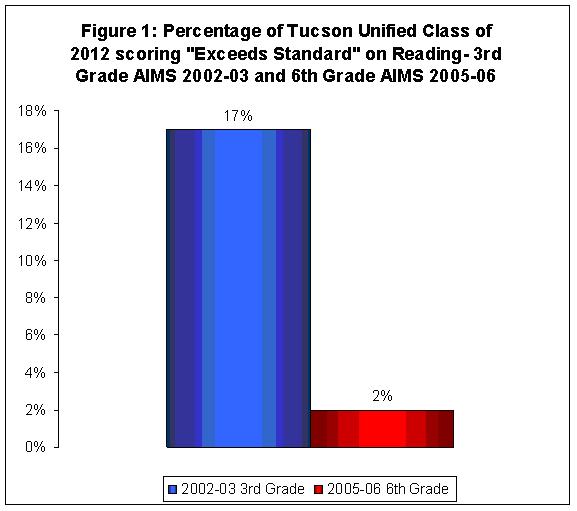
Let’s take a look, however, at the more stable category of “Exceeds Standard.” Cut scores have been much more stable at the top. Figure 1 below presents data from the Tucson Unified School District Reading AIMS. The figure presents the percentage of TUSD 3rd and 6th grade scoring “Exceeds Standard” on the Reading AIMS for the Class of 2012.

For those without an abacus on hand, that’s an 88% decline in the percentage of children scoring at the advanced level between 3rd and 6th grade. Strangely, TUSD finds enough money to spend on a “Raza Studies” program in the midst of such catastrophic failure.


Any interest in running for Governor of Arizona?

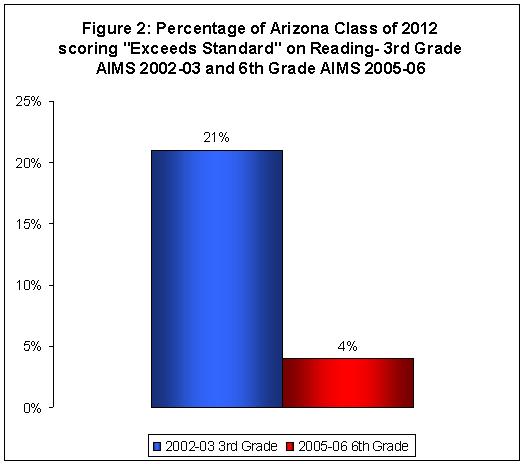
Figure 2 presents the statewide figures for all public schools in Arizona for the Class of 2012 for the same grades and years.

Figure 2 presents an 80% statewide decline. Attendance in a typical Arizona public school seems injurious to the ability to perform high-level reading at grade level, at least according to the state’s own standards and measures.


Buildings Don’t Teach Kids, People Do

October 23, 2008

Matt wrote about black-market private schools in the third world housed in open-air shacks on the same day that newspapers reported that my local school board in Fayetteville, AR wants to re-build the high school so that we have a “21st Century” facility

While it is better not to have schools in open-air shacks, I can’t understand why people think we need educational palaces to teach our children.  Buildings don’t teach kids.  People do. 

We should invest much more in ensuring that we attract, retain, and motivate the best people as teachers rather than in “21st Century” facilities (whatever that blather means).  The systematic evidence overwhelmingly shows that the quality of school facilities in the United States has no relationship to student achievement, while the quality of teachers is very strongly related.  In the Handbook of the Economics of Education, Eric Hanushek reviews all of the research meeting minimal quality standards regarding the relationship between school facilities and student performance.  He identifies 91 analyses on the issue in the U.S. and finds that 86% of them show no statistically significant relationship.  Of the remaining 14% of analyses that did show significant effects, 9% were positive and 5% were negative. 

Research from developing countries told a different story.  Of the 34 analyses he identified on the relationship between school facilities and student performance in developing countries 65% showed significantly positive effects, 9% significantly negative, and 26% not statistically significant.  Clearly there is some level of building quality below which student achievement suffers.  But school buildings in the United States are nowhere near that threshold where the facility makes a significant difference.  The kids in the open-air shacks would probably benefit from an environment that screened out noise and dust more effectively, but almost all kids in the U.S. are in buildings that meet the minimum requirements for student learning even if they are not all luxurious.

But I suspect that is the problem in Fayetteville.  Just up the highway in Springdale, they recently built a Taj Mahal of a high school, called Har-Ber.  The marble-floored interior is pictured above.  Here is the giant-columned exterior: (Web site with photos was taken down, but you can still view pictures of the school here: http://www.wddarchitects.com/ )

Har-Ber was built for about $37 million, or about $93 per square foot.  People in Fayetteville had been talking about building a new school for more than twice that amount.  In our version of keeping up with the Joneses, some folks in town fear that the superior academic reputation of Fayetteville High School could be eclipsed if we don’t top the Har-Ber building.

Yes, Fayetteville High School is half a century old.  Yes, its cafeteria and auditorium are too small.  But there are smarter and less costly ways of addressing those problems than temporarily housing students elsewhere while we spend tens of millions to build a new one.  How about if we just build a new cafeteria and auditorium?  The recently completed appraisal of the facility said that it was in “excellent condition,” so why do we have to tear it all down and build a shinier new one? 

And how about if we take some of the money that we were willing to spend on a shiny new building and invest it intelligently in recruiting, retaining, and motivating the best teachers?

As a separate matter, someone needs to look into why exactly school buildings cost so much.  The average cost for housing construction in the area is $55.10 per square foot compared to $93 at Har-Ber and who knows what at the potential new Fayetteville High School.  My guess is that school construction firms have effective lobbies that insert all sorts of gold-plating and burdensome requirements into school building codes.  Doing so limits possible bidders who could meet all of those requirements while it drives up the construction profit.  And I imagine that most of those requirements have nothing to do with educational necessity or realistic student health and safety.

(edited for typos and pictures currently unavailable from source site but can be viewed here: http://www.wddarchitects.com/)


Cascade Canyon

October 23, 2008

Matt and I went hiking in Grand Teton National Park last summer.  Here we are on the Cascade Canyon trail.  We made it all of the way from the trailhead at Jenny Lake to the western end of the canyon, about a 9 mile round-trip.  I thought the hike was going to kill a sleep-deprived Ladner, but it was nothing that buffalo burgers and drinks at the Cadillac Grille couldn’t heal. (edited for clarity)


Black Market Private Schooling in the Third World

October 23, 2008


(Guest Post by Matthew Ladner)


Jay, Greg and I all had the chance to see a presentation by Pauline Dixon on private schooling in the third world at a recent conference sponsored by the Friedman Foundation and Clemson Institute for the Study of Capitalism. The information was very compelling.


Dixon and her co-author James Tooley explained their research in the 2005 Cato Institute report Private Education is Good for the Poor. Their two-year in-depth study in India, Ghana, Nigeria, and Kenya found amazing results.

The first component of our research consisted of a systematic census and survey of all primary and secondary schools, government and private, in selected low-income areas. The second component examined a stratified random sample of between 2,000 and 4,000 children from each of those areas. Tests in mathematics, English, and (in Africa) one other subject were administered. Children and teachers were also tested for their IQ, and questionnaires were administered to students, parents, teachers, and school managers or headteachers.

What did they learn? For starters, a large majority of students in each of the low-income areas studies in all four countries were attending private, not public schools. For instance, the census of the low-income area of Ghana found 779 schools total, only 25 percent were government schools. The census found that 64 percent of schoolchildren in the area attended private school. In the surveyed area of Nigeria, 75% of students attended private schools.

Interestingly, the majorities of these schools are unregistered, and in many cases illegal. They are neighborhood proprietary operations, run almost exclusively based upon student fees. The vast majority of these schools and students receive no public subsidy whatsoever. In fact, many of them must pay bribes just to stay in business. Many of these schools provide subsidized spaces for the poorest of the poor, and all of them are the precise opposite of the Dead Poet’s Society stereotype of private schooling.

As you can see from the photo above (taken by the research team), these schools are not housed in fancy facilities. In fact, as Dr. Dixon presented a power point presentation of these schools, it brought to mind the old story about Abraham Lincoln learning to read by writing on a shovel with coal.

The story here isn’t that there aren’t public schools to attend- it’s more that those schools are dysfunctional to an unimagined (by me anyway) scale. Parents told the researchers of rampant absenteeism by teachers, meaning that children simply run wild when their teachers decide not to report- which is frequent.

My impression: the public school system in these countries represent blatant jobs programs, rather than schools. This impression seems borne out by the test score results:

The raw scores from our student achievement tests show considerably higher achievement in the private than in government schools. In Hyderabad, for instance, mean scores in mathematics were about 22 percentage points and 23 percentage points higher in private unrecognized and recognized schools, respectively, than in government schools. The advantage was even more pronounced for English. In all cases, this achievement advantage was obtained at between half and a quarter of the teacher salary costs.

So there you have it- much better and much less expensive. Oh, and often illegal and great for the poor.


Even I Agree – This Is a Bribe

October 22, 2008

(Guest post by Greg Forster)

Last month I got into a little back-and-forth with Fordham’s Liam Julian after we simultaneously published columns about the practice of financially rewarding students for good performance – mine for and his against.

Well, as a token of goodwill, here’s a form of “performance pay” for students that even I will agree is an impermissible bribe. Baylor has been caught paying students for good SAT scores. The catch: it’s paying them to go back and retake the SAT after they’ve gained admission, so that the statistical profile of incoming freshmen at Baylor will look better.

“I think we goofed on that,” said a spokesman. Gosh, do ya think?

What’s the difference between rewarding student excellence and bribing students? In our exchange last month, Julian tried to outline what he thought was the difference between a legitimate “reward” and an illegitimate “bribe.” I wasn’t buying his definition but offered no alternative of my own (I had been using the word “bribe,” in sarcastic scare quotes, to refer to financial rewards for student performance, so I wasn’t in a good position to make the distinction systematically). I’ll take a crack at it now, and to make things even more fun I’ll add a third category.

I understand a “reward” to be an incentive for a certain activity that arises organically from the nature of the activity itself. An Olympic runner is not “greedy” and “mercenary” for wanting to win the race; victory is the reward for (i.e. the natural fulfillment or fruition of) athletic excellence. Nor is he necessarily greedy for wanting to win a shiny gold medal and stand on the top level of the victor’s podium and thrill to the cheers of the crowd, because the medal and the podium and the cheering are rightly taken as tokens and recognitions of his victory – he can desire them not for their own sake, but as embodiments of the victory. (Of course he may also desire them for their own sake, to gratify his vanity, which is wrong – but that is his fault, not theirs. They remain the natural and proper “rewards” of his excellence even if he doesn’t desire them as such.)

Note that while we usually use the word “reward” only in the context of good behavior, in this sense a “reward” can attach just as easily to bad behavior as to good. For example, those who behave greedily sometimes end up making money as a result, but we don’t call this a “bribe” as such. It’s just the natrual result of his behavior. This is what the New Testament means when it repeatedly emphasizes that those who sin “have already recieved their reward.”

On the other hand, we can provide incentives for behavior that do not arise organically from the nature of the behavior itself. Here I see two categories.

If the act of providing the incentive does not change the nature of the behavior itself, we call that simply “pay.” Managing a business, or laying pipe, or providing heath care, or teaching (or blogging about education reform) is not a different activity simply because one recieves a salary to do it, which is why the salary is called “pay” rather than a bribe. And note that, just as with “rewards” for bad behavior, there is also “pay” for bad behavior; we don’t speak of mobsters “bribing” hit men to kill people.

Whereas if providing the incentive changes the nature of the activity, that incentive is a bribe. Signing a contract with a vendor, supporting a change to government policy, or (in the Baylor case) retaking the SAT becomes a different kind of activity when you’re doing it for money as opposed to when you’re doing it for the right reasons. The corporate officer who steers contracts to a vendor who is giving him kickbacks is not engaged in business for his company, but rather defrauding it. The politician who supports a bill because he’s getting paid under the table is not serving his constituents, but oppressing and exploiting them. And the Baylor student who retakes the SAT because the school pays him is not seeking educational excellence, but collaborating in fraud.

As C.S. Lewis once put it, a man who marries a woman for money is mercenary, but a man who marries a woman because he loves her is not, even though in both cases he is “getting what he wants” by marrying her; marriage is the natural fulfilment of love but it is not the natural fulfilment of acquisitiveness, and marrying someone out of acquisitiveness changes the nature of the act (or so some of us believe).

(One potential weakness of my definition of a “bribe” is that the word implies moral turpitude, and it’s concievable there may be incentives for an activity that change the nature of the activity without creating moral turpitude. I can’t think of any off the top of my head, though. But if there are any such incentives, we would need a different word for them.)

The question before us, then, is whether paying students to learn changes the nature of the activity of learning. I think the answer is no, for the reasons I stated in my Pajamas Media column:

These days, if a child asks why he should care about doing well in school, what kind of answer does he get? He gets the same answer from every source: from parents, teachers, and school administrators; from movies and TV shows; from public service announcements, social service programs, and do-gooder philanthropies; from celebrities, athletes, and actors; from supporters and opponents of education reform; from everybody.

The answer is always some version of: you need to do well in school in order to have prosperity later in life.

Well, if you scrape away the sanctimony, what is this but a “bribe” on a colossal scale? Why is it vulgar and horrible to tell kids that if they pass their APs they’ll get a $500 check, but noble and uplifting to tell kids that if they pass their APs they’ll be able to get a better job five years from now?

Let’s quit kidding ourselves that it’s somehow shocking that somebody would come up with the idea of paying students to do well in school. For at least a decade, money is more or less the only motive we’ve been offering students to do well in school. We’ve just been insisting that the payoff has to come later in life. But morally, the timeline doesn’t make a difference. If it’s OK to pay someone five years from now to do something today, then it’s OK to pay him today, too.

If learning isn’t learning when the student is motivated by his own material well-being, then there probably is no such thing as learning and never has been.

Not that I think that’s the only motive students have, or should have:

Now, as it happens, I would prefer that the cash motive not be the only reason we offer kids to do well in school. I think our culture has been remiss in emphasizing education as an opportunity to become a better person, both morally (through character formation, a concern that the government school system seems to have largely dropped or subordinated, though private schools make it a top concern) and developmentally (because those who learn more and develop their capacities more fully have richer, more blessed lives).

But I also think that denying the presence of a strong financial motive in education is a fool’s errand. Kids will always care about how their education impacts their material well-being. And so they should — looking after one’s own material well-being is a good and natural concern.

Moreover, kids aren’t fully able to appreciate the moral and developmental motives for education until well after their education is complete. The 30-year-old, looking back, may well say, “If I hadn’t worked hard in school and had such great teachers, my personal character and my capacity for a fully human life would have been infinitely poorer.” But try explaining that to a ten-year-old.

Concern for one’s own material well-being is one of the natural motives for education, always has been, and always will be. Admitting this doesn’t negate the other motives.


New Evidence Against the Bailout

October 22, 2008

(Guest post by Greg Forster)

As the evidence piles up, I’m moving closer to abandoning my studied neutrality on the bailout and joining Jay and Matt in opposing it. I still lack the expertise to evaluate the claims that there’s a credit panic, that markets behave irrationally during a panic, that panics turn into crashes, and that it is possible for government to prevent the crash by acting as a sort of substitute rational investor during a panic. But whether or not government intervention can counteract a panic, it’s looking more and more like that isn’t what’s happening.

Today’s datum? GM is buying Chrysler partly so that it will be considered “too big to fail.” (HT Jonah Goldberg)

Since I first saw this in The Corner, I’ve been meaning to post it, but haven’t gotten around to it. Glad I waited – now I can also direct you to America’s MVC (most valuable columnist), Holman Jenkins, whose Wall Street Journal column this morning discusses the case.