Random Pop Culture Apocalypse: Genre Benders

July 3, 2009

(Guest Post by Matthew Ladner)

Earlier we had a lively debate on the obvious superiority of cover songs. This is a good lead in to my grand theory of popular music, which is: there is nothing new under the sun, so you may as well repackage tried and true things.

My theory holds that rock music essentially played itself out in 1974 with the creation of Punk Rock. If Rock and Roll was ultimately about rebellion, then you can’t get any more rebellious than anarchists who don’t know how to play their instruments screaming into a microphone. Of course most punks were poseurs. As Johnny Rotten said in advance of a reunion tour for what remains of the Sex Pistols “I am the Anti-Christ, won’t you buy me merchandise?”

But I digress.

Rock has been dead for ages, what to do then? Answer: take other genres of music, put a fresh coat of paint on them, and sell them to the kids as something new and cool! Much of it actually is cool.

The Ramones invented punk by taking 50s bubble gum pop songs, speeding them up, and giving them a psychotic twist. The Police were basically a Anglo-American reggae band. Paul Simon went through an interesting and profitable stage of his career by blending African music into an American context. Big Bad Voodoo Daddy and others brought Swing music back into fashion in the 1990s, and Green Day and company did the same with punk, etc. etc. etc.

Bryan Setzer is obviously a master at this- having brought back Rockabilly with the Stray Cats and Swing with his orchestra. His latest album is a fun work that develops swing/rock versions of classical music.

Sting not only dabbled in reggae with the Police, but also jazz and even country music as a solo artist. In Desert Rose Sting wrote an Arabic song and got the biggest Arabic singer to do the song as a duet:

Genre-bending reached it’s natural conclusion with the development of mashups, which I understand to be matching different lyrics and music, with a good bunch of sampling thrown into the mix.

Example: take the tune to Jimmy Hendrix’s Purple Haze. Now do the same tune, but sing the words to the TV theme song to Green Acres in place of those of the original.

There, you just did your first mental mashup!

Some of the DJ’s doing mashups these days are really quite creative. They move in and out of genres within a single song, briefly foreshadow something to come, and then beat you over the head with the best part of it.

Here’s an example of two things you wouldn’t think would work in a fairly basic mashup: Madonna and the Sex Pistols

Ebert once describe Quentin Tarrantino movies as throwing a whole series of big scenes at you. He said that most thrillers might build up to a single shocking or grizzly scene, but that Tarrantino hits you with 12 of them with plenty of homages to previous films thrown in to boot.

A good mashup does the same: rather than having a song build to some single crescendo, they’ll take an alternate path to build to the same crescendo and then flip on to another. You already know how the original got to the crescendo-why not fast forward to the fun part?


USA Today on Freedom from Responsibility

July 2, 2009

6a00d83451b46269e2011570a731b4970c(Guest Post by Matthew Ladner)

USA Today has an editorial piece on Victor and Miguel Mendoza, two American servicemen in Iraq who become United States citizens on July 4th.

The Mendozas represent the best of what the nation is celebrating this Independence Day weekend — liberty, freedom and the sacrifice it takes to keep them strong. They symbolize what’s right with America, a nation of immigrants that was built by opening its doors. And they speak to what could be so much better. At a time when anti-immigrant sentiment has swept through great swaths of the nation, much of it focused on those from Mexico, it’s worth recalling that more than 65,000 immigrants serve in the armed forces, about one-third of them legal residents but not yet citizens. Military service can shorten the usual five-year wait.

We should all be joyful and proud to welcome the Mendozas to our nation. USA Today notes that this contrasts starkly with the performance of Arizona high school students:

Immigrants seeking to become U.S. citizens have to pass a test, and the Mendoza brothers aced theirs this week in Baghdad. That’s more than you can say for a group of Arizona high school students who were surveyed recently on their knowledge of U.S. history and civics.

Just in time for Independence Day, the Goldwater Institute, a non-profit research organization in Phoenix, found that just 3.5% of surveyed students could answer enough questions correctly to pass the citizenship test. Just 25%, for example, correctly identified Thomas Jefferson as the author of the Declaration of Independence.

I mentioned in an earlier post that we drew the title of this study from an Edward Gibbon quote:

In the end more than they wanted freedom, they wanted security. When the Athenians finally wanted not to give to society but for society to give to them, when the freedom they wished was freedom from responsibility, then Athens ceased to be free.

That quote certainly does not apply to the Mendoza brothers. Can we say the same for young Americans born here in the United States?  The United States was the first nation established not on the basis of ethnicity  or tribalism but upon a set of ideals.

If you don’t the basics of American history and government, what chance is there that you are committed to liberty and self-determination?  The pathetic level of ignorance displayed by this an other surveys are more than an indictment on our schooling system (and yes I’m looking at you too charter and private schools) but also an indictment of our entire society.

Consider the Gibbon quote and watch the above video. We have not been providing the type of education that the founders believed was essential to maintaining a system of ordered liberty.

It would be the height of folly to continue to do so.


Why Random Assignment is Important

July 2, 2009

Bill Evers has an excellent post over on his Ed Policy blog about how unreliable observational studies can be and how important it is to test claims with random-assignment research designs. 

Observational studies (sometimes called epidemiological or quasi-experimental studies) do not randomly assign subjects to treatment or control conditions or use a technique that approximates random-assignment (like regression discontinuity).  Instead they simply compare people who have self-selected or otherwise been assigned to receive a treatment to people who haven’t received that treatment, controlling statistically for observed differences between the two groups.  The problem is that unobserved factors may really be causing any differences between the two groups, not the treatment.  This is especially a problem when these unobserved factors are strongly related to whatever led to some people getting the treatment and others not. 

The solution to this problem is random assignment.  If subjects are assigned by lottery to receive a treatment or not, then the only difference between the two groups, on average, is whether they received the treatment.  The two groups should otherwise be identical because only chance distinguishes them.  Any differences between the two groups over time can be attributed to the treatment with high confidence.

If you don’t believe that research design makes a big difference, consider this table that Bill Evers provides on how much results change in the field of nutrition when random assignment (or clinical) studies are done to check on claims made by observational studies:

If we want to avoid the educational equivalent of quack medicine, we really need more random-assignment studies and we need to give the random-assignment studies we already have significantly greater weight when forming policy conclusions.

As I’ve written before, we have 10 random-assignment studies on the effects of vouchers on students who participate in those programs. Six of those ten studies show significant academic benefits for the average student receiving a vouchers and three studies show significant academic benefits for at least one major sub-group of students.  One study finds no significant effects.  

I believe that there are more random-assignment studies on vouchers than on any other educational policy and there are certainly more studies with positive results.  The depth of positive, rigorous studies on voucher participant effects is worth keeping in mind each time some new observational or (even descriptive) study comes out on school choice, including the most recent report from Florida.  Our opinion shouldn’t be based entirely on the latest study, especially if it lacks the rigorous design of several earlier studies.


Tampa Tribune Beats the Rush

July 1, 2009

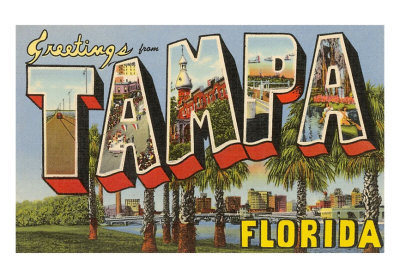
Greetings from Tampa

(Guest post by Greg Forster)

The editors of the Tampa Tribune have decided not to join the misinformed rush to judgment on Florida’s tax-credit scholarship program:

It’s too early to accurately gauge the students’ academic progress, as the University of Florida economics professor who oversaw the report emphasized. It measured only first-year test gains. Researcher David Figlio was handicapped by incomplete data for a baseline.

I’m shocked to see that in print. A newspaper actually checked the facts!

I do have to quibble with the editorial’s assertion that the Figlio study shows students who select into the program are among the most “academically challenged.” We don’t, in fact, know that. We know that they are more likely to come from schools that are among the most academically challenged. But school characteristics and individual student characteristics can vary considerably.

This matters because choice opponents have relied upon unsupported assertions about selection bias to wave away the consistent empirical research consensus showing that school choice works. In fact, the Figlio study doesn’t allow us to address this question, as the study itself explicitly says. Other research that does examine this question has not turned up any serious evidence that vouchers either “cream” (selecting high performers) or “dredge” (selecting low performers).

But the editors are back on solid ground when it comes to finances:

The program is a good deal for taxpayers.

Attending public school costs more. When local, state and federal costs, plus capital costs, are factored in, the average cost per student in public school is $12,000.

In the voucher program, the maximum scholarship is $3,950, about 57 percent of the roughly $7,000 the state pays per public school student.

And a scholarship parent pays on average $1,000 a year for their child to attend the private school. The program requires the parents and child to be motivated.

By taking challenging students from poor-performing schools, the Tax Credit Scholarships are easing the burden on the public school system, not diverting resources.

Kudos to the Tribune for checking the facts rather than rushing to judgment!


Welcome to School Choice, Indiana!

July 1, 2009

Welcome to Indiana

(Guest post by Greg Forster)

Yesterday, Indiana Gov. Mitch Daniels signed a budget bill that contained a $2.5 million school choice program. It’s a tax-credit scholarship program that will serve a couple thousand students.

So much for the negative nabobs who think school choice can’t win! No matter how many times it wins, they just keep sticking their fingers in their ears.

There are some eligibility restrictions, but they’re not as bad as the ones on the “legacy” programs in Milwaukee and DC that are restricted to the poor. This program is more in the mold of existing tax-credit scholarship programs in places like Pennsylvania, which include moderate-income families – in Indiana, the eligibility is set at 200% of the cutoff for free and reduced lunch programs. Also, like the program in Florida, Indiana’s program is limited to students who were in public school the previous year.

This means that the program isn’t ideal, but will be much easier to defend against union chicanery than the highly vulnerable “legacy” programs, which don’t provide much benefit to powerful constituencies able to mobilize and preserve the program. Indiana’s program isn’t leading us toward universal choice the way Georgia’s is, where a universal voucher bill is moving through the legislature. But it’s maintaining the gains school choice has made in the last five years, as the movement has moved toward more and more universal choice.


The Rush to Judgment

June 30, 2009

David Figlio’s latest report on Florida’s Corporate Tax Credit (CTC) Scholarship program was released yesterday.  I can’t find the report online but Ron Matus of the St. Pete Times sent it to me and you can read about it in his article

(UPDATE:  Here’s a link to the study.)

I agree with almost everything said in the article.  I even agree with Mark Pudlow, the spokesperson for the teacher union when he said: “There is no quick fix for struggling students.” 

The problem is that the standard for success when it comes to school choice is that it has to produce a quick fix or critics deem it a failure and declare: “we really ought to reconsider why we’re doing it.”  No one demands that every other education policy produce huge gains in a single year or they should be “reconsidered.”  Yes, promoters of policies may make unrealistic promises to get them adopted, but the standard for success should be long-term progress, not promises made by politicians.

So let’s slow the rush to judgment and review what we really know about the CTC program.  First, Figlio finds that 92.7% of all CTC students in private schools provided a usable standardized test to the evaluation.  This shows widespread compliance with the legal requirements for those students to be tested to satisfy political concerns for accountability.

Second, Figlio finds that the CTC program has largely targeted students who are significantly more disadvantaged than students remaining in Florida’s public schools — even significantly more disadvantaged than public school students receiving subsidized or free lunch.  So, concerns that the program would cream off the best students appear unfounded.

Third, and most importantly, Figlio’s report does not make any claims about whether students benefited academically from participating in the CTC program.  He simply provides descriptive information on the academic achievement of CTC students as well as subsidized lunch students in Florida public schools.  But we know that CTC students are even more disadvantaged than those public school students and Figlio makes no attempt in this report to control fully for those disadvantages.

Figlio makes these points explicitly and repeatedly in the report: “it is important to recognize that they are not causal estimates of the effect of program participation on student outcomes. Causal comparisons require more complete modeling of the selection decisions into the scholarship program and fuller data from a baseline than is afforded using the 2006-07 school year test score collection. More compelling causal estimates of program participation will be possible following the collection of the 2008-09 school year’s test score data. The comparisons in this subsection should be interpreted as purely descriptive in nature.”

Unfortunately, most people never pay attention to these warnings and rush ahead as if descriptive information is causal.  Folks wrongly conclude that if CTC students make year to year test score gains that are about the same as subsidized lunch public school students, then they must not be benefiting from the program.  Nothing in Figlio’s report supports that conclusion. 

To know whether CTC students are benefiting we would have to know how they would be doing had they remained in public schools.  The best way to judge that is with a random-assignment study where students admitted to the CTC program by lottery are compared with students who lose the lottery and remain in public schools.  Unfortunately, that research design is not possible because there was no lottery.  The next best thing would be to use a research design that approximated random-assignment (like a regression discontinuity) or a rigorous quasi-experimental design that controlled for all observed differences between the two groups.  But Figlio didn’t do that in this report.  He just provided descriptive statistics while promising a more rigorous research design next year.

Of course, we might wonder why Figlio bothered reporting this descriptive information without a more rigorous analysis.  I suspect that he was required to produce a report each year by the legislature, so he complied even though he didn’t have the information he needed for a causal analysis. 

And the descriptive information is useful.  It suggests that choice was no miracle cure since the raw differences between CTC and public students in academic progress were not huge.  Again, miracle cure is the wrong standard for judging a program’s success. 

The CTC program may well have attracted students who had been on a downward trajectory before they switched to a private school.  And the CTC program may well helped those students level-off and may, over time, enable them to make significantly greater progress than they would have made had they remained in public schools.  This is what we’ve seen from rigorous evaluations of other choice programs, including the most recent evaluation of the DC voucher program.  But these things require careful research designs and time to show themselves.  Let’s give David Figlio more time to use a better research design so that we can actually say something about the academic effects of the CTC program.

(edited for typos)


Reaction To SC Decision on Special Ed

June 29, 2009

Reactions are beginning to pour in on the Forest Grove School District v. T.A. Supreme Court decision, which Greg and I wrote about last week.  Predictably and unfortunately, those reactions are informed by concerns for the financial burdens of the decision that are lacking in both facts and perspective. 

Even the dissenting opinion, written by Souter and joined by Scalia and Thomas, made a point of worrying about the costs:

The majority’s suggestion overlooks the terms of the IDEA process, the substantial procedures protecting a child’s substantive rights under the IDEA, and the significant costs of its rule. To start with the costs, special education can be immensely expensive, amounting to tens of billions of dollars annually and as much as 20% of public schools’ general operating budgets. See Brief for Council of the Great City Schools as Amicus Curiae 22–23. The more private placement there is, the higher the special education bill, a fact that lends urgency to the IDEA’s mandate of a collaborative process in which an IEP is “developed jointly by a school official qualified in special education, the child’s teacher, the parents or guardian, and, where appropriate,the child.”Burlington, supra, at 368.

Just how much private placement is there?  How much does it really cost?  How big is this relative to total enrollment and expenditure in public schools?

As of 2007 there were 67,729 disabled students in private school at public expense who were there at the initiative of their parents.  That is 1.1% of the 5,978,081 students in special education and 0.14% of the 49,610,000 students in public education.  Theses percentages were not significantly different before 1997 when Congress amended the special education law in a way that the dissent believed would constrain burdensome private placements.  And Marcus Winters and I estimated that the total financial cost of private placement is less than a billion dollars and amounts to less than one-quarter of one percent of total public school spending

I understand that a billion dollars is a lot of money, but in a public education system spending more than $500 billion it is almost rounding error.  Souter, Scalia, and Thomas violate the Denominator Law, where it is required that all claims of “big” problems have to be put in perspective by including a denominator to show how large the problem really is given the full context.  As officers of the Court they should know that ignorance of the law is no excuse!

It’s also strange that Scalia and Thomas would join in a dissent that is based at least partially on concerns for the financial implications of their decisions.  I thought Scalia and Thomas believed in finding the original intent of the law.  A court ruling based on (false) fears of financial burdens of the law sounds like policymaking from the bench.

However, Debra Saunders, in a column on the decision at the San Francisco Chronicle, seems confused about what constitutes policymaking from the bench.  She writes: “the court arguably engages in policy-making when it tells districts how they must spend valuable education dollars.”  There is a federal law, IDEA, that tells schools how they must spend their money (along with the money they receive from the feds).  It says that all disabled students are entitled to a free appropriate public education.  It isn’t policymaking from the bench to say that students unreasonably denied appropriate services shouldn’t have to wait 2-3 years for the Courts to order the schools to provide those services.  The Courts can’t also provide a time machine, so we have to have a mechanism that handles what happens to kids while their parents fight with schools in the courts. 

In Forest Grove the Supreme Court said that parents should be able to take the risk of placing their children in private school and seeking reimbursement.  If the courts agree that the schools unreasonably denied services, then they can get reimbursed for their costs while they were waiting.  If the public schools were reasonable, then the parents are out the money. 

I agree with Debra Saunders that the facts in this specific case make it hard to understand how a lower court found that the public schools behaved unreasonably.  But the law isn’t about one set of facts; it applies to all instances.  If we pretend that the lower courts find that public schools denied a special education classification unreasonably, then obviously students would be denied their rights under IDEA if they had to wait 2-3 years for those services.

Debra goes on to violate the Denominator Law, writing: “It’s one of those nice people things. The government has expanded the notion of disability to the point of absurdity. But nice people refuse to look at the impending drain on public school budgets, or how one child’s boarding school tuition can mean that much less funding for all the other students’ educational needs.”  This was especially frustrating because I pleaded with her to report claims of financial burdens in context.  Besides quoting me, she chose to ignore my point and repeat her claims of burden with no basis to support it.

My colleague, Walter Olson, also has a post on Forest Groveon his blog, Overlawyerd.com.  While I disagree with Wally on this issue, I am sympathetic with his concerns.  Specifically, he notes that private placement is a remedy much more available to wealthy families than poor ones.  And he doubts the justice of disabled students having federally protected rights to an appropriate education while no one else does. 

I agree that rich kids have better access to this remedy than poor kids. That’s why I favor vouchers for special education, both to democratize this remedy and to better control costs. Vouchers control costs because the voucher is worth no more than would have been spent in public schools or private school tuition, whichever is less. Special ed vouchers also discourage over-identification of disabilities because schools would risk losing students when they classify students as disabled.

And I also agree that it is unclear why non-disabled students should have to wait in schools that fail to serve them appropriately while disabled students are entitled to find an appropriate education. But the solution is not to strip disabled students of that right.  The solution is to extend it to all students. Give vouchers to all students worth the amount that would be spent on them in public school (the amount would vary based on the cost of educating different kinds of students). If any student is unable to find what his family believes is an appropriate education, give them the resources to find it somewhere else.


Pass the Popcorn: The Red Violin

June 26, 2009

Title Screen

(Guest post by Greg Forster)

I don’t get to see many movies anymore – at least, not many by my standards. And when you can only see maybe four to six movies a year in the theater, you’re going to end up seeing the obvious ones – Batman, Star Trek, whatever Pixar does this year, etc.

But there was a time when we used to see a lot of movies. And that meant we had the luxury of picking through the enormous pile of garbage that is the arthouse and finding the few movies that make the arthouse worth going to. So I’m going to start using our Pass the Popcorn feature to show off some of our “finds,” in the hope that they won’t fade too far into obscurity.

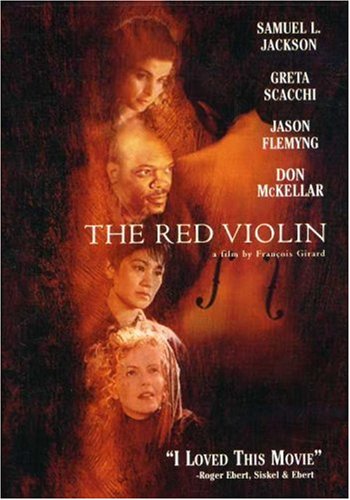
The Red Violin

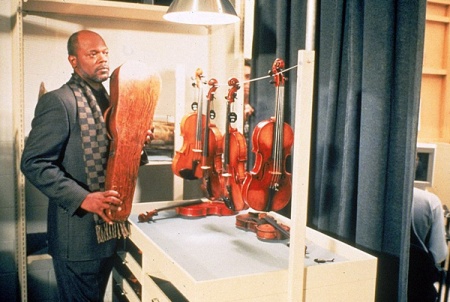
The Red Violin stars Samuel L. Jackson as the most badass professional musical instrument appraiser you will ever see depicted on screen. I’m serious, don’t mess with this guy. At one point a clerk fails to deliver an important package to him promptly, and he tears into the clerk so hard I thought he was about to start reciting passages from Ezekiel.

Jackson & violins

“And you will know my name is the LORD when I lay my violin upon thee!”

OK, now that I’ve sold Matt, here’s what the rest of you need to know.

The movie tells the story of a violin that was created by a Renaissance Italian craftsman as his greatest masterwork. Over the course of the movie, the action shifts back and forth between three storylines.

Making the violin 2

In 17th century Italy, we see the craftsman’s initial aspiration – to create an instrument worthy of his love for his unborn child, due to arrive any day, to whom he intends to give the violin as a gift. But in a surprise twist at the end, the violin comes to have a different, but equally profound, significance for him.

Jackson peeking

In our own time, the violin is going up for auction. Everyone else thinks the violin is nothing special, but badass appraiser Samuel L. Jackson suspects otherwise – that it may be the long-lost “red violin” made by that famous Italian craftsman. Once the truth becomes known, everyone wants the violin – but nobody other than Jackson wants it for the right reason, leading to a surprise twist at the end in which Jackson triumphs over the greed and pride of his adversaries.

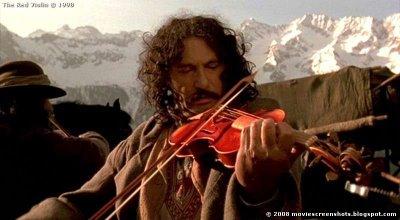
Gypsy

In between, we see what happened to the violin as it travelled around the world between its creation and its eventual rediscovery. Each vignette in this storyline illustrates the characteristic ways in which different civilizations have responded to the mystery of great art.

Kaspar dressed up

18th century Vienna is so obscessed with technical skill that art is reduced to mere performance – the ability to play very complex pieces very fast is valued above beauty. Following this path ultimately leads to the reduction of art into the novelty act of child prodigies – because the younger you are, the more amazing your skill is, and that’s all that counts. Form obliterates matter, and since form can’t exist without matter, it obliterates itself, ending in tragedy.

Victorian couple playing violin

In Victorian England, by contrast, “art” is put up on a pedastal and idolized. “Creativity” is fetishized to the point where mere novelty and thrill displace beauty, just as mere technique had displaced it a century earlier. Craftsmanship goes out the window in favor of irresponsible artistic self-indulgence. Matter obliterates form, and since matter can’t exist without form, it obliterates itself, ending in tragedy.

In China with violin

In 20th century China, during the cultural revolution, just to have an interest in art as such is a life-threatening proposition. The state holds that art, like everything else, exists only for political ends, so the desire to make art for the sake of beauty is an act of treason against the people. Far worse to make art that has western origins, given the regime’s awkward attempt to fuse its totalitarian ideology with crude appeals to nationalistic Chinese chauvanism. Yet in the end, the totalitarians prove as incapable of eradicating the desire for beauty as they are at eradicating any of the other fundamental desires of human nature.

Jackson & restorationist

What do we want beauty for? All answers other than “we want it because it’s beautiful” ultimately prove futile. The goodness of beauty, like the goodness of knowledge or the goodness of virtue, is categorical. Make it instrumental towards some other good and you destroy it.

What, then, should we do with beauty when we find it? To that, the movie has a definite answer, and I think it’s exactly the right one. But to find out what it is, you’ll have to see those two surprise twist endings I mentioned earlier – and I’m not spoiling them for you. Go rent it and find out.


GI: Hold the Phone on Higher Taxes

June 26, 2009

(Guest Post by Matthew Ladner)

Arizona has one of the worst budget deficit problems in the country (live by the property bubble…) written about here and here. New governor Jan Brewer has called for a “temporary” sales tax increase to prevent the sort of belt-tightening of the Arizona budget already having been done by most Arizona families.

We at the Goldwater Institute strongly disagree, and put out the following humorous video today to explain why:


GreenDot UFT Bargain

June 26, 2009

(Guest Post by Matthew Ladner)
In Shakespeare’s Richard III there is a scene where Richard makes an offer to Elizabeth, widow of the former King Edward. Allow me to marry your daughter and you will continue to live a life of royal luxury. If you refuse, you die.

Elizabeth asks Richard “Shall I be tempted by the Devil then?”

Richard replies “Yes, if the Devil tempt you to do good.

Needless to say, the Devil is not in the business of tempting anyone into doing good. People with far more expertise than I possess will be required to evaluate GreenDot’s own deal with the proverbial devil in the form of a collective bargaining agreement with the United Federation of Teachers. Needless to say, there is a potential for a win-win on both sides here, but as always, the devil is in the details. Here is one devilish detail that I certainly would have refused:

Article 10

Student-Teacher Ratio, Class Size and Teacher Load


The School shall maintain a school-wide staffing ratio of no more than twenty (20) students to one (1) full-time classroom teacher. Unless otherwise approved by the Calendar Committee and ratified by a majority of Bargaining Unit Members and the Board, an individual class may not exceed thirty (30) students. Moreover, there must be a total of no more than one hundred thirty (130) students in all of a teacher’s classes excluding advisory.

Translated: “There shall be an arbitrary and unsupportable cap on the total productivity of any individual teacher imposed on these schools. This cap will have the added benefit to the union of limiting the possibilities for differentiated pay, or attracting and keeping talented teachers in the classroom. Oh and by the way this will happily hamstring any hope of bringing Green Dot to a widespread scale.  Thanks for playing sucker– this mole has now been successfully whacked.  HURTCHA!!!!”

These standards may very well fit comfortably into GreenDot’s current practices. GreenDot’s current practices, however, are for a niche player and are not at scale. These terms of course could be renegotiated in the future, but good luck changing them once they are in place.

Teacher unions are rational actors. Their rational incentive is to maximize employment for dues paying members. If this happens to mean that we wind up throwing legions of all-to-often-ill-suited-and-ill-prepared-bottom-of-the barrell-students into the teaching profession at great expense and to castastrophic effect, them’s the breaks.  Things would be better if we spent (even more) money!

This agreement is almost certainly an improvement over what NYC’s rubber room contract, but that does not mean it will prove to be worthwhile.