Your Stimulus Money at Work

July 12, 2009

If you want to get a feeling for how education stimulus dollars are being used, check out this story from the Northwest Arkansas Times.  We learn that the Fayetteville School District is using stimulus dollars to double the regular pay of teachers working in a summer literacy program. 

That’s right.  The money is not being used to save teacher jobs that would have otherwise been cut.  The money isn’t being used to offer a new program that otherwise wouldn’t have been offered.  The money is simply being used to pay teachers more for the same thing that they would have been doing anyway.  The only thing that is “racing to the top” about this use of funds is teacher pay.  As the NWAT reports:

Fayetteville School District is using part of its federal stimulus funding to pay teachers in the Leap Ahead summer literacy program at Owl Creek School about double their regular pay.

Teachers in this program that targets at-risk students who have completed kindergarten through second grades will bank $8,000 for 12 days of classroom instruction and three days of preparation at the school.

That’s about $533 per day for working from 8:30 a.m. to 3:30 p.m. This does not include any extra time that school officials say teachers will be required to develop lesson plans and meet with parents.

Springdale Public Schools pays its summer school teachers $25 per hour, per district policy, said Rick Schaefer, the district’s public information officer.

For those of you without a calculator, that works out to paying Fayetteville teachers $76 per hour of scheduled work (excluding benefits) to do something that teachers in neighboring Springdale are doing for $25 per hour.  And it is apparently double what the same Fayetteville teachers are normally paid.

The Leap Ahead program may well be a good one.  But it isn’t clear how simply paying the same people more to do the same thing that would have been done in the absence of stimulus money helps anyone other than the people getting paid more. 

This is essentially a transfer of wealth from taxpayers (who on average earn less) to this group of teachers (who on average earn more).  And we wonder why the stimulus isn’t stimulating the economy.


DC Council: Continue Opportunity Scholarships

July 10, 2009


(Guest Post by Matthew Ladner)

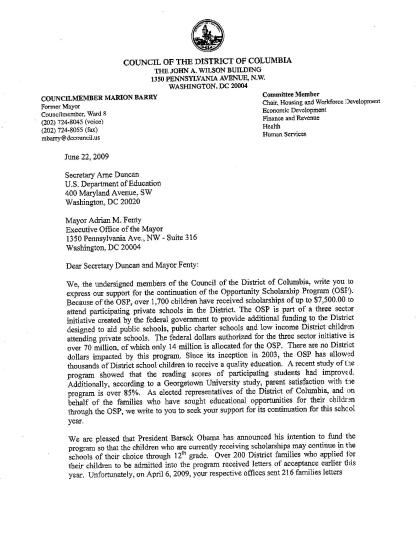
Yet another BOOOOOM! Now a majority of the DC City Council weighs in for DC Opportunity Scholarships!

Read the letter at the DC Children First website here.

Or read it below:DC letter 1 


DC letter 2 


Youth Fiction Without the Mopey Whining

July 10, 2009

I’ve become quite the connoisseur of adolescent fiction over the last several years.  One of our sons has trouble with reading comprehension, so he reads aloud with my wife or me so that we can discuss the book and make sure he is following the story.  We’ve read a whole lot of books that fall into the predictable pattern of youth fiction — they tend to be mopey, whiny stories about the death or injury of a loved one, family dysfunction, or psychological trauma.  Even if they are well-written, which some are, the repetitive, dreary themes are enough to make me want to jump off a Bridge to Teribithia. 

I’m not the only one to notice this.  Joanne Jacobs had an excellent post a while back about Anita Silvey’s artile in the School Library Journal about how depressing award-winning youth fiction tends to be:

Of the 25 winners and runners-up chosen from 2000 to 2005 [for the prestigious Newbery Medal], four of the books deal with death, six with the absence of one or both parents and four with such mental challenges as autism. Most of the rest deal with tough social issues.

Adults tend to prefer this type of literature much more than kids do.  This is especially true for boys, who’ve discovered that their adventure stories involving pirates have been replaced by touching family dramas.  It’s true that adolescents may desire books with a fair amount of whining and moping because it appeals to their over-wrought emotional tendencies, but I think most of the dreariness of youth fiction is driven by the depressing preferences of the adults who assign the awards, purchase the books for libraries, and write the books in the first place.  It’s as if they are trying to train future generations of therapy-seeking, mopey book-worms.

All of this matters because the award-winning books are the ones the school libraries are more likely to buy and teachers and parents are more likely to push kids to read.  If we want to get kids to read, especially boys, we have to offer them something less morose.  The solution is not to push the likes of Captain Underpants, Harry Potter, or Twilight.  Yes, they are less depressing, but they are also remarkably poorly written, weak excuses for literature.  Nor is the solution to push only classic works.  Kids also need contemporary works with modern themes and language.

I’m happy to report that there are still a number of quality works of youth fiction being produced.  They may not win the top awards, but you and your kids can find them and enjoy reading without having to take anti-depressants.  Most recently, we finished reading two really good books:  Peak, by Roland Smith, and Among the Hidden, by Margaret Peterson Haddix

They may not be great art, but they are decent youth fiction.  There’s enough mopey whining to appeal to those feelings among adolescents, but there’s also action, politics, self-sacrifice, and triumph.  That is, they’re good stories.

In Peakthe protagonist is a 14 year-old child of famous mountain-climbers who gets into trouble for climbing sky-scrappers.  He’s rescued from juvenile detention by being sent-abroad with his absentee dad who plans to get the 14 year-old to be the youngest person to summit Everest.  But the plan is complicated by an intrusive reporter, Tibetan politics, and oppressive Chinese army officials — not to mention the harsh conditions of climbing the world’s highest peak.  Along with the adventurous story of mountain-climbing, the book contains a fair dose of Tibetan-Chinese politics, and a strained father-son relationship.

Among the Hiddenis the first of a 7 book series about a future dystopia in which the government has forbidden anyone from having more than two children to prevent famine and other overuse of resources.  The protagonist is a third-child who was secretly born and raised on a remote farm.  When housing subdivisions are built near the farm, he is confined to hiding in the attic of his house so that the Population Police don’t discover him.  His family strains under excessive taxation, intrusive regulation, and the ever-present fear of being caught with a third child.  For a second you may forget that this is a future dystopia.  Eventually our hero discovers that he may not be the only “shadow child” out there and that it may be possible to do something to change the government’s oppressive policies.

These are books you can actually enjoy!


WaPo: A Plea to Mr. Duncan

July 10, 2009

(Guest Post by Matthew Ladner)

The Washington Post brings it again on behalf of the victims of Department of Education’s slavish decision to deny over 200 children access to the DC Opportunity Scholarship Program.

Seven council members — including those who represent the poorest sections of the city — wrote to Mr. Duncan on June 22 challenging his decision not to admit new students to the D.C. Opportunity Scholarship Program. The federally funded program provides vouchers of up to $7,500 so that low-income students can attend schools of their choice. Because the program’s future is uncertain, Mr. Duncan decided — disappointingly to our mind — to rescind scholarships awarded to 216 families for this upcoming school year.

Ooops, there goes the local control argument. Perhaps Mr. Duncan and company would like to stand up and confess “We’d like to help these kids, but sadly, we toil as the servile minions of teacher union thugs. Please don’t pay attention to what we do, but rather to what we say. Move along, nothing to see here…”


Texas has nothing to learn from California except…

July 10, 2009

2809LD1(Guest Post by Matthew Ladner)

Interesting article from the Economist on California vs. Texas: America’s future.

I’ve been an Economist reader for 20 years now, and their work is usually outstanding. They do however occassionally fall prey to an easy stereotype, and this article contains such a folly.

Read the article for yourself, but keep in mind that Texas has among the highest NAEP scores for Hispanic students in the nation (now edged out by Florida on 4th grade reading) and spends over $10,000 per child per year.

The only thing Texas has to learn from California is what not to do.

P.S.

This has been a settled question on the only true field of battle for some time now.


What Do You Really Think Bob?

July 9, 2009

(Guest Post by Matthew Ladner)

W*O*W


Carnival of Homeschooling

July 8, 2009

(Guest Post by Matthew Ladner)

Why Homeschool has it with an Independence Day Theme.


PJM on School Choice’s Political Wins

July 8, 2009

(Guest post by Greg Forster)

This morning, Pajamas Media carries my column on the upside of the political picture for school choice:

Some people think it’s been all bad news for school choice this year. Well, it’s all bad news if you follow the standard procedure of only paying attention to the bad news. But last month, the movement scored a big win: Indiana enacted a $2.5 million choice program, the state’s first. And if you take a broader view, you’ll see there was other good news for school choice along with the bad in the 2009 legislative season.

This is important because we’ve seen some people occasionally seize on any piece of bad news as an excuse to declare vouchers politically dead. It’s an easy way to avoid taking a stand on the issue, and in some of the more egomaniacal cases, to show the world how amazingly cool and above it all you are.


Kotkin: Who Killed California?

July 7, 2009

(Guest Post by Matthew Ladner)

Good read from Joel Kotkin.


UK Tories Propose Vouchers for Developing Countries

July 6, 2009

This is great news forwarded from Pauline Dixon, who with James Tooley, have done amazing work on the breadth and quality of private schooling in developing countries.  Here is part of the article in the Guardian:

Aid vouchers will be given to millions of people in the poorest parts of the world so they can shop around for the best schools and services, under Tory plans to inject free-market thinking into development policy.

A Conservative government would also spend part of the £9.1bn overseas aid budget on funding for private schools across the developing world, which it believes would achieve better results than state schools and drive up standards overall. The controversial plans are in a draft Tory policy document leaked to the Observer before publication this week of the government’s white paper on development.

Andrew Mitchell, the shadow international development secretary, confirmed last night that the Tories were “investigating” using aid vouchers “to empower people in developing countries”. He also said his party had no objection to supporting the growth of the private education and health sectors in the developing world.

“Governments have a responsibility to guarantee access to health and education for everyone, particularly the poorest,” Mitchell said. “We stand ready to work with public, private and not-for-profit sectors to help make that happen. I don’t have any ideological hang-ups about whether it’s private provision or public provision: I’m interested in what works.”

In his bid to promote compassionate Conservatism, David Cameron pledges to match Labour’s plans to increase development spending to 0.7% of GDP by 2013. The budget in 2010-11 will be £9.1bn. But the policy has not proved universally popular in the party, particularly on the right, where many believe too much aid money is wasted. A survey of Tory candidates found only 4% thought international development should be the policy most protected from cuts.

Cameron’s critics believe he is promoting Thatcherite policies for aid to appease the right and reassure them the money will be well spent. The draft document suggests planning for a voucher scheme is well advanced.

“The vouchers would be redeemable for development services of any kind with an aid agency or supplier of their choice,” it states. The paper also says that a Conservative government would “embrace the potential of the private sector, not treat it with suspicion” when administering the aid budget.

As a result it makes clear the Tories would support private education in countries such as Nigeria, Ghana, Kenya, India and China, where it claims it has delivered better results than state-run schools “even adjusting for children’s backgrounds”.

The paper states: “We will stand ready to work with the public, not-for-profit and private sectors. We will consider funding insurance schemes, bursaries or targeted vouchers for the poorest children to attend a school of their choice.”