Freedom from Responsibility Preview part Deux

June 25, 2009

 (Guest Post by Matthew Ladner)

In the end more than they wanted freedom, they wanted security. When the Athenians finally wanted not to give to society but for society to give to them, when the freedom they wished was freedom from responsibility, then Athens ceased to be free.

Edward Gibbon

Last week we had our first sneak peak at Freedom from Responsibility.

Today, more details about the results. The Goldwater Institute randomly drew 10 questions from the United States citzenship exam item bank. We hired a survey firm to interview a sample of both Arizona public and private school high school students.

The questions for neither the citizenship test nor our survey were multiple choice. When you are asked “Who was the first President?” you must answer “Washington” in order to receive credit. Applicants for citizenship must get six out of the ten questions correct to pass. A recent trial of a slightly reformatted exam found that 92.4% of citizenship applicants passed the test on the first try.

Charles N. Quigley, writing for the Progressive Policy Institute, explained the critical nature of civic knowledge:

From this nation’s earliest days, leaders such as Thomas Jefferson, James Madison, and John Adams recognized that even the well-designed institutions are not sufficient to maintain a free society. Ultimately, a vibrant democracy must rely on the knowledge, skill, and virtues of its citizens and their elected officials. Education that imparts that knowledge and skill and fosters those virtues is essential to the preservation andimprovement of American constitutional democracy and civic life.

Paul D. Houston, the executive director of the American Association of School Administrators, also put the issue in focus:

If you look back in history, you will find the core mission of public education in America was to create places of civic virtue for our children and for our society. As education undergoes the rigors of re-examination and the need for reinvention, it is crucial to remember that the key role of public schools is to preserve democracy and, that as battered as we might be, our mission is central to the future of this country.

Here are the 10 questions randomly selected, and their answers:

1.What is the supreme law of the land?Answer: The Constitution

2. What do we call the first 10 amendments to the Constitution?

Answer: the Bill of Rights

3. What are the two parts of the U.S. Congress?

Answer: Senate and House

4. How many Justices are on the Supreme Court?

Answer: Nine

5. Who wrote the Declaration of Independence?

Answer: Jefferson

6. What ocean is on the East Coast of the United States?

Answer: Atlantic

7. What are the two major political parties in the United States?

Answer: Democratic and Republican

8. We elect a U.S. Senator for how many years?Answer: Six

9 . Who was the first President of the United States?Answer: Washington

10. Who is in charge of the Executive Branch?Answer: The President

 
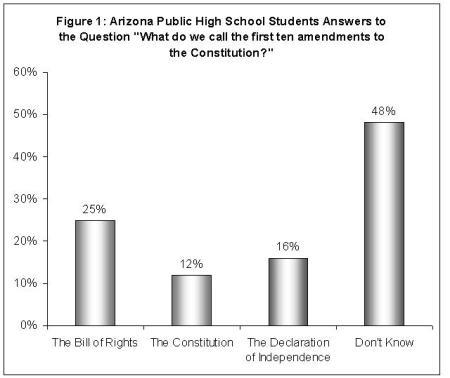
A majority of Arizona public high school students got only one of these questions correct, with 58% correctly identifying the Atlantic Ocean as being off the east coast of the United States, with 42% unable to do so. It was all downhill from there. 29.5% of students identified the Constitution as the supreme law of the land, 25% of students identified the Bill or Rights as the first 10 amendments to the Constitution (12% said they were called “The Constitution” and 16% “The Declaration of Independence.”)

Twenty three percent of Arizona public high schoolers identified the House and Senate as the chambers of Congress. Nine point four percent that the Supreme Court has nine justices. Only 25% of students correctly identified Thomas Jefferson as the author of the Declaration of Independence. An almost majority of 49.6 percent identified the two major political parties, only 14.5% answered that Senators are elected for six year terms. Finally, only 26.5% of students correctly identified George Washington was the first President. Other guesses included John F. Kennedy, Ronald Reagan, George Bush and Barack Obama.

Only 26% could identify the President as being in charge of the Executive Branch. All in all, only 3.5% of public school students passed the test by getting six or more items correct. That’s 40 students out of a sample of 1,134 district students.

There were no major differences in performance based on grade (Seniors did approximately as poorly as Freshmen) nor by ethnicity. Profound ignorance is quite equally distributed in large measure across students in the public school system.

Two obvious questions to ask: is it fair to give this test? In order to answer, I examined the Arizona state standards for 8th grade social studies, which all or nearly all of these students will have taken. These standards are included as an Appendix in the study. What they show is that students are supposed to have learned about John Locke, the Mayflower Compact, the Articles of Confederation, the Constitution, Checks and Balances, Seperation of Powers, etc. etc. etc.

Everything they ought to have needed, in other words, to have passed this test. If, that is, they had actually learned any of that material in practice, which they obviously did not.

Second, I gave the test to my own 1st and 2nd grade sons. They both got 3 answers correct. We’ll be working on that. In so doing, they outscored about 40% of the Arizona high school sample, and tied or exceeded about 60 percent.

Charter school kids performed far better but still terribly- with a passing rate about twice as high as the public school kids. Private school students passed at a rate four times higher, which ultimately is both much better and still pathetic.

I had a very difficult time writing a conclusion to this study. More on that for the next post, but you tell me: if you were an Arizona lawmaker what would you do about this?


The Supreme Court’s Special-Ed Vouchers

June 24, 2009

(Guest post by Greg Forster)

Following up on Jay’s observations on the Forest Grove School District v. T.A. decision – not being a lawyer, I’m not going to dwell on this point. But it seems to have passed under the radar and I want to bring it out into the open so that others, who may be better qualified than I, may give it the debate it deserves.

For years, whenever I’ve explained that if the IEP procedure (over which schools have predominant control) does not deliver to students their IDEA rights, the only recourse parents have is a lawsuit, people have looked at me like I was nuts. They just stare with this dumbfounded look on their faces. The system can’t really be that crazy, can it?

The Supreme Court seems to have the same dumbfounded look on its face:

Having mandated that participating States provide a FAPE [free and appropriate public eduction] for every student, Congress could not have intended to require parents to either accept an inadequate public-school education pending adjudication of their claim or bear the cost of a private education if the court ultimately determined that the private placement was proper.

Now, as a psychological observation (which it is formally presented as being) this is farcical. Why couldn’t that have been Congress’s intention? Why assume Congress had pure and unsullied motivations when it created IDEA, rather than allowing the possibility – just as a possibility – that Congress knew darn well what it was doing, and decided to screw over children with special needs in order to serve its real constituents?

But, of course, while this is formally a psychological observation, it is serving the function of legal reasoning. What the court is really saying is that it would be fundamentally unjust – it would be a disgusting inversion of the fundamental function of the law – for Congress to deliberately legislate a right and then create a process desigend in a way that effectively denies relief to people if they are denied that right. So the court is entitled to assume that this was not Congress’s intention.

This takes us very rapidly into deep philosophical waters. Should the court interpret the law on the assumption that Congress does not intend to use the law as a cover-up to screw innocent people?

This, it seems to me, is one of the problems that motivates Scalia’s distaste for framing legal interpretation in terms of “original intent” rather than what he calls “original public meaning.” And I’ve always thought, without being an expert in the field, that “original public meaning” was a much more plausible standard for legal interpretation.

Does that explain Scalia’s dissent in this case?

Discuss among yourselves.


Global Warming Evidence vs. Dogma in Australia

June 24, 2009

(Guest Post by Matthew Ladner)

Robert Tracinski and Tom Minchin have written an interesting article about the role of evidence in the global warming debate in Australia. By their account, the Aussie’s have looked over an economic cliff and decided not to jump.


Choice Victory in Special Ed SC Case

June 22, 2009
The Supreme Court ruled 6-3 today in Forest Grove School District v. T.A. that disabled students that the public schools unreasonably failed to identify as disabled don’t have to wait to seek placement in a private school and reimbursement for those costs. 
This ruling seems to give families with disabled children unilateral access to vouchers for private school if they can later prove that the public schools failed to provide adequate services or unreasonably failed to identify the disability.  The families assume the financial risk if they act unilaterally, but they can be fully reimbursed for their expenses if they are proven right.  The majority reasoned that delays were so long in adjudicating these disputes, that children would be denied their right to a free appropriate public education (FAPE) if they had to wait:
 
“Our decision rested in part on the fact that administrative and judicial reviewof a parent’s complaint often takes years. We concluded that, having mandated that participating States provide a FAPE for every student, Congress could not have intended to require parents to either accept an inadequate public-school education pending adjudication of their claim or bear the cost of a private education if the court ultimately determined that the private placement was proper under the Act.” (see p. 7 )
 
Now all we need to do is to grant to all children what we have given to disabled children.  Why should any child, disabled or not, be made to wait for an appropriate education?  Why can’t all parents seek a unilateral private placement and sue to be reimbursed if they can demonstrate that the public schools were failing to provide an appropriate education? 
 
Even better, why should we make parents prove to a court that the education in the public schools was not appropriate?  Why not let the parents be the judge of the appropriateness of the education being offered?
Updated:  I just noticed that Matt made a similar argument a while back.

Teacher Unions = The Tobacco Institute

June 22, 2009

I want to add a little to my post the other day about how the teacher unions lie and so should not be treated as credible players in policy discussions. 

The unions don’t have to lie.  The NEA didn’t have to falsely claim that the DC voucher program “yielded no evidence of positive impact on student achievement.”  They could have said something about the effects not being large or that there are other harms to vouchers that are greater than the benefits.  A pattern of lying fundamentally undermines the credibility of the teacher unions so that they will increasingly be shunned in policy discussions and lose in policy debates.

You may think that the unions are so powerful that they can just lie and get away with it, but you’d be wrong.  Remember the fate of the tobacco industry.  They created the Tobacco Institute, which produced “research” claiming to be unable to find links between smoking and cancer. 

The tobacco companies didn’t have to do this.  They could have just said that people should be free to choose whether they smoke or not regardless of health risks.  They didn’t have to lie about health effects, they could have just said that it was none of the public’s business whether people chose to smoke or not.

At the time it was conventional political wisdom that the Tobacco Institute could get away with lying because the tobacco lobby was so powerful and rich that they could do almost anything.  But eventually lying destroys one’s credibility in a way that no amount of money can restore.  And the teacher unions may suffer the same fate as the Tobacco Institute.  They may seem all-powerful right now, but over time it is hard to sustain dumb ideas, especially when lying.


Lieberman in WashPo

June 22, 2009

Sen. Lieberman has another great piece in the Washington Post on DC vouchers.  The issue just won’t go away as much as the cool crowd wishes it would.


No News — NEA Lies

June 20, 2009

You read it here on JPGB first.  The NEA sent a letter to members of Congress containing bald-faced lies about the DC voucher program.  Now the WSJ has picked up the story.  The WSJ wrote:

Public school teachers are supposed to teach kids to read, so it would be nice if their unions could master the same skill. In a recent letter to Senators, the National Education Association claims Washington, D.C.’s Opportunity Scholarships aren’t working, ignoring a recent evaluation showing the opposite.

“The DC voucher pilot program, which is set to expire this year, has been a failure,” the NEA’s letter fibs. “Over its five year span, the pilot program has yielded no evidence of positive impact on student achievement.”

That must be news to the voucher students who are reading almost a half-grade level ahead of their peers. Or to the study’s earliest participants, who are 19 months ahead after three years. Parents were also more satisfied with their children’s schools and more confident about their safety. Those were among the findings of the Department of Education’s own Institute of Education Sciences, which used rigorous standards to measure statistically significant improvement.

It should be no news that the NEA lies.  They do not have a commitment to the truth; their only commitment is to the interests of their members and leadership.  If that requires lying, they show no restraint.

The only news is that people, including the news media, public intellectuals, and policymakers, continue to treat the teacher unions as if they were credible actors in education policy discussions.  It is a mystery to me why they are ever contacted for comment by reporters or invited to serve on panels.  People who feel obliged to lie should be shunned and their opinions should never be solicited because their opinion can never be trusted as serving the truth.

I understand that the teacher unions have a right to exist, to represent their members in negotiations, and to attempt to influence policy.  But I don’t know why anyone should help them influence policy since they have shown such a callous disregard for truth and obsessive concern with self-interest.

Now I know that Leo Casey or one of his sock puppets might accuse me of being untrustworthy.  Here’s the difference:  While I might be mistaken, I am unlike the union folks in that my continued employment is not dependent on my holding particular opinions.  If I woke up tomorrow and decided that vouchers made no sense, I would be perfectly free to do so without penalty.  My position as a tenured professor does not depend at all on my believing that something  is true.

The same cannot be said for Leo Casey or other unions flacks.  If they woke up one morning and decided that vouchers were the key to improving the education system, they could not say so and expect to continue to be employed.  If they cannot change their mind without severe penalty, why would we believe that they are telling us their honest opinion now?  And if we can’t be sure that they are telling us their honest opinions, why would we ever ask them for their opinions?

I also know that some might accuse Matt or Greg of lacking the freedom to change their minds since they don’t have tenure like I do.  Actually, there is a remarkable amount of latitude at think tanks for people to say what they really think.  If you don’t believe that, think about Sol Stern or Diane Ravtich.  Besides, if Matt or Greg suddenly changed their minds they could pretty easily find work at another think tank that held a different view.  Where would all of the union people work if they changed their minds?

I say what I say because I believe it is the truth.  The teacher unions say what they say because they want something.


Teasing Out Freedom from Responsibility

June 19, 2009

(Guest Post by Matthew Ladner)

I have a new study coming out from the Goldwater Institute called Freedom from Responsibility: A Survey of Civic Knowledge Among Arizona High School Students. You dear reader get a special sneak-peak!

This study employs a straightforward methodology: we designed a telephone survey instrument to test civic knowledge based upon the United States Citizenship and Immigration Services (USCIS) exam items. The USCIS administers a test to all immigrants applying for citizenship and makes the questions public.

USCIS officials choose 10 questions out of the item bank of 100 questions and give them as a citizenship exam. In order to pass, the applicant for citizenship must answer six out of the 10 questions correctly. The questions are not multiple choice, instead requiring applicants to supply an answer. When they ask “Who wrote the Declaration of Independence” the applicant has to answer “Thomas Jefferson” in order to get the question correct. 

Recently, the USCIS had 6,000 citizenship applicants pilot a newer version of this test. The agency reported a 92.4 percent passing rate for the test among citizenship applicants on the first try. I did not expect Arizona high school students to do that well of course, given that those seeking citizenship have had the opportunity to prepare for the test. On the other hand, Arizona high school students have some advantages of their own: multiple courses in American history and social studies, hopefully exposure to American history outside of school, etc.

I randomly selected 10 of the USCIS questions and included them in a survey, curious to see how many high school students would pass the test required of immigrants.

civics1Here’s your free sample: One of the questions was “What do we call the first ten amendments to the Constitution?” How many high school students attending public schools answered correctly?

“I don’t know” beat “the Bill of Rights” by almost a two to one margin, and 75% of students got the question wrong.

Notice also that 12% of Arizona students thought that the first ten amendments to the Constitution were called “The Constitution.”

Phoenix, we have a problem…


Can Meg Whitman Save California?

June 17, 2009

(Guest Post by Matthew Ladner)

Fortune posed the question back in March and matters have only grown more desperate since. California voters (quite rightly in my view) rejected the Governator’s tax increase initiatives, raising the spectre of default and rumors of a federal bailout.

Living in Arizona, within California’s cultural and economic sphere of influence, you meet California refugees all the time. My colleague at the Goldwater Institute, Clint Bolick, quips that Arizona desperately needs to build a border fence-on our Western border rather than our southern border.

Business Week wonders aloud whether the American economy can recover without California righting its’ economic ship. California had a pretty rotten 1990s overall, with poverty rates significantly higher in 2000 than in 1990. It seems on track to have another rotten decade in the Oughts. The beatings will continue until morale improves.

Forbes recently created a list of the top 10 cities for economic recovery, and the 10 worst cities for economic recovery. Four of the best cities were in Texas. Five of the worst were in California. The country could benefit greatly from a reformed California economy rediscovering the vibrancy of the past.  As it is, California is an economic mess.

California is also dragging the nation down educationally. With 1 in 8 of America’s public school students attending California’s terribly underperforming public schools, we have little chance of climbing the international league tables with California performing so poorly.

The public sector unions speak with a loud voice in Democratic Party primaries, and the Democrats have huge majorities in the legislature. Perhaps California’s public sector unions are following the UAW model: suck the blood out of your host and then seek a federal bailout.

I am a confirmed Californiaphobe, but if the question is: can Meg Whitman save California, my only response can be: I certainly hope so.


New Blog Alert

June 17, 2009

(Guest Post by Matthew Ladner)

John Stossel has lauched a blog. It’s going into my google reader.