McGuire on Unions and Urban Students

June 16, 2009

(Guest Post by Matthew Ladner)

 MaryEllen McGuire of the New America Foundation takes on the unions for dealing out the least experienced teachers to the neediest children in U.S. News and World Report:

Teachers with the least experience are educating the most disadvantaged students in the highest poverty, most challenging schools. Low-income kids are being “triaged” not by experienced teachers, but by those with fewer than three years of teaching to go on.

Does it matter? Absolutely. According to the research, teacher experience is at least a partial predictor of success in the classroom and, at present, one of the only approximations for teacher quality widely available. Experienced teachers tend to have better classroom management skills and a stronger command of curricular materials. Novice teachers on the other hand struggle during their initial years in any classroom.

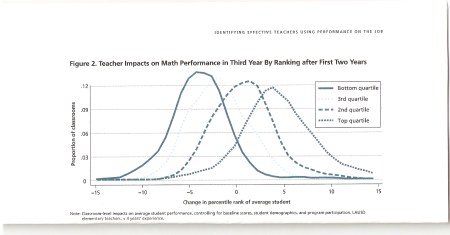
McGuire’s point is valid, but of course we should not be content to use experience as an approximation for teacher quality. There are both outstanding young teachers and truly awful experienced teachers, as you might recall from the Son of Super Chart:
scan0001

The Son of Super Chart broadly  backs up McGuire-the curve for 1st year teachers is centered on -5, and the curve for 3rd year teachers on 5.  All else being equal matching inexperienced teachers with high needs kids is an abominable practice.

Of course, all else need not be equal, which is why Teach for America works well.

McGuire proposes solutions:

Once we can wrap our heads around the true extent of the problem we can start taking down the second obstacle: figuring out a way to entice more experienced teachers to teach in high need schools. This will require a long-term commitment to systemic reform including investing in low-poverty schools to make them more attractive teaching placements and funding incentives to initially attract experienced and, we hope, higher quality teachers to low-income schools.

Will this require dollars beyond what we have? Not necessarily.

Federal law already provides schools with money to pay for this. It’s just that the funds typically go to reduce class sizes or provide professional development for teachers instead – strategies that have mixed results. Some of these funds should be redirected to pay for incentives drawing teachers into high-poverty schools. This is also a great use of stimulus money.

I’m glad to see to someone from the New America Foundation describe the results of class size reduction as “mixed.” Wow- you are half way there. The real word you are looking for however is “c*a*t*a*s*t*r*o*p*h*i*c” and the issue goes much deeper than the distribution of experienced teachers. On average, American colleges of education are recruiting from the bottom third of American college students based on admission scores. 

Reading between the lines, the world is precisely as the unions want it to be: an emphasis on class size and seniority over teacher quality or equity. The system is also perfectly designed to deliver the most needy students low-quality teachers.

John Rawls is surely spinning in his grave.

UPDATE/CORRECTION

I loaded the wrong Brookings study Super Chart! The correct Super Chart! is from page 28 of the same study and shows a  weaker relationship between experience and student learning gains, with year one teachers with a bell curve centered around -3 and second and third year teachers around zero.


TV News

June 15, 2009

How can anyone watch TV news?  First we had the media fawning over Susan Boyle, the British Idol singing star.  Sure she has a nice voice, but the not so subtle subtext of the coverage was: “How can anyone so homely have such a beautiful voice?!”  Wow, we always thought that beauty was an essential ingredient to a good singing voice.

And now we have the sensational coverage of Amanda Knox’s murder trial in Italy.  The not so subtle subtext of the coverage is: “How can anyone so pretty be a murderer?”

I know that all sentient beings understand the shallowness of TV news, but it is worth remarking on these egregious examples.


The Lie Seems to Be Spreading

June 15, 2009

Pinnochio

(Guest post by Greg Forster)

Here on JPGB we’ve been tracking the progress of Dick Durbin’s lie that the DC voucher program didn’t show academic gains – which is all true except for the part where it says that the program didn’t show academic gains. (We’ve also had some fun passing along the AP’s reprot that Durbin tried to help Rod Blagojevich make a deal for Barack Obama’s vacant Senate seat.) Now it would appear that we’ve made our way back upstream to the source.

A little bird told me the NEA has mailed out the following letter to all U.S. Senators. Note the line I’ve highlighted.

June 11, 2009

Dear Senator:

On behalf of the National Education Association’s (NEA) 3.2 million members, we would like to express our strong opposition to proposals reportedly under consideration in the Armed Services Committee to provide private school vouchers for military families.

Vouchers are not real education reform.  Pulling children out of the public school system doesn’t solve problems – it ignores them.  Real reform will put a qualified teacher in every classroom, keep their skills up to date with continuing education, and raise pay to attract and retain the best teachers.

Proponents of a military family voucher program have cited the District of Columbia voucher program as a model.  However, the DC voucher pilot program, which is set to expire this year, has been a failure.  In fact, over its five year span, the pilot program has yielded no evidence of positive impact on student achievement.

Vouchers are clearly not the right solution to ensure every student the highest quality education.  Voucher schools are permitted to maintain their admissions standards and can reject any public school student they choose.  They can reject students based on prior academic achievement and on the basis of gender.  Students with special needs often cannot find a private school that can serve them.  In contrast, public schools serve all students who come through their doors.

Providing vouchers for 750,000 students in military families stationed in the United States would be a huge expense.  These resources would be much better spent on to ensure ALL children the highest quality education.  The U.S. Department of Education has created the What Works Clearinghouse (WWC) clearinghouse to help school districts, educators, parents, and other stakeholders choose programs that have been proven effective.  A brief review of their database revealed dozens of programs that have been scientifically proven effective at improving student achievement in reading and math, at increasing the likelihood of students staying in school and completing their education, and at improving the language and achievement of English language learners.  We have attached examples of these programs for your information.

Again, we urge your opposition to any proposals to create a private school voucher program for military families.

Sincerely,

Diane Shust
Director of Government Relations

Randall Moody
Manager of Federal Advocacy

Of course, the whole letter is shot through with dishonesty – but it’s the sort of dishonesty that’s routine in politics. (E.g. The empirical evidence consistently shows that vouchers do in fact “solve problems,” not only by helping the students who use them but by improving public schools.)

The highlighted sentence, on the other hand, represents the kind of thing you normally can’t get away with. No matter how many Senators you buy.

Hey, here’s a question (and not just for Leo): If vouchers are really so bad, why do their opponents have to lie about them all the time?


Pass the Popcorn: Where Are They Now?

June 12, 2009

(Guest post by Greg Forster)

Don’t let anyone tell you Pass the Popcorn doesn’t take accountability seriously. Opinion about pop culture is so ephemeral, it’s easy to get away with writing crud because you know nobody will remember it in ten minutes anyway.

So to hold myself to a higher standard, here’s a retrospective of my 2008 movie posts, along with an updated opinion with the benefit of 20/20 hindsight (including home viewing where applicable).


Speed Racer

Speed Racer

What I thought last year: Fantastic. Much more than a thrill ride – an exceptionally well constructed and executed melodrama. One of the best movies I’ve seen in years. But I probably won’t enjoy it as much on a small screen.

What I think this year: Boy was I wrong about that last part.


Iron Man

Iron Man

What I thought last year: A better-than-just-good movie that could have been great, except the marketing suits wouldn’t allow the movie to be either clearly pro-weapons-makers or clearly anti-weapons-makers, so the central character development around which the whole movie is built is left ambiguous. That and the climactic battle is lame.

What I think this year: The ambiguity isn’t as bad as I had thought – there are some subtleties that I missed. What’s driving Stark’s crisis of conscience is not that making weapons was bad per se, but that his weapons are being abused. So I’ll upgrade the movie from better-than-just-good to really good. But the battle is still lame.


Hulk 1

The Hulk

What I thought last year: The last Hulk movie really stank in spite of having been made by one of the few really great moviemakers of the 1990s, and this one doesn’t look any better. The Hulk character is probably unfilmable; the emotional intimacy you get in comics and (to a lesser degree) on TV isn’t available in the movie format, so the character’s dependence on anger probably just can’t be well exploited on film. I’m going to skip it.

What I think this year: No regrets.


The Happening

The Happening

What I thought last year: Shyamalan got lazy and his work has gone precipitously downhill. Early reports indicate this doesn’t look like the movie that will turn him around. Skip.

What I think this year: No regrets.


Wall E

Wall-E

What I thought last year: It’s an “A” movie about a lonely robot who discovers companionship, wrapped in a “C” movie about the evils of consumerism.

What I think this year: The more I watch it, the easier it gets to ignore the “C” movie.


Hancock 3

Hancock

What I thought last year: Boy, it’s fun to remember Will Smith’s early-90s novelty act. And this was a fun movie. But not one I’d feel the need to see again.

What I think this year: Yup.


Joker 2

The Dark Knight

What I thought last year: Well, I wrote about it six times (here, here, here, here, here and here) so that gives you an idea of what I thought.

What I think this year: Was six posts really enough?


Quantum-Of-Solace

Quantum of Solace

What I thought last year: Fantastic potential. Squandered.

What I think this year: Can’t wait for the next movie. Can wait to buy this one.


WSJ Dances Kabuki

June 12, 2009

Pollyanna

(Guest post by Greg Forster)

First it was Mike Petrilli, now the Wall Street Journal joins the Obama/Duncan dance on charter schools.

Kids, simply having a charter law does not mean you actually have charter schools worthy of the name.

It can’t be! The Journal!

Jim, we knew this was a possibility when we first confirmed the presence of the kabuki phenomenon.

But . . . the Journal!

The Wall Street Journal is a newspaper, subject to the same political imperatives as any other. To expect it to be immune to kabuki would be illogical.

Oh, come of  it! This is the Journal we’re talking about, you green-blooded hobgoblin! Can’t you think about anything but logic at a time like this!

Shouting will not remedy the situation, doctor. I recommend we ask Mr. Checkov to arm the photon torpedoes.


Rock star teacher pay for Rock Star teachers: Part 4

June 11, 2009

(Guest Post by Matthew Ladner)

How do you get rock star teachers? Offer rock star wages of course! I coauthored a study for the Goldwater Institute laying out a model of achieving $100,000 teacher salaries based on Arizona charter school funding. You can read the previous posts on this here, here and here.

The New York Times features a new charter school that apparently had a similar idea: they are offering teacher salaries of $125k and merit bonuses of up to $25k.

What do you get for that? Well for starters, Kobe Bryant’s former personal trainer as your gym teacher.  “Developed Kobe from 185 lbs. to 225 lbs. of pure muscle over eight years,” his resume says.

The school, named the Equity Project, is located in a rough part of town and will have class sizes of 30 to pay for those rock star teacher salaries.

I don’t know whether the school will be tracking value-added learning gains over time as we recommend in our study.  I hope they will. I for one will be watching with great interest to see how they do over time.


Do You Know What Else Rises to the Top?

June 10, 2009

If Arne Duncan did half of what he talks about, we’d be making huge progress toward education reform.  It would be great if  he actually followed the evidence regardless of ideology, only funded what works, made strides to end the lifetime-guaranteed employment of ineffective teachers, provided financial rewards to the most effective teachers, etc… 

We’d be lucky if Duncan manages to do one-tenth of what he talks about.  But I’m amazed at how many people confuse words with action.  Mike Petrilli is right that we should praise this new rhetoric and Greg has persuasively argued that rhetoric is politically important, but people really get carried away in their praise of a bunch of mostly empty words

Perhaps it is natural for people to suck up to whoever is in power.  Perhaps it is the triumph of hope over experience.  But I have to say that I am deeply skeptical of what Duncan will accomplish.

Let’s take as an example the Race to the Top money.  How does anyone really believe that a one-time expenditure of less than $5 billion is going to have any significant influence on the nature of $550 billion in annual expenditures?  This isn’t the tail wagging the dog.  This is the tail of the flea on the dog wagging the dog. 

What’s more, everyone except the most politically naive understands that there is enormous political pressure on Duncan to distribute the $5 billion roughly equally so that it provides absolutely no incentive to race to the top.  Andy Rotherham has dubbed this the peanut butter meme because people are guessing “how many states the Department of Education will have to include in the ‘Race to the Top’ funds to make the initiative politically palatable without spreading the money like ‘peanut butter’ across the states”

For those who still somehow believe that the Race to the Top money is going to have a big effect (and may also believe in the tooth fairy), I’d like to make a little wager.  I’m willing to bet that every state will receive at least some money from the Race to the Top fund and that the distribution of money will be roughly proportionate. If you think I’m wrong, would you be willing to bet that fewer than 30 states get the money? 

Like with much else that Duncan says, the Race to the Top fund is just a bunch of empty words.  You can’t have 30 and certainly not 50 states at the top.  Unfortunately, cream isn’t the only thing that rises to the top.

Edited to fix the link to Greg’s post; see also Matt’s post and to clarify Andy’s quotation.


Question for Sara Mead

June 9, 2009

(Guest Post by Matthew Ladner)

I saw a documentary on Napoleon’s Egyptian campaign a few years ago. After a completely nasty setback, Napoleon retreated in defeat back to Cairo, but then ordered a victory parade to be held before fleeing the country entirely.

Watching Fordham’s pre-school event online, I can’t help but think that pre-k advocates are trying to do the same thing with Oklahoma: pretend its a victory, when in fact it looks more like their Waterloo.

I watched the Fordham Foundation pre-school event online yesterday. I was especially taken by Sara Mead’s claim that universal preschool could lead to dynamic changes in K-12, and that disadvantaged kids in Oklahoma’s pre-k program made larger gains than other students.

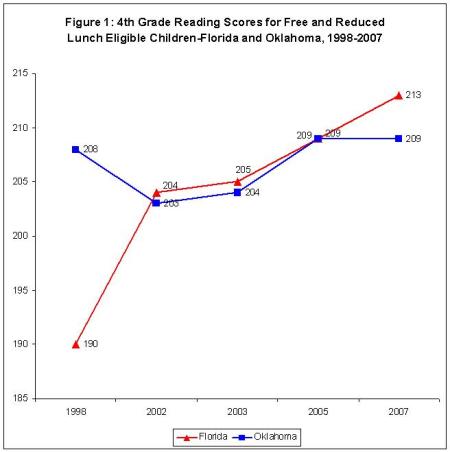
The biggest problem for universal pre-k advocates, in my view, is that the academic gains associated with Pre-K programs fade out. Consider the blue line in the chart below-4th grade NAEP scores from Oklahoma. In 1998, Oklahoma adopted a universal pre-k program.

FL vs. OkI assume that Ms. Mead has a basis to say that disadvantaged children make bigger gains under the Oklahoma pre-k program. The more important question is whether those gains are sustained over time.

Based upon the NAEP scores, Oklahoma’s program looks like a dud, increasing all of one point between 1998 and 2007.

The best one can try to spin out of the Oklahoma situation is scores might have actually dropped in the absence of the program, but now you are really grasping at straws. I seriously doubt that anyone who voted for this program in 1998 could be anything other than disappointed.

The red line, Florida, shows what can be done with a vigorous effort to improve K-12 schools. Florida’s low-income children improved by 23 points between 1998 and 2007.

Florida voters created a universal pre-k program, which was implemented as a voucher, but none of those students had reached the 4th grade by 2007.

Mead would likely argue, and I think she did at the event, that Pre-K and K-12 reform aren’t mutually exclusive, and I agree. It seems fair to ask however: is Pre-K a waste of time as an education improvement strategy? If not, why are the Oklahoma results so dreadfully unimpressive?


The National Standards Sausage-Making

June 9, 2009

Every decade or so we have to debate the desirability of adopting national standards for education.  People tend to be in favor of them when they imagine that they are the ones writing the standards.  But when everyone gets into the sausage-making that characterizes policy formulation, it generally becomes clear that no one is going to get what they want out of national standards.  What’s worse is that the resulting mess would be imposed on everyone.  There’d be no more laboratory of the states, just uniform banality.

Of course, some people always hope that they’ll somehow manage to sneak their preferred vision into place without having to go through the meat grinder.  That’s what is happening now with the National Governor’s Association effort at “voluntary” national standards.  In a process completely lacking in transparency and open-debate, some are rushing to announce a national standards fait accompli.

My colleague Sandra Stotsky tells us what’s what:

“If another country wanted other countries to respect its educational system and the reforms it was trying to make, who would it choose to lead such an important professional project as the development of its national standards in mathematics and in the language of its educational system itself?  In any other country in the world, one would expect a distinguished mathematician at the college level to be asked to chair the mathematics standards-writing committee–someone who commands the respect of the mathematics profession (and obviously is an expert on mathematics).   For the language standards-writing committee, one would likewise expect an eminent scholar in a college-level department–someone whose command of the language and understanding of the texts that inform the development of this language could not be questioned.   If the National Governors Association and the Council of Chief State School Officers had thought about national pride (and national need) as well as academic/educational expertise, then all of us would respect the Common Core Initiative and look forward with eagerness to the drafts the NGA and CCSSO have promised to make public in July.

 These two organizations could have followed, for example, the exemplary procedures followed by the National Mathematics Advisory Panel, on which I had the privilege to serve.  The Panel was chaired by the former president of one of the major universities in the country, all Panel members were identified at the outset, their qualifications were made known to the pubic, their procedures were open to the public and taped as well, and the final product was hammered out in public, after dozens of reviewers provided critical comments. 

 But instead of choosing nationally known scholars to chair and staff these committees–to assure us of the integrity and quality of the product–the NGA and the CCSSO have, for reasons best known to themselves,  treated the initiative as a private game of their own.  The NGA and the CCSSO haven’t even bothered to inform the public who is chairing these committees, who is on them, why they were chosen, what their credentials are, and why we should have any confidence whatsoever in what they come up with. 

 One person has announced on his own to the press and to a state department of education that he is chairing the mathematics standards-writing committee. He has not been contradicted by anyone at NGA or CCSSO, so we must assume he’s for real.  It turns out he is an English major with no academic degrees in mathematics whatsoever.  No one has yet announced on his/her own that he/she is chairing the English standards-writing committee.   One wag has already wondered whether this person might be a mathematics major with no academic degrees in English.  But it’s possible the sad joke in mathematics is not being repeated in English. 

 This country deserved better for a project of such national importance.”

Sandy Kress added these words of wisdom (pardon the capitalization since this was a comment on a post at Eduwonk):

“i suspect after the good feelings wear off, other governors and chiefs will begin to ask whether they can or should consider new standards at this time. once they learn about how hard it is to write new standards, they will ask even more questions. when we get to the controversies around whole language vs. phonics, they will ask more questions still. then comes computation vs. concepts. then comes all the many questions that arise once you get below the level of 30,000 feet. then – God forbid – you might even get to the place where you might possibly find the new standards under consideration to be no better than (or even possibly worse than) the standards you have! could it be that the tradeoffs that happen nationally will be the same as those that occur in the states? could the same interest groups intervene? could this nice dream be interrupted by the demons that bedevil state standard setting? could these interests be the problem as much as variation? oh no, could it be there’s no santa… no, i won’t go there.

and, oh yes, what about performance standards? if we ever get to detailed precise standards in each grade for reading and math, do the participants agree to common performance standards? if they don’t, who’s kidding whom? the real problem today is not so much that some states have vastly higher standards than other states; it’s more that their performance standards are greatly different. have the states, or will the states, commit to making those the same? if not, this will be utterly fruitless.

listen – DO NOT GET ME WRONG – i’m all for higher, fewer, clearer standards. i’ve spent a lot of time working on improving texas’ standards over the past 20 years. i’ve spent a lot of time with the hunt institute pushing more common standards. this is indeed the right thing to do.

but this process is going to be much more difficult than some think. it won’t happen overnight, nor should it. and there will remain great variation at the end of the day. it is utterly naiive and/or foolish to expect states to jump track from their current gameplans, particularly where they’re reasonably well thought out.

be prepared for states to recognize this “the morning after.” texas just recognized it before “the drinking began.”

also be prepared to realize that a better approach might be for one or more of these organizations to begin by recruiting the best and the brightest and actually doing the hard work of developing a few sets of model standards and then shopping them to the states, with the political support of those who rightly want high, common standards as well as perhaps some incentives from the feds to take these steps.” 

(edited for typos)


Synchronize Your Watches…

June 8, 2009

(Guest Post by Matthew Ladner)

James Sherk and Dan Lips point out that the Obama administration is lowering the amount of transparency for unions even as the Indiana swindle unfolds.

Meanwhile the NEA seems to have shifted its position from “we will take care of this” to “it sucks to be you disabled teachers” back to “we will take care of this.”

Synchronize your watches for 15 minutes and we will see what they say next.