Los Estados que no desea ser reencarnado en si viene como un niño pobre de los hispanos.

November 4, 2011

(Guest Post by Matthew Ladner)

So how did my English to Spanish translator website do? I studied French while a student, which has come in handy about three times in my life, and may never do so again.

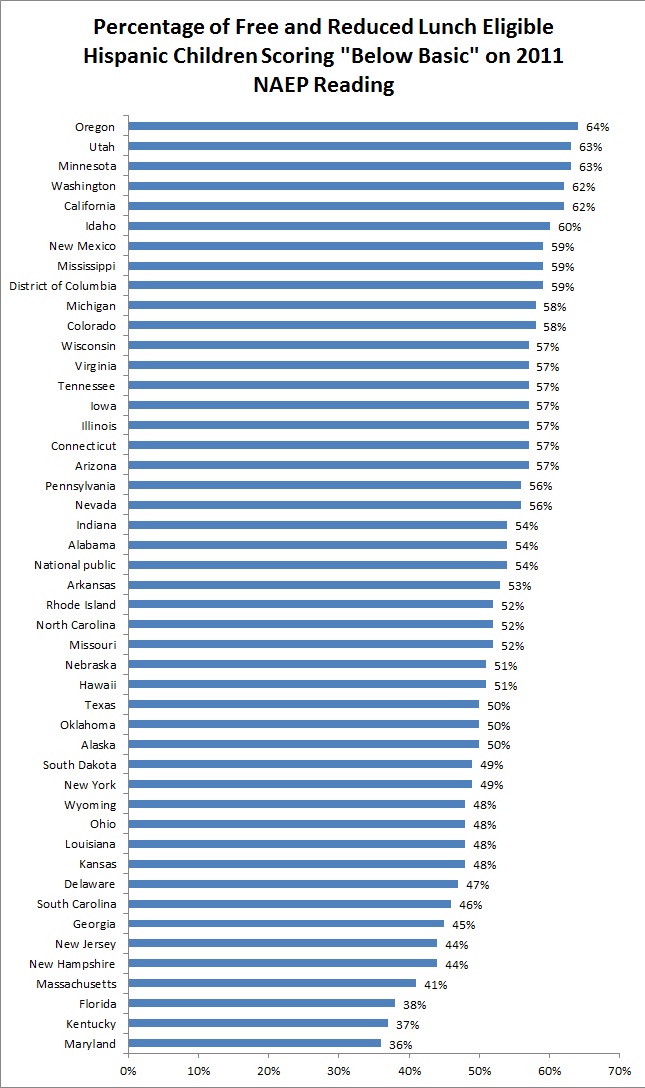
But I digress. The chart here ranks states by the percentage of low-income Hispanic students scoring “Below Basic” on the 4th grade NAEP reading exam in 2011.

Like any of these reincarnation charts, there are any number of factors to bear in mind. Some states have more ELL students than others, generational effects are important, and Hispanics are far from monolithic.

Nevertheless, isn’t it interesting that Oregon yet again makes an appearance in the hall of shame. Last time I visited, Oregon was way up in the Pacific Northwest and far from the southern border.

Now that the mandatory Oregon mocking is complete, let’s talk serious business: California is a disaster. The sheer size and low scores of the California Hispanic population ought to be a national concern. While it is fun to poke at Oregon for a being even worse than California, California’s Hispanic population is a sea to Oregon’s pond.

Matters are far better in Texas, the home of the second vast Hispanic population in America, but still very much in need of improvement.

California and Texas educate more than half the nation’s Hispanics, almost 5.5 million students. We need California to wake up, and for Texas to step up.


2011 NAEP: Florida Finally Hits a Wall

November 3, 2011

(Guest Post by Matthew Ladner)

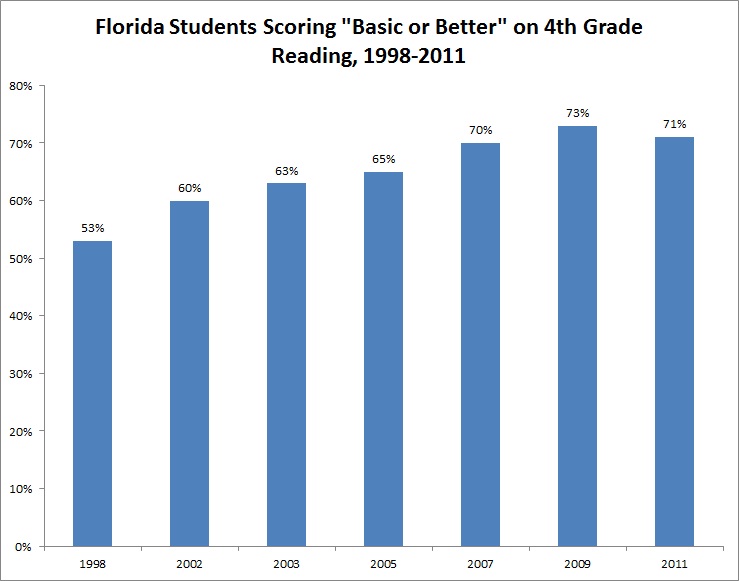
The Florida Age of Public School Improvement hit a wall in the 2011 NAEP. This should not be terribly surprising, as Florida’s improvement seemed certain to plateau in the absence of additional reforms.

Governor Jeb Bush relentlessly pursued a dual strategy- transparency with teeth from the top down, parental choice from the bottom up. Together these reforms drove improvement in the public schools for a number of years.  Accountability measures included school grading (A-F) and earned promotion in the early grades. Parental choice measures included Opportunity Scholarships for children attending F rated schools, the nation’s first special needs voucher program (McKay Scholarships), the nation’s largest scholarship tax credit program (Step Up for Students), a decent charter school law and the nation’s most robust system of digital learning. Florida lawmakers also attempted to thoughtfully incentivize success.

Governor Bush took office in 1999 and left office in 2007. It would be nice if these efforts could indefinitely push progress forward, but there have been plenty of bumps and problems along the way. In 2006, the Florida Supreme Court rendered a logic-free ruling abolishing Opportunity Scholarships (failing school vouchers) for private schools, and followed that up by ruling against a state authorizer for charter schools. Tax-credits, McKay and digital learning continued to incrementally advance, but not at an earth-shattering rate.

The larger problem may have come in the top down measures. The chart below presents the distribution of district and charter school grades, with one line being the A/B grades and the other D/F grades. The dotted lines represent instances when the state board raised school grading standards.

The setting of these standards represents far more of an art than a science. Set them far too high and disaster follows (this happened in Arizona). Set them too low, and you remove the tension in the system needed to drive improvement. Even after the last increase in grading standards, more than 10 times as many Florida schools received A/B grades as D/F grades.

Florida’s policymakers raised standards four times, and last year (wisely) put in an automatic trigger to raise standards by a preset amount when a certain ratio of schools get A or B grades. In addition, a fresh set of reforms passed the Florida legislature in 2011, revamping teaching and increasing charter school and digital learning options.

Just as it is impossible to exactly pinpoint how much of what caused the gains, it is likewise impossible to say exactly what made them stall. Note however that one of the favorite explanations of the anti-reform crowd, the pre-school, finally saw the advent of children old enough to have participated in the program and age into the 4th grade NAEP sample. I hope that someone is carefully studying variation in participation and corresponding trends in FCAT data, but the results at the aggregate level thus far seem underwhelming.

Plenty of other things, however, have been going on- including the collapse of a housing bubble, cutbacks in public school funding (including of some of the incentive funding programs) and a variety of other very bad things. My advice to Florida policymakers: roll up your sleeves and get back at it. Despite the enormous amount of progress seen on NAEP (and no one loves celebrating it more than me) too great of a gulf lies between a state system awarding ten times as many top grades as low grades but still  suffering from large minorities of students scoring below basic on the NAEP exams.

Governor Bush has consistently said for years that success is never final, and reform is never finished. The 2011 pause in progress demonstrates that he called it correctly.  Moving the needle on student learning on a meaningful scale and at a sustained basis represents one of the greatest public policy challenges of our times. Governor Bush has passed the torch to a new generation of Florida reformers, and they must now find new ways, and fine-tune the old ways, to push academic progress forward.

Edited for typos

The New No Excuses: Where Not to be Reincarnated a Rich White Kid

November 3, 2011

(Guest Post by Matthew Ladner)

So the plot thickens, as many JPGB readers (including this author) was born as an American White kid who was not eligible for a Free or Reduced Lunch. In the Great Reincarnation to Come, maybe that is always how it works out!

Or maybe not.

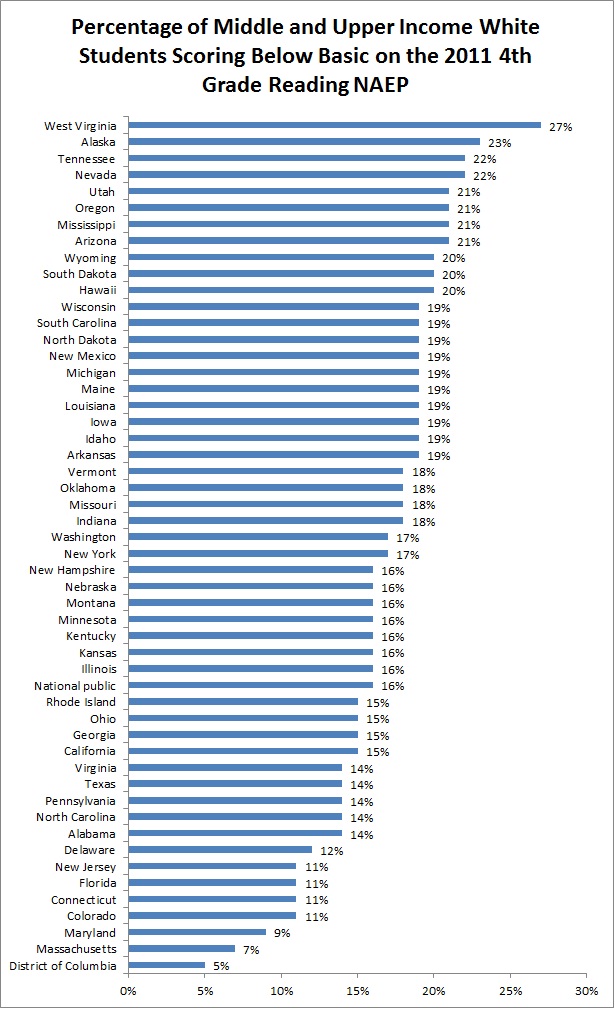
In any case, you ought not to feel overly reassured. Assuming again that you want to learn to read, the above chart shows achievement levels from the 2011 NAEP for non-FRL eligible White students.

Before proceeding to dwell on West Virginia and others, I should note that DC has finally come in first place in something! If you are an ultra-wealthy White student going to one of the highly exclusive public schools in Georgetown, your reading ability rocks. Congratulations to the portion of the DC school into which few poor kids ever step foot much less attend.

Something has been going wrong in West Virginia, as their NAEP scores have been declining. Alaska is a different sort of place that obviously needs to get their act together on K-12. Tennessee can’t be happy to see themselves near the top of this list, and Nevada needs to let go of the idea that you don’t need to be well-educated to deal blackjack.

And then, there’s Oregon. Someone please explain to me why 21% of middle and upper income Anglos in Oregon should be illiterate.


2011 NAEP Guide Where to Avoid Being Reincarnated as a Student with a Disability

November 2, 2011

(Guest Post by Matthew Ladner)

I’m back from SLC, where I had the honor of serving as the opening act to Indiana Superintendent of Public Instruction Tony Bennett. Getting back to the mad science of exploring the 2011 NAEP, and keeping with a sudden OCD fear that I have developed over the possibility of being reincarnated, I present to you the states you want to avoid and those you want to pray to be born into in the next go-around if you happen to be born as a child with a learning disability, and you would like to learn how to read by the 4th grade.

So, whatever you do, try to load the dice to stay out of Washington DC, Hawaii, South Carolina, Alaska and Arizona if you think you might be coming back as a child with a disability.

Conversely, you’ve hit the relative jackpot if you land in Maryland, Massachusetts, Kentucky,New Jersey or Florida.

Seriously DC? 153?!? A mere 60+ point difference between next door neighbor Maryland?

My Cosmic Awareness/Spidey Sense just told me that you were just thinking “yeah, but hey no fair, because Maryland is far wealthier than DC.”

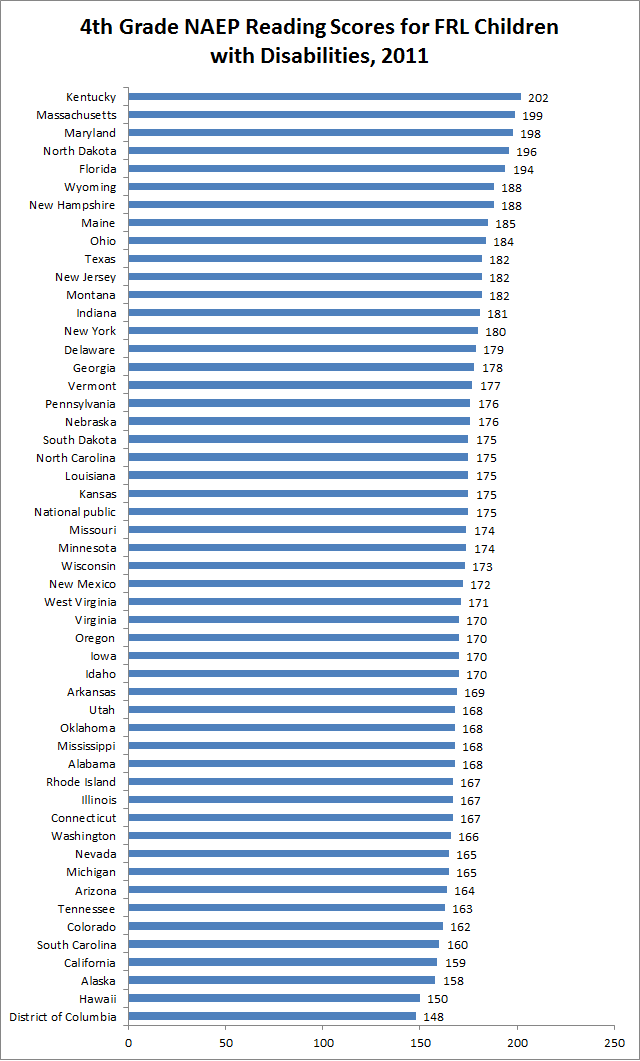
Except, well, it doesn’t really matter so much in terms of the gap. Below you will see a chart for Free and Reduced Lunch Eligible students with disabilities. The top 5 get shuffled a bit, but there is still an appalling gap between DC and the top performing states.

So as you make your reincarnation plans, just remember to stay away from DC, whereas if you have the misfortune of being born with a disability the chances of being academically warehoused seem to approach a near certainty.

Sadly, DC has plenty of company at the bottom.


Review the Charter Research, Don’t Pick the Outlier

November 2, 2011

Julian Betts and Emily Tang at the University of California at San Diego have a new systematic review of the research on charter schools.  They look at more than 30 studies that meet minimal criteria for research quality.  They find that charters have statistically significant positive effects on math and reading achievement in elementary grades and on math in middle school.  There are no significant effects for reading in middle school or for high school student achievement.  The size of the effects are modest, ranging between 2% and 6% of a standard deviation.  (See Table 2)

It’s important to step back and review an entire literature, rather than focus on a single study.  It is sensible to focus on higher quality research, since results are highly sensitive to research design.  But it is completely inappropriate and misleading to pick a single study while ignoring all others of equal or higher quality simply because that one study produces the result you like.

Of course, highlighting the one study she likes is Diane Ravtich’s stock in trade.  All we hear from Ravitch and her Army of Angry Teachers is about the CREDO study.  That’s one study — and not a high quality one.  And even then Ravitch distorts what CREDO finds.

But Betts and Tang’s review includes CREDO and dozens of other studies.  When we look at the full set of research, we see some significant and positive results.  And in Table 4, Betts and Tang show us that if you exclude the CREDO study, the positive effects for charters get stronger so that charters significantly improve math achievement across all grades.

Of course, you shouldn’t exclude that one study, but it is informative that the one study that Ravitch and her Army of Angry Teachers hold up as proof of their view that charters don’t work is clearly an outlier from the full set of research.  And if we focus on the highest quality random-assignment studies of charter schools, the positive results are even stronger.

I wonder if Diane does this in her historical research.  Does she pick the one quotation or document that supports her argument while misleading readers about the entire set of information?  It’s harder to catch Ravitch in this sort of deceptive scholarship in historical work, but in quantitative empirical research, it is the essence of what she does.

(edited for typos)


Make Sure Not to Be Born in Michigan when Poor and Black

November 1, 2011

(Guest Post by Matthew Ladner)

If you want to learn how to read anyway, you need to stay away from Michigan, that is to say Detroit, if you are concerned about being born a poor Black child in the next life. The 2011 NAEP says to stay away from Iowa, Maine and DC for good measure.

On the other end of the scale: MA, NJ, DE, MD and FL are looking relatively good. Low-income Black children in Massachusetts reads a mere 2.5 grade levels ahead of their peers in Michigan on a 4th grade test.

Must run to the airport now. More later…


The 2011 NAEP Guide Where Not to be Reincarnated as a Poor Child

November 1, 2011

(Guest Post by Matthew Ladner)

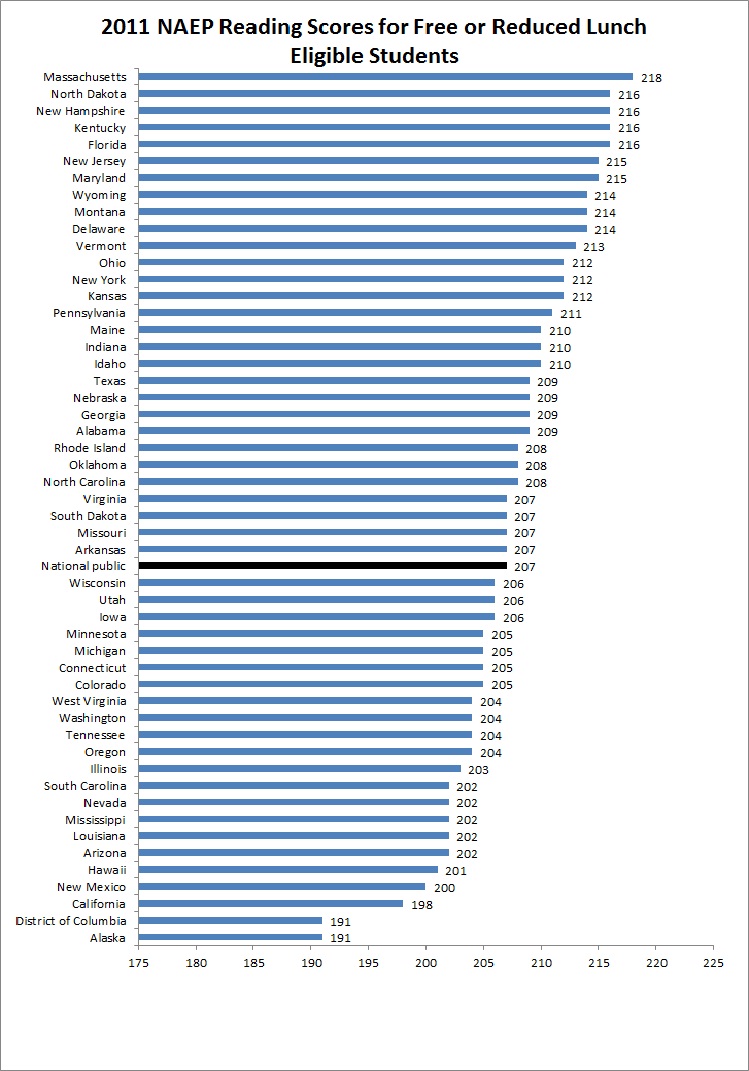
The chart on the right presents scores for Free and Reduced Lunch Eligible students on the 2011 NAEP 4th grade reading test. Memo to self: remember not to come back as a poor kid in Alaska or DC in the next life. Ten points roughly equals a grade level worth of progress. Low-income kids in Alaska and DC are reading almost as poorly as 1st graders in Massachusetts, which is to say, not much all.

Florida hit a wall in terms of improvement (more on that later), DC saw nice math gains but not much progress in reading, Arizona finally started to move the needle a bit, and it is not entirely isolated to Hispanic children.

The 2009-2011 scores are pretty “meh” so far, and this biggest story I am finding is something big and positive going on with Maryland’s reading scores: 8 point gain for FRL kids between 2009 and 2011, and a nothing to sneeze at five point gain among middle and high income students.

More to come…


Save a Pretzel for the Gas Jets

November 1, 2011

There’s a hilarious series of videos of “bad lip reading” of presidential candidate’s speeches.  Check out these to get you started.  And for your information, I am in 100% agreement with Perry that we should “save a pretzel for the gas jets.”


Winner of the 2011 Al Copeland Humanitarian Award: Earle Haas

October 31, 2011

We had several especially worthy nominees for this year’s Al Copeland Humanitarian Award.  Greg nominated Charles Montesquieu, I nominated David Einhorn, and Matt nominated Steve Wynn.  But Anna Jacob nominated this year’s winner: Earle Haas, the inventor of the modern tampon.

Montesquieu’s nomination was especially important in light of the clear shift away from rule by law to rule by regulators.  No one knows what the health care bill actually required; most of the important parts were left to be decided later by regulators.  The new financial regulation is similarly just a template for regulation to be determined later.  This is a very corrosive and dangerous development in a representative democracy and Greg was right to warn us about this.

But it is not quite worthy of “The Al.”  As Greg notes, we are letting Montesquieu’s ideas about the rule of law slip away from us.  If someone were able to reverse that alarming trend, that person might be worthy of “The Al.” There is no shortage of good political philosophers and most have received plenty of recognition.  The tricky and courageous part is to properly implement those ideas.

My nomination of David Einhorn was, I thought, a useful antidote to the economic illiteracy of the Occupy Wall Street movement as well as the petty financial regulators who impede short-selling to appease mob anger and (they claim) promote stability.  But I’m not sure Einhorn’s contributions have lacked proper recognition.  Financial news regularly repeats whatever he says and gives him plenty of credit for correctly identifying past corporate frauds and excesses.

Steve Wynn probably most closely resembles Al Copeland in his personal biography.  They are both business people whose products are adored by some while denounced by others.  They both nearly drove their businesses into the ground.  They both have reputations for being personally difficult.  But despite all of these and other failings, they have both done much more for humanity than most people who win humanitarian awards.

But the “Al” is not given for personal similarity to Al Copeland.  Wynn has built some very nice hotels, turned around an increasingly seedy Las Vegas, and launched a fast-growing subsidiary in Macau.  But frankly my life (and most other people’s lives) would be just fine without these things.  I like the frivolous nature of Wynn’s gambling hotels, just like Copeland’s spicy chicken, but the “Al” is not mostly about being frivilous.

Earle Haas’ tampon, on the other hand, has made an enormous difference in improving women’s lives and making our society better.  Women often felt confined to their house a few days every month.  This limited their ability to work, travel, and engage in public life almost as much as restrictions on women in Saudi Arabia — at least for those few days.  Just look at the ad copied above.  The tampon allowed women to more regularly work during World War II to increase productivity.  The tampon helped defeat the Nazis!

But the tampon also helps illustrate where advancements for women really tend to come from.  Technological innovation, like the tampon, helped liberate women and that innovation comes from a capitalist system.  Earle Haas invented the tampon, at least in part, to make money.  Tampax Corporation brought the product to a mass market primarily to make money.  And women were successfully educated about the benefits of tampons through advertising.  Contrary to the loosely Marxist notion that advertising artificially creates desires for unnecessary products, just look at how essential advertising of tampons was in overcoming irrational opposition and ignorance of its benefits for women and society.

Activists, politicians, and other miscreants who regularly receive credit for advancing the interests of women have often done no such thing.  In fact, quite often they have undermined the cause.  Demanding that women be paid the same even if they are more likely to be absent from work just discourages people from hiring women.  But inventing new technologies that reduce the need for women to be more absent from work allows women to be paid the same without harming their employers.  If speeches and laws created reality we would be right to recognize the activists and politicians.  But Earle Haas was able to create a new reality that no speech or law could do on its own.

If the tampon was good enough to defeat the Nazis and undermine Saudi-like restrictions on women, its inventor is good enough for the “Al.”

(Updated for missing paragraph)


Liberal Goons Disrupt Common Core Presentation

October 29, 2011

(Guest Post by Matthew Ladner)

Jay, Rick Hess and others have been critical of the Common Core effort for running a “stealth campaign.” Here in the following youtube video however, you will see Common Core proponents come out to make a public presentation, only to be shouted down by a bunch of left wing yay-hoos.

Apparently the irony of inviting officials to a “real conversation about education” when they have just shouted one down doesn’t sink in to the tiny little brains of these people. Ditto for shouting “Shame! Shame!” as the panel takes the only sensible action and leaves.

Sadly a growing portion of the left seems to espouse free speech right up to the point when someone says something with which they disagree.