Jeb Bush’s big speech about education reform has made it onto NRO this morning. He does not include school choice as one of the four key components of education reform. I can’t imagine why Jeb would no longer view school choice as having been an important part of the Florida formula for success. Oh, wait, yes I totally can.
I am for standards. But choice must succeed before standards can succeed. By dropping school choice from his list of must-have reforms, Jeb is undermining the necessary path to success for standards.
Granted, he does turn aside at one point, under his section on digital learning, to tangentially mention school choice. But then, weirdly, he immediately feels the need to insist that “accountability is the cornerstone of reform.” Why is he suddenly going back to the subject of accountability when he’s already discussed that in a previous section? It’s a total non sequitur for him to bring it back up here – unless, that is, he shares my view that school choice is ultimately at odds with the technocratic, “trust us, we’re experts” spirit of Common Core.
He also asserts CC won’t hurt school choice – but his own defensive rush to demand that “accountability is the cornerstone of reform” after merely mentioning school choice undermines confidence in that assertion.
If anyone wants to contest my read of this speech I would request their responses to two questions: Why isn’t school choice one of Jeb’s four must-have reforms? And why does he suddenly rush to insist that “accountability is the cornerstone of reform” right after working in an anodyne mention of school choice?
One last point: We who prioritize school choice did not pick this fight. It was the CC crowd who came out with guns blazing, demanding that all schools must be judged on their yardstick (not parents’ yardsticks) and spitting on anyone who questioned their orthodoxy. We did not pick this fight. But we will not roll over just because the CC folks have all the money and power. A decade ago, the unions had all the money and power. We survived them, and we’ll survive Common Core as well, because we’re right.
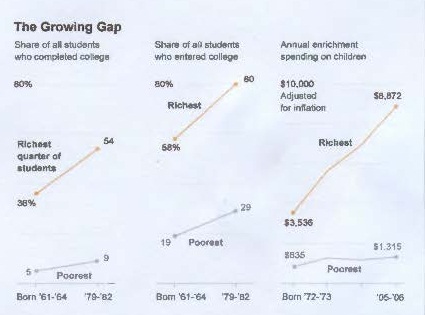
The New York Times published the above chart last December here’s a link if you would like a better look. It basically shows that both college attendance and completion and private enrichment spending have been increasing at a much faster rate among wealthier students.
I find the enrichment spending trend particularly interesting for a couple of reasons. First, like Collin’s grit measure, it seems like an example of something that has been lurking in the error term of our limited understanding of K-12 trends. I’m not sure how the authors define “enrichment spending” but $8,900 per year for well-to-do kids is striking. How much does this matter? I’m not sure but I think it ought to be rigorously researched. It could matter quite a bit.
Four states have average family incomes for a family of four above six figures and one cannot help but wonder how much more this trend influences academic trends than in other states. Washington DC has been gentrifying strongly and has also had a large increase in the economic achievement gap despite large gains for low-income kids. Could this trend be partially explained by this phenomenon?
Money is used so loosely in public education – in ways that few understand and that lack plausible connections to student learning – that no one can say how much money, if used optimally, would be enough. Accounting systems make it impossible to track how much is spent on a particular child or school, and hide the costs of programs and teacher contracts. Districts can’t choose the most cost-effective programs because they lack evidence on costs and results.
The country is broke and even if we did raise taxes to punishing levels to fund this stuff no one should feel the least bit confident that enrichment spending would actually work if funnelled through the existing system. Jay’s idea about supplementing private summer camp attendance might be a better idea but again public finances are a total mess. This is currently in the private realm and it is necessary to keep it that way.
This would seem to leave us with at least few possibilities. Better use of technology may enhance the efforts of both public and private enrichment efforts. Khan Academy is doubtlessly one of the most powerful remedial education tools ever developed. It is free of charge and has branched out into the fine arts, and it is hardly alone. Sandra Day O’Connor has an online civics project for instance but I suspect that these efforts will require some concerted effort to realise their full potential. Putting them up online is a first crucial step, but one cannot help but to fear that their impact might be reminiscent of public libraries absent a sustained effort to get children to use them.
In the TV series Lost some of the characters believed that a set of six numbers had to be entered into a computer every 108 minutes or something terrible would happen. At least initially, it was unclear whether this compulsion to type The Numbers really would save the world from destruction or was just a manifestation of madness.
Typing 6 numbers into a computer every 108 minutes comes to mind when I think about the role that Twitter plays in education policy debates. Some people feel the urgent need to type fewer than 140 characters into Twitter on a very frequent basis. Are they saving the world from something terrible or are they suffering from a form of madness?
Judging by the high status of many of these manic Tweeters you might think they are saving the world. They include respected academics, think tank leaders, and foundation officials, so it would seem that they really must engage in these compulsive acts to prevent something terrible from happening.
Unfortunately, I think they are suffering from a form of madness. Issuing dozens of 140 character messages every day has no real impact on making the world better. It just encourages shallow thinking and petty sniping. In the history of the Universe it is highly unlikely that any Tweet influenced or helped anyone. Yes, maybe an occasional link to an interesting article was influential, but how many interesting articles can one link to each day? It is virtually certain that dozens of Tweets per day have never done anything beyond soothe the Tweeter’s manic anxiety.
Yet, we see that many seemingly respectable education policy analysts feel the compulsion to type 140 characters more frequently than every 108 minutes. And millions of Foundation dollars are being allocated to organizations based on “metrics” that include Twitter counts. What a remarkable waste of Foundation money, not to mention the time of highly educated individuals who could be engaged in productive tasks. Even worse, manic Twittering has coarsened education policy discussions by substituting superficial slogans and snark for actual thought. It has electronically lobotomized people into thinking that “tight-loose” is actually an argument.
To gauge the extent to which this madness has overtaken education policy analysts I’ve updated my Narcissus Index to see how frequently people are Tweeting. When I published the Narcissus Index on April 2 I recorded how many Tweets people had issued as of that date. I collected information on how many Tweets they had sent as of this morning to calculate the number of Tweets people have sent over the last 134 days. In the table below you can see the number of Tweets issued over the last 134 days as well as the average number of Tweets per day, rounded to the closest whole number.
I also calculated how many minutes, on average, went by during every waking hour between Tweets. I assumed that people slept 8 hours per day, so there have been 2,144 waking hours since April 2. That works out to 128,640 waking minutes. Dividing that number of minutes by the number of Tweets since April 2, we can see how frequently people Tweet. Of the 81 people for whom I had information as of April 2, 3 have discontinued use of Twitter. (Good for them!) The results for the remaining 78 are listed below. I’m sorry I can’t easily add new people because I only have the April 2 info for these people.
Of those 78 people, 22 send out a Tweet more often, on average, than every 108 minutes. They meet the Lost threshold for saving the world from destruction. Larry Ferlazzo manages to Tweet every 16 minutes of every waking hour over the last 134 days. Sara Goldrick-Rab is not far behind at one Tweet every 18 minutes. And RiShawn Biddle manages one Tweet every 23 minutes. Diane Ravitch may be slacking as she only Tweets every 46 minutes of every waking hour over the last four months.
Keep in mind that these people must also shower, eat, go shopping, talk with family and friends, etc… It’s summer, so maybe they went on vacation or took a day at the beach. Just think of the number of available minutes consumed with Tweeting. Presumably they also have jobs.
Hitt and Trivitt have taken an enormous step forward to solve this problem. They have discovered that student non-response on surveys (not answering questions or saying they don’t know) is an excellent measure of non-cognitive skills that are strongly predictive of later life outcomes. In particular they examined survey response rates from the National Longitudinal Study of Youth (NLSY) given to students ages 13 to 17 in 1997. The number of items that students answered was predictive of the highest level of education students attained by 2010, controlling for a host of factors including measures of their cognitive ability. If students care enough to answer questions on a survey they are more likely to care enough to pursue their education further.
They then examined another data set to see if they found the same relationship. They did. The number of items that students in Milwaukee answered in a survey when they were in 9th grade was predictive of whether they graduated high school and went to college later, controlling for their academic achievement and other factors.
If this holds up when examined with multiple data sets, it will be an amazing breakthrough for researchers. We will finally have a fairly easy to obtain measure of an important non-cognitive skill that is predictive of later life success.
When studying voucher or other school choice programs, for example, we have observed modest test score benefits for participants, but fairly large attainment benefits. This suggests that school choice has larger effects on non-cognitive skills, but up until now we haven’t been able to observe these non-cognitive benefits without waiting nearly a decade to see if students graduate high school and go on to college. With the Hitt and Trivitt measure, we will have an early warning indicator of whether students are acquiring non-cognitive skills and are more likely to have higher attainment later.
I am not suggesting that the Hitt and Trivitt measure can be used in an accountability system, since it is certain not to work once high stakes are attached. But for research purposes it could be incredibly useful.
Of course, the Hitt and Trivitt measure requires a lot more testing and field research, but it is one of the more exciting recent developments in education research.
When I was a counselor at Sun Fun summer day camp in Glencoe, Illinois we had an annual tradition of “boys day.” The girls had a sleepover the night before, so they all went home to finally get some sleep, while just the boys and male counselors remained at camp. We would divide the boys into color-coded teams and have a “color war” pitting each group against the others in every activity from singing to lanyard-making. At the end of the day, following a giant capture the flag contest, the boys were so riled up that we could have conquered neighboring Winnetka and claimed it for Glencoe. Hubbard Woods was ours for the taking!
At the time my fellow counselors and I used to joke that “boys day” resulted in an anarchic state like Lord of the Flies, with the only exception being that we didn’t kill Piggy. But looking back on it, I see that summer camp was probably the closest thing to true liberty that our kids had experienced. It was certainly more conducive to liberty than school, which gave almost exclusive emphasis to obedience to authority. School was where kids were trained to obey the state and become cogs in a giant corporate machine. Camp was where they learned to be free.
Yes, camp has rules. Yes, camp has authority figures to enforce those rules. But the rules are quite minimal compared to what we find in schools. At camp, kids are given remarkable freedom to explore their interests and develop their individual personalities. They literally can choose to fish in the morning and write poetry in the afternoon.
How is camp able to accommodate so much individual freedom while school seems determined to squash it? A big part of the answer is that camps are generally organized around clear and strong missions, such as religion, sports, music, dance etc… Because people usually choose their camps based on their agreement with the camp’s mission, the leaders of the camp do not have to regulate camper life so tightly to ensure that the organization’s mission is advanced. Schools generally have weaker and less focused missions and so have to create a more oppressive environment to produce compliance. Similarly, freely chosen governments have greater legitimacy and so do not have to use as much force on their subjects.
So purely in the interests of keeping your fighting skills sharp just in case some Common Core supporting crazy old man in a brown robe intrudes on the anti-Common Core cantina, note that a second state after Kentucky released Common Core test results. The results look eerily similar to what happened in Kentucky.
Those guys over there! They said something about cut scores!
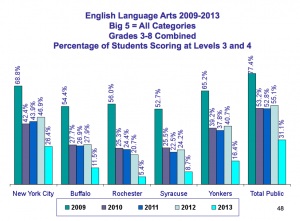
Hat tip to Gotham Schools, here is what happened in Reading:
The math chart looks pretty similar. Proficiency rates, in short, crashed across New York and are now far closer to the proficiency rates of NAEP.
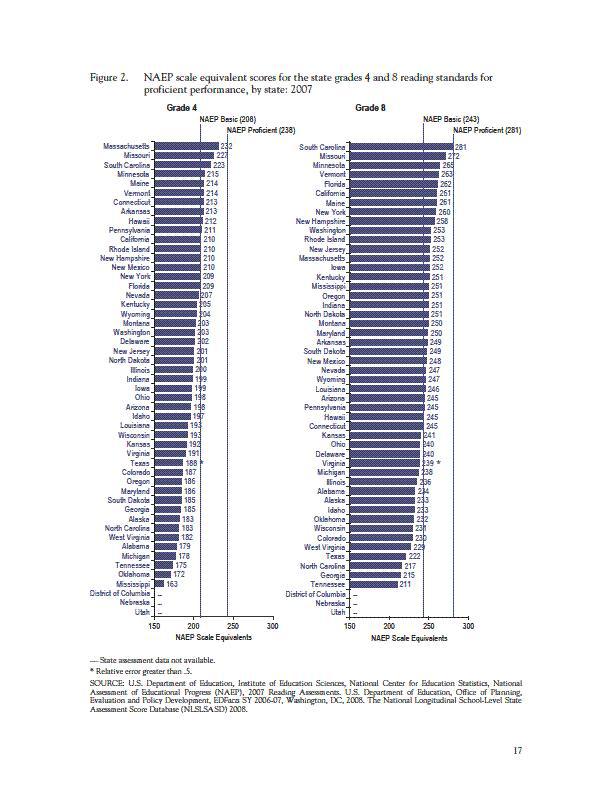
How did the old New York tests compare to NAEP? High middle and high in 4th and 8th grade reading respectively:
Note that neither Jay nor Greg have ever to my knowledge based any argument on the notion that Common Core standards were low or that the tests would be simple. Your humble blogger noted some years ago that even if the tests start out well, that he’d like to hear the plan for keeping them that way. I’ve heard realistic plans for states to pull out if (yes I heard you yell “WHEN!!!” all the way from the Raven Coffee Bar in Prescott Arizona-try the London Fog btw) the bad guys take them over but nothing yet on a broad strategy.
I’m, umm, not famous for paying close attention but my ears do remain open on that front.
Anyway the dummy down narrative however should be (at least for the time being) mothballed, as it is starting to look increasingly unsupportable by that pesky empirical reality stuff. Forewarned is forearmed, and you wouldn’t want to end up like, well, you know…
I noticed Mike Petrilli’s latest post on Flypaper and EdNext Blog about how Common Core will be great despite signs that it is being hijacked and misunderstood. If only we implement the standards as he understands them and “we don’t let misguided ideas stand in our way,” it will signal “a return of history, civics, literature, science, and the fine arts to the elementary school curriculum.”
I tried to think of where else I’ve heard this argument and then I realized that Mike’s piece must have been mangled when it was posted. I think I’ve been able to reconstruct what his original submission must have looked like, and here it is:
Communism’s Best Kept Secret
Shout it from the rooftops, tell all your friends: The Communist era signals a return of equality, decency, and brotherly love. That’s if we don’t let misguided ideas stand in our way.
If this is news to you, you’re not alone. But Karl Marx is doing his darndest to spread the word:
The success of Communism, adopted by more than 29 countries, is supremely important for many reasons, not least because of the recent intensification of global income inequality. But if you look at the actions of those 29+ countries, you will see that they have fallen short of Communist ideals and misunderstood the true spirit of our movement.
There’s a lot about Communism’s implementation that’s tough work and highly controversial. This is not one of them. What workers or vanguard of the proletariat don’t want to usher in the new utopia? Equality, dignity, compassion? Yes please!
Yet the revolutionary leaders might still find a way to screw this up—because they think gulags for dissenters and dachas for the elite are necessary.
So spread the word. As Marx urges in his article’s title, “Workers of the World Unite! You Have Nothing to Lose but Your Chains.”
Check out the new article in Education Next by my current and former students, Marc Holley, Anna Egalite, and Marty Lueken on how traditional public school systems respond to competition from charters. Using an innovative technique they gauge the types of responses exhibited by a dozen school districts. While traditional districts engage in some non-constructive reactions, like focusing on blocking or regulating charters to minimize the competitive threat, overall they find districts rising to the challenge in positive ways. In particular they are finding that districts often respond to charter competition by replicating charter practices, collaborating with charters, developing innovative schools and programs, and expanding school offerings.
Of course, this analysis does not demonstrate that these positive reactions are resulting in improved student outcomes. But responding positively is the first step that we hope will lead to better outcomes. It is certainly a big change from earlier analyses that found districts focused almost exclusively on fighting and blocking charters. It appears school districts have come to realize that charter competition is here to stay and it is best to try to rise to the challenge rather than squash the competition.
Harlem Promise Academy is a charter middle school, part of the Harlem Children’s Zone. Previous studies from Will Dobbie and Roland Fryer have found big test score gains. A new paper by the Harvard research pair finds that the school had large impacts on college attendance, even larger than the previous gains in test scores would have indicated. From their new paper:
Attending the Promise Academy increases the probability of enrolling in college by 24.2 (9.7) percentage points, an 84 percent increase. In Appendix Table 2, we show that lottery winners are also 21.3 (5.9) percentage points more likely to attend a four-year college and 7.2 (2.3) percentage points less likely to attend a two-year college.
The charter school not only increases the likelihood that its students will attend college, but it increases the quality of the colleges that they attend. Harlem Promise Academy is considered an exceptional school in many minds because of its inclusion in the larger HCZ neighborhood experiment, which includes “wrap-around” social services meant to address issues of poverty. So Dobbie and Fryer collected lottery records at three other charter schools across the country that don’t feature HCZ-style community services, including Noble Network in Chicago, a personal favorite of mine. They found similar college enrollment gains.
They also tested whether the Promise Academy had an impact on lifestyle choices. Charter enrollment appeared to lower teen pregnancy rates by 71 percent and, for boys, drove the observed incarceration rate to almost zero.
They close with what I think is a crucial point for the academic community and the education reform movement to understand:
The education reform movement is based, in part, on two important assumptions: (1) high quality schools can increase test scores, and (2) the well-known relationship between test scores and adult outcomes is causal. We have good evidence that the rst assumption holds (Angrist et al. 2010, Abdulkadiroglu et al. 2011, Dobbie and Fryer 2011a). This paper presents the first pieces of evidence that the second assumption may not only be true, but that the cross-sectional correlation between test scores and adult outcomes may understate the true impact of a high quality school, suggesting that high quality schools change more than cognitive ability. Importantly, the return on investment for high-performing charter schools could be much larger than that implied by the short-run test score increases.
As discussed on this blog, there is now a litany of gold-standard studies of charter schools that find test score gains. Perhaps these studies provide only a glimpse of the benefits to come. We don’t know yet, which is why Dobbie and Fryer do what every smart researcher does – they call for more research.
For now, we can say one thing: ANOTHER random-assignment, gold-standard study finds impressive gains for charter schools. What is that now, thirteen? It’s actually getting hard to keep track.
P.S. There’s another intriguing finding. Alums of Harlem Promise Academy were given a survey that included Duckworth’s “Grit Scale,” which asked them to self-report their persistence, focus and work ethic. The charter school alums scored far lower than the comparison group. This suggests that the self-reported Grit Scale may be a bad measure of actual grit, since it suggested the opposite of the grit outcomes that were observed.


 Posted by Greg Forster


 (Guest Post by Matthew Ladner)


 Jay P. Greene's Blog
