If You Thought Education Research was Bad…

August 2, 2013

I’m back from my hiatus and wonder whether I shouldn’t take a break more often given all of that great posts and discussion that occurred in my absence.

I also feel renewed enthusiasm for work from an item I saw in this morning’s Wall Street Journal.  If you think education policy is being made on flimsy research, just look at what the WSJ says some investment firms are using to make decisions.  In Japan traders have noticed a relationship between the airing of Studio Ghibli films, like Kiki’s Delivery Service and Spirited Away, on Japanese TV and bad economic news.  And they are making investment decisions timed with these broadcasts.

Here’s how the WSJ describes it:

Traders call it the “Ghibli Rule” or the “Curse of Ghibli.”… Believers point to the uncanny accuracy of the “rule.” Since January 2010, NTV has aired Ghibli films 24 times. In the following Tokyo trading session, the dollar fell versus the yen nearly three-quarters of the time.

More:

On July 8, 2011, during a showing of “Kiki’s Delivery Service,” a Ghibli film about a young witch and her cat, the payroll numbers came in 86% below expectations and the dollar fell 1.2%. The following Monday, Japan’s benchmark index fell 0.7%.

“I always factor into my trading that when a Ghibli movie airs on a Friday, the dollar-yen market could get volatile,” says Yukio Nakamura, a senior manager at a French insurance company in Tokyo, who dabbles in foreign exchange on the side. “I don’t watch Ghibli movies on TV myself, but I’m always checking the broadcast schedule as a kind of risk hedge.”

Ummm… O.K.  So if Gates wants teachers to make educational decisions based on glorified mood rings while ignoring their own positive random assignment results on small schools and early college, they look like Socrates compared to Japanese traders.  See?  Education policy-making could be worse.


Choice First, Standards Second

August 1, 2013

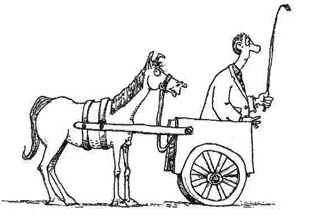
cart-before-the-horse

(Guest post by Greg Forster)

The Miami Herald and Tampa Bay Times are now reporting that Tony Bennett is expected to resign.

As I’ve said all along, this is not about Tony Bennett. This is about whether educational standards should be formulated by politicians and their allies behind closed doors and then presented as the One Best Way to which all schools ought to conform.

Does that mean there can be no standards? Of course not! It means school choice must come first, standards second. Common Core and its allies are putting the cart before the horse.

Creating standards and accountability measures requires judgment. Judgment requires trust. What trust requires is a huge metaphysical subject we don’t have space to get into today, but let’s cut to the chase – people don’t trust the government to do this job by itself, behind closed doors and with no alternatives permitted, and they are right not to do so.

That is not because one particular person or one particular party is corrupt. It is written into nature of things, it is woven into the very fabric of the universe, that human social systems don’t work that way. Not even Denethor, the most virtuous man in Gondor, could be trusted to hold the ring without using it: “If you do not trust me to endure the test, you do not know me yet.” “‘Nonetheless I do not trust you…Nay, stay your wrath! I do not trust myself in this.”

So if that’s not where standards come from, where do they come from? We obviously do have standards, for everything from technical specifications for smart phones to English grammar to the scientific method. Right now we don’t have standards for education. How do we get them?

We get them from the only place standards ever really emerge from: the open, free interaction of civil society, where people are allowed to try whatever makes sense to them and see what works.

Take the scientific method as an example. The early pioneers of modern science – Descartes and Bacon and that crowd – went down all kinds of ridiculous blind alleys. They tried things we would never bother with today. They set down rules for what you’re not allowed to do in science that we would now laugh at. Poor Bacon died from a pneumonia he caught while pursuing a cockamamie experiment, invented on the spur of the moment while travelling during the winter, to test the efficiency of snow as an agent for preserving meat.

So how did we get from there to here? Did the Royal Society convene the smartest smarties in the land and impose order on this chaos? No, we got here by giving scientists the freedom to try what made sense to them and seeing what worked.

They had endless debates. They disagreed about how to do science, about why they did science, about what science could and could not do. The debates were not a part of the chaos, the debates were the method by which order was eventually imposed on the chaos.

That’s what we need today. Instead of cooking up a One Best Way and then demonizing anyone who dissents, we need a forthright admission that we don’t have a consensus about what works, and to give people not only the freedom to experiment, but a social legitimization of their experimentation. Then we can have some really heated debates where we argue with each other over what works. This, and only this, can ultimately create consensus about what works.

I am not saying that government and political power play no role. I am saying government should play its proper role – as a servant of our civilization, not its master. I even think government has more of a job to do than simply forbidding force and fraud. That is why I favor school choice policies on their own merits, not merely as a stepping stone to “the separation of school and state,” as my libertarian friends would prefer.

A thriving marketplace of diverse options, where people are not only empowered to choose but also respected and honored for making their own choices, is the only path to standards. It is the only thing that can make standards legitimate and widely accepted. Of course this means giving up on the desire to impose them on everyone by force, but then, force is wrong and it doesn’t work anyway.

As long as the government runs a school system, it will need to set standards for that system. But it cannot even do that very effectively in the current environment, as we are seeing. A thriving marketplace of options would ultimately create standards with legitimacy and widespread acceptance. Those standards could then be imposed on the government system much more effectively than at present.

People who think standards are everything must choose – is it your goal to have the law tell everyone they must use your standards, and have everyone ignore the law; or to get everyone actually using some standards, even if they’re not yours? You can’t have both.


Are We Allowed to Be Neither Naive Nor Cynical?

July 31, 2013

balance
(Guest post by Greg Forster)

I have a question. Am I permitted to be neither naïve nor cynical about the Tony Bennett emails? Or is there some sort of law that dictates I must be one or the other? Indiana StateImpact places me with the Bennett supporters while Matt seems to think I’m attacking Bennett (I’m not sure how else to interpret “haters gonna hate”). I don’t intend to be either.

I find it difficult to buy the new house line, and I will continue to find it difficult until someone asks Bennett the obvious question: “If this was a glitch in the system, as we are now being told, why did you seek to change the grade only for this one school?” Rick Hess didn’t ask him that question. Matt seems uninterested in asking it, and seems to think I’m a “hater” for asking it. Until that question is answered, I don’t see why I’m a “hater” for pointing out uncomfortable realities.

Is it really so scandalous, does it really make me a “hater,” to acknowledge the obvious fact that politicians are responsive to their donors? When government sets educational standards and has to do what Bennett himself calls a “face validity” test, it is going to know which schools are run by major donors and it is going to be sensitive to that fact. Good grief, are we this naïve?

What we have now is not “the rest of the story” but a failure to seek the rest of the story. Or am I somehow missing something?

On the other hand, Ze’ev and others seem to think I’m saying all standards are arbitrary and there’s no such thing as a rational public consensus. I’m not; I’m just trying to be realistic about what I called “the sausage-making nature of the process” when those standards are being cooked up behind closed doors by a government bureaucracy and its political allies, as opposed to standards that emerge organically from the give and take of a thriving marketplace of options. Technology standards emerge in the context of a system dominated by consumer choice. Educational standards should emerge in the same way.


The Rest of the Story on Indiana Grading

July 31, 2013

(Guest Post by Matthew Ladner)

Rick Hess interviews Tony Bennett about the grading flap.  Odd that a few critically important details were left out of the AP story. Perhaps the reporter would like to come by and explain why 13 schools who lacked 11th and 12th grade students should have received zeroes for graduation rates and Advanced Placement work.

What if Tony had let those zeroes stand? Do you think for a moment that some of these same critics would have failed to howl at injustice of it all?

Me neither.


Tony Bennett Is Having a Bad Week

July 29, 2013

locke-and-walt-LostBG

(Guest post by Greg Forster)

What’s the best way to top off a really Walt-on-Lost level bad week for Common Core? How about a scandal in which emails show one of its most prominent supporters having manipulated his state’s “high standards” system to ensure that a particular school (one founded by a major donor) scored high? Just as that same state becomes the latest to move toward dropping out of a CC testing consortium?

I’d like to take Andy’s bafflement about CC supporters not anticipating pushback on the costs of implementation and double it in this case, if not triple it: why on earth did they discuss this so transparently in their government email accounts, which made it inevitable that the whole ugly show would eventually come out?

I feel sympathetic to Tony Bennett here. Any kind of evaluation system must involve qualitative as well as quantitative testing. That is, you not only have to make sure the numbers are accurately collected, crunched and reported, you have to make sure that what the system is calling “good” really is good. Of course you could in theory test your system by comparing it to the results of other systems, but if that’s all you do, the whole thing is circular. Ultimately you have no choice but to pick some examples of cases that you presuppose to be very good or very bad (or in the middle, for that matter) based on some kind of opinion – maybe yours, maybe your organization’s, maybe a consensus of experts, maybe a popular majority – and see if your system ranked those cases in accordance with the presupposed opinion. It is logically impossible to remove this element of judgment. You just can’t fully test a system for evaluating schools without at some point picking out some super-schools and asking “did these score well?”

Of course, everything hinges on what basis you use for selecting those cases – in other words, whose opinion of which cases are “good” you presuppose, and why. In the real world, if the standards are being set by government, that is always going to be a political process in which one or another set of powerful constituencies are privileged. The Bennett emails reveal the sausage-making nature of the process. What I want to emphasize is that this is not because Bennett is in some way specially corrupt but that this is what any such process must always look like. It is, again, logically impossible to avoid this type of qualitative reality check, and it would be naïve in the extreme to think that any set of political actors would carry out that reality check in any way other than something like what the Bennett emails reveal.

The lesson here is not “Bennett is corrupt” but “all educational standards privilege someone’s opinion of what is a good school, and government privileges the opinion of powerful interests.”


Pass the Popcorn: Much Ado About Nothing

July 29, 2013

(Guest Post by Matthew Ladner)

So in April I wondered whether 2013 would offer up anything to challenge a random collection of old movie favorites I had recently seen on the big screen. It wasn’t looking good, but the Prescott Film Festival just scored, even if it was kind of cheating with a 2012 film.

The Prescott Film festival had what they advertised as the only Arizona screening of Josh Whedon’s Much Ado About Nothing this weekend (Phoenix is not just a physical desert) so I eagerly bought a ticket.  Actress Emma Bates, who played Ursula, was on hand for Q and A after the film.  Here’s the trailer:

.

So the back story on the film is that Whedon has had actors over to his house on Sundays for years to read Shakespeare. He had a short break between shooting and post-production for The Avengers and instead of going on a trip to celebrate his 20th wedding anniversary, Whedon’s wife talked him in to shooting Much Ado About Nothing.  Whedon summoned his friends, including veterans from Buffy, Angel, Firefly and the Avengers, assigned parts, and shot the entire film at his own house in 12 days.  Bates related that Whedon’s wife is an architect and that she had in fact designed their house with shooting Much Ado About Nothing in mind. When you see the flick, you won’t doubt it.

I generally have a bias against American film actors trying to pull off Shakespeare. I watched the old Julius Caesar recently, and while Heston made a pretty good Marc Anthony, enduring Jason Robards playing Brutus with a midwestern deadpan accent was, well, brutal. I don’t think there was a single Brit in the bunch for this Much Ado but it didn’t matter because these guys were rolling with it and having fun. Sean Maher in particular was very good:

But maybe it was because the last American actor I saw play his role was:

Whether you love Whedon or Shakespeare, this movie is well worth the watch.


Al Winner George P. Mitchell Passes Away

July 29, 2013

(Guest Post by Matthew Ladner)

George P. Mitchell, the Texas wildcatter who revolutionized global energy and (among other things) winner of the last Al Copeland Humanitarian Award, has died at age 94. Rest in Peace big guy- you done good.


What I learned in P.E. class

July 26, 2013

(Guest post by Jonathan Butcher)

A few months ago, I grabbed my tennis shoes and went to my son’s last P.E. class of the year, which happened to be a “parent participation” day. This P.E. class is a program for homeschool students, so children of all ages and backgrounds were there to have relay races and play dodge ball.

I had the chance to run around that day with Jordan Visser, a young man I met about a year ago when his mom, Kathy, signed him up for one of Arizona’s education savings accounts. Regular readers of this blog will recognize his name and story from this post.

Jordan is a quiet kid, but he’s got a big smile and plays as hard as any of the other boys. From the video available on the link above, you will learn that Jordan has mild cerebral palsy and has a hard time with is balance—or at least, he did at one time. Since he’s been using the savings account, he’s seen specialists and used therapeutic horseback riding lessons to help his motor coordination, paid for with the education savings account. The account has also helped Jordan’s parents find individual tutors to help with subjects like math and reading.

Now, having run alongside him in a relay where we grabbed a sponge out of a bucket, squeezed it into a cup, then handed it off to the next person, let me be the first to say Jordan’s quality of life has dramatically improved. If you didn’t know Jordan’s story and were watching the PE class from the sidelines, you wouldn’t be able to tell the difference between Jordan and the other kids who were soaking wet and laughing.

Vouchers and tax credits have helped children like Jordan, along with students in failing schools and from low-income households, all over the country for more than 20 years. Education savings accounts use a student’s funds from the state formula to give families the same great educational choices as vouchers and scholarships—and more. The flexibility that parents have to meet their child’s unique needs with an account is unprecedented. Parents can buy online classes, pay private school tuition, buy textbooks, and save for college, to name just a few possible uses.

Lindsey Burke and I wrote a special report that was released today explaining the benefits of the accounts’ flexibility. We also propose ways in which vouchers and scholarships can be enhanced by education savings accounts:

  • Creating public school education savings accounts. Parents could use a public school education savings account for traditional school classes, public charter school offerings, public virtual schools such as the Florida Virtual School, community colleges, or state universities.
  • Shifting existing school voucher or scholarship tax credit funds to an education savings account. States with existing voucher programs or scholarship tax credit programs should allow parents to deposit voucher or scholarship funds into an education savings account in order to gain more flexibility with their child’s funds.
  • Expanding the approved expenses covered by a voucher or private school scholarship. This would include expanding the uses of a school voucher or scholarship, transitioning the program into an education savings account.

Jordan’s education savings account changed his life, and it didn’t take an increase in funding, school turnaround plan, or district consolidation. Let’s keep school choice out front and give all parents the flexibility to help their children, whatever their needs are.


Common Core Is Having a Bad Week

July 26, 2013

locke-and-walt-LostBG

(Guest post by Greg Forster)

When Locke first meets Walt, he says something about Walt getting back to his mother soon, and Walt tells him that his mother died two weeks ago. Locke looks around at the deserted island where they’ve all just crash-landed and says, “you’re having a bad month.”

Common Core is having a bad week. Pop some popcorn and enjoy watching the excruciating downfall of civilization with your host, Andy Smarick. Line for the ages: Smarick links back to an old post of his where he predicted this would happen and then says, “I can’t help but wonder: If some dude blogging from a coffee shop could see this coming, why in the world didn’t Common Core’s and common assessments’ powerful, well-staffed, and deep-pocketed backers get ahead of this?” He should check out the latest medical literature on PLDD.

In the meantime, the argument that Common Core is bad for school choice seems to be getting some traction, to judge by the increased level of desperate insistence (unconnected to logic or evidence) that Common Core is really great for school choice. Hope you’ve got more popcorn, because master magician Jason Bedrick is here to cut those arguments in two. Unfortunately for CC supporters, he hasn’t learned the part of the trick where they go back together.

You still have more popcorn, and you’re tired of knock-down, drag-out knife fights for the fate of the world on the edges of slowly crumbling cliffs? Don’t worry – we have the lightsabers you’re looking for.


What Is Public Education

July 26, 2013

(Guest Post by James Shuls)

What does it mean to support public education? To some, it means supporting the traditional system of education, whereby students are assigned to a local school based on where they live. In my new essay, Redefining Public Education, I discuss why this notion is completely and utterly wrong. Public education is not a system; it is the idea that all students should have access to a quality education at public expense.

Check out the full essay below:

http://

View this document on Scribd