Tuthill on the Shape of Things to Come in the K-12 debate

November 7, 2014

(Guest Post by Matthew Ladner)

Generals are always fighting the last war, and in this must read piece by Doug Tuthill over at RedefinED, Tuthill makes the case that many of our current K-12 debates are already sliding towards irrelevance in an emerging multi-provider K-12 landscape.


Forster-Mathews over/under challenge- place your 2015 bets now

November 6, 2014

(Guest Post by Matthew Ladner)

Election coverage inevitably drifts to beltway drama, but I’m at more than a bit of a loss to understand why. It’s kind of like the nation’s bizarre fascination with 32 football teams running the same offense and defense when a far more interesting and gloriously chaotic brand of football rumbles along in the colleges. My memory gets fuzzy trying to remember the last positive and interesting thing to happen in DC. The action in America is out in the states.

Longtime Jayblog readers will doubtlessly recall the world-famous bet between our own Greg and WaPo columnist Jay Mathews regarding whether parental choice programs were just too politically difficult. They eventually decided to put the over/under for new school choice programs or expansions in 2011 at 7, with the loser picking up dinner.

I can’t remember whether the total got to 21 that year or not. If not, it was close. The school choice movement easily cleared the bar again in 2012. Then in 2013, it was time for a three-peat!  Finally in 2014, the pace slowed a bit nationally in an election year and the Forster-Mathews bar proved too high.

And now?

Only time will ultimately tell, but the elections of 2014 must look pretty bleak if you are burdened in life with reactionary K-12 preferences. Scott Walker for instance not only just won his third statewide election in four years, he’s talking about expanding school vouchers into new districts and providing choice to children with disabilities. Arizona Governor-elect Doug Ducey stated in his victory speech “Schools and choices open to some parents should be open to all parents.”

Out in Florida, Republican Governor Rick Scott defeated Republican, Independent Democrat Charlie Crist in an epic battle. It did not escape the notice of some that the tight margin could have been swayed by the parents of the parents of the near 100,000 children participating in Florida’s private choice programs this year.

In Indiana, Republicans added to their already large legislative majorities and the same thing basically happened in Ohio. A few years ago, an observer of Nevada politics told me that the map of Nevada House were drawn such that a Democratic majority would live at least as long as the current map. Well lo and behold, Gov. Sandoval gets reelected with 70% of the vote and the Republicans capture both chambers.

The WaPo produced this handy map:

This same article notes that Republicans hold unified control over both chambers and the chief executive in 24 states compared to 6 for the Democrats.

Don’t ignore Blue states however. Out in New York, easily reelected Gov. Andrew Cuomo expressed public support for tuition tax credits. From the linked story:

Mr. Cuomo echoed the assemblyman’s call for the passage of the Education Investment Tax Credit, which would help parents pay for religious schools–which the governor compared to his expansion of the state’s Tuition Assistance Program to cover yeshivas and his public funding of busing for students of Orthodox Jewish schools. Mr. Cuomo claimed such funding is simply equitable and right.

“It’s not charity, it’s not a favor. It’s justice. TAP. Public transportation and the school buses, that was justice. Education tax credit–this is a matter of justice,” he said as the crowd broke into applause. “I want you to understand that’s the way I see it. On a personal level, this is a very important relationship that I honor. And as governor, I have sworn to do justice. And there have been a number of great injustices that your community has endured for a long, long time. And it is my profound wish that we should work together and we should resolve them and bring justice to the community that we deserve.”

This is welcome news, as the private choice movement has made very limited progress overall in the mega-states of California, Texas, Florida, New York and Illinois aka where a whole bunch of the kids are located. Charter schools however are rolling along in all of those states, and they seem poised to crush private schools at a much higher rate than low-performing district schools. Even Florida’s nearing 100,000 private choice children in private choice programs seems small when viewed in this fashion. The Illinois $500 personal use tax credit comes across as a bit of a cruel joke when put into this context: the state will lavish many thousands of (increasingly hard to come by) dollars on you if you choose to attend a district or charter school, but will give you a $500 tax break if you choose to bear the financial burden of sending your child to a private school if you have a sufficient tax liability.

The Illinois credit may only be a small step in reducing double payment penalty, but it is more than California, New York or Texas has done to date while charters continue to surge. In the end, private schools ought not to be preserved by nostalgic state lawmakers, but rather (if it is going to happen) by the free choice of parents operating on something approaching a level financial playing field. We need both broader and better designed account-based programs.

Finally choice proponents need to be aware that even seemingly shiny legislative majorities spring on you like a bear trap if you mistake them for an actual consensus. Proponents must never forget the need to persuade a broader universe of opinion leaders and the public regarding the justice of their cause.

Okay so with all that said, I will take the over in 2015. What about you?

UPDATE:

The Friedman Foundation has a handy-dandy guide to the governors and how they stand on parental choice.

UPDATE PART DEUX:

WaPo on the teacher unions spending $60m on races and mostly getting crushed. Money quotes:

“We knew this was going to be an uphill battle,” said Lily Eskelsen García, president of the National Education Association, the country’s largest labor union. “But I don’t think anybody on our side, and we’ve got some very savvy people, anticipated going over the falls like this. Tectonic plates have shifted. And we’re going to have to come back with a new way of organizing for these kinds of races.”

and…

“The surprising thing is you now have Democrats who are willing to buck the union,” said Howard Wolfson, an adviser to former New York mayor Michael R. Bloomberg (I), who contributed to Democratic and Republican candidates around the country who want to introduce more choice and competition in public education, and greater accountability for teachers. “You can take reform positions and be successful not only in general elections, but in primaries. It’s a major sea change in the Democratic party that you can now oppose the union and be successful.”


Let’s “Put on a Show”

November 5, 2014

Below is a piece I wrote for Lenore Skenazy’s Free-Range Kids blog.

Picture

It was a staple of Mickey Rooney and Judy Garland movies that kids from the neighborhood would get together to “put on a show.”  Someone would get the curtains, someone would build the set, and – after some practice – they would perform a play.  Of course, these movies were works of fiction, but they were based on a kernel of truth.  Kids do like to get together, dress up in costumes, and put on shows.  They tend not to be as good as those in the movies, but kids will organize theater performances by themselves if left to their own devices.

But because kids aren’t left to their own devices as much these days, it is remarkably rare to find young people organizing theater performances by themselves.  Instead, these tend to  be part of a school or youth theater activity organized and supervised by adults.  Those can be very positive experiences, but kids don’t learn the responsibility and creativity they could from putting on shows themselves.

Happily, theater organized by young people has not disappeared entirely.  In the middle of America’s heartland, in Fayetteville, Arkansas, a group of adolescents have formed New Threshold Theatre, which is run completely by young people without adult sponsorship or supervision.  My youngest son has joined the group and I’ve been incredibly impressed with the professional quality of their productions.

This year they performed the Broadway musical Into the Woods, and have four more shows planned, including two original works written by kids.  Last year they produced the Broadway musical 13, and had a live sketch comedy show on local television.  They’ve also started a film production company, Archway Productions.

They have done all of this by themselves.  They’ve secured their own performing spaces, sometimes using unused business spaces or renting an auditorium.  They find their own costumes and build their own sets.  They select the works to be performed, cast the actors, and direct the shows.  They even have their own dramaturg.

And all of this is being done by young people.  No one told them to do it.  It is not a school club.  They don’t get grades or class credit.  There are no adult advisers.   It is simply a group of kids who have gotten together to form a theater and video company completely for the fun of it.

I don’t think there is anything else quite like New Threshold Theatre out there these days.  Maybe if we structure our kids a little less, we might open up more opportunities for them to organize amazing things for themselves. That would be something to sing about!


And the Winner of the 2014 “Al” is… Peter DeComo

November 2, 2014

DeComo

This year’s nominees for the Al Copeland Humanitarian Award were a strong group, but one of them clearly stood out as especially worthy — Peter DeComo.

Yes, Markus Persson (nominated by Jonathan Butcher) has done something amazing by developing Minecraft, a game that millions of people enjoy.  But that accomplishment is widely recognized and praised.  The Al tends to recognize the unrecognized, or even reviled.  For some reason video game developers tend to be praised while spicy chicken developers do not.  We’re more interested in the spicy chicken kind.

Lindsey Burke’s nominee, Ira Goldman, developed the Knee Defender, which prevents airplane seats from reclining to preserve leg room.  This nominee is not widely recognized, but falls short for a different reason — the effects of the Knee Defender are zero-sum and do not make a net contribution to improving the human condition.  The device benefits the user by preserving legroom but does so at the expense of the person who cannot recline.

My nominee, Thomas J. Barratt, is generally not recognized and greatly improved the human condition by developing modern advertising.  But many others made significant contributions to the development of advertising.  As beneficial (and wrongly reviled) as advertising is, we cannot properly credit one person for this improvement of the human condition.

Matt’s nominees, Thibaut Scholasch and Sébastien Payen, are strong contenders.  They are not widely recognized.  Their introduction of scientific irrigation methods into the winery business does significantly improve the human condition.  And while French nationals themselves, they face French wine-snob opposition.  As fans of The Higgy and Indiana Jones know, everyone loves a French villain.  But how tough could these French wine-snob villains really be?  They have no legal or regulatory power to block the adoption of scientific irrigation methods.  Only tradition and snootiness stand in the way.  Scholasch and Payen will hardly need more than 6 weeks to overcome this Maginot Line and conquer all of French wine-making.

Greg’s nominee, Peter DeComo, faces a much more formidable set of foes — the FDA and the Department of Homeland Security.  DeComo’s Hemolung Respiratory Assist System might save people’s lives while they wait for lung transplants.  But if DeComo’s company, ALung, fails to fill out the equivalent of a 27B/6 Form, you’ll have to die rather than risk using an unapproved device.  By overcoming the FDA and Border Guards from Central Services to save a life, Peter DeComo has significantly improved the human condition, done so with insufficient recognition, and succeeded in the face of powerful opposition.  That makes him worthy of “The Al.”

As Matt likes to remind us, the movie Brazil is increasingly looking like a documentary rather than a work of fiction.


Gone Trick or Treating

October 31, 2014

You’ll have to wait to learn the winner of “The Al” until this weekend.


Iron Maiden?!? Excellent!!

October 31, 2014

(Guest Post by Matthew Ladner)


Peter DeComo for Al Copeland Humanitarian

October 30, 2014

DeComo

Jon David Sacker and Peter DeComo

(Guest post by Greg Forster)

In the storied tradition of Herbert Dow and the inventors of the heatball, I am proud to nominate Peter DeComo for this year’s Al Copeland Humanitarian of the Year.

DeComo is the chairman and CEO of ALung Technologies, which produces cutting-edge innovative medical technologies that save lives when lungs fail. Get this – ALung makes a gizmo called the Hemolung Respiratory Assist System, which can keep you alive without using your lungs long enough for doctors to perform a double lung transplant, including the time needed for your body to accept the new lungs and start using them.

Pretty awesome, huh? In a perfect world, that alone would be enough to qualify DeComo for public honors.

But we don’t live in a perfect world, and few people have seen that illustrated as starkly as Peter DeComo.

You see, the Hemolung is in active use, saving lives across Europe and Canada – but not in America, the land of its birth. This lifesaving device was invented here, but apparently “for export only,” as Mark Steyn put it. It’s not approved for use in the U.S.

But that didn’t stop Peter DeComo.

This February, Jon David Sacker was rushed to the University of Pittsburgh hospital after his body rejected the transplanted lungs he’d received two years earlier. The Hemolung was his only hope of survival. It was the Hemolung or the hearse for Sacker.

Pittsburgh happens to be the city where ALung manufactures the Hemolung. The University of Pittsburgh is the medical school where the Hemolung was invented. And there were no Hemolungs at the university hospital.

But that didn’t stop Peter DeComo.

The closest Hemolung fit for actual use was in a Canadian town on Lake Ontario. DeComo hopped in the car and personally drove north to the border crossing. He made the trip in the middle of the night, having gotten the first phone call at 11pm. He was met by Murray Beaton from the Canadian hospital, who had popped the device into his car and driven south to meet DeComo. They met and handed off the device in the dark on a tiny dirt road just north of the crossing, and DeComo headed back toward Pittsburgh and the desperately ill Sacker.

Whereupon the border guard informed DeComo that he was not allowed to bring the Hemolung into the U.S., because it was not approved for use there.

DeComo told him that a man’s life was at stake. No dice. Apparently the people who rule our country are perfectly willing to take “someone’s life is at stake” as a reason to actively help terrorists commit more murders and destroy our freedom, but not as a reason to let Jon David Sacker go on breathing.

But that didn’t stop Peter DeComo.

DeComo’s brilliant split-second thinking saved Sacker’s life. The Toronto Star relates the key moment:

Then he changed tactics. He said that he wasn’t really importing the device. Since it was an ALung product and he was ALung CEO, the Hemolung was his property and he was simply retrieving it.

“He closed his little cabin door,” DeComo said. “He made a call and he came out and said, ‘Okay you can go.’”

God bless Peter DeComo.

Are you ready for the kicker? Here it is:

Before they sped off, the border guard shouted out one last comment.

As DeComo recalls, he said: “Hey, let me tell you something. I would recommend that you keep some of that (expletive) on your shelves and next time, you won’t have to make that drive.”

I’m sure he’d love to. In the meantime, since I can’t give him a sane world, I will give him the next best thing: a nomination for Al Copeland Humanitarian of the Year.


School Choice and Religious Freedom

October 30, 2014

Marcher with flag

(Guest post by Greg Forster)

OCPA’s Perspective has published my article on how school choice promotes religious freedom, pluralism, and peace:

It’s folly to be afraid of letting religious institutions participate in public programs on the same terms as everyone else. That kind of oppressive Kemalism has only exacerbated religious hatred when it’s been tried in places like Turkey or France. Americans have historically been more enlightened.

Believe it or not, school choice often helps children learn to respect the rights of those who don’t share their faith, and has never been found to have the opposite effect. A large body of empirical research (reviewed by Patrick Wolf in an article titled “Civics Exam” in the journal Education Next) finds that private school students are more likely to support civil rights for those whose beliefs they find highly unfavorable. Five of these studies have specifically looked at school choice programs; of those, three found the choice students were more tolerant of the rights of others while two found no difference. No empirical study has ever found that school choice makes students less tolerant of the rights of others.

The occasion for the article is an unwise legal decision as an Oklahoma school choice program winds its way through the painfully slow processes of the legal system:

If the church is burning down, don’t call the fire department! That’s using government funds to benefit a church. If someone scrawls swastikas on the synagogue, don’t call the police! And heaven forbid we allow the mosque to use our municipal water and sewer lines. Alas, Judge Jones doesn’t see things that way, and the case will continue its four-year journey through the courts.


Report Card on American Education Released Today

October 29, 2014

(Guest Post by Matthew Ladner)

The 19th Edition of ALEC’s Report Card on American Education: Ranking State Performance, Progress and Reform coauthored by yours truly and Dave Myslinski hit the presses today. Lots of good stuff in this year’s model, including an update of state rankings, a review of the first decade of universal NAEP participation, and a chapter focused on comparing the results of large urban districts.

So going up to the 30,000 level and back down, international results show that the United States is world-class in spending per pupil, not so much in learning per pupil, and that our results for Black and Hispanic students are closer to those of Mexico than of South Korea, despite the fact that Mexico has a far larger poverty problem and spends a small fraction of American spending.

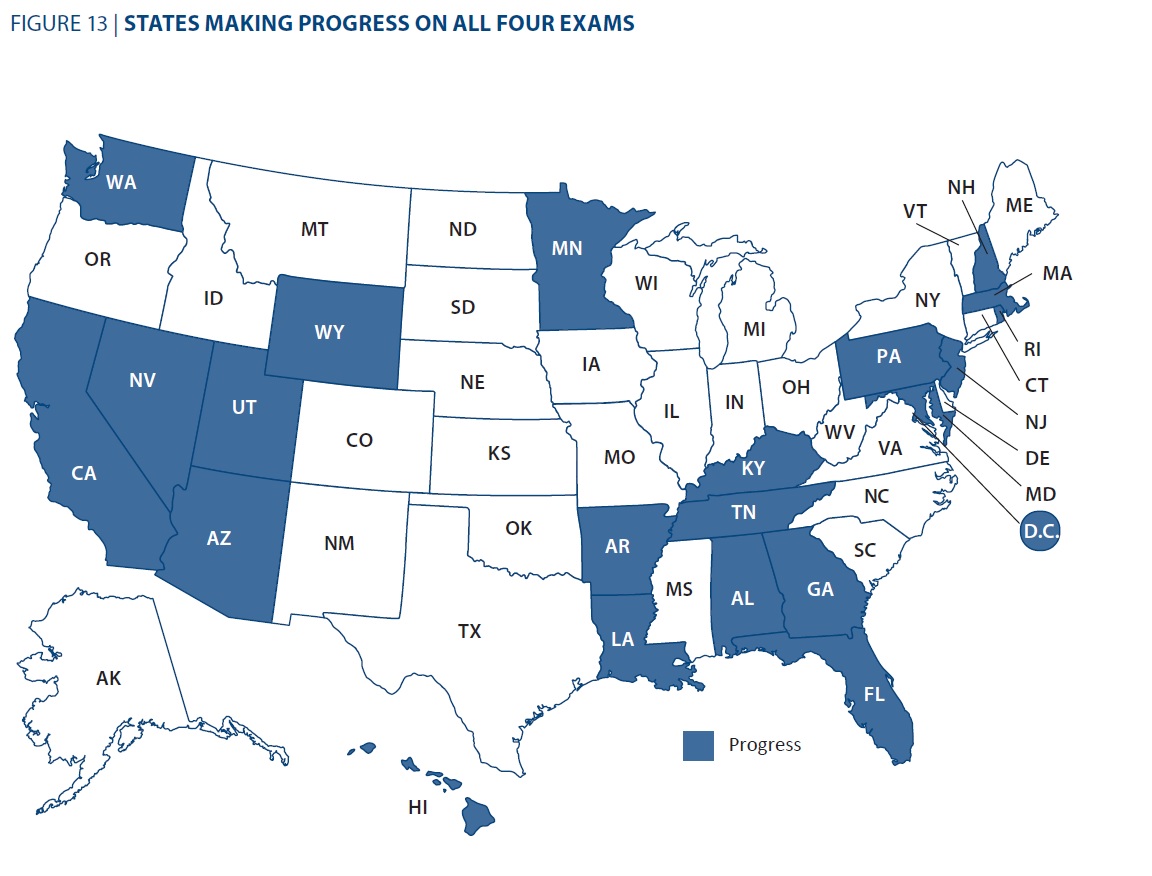
The United States is making progress, but only an average amount of progress so we aren’t going to be catching up  much at the current pace. When you break down American results by state, you find that some states are pushing the national average cart, while others are riding in the cart. Which ones? Glad you asked:

4 NAEP exams


So the states in blue have made statistically significant gains in all four regular NAEP tests (4th and 8th grade reading and math) between 2003 and 2013.  Of the 21 states pulling that feat off, 14 are located in either the West or the South. The Midwest excepting MN, Great Plains, Mid-Atlantic, New York and Texas didn’t carry their weight on improvement (to varying degrees in general math gains were easier to come by than reading, 4th grade improvement easier than 8th grade) during this period. Michigan was the only state to make no significant progress on any of the four regular NAEP exams, a trend I hope they will reverse soon. All other states made progress on one or more of the exams. Note also that this map only shows improvement, few if any of the darkened states have internationally competitive scores, and the few that do tend to hold the good end of the stick on various achievement gaps.

So on the one hand, American education outcomes have never been higher than the 2013 NAEP.  On the other hand, no one yet has any cause for celebration. When we have any states that approach a Asian/European level of bang for the buck in learning outcomes, we’ll let you know about it, but thus far, not so much.

In Chapter 4 of the Report Card we take a close look at the Trial Urban District Assessment (TUDA) NAEP and apply the same “general education low-income” student comparison that we use in the states to improve comparability. Low-income general ed kids were seven times more likely to reach the Proficient level of 4th grade reading in Miami (the top performing district) as in Detroit (the lowest performing). Mind you have only a little better shot at 1 in 3 of scoring Proficient in Miami, so there are many miles to go. Looking at both 4th and 8th grade reading, Miami, New York City, Hillsborough County FL (Tampa) and Boston cluster near the top of the ratings. The District of Columbia does not (yet) rate near the top of the ratings, but their progress over time on NAEP is nothing short of remarkable since the mid 1990s. A large percentage of District students attend charter schools these days, and those charter schools show not only higher scores but also faster improvement than district schools, which are themselves improving.

In any case, slide on down to the following link if you want to see how your state is doing.

Indiana State page


Space-age kid caught in a cave-man system, until now

October 27, 2014

(Guest Post by Matthew Ladner)

The Dayton Beach News Journal has a piece on the new ESA program- Florida’s Personal Learning Scholarship Accounts. We’ve already seen one Arizona ESA parent display a much deeper understanding of the term “accountability” than a number of think-tankers can seem to muster, and this story brings another gem of insight from a participating parent. The News Journal story relates the educational challenges facing a student named Brandon Bremen. Mr. Bremen is working to overcome autism, muscular dystrophy, seizures and an impaired immune system. Brandon had tried everything from public schools, a McKay scholarship voucher to education as a home-bound student with an occasional visit from a teacher. Brandon’s mother Donna sums it up:

Berman stresses she’s not opposed to public schools (she points out her daughter, Bailey, graduated from Atlantic High School in May). She praised the public school staff members’ efforts to help her son, saying she feels they did everything they could within the constraints of state mandates and limited resources. But she felt the schools couldn’t keep up with Brandon.

“It’s unfortunate when you have a space-age child with a caveman system,” Berman said. “His needs out-taxed what the public school is able to give him.”

My reaction to reading this:

LIGHTBULB!!!!!!!!!!!!!