(Guest Post by Matthew Ladner)
The Illinois Policy Institute interviews Howard Fuller on vouchers and voucher critics:
Priceless…
(Guest Post by Matthew Ladner)
The Illinois Policy Institute interviews Howard Fuller on vouchers and voucher critics:
Priceless…
 2 Comments |
  vouchers | Tagged: Howard Fuller, Illinois Policy Institute, School Vouchers |
  Permalink
 Posted by matthewladner

(Guest post by Greg Forster)
In his post yesterday, Jay mentioned that the imperatives behind Common Core are hostile to school choice:
Pushing it forward requires frightening reductions in parental control over education and expansions of federal power. These are not the unnecessary by-products of a misguided Obama Administration over-reach. Constraining parental choice and increasing federal power were entirely necessary to advance Common Core. And they were perfectly foreseeable (we certainly foresaw these dangers here at JPGB).
But back in the day, Jay and I were both supporters of Jeb Bush’s A+ program, which combined standards and choice. So why is Common Core anti-choice where Florida’s standards were choice-friendly?
The answer lies in the imperative to expand standards. As Jay and I have both pointed out, the whole CC project is centrally built on the assumption that there is a positive relationship between the geographic scope of standards and their academic quality. Consistently, CC advocates have used adjectives like “national” and “common” as if they were synonyms for “better.”
Why would we expect standards to be better if they are set at a higher geographic level? The implicit educational worldview behind this is a technocratic scientific progressivism: there is one best way to educate children, and an elite class of technocrats can be trusted to know what it is and get the bureaucracy to carry it out successfully (and without corruption). Consequently, we should want more uniformity across schools. If parents have diverse opinions about what is best for their children and wish to choose diverse schools, we must not permit ourselves to think that this may be because 1) there is no “one best way” because every child is unique; 2) the technocrats’ knowledge of the one best way is fallible; 3) the technocrats’ ability to get the bureaucracy to do its will is severely limited; or 4) power corrupts, and the technocrats and the bureaucracy alike are not to be trusted with monopoly power. Diverse parental desires are to be interpreted as a sign that parents can’t be trusted.
By contrast, A+ did not seek to expand standards; it only sought to impose them on one school system. The implicit logic of A+ ran as follows: if the state is going to run a school system, it ought to set standards for what that system should be doing. However, we have no illusions that the standards we are setting for our own system represent the “one best way,” so parents ought to be free to choose whether our school or some other school is best for their child. With this logic, as Jay used to say, standards and choice are like chocolate and peanut butter – two great tastes that taste great together.
(Of course, it is a comparatively recent development that all the public schools in a state are effectively one school system. Over the past half century or so, America has dramatically shifted from having many thousands of local school systems to having just fifty state systems. And that has been a bad development because it has reduced choice and thereby reduced pressure for improvement. But that’s a discussion for another day; it doesn’t change the fact that the logic behind A+ was non-expansionary.)
Now, it is logically possible for a person to favor both CC and school choice. But the arguments in favor of CC that you have to construct in order to get to that result are the intellectual equivalent of a Rube Goldberg machine. It’s like that court case a few years ago over teaching intelligent design in public schools, where the expert called to testify in favor of ID said that you don’t need to believe in God to believe in ID. That is true, at the level of logical possibilities; you can construct an argument that simultaneously affirms ID and atheism. But there is no one who actually believes that, because the intellectual contortions necessary to get there are absurd. In fact, ID is intuitively theistic even though it does not logically require theism. That fact is not an argument against its truth (unless you begin by begging the question and assuming atheism is true) but it is relevant to the consideration of how students encounter ID in public schools.
In the same way, CC is intuitively anti-choice even though it does not logically require opposition to choice.
32 Comments | National Standards, vouchers | Tagged: A+, common core, Greg Forster, Jeb Bush | Permalink
Posted by Greg Forster

(Guest post by Greg Forster)
Jay has already linked to Pat Wolf’s devastating knockout of the special ed smear campaign against Milwaukee vouchers. However, it’s such a long piece (there’s so much falsehood to debunk!) that I want to make sure the most important points don’t get overlooked:
Pat also points out, against the USDOJ’s claim that private schools in the voucher program are covered by Title II of the Americans with Disabilities Act, that the U.S. Supreme Court has twice reviewed and let stand Wisconsin court rulings finding that voucher schools are not government contractors, and students in the program are “parentally placed” not “government placed” in their schools, so the schools are not within reach of laws that apply to government services. In my (non-lawyer) opinion that does not make it a slam dunk that the voucher schools aren’t covered by ADA, because the ADA is such a badly crafted law. But it’s still worth remembering.
Update: This post has been modified because the original version didn’t state point #2 quite right. My apologies!
1 Comment | special ed, vouchers | Tagged: Greg Forster, Milwaukee, Pat Wolf | Permalink
Posted by Greg Forster
Pat Wolf does a beautiful job on the Ed Next blog of dispensing with a series of false claims about school choice and disabilities in Milwaukee. You should really read it. It’s a work of art.
2 Comments | special ed, vouchers | Permalink
Posted by Jay P. Greene

(Guest post by Greg Forster)
At Brookings, Matthew Chingos looks at a huge swath of CCD data and finds no evidence that charter schools increase racial segregation. No surprise there, as readers of Win-Win already know. It’s been a while since I had occasion to trot out the old race card graphic – my sense is that the segregation talking point has had its day in the sun.
In Education Finance and Policy, Rajashri Chakrabarti looks at Florida school data and contributes the latest in a line of studies showing that schools act in self-interested ways, responding to structural incentives, when classifying students into special programs. Chakrabarti finds that schools threatened with vouchers due to low test scores increased the classification of students as Limited English Proficient, removing them from the pool of tested students; however, schools did not increase classification of students into special education, where they would become eligible for McKay vouchers. The obvious conclusion? All students should be eligible for vouchers – then there’s no system to game.
PS Sorry for the awkward headline – I couldn’t come up with anything snappier or any pop culture references. Uh . . . release the kraken!
2 Comments | charter schools, civic values, special ed, vouchers | Tagged: Greg Forster, Matthew Chingos, Rajashri Chakrabarti | Permalink
Posted by Greg Forster
 (Guest post by Greg Forster)
My colleagues at the Friedman Foundation have released a big new survey of mothers of school-age kids. And let me tell you, momma ain’t happy:
The study also surveyed non-moms, so you can compare and contrast. Unsurprisingly, the differences aren’t large – because if momma ain’t happy…
2 Comments | research reports, vouchers | Tagged: Friedman Foundation, Greg Forster | Permalink
Posted by Greg Forster

(Guest post by Greg Forster)
Well, this is interesting. Someone just sent me a hyperventilating press release from the ACLU bragging about how they got the USDOJ to issue a letter to Wisconsin’s Department of Public Instruction. The letter declares that the Milwaukee voucher program is a “public entity” under Title II of the Americans with Disabilities Act, and is therefore subject to ADA prohibitions on discrimination. USDOJ orders Wisconsin to undertake several actions designed to allow USDOJ to determine whether such discrimination is taking place, and to deter it. You can read the letter here.
I doubt this will be a big deal. There is certainly some minor bad news for school choice here. Assuming this letter stands up to any challenges brought against it, private schools may lose a small degree of autonomy over admissions and services. Private schools ought to be free to say to some parents “we are not able to accommodate your needs”; I know some people think that’s bad, but not every school can be the right school for every child. The failure to realize this basic fact is at the very heart of our dysfunctional government school monopoly. Turning from admissions to services, one reason private schools are able to provide better services to disabled students is because they aren’t tied down to the rigid IDEA bureaucracy that public schools are required to use. This letter will not impose the IDEA monster on voucher schools, thankfully, but it could lead to steps in the wrong direction. The letter also orders Wisconsin to conduct ADA training for staff in voucher schools; that’s a hassle they don’t need, but not likely to impact education in a major way. Still, things like this are a good example of why ADA is a very badly crafted law – it basically empowers USDOJ to issue arbitrary orders based on ambiguous definitions (what exactly is a “reasonable accommodation”?).
On the other hand, I wonder if the ACLU has rushed to brag about something that, upon further reflection, it may live to regret. The USDOJ letter begins by listing the allegations made against Wisconsin public schools, which justify its investigation. The very first allegation is that “students with disabilities in the Milwaukee Public Schools are deterred by DPI and participating voucher schools from participating in the school choice program.” That’s “DPI” as in “Department of Public Instruction.”
So the U.S. Department of Justice is now officially investigating whether Milwaukee public schools are blocking students from using vouchers . . . thanks to the ACLU!
One thing the letter orders Wisconsin to do is conduct “public outreach about the school choice program to students with disabilities.” By all means – make sure they know their options!
Thanks, ACLU geniuses!
PS Do you think anyone at the ACLU asked themselves why public schools would seek to prevent students from using the voucher program, if (as we are constantly told by voucher opponents) the imperative to serve those students is a terrible drain on the public school system?
6 Comments | vouchers | Tagged: ACLU, DOJ, Greg Forster, Milwaukee | Permalink
Posted by Greg Forster

(Guest post by Greg Forster)
In a major news development, today the Heartland Institute described JPGB as a “widely read education reform-pop culture blog.” After all these years of struggling for recognition as a major voice in the pop culture world, at long last our toil and struggle has been vindicated.
Oh, and they have this podcast I did on the Win-Win report showing that the research consistently supports school choice. If you’re, you know, into that kind of thing.
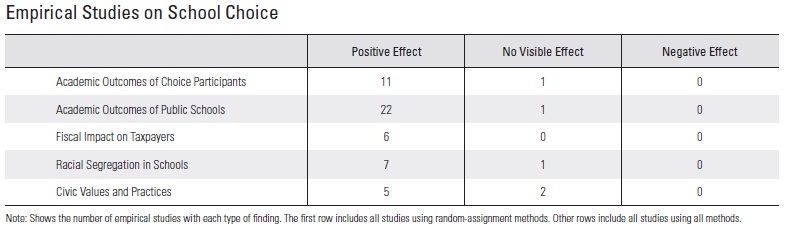
In case you forgot what that column of zeros on the right looks like, here it is again.
Leave a Comment » | civic values, competitive effects, methodology, random pop culture, research reports, tax-credit scholarships, vouchers | Tagged: Greg Forster, Heartland Institute, Win-Win | Permalink
Posted by Greg Forster
 (Guest post by Greg Forster)
Remember the hoopla a few weeks back about the MSNBC promo that told us our children aren’t really ours? Well, in case you were wondering whose they were, the president of the Louisiana teachers’ union spells it out for you:
There isn’t anything fair about using something like [school choice] only against the public schools and then taking our children from us, and sending us where we don’t know what they’re getting. [ea]
Mocking her is left as an exercise for the reader.
I’m starting to get worried. The unions are still powerful because they have money and troops, but they’re now totally humiliated and publicly shamed for their evil, and they’re clearly lost and bewildered in a new social world where the rules of legitimacy have all changed and they can’t make sense of anything. At what point is it just cruel to go on pointing out their depravity?
7 Comments | teacher union, vouchers | Tagged: Greg Forster, Loisiana | Permalink
Posted by Greg Forster

(Guest post by Greg Forster)
Picking back up on our discussion of narcissism, I’m sure you’re all dying to know that my new Win-Win report was featured on John Stossel last night! While you other losers here on JPGB have been wasting your time on Twitter, I’m finally getting the undivided attention of millions that I’ve always known I deserved.
Oh, wait, sorry – I didn’t mean to bash Twitter, because . . . Stossel also tweeted my study. Twitter’s totally cool now!

In case you forgot what I look like.
Seriously, I’m always grateful when people bring attention to my work. Stossel highlighted the numbers for impact on public schools: 23 empirical studies have looked at how school choice impacts academic outcomes in public schools, of which 22 found a positive effect and one found no visible difference; no empirical study has ever found a negative impact. He also mentioned the numbers for racial segregation: eight studies, seven positive, one neutral; none negative. (Stossel’s description may have left viewers thinking those public school academic effect studies were participant effect studies – I know it’s hard to do justice to the details in the short time TV allows, but at least I can note the difference here.)
Hope others are finding the report useful – that unbroken line of zeros in the “negative effects” column can’t be publicized too widely!
4 Comments | journalism, vouchers | Tagged: Greg Forster, Win-Win | Permalink
Posted by Greg Forster
You are currently browsing the archives for the vouchers category.

 Jay P. Greene's Blog