Robert Pondiscio Calls the Social Justice Bluff

October 13, 2016

That look on someone's face When you call their bluff

Several months ago Robert Pondiscio started a little storm within the education reform movement by raising alarms regarding the movement’s heavy leftward tilt over the last several years.  I joined the fray emphasizing that the social justice takeover of ed reform organizations was politically foolish since state-based Republicans are the ones who do almost all of the work in actually adopting meaningful ed reform.  I tried to address the political foolishness of alienating your key backers while making futile attempts to woo one’s opponents by providing some basic lessons from political science.  And Matt Ladner warned ed reformers against marching into a political dead-end alley.  Many others added their two cents, including Max Eden, Rick Hess, and Derrell Bradford.

But Robert Pondiscio — the man who sparked this debate — has topped all of us with the post to end all posts on the social justice wars in ed reform.  It is part of an excellent forum that Education Next has organized on the topic.  Pondiscio accurately describes the angry reaction of white ed reform leaders to his original piece and their call to remedy the fact that “The leaders of reform organizations are mostly white, and mostly from backgrounds of relative privilege, creating a stark contrast with the communities, and leaders, of color that demand rapid improvements in their schools.”

In his new piece Pondiscio calls their bluff.  If creating greater diversity among ed reform leaders is a priority for these white social justice leaders, why don’t they step aside and let more people of color take their jobs?  They say actions speak louder than words, unless, as it appears, these leaders care more about words than actions.  The failure of these national organizations to cause much action in changing state policies seems to reinforce the point.

Here’s the heart of Pondiscio’s piece:

The founder and leader of Education Post is Peter Cunningham, who was an assistant secretary for communication at the U.S. Department of Education under Arne Duncan, with whom he also served when Duncan ran Chicago Public Schools a decade ago. Cunningham has worked in PR, politics, and for small weekly newspapers but never, to my knowledge, as a teacher. He’s also a middle-aged white man. He is, in the argot of social justice thought, deeply privileged….  But if Education Post is serious about “elevating the voices” of the communities it serves, at some point it should be run—should it not?—by someone representative of those communities.

What about now? What about right now? What about Marilyn Anderson Rhames?

I ask this not to be mischievous, but to call the question and settle one of ed reform’s most sensitive debates. When I published my now-infamous piece earlier this year, it prompted, in addition to Rhames’ piece and others, an “open letter” signed by 170 “white education leaders” (including, not incidentally, much of the staff of Education Post) who took serious exception to my critique and lamented reform’s failure to put people of color in leadership positions.

“The education reform coalition has a problem,” the letter started. “Unlike other historical movements dedicated to the urgent betterment of social conditions, the most prominent leadership and voices of the school improvement coalition have not been representative of the communities that the effort hopes to serve. The leaders of reform organizations are mostly white, and mostly from backgrounds of relative privilege, creating a stark contrast with the communities, and leaders, of color that demand rapid improvements in their schools.”

All true, but this elides an awkward truth. Closing the achievement gap will take decades. Closing the leadership gap can be done this afternoon. All it takes is for the “white, privileged leaders” who signed the letter to recruit a person of color and step aside. The right person, like Rhames, might already be on staff, already contributing to the movement as a foot soldier or subordinate but not occupying a position of leadership or authority.

My paramount concern, almost completely unaddressed in the outsized reaction to my piece, remains that a militant leftward tilt in education reform endangers the longstanding bipartisan political support that has long fueled the movement. Neither do I believe that the only children poorly served by their schools are from families of color. But it makes little sense to bemoan “the extraordinary flaws and shortsightedness in our own leadership for letting the field become so lopsidedly white.” This is, as Teach For America likes to tell its corps members, within your locus of control. Those who signed the “open letter” may believe they are standing on principle. But if their theory of change rests on diversifying leadership, they are mostly standing in the way.

I invite those leaders to step aside for the greater good. No more open letters. No more manifestos. No more virtue signaling on Twitter. Either you are serious about the need to diversify the leadership of the reform movement, or you are not. It simply will not do to congratulate yourselves for being “brave leaders” and cluck earnestly at conferences about the need for education reform to “look like the communities it serves” year after year, while blocking exactly those people from the positions you insist they deserve.

To be clear, I continue to question whether the ed reform movement at large is properly viewed as a race-focused “social justice” movement or a broad school improvement initiative benefitting all children, thereby serving social justice ends. But let’s not quibble. If diversity of leadership is integral to your theory of change, why not practice within your organizations? And why not do it now?

Our infant nation survived George Washington relinquishing power and returning to his fields at Mount Vernon. Ed reform will survive without its current cadre of self-flagellating white leaders.

What – what exactly – is stopping you?


Nominations Solicited for the 2016 Al Copeland Humanitarian Award

October 6, 2016

It is time once again for us to solicit nominations for the Al Copeland Humanitarian Award.  The criteria of the Al Copeland Humanitarian Award can be summarized by quoting our original blog post in which we sang the praises of Al Copeland and all that he did for humanity:

Al Copeland may not have done the most to benefit humanity, but he certainly did more than many people who receive such awards.  Chicago gave Bill Ayers their Citizen of the Year award in 1997.  And the Nobel Peace Prize has too often gone to a motley crew including unrepentant terrorist, Yassir Arafat, and fictional autobiography writer, Rigoberta Menchu.   Local humanitarian awards tend to go to hack politicians or community activists.  From all these award recipients you might think that a humanitarian was someone who stopped throwing bombs… or who you hoped would picket, tax, regulate, or imprison someone else.

Al Copeland never threatened to bomb, picket, tax, regulate, or imprison anyone.  By that standard alone he would be much more of a humanitarian.  But Al Copeland did even more — he gave us spicy chicken.

Last year’s winner of “The Al” was the internet humorist, Ken M.  Ken M did more to improve the human condition than just make us laugh by making idiotic comments on social media (although that would have been enough).  His humor reveals the ridiculousness of people trying to change the world by arguing with people on the internet.  Given how much time ed reformers waste on social media, especially the soon-to-be-sold Twitter, Ken M’s humor is a useful reminder that many of the people reading your posts are probably not much swifter or influential than the Ken M persona.  Ken M beat a set of strong nominees, including Malcolm McLean, Gary Gygax, and John Lasseter.

The previous year’s winner was Peter DeComo, the inventor of the Hemolung Respiratory Assist System.  To save a life DeComo had to trick border control officials to bring a model of his artificial lung machine into the US from Canada because the device had not yet been fully approved by the FDA.  DeComo won over a worthy field, including Marcus Persson, the inventor of Minecraft, Ira Goldman, the developer of the “Knee Defender,”  Thomas J. Barratt, the father of modern advertising, and Thibaut Scholasch and Sébastien Payen, wine-makers who improved irrigation methods.

The 2013 winner of “The Al” was Weird Al Yankovic.  Weird Al beat an impressive set of nominees, including Penn and Teller, Kickstarter, and Bill Knudsen.

The 2012 winner of “The Al” was George P. Mitchell, a pioneer in the use of fracking to obtain more, cheap and clean natural gas. Mitchell won over a group of other worthy nominees:  Banksy, Ransom E. Olds, Stan Honey, and Alfred Fielding and Marc Chavannes.

In 2011 “The Al” went to Earle Haas, the inventor of the modern tampon.  Thanks to Anna for nominating him and recognizing that advances in equal opportunity for women had as much or more to do with entrepreneurs than government mandates.  Haas beat his fellow nominees:  Charles Montesquieu, the political philosopher, David Einhorn, the short-seller, and Steve Wynn, the casino mogul.

The 2010  winner of  “The Al” was Wim Nottroth, the man who resisted Rotterdam police efforts to destroy a mural that read “Thou Shall Not Kill” following the murder of Theo van Gogh by an Islamic extremist.  He beat out  The Most Interesting Man in the World, the fictional spokesman for Dos Equis and model of masculine virtue, Stan Honey, the inventor of the yellow first down line in TV football broadcasts, Herbert Dow, the founder of Dow Chemical and subverter of a German chemicals cartel, and Marion Donovan and Victor Mills, the developers of the disposable diaper.

And the 2009 winner of “The Al” was  Debrilla M. Ratchford, who significantly improved the human condition by inventing the rollerbag.  She won over Steve Henson, who gave us ranch dressing,  Fasi Zaka, who ridiculed the Taliban,  Ralph Teetor, who invented cruise control, and Mary Quant, who popularized the miniskirt.

Nominations can be submitted by emailing a draft of a blog post advocating for your nominee.  If I like it, I will post it with your name attached.  Remember that the basic criteria is that we are looking for someone who significantly improved the human condition even if they made a profit in doing so.  Helping yourself does not nullify helping others.  And, like Al Copeland, nominees need not be perfect or widely recognized people.


More on the Failure of Technocracy

September 29, 2016

Education Reform has taken the counter-productive path of focusing narrowly on identifying the “scientifically” validated techniques to maximize  math and reading test scores.  The advocates of this approach imagine themselves as rational people, using the tools of science to improve others’ lives.  In reality, they have failed to grasp the limitations of science and the inability to centrally plan improved outcomes for all.  Rather than truly relying on science, they are abusing the authority of science to exercise control.

This abuse of science to wield power is also known as technocracy, the rule by self-proclaimed experts.  Greg had an excellent piece yesterday describing the problems of technocracy.  In this post I would just like to add two illustrations of the failure of technocracy in education — one from program evaluation and the other from the perspective of the humanities.

The program evaluation illustration comes from the results of a US Department of Education’s National Center for Education Evaluation study of “a 93-hour professional development program focused on deepening math content knowledge.”  Teachers were randomly assigned to receive this intensive math professional development or to a control group that did not receive any additional training.  Measures of math knowledge collected from the teachers show that those who received the professional development learned what the training was attempting to convey.  And independent classroom observations found that the “quality” of classroom instruction was higher for the teachers who received the training.  Again, the professional development intervention appears to have been properly implemented in that it changed the treatment group teachers’ knowledge and their classroom practice.

Despite successful implementation of this professional development based on what many experts believed to be the best practice for improving math instruction, scores on the NWEA and state math tests showed small declines (and the NWEA decline was not statistically significant while the state test decline was).

It is unclear what part of this effort failed.  We can’t simply conclude that this PD, like many before it, was unproductive.  To do so, we’d have to know that the measures of implementation — teacher knowledge and classroom instruction quality — are in fact capturing knowledge and quality.  And we’d have to know that the NWEA and state math test scores are valid predictors of later life outcomes.  So, even with a clear failure we have no idea whether the failure was in the PD, the measures of implementation, or the measures of the outcomes.  Of course, it is also possible (perhaps highly likely) that the math approach deemed the best by math education experts wasn’t actually the best for all.

This illustrates the trap of technocracy in education.  Experts may well be wrong and our tools for scientifically evaluating policies are very imperfect.  And all of this assumes that we do not differ on values and priorities which might lead to legitimate differences about what outcomes should be optimized and for whom.

My second illustration of the failure of technocracy in education comes from the perspective of the humanities.  Scott L. Newstok, who directs the Pearce Shakespeare Endowment at Rhodes College, recently gave the convocation address to the entering class of 2020 at that institution.  His entire remarks were published in the Chronicle of Higher Education, and they are well worth reading in full.  To paraphrase Lincoln, I can do little to add or detract from what he said other than to highlight some of the key passages below:

Your generation is the first to have gone through primary and secondary school knowing no alternative to a national regimen of assessment. And your professors are only now beginning to realize how this unrelenting assessment has stunted your imaginations.

In response to the well-intentioned yet myopic focus on literacy and numeracy, your course offerings in art, drama, music, history, world languages, and the sciences were all too often set aside “to create more time for reading and math instruction.” Even worse, one of the unintended consequences of high-stakes testing is that it narrowed not only what you were taught but how you were taught. The joy of reading was too often reduced to extracting content without context, the joy of mathematics to arbitrary exercises, without the love of pattern-making that generates conjecture in the first place.

You’ve been cheated of your birthright: a complete education. In the words of Martin Luther King Jr. (at your age of 18), a “complete education” gives “not only power of concentration, but worthy objectives upon which to concentrate.”…

The most fascinating concept that Shakespeare’s period revived from classical rhetoric was inventio, which gives us both the word “invention” and the word “inventory.” Cartoon images of inventors usually involve a light bulb flashing above the head of a solitary genius. But nothing can come of nothing. And when rhetoricians spoke of inventio, they meant the first step in constructing an argument: an inventory of your mind’s treasury of knowledge — your database of reading, which you can accumulate only through slow, deliberate study.

People on today’s left and right are misguided on this point, making them strange bedfellows. Progressive educators have long been hostile to what they scorn as a “banking concept” of education, in which teachers deposit knowledge in passive students. Neoliberal reformers — the ones who have been assessing you for the past dozen years — act as if cognitive “skills” can somehow be taught in the abstract, independent of content. And some politicians seem eager to get rid of teachers altogether and just have you watch a video. You, having been born when Google was founded, probably take it for granted that you can always look something up online.

But knowledge matters. Cumulatively, it provides the scaffolding for your further inquiry. In the most extreme example, if you knew no words in a language, having a dictionary wouldn’t help you in the least, since every definition would simply list more words you didn’t know. Likewise, without an inventory of knowledge, it’s frustratingly difficult for you to accumulate, much less create, more knowledge. As the Italian novelist Elena Ferrante said, “There is no work … that is not the fruit of tradition.”

Tradition derives from the Latin traditio — that which is handed down to you for safekeeping. I think part of our innate skepticism of tradition derives from our good democratic impulses: We don’t want someone else telling us what to do; we want to decide for ourselves. In other words, you rightly reject a thoughtless adherence to tradition, just as you rightly reject (I hope) the thoughtlessness that accompanies authoritarianism. However, as the political philosopher Hannah Arendt insisted, education “by its very nature … cannot forgo either authority or tradition, and yet must proceed in a world that is neither structured by authority nor held together by tradition.” Educational authority is not the same thing as political authoritarianism.


Segregationist Neanderthal 1, Florida’s First Integrated School 0

September 22, 2016

(Guest Post by Matthew Ladner)

Make sure to catch this post over at RedefinED by Patrick Gibbons about the racist “founder of Florida public education” and his 18 year jihad to close a racially integrated private school.

You couldn’t make this stuff up, and even if you tried, no one would believe you, which is why Gibbons included a sources appendix at the end of the post. Very worth the read.


Texas Special Education Disgrace-“It Was All a Numbers Game”

September 13, 2016

(Guest Post by Matthew Ladner)

The Houston Chronicle has delivered an expose on a covert and “successful” effort by the Texas Education Agency to create a defacto cap of 8.5% on the number of Texas public school students who would receive special education services. Successful gets air quotes btw if you define success as avoiding delivering special education services to hundreds of thousands of kids by keeping them cooped up a Section 504 no man’s land.

The process of identifying children for special education services is conducted by human beings and thus involves all sorts of error- children who do not actually have disabilities are often identified for services, students who do have disabilities do not receive services, students who do have disabilities don’t always receive the correct services. It’s a difficult process. The Texas Education Agency created an arbitrary target for special education enrollment in 2004 of 8.5% of a school population, effectively incentivizing districts to deny services to students. In theory the restraining of services could have come in the category most prone to over-identification: specific learning disability. If that had been the case maybe, maybe there would be a silver lining to this story. Instead the Chronicle found across the board reductions in all disability types. From the Chronicle:

Over a decade ago, the officials arbitrarily decided what percentage of students should get special education services — 8.5 percent — and since then they have forced school districts to comply by strictly auditing those serving too many kids.

Their efforts, which started in 2004 but have never been publicly announced or explained, have saved the Texas Education Agency billions of dollars but denied vital supports to children with autism, attention deficit hyperactivity disorder, dyslexia, epilepsy, mental illnesses, speech impediments, traumatic brain injuries, even blindness and deafness, a Houston Chronicle investigation has found.

More than a dozen teachers and administrators from across the state told the Chronicle they have delayed or denied special education to disabled students in order to stay below the 8.5 percent benchmark. They revealed a variety of methods, from putting kids into a cheaper alternative program known as “Section 504” to persuading parents to pull their children out of public school altogether.

“We were basically told in a staff meeting that we needed to lower the number of kids in special ed at all costs,” said Jamie Womack Williams, who taught in the Tyler Independent School District until 2010. “It was all a numbers game.”

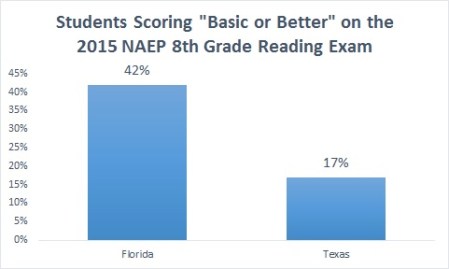
Perhaps someone could attempt to justify this practice by claiming that Texas schools did a fantastic job educating the 8.5% of students they provided services. Well, not so much:

texas-vs-fl-sped

Having the state effectively punish districts going over an arbitrary cap on the percentage of special education students at a minimum violates the spirit of federal special education law. As flawed as the Individuals with Disabilities Education Act and the associated practices remain, the unmistakable intent of the law has been to provide special education services to all students who need it. IDEA, warts and all, stands as landmark civil rights legislation for children with disabilities and the practices adopted by unelected officials at the Texas Education Agency must be viewed as an attempt to subvert this legislation at the expense of some of the most vulnerable students.

The reader should note that while the Chronicle article places blame for the 8.5% policy squarely upon the Texas Education Agency, this practice could not have endured for so long without the active acquiescence of Texas school districts. If they had objected to this policy, as was their moral duty, we would not have learned of this a decade after formulation as a part of an investigative report. Texas school districts have long complained however of the costs associated with special education, and that state and federal funds fail to cover the full cost of providing services. Kudos to the school officials who spoke to the Chronicle’s investigators, but the number who quietly went along with this greatly outnumbered those who made any attempt to set things right.

The Florida approach of setting special needs students free to attend public and private schools with their state funding represents a profoundly more humane approach to special education. If the districts resent having to divert dollars from general education to special education, let special needs family seek out a solution with their “inadequate” state dollars. The Chronicle article represents another chapter in the long book of what happens when people are forced to rely upon the goodwill and sound thinking of soulless bureaucrats.

No one enjoys bragging on Texas more than me, but this is nothing short of disgraceful and needs to be made right.


Setting the Record Straight on Florida’s Tax-Credit Scholarships

August 30, 2016

imageresize-ashx-3

(Guest Post by Jason Bedrick)

Opponents of school choice spend a great deal of time and energy perpetuating all sorts of easily debunked myths about choice programs. In Florida, the state teachers’ union has worked very hard to spread two such myths about the state’s tax-credit scholarship program, which Mark Pudlow of the Florida Education Association calls a “scheme”:

“It’s a scheme because this tax credit voucher [sic] was enacted by the Legislature to circumvent a previous state Supreme Court ruling saying that public money could not go to fund vouchers,” he said. “So the Legislature set up a scheme that would allow certain types of taxes to be ‘donated’ to the groups administering the voucher program. So instead of paying taxes to the state, they were forgiven their tax obligation if they donated the exact same amount of money to the voucher administrators.”

Fortunately, the Daily Commercial gave Ron Matus of Step Up for Students, Florida’s largest scholarship organization, the opportunity to set the record straight:

“The union kept saying the tax credit scholarships were done to circumvent the ruling,” he said. “Their timeline is off. The fact of the matter is the tax credit scholarship program was passed by the legislature and signed into law in 2001, five years before the Supreme Court ruling. The opponent keeps arguing the program drains money from public schools. Every single study that has been done over many years by multiple different parties that has looked at the fiscal impact says it does not harm public schools or drain money from public schools.”

The Office of Program Policy Analysis and Government Accountability estimated the Florida Tax Credit Scholarship Program saved the state $36.2 million in 2008.

Government Accountability stated that while the program “reduces the amount of tax revenues received by the state, it produces a net fiscal benefit.”

This academic year, Step Up for Students will provide more than 90,000 tax-credit scholarships to students so that they can attend the school of their choice. Additionally, they will administer nearly 6,000 education savings accounts. Florida also has a second scholarship organization, AAA Scholarship Foundation, so it’s likely that more than 100,000 Florida students will receive tax-credit scholarships this year.

As Step Up demonstrates, scholarship organizations do much more than just cut checks. They also can provide parents with vital information about their educational options, help connect parents and schools, and–when necessary–they can organize to defend the scholarships from outside attacks. As Jay noted in a recent post, politically viable policies require “constituents who can then be mobilized to protect and expand” them. School choice policies generate those constituents, and as Step Up has amply demonstrated, scholarship organizations can mobilize them.


Pass the Popcorn: If You Need to Blink

August 25, 2016

kubo_0_0

(Guest post by Greg Forster)

If you need to blink, do it now. If you miss a single word of the blog post below, our hero will perish.

Do yourself the biggest favor you’ve done yourself in a long time and go see Kubo and the Two Strings while it’s still in theaters. This masterpiece demands to be seen on the big screen, so you can appreciate not only its oustanding story but its gorgeous visuals.

If you know Coraline, you know what greatness the offbeat animation studio LAIKA is capable of. LAIKA’s last few offerings haven’t been as well recieved, but let me assure you Kubo not only matches but actually surpasses the storytelling and artistic accomplishments of Coraline.

Kubo-2strings-3

It would be criminal to reveal the plot of Kubo. Indeed, one of the many ways in which this movie shines is the perfect craftsmanship of its progressive plot revelations. These people know how to tell a truly epic story.

I will say this much, though, to motivate you to see it. Kubo is the son of a great samurai warrior who fought a duel with the moon. The plot is driven by this question:

Is it better to be a man, to live a life marred by suffering and then die, leaving behind deeds well done and the memories held by those who loved you?

Or is it better to be the moon, floating high above the world and immune to death and suffering, and have no story?

Don’t miss this gem. I’ll be going back as soon as I can to see it again.

Update: Saw it again, loved it more the second time. “It amazes me that creatures down here will fight so hard, just to die another day.” “Down here there are days worth fighting for.” Don’t miss your chance to see it on the big screen!


The Next Accountability – Teachers and Schools

August 25, 2016

Little-sprouts_-Grow-bean-sprouts-in-your-back-garden

EdChoice has posted Part 2 of my new series on The Next Accountability. In Part 1 I outlined what we most want from a good education; now I outline the most important qualities teachers and schools should have to deliver these results:

All this can be summed up by saying that teachers need to be wise and professional. Wisdom means teachers possess themselves the capacities of head, hands and heart that we want students to develop. Professionalism means that teachers’ primary motivation is not to check boxes on a curricular chart or maximize formal outcomes such as test scores, or even to please parents, but to help students develop those capacities of head, hands and heart that the teachers possess and the students need.

The great challenge we face is that in our society, where we are free to disagree about what is good, true and beautiful, we lack consensus about what constitutes a good education. Good schools are therefore those that manage to overcome legal and bureaucratic obstacles to operate as free communities, with a shared commitment both to freedom of disagreement about the highest things and also to bonds of interdependence and reciprocity:

Freedom and community tend to lose their meaning when separated from one another. Real community means people freely choose to be in community. And real freedom can only be protected by a community that loves freedom and institutionalizes it as a shared, public moral commitment.

Next, in Part 3: how the two great camps in the debate over accountability – advocates of technocracy and choice – are, in different ways, trying unsuccessfully to sidestep the core problem of building consensus in a pluralistic society.

Stay tuned! Your thoughts are very welcome as always.