Between the Promise of his greener days and these he masters now

March 21, 2016

(Guest Post by Matthew Ladner)

So I was looking at the National Alliance for Public Charter Schools Dashboard on state charter school sectors trying to figure out how the Arizona Charter sector managed to put it all together to rock the 2015 NAEP like a rock star on an epic hotel room thrashing bender. Just as a reminder, Arizona has long been known as a Wild West of charter schooling- liberal authorizing, relatively light-touch state oversight, etc. Just the sort of thing that a central planner hates. In addition, the sector is not generously funded by national standards, pulling in about $8k per student from all sources, and educates a majority-minority student body. Moreover the Credo analysis from a few years ago held its nose at AZ charter results. And yet, the 2015 NAEP comes in and shows AZ charter students scoring like a New England state in all four exams and these results are backed up by the state AZ Merit exam. What gives?

One possible factor- maturation:

AZ charter sector age

Paul Peterson noted years ago that the Credo analysis of charter test scores had not controlled for two potentially important factors- let’s call them shakedown cruise and transfer effects. Like any social enterprise, a school is unlikely to be at peak effectiveness in the early going.  In 2005-06 Arizona charter schools in years 1-3 outnumbered those that had been operating for 10 or more years three to one. Let the clock run a bit however and by 2013-14 old timers outnumber newbies by more than two to one. As far as transfer effects go, some brand new schools will have nothing but transfers, whereas established schools will typically be breaking in a new class of their youngest grade covered and some transfers. So we waited things out in Arizona and eventually we were rewarded with results like:

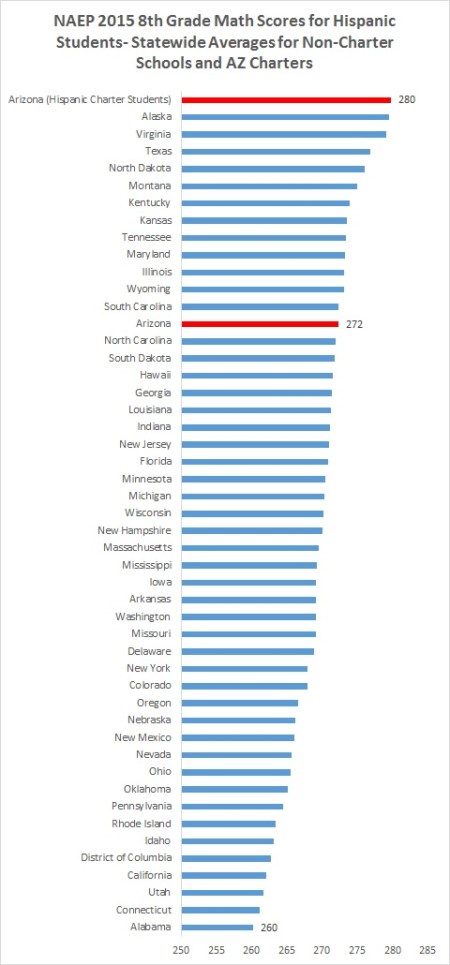
8m 2015 AZ Hispanic charter

Well AZ charters- you are growns up, you’re growns up and you’re growns up!

Next factor: churn.

The National Alliance for Public Charter Schools notes that between 2010-11 and 2014-15, 215 new charter schools opened. During the 2010-11 to 2013-14 period 96 Arizona charter schools closed. So factoring in life cycle performance, those 215 that opened may have looked pretty meh when Credo checked in on them as youngsters, but perhaps they were just out having an ale with Falstaff and the gang figuring a few things out getting their sea-legs under them as young organizations.

Let’s assume further that those 96 schools that closed actually were worse than meh on average. Arizona grants 15 year charters, so the oldest of the lot did not start coming up for renewal from the Arizona State Charter School Board until 2010. Charters of course sometimes close due to factors other than state action as well, and academically fantastic schools will be greatly under-represented in this subset. So you open about twice as many schools as you close over the last few years but the ones you open are sorting things out and getting better, while the ones you closed just couldn’t cut it results in:

Florida’s charter sector also rocked the 2015 NAEP. How much did they rock the 2015 NAEP you ask? Well this much:

Hey it’s cute Vermont almost tied Florida charter schools on the reading NAEP, especially since they are 92% Anglo and spend $15,500 per kid. Florida charters btw: 76% minority student body. I’m not going to look up the spending number but it is far less than $15,500. How’s that for closing the achievement gap? If you don’t believe it go and run the numbers for yourself here.

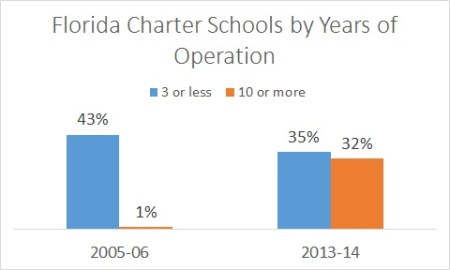
Florida charters seem to be doing something right. Possible maturation factor here as well? I’ll take “Sure Looks that Way to Me” for a thousand Alex:

Florida charter schools age

The National Alliance shows about 300 new charters opening and 101 closing in Florida in recent years. You let parents pick schools that are good fits for their kids, open a new bunch of schools on their way to improving, and close sub-meh, guess what your majority minority sector can rock the NAEP like a New England state.

Now not every charter sector, even among the long-standing ones, sees these kind of results. Many factors can and will influence such scores besides those discussed here. For instance, Michigan charter schools look pretty bad at first blush, but a concentration in Detroit may have something to do with that. The ability to slice and dice the NAEP data has definite limits and multiple factors can be simultaneously at play.  Minnesota however has the nation’s oldest charter law and seems to notably lack the sort of grand-slam ability of the Arizona, Colorado and Florida sectors. A lack of dynamism may be contributing while the average age of Minnesota charter schools has increased, very few new schools have been opening, and very few established schools closing- almost as though charters have their little niche but have been safely contained.

Last month Neerav asked “Is School Supply F***ing Everything?” Maybe so. Keep those new schools coming, let parents sort them out, and if parents don’t torpedo the low-performers don’t renew their charters. Otherwise sit back and enjoy!


Please Check the Scoreboard

March 16, 2016

(Guest Post by Matthew Ladner)

The Arizona Republic ran the following LTE from your favorite bearded wonk today. Okay, okay…fourth or fifth favorite…geez…

Linda Valdez (“How school choice sabotages Latino kids“) asserted that Arizona’s school choice options have been undermining the education of Hispanic students attending district schools.

This assertion cannot, however, withstand scrutiny. The National Assessment of Educational Progress shows that Arizona Hispanic students have made large academic gains.

Since all states began participating in NAEP in 2003, Arizona Hispanic students tied for first for the highest Hispanic on eighth-grade math, third among states in eighth-grade reading gains. Arizona Hispanic students tied for 6th in fourth-grade math and reading gains.

Arizona charter schools have more than done their part with a majority-minority student population and gains above and beyond the statewide average. Arizona Hispanic students attending charter schools, for instance, tied the statewide average for Delaware on eighth-grade math in 2015 on NAEP.

We have ample reason to desire a faster rate of progress, and I agree with Valdez that Arizona’s future rests heavily upon the success of Hispanic students. District schools, however, remain the most generously funded of Arizona’s school options by a wide margin and outcomes for Hispanic students have been trending in a positive direction.


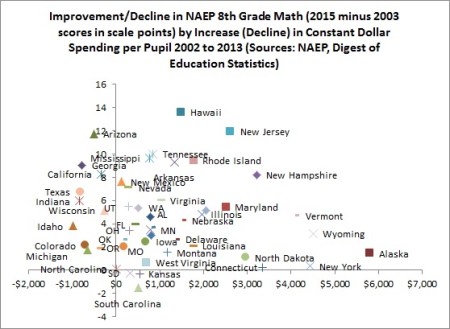
NAEP Gains by Spending Trend- Some States are the Harlem Globetrotters, Others the Washington Generals

February 24, 2016

(Guest Post by Matthew Ladner)

Notice the large number of states on the negative side of zero on the spending bar. In the immortal words of Lee Ving it’s already started.

Winning

Once again let me note with insufferable state pride that Arizona is your ROI champion doing things that no one would have thought possible.

Go majority-minority, cut funding and improve scores? No problem-nothing but net!

So it is tough to pick a Washington Generals, but I’ve got mine narrowed down between Alaska, New York and Wyoming.


DCPS Tragedy

February 22, 2016

Ford table


Note: I am very grateful to longtime Jayblog reader Peter D. Ford III for sharing his first-hand perspective on DCPS. -ML

(Guest Post by Peter D. Ford III )

While I have been a public school educator in the Los Angeles area for the past 20 years, DCPS will always have an impact on my teaching being the son of career DCPS educators through three decades (60’s through 80’s). Followers of professional sports wax nostalgic about the feats of great players from the past and the numbers they produced ‘before records were kept.’ The tragic data portraying the minimal academic growth of Black DCPS students would not surprise my parents as they confronted the seeds of this tragedy when they were teaching. Unless there are fundamental changes in the teaching profession the educational crime perpetrated upon Black children in our Nation’s Capital may never end.

Until this day the question posed by one of my Daddy’s colleagues, “Who’s gonna teach these kids?” still resonates. In the 70’s when I first heard that over another dinner conversation that statement implied there were too many teachers not committed to teaching Black children, poor Black children specifically. Back then Parliament called it ‘Chocolate City’ for a reason, thus the lyric “…the last percentage count was 80…” The typical retort ‘but most teachers do a great job’ has never held up to my scrutiny. For example, very recently the Los Angeles Unified School District (LAUSD) has had about 30,000 teachers. If 95% were ‘doing a good job,’ that leaves 1500 teachers ruining children’s futures year after year after year. Unlike the military you cannot staff the neediest schools with the best teachers, even if you could figure out who the best teachers were as seniority isn’t an automatic identifier.  Not all teachers can teach in upper Northwest or the Gold Coast; somebody has to teach in Hanover or Anacostia. For decades before NAEP and NCLB there’s been a deficit of teachers willing and committed to teaching these children, or at least there has been enough poor education in the neediest schools that has grown like a cancer with no chemotherapy.

The late, great, Dr. Barbara Sizemore, first African-American to head a major city school system in the 70’s, was my parents’ hero no matter how embattled her tenure as head of DCPS. Dr. Sizemore’s quote, as told from my parents, also predicted the horrid learning we see in DCPS students today: “These teachers aren’t teaching these kids anything.” Dr. Sizemore and my parents were not happy with their colleagues getting into a classroom and doing their own damn thing vs. inspiring and expecting young people to acquire the very same body of knowledge they did to earn their education. If you were to talk to 50-60 year old native Washingtonians it would appall you how many of them were allowed to stop taking math after their freshman year in high school, let alone the natural sciences. My father was a music teacher, and a pretty damn good one. Music instruction in DCPS began a slow death from the late 70’s onward; the famed Ellington School for the Arts today was no better than Cardozo or McKinley Tech in music instruction was then. Listening to NPR’s ‘From the Top’ you see these incredible young performers are great students, just as my father’s best musicians were good at math. Black children in DC aren’t getting this, and haven’t for decades. When you combine teachers not committed to teaching these children with teachers not teaching them much of anything, the current data we see was inevitable. This perfect storm of malfeasance is the root of poor Black academic achievement in every major metropolitan area. In a K-12 career all it takes is to have a lousy 3rd grade teacher, so you don’t learn your times tables, then an 8th grade teacher who couldn’t control your classroom, and your math career is all but ruined.

I hope, no I pray Ms. Davis’ plan includes giving school cites more control over whom they can hire to teach the children who need the best instruction. I pray there isn’t another finger pointed at poverty from educators. None of us have credentials in violence prevention, dysfunctional family mitigation, or poverty abatement. Like coach Belichik says teachers must ‘do your job,’ and that must be a 100% commitment to the young people in your classroom, and a laser focus on students acquiring a body of knowledge, skills, thus reasoning from your respective content.  If you’re going to point to poverty, then also point at everyone else who has a hand at fixing it. When Ms. Davis hopes for “the voice of those working with the students in the classroom is a meaningful part of the improvement discussion,” that’s a direct indictment of the other impediment to academic achievement for Black children: bad school leadership.

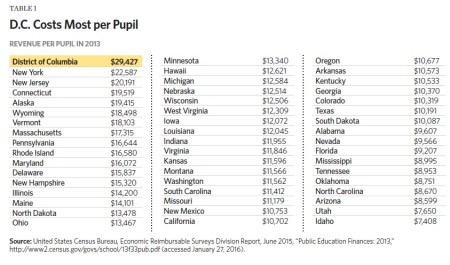
Don’t save your trump card waiting for DCPS admin to respond; during my parents’ time as now the so-called leaders of DCPS were pretty much who drove them to retire (their sons were educated and out the house, so they said ‘to heck with these knuckleheads’ running things). Is Ms. Davis willing to challenge traditional union contracts to allow teachers to be assigned where they’re needed? Is the DCPS bureaucracy willing to decentralize control to allow schools to meet the needs of their students as Dr. Sizemore sought? DC’s per student revenue has always been one of the highest in the country; I remember being aghast at $18,000/student, let alone $29k./ student. Who will demand for parents to be able to use that $29k as they see fit?

When I transitioned from my military career to teaching the only thing my father told me was “Focus on the students, not the adults.” My corollary to his words of advice: “It’s not the students (who are the problem), but the adults.”

While I have been a public school educator in the Los Angeles area for the past 20 years, DCPS will always have an impact on my teaching being the son of career DCPS educators through three decades (60’s through 80’s). Followers of professional sports wax nostalgic about the feats of great players from the past and the numbers they produced ‘before records were kept.’ The tragic data portraying the minimal academic growth of Black DCPS students would not surprise my parents as they confronted the seeds of this tragedy when they were teaching. Unless there are fundamental changes in the teaching profession the educational crime perpetrated upon Black children in our Nation’s Capital may never end.

Until this day the question posed by one of my Daddy’s colleagues, “Who’s gonna teach these kids?” still resonates. In the 70’s when I first heard that over another dinner conversation that statement implied there were too many teachers not committed to teaching Black children, poor Black children specifically. Back then Parliament called it ‘Chocolate City’ for a reason, thus the lyric “…the last percentage count was 80…” The typical retort ‘but most teachers do a great job’ has never held up to my scrutiny. For example, very recently the Los Angeles Unified School District (LAUSD) has had about 30,000 teachers. If 95% were ‘doing a good job,’ that leaves 1500 teachers ruining children’s futures year after year after year. Unlike the military you cannot staff the neediest schools with the best teachers, even if you could figure out who the best teachers were as seniority isn’t an automatic identifier.  Not all teachers can teach in upper Northwest or the Gold Coast; somebody has to teach in Hanover or Anacostia. For decades before NAEP and NCLB there’s been a deficit of teachers willing and committed to teaching these children, or at least there has been enough poor education in the neediest schools that has grown like a cancer with no chemotherapy.

The late, great, Dr. Barbara Sizemore, first African-American to head a major city school system in the 70’s, was my parents’ hero no matter how embattled her tenure as head of DCPS. Dr. Sizemore’s quote, as told from my parents, also predicted the horrid learning we see in DCPS students today: “These teachers aren’t teaching these kids anything.” Dr. Sizemore and my parents were not happy with their colleagues getting into a classroom and doing their own damn thing vs. inspiring and expecting young people to acquire the very same body of knowledge they did to earn their education. If you were to talk to 50-60 year old native Washingtonians it would appall you how many of them were allowed to stop taking math after their freshman year in high school, let alone the natural sciences. My father was a music teacher, and a pretty damn good one. Music instruction in DCPS began a slow death from the late 70’s onward; the famed Ellington School for the Arts today was no better than Cardozo or McKinley Tech in music instruction was then. Listening to NPR’s ‘From the Top’ you see these incredible young performers are great students, just as my father’s best musicians were good at math. Black children in DC aren’t getting this, and haven’t for decades. When you combine teachers not committed to teaching these children with teachers not teaching them much of anything, the current data we see was inevitable. This perfect storm of malfeasance is the root of poor Black academic achievement in every major metropolitan area. In a K-12 career all it takes is to have a lousy 3rd grade teacher, so you don’t learn your times tables, then an 8th grade teacher who couldn’t control your classroom, and your math career is all but ruined.

I hope, no I pray Ms. Davis’ plan includes giving school cites more control over whom they can hire to teach the children who need the best instruction. I pray there isn’t another finger pointed at poverty from educators. None of us have credentials in violence prevention, dysfunctional family mitigation, or poverty abatement. Like coach Belichik says teachers must ‘do your job,’ and that must be a 100% commitment to the young people in your classroom, and a laser focus on students acquiring a body of knowledge, skills, thus reasoning from your respective content.  If you’re going to point to poverty, then also point at everyone else who has a hand at fixing it. When Ms. Davis hopes for “the voice of those working with the students in the classroom is a meaningful part of the improvement discussion,” that’s a direct indictment of the other impediment to academic achievement for Black children: bad school leadership.

Don’t save your trump card waiting for DCPS admin to respond; during my parents’ time as now the so-called leaders of DCPS were pretty much who drove them to retire (their sons were educated and out the house, so they said ‘to heck with these knuckleheads’ running things). Is Ms. Davis willing to challenge traditional union contracts to allow teachers to be assigned where they’re needed? Is the DCPS bureaucracy willing to decentralize control to allow schools to meet the needs of their students as Dr. Sizemore sought? DC’s per student revenue has always been one of the highest in the country; I remember being aghast at $18,000/student, let alone $29k./ student. Who will demand for parents to be able to use that $29k as they see fit?

When I transitioned from my military career to teaching the only thing my father told me was “Focus on the students, not the adults.” My corollary to his words of advice: “It’s not the students (who are the problem), but the adults.”


Much to her credit, Washington Teachers Union President Elizabeth Davis responds to DC achievement gaps before anyone in DCPS or in the broader DC Reform Community

February 19, 2016

(Guest Post by Matthew Ladner)

Washington Teacher’s Union President Elizabeth Davis left a response to the post here on Jayblog showing that DCPS black students would go well into their high school years before catching up to where White DCPS students stood in 4th grade. I disagree in large part (but agree partially) with her take, and will briefly explain why below. Let the record show however that the score as of now stands WTO 1, DCPS 0 on the acknowledgement scorecard. Anyone? Anyone? Kaya?


Perhaps the large community of DC K-12 reform oriented organizations would like to join the conversation that Heritage started as well. I know the allure of delving into the minutiae of federal statutes can be very powerful, but it’s okay to leave the tower now and again to examine what is going on around you. As in right around you with your own tax dollars.

But silly me I digress! Ms. Davis’ response:

The PARCC scores showed that 24% of students in grades 3-8 in public and public charter schools met or exceeded expectations in math and 25% of those same students met or exceeded expectations in English Language Arts. The bottom line is that a full 75% of our students failed to meet expectations.

The Washington Teachers’ Union acknowledges that some aggregate gains have been made, and some of those gains have been significant. However, those significant gains are found in schools that have been least effected by the so-called reform strategies. In other words, where the school district has made the greatest gains is in the schools that were already high performing and not a target of the reforms. Conversely, students in schools where the most teachers were fired, that attended schools that were closed due to low test scores, and had the most teacher turnover saw meager gains compared to their wealthy counterparts.

For years the WTU has called on the District Administration to adequately address these unacceptable and rapidly growing achievement gaps. Those calls were met with hubris and more of the same top-down failed policies.

Today we ask the community to review these data and understand that doing more of the same will only make a bad situation worse. In the coming days we will share more data that helps explain this unfortunate situation and share the plan we proposed to the district many months ago.

We can close the achievement gap. But that will only happen when the current failed policies are discontinued and the voice of those working with the students in the classroom is a meaningful part of the improvement discussion.

Maybe most importantly, we must ensure that the school district’s teacher evaluation system does not penalize those teachers who take on the challenge of educating our neediest students. Over the past eight years, DCPS has replaced over 3,000 of its teachers. So the bad teacher narrative no longer applies as a credible reason for the growing achievement gap in our school district. Many of our members have told us that the IMPACT evaluation system victimizes those who teach in low-performing schools.

-Elizabeth Davis, President of the Washington Teachers’ Union

My brief take on the substance: yes the gentrified schools will have been least affected by the reforms but when they are posting NAEP scores that make Massachusetts blush policies aimed at removing ineffective educators won’t be very much in play.  Given the plight of disadvantaged children in DCPS it would seem difficult at best to argue that the staff hired to educate these children have too little job security. I am however willing to hear the case made.

Please note further that the DCPS charter sector has made progress in closing the achievement gap with significantly fewer resources per pupil than those granted to DCPS. I’ve seen but have not explored claims that these reforms are contributing to progress in DCPS, but I will say this much to agree with Ms. Davis- it is very difficult to find evidence of that claim in DC NAEP scores to date. While there is absolutely blindingly clear evidence that DC choice policies (charters and OSP) have clear benefits to disadvantaged DC children, you are hard pressed to make the case that anything else has done much for these kids to date in terms of generating positive trends.

I am entirely open to discussion and debate on that point, but when you have schools with scores barely above Detroit receiving over $29,000 per student in revenue, I find it difficult to reach any other conclusion. DC charters get less and show higher NAEP scores and gains. OSP shows higher graduation rates for profoundly disadvantaged kids with a fraction of the spending.

I’m at the point where it only makes sense to decentralize power further into the hands of the parents and let them sort things out. The details over equity (more money for low-income kids), academic transparency (light touch please) and financial accountability (brutal is better) would be crucial, but disadvantaged children in DCPS have nothing to lose and much to gain.

(edited for typos)


DCPS Black Students need six years to reach where DCPS White students stood in 4th grade

February 15, 2016

“DC achievement gaps now, DC achievement gaps tomorrow, DC achievement gaps FOREVER!”

(Guest Post by Matthew Ladner)

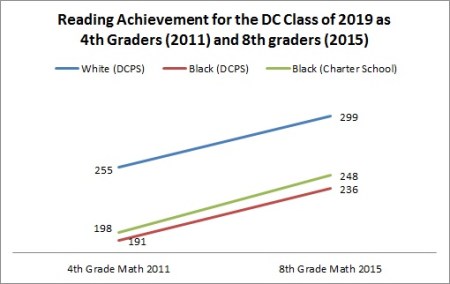
Last week I told you that White DC 4th grade students were outscoring the average achievement of Black 8th graders on math by a wide margin. The below chart presents data from the 2011 4th grade math NAEP along with 8th grade scores from 2015. Data for White and Black students from the DCPS and Black students from DC charters are presented.

DC gap trend 1

I’ve looked at the both the main NAEP and the Trial Urban District Assessment and you simply cannot find another spot that matches DC for achievement gaps. As you can see, by 4th grade DC White students have already demonstrated  a level of mastery of mathematics that 8th grade Black students come nowhere close to matching by 8th grade. At fourth grade a sixty point gap between the achievement of White and Black students yawns (272 to 212). Meanwhile DCPS Black students have not come close to catching up to the 4th grade White score 4 years later. In fact at the rate of progress shown by DCPS Black students we would expect them to catch up to the 4th grade scores of DCPS White students somewhere around their sophomore or junior year of high-school.

No one should view the closing of these gaps as easy. Notice that DC Black students attending charter schools started 8 points ahead of their district counterparts in 2011 and then gained more between 2011 and 2015 (46 points for charter students, 36 for District). This left DC Black students within striking distance of the 4th grade score of DC White students (272 to 266) but still far behind DCPS 8th grade White students (314 to 266). Still DC’s Black charter school students made the largest overall gains (46 points) and did so for about half of the average revenue per pupil in DCPS.

Sick to your stomach yet? Can’t believe it? Well let’s check the tape for the NAEP reading exam.

DC gap trend 2


We see precisely the same pattern- by 4th grade DC White students demonstrate a level of mastery of reading that Black students will not equal by 8th grade. A huge gap between DCPS White and Black students (64 points) yawns out in the 2011 4th grade scores and does not meaningfully narrow by the time the cohort reaches 8th grade in 2015 (63 points). DC Black students attending charter schools demonstrated a smaller gap in 2011 (57 points) and had narrowed it a bit further by 2015 (51 points) but had still not caught up to the score of DCPS White students in 2011.

Before you reach for your demographic fatalism pistol let me just note that FRL eligible Black students attending district schools in Boston scored 24 points higher than FRL Black students attending district schools in DC. New York City and Houston clobbered DCPS by 16 points in the same comparison. None of these districts receive $29,000 per student in revenue. Houston didn’t sniff half of that figure. We cannot disentangle the effect of schooling and family with these data, but other systems seem to do much more for similar students with much less.

Getting back to the Heritage study– someone take a look at this data and tell me why oh why would we want to shower $29,000 per student on the system that produces such catastrophic results for disadvantaged kids. Charters receive only $14k per student that and get better results. Congress provides a constantly politically imperiled $8k per child on a small voucher program for low-income DC kids that merely gets them over the high-school graduation finish line at a 20% higher rate. This system of finance has been in place for decades now. Piling money on a system proficient only at serving the needs of the already advantaged while starving systems serving the disadvantaged for funds makes sense to someone.

It just doesn’t make sense to me. It shouldn’t make sense to you either.


DC: Achievement Gap Capital of the United States

February 12, 2016

(Guest Post by Matthew Ladner)

So when you have this go on for years (huge gains for the well to do, not so much for low-income kids):

Ladner DC 7

You wind up with this:

DC achievement gap

It is only with some reluctance that I raise this topic. In one of the editions of the Report Card on American Education we spent an entire chapter on achievement gaps and just how tricky they can be. West Virginia for instance, down at the bottom of the chart, had a low achievement gap a few years ago because both White and Black scores were declining, but White scores were falling faster than Black scores…but the achievement gap was closing….Huzzah?

Um, no.

In the end though the situation in DC is much more straightforward: White scores are really, really high while Black scores are really low. In the end there really isn’t much lipstick to put on an almost sixty point achievement gap pig. DC has the highest scores for White kids in the country by a 12 point margin but scores for Black students towards the bottom of the barrel.

In 2015 DC’s White 4th graders had a substantially higher score on the 4th grade math exam (274) than Black students attending DCPS had on the 8th grade exam (248). I’m no social justice warrior, but that should sicken anyone’s soul.

This is again a partially a reflection of the gentrification trend. The fact that more well to do families are staying in the District is very good for the financial health of the city. Most of DC’s school budget is locally generated and the rising affluence of the District has in fact generated an embarrassment of riches on the revenue per pupil statistics ($29k+ per year per kid).

Would that the District of Columbia Public Schools had made better use of it. The charter sector, with approximately half of the resources per pupil, Black students scored 18 points higher on the above exam. This cuts the achievement gap between Black students attending charter schools and White students in their enclaves of excellence in DCPS by approximately a third. Miles and miles to go to be sure, but at least the journey is underway.

Meanwhile back at DCPS…it can be very hard to focus.


Urban but No Longer Poor in DC

February 11, 2016

(Guest Post by Matthew Ladner)

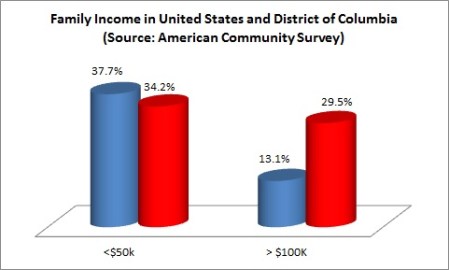
DC has a long-standing spot in our thoughts as a poor urban district. While there certainly low-income folks with kids attending DC public schools, this image is in need of an update. Here is some data from the United States Census Bureau American Community Survey from 2014, DC is red:

DC family income

So the percentage of families with incomes over $100k is comfortably above twice the national average, while the percent below $50k is slightly below the national average. Mean family income:

Mean family income

Whatever statistic you want to examine- median income, mean income, workforce participation, etc. it all looks better in DC. Once upon a time you could say this doesn’t necessarily reflect upon public school scores because the affluent sent their children to private schools. Ah, but recall that private school attendance has been collapsing in the district despite the presence of a private scholarship program:

So between private school enrollment declining and overall public (district and charter combined) enrollment increasing and average family incomes well above the national average, the socio-economics of DC public education have likely never looked more favorable than now.


Drowning in Dollars but Starving for Gains: DCPS Spending and Scores in Context

February 10, 2016


(Guest Post by Matthew Ladner)

In our next exciting episode of reviewing the DC education scene from the new study I wrote with Heritage we take a look at where the District remains despite a stunning level of investment and 25 years of improvement.

So let’s put DC into context in terms of revenue per pupil with data from the United States Census Bureau.

Ladner DC 1

DC charter schools seem to be bringing in somewhere in the neighborhood of half of that figure on a per pupil basis. Now let’s see what the Trial Urban District Assessment NAEP has to say about how DC kids compare. The chart below compares kids on NAEP 8th grade math scores for students whose parents graduated from high-school but did not attend college. The hope here is to rank districts by kids not born on third base.

Ladner DC 5

Note that if you do the same comparison by FRL status instead of parental education you still find DC ranked only ahead of Detroit and behind everyone else. The 17 point advantage for DC charter school kids in the above chart is considerable, but as the comparison makes painfully obvious, DC charters may be on their way, but they have not arrived. Still with less money and better scores the ROI is far, far higher than DCPS.

The heartbreaking part of the story however lies with the DCPS students. I’m not going to bother to look up the revenue per pupil statistics for Detroit but I am putting the over/under at half that of DC. Decades into DC reform efforts DCPS remains largely unchanged- far better at spending money than at teaching children, other than those who bought or worked their way into the high performing schools.

Next episode we’ll discuss what to do next. It shouldn’t involve continuing to bang our heads against the “better scores through improved management in an utterly broken system” wall. It also does not involve giving up.


Gentrification is the primary driver of District of Columbia Academic Gains

February 9, 2016

The Capital is playing games with some limited success but low-income kids still hunger for academic gains.

(Guest Post by Matthew Ladner)

New study out today from the Heritage Foundation authored by yours truly on education in the District of Columbia. I will serialize the study a bit with a chart or two per post. The view I had of K-12 in the nation’s capital going into the project did not survive my investigation. My initial view going into the project is summarized in this chart:


Ladner DC 4

Moving your 8th grade math scores from 230 in 1990 to 263 (combined district and charter) in 2015 is a lot of progress- by far the largest gains in the nation. While things are somewhat worse if we look at District of Columbia Public Schools (DCPS) scores alone (258) they still are far above the earliest measure. Better yet- when you examine charter scores in isolation from DCPS scores, the scores are higher still. Any actual education going on in DCPS back in 1990 looks to have been mostly accidental- I’m not sure what you would score on the NAEP math test if you just answered “B” every time, but with 3% of DC students scoring proficient and 83% scored “Below Basic” on the NAEP 8th grade math exam in 1990, it could not have been much lower. In 2015 19% of DC students scored proficient and only 49% scored Below Basic. The improvement is undeniable: time to CeleNAEP? Those gains dwarf anything seen out in the states, and the charter school sector getting close to half of the students is clearly a major driver of improvement. Twirl for me, girl on fire!

Alas while this story is true it is far from complete. What is going on in DC is both complex, partially encouraging and in the end very disturbing.

Overall enrollment in DC (district and charter) had been growing in recent years along with average incomes. A complex phenomenon is underway in which sophisticated young parents have figured out that they don’t need to move to Maryland or Virginia if they can find a spot in the right district or charter school in the District. In the end your kid doesn’t get educated by a district or a CMO but rather by a school. DC is the champion for NAEP gains, but it is also the champion for achievement gaps.

You can see the gentrification going on both in DC’s statistics and with the naked eye walking around town. Somebody keeps buying those million plus dollar brown stones and some of them are parents. This begs the question: how much of DC’s apparent academic gains owes to gentrification?

Sadly the answer is- affluent children have banked the vast majority of DC NAEP gains over the last decade.

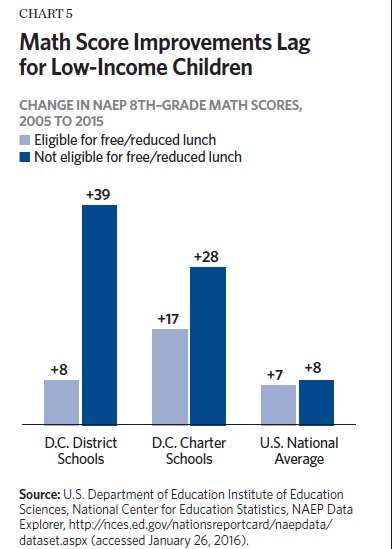
Ladner DC 7

There is a lot going on in this chart so pay close attention. These are again NAEP 8th grade math gains by family income (FRL status) over the last decade. First look at the light blue columns- gains for FRL eligible kids. DCPS district equals an 8 point gain, which is indistinguishable from the national average of 7 points. The 17 point gain for free and reduced lunch kids attending DC charter schools is the only real bright spot for disadvantaged kids in the public school system despite decades of reform. We used 8th grade math for purposes of illustration but you see a similar pattern across the NAEP exams.

Now observe the dark blue columns- DC kids whose incomes are too high for a Free or Reduced price lunch under federal guidelines. Here the gains are truly extraordinary- a 28 point gain for non-FRL kids attending charter schools and a 39 point gain for middle to high income district students. I’m placing my bet now that this isn’t solely due to schools in Georgetown doing an ever-better job educating kids with law-firm names, but also to the fact that people who once fled to Va and MD finding a spot that suited them in DC.

So in 1990 let’s estimate that the number of DCPS FRL kids scoring proficient on 8th grade math as effectively zero. Twenty five years later, that figure is up to 8 percent for district kids (charters excluded). DCPS in other words remains largely what it has always been- an organization far better at employing adults than meeting the needs of disadvantaged children. As we will see in a future post, the academic results of DCPS continue to disappoint even in comparisons against other urban districts despite 15 years of strong progress and gentrification.

I am Ozymandias-Queen of Queens! Look upon the ineffectiveness of my broom ye mighty and despair!

Overall the situation in DC K-12 is very complex- with both positive trends and heartbreaking stagnation. Regardless of where you are coming from on the political/philosophical side of things, if you are a DC taxpayer you should not stand for this state of affairs as it touches upon economically disadvantaged children. The above chart shows is that despite a truly shocking amount of tax effort and a decade and a half of reform, what DCPS has figured out how to do is to give the most academically to the kids born on third base. Mind you this is much better than giving approximately nothing to anyone a la DCPS circa 1990, but that is in the big picture a cold comfort. In the end it is very positive for the fiscal health of the District of Columbia that third base parents can in fact get a quality education for their children it in the right bits of DCPS. Moreover, those third base parents are paying a mind-numbing level of tax and they deserve a quality education for their children.

So does everyone else.