Panic on the Streets of Motown

April 20, 2013

Michigan Skunk Works tries to create better and cheaper schools…errr….I mean UX restores artwork in underground workshop…

(Guest Post by Matthew Ladner)

Just to take the UX theme a bit further, you can get a pretty good insight into much of what is wrong with our education policy discussion by reading this article from the Detroit News:

Education reform group forges voucher-like plan for Michigan

Proposal would create ‘value schools’ to operate at lesser cost than  now

From The Detroit News: http://www.detroitnews.com/article/20130419/SCHOOLS/304190361#ixzz2R1FbwpN1

Only in education could having a group of people working to design a more effective and cost-efficient service be viewed as some sort of dark conspiracy. I mean the Trial Urban District Assessment of NAEP reveals that a full 7% of Detroit 8th graders can read at a Proficient level- only 93% to go. Why would anyone want to seek a better return on the annual investment for the almost $20k per student spent in DPS? Perhaps when the people of Michigan evolve from their cheap skate tendencies and spend $40,000 per student per year they will get that proficiency rate up to 14%.

Or perhaps not.

Notice the use of the term “voucher-like” when in fact the Michigan constitution prohibits public funds following a child to a private school rather completely. I guess it is “voucher-like” however in that vouchers clearly deliver superior academic results for less money. Other than that this plan sounds like an interesting combination of digital learning, charter schools and education savings accounts. Sadly the Pascal Monnett types of the Motor City will quickly be trying to find ways to undermine them.

HT: RedefinED twitter feed.


Pascal Monnet for the Higgy

April 14, 2013

(Guest Post by Matthew Ladner)

A fascinating 2012 article in Wired introduced readers to the exploits of Urban eXperiment (UX for short). UX is a clandestine group of Parisians who make use of the underground tunnels break into museums in order to restore neglected pieces of art. Pascal Monnet is a museum administrator who did everything in his power to shut them down.

If this sounds too much like Robert DeNiro’s rebel-commando air conditioner repair man character from Brazil for comfort, well, yeah-me too.  A friend of mine from graduate school, Dan Twiggs, sagely noted that Brazil was actually a documentary rather than a bizarre dark comedy.

UX is more than cool enough to force you to revise any stereotypes Americans hold about the French, but people like Monnet force you to reconsider your reconsideration. The group invests their time, effort and money into restoration projects neglected by the state, and even gives pointers to museum administrators regarding the flaws in their security. Armed with a map of the underground tunnel networks beneath Paris, UX members set up workshops in order to conduct late night restoration projects.  In 2006, they decided to fix a large clock within the Pantheon:

That September, Viot persuaded seven other UX members to join him in repairing  the clock. They’d been contemplating the project for years, but now it seemed  urgent: Oxidation had so crippled the works that they would soon become  impossible to fix without re-creating, rather than restoring, almost every part.  “That wouldn’t be a restored clock, but a facsimile,” Kunstmann says. As the  project began, it took on an almost mystical significance for the team. Paris,  as they saw it, was the center of France and was once the center of Western civilization; the Latin Quarter was Paris’ historic intellectual center; the Pantheon stands in the Latin Quarter and is dedicated to the great men of French history, many of whose remains are housed within; and in its interior lay a clock, beating like a heart, until it suddenly was silenced.

Untergunther wanted to restart the heart of the world. The eight shifted all their free time to the project.

After fixing the clock, UX notified the administration of the Pantheon, whereupon the story started to go wrong:

As soon as it was done, in late summer 2006, UX told the Pantheon about the successful operation. They figured the administration would happily take credit for the restoration itself and that the staff would take over the job of maintaining the clock. They notified the director, Bernard Jeannot, by phone, then offered to elaborate in person. Four of them came—two men and two women, including Kunstmann and the restoration group’s leader, a woman in her forties who works as a photographer—and were startled when Jeannot refused to believe their story. They were even more shocked when, after they showed him their workshop (“I think I need to sit down,” he murmured), the administration later decided to sue UX, at one point seeking up to a year of jail time and 48,300 euros in damages.

Jeannot’s even more clueless successor, Pascal Monnet, not only continued to file suit against known members of UX,  and he even hired someone to break the newly restored clock:

Jeannot’s then-deputy, Pascal Monnet, is now the Pantheon’s director, and he has gone so far as to hire a clockmaker to restore the clock to its previous condition by resabotaging it. But the clockmaker refused to do more than disengage a part—the escape wheel, the very part that had been sabotaged the first time. UX slipped in shortly thereafter to take the wheel into its own possession, for safekeeping, in the hope that someday a more enlightened administration will welcome its return.

Meanwhile, the government lost its lawsuit. It filed another, which it also lost. There is no law in France, it turns out, against the improvement of clocks. In court, one prosecutor characterized her own government’s charges against Untergunther as “stupid.” But the clock is still immobile today, its hands frozen at 10:51.

Well thank goodness for that- after all we wouldn’t want a clock actually displaying the correct time for more than two minutes a day- that would be like having a public school system that actually taught children how to readquelle horreur! It strikes me that in a sense we are all waiting for that “more enlightened administration” in one form or another. I happily nominate Pascal Monnet for the Higgy, as he is a good candidate to be Patron Saint of Soulless Bureaucrats everywhere by displaying rigidity well past the point of absurdity.


Texas Freedom Fighters Bypass Borg Shields

April 12, 2013

(Guest Post by Matthew Ladner)

Improved news from Texas- the Senate Education committee passed both a special needs voucher and a scholarship tax credit proposal, and the full Texas Senate passed a modest increase in the charter school cap 30-1. Lotexas of Borg however shrugged off the damage and repeated the demand to be lead to Sector 78701 for more money, less accountability and no parental choice. Lotexas explained the collective’s position to a local Austin radio station succinctly: “You will be assimilated. Resistance is futile. You don’t want none of this, son!!”

You know what I love about the last decade of Texas public education? Every year I get a little older and they get more expensive without teaching students how to read any better.

Let’s see what happens next.


ESA makes a Customized Education Possible for Jordan Visser

April 10, 2013

(Guest Post by Matthew Ladner)

Watch the above video from the Alliance for School Choice, and mind you, that the customized education that Jordan is receiving is using only state funds which districts have spent decades describing as inadequate. Whatever school district Jordan used to attend, assuming that school finance works the way public school advocates and lobbyists have claimed, would have been making a large shift of their own general education dollars in an attempt to educate Jordan.  The district suffers no harm in losing Jordan, and in fact, one could make the case that they now have more resources to use on their remaining students.

Jordan benefits having an education custom designed to meet his needs.

Sadly a group of the anti-choice usual suspects are in court trying to make use of Blaine language forged by 19th Century Know-Nothing and Ku Klux Klan bigots in an effort to force students like Jordan back into district schools. I hope they will reconsider.


More Bad News from Texas

April 5, 2013

(Guest Post by Matthew Ladner)

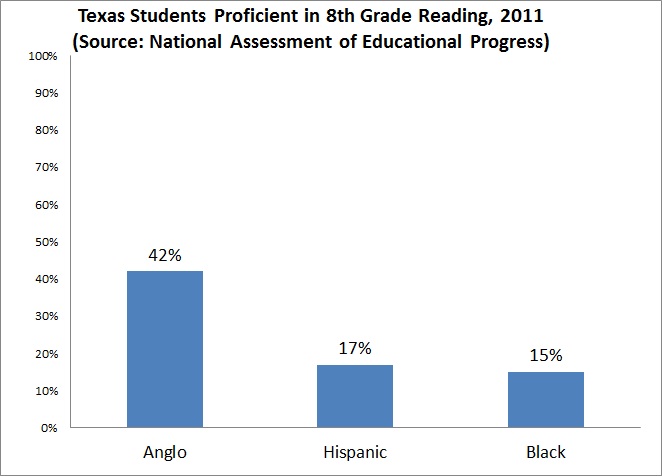
Bad news from Texas– bipartisan super-majority of the House votes to prohibit vouchers in the House budget plan. It remains to be seen whether the state adding 80,000 new public school students per year and which has 17% of Hispanic and 15% of Black 8th graders reading proficiently will allow 10 new charters to be added to the state’s cap per year or not.


ESAs in the NYT

March 28, 2013

(Guest Post by Matthew Ladner)

The New York Times has a story on the progress of the school choice movement. Money quote on Arizona’s Empowerment Scholarship Account program:

The Arizona Legislature last May expanded the eligibility criteria for education savings accounts, which are private bank accounts into which the state deposits public money for certain students to use for private school tuition, books, tutoring and other educational services.       

Open only to special-needs students at first, the program has been expanded to include children in failing schools, those whose parents are in active military duty and those who are being adopted. One in five public school students — roughly 220,000 children — will be eligible in the coming school year.       

Some parents of modest means are surprised to discover that the education savings accounts put private school within reach. When Nydia Salazar first dreamed of attending St. Mary’s Catholic High School in Phoenix, for example, her mother, Maria Salazar, a medical receptionist, figured there was no way she could afford it. The family had always struggled financially, and Nydia, 14, had always attended public school.       

But then Ms. Salazar, 37, a single mother who holds two side jobs to make ends meet, heard of a scholarship fund that would allow her to use public dollars to pay the tuition.       

She is now trying to coax other parents into signing up for similar scholarships. “When I tell them about private school, they say I’m crazy,” she said. “They think that’s only for rich people.”

BOOOOOOOOOOOOOOOOOOOOOOOOOOOM


Defeated at Wolf 359 but Texas is not completely assimilated yet

March 24, 2013

“The fight does not go well Enterprise…rendezous with fleet remnants at.. !*!Ktzzzzzzzzsszzz!*!”

(Guest Post by Matthew Ladner)

An old joke holds that you should never ask a man where he is from. If he is from Texas he will tell you, and if he is not, you don’t want to embarrass the poor feller.  Texans are famously/infamously proud of their state, and not without cause. Texans have been enjoying their national status as an economic juggernaut. Wildcatter George P. Mitchell is probably the first Texan to transform the economy of the 21st Century profoundly for the better but he won’t be the last.

Progressives will often bemoan the modest size of government in Texas and attempt to throw cold water on the state’s success by citing various statistics heavily influenced by the fact that the state is a huge destination for immigrants. And yet they continue to come on. Texas is an opportunity rather than a welfare magnet. Texas was the only state to gain 4 Congressional seats after the 2010 Census, all of which came from sclerotic regions of the country. Y’all have fun with that nanny state business and we will keep helping ourselves to your electoral votes, companies and jobs is a prevalent attitude in the Lone Star State.

Mitchell’s hometown of Houston, the global center of the oil business, is jumping but the good times extend well beyond the oil patch. Austin, once a smallish but funky university/state government town, now has condo towers dominating the skyline and far more on the way. A stroll through downtown during SXSW proved to be an eye-opening experience for this former Austinite. I’ve been gone for a decade and the city is both transformed and growing at a mind-boggling pace.  Oh sure, an old guard is still around to complain about traffic and the “lost golden age of Austin” back when they shared herbal blends with Willie at Liberty Lunch or whatever but no one seems to be listening much. The city and state is on a monstereous economic roll.

Texas however has an Achilles heel and doesn’t seem to be aware of it: K-12 education. To stretch a metaphor a bit, I would say that Texas is a horned frog boiling in water.

Here is the problem in two simple charts. First Texas 8th graders scoring “Proficient or Better” in 8th Grade Reading:

Texas 8th Grade NAEP ReadingSo let us take 8th Grade Reading Proficiency on NAEP as a rough proxy for solid preparation for college and/or career readiness. The NAEP proficiency standard is a high bar relative to the various state minimal skills tests floating around, but it equates well with international examinations.  The level below Proficient – “Basic” signifies “partial mastery” of grade level skills, so we are looking for full grade level mastery. So what we are looking for here is at least:

Eighth-grade students performing at the Proficient level should be able to provide relevant information and summarize main ideas and themes. They should be able to make and support inferences about a text, connect parts of a text, and analyze text features. Students performing at this level should also be able to fully substantiate judgments about content and presentation of content.

As the figure shows, not very many Texas students can actually do these sorts of things. Only a large minority of Anglo students along with a tiny minority of Hispanic and Black students show this level of reading ability.

Here is the kicker:

Texas K-12 ethnic breakdownNewsflash Tex: that 42% of Anglo kids being ready to face the rigors of the global economy doesn’t go nearly as far as it used to back in the day. Just in case I don’t have your undivided attention yet, check this out:
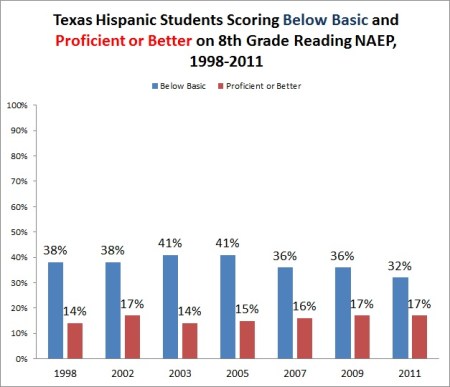
Texas HispanicAmongst Hispanics, the group that constitute a majority of K-12 students in the state, the functionally illiterate outnumber proficient readers by a very wide margin. Texas spent $11,146 per pupil in the public school system in 2010-11, which is an amazing sum when placed in context of just how much enrollment growth the state is attempting to accomodate. Texas has a public school population twice the size of Florida’s (with FL having the nation’s 4th largest btw) and approximately equal in size to the public school systems of the 20 smallest states combined.

The state has been adding around 80,000 students per year, which approximately equals the size of the Wyoming public school system. The public school lobbying groups pretend that any kind of choice program is going to leave the Texas public school system a financial ruin when in fact even the most far-reaching choice programs could at most put a dint in school district enrollment growth. If you waved a magic wand and moved every charter school that has opened west of the Mississippi River since 1990 into Texas, Texas school districts still would have gained hundreds of thousands of students.

Despite all of this, Texas Senate Education Chairman Dan Patrick, a strong supporter of parental choice, announced last week that he would be modifying a bill to eliminate the state’s charter school cap, and to instead raise it by a few dozen schools per year. Senator Patrick did this out of necesssity just to get the bill out of the committee. Worse still, this is happening in a session that seems destined to dummy down the state’s high-school graduation requirements in a major fashion. We have yet to reach the end of the movie, but this is the part where things are looking bleak for the good guys.

Don’t worry Tex…even though I control your K-12 vote I will still let you describe yourself as “conservative”…

Rather than blame the lawmakers, I’ll go ahead and blame people like myself. We reformers have done a poor job thus far in communicating the reality of the Texas situation. Consequently, there is a greatly misplaced complacency with regards to K-12 policy. We must do much better.

The greatest weakness of the powerful Status-Quo Collective that has assimilated many Austin decision makers is that they have no plausible plan for improving the Texas public education system. The problems embodied in the figures above (and others) will continue to go unaddressed while they seek yet more money for an outdated and ineffective system of schooling.

The current Texas public education system is however taking the state in a direction that almost no one will want to go. By educating only a small cadre of students to participate and prosper in the global economy, the future of the state will begin to look like that of Brazil in the late 20th Century, which one of my professors once described to me as “Belgium floating on top of India.”

As a purely economic matter, Texas can continue to import college educated workers from the less dynamic states indefinitely. As a matter of socio-economics however one cannot avoid asking fundamental questions regarding the long-term stability of both the prosperity and even democracy itself.  A public education system with only 17% of Hispanics and 15% of Black students reading proficiently constitutes a foundation of sand for the opportunity society needed to secure the future.

Time to choose…

In short, Texas can either continue to be Texas- a rapidly growing opportunity society, or it can morph into California. From my perspective in the nearby cactus-patch, California looks like a place from which Belgians are fleeing and have been for decades now-a rather loud wake up call. Ironically this leaves “progressive” California as a society increasingly divided by wealth and race. Politically incapable of addressing their education problems, California looks set to become Monaco floating on top of India. Good luck with that.

In the long run, Texans will either embrace their ideals or their education status-quo. It will become increasingly obvious that they cannot do both.


Where Have You Gone Mr. Moynihan? Our Nation Turns its lonely eyes to you

March 12, 2013

(Guest Post by Matthew Ladner)

The lovely Mrs. Ladner gave me Daniel Patrick Moynihan: A Portrait in Letters of an American Visionary for Christmas. Once I started reading it, a found it quite difficult to put down the 702 page tome. DPM’s career as advisor to Presidents Kennedy, Johnson, Nixon, Ambassador to India and the United Nations and United States Senator is interesting in itself. The real value of the book however lies in the letters of the scholarly Senator providing a first hand account of how Washington elites wrestled with the issues that still consume us today.

Despite the fact that Johnson viewed DPM somewhat suspiciously as an Irish Catholic “Kennedy man” Moynihan’s memoranda to President Johnson especially jump off the page. Moynihan laid out in detail why the path to the Civil Rights Act was comparatively easy compared to what faced the nation going forward. Americans broadly support equality of opportunity he explained but the reform coalition would inevitably fragment over attempts to provide equality of condition.

Citing data from the United States Armed Services exam, he attempted to steel the resolve of the Johnson administration that American Blacks had been so profoundly damaged by the legacy of slavery and Jim Crow that they were poorly situated to thrive in an atmosphere of free competition. DPM estimated that the nation faced a 50 year project to right this wrong, and that it would be enormously controversial, but that the administration may as well get on with it.  You can judge for yourself whether this was a wise course to follow, but Moynihan’s clear-eyed prescience regarding everything leading up to the Civil Rights Act having been the easy part of the struggle is breathtaking in its stark clarity.

During this same period however Moynihan began to sound the alarm concerning the dissolution of the Black family, predicting that the trend would ultimately undermine anti-poverty efforts. DPM gained lifelong enemies on the left for having dared to speak such a truth, only some of whom ever apologized to him years and even decades after it had become abundantly clear that he had been quite correct.

DPM’s cross-species jump to become a prominent policy advisor in the Nixon White House is amusing to watch. Many of DPM’s memos contain dark warnings concerning the New Left campus radicals. While DPM clearly viewed such people as illiberal thugs, as someone born in 1967 I can’t quite decide whether he genuinely viewed such people as a threat to democracy or whether he was simply manipulating a group of gullible Republicans.  Perhaps both and someone who lived through this era should let me know what they think. Regardless, Moynihan paints a vivid picture of a deeply chaotic and misguided America which I am quite happy to have left to others to endure.

DPM’s writings of the time reveals the Nixon administration as deeply concerned with issues of poverty and race along with Moynihan’s growing disenchantment with the Vietnam War. Repeatedly he warns Nixon that what had been Johnson’s War in the public’s perception steadily transforming into Nixon’s burden. DPM pushed Milton Friedman’s proposal for a negative income tax hard, hoping to defuse what he saw as a catastrophic cycle of resentment over welfare programs.

Welfare reform remained Moynihan’s white whale throughout his career in the Senate. He championed meaningful reform legislation in 1989, and led a desperate effort to get the Clinton administration to address the subject in the early 1990s. Moynihan seemed to carry the Hillarycare bill primarily to leverage stronger action on welfare reform, and eventually he turned on the administration. At one point he even set up a meeting between Hillary Clinton and economist William Baumol in an effort to explain the doom of the approach. Later to her credit Senator Clinton graciously admitted that she ought to have listened.

In the end, DPM passionately opposed the Personal Responsibility Act of 1996, coming across as misguided in the process to this reader. Unfortunately it does not come across clearly in the book exactly what sort of welfare reform DPM would have pushed in 1993 if given the chance. In any case, the country will once again be facing these sort of issues as we face the painful task of putting the nation’s fiscal house in order.

It is impossible to read this book without yearning for Moynihan’s trained mind, keen intellect and above all moral courage to return to our national politics.  Moynihan’s lifelong passionate support of parental choice served as simply one example of these towering qualities. Just in case no one else is going to suggest it, a Daniel Patrick Moynihan Institute dedicated to pursuing the still unfinished business of the Senator’s career could greatly enrich our public debate.

Whether you agreed or disagreed with him, Moynihan was one of the great figures of the United States Senate. When will we see another?


Heads You Win, Tails You Still Win

March 5, 2013

(Guest Post by Matthew Ladner)

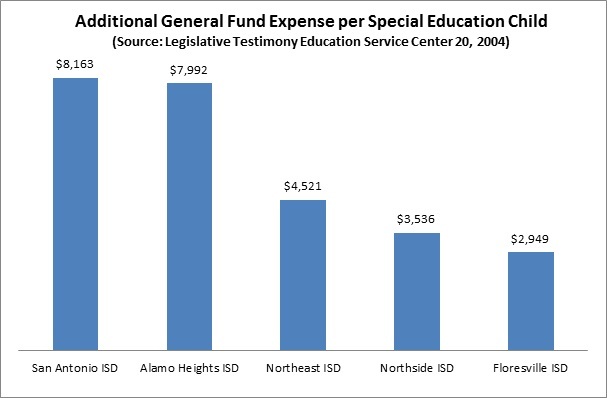
I had the opportunity to testify to the Senate Education committee in Texas today on the experience with parental choice programs for special needs children. One of the items of discussion was the following chart:

McKay Texas 1This phenomenon is often discussed regarding special education, but seldom quantified. In 2004 however officials from Education Service Center 20 (a regional body roughly covering school districts in the San Antonio area) provided the following chart to quantify the additional cost per special education student in a number of school districts. There were costs above and beyond those covered by state funding, and thus represented in effect a transfer from district general funds into special education funds on a per special education student basis.


Stanford economist Caroline Hoxby also testified to this interim committee in 2004, and she made the point that since school districts have been complaining that states don’t cover the full costs of special education for decades, that they have no cause to complain about students leaving with their (inadequate) funding. Districts can either keep these funds in the general education effort, or spend more on their remaining special education students (approximately 5% of Florida special education students directly utilize McKay but far more benefit from it) but either way they benefit.


Alabama Lawmakers Pass Tax Credits for Children Attending Failing Public Schools

March 1, 2013

(Guest Post by Matthew Ladner)

Wow– Alabama lawmakers are officially the Cinderella kids, coming out of nowhere to shock the school choice world with an unexpected victory with the creation of two new tax credit programs for children attending failing public schools.

Here is a link to the bill, with the tax credit programs starting on page 14.