The No-Stats All Star Retires

June 18, 2014

(Guest Post by Matthew Ladner)

Shane Battier, the man dubbed by Michael Lewis as the No-Stats All Star– has announced his retirement from the NBA at age 35 to take a college basketball analyst position with ESPN.  Battier never looked like much on the stat-sheet but when the statisticians got around to crunching the NBA they discovered that all he does is little things-like help his team win basketball games.  Battier-type “White Space” employees raise important questions about how to approach employee evaluation including teachers.

John White and I spoke on a panel together a few years ago and the topic of evaluation came up.  I sounded a note of caution but Superintendent White saw my bet and raised me by opining that we were in danger of making a fetish out of value added scores and that ultimately we should rely upon the professional judgement of administrators informed by data rather than merely the data itself. At least that is how I interpreted what White said, and if so, I agree with him.

Greg has been saying all along that ultimately this system requires choice.  Give parents meaningful choice, let Principals hire their own teams, have Superintendents evaluate Principals on the basis of the health of their school.  This strikes me as not only as the best way to do teacher eval, but also the only way to create a system to recognize the value of woefully under-appreciated highly effective instructors.  To choose another sports analogy developed by Michael Lewis, the pay of Left-Tackles took off after the advent of free-agency in the NFL.  Once a true market for players had been established, guys who had the skills to block a Lawrence Taylor found themselves in high demand, whereas the old system kept their compensation under wraps.

There are only a few states where we might be inching towards meaningful levels of parental choice, probably fewer still if any where the school leader has anything approaching a free hand to choose their own team. Mechanistic programs that attempt to identify and reward and remove instructors will be better than a unconditional tenure and dance of the lemons system but will never match a system in which trained professionals with healthy incentives exercise professional discretion. The Heat for instance hired Battier because they understood that there is a great deal more going on than the stat sheet, and won a couple of championships.

The primordial soup is slowwwwly starting to bubble…

Now imagine a burnt out and disgruntled Charles Barkley riding the bench of the Heat as a player in 2014 drawing a bigger salary than LeBron because the coaches can’t make best use of their salary cap…


Vergara vs. California

June 10, 2014

(Guest Post by Matthew Ladner)

Read the decision here.  I’m not a lawyer and I don’t play one on tv, so I will leave the legal analysis to others.  Two things seem obvious: an appeal of this decision is inevitable, and second this type of lawsuit will be emulated in other states- many other states.  The conclusion of this will doubtlessly take years to reach but this may prove to be a decisive turning point on teacher quality issues.  If it proves decisive it will be more like Midway than Waterloo, but reading through the decision gives you the feeling of a decisive turning point having been reached.

Reading through the decision also reveals just how deeply discredited practices like unconditional tenure and LIFO have become. The limits to the National Education Association’s attempt to muddy the water on research through “rent-a-reactionary critiques” of the groundbreaking research on teacher impacts seem completely exposed as well. It is much harder to pull the wool over the eyes of a discerning judge than an education reporter on deadline.

The courts often prove to be a lagging indicator in the war of ideas.  This war is far from over but congratulations to the team who fought this battle.


Delaware Lawmakers to Debate Broad ESA measure

June 10, 2014

(Guest Post by Matthew Ladner)

Delaware lawmakers are set to debate a broad ESA measure with a sliding scale by income.  The proposal has activated the anti-bodies of the public school establishment, and the sponsors acknowledge in the article that they do not expect the measure to pass this year. NAEP indicates that Delaware has done a good job in improving the public school system in recent years, and it seems likely that parental choice is playing an unsung role in Delaware’s improving scores.

Delaware has the second highest private school attendance rate in the nation (behind only Hawaii) at 20% of students. Note that this percentage dwarfs that in states like Arizona and Florida, whose private choice programs are essentially trying to play catch-up to the old-fashioned checkbook choice widely exercised in states like Delaware. Delaware charter schools have been heading towards a 10% of the market as well, and many Delaware charter schools have waiting lists.

The question for Delaware lawmakers to consider therefore is not whether they should have parental choice.  They already have parental choice.  The question to face: who should be exercise parental choice?  Currently Delaware’s answer to that question is: the wealthy, with others getting a less-diverse form of choice in the form of charter schools or their wait lists.

People prize stability in life, and it is clear that many in Delaware feel acute discomfort from the mere advent of charter schools. Education spending ought however to be the entitlement of the child, not of any system of education. Moreover, the Census Bureau forecasts a 90% increase in Delaware’s elderly population between 2010 and 2030, foretelling a deep battle between health care and education spending in the state. It would be wise for the state to experiment in making parents the voluntary offer of less spending in return for greater control and flexibility. Simply maintaining the status-quo does not represent a viable option even in the medium term. Our experience from other private choice programs demonstrate that there will not be a mass exodus from the public school system.

The Delaware proposal is admirable in giving the most to the children starting with the least. I look forward to the conversation.


Poetic Justice on NYC Charter Schools

June 9, 2014

This is my apprentice, Darth de Blasio. See if you can help him find a way out of the charter school fiasco that he created for himself…

(Guest Post by Matthew Ladner)

The story just keeps getting better in NYC as the chickens come home to roost. From Chalkbeat New York:

The new law requires the city to provide new charter schools with free space inside the city’s own buildings or public funding to cover rent in a private facility. The legislation is a rebuke from state lawmakers of de Blasio’s criticism of charter schools during the mayoral campaign and his early months in office.

One challenge the law poses for de Blasio is that it makes financial sense to keep charter schools in city buildings. If the city doesn’t provide space, the law provides for charters to receive an extra funding allowance for each student, which in 2015 would be $2,775, from the city.

Thirteen charter schools have already been approved to open that year, serving 2,000 students at first and 5,800 at full capacity. Private space for those schools would cost as much as $5 million in the 2015-16 school year and $16 million once they are all at capacity, based on enrollment estimates.

In addition, the city is planning to spend $5.4 million next year for three displaced  Success Academy schools, which will have fewer than 500 students next year, to operate in Catholic school buildings.

So basically de Blasio is now hostage to a trumped-up grievance industry on co-locations that he helped to whip up but also financially on the hook for providing charter school facilities.  The bill on this is only going to grow unless the Mayor would like to discover the virtues of co-location. Memo to Sith apprentices: think twice before attacking decentralized education reforms enjoying broad support.


Let’s Search for Sweet Spots, but with modesty please

June 5, 2014

(Guest Post by Matthew Ladner)

I have a number of friends who have either helped develop or have signed on to a Statement of Principles regarding a three sector reform strategy and what they view as a desirable level of state oversight of private choice programs.  This post will work better for you if you go and read the document first.

The needle starts to scratch across the vinyl for me at:

Even with the expanded choice to the private sector, they also have produced modest results.

This has become a mantra in recent years, but I believe that this statement reflects an incomplete understanding of the research results, and specifically a lack of understanding regarding our random assignment studies of voucher programs. The basic takeaway from the random assignment studies in my view is as follows: the test score impacts are modest but often statistically significant within the three year window that we can reliably study them.

So the Milwaukee Parental Choice Program offered $6,400 vouchers to very low-income inner city parents whose other options were to attend a district spending $14,000 per child and/or charter schools spending somewhere between the voucher and district spending.  We have several random assignment studies of the test score impacts that find that the experimental group basically stays on grade level (a triumph for poor inner city children) whereas the control group declines year by year.  You get to watch this process for about three years before the random assignment breaks down on you.

What happens to test scores after Year 3?  No one knows for sure- these studies fall apart over time.  We do know things however about what happens regarding high-school graduation, college attendance, college persistence, etc.  Borrowing a slide that Pat Wolf presented at the Alliance for School Choice conference:

Slide11

So basically you are less likely to graduate in 5 years (first red column) because you are more likely to graduate on time, less likely to graduate from a two-year college (second red) because you are more likely to be going to a four-year college.  The blue columns are all positive impacts from having been a choice student.

Now if you are determined to cling to the “modest” camp by saying that you wish these impacts were even larger, well, I do too.  I also wish that Chuck Norris’ tears really did cure cancer.  At this point it might be appropriate to raise the question as to just how much a positive impact we should reasonably expect from a program giving profoundly disadvantaged children a $6,400 coupon.  Although we don’t know what happens after a few years of random assignment study, those graduation figures ultimately are far more important than 6th grade math scores.

Being far more likely to graduate from high-school and college for less than half the money sounds like a triumph to me, albeit one that we could and should hope to improve upon through more robust program designs.  The standard here should not be to expect MPCP to transform every last profoundly disadvantaged inner city child into a Dean’s List Ivy Leaguers.  Rather in judging the impact of MPCP we should look at it on a return per dollar invested basis.  When you look at it appropriately through this ROI it is clear that the return on MPCP has been quite good, and that we should be looking for ways to get even more of it.

Then I got to this statement:

We know that smart accountability measures can ensure that public money and young lives are not invested in low-performing private schools.

The statement offers no evidence to support this claim, and moreover the claim itself dodges the more important question of costs and benefits to regulation.  Is it possible for “smart” accountability to keep young lives out of low-performing private schools?  Sure it’s possible.  Smart training can ensure that I could go from being a 46-year-old policy wonk to heavyweight champion of the world. I mean it is possible right? Is it also possible, even highly likely, for the whole enterprise to go south on you in a variety of different ways? Yep, that’s very possible too.

Who is going to administer these smart accountability measures and who will administer them a few years later?  What about 25 years from now?  How often will these people do something they think is smart which proves to be otherwise?  Unless we want to have the Federal Reserve administer these programs, how long will it be until politics will subvert the process of “smart” technocratic policymaking?  Also like the Fed, the costs of technocratic mistakes may prove quite costly.

Even well-intentioned efforts at “smart accountability” could easily backfire.  Let’s take Louisiana as an example.  Louisiana policymakers decided to grade all their schools A-F based upon a state accountability test tied to the state academic standards, and then decided to create a mechanism to remove low-performing schools from eligibility to take new students.  This probably sounds clever at a Georgetown cocktail party, but in Louisiana two-thirds of the state’s private schools have decided to stay out of the program, denying thousands of seats to low-income children attending relatively poor performing public schools in one of the lowest performing states in the union.

Ooops.

Let’s take things a step further. Is it possible that the one-third of Louisiana private schools that chose to participate in the program may have had a selection bias towards being more on the financially desperate side than those that have decided to stay out?  I have no data to support that this in fact did happen, but who would be surprised if it in fact did happen?  The correlation between financial desperation and academic ineptitude often proves strong.  In such a case the initial impact of the regulatory regime might have precisely the opposite of what was intended with many higher performing schools choosing to keep their distance.  Worse still, it might create an incentive for private schools to engage in the same sort of gaming strategies that have been common in states with rising state test scores but flat NAEP scores- teaching to test items rather than to standards (Arizona is waving hello!).  Finally of course it is no triumph if the schools do actually teach the state standards because the whole idea of a choice program is to provide, well, meaningfully varying choices for parents.  If you want state tests and standards in Louisiana you already have thousands of options available to you in the form of district and charter schools.

In the end of the day, policymakers must make decisions about where to draw the line in such matters. We have no wrong or right answers here, only preferences. Personally I believe that choice programs should provide academic transparency to the public in ways designed to have the lightest possible touch on the curricular independence of schools.  I’m willing to sacrifice some level of private school participation in return for transparency.  Preferences will vary and we will learn things along the way through variation between programs.  What I think I have learned however is that Arizona’s transparency-light programs represent a costly obstacle to building broad support, and that the Louisiana and Indiana model has far too many private schools saying “thanks but no thanks.”

To my friends who crafted and signed on to this statement I say only that we should continue the dialogue and gather more information.  I don’t believe in regulation free programs nor do I expect or desire for us to pass any, so I agree with you to a degree. I however strongly suspect that many of you are underestimating the cost of regulation and overestimating the capacity of technocratic regimes.



U.S. K-12 spending drops for the first time in 35 years

May 29, 2014

(Guest Post by Matthew Ladner)

Mmmkay, well, this sort of thing is going to happen when your labor participation rate hits 1978 levels.  With tens of millions of Baby Boomers reaching retirement age, it looks like it will be much easier to increase K-12 flexibility than funding going forward. Ah for the halcyon days of 2008 when the AFT dreamed of putting dentists and personal trainers in the public school system for transparently self-interested reasons the vague promise of creating a 21st Century utopia.


Don’t Worry California, Texans will Eventually Figure out How to Get Your Oil

May 23, 2014


(Guest Post by Matthew Ladner)

So the bad news for California just keeps rolling in-turns out that the technology is not just there yet to get to more than a fraction of California’s 13.7 billion barrels of tight oil.   Not to worry Keanu, Texas wildcatters are getting better at the drilling techniques all the time.  Meanwhile in Texas, Mark J. Perry notes that in human history there have been 10 oil fields that have produced a million barrels of oil per day, and two of them are operating in Texas right now, largely thanks to the 18 years of visionary effort from the great George P. Mitchell.


How I Learned to Stop Worrying and Love the Demographic Time Bomb

May 22, 2014

Ladner Orlando

(Guest Post by Matthew Ladner)

Yesterday I had the opportunity to present at the American Federation for Children conference in Orlando along with Pat “PDiddy” Wolf, Lance Izumi, refereed by our main man Ed Kirby.  Lance busted out depressing “Not as Good as You Think” evidence on suburban public schools  in California and Illinois.  PDiddy used Bud and Sissy from one of the greatest really bad movies of all time to tell us that school choice research is looking for love in all the wrong places, and even included the great Scott Glenn:


Make fun of my transparent muscle shirt and I will put you in the hospital…

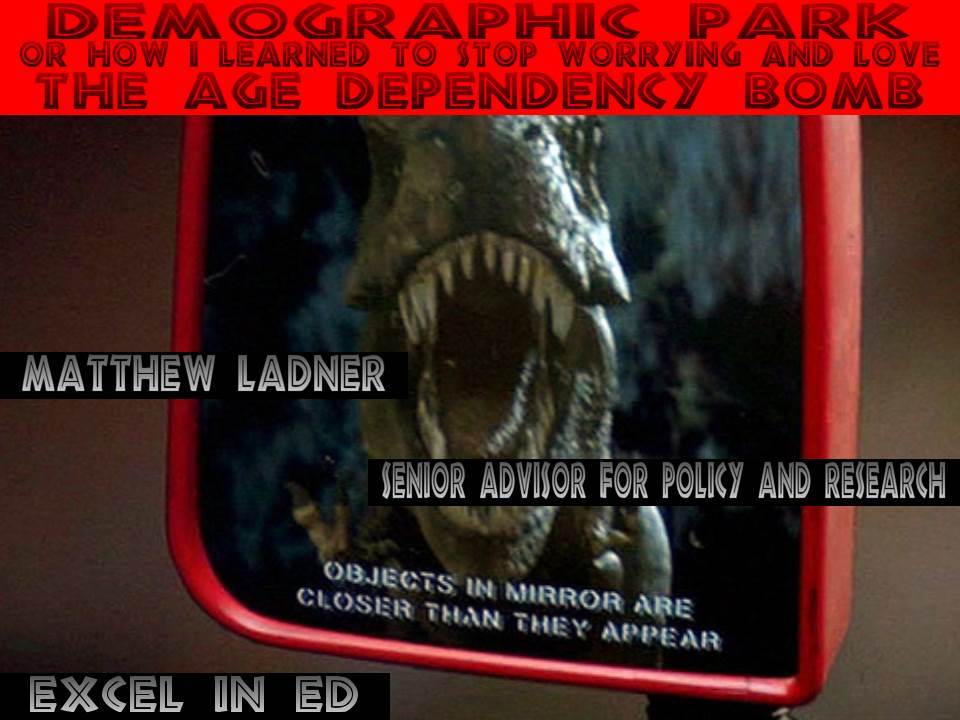
I batted clean up with a talk on age demographics. Someone told me that you can save a power point as jpg files, so I gave it a try. Here is the first slide:

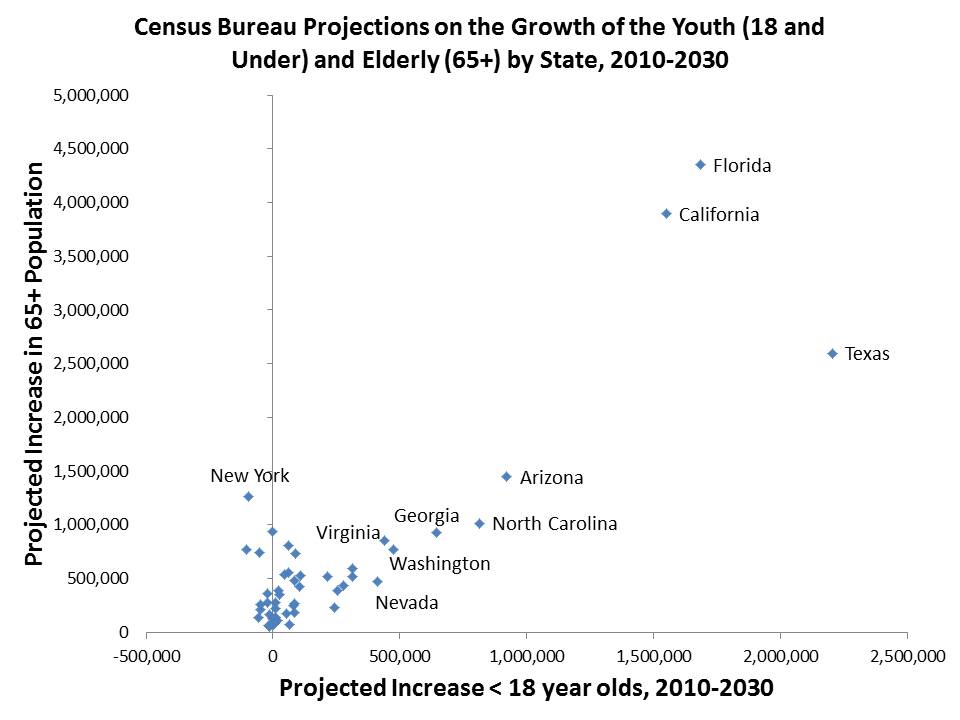
Slide1Here is the most relevant middle slide, showing that a number of states are set to get hit with a double challenge of large increases of young and old people by the year 2030 according to Census Bureau estimates, causing all kinds of health care, pension and education challenges:

Slide6

So some of you are wondering what your state looks like. Let me just tell you- it is bad. Stay tuned for a Friedman Foundation with the gory details by state. Oh by the way, the people who will be in their prime earning years in 2030 are in the public school system right now, and only a minority of them are being educated to a high level. Ergo the conclusion:

In short, everything we’ve done up to this point needs to have been baby steps towards what comes next.  What comes next needs to be a far deeper and more powerful policy interventions than incremental policies like our current charter and voucher programs. In an earlier panel, Derrell Bradford related that we used to buy our music at Tower Records, used to buy whole albums in order to get a single song, but that Napster and then iTunes had changed all of that for the better. Gisele Huff then made the point that too much of what we are doing in the school choice movement is dedicated to setting up new record stores.

Or perhaps in getting public funds to add a new wing on to the existing Tower Records.

I don’t want to pick on my friends in Indiana too much, as this idea of using public funds to add existing space onto participating private choice programs would doubtlessly have a higher ROI than much public K-12 spending in Indiana and would provide a better opportunity for thousands of disadvantaged children.  Having said that, it strikes me as a troubling idea. In my opinion the focus should clearly be on how to get many of the 2/3 of Indiana private schools who do not participate in the voucher program to change their minds (**cough**less regulation **cough**).

Next, let’s get the scholarship amount up to something decent, let the colleges and universities into the K-12 space, have blended learning make the jump into private schooling, see if you can get a private tutoring sector to flourish (it worked out really well for Alexander the Great and many of the founder fathers btw) etc.  In other words, let’s give parents control of the money and an incentive to consider opportunity costs and see what they come up with.  This could resolve a number of vexing questions.  For instance, how should technology be used to improve learning? I’m not sure, and if you are sure then you may need to work on humility. Perhaps we should let the parents figure that out through a system of voluntary exchange, let them change, customize and improve it over time.  How much should a digital course cost? I have no idea but we have these demand and supply curves that have a really strong track record in figuring questions like that out.

Right now we have an incrementally expanding charter school sector and few private choice programs capable of spurring new private school creation. Even if we improve our choice programs to spur new private school creation, it will essentially resemble a second charter school program incrementally adding new space year by year. This is both highly desirable and nowhere close to where we urgently need to go.

We need to be in this for the kids and the parents, not for a tiny preexisting stock of private schools. Don’t get me wrong private schools- I do deeply love you– but choice funding is the entitlement of the child not of any system of schools.  Private schools need to be a bigger part of the solution, but we should never mistake them for the entire solution.

“We’ve squeezed everything we can out of a system that was designed a century ago,” Marc Tucker, vice chairman of the New Commission on the Skills of the American Workforce told the Christian Science Monitor in 2006. “We’ve not only put in lots more money and not gotten significantly better results, we’ve also tried every program we can think of and not gotten significantly better results at scale. This is the sign of a system that has reached its limits.”  Personally I can think of some ways to squeeze more out of the current system, but their political sustainability will always have limits and Tucker is basically right in his assessment. “I think we’ve tried to do what we can to improve American schools within the current context,” Jack Jennings told the CSM. “Now we need to think much more daringly.”

Time to change the “current context”

Here is my version of daring- let’s give parents complete control over our K-12 funding within a system of financial oversight and academic transparency and incentives to economize and sit back and marvel as they figure out solutions of how to make the best use of limited resources.  We are going to have far fewer resources to provide in the future due to the looming battle between health care and education spending. We must go faster towards increased return on investment and customization. The Economist magazine said it better than I can after it reviewed the evidence on choice and concluded:

In rich countries, this generation of adults is not doing well by its children. They will have to pay off huge public-sector debts. They will be expected to foot colossal bills for their parents’ pension and health costs. They will compete for jobs with people from emerging countries, many of whom have better education systems despite their lower incomes. The least this generation can do for its children is to try its best to improve its state schools. Giving them more independence can do that at no extra cost. Let there be more of it.

Lots and lots more as fast as possible.


Centralized and Decentralized Reform Longevity in NYC

May 14, 2014

This is my apprentice Darth de Blasio. He will deal with your beneficial retention policy….

(Guest Post by Matthew Ladner)

Jay’s important post on choice programs developing a stronger constituency than many other types of education reform has an obvious recent example in Mayor de Blasio’s New York City. New York City has a earned promotion policy for improving literacy instruction. The program demonstrated strongly positive results, including not one but two positive evaluations from the RAND Corporation using advanced statistical analysis.  Sadly when this worthy retention policy ran up against Darth de Blasio the result was:

The unfortunate reality is that the earned promotion policy, while demonstrably effective, has a limited constituency to defend it.  A large population could benefit from the continuation of the policy but lacks organization. One of the most basic laws of politics is that organized interests defeat disorganized interests 99 times out of a hundred trials, or thereabouts.

What happened when de Blasio went after charter schools? Oh yeah…

So how did the assault on charter schools turn out for the Darth Randi’s apprentice?

Does this mean we should avoid all top down policies like the plague and focus only on promoting choice? Not in my book, but it is worth noting that policies enjoying little support outside a small group of supporters can be easily reversed. Developing a base of support is essential to policy longevity.  I don’t think that choice is the only K-12 policy reform that has the potential to develop broad support, but it is an equation that few other policies have solved.