
(Guest post by Greg Forster)
If you value your productivity, do not click here.
Also, to keep this rolling, I made this:

Your move, Matt.
(Guest post by Greg Forster)
If you value your productivity, do not click here.
Also, to keep this rolling, I made this:
Your move, Matt.
 Leave a Comment » |
  random pop culture | Tagged: Greg Forster, John Rawls, Robert Enlow |
  Permalink
 Posted by Greg Forster

(Guest post by Greg Forster)
My colleagues at the Friedman Foundation have released this year’s ABCs of School Choice, which you can find here – but only if you want the very latest and best data on school choice.
Just inside the cover is this striking photograph of Milton and Rose, which I had never seen before. Coming up on seven years after his passing, I’m tremendously heartened by the progress school choice has made. Right up until his death Milton was boldly predicting that he would live to see one state enact a universal voucher. As I’ve said on numerous occasions, it was a gutsy thing to say for a man who had seen the far side of 90 and was cracking jokes about having outlived the actuarial tables.
Next to the photo appears this statement, which first ran in The School Choice Advocate in 2004:
Government is committed to assuring that all children receive a minimum education. It currently does so by setting up and running schools, assigning students within a designated catchment area to each school. Students are thereby deprived of choice. They go to the designated school or else they do not benefit from the government commitment and their parents must pay twice for their education—once in the form of taxes, again in tuition.
Equally important, government is deprived of the benefits of competition. It is as if the government decided that the automobiles it uses must be built in government factories. What do you think the quality and cost of government cars would be? Or, to take another example, it is as if recipients of food stamps were required to spend them in a specified government-run grocery store.
It is only the tyranny of the status quo that leads us to take it for granted that in schooling, government monopoly is the best way for the government to achieve its objective.
A far more effective and equitable way for government to finance education is to finance students, not schools. Assign a specified sum of money to each child and let him or her and his or her parents choose the school that they believe best, perhaps a government school, perhaps a private school, perhaps homeschooling. Let the schools in turn, whether government or private, set their own tuition rates, and control their own operating procedures. That would provide real competition for all schools, competition powered by the ultimate beneficiaries of the program, the nation’s children.
Check it out.
5 Comments | tax-credit scholarships, vouchers | Tagged: Greg Forster | Permalink
Posted by Greg Forster
(Guest post by Greg Forster)
Are you ready for this? A Theory of Justice: The Musical!
No, really:
In order to draw inspiration for his magnum opus, John Rawls travels back through time to converse (in song) with a selection of political philosophers, including Plato, Locke, Rousseau and Mill. But the journey is not as smooth as he hoped: for as he pursues his love interest, the beautiful student Fairness, through history, he must escape the evil designs of his libertarian arch-nemesis, Robert Nozick, and his objectivist lover, Ayn Rand. Will he achieve his goal of defining Justice as Fairness?
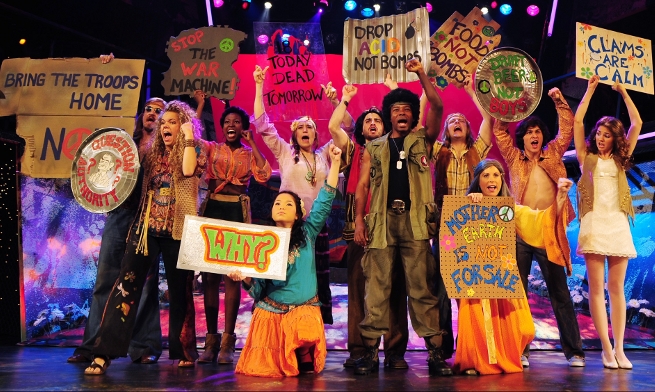
Wait, I thought they already made that show. It was called Hair.
Here’s a publicity photo from the production – Matt Ladner in costume for his co-starring role as “The Difference Principle”:

HT David Koyzis
6 Comments | politics | Tagged: Greg Forster, John Rawls, Matt Ladner | Permalink
Posted by Greg Forster
(Guest post by Greg Forster)
Many readers of JPGB will be familiar with the hard-left, union-friendly Economic Policy Institute. A recent article by Jonthan Rauch uses some EPI graphs to argue that the U.S. economy no longer rewards working-class employees for productivity. Over on Hang Together, I say the graphs are deceptive. The problem is a decline in productivity in the workers, caused by – JPGB readers will be shocked – lousy K-12 schools (and also a loss of the older religious work ethic).
If you’re familiar with EPI’s work, you won’t be surprised – Jay, Marcus and I took on some very shoddy work they did on teacher pay back in Education Myths.
1 Comment | economics | Tagged: Economic Policy, EPI, Greg Forster, Hang Together, Jonathan Rauch | Permalink
Posted by Greg Forster

(Guest post by Greg Forster)
What a shock – Randi Weingarten wants to solve the teacher quality crisis with higher barriers to entry. Because unions never erect barriers to entry for a profession in order to fatten themselves by exploiting the weak and vulnerable.
Weingarten’s article opens with yet another sign that we’re winning: “Every profession worth its salt goes through such periods of self-examination. That time has come for the teaching profession.” Yes, it sure has!
But you know, maybe this is a good idea. Hey, Randi, how about this: we institute a bar exam for teachers and then anyone who passes the exam is allowed to teach. What do you say to that?
1 Comment | teacher quality, teacher union | Tagged: Greg Forster, Randi Weingarten | Permalink
Posted by Greg Forster

(Guest post by Greg Forster)
At what point does refuting Jay Mathews’ lame rationalizations of his politically chosen position become bad sportsmanship? Well, I suppose I left that exit behind miles back, having shamelessly run up the score on him during last year’s humiliating wager, and then followed up with this.
So if he were flogging the same old lame arguments in his recent column, I’d leave it alone. But he’s not. He’s got all new lame arguments!
The main thing I want to point out is that Mathews isn’t even pretending that vouchers are politically dead. That used to be his main argument (see Wager, Last Year’s Humiliating for more information). Now he doesn’t even gesture towards it.
See this?

That’s the trophy case I just bought because I ran out of room to store all the arguments my opponents stopped making.
So now that he’s abandoned his old lame rationalization for his politically selected position, what’s his new one? Apparently, a shocking Washington Post article recently “revealed” that parents, not the corrupt D.C. school bureaucracy, are in charge of deciding whether schools taking vouchers are doing well. No, seriously, that’s his argument.
In other news, a shocking post here on JPGB recently “revealed” that water runs downhill.
Mathews goes on at some length about one (1) voucher school that isn’t up to snuff. As opposed to the D.C. public school system! Mathews himself opens the column by admitting that “if I were a D.C. parent with little money and a child in a bad public school, I would happily accept a taxpayer-supported voucher to send my kid to a private school.” So that’s pretty much the only answer I need for that.
He also waves around some big dollar figures trying to create the impression that vouchers cost a lot of money, never comparing them to the amount we spend on D.C. public schools – twice as much (or more, depending on whose figures you use). Arrest that man for flagrant violation of the Denominator Law.
And he argues that if vouchers ever got big enough to serve lots of kids, they’d have no choice but to accept government control over voucher schools comparable to what charter schools have now. Tell that to Indiana and Louisiana, which just enacted gargantuan new voucher programs. Honestly, you would think by now he’d learn to check first.
Once again, Dr. Mathews, we see there is no lame rationalization for your politically chosen position you can possess which I cannot take away.
HT to unofficial honorary Al recipient George Mitchell

Bubble wrap calendar
(Guest post by Greg Forster)
Pop! Alfred Fielding and Marc Chavannes invented bubble wrap in 1957. Pop! If that doesn’t deserve The Al, I don’t know what does. Pop! Pop!
If you’re like me, reading those little pops! gave you a vicarious thrill by bringing to mind all the times you’ve popped bubble wrap and loved it. It’s a visceral joy. If you consider both quality and quantity of enjoyment, there’s not a lot out there that beats bubble wrap.
Like many Al nominees, Fielding and Chavannes benefitted humanity through a combination of innovative thinking, entrepreneurial drive, guts, and some serenedipity. Working in a New Jersey garage, they were trying to invent a new kind of wallpaper – paper on the bottom where it sticks to the wall, plastic on the top where people see it. I can’t seem to determine whether they were actually envisioning something we would describe as “bubble wrap wallpaper” or if they were just trying to get a layer of plastic on top of a layer of paper, but Wikipedia says the product they were working on was “three dimensional wallpaper,” so hey, I say that’s good enough. It was bubble wrap wallpaper.
Bubble wrap wallpaper? Hey, it was 1957. But our intrepid heroes realized – to their credit – that bird wouldn’t fly. But they realized that their process for injecting air into plastic would provide a revolutionary packaging material. They founded the Sealed Air Corporation in 1960 and the rest is history.
Let’s look at bubble wrap as a helpful product first. Bubble Wrap is actually a name brand; Sealed Air Corporation holds the trademark. The product is manufactured in 52 countries and the company reported revenue of $4.2 billion in 2009. And then of course you have to add all the copycats. I can’t find information on the total amount of “plastic bubble packaging” used in the world, but it must be enormous.
Bubble wrap helps a lot of people do a lot of things. In addition to keeping your great-grandmother’s china safe during a move, a variety of special kinds of bubble wrap serve industry (and thus all of us) in a number of ways. For example, they make a special anti-static bubble wrap for shipping computer chips.
But you don’t want to hear about any of that. I know what you want. Pop!
Just add up all the pleasure everyone has ever gotten from popping those bubbles. Just the other day my daughter got a birthday present in the mail, and we had to get her to stop popping the bubbles before she would open the present!
Here’s a good test of the value of bubble wrap. You can buy hand-held, key fob sized bubble wrap simulators. You pop the little bubbles and they reinflate. And these days, bubble wrap has gone cloud. That’s right – there’s an app for that.
What makes popping bubble wrap so fun? Is it about power – the thrill of destruction? Maybe for some, but I doubt that’s the main attraction. Is it the excitement of steadily building the pressure, not knowing when the threshold will be crossed, until suddenly pop! – essentially a hand-held roller coaster or scary movie. That’s more plausible. But people who don’t care for roller coasters or scary movies – me, for example – seem to get as much out of bubble wrap as everyone else. In the end, I think it’s a mystery. Why do lots of people like chocholate and few people like anchovies? They just do.
So in addition to sheer quality and quantity of enjoyment, there’s another reason bubble wrap embodies The Al. It’s an improvement to the human condition that no central planner or philosopher could ever have dreamed up. It reminds us that at the deepest level, the universe is the way it is simply because it is that way. That doesn’t mean the universe is irrational or amoral at its core; it means that the deepest mind and morality of the universe are what they are independent of whether we understand or approve. And so also with beauty, which is the third of the three classical Aristotelian transcendent experiences (the good, the true and the beautiful) – including the beauty of popping bubble wrap.
Pop!
5 Comments | Al Copeland Humanitarian Award | Tagged: Alfred Fielding, Greg Forster, Marc Chavannes | Permalink
Posted by Greg Forster
(Guest post by Greg Forster)
One guy who isn’t going to be nominated for this year’s Al Copeland award is Lorenzo Garcia, disgraced ex-superintendent of El Paso schools. He’s at the center of the latest major cheating scandal connected to NCLB. From the New York Times:
Students identified as low-performing were transferred to charter schools, discouraged from enrolling in school or were visited at home by truant officers and told not to go to school on the test day. For some, credits were deleted from transcripts or grades were changed from passing to failing or from failing to passing so they could be reclassified as freshmen or juniors…
In 2008, Linda Hernandez-Romero’s daughter repeated her freshman year at Bowie High School after administrators told her she was not allowed to return as a sophomore. Ms. Hernandez-Romero said administrators told her that her daughter was not doing well academically and was not likely to perform well on the test.
Ms. Hernandez-Romero protested the decision, but she said her daughter never followed through with her education, never received a diploma or a G.E.D. and now, at age 21, has three children, is jobless and survives on welfare.
“Her decisions have been very negative after this,” her mother said. “She always tells me: ‘Mom, I got kicked out of school because I wasn’t smart. I guess I’m not, Mom, look at me.’ There’s not a way of expressing how bad it feels, because it’s so bad. Seeing one of your children fail and knowing that it was not all her doing is worse.” [ea]
Accountability systems don’t work when those being held accountable percieve the system as political and illegitimate. Schools need these systems but they’re not going to work as long as education is a government monopoly. More on that here and here.
Via Bill Evers
6 Comments | politics, school accountability | Tagged: Greg Forster, Lorenzo Garcia, New York Times | Permalink
Posted by Greg Forster
(Guest post by Greg Forster)
There was a time when Jack Jennings posed as a nonpartisan voice of apolitical wisdom. That was then! It was always a thin disguise, but the mask is really off now:
The Republicans’ talk about giving parents the right to choose is a politically expedient strategy … Just beneath the surface of the education rhetoric are political motivations to thwart integration, weaken the Democratic coalition, and cripple the teachers’ unions.
Over on RedefineED, Doug Tuthill responds with a really amazing history of progressive support for school choice. Go take a look! Even if you think you know this history, you’ll learn something.
Actually, Tuthill leaves two major figures off his list. Thomas Paine proposed school vouchers for England, justified as a way to advance the well being of the poor, in the appendix to the second edition of The Rights of Man. And J.S. Mill supported vouchers as a blow against socially conservative cultural dominance, writing that “A general State education is a mere contrivance for moulding people to be exactly like one another.”
(via Bill Evers)
1 Comment | politics, vouchers | Tagged: Greg Forster, Jack Jennings | Permalink
Posted by Greg Forster

(Guest post by Greg Forster)
If you subscribe to National Review, don’t miss Kevin Williamson’s fantastic piece in the new issue on home schooling. Here are three little tastes of a long article in which every paragraph is good:
In the public imagination, homeschooling has a distinctly conservative and Evangelical odor about it, but it was not always so. The modern homeschooling movement really has its roots in 1960s countercultural tendencies; along with A Love Supreme, it may represent the only worthwhile cultural product of that era. The movement’s urtext is Summerhill: A Radical Approach to Child Rearing, by A. S. Neill, which sold millions of copies in the 1960s and 1970s…
[Dana Goldstein, writing against home schooling in Slate] went on to argue that the children of high-achieving parents amount to public goods because of peer effects…She does not extend that analysis to its logical conclusion: that conscientious, educated liberals should enroll their children in the very worst public schools they can find in order to maximize the public good…
Teachers’ unions have money on the line, and ideologues do not want any young skull beyond their curricular reach. A political class that does not trust people with a Big Gulp is not going to trust them with the minds of children.
If you don’t subscribe – shame on you!
3 Comments | politics | Tagged: Greg Forster, homeschooling, Kevin Williamson, National Review | Permalink
Posted by Greg Forster


 Jay P. Greene's Blog