Williamson: Evict the Rich!

August 30, 2013

(Guest post by Greg Forster)

If you’ve been waiting for the ultimate rejoinder to that ridiculous Slate article arguing that private schooling is evil, your wait is over. Kevin Williamson has a better idea: force rich white do-gooders to move to poor neighborhoods.


Jeb Bush Drops School Choice – I Wonder Why

August 19, 2013

(Guest post by Greg Forster)

Jeb Bush’s big speech about education reform has made it onto NRO this morning. He does not include school choice as one of the four key components of education reform. I can’t imagine why Jeb would no longer view school choice as having been an important part of the Florida formula for success. Oh, wait, yes I totally can.

I am for standards. But choice must succeed before standards can succeed. By dropping school choice from his list of must-have reforms, Jeb is undermining the necessary path to success for standards.

Granted, he does turn aside at one point, under his section on digital learning, to tangentially mention school choice. But then, weirdly, he immediately feels the need to insist that “accountability is the cornerstone of reform.” Why is he suddenly going back to the subject of accountability when he’s already discussed that in a previous section? It’s a total non sequitur for him to bring it back up here – unless, that is, he shares my view that school choice is ultimately at odds with the technocratic, “trust us, we’re experts” spirit of Common Core.

He also asserts CC won’t hurt school choice – but his own defensive rush to demand that “accountability is the cornerstone of reform” after merely mentioning school choice undermines confidence in that assertion.

If anyone wants to contest my read of this speech I would request their responses to two questions: Why isn’t school choice one of Jeb’s four must-have reforms? And why does he suddenly rush to insist that “accountability is the cornerstone of reform” right after working in an anodyne mention of school choice?

One last point: We who prioritize school choice did not pick this fight. It was the CC crowd who came out with guns blazing, demanding that all schools must be judged on their yardstick (not parents’ yardsticks) and spitting on anyone who questioned their orthodoxy. We did not pick this fight. But we will not roll over just because the CC folks have all the money and power. A decade ago, the unions had all the money and power. We survived them, and we’ll survive Common Core as well, because we’re right.


Choice First, Standards Second

August 1, 2013

cart-before-the-horse

(Guest post by Greg Forster)

The Miami Herald and Tampa Bay Times are now reporting that Tony Bennett is expected to resign.

As I’ve said all along, this is not about Tony Bennett. This is about whether educational standards should be formulated by politicians and their allies behind closed doors and then presented as the One Best Way to which all schools ought to conform.

Does that mean there can be no standards? Of course not! It means school choice must come first, standards second. Common Core and its allies are putting the cart before the horse.

Creating standards and accountability measures requires judgment. Judgment requires trust. What trust requires is a huge metaphysical subject we don’t have space to get into today, but let’s cut to the chase – people don’t trust the government to do this job by itself, behind closed doors and with no alternatives permitted, and they are right not to do so.

That is not because one particular person or one particular party is corrupt. It is written into nature of things, it is woven into the very fabric of the universe, that human social systems don’t work that way. Not even Denethor, the most virtuous man in Gondor, could be trusted to hold the ring without using it: “If you do not trust me to endure the test, you do not know me yet.” “‘Nonetheless I do not trust you…Nay, stay your wrath! I do not trust myself in this.”

So if that’s not where standards come from, where do they come from? We obviously do have standards, for everything from technical specifications for smart phones to English grammar to the scientific method. Right now we don’t have standards for education. How do we get them?

We get them from the only place standards ever really emerge from: the open, free interaction of civil society, where people are allowed to try whatever makes sense to them and see what works.

Take the scientific method as an example. The early pioneers of modern science – Descartes and Bacon and that crowd – went down all kinds of ridiculous blind alleys. They tried things we would never bother with today. They set down rules for what you’re not allowed to do in science that we would now laugh at. Poor Bacon died from a pneumonia he caught while pursuing a cockamamie experiment, invented on the spur of the moment while travelling during the winter, to test the efficiency of snow as an agent for preserving meat.

So how did we get from there to here? Did the Royal Society convene the smartest smarties in the land and impose order on this chaos? No, we got here by giving scientists the freedom to try what made sense to them and seeing what worked.

They had endless debates. They disagreed about how to do science, about why they did science, about what science could and could not do. The debates were not a part of the chaos, the debates were the method by which order was eventually imposed on the chaos.

That’s what we need today. Instead of cooking up a One Best Way and then demonizing anyone who dissents, we need a forthright admission that we don’t have a consensus about what works, and to give people not only the freedom to experiment, but a social legitimization of their experimentation. Then we can have some really heated debates where we argue with each other over what works. This, and only this, can ultimately create consensus about what works.

I am not saying that government and political power play no role. I am saying government should play its proper role – as a servant of our civilization, not its master. I even think government has more of a job to do than simply forbidding force and fraud. That is why I favor school choice policies on their own merits, not merely as a stepping stone to “the separation of school and state,” as my libertarian friends would prefer.

A thriving marketplace of diverse options, where people are not only empowered to choose but also respected and honored for making their own choices, is the only path to standards. It is the only thing that can make standards legitimate and widely accepted. Of course this means giving up on the desire to impose them on everyone by force, but then, force is wrong and it doesn’t work anyway.

As long as the government runs a school system, it will need to set standards for that system. But it cannot even do that very effectively in the current environment, as we are seeing. A thriving marketplace of options would ultimately create standards with legitimacy and widespread acceptance. Those standards could then be imposed on the government system much more effectively than at present.

People who think standards are everything must choose – is it your goal to have the law tell everyone they must use your standards, and have everyone ignore the law; or to get everyone actually using some standards, even if they’re not yours? You can’t have both.


Are We Allowed to Be Neither Naive Nor Cynical?

July 31, 2013

balance
(Guest post by Greg Forster)

I have a question. Am I permitted to be neither naïve nor cynical about the Tony Bennett emails? Or is there some sort of law that dictates I must be one or the other? Indiana StateImpact places me with the Bennett supporters while Matt seems to think I’m attacking Bennett (I’m not sure how else to interpret “haters gonna hate”). I don’t intend to be either.

I find it difficult to buy the new house line, and I will continue to find it difficult until someone asks Bennett the obvious question: “If this was a glitch in the system, as we are now being told, why did you seek to change the grade only for this one school?” Rick Hess didn’t ask him that question. Matt seems uninterested in asking it, and seems to think I’m a “hater” for asking it. Until that question is answered, I don’t see why I’m a “hater” for pointing out uncomfortable realities.

Is it really so scandalous, does it really make me a “hater,” to acknowledge the obvious fact that politicians are responsive to their donors? When government sets educational standards and has to do what Bennett himself calls a “face validity” test, it is going to know which schools are run by major donors and it is going to be sensitive to that fact. Good grief, are we this naïve?

What we have now is not “the rest of the story” but a failure to seek the rest of the story. Or am I somehow missing something?

On the other hand, Ze’ev and others seem to think I’m saying all standards are arbitrary and there’s no such thing as a rational public consensus. I’m not; I’m just trying to be realistic about what I called “the sausage-making nature of the process” when those standards are being cooked up behind closed doors by a government bureaucracy and its political allies, as opposed to standards that emerge organically from the give and take of a thriving marketplace of options. Technology standards emerge in the context of a system dominated by consumer choice. Educational standards should emerge in the same way.


Tony Bennett Is Having a Bad Week

July 29, 2013

locke-and-walt-LostBG

(Guest post by Greg Forster)

What’s the best way to top off a really Walt-on-Lost level bad week for Common Core? How about a scandal in which emails show one of its most prominent supporters having manipulated his state’s “high standards” system to ensure that a particular school (one founded by a major donor) scored high? Just as that same state becomes the latest to move toward dropping out of a CC testing consortium?

I’d like to take Andy’s bafflement about CC supporters not anticipating pushback on the costs of implementation and double it in this case, if not triple it: why on earth did they discuss this so transparently in their government email accounts, which made it inevitable that the whole ugly show would eventually come out?

I feel sympathetic to Tony Bennett here. Any kind of evaluation system must involve qualitative as well as quantitative testing. That is, you not only have to make sure the numbers are accurately collected, crunched and reported, you have to make sure that what the system is calling “good” really is good. Of course you could in theory test your system by comparing it to the results of other systems, but if that’s all you do, the whole thing is circular. Ultimately you have no choice but to pick some examples of cases that you presuppose to be very good or very bad (or in the middle, for that matter) based on some kind of opinion – maybe yours, maybe your organization’s, maybe a consensus of experts, maybe a popular majority – and see if your system ranked those cases in accordance with the presupposed opinion. It is logically impossible to remove this element of judgment. You just can’t fully test a system for evaluating schools without at some point picking out some super-schools and asking “did these score well?”

Of course, everything hinges on what basis you use for selecting those cases – in other words, whose opinion of which cases are “good” you presuppose, and why. In the real world, if the standards are being set by government, that is always going to be a political process in which one or another set of powerful constituencies are privileged. The Bennett emails reveal the sausage-making nature of the process. What I want to emphasize is that this is not because Bennett is in some way specially corrupt but that this is what any such process must always look like. It is, again, logically impossible to avoid this type of qualitative reality check, and it would be naïve in the extreme to think that any set of political actors would carry out that reality check in any way other than something like what the Bennett emails reveal.

The lesson here is not “Bennett is corrupt” but “all educational standards privilege someone’s opinion of what is a good school, and government privileges the opinion of powerful interests.”


Common Core Is Having a Bad Week

July 26, 2013

locke-and-walt-LostBG

(Guest post by Greg Forster)

When Locke first meets Walt, he says something about Walt getting back to his mother soon, and Walt tells him that his mother died two weeks ago. Locke looks around at the deserted island where they’ve all just crash-landed and says, “you’re having a bad month.”

Common Core is having a bad week. Pop some popcorn and enjoy watching the excruciating downfall of civilization with your host, Andy Smarick. Line for the ages: Smarick links back to an old post of his where he predicted this would happen and then says, “I can’t help but wonder: If some dude blogging from a coffee shop could see this coming, why in the world didn’t Common Core’s and common assessments’ powerful, well-staffed, and deep-pocketed backers get ahead of this?” He should check out the latest medical literature on PLDD.

In the meantime, the argument that Common Core is bad for school choice seems to be getting some traction, to judge by the increased level of desperate insistence (unconnected to logic or evidence) that Common Core is really great for school choice. Hope you’ve got more popcorn, because master magician Jason Bedrick is here to cut those arguments in two. Unfortunately for CC supporters, he hasn’t learned the part of the trick where they go back together.

You still have more popcorn, and you’re tired of knock-down, drag-out knife fights for the fate of the world on the edges of slowly crumbling cliffs? Don’t worry – we have the lightsabers you’re looking for.


This Time It Counts

July 19, 2013

Contents under pressure

(Guest post by Patrick Wolf)

My friend Adam Emerson at the Fordham Foundation is championing the combination of high-stakes test-based accountability and parental school choice recently adopted by Louisiana, Indiana and Wisconsin, as “sunshine and school vouchers.”

His reasoning is that the free educational choices of parents alone are insufficient to ensure that choice-based reforms benefit the public by generating actual improvements in student learning.  He cites a study that my research team recently completed of the Milwaukee Parental Choice Program (MPCP), where high-stakes test-based accountability was added requirement to the long-running voucher program in 2010-11, and the achievement scores for voucher students surged in relation to the comparison public school students that year.

Now, like most researchers, I’m vain.  I like it when people cite my research in policy debates.  That’s why I do it – to speak truth to power.  But let’s not get too far ahead of ourselves here.  Ours is one study of what happened in one year for one school choice program that switched from low-stakes testing to high-stakes testing.  As we point out in the report, it is entirely possible that the surge in the test scores of the voucher students was a “one-off” due to a greater focus of the voucher schools on test preparation and test-taking strategies that year.  In other words, by taking the standardized testing seriously in that final year, the schools simply may have produced a truer measure of student’s actual (better) performance all along, not necessarily a signal that they actually learned a lot more in the one year under the new accountability regime.

If we had had another year to examine the trend in scores in our study we might have been able to tease out a possible test-prep bump from an effect of actually higher rates of learning due to accountability.  Our research mandate ended in 2010-11, sadly, and we had to leave it there – a finding that is enticing and suggestive but hardly conclusive.

What about the encouraging trend that lower-performing schools in the MPCP are being closed down?  Adam mentions that as well and attributes it to the stricter accountability regulations on the program.  That phenomenon of Schumpeterian “creative destruction” pre-dated the accountability changes in the choice program, however, and appears to have been caused mainly by low enrollments in low-performing choice schools, as parents “voted with their feet” against such institutional failure.  Sure, the new high-stakes testing and public reporting requirements might accelerate the creative destruction of low-performing choice schools in Milwaukee, but that remains to be seen.

I like sunshine – I live in Arkansas, after all.  I also like program evaluations enabled by student testing, since it pays my bills.  But I also like liberty and appreciate the innovation that I’ve seen in some schools of choice that eschew our testing-focused political culture.  This is all to say that the issue is one of reasonable and debatable tradeoffs, not absolutes.  Mainly, it would be helpful to see more studies, like mine, that shed light on what is gained and what might be lost when high-stakes testing is added to the choice mix.


True vs. the Opposite of True at Ed Next

July 10, 2013

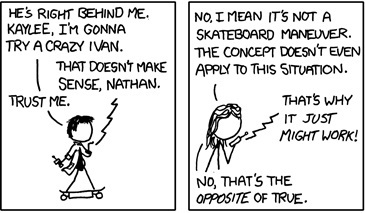
xkcd the opposite of true

HT xkcd

(Guest post by Greg Forster)

Education Next hosts a throwdown between Jay and Kate Walsh on the NCTQ teacher training standards. Backfill here.

What strikes me most about the exchange is that Walsh begins her response by essentially giving away the store to Jay:

The idea of encouraging experimentation in the education sector makes sense: if you don’t know what works, let a thousand flowers bloom. And the field of teacher education would appear to be particularly fertile ground. After all, there’s been a common presumption that no one knows what works.

Then, bizarrely, she argues that because Jay is right that we need to have more experimentation and “let a thousand flowers bloom,” we should impose regulations that restrict experimentation and limit how many kinds of flowers are allowed to bloom:

Teacher prep is the Wild West of higher education…This level of disarray raises an important question:  How much experimentation should we tolerate, given what’s at stake?…No doubt there is a difference between the kind of experimentation that Jay is calling for and teacher prep’s current modus operandi of throwing anything against a wall and seeing if it sticks—or worse, not even caring if it sticks, just doing it because a professor has decided he’s right, no matter the evidence to the contrary. But since the field itself is not rigorously gathering data on what works — and the risk for the students of new teachers is so great — it makes sense to establish reasonable guidelines as to what should go into teacher training to ensure, at the very least, that new teachers “do no harm.”

No, that’s the opposite of true. If we don’t know what works because we aren’t collecting data, and our top priority is to do no harm, the very last thing we should do is impose new regulations! The whole point of regulations is to prevent people from doing things that we know do harm. We impose lead regulations on paint manufacturers because we know putting lead in paint does harm. We impose medical trial regulations on medicine companies because we know selling untested medicines does harm. We impose broken glass regulations on fast food restaurants because we know putting broken glass in hamburgers does harm. (At least until you grind it up so fine that it’s no longer sharp, like they do in McDonald’s milkshakes.)

Imposing regulations when you don’t know what works is the quickest path to doing lots and lots of harm – and, by the way, it also prevents you from collecting data to find out what works (which is what we ought to be doing) because you can’t collect data on methods you aren’t allowed to try.


Oops, Sorry, Turns Out Common Core is Anti-Choice

June 28, 2013

octopus

(Guest post by Greg Forster)

Well, folks, I have to recant my recantation from yesterday. Turns out Common Core really does destroy parental options.

At Heritage, Brittany Corona points out that the SAT, ACT and GED are all competing to see who is most “aligned” to Common Core. As the College Board begins a major overhaul of the SAT, prompted by the ACT recently surpassing it as the most-used college exam, the Board is bragging that “in its current form, the SAT is aligned to the Common Core as well as or better than any assessment that has been developed for college admission and placement.” The revisions will seek even stronger “alignment” between the SAT and Common Core. No doubt the SAT feels like it has to play catch-up because the ACT has been boasting for some time that it “pledges to work with other stakeholders to develop strategies and solutions that maximize the coverage of the Common Core State Standards to meet the needs of states, districts, schools, and students.” Meanwhile, the GED cites “the shift to the Common Core standards [that] is happening nationwide” as one reason it has to make major changes to its test.

Corona points out that private schools and homeschoolers are impacted by these changes. Private schools are already under pressure from short-sighted and/or cowardly system leaders to adopt (or pretend to adopt) Common Core, so that they won’t be stigmatized as dissenters from the One Best Way. If college entrance exams are Common-Core-ized, it will be virtually impossible for private schools and homeschoolers to maintain any kind of alternative to the One Best Way. As for the GED, Corona points out that homeschoolers often use it for external validation of their education.

Now, just like everything else associated with Common Core, there is less here than meets the eye. That’s because the claims that these tests are, or will be, “aligned” to Common Core are all meaningless BS (just like so many other claims associated with Common Core). As Jay has pointed out, it’s overwhelmingly unlikely that anybody is ever really going to align anything to Common Core in a meaningful way. You can see that just from what the College Board people are saying. “In its current form, the SAT is aligned to the Common Core as well as or better than any assessment.” What the heck does that even mean? What can that mean? The federal government’s contractors haven’t finished developing their official federal-government-designed assessments “aligned” to Common Core. We don’t even have the standards themselves yet! These people are simply talking out of their bodily orifices (just like…).

Moreover, as Corona points out, the deadening hand of dictatorial control by cynical elites is a constant wellspring of opportunity for entrepreneurial innovators: “Thankfully, tests like the SAT and ACT can be changed or replaced, even though they have begun a transition to Common Core. If a significant number of states pull out of Common Core, these exams can be modified, or there could be an opening in the market for other college entrance exams to take root.”

But although Common Core is unlikely to do the kind of extensive damage to parental control and educational diversity that the bragging of the College Board, ACT and GED would imply, nonetheless it is increasingly clear that Common Core represents the technocratic spirit of the One Best Way, to which all families should (in principle) bow the knee and conform. The inability of the technocrats to achieve their dream of forcing all parents into the One Best Way should not blind us to the fact that this is, in fact, their dream. Or that is what is implied by their behavior, at any rate.

My apologies for the wrong turn yesterday, folks. I was right the first time – Common Core is bad for school choice.

HT Bill Evers and Breitbart


I Recant! Common Core for All!

June 27, 2013

Greg loves CC cropped

(Guest post by Greg Forster)

Just like Jay did a little more than a year ago, I am recanting my opposition to Common Core. I’m all for it! Never mind everything we said about how there’s no one best way to teach children, and even if there were, we don’t know what it is yet; never mind everything we said about how unions would inevitably get control of the standards or how they would reignite the culture wars; never mind everything we said about how the standards are already being set too low, how they’re being put together by people with conflicts of interest, how they’re being illegally pushed from Washington.

Never mind all that. I’m all for Common Core. Why? Because Common Core is good for school choice!

Yes, I just wrote a big post about why Common Core is bad for school choice. I take it all back. Every word of it.

As Matt has just pointed out, 2013 is turning out to be the third big year in a row for school choice. Now here’s the thing. Back when 2011 was a big year for school choice, you heard about it everywhere. I mean every-frikkin-where. And don’t get me wrong, that was sweet. But 2012 and 2013 have been good years for choice, and for some reason, nobody’s noticing.

What gives? Well, for years we’ve been saying that “vouchers make the world safe for charters.” Whenever vouchers get on a roll, the unions have to train all fire on vouchers – leaving charters to slip through with less opposition. Meanwhile, mushy-middle politicians, academics and journalists can triangulate by opposing vouchers but supporting charters. It was Jay’s idea originally, but I wrote about it at some length in the Freedom and School Choice book a while back.

It would appear that just as vouchers make the world safe for charters, Common Core makes the world safe for vouchers. Everyone is so busy running around fighting over Common Core – especially the unions – that voucher supporters seem to have a freer hand. A while back, Jay wrote that one reason Common Core is a problem is “because it is a gigantic distraction from other productive reform strategies….Common Core is consuming the lion’s share of reform oxygen and resources.” But it’s also consuming the anti-reform oxygen and resources!

And when money and muscle cancel out, there’s nothing left to determine the outcome but the merits – a debate we’ve already won.

So lock the government collar around my neck and break out the Gates Foundation checkbook, because starting now I’m all for Common Core.

PS Yes, that is St. Milton watching over me in the background.