Diversity and Community on Campus

September 15, 2017

IMG_1869

(Guest post by Greg Forster)

Just in time for the Ben Shapiro non-Ragnarok in Berkeley, OCPA’s Perspective carries my article on diversity and community on campus:

The dominant group, on the political Left, learns from these episodes that getting offended brings power. Stigmatizing people and destroying their lives pays off. By crushing their victims, they establish themselves as the people who must be kept happy if peace is to be maintained.

The oppressed minority group, on the political Right, is also incentivized to escalate the conflict. Increasingly, conservative students conclude that they are desperately besieged, and fighting back with equally divisive tactics is the only realistic response to their oppressed state. Worse, conservative websites and activists make big bucks circulating stories of on-campus outrage for clicks and donations.

I dissent from criticism of Harvard’s “black graduation” on the Right:

It was a student-run, unofficial event that took place two days before the official ceremony, and thus did not affect it. Anyone was permitted to attend the event.

In other words, a private student group held its own event on campus, celebrating something it wanted to celebrate—its positive sense of its own identity and achievements. That’s a perfect example of what happens in real communities. It’s no more a threat to the solidarity of the broader, multiethnic university than a “Kiss me, I’m Irish” button.

Thankfully Harvard hasn’t done anything monumentally stupid in the meantime that might make me regret defending them.

I also offer thoughts on how colleges can strengthen both community and free speech. Your free speech in response is welcome!


Christian Theology and Sending Your Kids to Public School

August 11, 2017

imagesF6CRZCR6

(Guest post by Greg Forster)

OCPA’s Perspective carries my latest, on the question of whether sending your children to public schools should be considered mandatory, forbidden or neither under Christian theology.

First I respond to a Presbyterian pastor who says Christians should feel obligated to send their kids to public schools, because hundreds of years ago churches created the schools that public schools were later modeled on:

Moore seems not to have asked why, if churches were so aggressive in creating schools, government stepped in and used its power of taxation to drive churches (mostly) out of the schooling business. One reason was because the church schools taught people to think for themselves and live independently. As industrialists grew more powerful in the 19th century, they enlisted government to create a new school system whose products would provide more submissive and narrow-minded cogs for the factory machine. (Big business and big government colluding to destroy freedom and oppress the poor—it all seems so familiar, almost as if we’ve seen it somewhere before.)

However, the more important reason was religious. Massachusetts created the first government school monopoly in America in the 1830s, partly out of submission to exploitative industrialists, but also because the Unitarian Boston Brahmins were horrified at the unreconstructed Calvinism of the Massachusetts countryside. The new public schools indoctrinated students in a religion of good works without the cross, tearing up the cultural roots of puritanism. (One would think this history would be of interest to a Presbyterian pastor.)

The tool created to destroy Calvinism in Massachusetts was soon deployed nationwide in hopes of destroying Catholicism…

Then I respond to an Anglican priest who says any school that isn’t explicitly Christian must be treated as atheistic and avoided:

It is true, as Fowler argues, that there is no such thing as religious neutrality. All human beings have some kind of cosmic worldview, and everything we do presupposes that worldview. Even to assert “2+2=4” presupposes the view that the human mind is rational, and its spontaneous intuitions about the relationships between numbers are sound (and, for that matter, that other minds exist and I can communicate meaningfully with them). All of these premises are religious, or at least metaphysical.

However, while there is no such thing as religious neutrality, there is religious ambiguity. To assert “2+2=4” is not a religiously neutral statement, but it does not settle all religious questions, either. A Christian, a Muslim, and a Hindu have three very different metaphysical accounts of what the human mind is, yet each can square “2+2=4” with their view.

Thus, a school that is not explicitly Christian need not become explicitly atheist. It need not even become implicitly atheist. It may be implicitly Christian! Or it may be a shared possession, offering an educational discourse that accommodates a diverse population without resolving their religious differences.

I argue we are neither compelled nor forbidden by Christian theology in the matter of sending children to public school:

Parents should evaluate local schools, public and private, and select the one that aligns best with their views and goals. My wife and I send our daughter to the local government school, because we are more satisfied with it on all counts—including spiritually—than the available alternatives. Others, facing other circumstances, may legitimately make other choices.

We live under neither a Babylonian captivity to public schools nor an Egyptian exodus from them. We live in the freedom of Pentecost, sent out into the nations to live in the tension of being in the world but not of it:

The problem with both Babylon and Exodus as social models for Christianity today is that they both come from the Old Testament, before Christ’s coming. With the Great Commission, Christ has sent his people out into the world; he wants disciples of every nation. Where the Jews were called out of Egypt, we are called into Egypt—our road is an eisodus, not an exodus. But we are not called to live passively, like the exiles in Babylon, merely marking time in a foreign land. The church has a mission to build godly ways of life wherever we go, and that means we can’t simply conform to the world around us or bunker down in Christian ghettos.

Whatever your faith and whatever you think of my theology, I welcome your feedback – and I promise not to lie about your views and then fire you!


School Choice and Segregation in Perspective

July 31, 2017

image

(Guest post by Greg Forster)

OCPA’s Perspective carries my new article on school choice and segregation. I wrote it before the recent silliness from our friends at CAP, so my expectation that the recent increase in focus on this issue would only continue is holding up well so far:

The accusation that school choice will increase ethnic segregation in schools, after a long period on the rhetorical back-burner (during the age of test-score obsessions), has suddenly returned to the forefront of public debate. That’s no surprise, given rising levels of ethnic tension and polarization.

Last time the other side tried to make hay out of this, it failed, largely because the empirical evidence we have on this question is in favor of choice:

In fact, that body of research is the reason it’s been a while since we heard much talk about segregation in the debate over school choice. I remember hearing this talking point much more in the early 2000s, when fewer of these studies had been done. As the evidence piled up, the talking point went away.

In the new article I go into some of the politics of schools and ethnic segregation, arguing that while “most parents aren’t racist” is one possible explanation of the evidence for choice, you can also believe race is an important factor in school selection and still believe school choice will reduce ethnic segregation as compared with the status quo:

To whatever extent parents are racist, consciously or unconsciously, the government monopoly system is perfectly designed to cater to those racist preferences. Segregation flourishes under the government monopoly, both because schools are tied to ZIP codes and because power brokers draw the attendance lines.

So the strongest argument for choice is not “parents aren’t racist.” It’s “under the government monopoly, segregation happens by default, regardless of what parents prefer; only school choice creates the opportunity for integration.”

Check it out and let me know what you think!


The Future of School Choice: Bickering about Words!

July 25, 2017

Logomachy

(Guest post by Greg Forster)

Will Flanders is right that school choice is not welfare (you heard it here first) and more broadly that school choice has not benefitted from appropriating the Rawlsian language of fairness (ditto). But he is wrong to think we would be better off making big investments in the free market movement’s language of markets and competition. I’m as big a fan of Milton as anyone (proof) but that language has all the wrong non-cognitive associations for the present moment. Flanders cites Jonathan Haidt but doesn’t seem to have learned the biggest lesson Haidt has to teach, which is that the non-cognitive content of language is more politically important than its cognitive content.

What we need is a new language of justice, equal opportunity, diversity and freedom that both Rawlsianism and the free-market movement used to have, say, fifty years ago, but that neither currently has in a very robust form. Much, much more about that here.


Does School Choice Expand the State?

June 26, 2017

image

(Guest post by Greg Forster)

OCPA’s Perspective carries my response to folks in Oklahoma who have tried to peel off small-government types (thick on the ground in that state) from the school choice coalition by arguing that choice expands the state:

Now, it is true that ESAs are an “entitlement” in the way that term is normally used in the context of public policy. Like Social Security and food stamps, they create a benefit to which all people in the relevant class (retirees for Social Security, the poor for food stamps, parents for school choice) are entitled under the law.

The key difference is that Social Security, food stamps, and other typical entitlement programs represent the expansion of government into a leading role in areas previously dominated by private savings, employer-paid pensions, church and community organizations, and other non-governmental solutions…

School choice, by contrast, reverses the endless expansion of government by moving us away from a government monopoly…Compared to the government school monopoly, school choice liberates individual initiative, economic interdependence, and spiritual community. It allows parents to take control of their children’s education, becoming stewards over their own lives, instead of treating them like perpetual wards of government—as if they were cattle in the government’s pen. It supports educational entrepreneurs who create new school systems designed to serve the customer base created by school choice. And it allows schools to have a holistic vision of what it means to be an educated person—one that doesn’t yank the leash and stick a gag in teachers’ mouths when students ask big spiritual questions about the meaning and purpose of human life.

Oh, and it also contains this moment:

The email exchange was later made public by subpoena, to Hofmeister’s embarrassment. (Why anyone involved in government uses email or texting is beyond me.)

Come for the well-deserved embarrassment of a politician caught in shenanigans, stay for the political philosophy of the modern state!


Against Federal School Choice (Even Tax-Credit Scholarships)

May 16, 2017

img_1358

(Guest post by Greg Forster)

OCPA’s Perspective has posted the second of my two articles making the case against any federal school choice program that goes beyond D.C. schools – or other legitimately federal jurisdictions (other territories, military bases, etc.). This is only my own opinion; I recognize the reasons why others, including at EdChoice, are supportive of federal choice or are at least fed-curious. But I’m here to make the case in opposition.

Having already argued against federal vouchers, through Title I or by other means…

If we want to continue living in a democratic republic and not in a technocratic oligarchy, we should be fighting tooth and nail to resist the process of federal takeover, not strengthening it…[Moreover,] it would be the states, not the federal government, which would create systems for parents to access choice through Title I portability. And not just the states, but the education bureaucracies of the states. So the bureaucrats most directly threatened by school choice would be the ones designing the programs. In other words, these programs would be designed to fail.

…in my latest article I argue against federal tax-credit scholarships:

The idea behind federalism is that governance should be kept as close as possible to local communities. That is partly because big, distant legislatures and bureaucracies are not likely to serve people well if they’re not directly connected to them. And that’s still going to be a problem even if you do find a clever way to circumvent the Constitution’s legal barriers to national education policy…

I never thought I’d live to see freedom-loving activists demanding to have the future of school choice put into the hands of the IRS. I feel like Rip Van Winkle. What did I miss here?

Federal choice of any kind also involves a sacrifice of moral legitimacy, which is destructive for any policy and fatal to a reform movement:

Lately I’ve heard a lot of talk from my conservative friends about how wrong it is when distant, powerful elites who are culturally alienated from the population at large shove laws down our throats that we regard as unjust. The question is, do we dislike that because we would rather it was our distant, powerful elites imposing our preferred laws upon populations from whom we are culturally alienated, and who view those laws as unjust? Or because elites shoving things down people’s throats is inherently wrong, whoever does it?

I also canvas the danger we run of a high-profile, national political loss should the bill fail, and other fun topics.

The school choice movement has gained enormous ground by focusing on the states. Let’s stick with what works and not sell our birthright for a D.C. mess.


Bedrick BOOOOM at Bradley

May 1, 2017

(Guest post by Greg Forster)

As the inevitable breach between technocratic and choice reforms looms larger and larger, seems like a great moment for an ICYMI on Jason’s appearance at the 2017 Bradley Symposium. Jason argues that – well, that a breach between technocratic and choice reform is inevitable, and we ought to embrace choice fearlessly. Check it out!


Would School Choice Segregate Well-Off Students?

April 12, 2017

school-1016263_640

(Guest post by Martin Lueken)

The confirmation of Betsy DeVos as the nation’s Secretary of Education is shining a national spotlight on educational choice. It has also drawn attention from school choice skeptics and opponents and a flurry of criticisms about choice with it.

A recent report by Halley Potter of the Century Foundation claims that educational choice increases ethnic segregation. Never mind that it misinterpreted a study on Louisiana by Anna Egalite, Jonathan Mills, and Patrick Wolf (you can find Egalite’s rejoinder here).

But ethnic segregation is not the only kind of segregation about which concerns are raised. Opponents also argue that choice policies will lead to “creaming,” in which well-off students disproportionately choose to participate in choice programs, leaving public schools worse off.

These claims are making a prediction about which students and families will respond more to the offer of an ESA or voucher. Economists use the term elasticity to describe this responsiveness. In the context of school choice, for a given change in the price of private schooling (which is what ESAs and vouchers essentially do), a higher elasticity means that a larger number of students will respond by enrolling in or leaving a given school.

The analytic challenges involved in estimating elasticities of demand for private schooling are substantial because it is difficult for researchers to obtain causal estimates. Fortunately, a team of researchers conducted a study which speaks to the issue of school choice’s probably effects on this kind of segregation, and its analysis produced some interesting findings.

Susan Dynarski of the University of Michigan, Higgy winner Jonathan Gruber of the Massachusetts Institute of Technology, and Danielle Li of Harvard estimate the price elasticity of demand for private schooling. This team of researchers could observe differences in responsiveness to price among families with different backgrounds.

In a finding with huge relevance to the school choice debate, they conclude that families “with lower levels of parental education are about over four times as price elastic than other families.” In the words of the researchers:

The results indicate that vouchers would tend to increase the share of private school students who come from families with relatively low levels of parental education.

Moreover:

These results suggest that vouchers would increase the representation of low- and middle-income families at private schools.

Other model specifications “indicate that families with the highest predicted probability of private school attendance are the least sensitive to price” (p. 29).

The authors conclude:

These results suggest that a voucher program would disproportionately induce into private schools those who, along observable dimensions such as race, ethnicity, income and parental education, are dissimilar from those who currently attend private school. This is in marked contrast to the assumption made in previous studies… that the new students that vouchers would induce into private school would look demographically similar to current private school students.

…Overall, it is those families who (along observable dimensions) are least like the current population of private school customers that are most sensitive to price, suggesting that vouchers would substantially alter the socioeconomic composition of private schools.

While this study provides one useful data point for policy makers who are considering introducing or expanding educational choice in their states, policy makers should also consider information generated by studies that have already measured the impact of educational choice on segregation. The most rigorous studies available examined Louisiana’s voucher program, where researchers found that the program reduced segregation. Other studies found that school choice programs move students into less segregated schools in D.C. and Cleveland; results in Milwaukee either find no difference or suggest a positive effect. When one weighs the overall evidence about the impact of private school choice on segregation, a picture develops where findings from empirical research on school choice programs bolster the predictions suggested by Dynarski, Gruber, and Li’s findings.

These studies suggest that empowering parents to choose would change private schools. And empirical research on private school choice’s effects on segregation are largely positive. For those who value diversity and empowering parents, increasing educational options is a good thing.

Martin Lueken, Ph.D. is the Director of Education Finance and Policy at EdChoice.


Pay No Attention to the Research Consensus Behind the Curtain

April 6, 2017

rN8STVb.gif

(Guest post by Greg Forster)

Noah Smith dresses up a few fussy methodological quibbles and one big, really dishonest bit of fakery in order to cast aspersions on my Win-Win report and distract you from the research consensus behind the curtain.

My report reviewed over 100 empirical findings on private school choice programs, showing that there is a very strong research consensus in favor of positive effects from such programs. Smith identifies two (2) cases where he thinks I ought to have used a different method to classify the findings. I disagree, but frankly, it’s not worth quibbling about. The research consensus in favor of school choice is still clear even if we were to accept Smith’s cavails.

His statement that “vouchers have generally disappointed” is totally unsupported by the evidence – and if he read my report, he knows it.

But his big, dramatic “gotcha!” is that I allegedly omit a well-known study with a null finding. That would indeed be a serious omission.

Unfortunately for Smith, the study he dramatically accuses me of omitting is not a study of private school choice. Here is the abstract with emphasis on Smith’s dishonesty added:

School choice has become an increasingly prominent strategy for enhancing academic achievement. To evaluate the impact on participants, we exploit randomized lotteries that determine high school admission in the Chicago Public Schools. Compared to those students who lose lotteries, students who win attend high schools that are better in a number of dimensions, including peer achievement and attainment levels. Nonetheless, we find little evidence that winning a lottery provides any systematic benefit across a wide variety of traditional academic measures. Lottery winners do, however, experience improvements on a subset of nontraditional outcome measures, such as self-reported disciplinary incidents and arrest rates.

From the very first sentence, Smith explicitly frames his whole article as an article about private school choice. For him to accuse me of omitting a study on private school choice because I omitted this study is dishonest.

Smith owes me an apology and a retraction. If he refuses, Bloomberg owes me a correction.

I’ll hold my breath waiting.


For a Lifetime Achievement Higgy: Joe Biden

April 4, 2017

untitled

(Guest post by Greg Forster)

In this golden age when Higgyworthy candidates are so numerous that last year’s Higgy convention almost failed to nominate one because the delegate was paralyzed by choice, it takes something special to stand out among the crowd. But one sure way to find the heroes whose “arrogant delusions of shaping the world to meet their own will” truly tower over the rest is to look to your elders – to those special people whose decades-long commitment to diligent and sustained blowhardism has not only accumulated a distinguished track record of inane interference and pointless posturing, but has moved the all-important “Higgyton Window” so future generations of aspiring PLDDers can sink to new depths that their elders only dreamed of.

With that in mind, I’d like to nominate recently retired Vice President Joe Biden not only for 2017 William Higginbotham Inhumanitarian of the Year but also for a Lifetime Achievement Higgy Award.

With Biden recently talking about how he totally would have won the presidency if he had run, it seems like a perfect time to recognize him with The Higgy. I submit the following achievements for the judge’s consideration:

World-Class Dispropotion of Reputation to Achievement

As Mark Hemingway pointed out when the race for the 2016 nomination was getting underway, one reason Biden had a strong incentive to run against Clinton was also a reason he might have had trouble gaining traction against her: He, like she, wanted to win the presdiency in order to secure a legacy – because he, like she, had built a strong reputation as a Very Serious Political Leader based on a long and distinguished career of accomplishing nothing in public service: “Biden spent 36 years in the Senate beginning in 1972, and if you blinked, you’d miss the highlight reel.

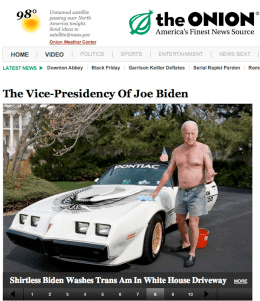
His Vice Presidency did little to augment this record, as The Onion constantly reminded us.

Truly Epic Mouthrunning

Joe Biden’s mouth has been a running gag for so long, it’s hard to recapture an appreciation of just how unique his talent for blowhardism is. This, mind you, is a man in a line of work where the standards for blowhardism are very high. Don’t bring your complaints about listening to you boring uncle around here, kid – in DC, that stuff doesn’t even get past the bouncer.

But in a field of top-notch blowhards, Biden is literally a blowhard’s blowhard. A while back (can’t find it now) a Weekly Standard profile opened with the observation that Biden’s tendency to blowhardism is a running gag even to Biden himself; he arrives on the scene of a speech he is to give and when the host pleads with him not to run over, he smiles and blows her off, and proceeds to run something like double his allotted time.

He Totally Helped Invent Borking But Also Totally Didn’t!

Among the many ups and downs of the American republic, there have been only a handful of really disastrous, unambiguously bad and wrong changes in our constitutional structure – like direct election of senators (bye bye, federalism). One of the worst of these was the decision to import the politics of dishonest personal destruction into judicial nominations. Now, it is important not to romanticize the political past. But the reasonably fair treatment of judicial nominees really was a bipartisan tradition that we relied on to make American democracy work. There is now no realistic path to restore it and no serious substitute.

If we were talking about Ted Kennedy’s role in the original Bork hearings, I would say there’s a case that he was more BSDD than PLDD. Kennedy destroyed the career of an innocent man by abusing power – like that notorious asterisk in the Higgy record books, David Sarnoff.

Biden’s role was Higgyworthy because he did his best to eat his cake and have it too. He tried to appease his party’s irresponsible Left while also trying, as chairman of the hearings, to look fair and respectable. He thus positioned himself for his long career run as a Very Serious Man who is not to be taken seriously.

Eww.

Just eww.

Plagarism and Lies

I’m actually inclined to give Biden a break for the infamous Kinnock incident. Biden had used the Kinnock line with attribution on multiple previous occasions; it seems clear to me that he just didn’t remember to include the attribution this one time. A mistake, but it shouldn’t be a hanging offense. This strikes me as akin to the famous Howard Dean Howl – something that wouldn’t have been a big deal except that it could be interpreted in light of a larger public predisposition toward the candidate, fair or unfair (Dean was seen as ideologically nutty, Biden as a phony).

But let’s not forget that Biden also committed plagarism in law school! And told a series of lies about his law school accomplishments:

A few days later [after the Kinnock kerfuffle], Biden’s plagiarism incident in law school came to public light. Video was also released showing that when earlier questioned by a New Hampshire resident about his grades in law school, he had stated that he had graduated in the “top half” of his class, that he had attended law school on a full scholarship, and that he had received three degrees in college, each of which was untrue or exaggerations of his actual record.

What could be more Higgyworthy, more an expression of “arrogant delusions of shaping the world to meet their own will,” than plagarism and lying about your academic accomplishments?

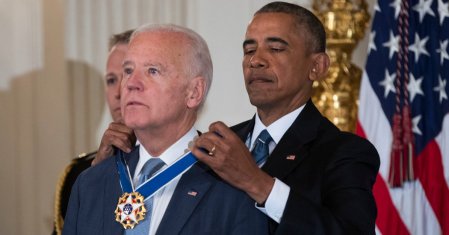
Medal of Freedom

No, seriously, Joe Biden totally got the Medal of Freedom:
13biden1-facebookJumbo

Tell me that alone is not Higgyworthy.

Remember, The Al got its glorious start largely as a response to Obama winning the Nobel Peace Prize. Let’s keep the tradition alive!