Nominate a Deserving Fool for the Higgy

April 1, 2018

untitled

(Guest post by Greg Forster)

Ah, yes, it’s once again that magical time of year when a young man’s thoughts turn to fools. I refer of course to The Higgy – the William Higinbotham Inhumanitarian of the Year Award. For the next two weeks, we’ll highlight our (un)favorite inhumanitarians; please join the fun and submit your nominations by email or comment! This year’s most (un)deserving nominee will be (dis)favored with The Higgy on Tax Day, April 15.

The award is named for history’s greatest monster, William Higinbotham.

For reference, here once again are the official criteria for selecting the winner:

“The Higgy” will not identify the worst person in the world, just as “The Al” does not recognize the best.  Instead, “The Higgy” will highlight individuals whose arrogant delusions of shaping the world to meet their own will outweigh the positive qualities they possess.

In other words, we’re looking for PLDD not BSDD.

In that spirit, I’m nominating pointy-headed academic and bloviating edu-blogger Jay P. Greene for The Higgy this year. His arrogant delusions of shaping the world include endorsing Common Coreunion corruption, communism and even slavery. Last year, though, he went too far – he took all the fun out of The Higgy by giving it to Plato. He said the Republic could earn The Higgy even if it was actually a satire of irresponsible utopianism. Well, guess who else writes satires of irresponsible utopianism!

April Fool’s, of course! My real nominee will be coming in the next few weeks – as, I hope, will yours. May the best fool win!


Lax School Policing Lets Kids Become Killers

March 2, 2018

25BEF620-46A0-40A9-AD00-C2DC0B6C0DD5

(Guest post by Greg Forster)

RealClearInvestigations carries a well reported and persuasive article by Paul Sperry documenting how Broward County has for years been among the most enthusiastic adopters of initiatives to stop the “school to prison pipeline” by . . . not arresting students when they commit crimes.

A surer way to make sure a kid stays in the pipeline to prison would be harder to imagine.

“If you commit crimes, there will be no consequences.” Yes, that’s exactly the lesson we want to teach at-risk youth. That’s going to work out just great for them in the long run.

Not to mention everyone else. The failure of police to take any action against the kid who went on to become the mass shooter, even as he committed crime after crime after crime and was never arrested – so he had a clean record when the time came – suddenly makes much more sense in this light.

What we need to look into now is the extent to which the whole system of having police officers assigned to schools has been subverted to serve purposes other than school safety. The more comes to light about the Broward Coward, Scot Peterson, the more it looks like being a school officer is something other than a legit police assignment. Is it merely a cushy job for lousy cops who want to draw a salary for no real work, which would be bad enough? Or is something more sinister going on – is there an organized system for placing officers in schools who know that they’re not supposed to make arrests?

Why did Peterson refuse to share information with a Department of Children and Families investigator about an incident involving the kid who went on to become the shooter? Is it normal for a cop to withhold information from investigators?

It is when they have something to hide.

HT David French 


Public Service Announcement

February 14, 2018

(Guest post by Greg Forster)

Citizens! You are hereby notified that Mary and the Witch’s Flower, which I reviewed here, is returning to US theaters for two days only next week, due to overwhelming demand.

If you missed it the first time, attendance is mandatory. Otherwise, attendance is merely meritorious.

A theater near me has brought back Darkest Hour, the surprise hit of the Oscar noms – perhaps one near you has done so as well. As I said before, you should see that one on the big screen, too!

End transmission.


The Not-So-Wild West in Oklahoma

February 7, 2018

sunset-3085578_640

(Guest post by Greg Forster)

While we’re on the subject of the Arizonan wild west, here’s my latest for OCPA’s Perspective on some very non-wild-west Oklahoma school overregulation:

The more prominent strategy, the one that got the most attention and funding, was toward greater centralized control. If schools are given more inputs and they fail to use them to produce better outcomes, then the schools are clearly working to enrich themselves. They can’t be trusted to carry the ball for fixing education.

Who could be trusted? Why, the reformers, of course.

Some interesting information from a state think tank:

The 1889 Institute’s database of public school regulations is the cumulative legacy of these earlier forces and the dramatic increase of regulations in the last generation. It runs to 610 entries. Schools are required to track every individual student’s progress in financial literacy education and every individual teacher’s professional development “points,” spend at least a certain minimum amount on their libraries, and meet test score targets or be subject to sanctions. They must also master obscure laws governing everything from inter-district transfers to the nutritional value of diet soda…

Very few of the regulations in the 1889 Institute’s database deal with issues that really need to be handled at the district level, never mind the state. I honestly think that the nutritional value of diet soda might not even need to be managed by schools at all. But if it does, why not let the principal hire lunchroom staff who are up to the job?

If you want to let me know what you think, the comment section below is not overregulated!


Pass the Popcorn: Words and Deeds

January 24, 2018

darkest-hour_de5745f86cac1e5c466d8d21ac667752

(Guest post by Greg Forster)

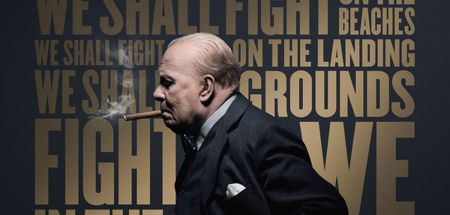
Okay, depending on where you live, maybe maybe maybe it’s not too late for you to head out and see Darkest Hour on the big screen. As the surprise standout in Oscar nominations, the movie may find itself on a few extra screens. (Theaters screening Mary and the Witch’s Flower get a dispensation, all others are on notice.)

This is a visually stunning movie and it well deserves a big-screen screening. I especially appreciate the filmmakers’ having lavished so much effort on the cinematography of a movie that isn’t about superheroes or spaceships, and for that matter doesn’t even have that much to work with in terms of war machines.

Yes, part of it is the effort put into the bombing scenes. But it’s also recreating the cramped quarters of the underground bunker, the vast chamber of Parliament, and the dingy makeshift bedroom in which the king made his decision to back the war.

Oh, and whoever it is playing Churchill does a pretty okay job, too.

(I’m proceeding with full spoilers because, duh, history.)
958d9676bd9168931e63dd43f538cc5a0a40aacf

This movie begins as a character study of Churchill. But any character study of Churchill must ask the question: What is it that makes a man refuse to agree to surrender his nation (for that is what “negotiations” with Hitler would have meant) even in the face of certain destruction? And that is not really a question about the man. It is a question about the nation. For, as it is the burden of this movie to show, Churchill could not have stood firm if the nation had not been willing to stand firm.

Yes, part of the story is that Churchill’s leadership brought the nation to choose resistance unto death. But leaders must have something to work with. The nation itself has to have moral resources for making right but hard choices.

This is why I cannot join those who are upset that this movie emphasizes Churchill’s temporary willingness to broach negotiations. It looks to me like the movie did not deviate from the historical record as far as some suggest. Perhaps it would have been better to show a little more of the cunning that lay behind Churchill’s decision to speak to the outer cabinet; Churchill did manufacture their pressure upon him to change course and forbid negotiations. But the point of this movie is that Churchill was almost boxed in. The professional political class did not provide the moral resources needed to sustain a stand against Hitler. Churchill had to go find them elsewhere.

So this movie transitions from a character study of Churchill to a character study of Great Britain. It asks: What are the moral resources of a nation?

The answer is words – but not words.

Words cannot produce the needed force by themselves, because the needed force is moral, and it transcends mere words. That is the abracadabra fallacy. But words rightly used are needed to transform moral truth into moral action.

Persuasion is not an autonomous power. Persuasion exists to connect people to truth.
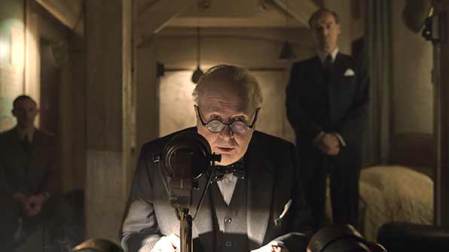
darkest-hour-still

The first big turning point of the movie is when Churchill lies to the nation about the severity of the situation in France. As he says to his wife, for years he has been the only person with the guts to tell the people the truth. But now he believes he has to lie to them.

This, the movie makes clear, was a wrong move – the abracadabra fallacy.

Halifax, demanding Churchill negotiate, tells him that with the British army facing certain destruction, he has nothing to fight Hitler with but “words, words, words!”

Yet that same Halifax, at the end of the movie, declares that Churchill has won with words. “What just happened?” someone asks Halifax after Churchill wins over Chamberlain’s faction to support the war effort.

“He mobilized the English language and sent it into war,” replies Halifax.

And what is the bridge between words and moral reality? History.
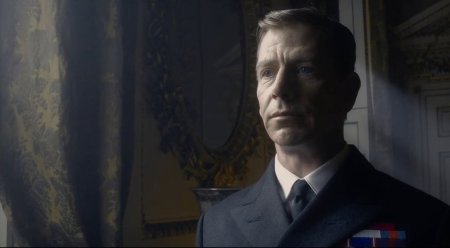
darkest-hour-ben-mendelsohn

History brings us into contact with two things that give words moral reality: kings and books.

Our nations and their institutions and traditions are a mess. They really are. They’ve done much wrong and are shaped by many irrational forces. And they are not an absolute authority, for there are authorities in whose light they too can be judged (we will come back to that in a moment).

But they embody moral truths, because human beings are moral creatures and we cannot organize our lives in any kind of sustainable way except around moral truth. And so the institution of the monarchy may be irrational, but it exists to embody something. When the monarch chooses to carry out this function rather than neglect it, he has extraordinary power. The same can be said to some extent of all political institutions and traditions (including those in republics).

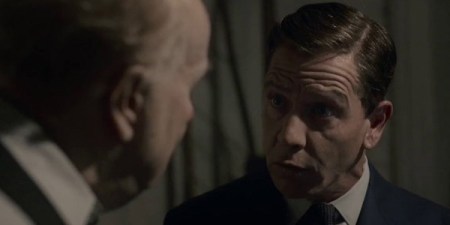
The makers of this movie thought a lot about how to portray George VI. It is clearly in dialogue with another outstanding movie that reflects on the tensions between aristocracy and democracy in light of World War II, The King’s Speech. For one thing, Darkest Hour really wants to make sure you know that Churchill stupidly opposed Edward’s abdication and George’s ascension, despite what you may have seen in that other movie.

It falls to George, who hates Churchill and has every good reason to do so, to make the decision to back Churchill at the crucial moment. When the short-sighted political class all go one way, the king goes the other – because that is his job.

And it is through words, used rightly, that George helps Churchill understand the moral ground he has been lacking. Go to the people, he says, draw from their moral strength and give them “the truth unvarnished.”

Yet this call to go to the people suggests that kings (and by extension political institutions and traditions generally) are not the highest authority.

We find the highest authority in another part of history, in the world of ideas – literature, religion, philosophy – that comes to us from the great minds, through their books.
DH4

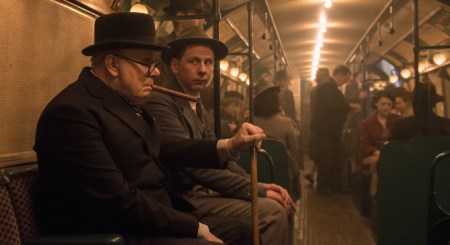
Yes, the subway scene is odd, and ahistorial, and if the filmmakers had asked me I probably would have told them to find another way to accomplish what they’re doing here. But what they’re doing here is the right thing.

Some have interpreted the scene as an attempt to tear down quasi-aristocratic leaders like Churchill, establishing that they’re not allowed to lead us but we must lead them. That’s not how I read it, and I think Steven Hayward has made that case well, so I don’t have to.

Churchill is going to the nation to find out what they’re made of, how far they’re willing to go. It is right for political leaders to lead with full awareness of how much they can ask of their people.

And what does Churchill find among the people? The words of Macaulay – the same words, if I remember rightly, that he found in his library in an earlier scene:

Then out spake brave Horatius, captain of the gate:

“To every man upon this earth death cometh soon or late.

And how can man die better than facing fearful odds,

For the ashes of his fathers and the temples of his gods?”

And so we are led back to political institutions and traditions (the ashes of his fathers), but now in light of what is higher (the temples of his gods) and also what is lower (Londoners on the tube).

For the words of great books are democratizing; they make the lowest highest. They arm ordinary people – even a black man in 1940 Britain – with the moral strength to stand in judgment of a Chamberlain, a Churchill or a George.

And so, in the end, having drawn strength from the words of his national traditions (by way of the king) and the words of the greatest of the wise (by way of the people), Churchill uses his enormous gift with words to rally the nation, giving form and force to their moral resources and saving the world.

His gifts really were extraordinary, but the point of this movie is that his gift with words was less important than his willingness to deploy them for moral truth.

As Chamberlain said: “He was right about Hitler.”


Pass the Popcorn: Powers that Cannot Be Harnessed

January 19, 2018

(Guest post by Greg Forster)

I know, I owe you a review of Darkest Hour – which is so great on the big screen, you should go out and see it before it leaves theaters. I’m working on that review! (At least I don’t have to worry about spoilers.)

You know what else you should see before it leaves theaters? Mary and the Witch’s Flower, a worthy successor to the Studio Ghibli legacy producd by the fledgling Studio Ponoc, and helmed by Hiromasa Yonebayashi, director of the outstanding Secret World of Arietty.

So, yes, this movie has credentials. And it lives up to them.

Mary2_0

Some have unfortunately attempted to describe it as “Harry Potter meets Spirited Away.” That is accurate as to subject matter. It’s about an ordinary kid who gets swept away to a magical alternate world, and spends most of her time in a magical school. But the magic in this movie is the weird and dangerous magic of pagan animism, not the rational and orderly – the essentially Christian – magic of Harry Potter. So that description is technically correct.

Actually, you could have made a pretty interesting movie out of “What if Hogwarts were pagan?” But that movie is not Mary and the Witch’s Flower.

This movie has a point, and a good one. It’s not actually about magic – ancient or medieval. It’s about the corruption of good causes and ambitions into bad ones. In particular, it illustrates the tendency of well-meaning people to seek to harness and control the whole universe in the name of their high ideals and aspiration to progress. What disappears in this mental world of total control is any kind of standard – nature – that is outside our control and to which our efforts at progress and reform are supposed to conform. We set out to produce order and beauty, we take control of the world to produce order and beauty, and by taking everything under our own control, we lose any standard outside ourselves for what counts as order and beauty. And so we destroy even the imperfect order and beauty that was already in the world before we took control of it, and we produce only monsters.

MARY_AND_THE_WITCHES_FLOWER

Those who remain morally awake, who don’t lose their heads under the influence of grand ideologies, are those who combine a love of adventure and a love of ordinary life. Paradoxical as it seems, this is actually a very normal and logical combination. The dream of total control kills both the awe of an uncontrollable world that is the essence of adventure, and the unselfconscious, purely natural domestic affections. Adventure and comfort must both be spontaneous and unplanned. And of course it is the contrast with being at home that makes the road romantic. As G.K. Chesterton puts it, the boy at the center of the fairy tale must be ordinary for the tale to be extraordinary; Jack must be small for the giant to be gigantic.

As a wise person says to Mary, “there are powers in this world that cannot be harnessed.”

I can’t get much more specific than that without spoiling things. Like Kubo, this is a movie you want to discover as you experience it.

Just go!


Pass the Popcorn: The Past Jedi

December 31, 2017

ED3E5D48-903D-4E5F-A622-D8E1009E12C0

(Guest post by Greg Forster)

Start 2018 off right with my review of The Last Jedi over on Hang Together:

Where TFA was about the family, TLJ is about the past. We need the wisdom of the past, but the corruption of the past threatens to destroy us.

Looking forward to hearing what y’all think!

PS Coming soon, Darkest Hour. Go see it while it’s still in theaters, it benefits from the big screen!


Oklahoma’s Doubleminded ESSA Plan

December 8, 2017

(Guest Post by Greg Forster)

In OCPA’s Perspective I review Oklahoma’s ESSA plan, and the story will be of interest to those outside Oklahoma. The basic problem with imposing reform on school systems that don’t want it is that the “reforms” become two-faced – they say what they need to say to please the reformers, but the substance of reform is another story:

Throughout the document, the bright, photogenic images and superficial, focus-group-tested buzzwords favored by the professional education reformers who run the ESSA regime collide over and over again with dense, esoteric clouds of opaque legalese, emitted—like ink from an octopus—by education special interests protecting their budgetary turf from scrutiny.

The document even has two title pages. The first is slick and professionally designed: a gorgeous, full-page image of a little girl with her hand over her heart is juxtaposed with the title under which the plan is being marketed—Oklahoma EDGE—in the form of a branded logo, like Pepsi or Google. The second title page is plain white with nothing on it but a little bit of text and the state education department’s logo. This page delivers the plan’s legal (i.e., actual) title, which is: “Revised State Template for the Consolidated State Plan: The Elementary and Secondary Education Act of 1965, as amended by the Every Student Succeeds Act.” Try making a branded logo out of that.

The report’s visual and verbal doublemindedness is reflected in the structure of the underlying plan, which dumps tons of money (the plan is always careful to set minimum goals for spending levels) into programs that don’t tend to improve educational outcomes. This makes both the system and the reformers look bad:

All this indictment of the Old Guard, for putting their own voracious desire for money and power ahead of real educational reform, is also an indictment of the New Guard. The professional education reformers, frustrated by decades of limited results from state activism, got impatient and decided to take a shortcut to power through Washington, D.C. But the Constitution’s federalist system, and the striking Left/Right political coalition suspicious of federal meddling in schools, really will not allow Washington to exercise the level of control the reformers want.

The end result is this ridiculous dance where Oklahoma has to submit a 218-page “eight-year strategic plan” for change and reform … under which it will continue to do the same thing it has done for decades: dump truckloads of money into expensive programs with no proven or even probable relationship to education outcomes. Which is exactly what the professional reformers have spent decades trying to stop the system from doing. Welcome to Wonderland.

Let me know what you think – and dont’ worry, your comments do not have to be accompanied by glossy graphics or popular buzzwords.


For the Al: Whittaker Chambers

October 30, 2017

78660-004-F7B14FDF

(Guest post by Greg Forster)

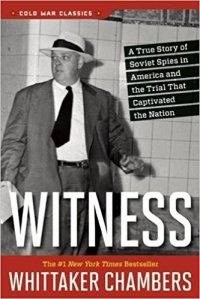
The Al does not go to people who are already widely recognized. However, I submit that today, in spite of the intense public attention he endured in 1948, Whittaker Chambers is not at all widely recognized. Since I read Witness for the first time early this year, I have begun mentioning him to people and am stunned to discover that almost nobody even knows his name today.

The first thing to understand about Whittaker Chambers is that he allowed his life to be destroyed rather than tell a small lie. He lost his job as senior editor of Time and never held another job in mainstream American journalism; he went home and became a full-time farmer, which is not a life that allows a man like Chambers to do what he was obviously made to do, which is journalism. He couldn’t even make the farm go – it failed.

He made this sacrifice in part to arouse the nation to face a totalitarian threat that its guilty conscience wouldn’t allow it to acknowledge (more about that in a moment) but at least as much to honor the dead whom he had helped kill. Unable to go back and undo his years of work building up Soviet communism, all he could do for its victims was tell the truth about what he had done, no matter what it cost him. And it cost him all.

The second thing to understand about Whittaker Chambers is that all the forces of American civilization were arrayed to destroy him. This is why his testimony cost him everything.

Before the Hiss Case in 1948, virtually no one with any position in American civilization viewed communism as totalitarianism. It is very difficult for us to recapture an awareness of this, in light of subsequent history. But in 1948, the consensus was that communism was illiberal or authoritarian, but not totalitarian. It was not genocidal. There were no gulags, no starving millions in Ukraine who were being put to death intentionally for the sake of the great project. (The New York Times still has not given back the Pulitzer it won for coverage of the glories of communist agriculture, or even run a correction, in spite of the fact that its reporter knew about the mass murder and covered it up intentionally.)

Whittaker Chambers and John Slater

Chambers’ testimony about his work as a Soviet spy implicated high-ranking American leaders. Reading through Alger Hiss’ defense of himself, I’m amazed that it really does all boil down to this: “I helped build the New Deal, negotiate the Yalta agreement and design the United Nations. If even a man like me can be a traitor, American society must be so utterly bankrupt that its entire leadership class would be implicated in bottomless moral corruption. Therefore a man like me could not possibly be a communist spy – and every leading politician, journalist and professor had better get busy testifying in my defense, lest the bankruptcy of American leadership – and hence his own bankruptcy – be exposed.”

He did not put it in precisely those words, but close enough.

The president called Chambers a liar on campaign stops. Two justices of the Supreme Court testified as character witnesses for Hiss. Rumors flew around the Washington press corps that Chambers was a drunkard, that he was mentally ill, that he had slept with Hiss’ wife, that he had sexually abused his own brother as a child and had then abused Hiss’ stepson.

All baseless, of course – but a ruling class believes what it hears from its own. It will believe any lie, however outrageous, about a commoner before it believes any uncomfortable truth about itself.

If you doubt this, consider: James Reston, the legendary DC correspondent for the New York Times, had recommended Hiss for his job as head of the Carnegie Endowment. If Hiss was a traitor, what did that say about Reston? So naturally Reston did all in his power to destroy Chambers, including inventing lies about him.

When Chambers went on the radio show Meet the Press, Reston “moderated” the panel of journalists dedicated to destroying him. Obviously there was no acknowledgement of Reston’s conflict of interest. After the broadcast, Chambers’ son asked him: “Papa, why do those men hate you so?”

Chambers replied: “We are in a war, and they are on the other side.”

Nor was it only journalism that was corrupted. The chair of the Harvard psychiatry department testified in court that he had diagnosed Chambers as a dangerous lunatic, solely on the basis of reading his journalism in Time. Upon cross-examination, however, the good Harvard doctor recanted his testimony and admitted that he had in fact gone around to former co-workers with stories of Chambers’ depravity, and tried to wheedle them into affirming them. (Rules of evidence for “expert” testimony are a little tighter now than they were then.)

Chambers had indeed exposed the corruption and bankruptcy, not of Alger Hiss, but of the entire ruling class of the nation.

He had known this would be the effect of his testimony from the beginning. He had seen how the narrative of inevitable and government-led secular progress, to which the entire ruling class of the nation in both parties was wedded, was not very far removed from the totalitarianism of communism.

The issue was not safety-net programs. The issue was a society that had decided comfort and safety were the only really necessary elements of a good human life. This, not the role of government as such, is the deep corruption of the narrative of inevitable secular progress. It is this materialistic view of life that is the real cause of the endless creeping expansion of government.

51u6w06E-sL__SX331_BO1,204,203,200_

As he put it in Witness, the great question in our time is “God or Man?” The communist east had answered “Man,” and embraced totalitarian mass murder because it had the courage of its conviction. The capitalist west has also answered “Man,” but it lacks the courage of this conviction. So far.

Communism is not immorality. Communism is morality without God. It is not a quest for injustice, it is a quest to achieve justice for all people – accomplished by purely human means. Its vision is that “the destiny of man is in the hands of man.” But “without God man cannot organize the world for man; without God man can only organize the world against man.”

Hence the hammer and sickle insignia on Antifa paraphanalia; hence Che Guevara and Fidel Castro on the t-shirts of so many well-meaning moral crusaders seeking justice for all. The neo-Nazis of the alt-right, meanwhile, are non-communist only because they do not strive toward justice for all, but only justice for their own people and causes. The difference between Antifa and the alt-right is that the former is universalistic and the latter parochial, and this is always the difference between communism and fascism.

And today, as in 1948, a morally sick society does not want to see what communism is.

Chambers is also famous for thinking that by defecting from communism to freedom, he was joining the losing side. What is less well known (I found it in his letters to William F. Buckley, published posthumously in Odyssey of a Friend) is the reason Chambers gave for his pessimism about the future of freedom.

There is, he said, no political remedy for spiritual decay in a society.

But to say there is no political remedy is not to say there is no remedy. One of the things we can do to remedy spiritual decay is honor those who do what Chambers did – sacrifice themselves so that others may enjoy freedom.

There is much more to his story, and if you want to know it, you can read the first chapter of Witness, entiteld “Introduction in the Form of a Letter to my Children.” If you read that and don’t then want to read the rest of the book, I don’t know what to tell you.

What matters most for The Al, I think, is the long-term impact of Chambers’ exposure of the threat of communism, which forced the nation for the first time to recognize communism as a totalitarian threat rather than merely just another variation on the old-fashioned authoritarian Great Power game. Without Chambers’ willingness to give up everything for the sake of telling the truth, there would have been no mass mobilization against communism until much later, by which time it may have been too late – or at least it would have been too late for millions who were saved because Chambers forced the nation to wake up when he did.

Yes, Chambers has been recognized in the past. But those recognitions (including the Medal of Freedom given him posthumously by Reagan) have been almost entirely on the political Right. The nation at large has never honored Chambers as it ought.

And now, even the Right forgets. Few of my friends even on the Right are familiar with Chambers’ name. And just recently, George Will blamed Chambers for the success of Donald Trump; one might just as easily blame the doctor who diagnoses a cancer with the madman who seeks to avoid dying of cancer by drinking poison.

Let’s give Chambers his due. Let’s give him The Al.


Emergency Shortage of (Common Sense in the Hiring of) Teachers

October 12, 2017

classroom-1910014_640

(Guest post by Greg Forster)

OCPA’s Perspective carries an article of mine with a headline I’m particularly proud of: “Teacher Hiring Devastated by Emergency ‘Common Sense Shortage'”:

New moons cause teacher shortages because teachers have accidents driving in the dark without moonlight. Full moons cause teacher shortages because teachers become werewolves.

Claims about the causes are always changing, tailored to whatever is in the news. The claim that there’s an urgent, emergency shortage that we need to address right now never goes away.

News reports about lots of “emergency certifications” in Oklahoma are misleading:

These exceptions are being described as “emergency” certifications. This term has been adopted not only by the old guard but by many others, including some of their critics. I suspect it comes into wide use not only because the old guard and the click-addicted media benefit from public hysteria, but also because the schools seeking permission to make these hires think they’re more likely to get it if their need is described as an emergency. However, the state refers to these simply as “exceptions” to the standard certification requirements. This more neutral description might permit a more careful analysis…

If these exceptions are evidence of a problem, the obvious thing to do is target our response to the particular localities and disciplines where the overwhelming majority of the exceptions are being granted. That way Oklahoma can solve the problem it actually has, not some other, imaginary problem.

Ha, ha! Just kidding. The obvious thing to do is raise teacher salaries across the board, shut down accountability systems statewide, and give the old guard all the other things it wants. Such measures will have only a very indirect effect on the localized and specialized areas where certification exceptions are being granted. But that’s not what teacher shortage hysteria is ever about.

PS: Special guest appearance by Matt Ladner and his Brookings “Super Chart!”

Please help us address our emergency shortage of blog comments by leaving your thoughts below!