Pass the Popcorn: That’s My Girl

July 2, 2018

Incredibles-2-sneak-peek-still-Helen-Bob-and-Lucius

(Guest post by Greg Forster)

This post contains mega major spoilers. I mean it. You have been warned.

Okay, let’s get the tiresome part out of the way first. Pass the Popcorn hereby presents:

EVERYTHING WRONG WITH INCREDIBLES II

  • Ridiculously patronizing fan service: A visit to Edna, with the conveyor belt and everything, is shoehorned in; Frozone gets yelled at by Honey
  • Act I totally undermines the psychological climax of the first movie: They put on their masks to fight the Underminer – they are now supers again, and proud of it! But then we needed to make another movie, so suddenly they’re not.
  • The visual look of this movie is just different enough from the original that you constantly notice it – especially Dash, did no one go back and review what he looked like in the first movie? – but not so different that your brain accepts it as different. It’s the animation version of the uncanny valley.
  • The villain’s back story is insultingly contrived: It would have been sufficient if she’d just hated supers for the reasons given in the big Screenslaver speech, which would have made her a really interesting political/ideological villain with a megalomaniacal vision of reshaping the world by force; but no, it all had to go back to a ham-handed story about a personal trauma, because we’re all babies now.
  • Mind control is always bad: It negates the only part of any story that’s really interesting: the characters’ choices and struggles.

What bugs me is not that these are huge problems, because they aren’t, but that they would have been so easy to fix if the studio had respected our intelligence just a wee bit more. I think these issues collectively made the difference between I2 being a really good movie (which it is) and a really great movie, on par with the original (which it isn’t, alas).

Whew! Now let’s get to the fun part.
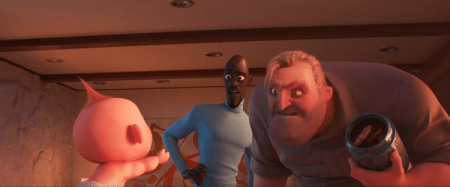
16incredibles-2-1-articleLarge

I2 continues the Pixar/New Disney tradition of goring our cultural sacred cows, but doing it in just the right way so people will take it. In this case, as in some others (see: Frozen) it’s done by giving us a real encounter with the reason people believe in those sacred cows – the other side gets a full airing of its case before the movie pulls the rug out.

The Incredibles franchise, here as in the first movie, takes on two big cultural dimensions at once. Which is what would have made I2 a really great movie if they hadn’t fumbled too much of the small stuff, since taking on just one is tough enough.

The first dimension is the male ego. In the first movie this was simply (simply!) the conflict between Mr. Incredible’s longing for the glory days and the prosaic task of being a father. He must learn that parenting is heroic. “You are my greatest adventure, and I almost missed it!”

That theme is echoed in I2 by having Mr. Incredible become a full-time dad to three unruly kids with superpowers, the comedic value of which is expertly milked. And it leads, halfway or so through the movie, to the same conclusion – parents are the real heroes.

But now there is a new twist. The male ego comes up against the female ego.

cycle

Mr. Incredible is not just invested in his own professional success – his glory days. Now he’s also deeply threatened by the possibility that his wife might outshine him.

All civilizations always needed to mortify the male ego sufficiently to make men into good fathers. But in the new social order that is emerging after feminism, the male ego must be further mortified to make room for female competition in the workplace – without the compensatory satisfaction of the paternal role being valued in the same way the maternal role is valued. Whether that is sustainable is an open question, but if it is, it will only be so if men learn heroic virtue similar to the heroic female virtue Tocqueville praised as the foundation of the American regime. Tocqueville said (in substance) that the American experiment in constitutional democracy avoids degeneration into atomistic indiviudalism only because its women had not demanded the equal rights to which they were clearly entitled under the governing principles of the regime; if they ever did demand those rights, he warned, the regime could not deny them, but the result would be the collapse of the traditions by which the family rather than the atomized indiviudal is the basic unit of society. That, in its way, is one of the lessons of I2 – only men of heroic moral virtue can sustain the new social order feminism has catalyzed.

You see what I mean about goring sacred cows? But we’re not done yet.

The female ego comes in for a subtle but no less sharp skewering in I2. From the moment they meet, Evelyn begins stroking Helen’s female ego – her sense of resentment and exclusion in a man’s world – in order to get under her defenses and take advantage of her. And Helen falls for it hook, line and sinker. The two of them spend half the movie just stroking each other’s female egos, right up to the point where Evelyn plunges in the knife. Like Iago worming his way into Othello’s trust by flattering his male ego and then twisting that very ego to his own purposes, Evelyn has used Helen’s feminist pride to destroy her.

The other big social topic is of course the role of superheroes.
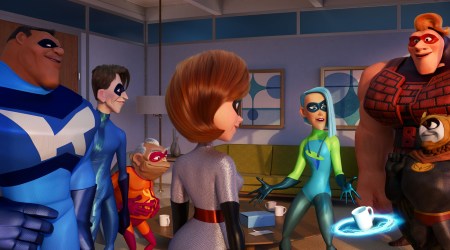
INCREDIBLES 2

In the first movie, Syndrome spoke for the envy and resentment of all those who hate heroes – and they have been a prominent and influential voice throughout the modern period of history. So pervasive is this resentment that Helen herself parrots it without really thinking – “Everyone is special, Dash.” The modern period could almost be defined as the period during which it became plausible to say that it is evil to admire heroes.

I2 tries to pick that thread back up. In the Screenslaver speech, the critique of superheroes is even broadened into a critique of the Big Media and Internet culture for which superhero franchises are a sort of proxy. “You don’t talk, you watch talk shows; you don’t play games, you watch game shows.”

The makers of I2 have seen that under the surface of the standard-issue snobbery about mass media we constantly hear is an aristocratic (or worse) contempt for democracy and egalitarianism. Evelyn’s attack on bourgeois society strikes the note of every totalitarian ideology: You’re all SHALLOW and WEAK and LAZY. That’s why mass media is nothing but a tool of social control – you’re all so easily controlled because you’re pathetic and worthless. WAKE UP, SHEEPLE!

This is all botched, however, because it does not remain at the center of the villain’s character and motivation. The contrast with Syndrome is instructive. Syndrome has a personal trauma to provide resentment and a motive for megalomania, yes. But Syndrome’s revenge consists of remaking the world according to a new political vision, a vision whose principles he understands and articulates as a coherent ideology. This is precisely what makes him interesting. “When everyone is super, no one will be!” If Evelyn’s big “monologuing” scene with Helen in the frozen chamber had been a further elaboration of that political vision and not the recitation of a mind-numbingly boring series of convolutions designed to give her a stronger personal trauma, she could have ranked with the best of the Bond villains.
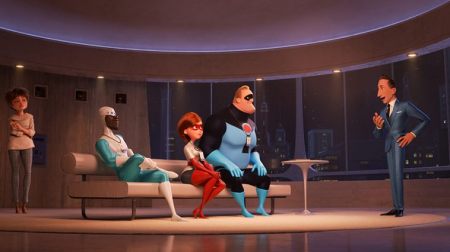
incredibles2_1

But in spite of this misfire, I2 does remember to pull the rug out from under Evelyn’s ideology. And the character who does it is Violet.

Let’s face it, there’s a great deal to be said for the critique of bourgeois society as shallow and morally undeveloped. But the bourgeois society is a little like Winston Churchill’s democracy – it’s the worst kind of society, except for all the others that have been tried from time to time.

The self-appointed superiors who look down upon the shallow complacency of bourgeois society never actually rise to moral heights. Time after time, in arrogance and contempt, they sink to moral depths.

Who is it that learns real humility? The supers, who – precisely because they have so much power – must learn to use it rightly or face catastrophe.

Violet spends the whole movie wanting to be a superhero. Even when she says she doesn’t, she only says it because she really does – and the sacrifices are so painful. And then, in the climactic moment, she chooses to stay out of the fray in order to protect her baby brother rather than seek glory and adventure.

And her father says, “that’s my girl.”


Responding on Pre-K

June 27, 2018

469EADCA-45D4-4475-8720-5953C9D0B5C2

(Guest post by Greg Forster)

The Oklahoman has run a quasi-response to my recent op-ed on whether Pre-K is worth the investment. I say “quasi-response” because the author, Craig Knutson, says he’s not trying to refute what I wrote, just putting his own two cents on the table – which is fair enough.

I appreciate that Knutson agrees Pre-K has to produce an “ROI” (his term) sufficient to justify the investment. Unfortunately, the evidence he provides doesn’t establish how large the ROI of Pre-K is:

  • He says he looked at “five distinct reports and programs,” but doesn’t tell us what they are, so we can’t evaluate either his characterization of their findings or the quality of their methods.
  • He says “all of the studies concluded that returns on investment were greatest among high-risk demographics,” which doesn’t tell us how great the returns were.
  • He says “Oklahoma certainly has a disproportionately large number of high-risk families and children.” This admittedly would depend on how those terms are defined, but it’s hard to think of any reasonable definition by which this assertion would be true – assuming “disproportionately” means “disproportionately compared to other U.S. states,” and I don’t know what other basis of comparison would be relevant. Oklahoma has plenty of struggling people, but not a “disproportionate” number of them as compared with, say, New York or Mississippi.
  • He says “another aspect of these programs was that each was voluntary.” He stresses that this means the programs were selected by parents because they’re valuable and produce returns. He thinks this supports his argument, because it’s evidence these programs are valuable. But if the parents themselves aren’t paying for the programs, then their choice by itself doesn’t establish ROI on a cost basis. More importantly, the public question in Oklahoma right now is whether Pre-K should be expanded. ROI will inevitably go down (as costs go up and benefits go down) when we stretch beyond families who have chosen Pre-K proactively, to rope in families that have to be goaded – or perhaps forced – into attending.
  • He quotes James Heckman saying that “high quality” programs produce benefits, without defining “high quality” or telling us how large the benefits are.
  • The only specific study Knutson cites is this one, which studies a highly targeted program for a specific population that doesn’t represent what Pre-K looks like for the general population. Knutson not only does not inform the reader that the study is looking at a targeted program, he actually protrays it as if it were a study of “high quality” Pre-K programs generally, serving the general population: “But Heckman’s latest research, ‘The Lifecycle Benefits of an Influential Early Childhood Program,’ shows that high-quality programs can deliver a return on investment of 13 percent per year.”

Other than that, there were no problems with it.


How Beneficial Is Pre-K?

June 16, 2018

469EADCA-45D4-4475-8720-5953C9D0B5C2

(Guest post by Greg Forster)

That’s the question in my new policy brief from OCPA.

Today the Oklahoman ran an op-ed adapted from that policy brief:

Policymakers shouldn’t spend big money expanding pre-K when the benefits are so uncertain. They should also take pre-K off Oklahoma’s automatic-funding conveyor belt; it should have to make a case for itself like every other discretionary expense.

Moreover, Oklahoma should consider introducing school choice design in existing pre-K programs, to strengthen the freedom and power of parents. Oklahoma’s existing program permits schools to partner with community organizations; why not allow community organizations to serve parents directly?

Let me know what you think!


Genuinely Restorative Justice Must Be Strict, Not Soft

June 13, 2018

Max Eden

(Guest post by Greg Forster)

Max Eden’s outstanding piece, which Jay extols here, shows not only how lax discipline leads to bullying, chaos and death, but also how the language of “restorative justice” has been corrupted in ways that are already having terrible consequences.

Justice ought to be restorative. The purpose of justice is not revenge. It is to restore offenders to society – debt paid and ready to try again.

But the debt must be paid. With some exceptions, in general an offender is not really “restored” on a moral, psychological or social level until they have suffered just punishment. That is the only reason punishments exist. And people are ruined if they are raised up learning the lesson that there will be no consequences for bad behavior.

In other words, retributive justice is a necessary element of genuinely restorative justice.

Unfortunately, people whose goal is not to do justice but to reduce the severity of punishments have hijacked the concept of restoration. We are now trapped in a terminological system in which “restorative justice” means the opposite of “retributive justice.” People think they are helping restore kids when they are actually destroying them.

The really terrifying result of this change is not that it gives unearned rhetorical credibility to advocates of lax discipline. It is the response from the other side.

The overwhelming majority of people can see the destructiveness of lax discipline. They are therefore concluding that “restorative justice” is dangerous and destructive. Therefore they are rejecting restoration as a goal of justice. And when you do that, all that’s left is the limitless cruelty of revenge.

The increasing tendency of some to dehumanize criminals and demand harsher and harsher treatment of them cannot be fought by advocacy of lax punishments in the name of “restorative justice.” It is directly caused by advocacy of lax punishments in the name of “restorative justice.”

Only retributive justice, which affirms that punishment is not an arbitrary tool of social control but a just and necessary consequence of the crime that the criminal is morally obligated to suffer, can be effective in restraining the abuse of criminals – and promoting their genuine restoration.

As C.S. Lewis once said, I plead for retributive justice not primarily for the sake of society, or for the sake of crime victims, but for the sake of the criminal.


Another Look at Heavy Regulation and Minority Operators

April 25, 2018

MI LA charters 8m

(Guest post by Greg Forster)

EdChoice carries my post using the new NAEP results to bring us back to our earlier discussion of Ian Kingsbury’s finding about what our condescending friends at NACSA do to minority charter operators:

If you’re wondering why the education status quo wants heavy regulation, ask yourself why Facebook CEO Mark Zuckerberg asked Congress to regulate social media: Regulation cements the power of dominant providers, shutting out smaller and less powerful rivals. That’s why heavy regulation does so much damage to minority communities. They have less political power to influence the content of regulations — which more powerful providers can shape in their own favor — and less ability to afford the enormous cost of compliance.

Borrowing Matt’s graphic above to make the point about Louisiana, land of the overregulated NACSA dream.


OK Ed School Follies

April 20, 2018

classroom-2787754_640

(Guest post by Greg Forster)

My latest in OCPA’s Perspective is on ed schools as barriers to entry in the teaching profession:

Arne Duncan, the Obama administration education secretary, said in 2009 that “by almost any standard, many if not most of the nation’s 1,450 schools, colleges, and departments of education are doing a mediocre job of preparing teachers for the realities of the 21st-century classroom.” He said education schools are “cash cows,” and he’s right. Teachers who need credentials are hostages to the ed school system, so universities create ed schools in order to collect the ransom money.

In addition to economic rent-seeking, I also cover the ideological side of the problem:

Gregg Garn, the dean of the University of Oklahoma College of Education, lists “politics of education” as his first area of research interest. On his web page, a document full of left-wing political and policy posturing is listed more prominently than his curriculum vitae. I suppose since education schools seem to exist for political propaganda, it’s fair enough that he considers his political platform a more relevant credential to establish his qualifications than his academic track record.

School me on what you think!


Test Scores and Life Outcomes

April 17, 2018

classroom-2787754_640

(Guest post by Greg Forster)

I have a post at OCPAThink on the lack of alignment between short-term test score changes and long-term life outcomes:

As an education researcher, I feel a little like an engineer hearing that the coefficient of gravitation has been cut in half as an energy-saving measure, or a mathematician getting the news that for the sake of simplicity, Pi will henceforth be rounded down to 3. We’ve spent a generation building our discipline—and education reform ideas—on the assumption that rising scores mean better education. If they don’t, we have to rethink everything.

We’ll have to look beyond tests for the next accountability – school choice and other forms of local control.

We won’t set high standards with the narrow tool of test scores alone. It takes a broad vision to know what education is, and qualitative human judgment to know when schools are providing it. The future of school accountability is the people at large—not a specialist expert class—empowered to use their full human judgment to evaluate schools that they know personally. In other words, school choice and other forms of local control.

The post contains tons of links to Jay’s writing on this, natch!


For the Higgy: Romanus Cessario

April 14, 2018

431CF8D8-5EFF-48DE-96DA-5B67DA8C67D6

The Kidnapping of Edgardo Mortara, Moritz Daniel Oppenheim, 1862

(Guest post by Greg Forster)

Without a doubt, the biggest shock in years in the world of “social conservative” intellectuals was the publication, this February, of Romanus Cessario’s defense of Pius IX for forcibly removing six-year-old Edgardo Mortara from his Jewish parents in 1858, and raising him as a Christian. Cessario defends Pius not on “it was a different time” grounds, but absolutely, affirming the general principle.

Serious doubts about religious freedom and liberal democracy have been growing for some time among some people in the insular and deeply self-satisfied intellectual world of what used to be social conservatism. As doubts about religious freedom and liberal democracy have grown, the aptness of the label “conservative” has shrunk, for no one who wants to induce a catastrophic social revolution in order to overturn the 700 year political tradition that provides all our public moral language and shared moral universe ought to be called conservative.

Cessario’s folly has brought matters to a head by revealing what is really at stake in these growing doubts. Centuries ago, it was possible to govern out of authoritative traditions because social worlds were by and large epistemically isolated from one another. As a result, traditions were not much recognized as the social conventions they were. Traditions were not “traditions,” they were simply the wisdom of elders.

But once modernity makes us aware of how socially contingent traditions are – makes us aware of them as traditions – they are no longer authoritative. To impose them on the recalcitrant is merely an act of brute force. Today there is no governing out of traditions, there is only one social group ruling another.

There is no space to enter here into the details of how Cessario’s choice to pick this particular fight in this particular way smacks strongly of anti-Semitism or, for that matter, how the Mortara case can be related to the perfectly legitimate general debate over the validity of religious freedom and constitutional democracy. Of all political forms, liberal democracy has the least right to avoid responsibility for making a case for itself or tell its critics to shut up and go away. As I remarked to a friend during the Cessario blowup, every liberal’s business card should say “Justify Your Social Order – Ask Me How!”

The real Higgyworthiness of Cessario’s article is the desire it reveals, on his part and that of his allies, to eat their cake and have it, too – to defend the enforcement of religious laws on those of other religions, and then pose as champions of the downtrodden whose opponents are the real oppressors. Cessario emphasizes the global opprobrium heaped on Pius IX and on Catholics, especially traditionalists, today, comparing both to the Diocletian martyrs. Steven Spielberg is apparently working on a Mortara film, which Cessario expects to be anti-Catholic; hence the need to instruct the faithful about the Mortara case preemptively.

Cessario has attracted some defenders, but also a much, much larger number of sympathetic commentators who might be described as anti-anti-Cessario (links here). They’re not yet prepared to admit that their position logically entails Cessario’s, but the one thing they do know is that Cessario’s critics are defenders of “bourgeois society,” which is to them a sort of Anselmic being than which nothing worse can be conceived.

There is no question that Catholics continue to face widespread bigotry; readers of JPGB may recall some of the many occasions we’ve had to discuss that bigotry. But you can’t have it both ways. If you ought to be protected, so should everyone else. To take Jewish children by force and raise them as Christians is BSDD; to defend such acts and then paint yourself as the oppressed party is paradigmatic PLDD.

Image HT


Pass the Popcorn: Living in Shadows

April 13, 2018

08-chappaquiddick_w710_h473

(Guest post by Greg Forster)

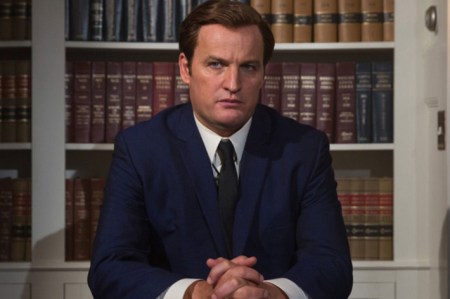
Chappaquiddick accomplishes something very few movies do: it explores why a man made an evil choice. That is very hard to do because (as James Q. Wilson put it in his brilliant little book Moral Judgement) any explaination for why someone made a decision naturally becomes an excuse for that decision. A man beats his children now because his father beat him twenty years ago; to the extent that the beatings twenty years ago really do explain the beatings now, the man’s choices seem less culpable, and to the extent that they don’t, the man’s choices are less comprehensible. Either the explanation of the evil act is not satisfactory as an explanation, in which case we are left unsatisfied, or the explanation of the evil act does satisfy as an explanation, in which case the act seems less evil.

Chappaquiddick does not compromise on the fact that Teddy Kennedy’s choices were evil. For that reason, it is getting a lot of attention from right-wingers who have long waited for some sort of justice to be done upon the Kennedy family’s crimes. Chappaquiddick shows, in ways that would be impossible for any fair-minded observer to deny, that Teddy Kennedy did evil things, and that is a sort of justice for which we have indeed waited long.

But if you walked out of this movie saying to yourself, “boy, Teddy Kennedy really did evil things in Chappaquiddick, didn’t he?” you missed the point of the movie.

The filmmakers have set out to explain, without excusing, what Kennedy did. And they succeed brilliantly.

I must reluctantly admit that part of the formula for success in this endeavor was for the film to steer completely clear of the sexual side of Kennedy’s depravity. This is unsatisfying to my sense of justice, in light of the fact that Kennedy spent his whole adult life – long after Chappaquiddick – leaving behind him a trail of harrassed and attacked women, not only in his own workplace and on his own payroll but in restraurants, airplanes, you name it. Full justice is not done to Kennedy’s depravity in this movie. But that is probably necessary, because such matters probably could not be depicted or even suggested without ruining the project of explaining rather than condemning.

The traditional story of the burden of growing up in the shadow of Jack and Bobby – and of Joe, Jr., who died a war hero – is of course an important theme. At the beginning of the movie, we see Teddy being interviewed for an upcoming television broadcast about Jack’s legacy. The occasion is the immanent landing of Neil Armstrong on the moon – Jack’s big challenge to the nation in 1961. Teddy displays the extraordinary Kennedy eloquence, which he possesses in equal measure to his brother, then suddenly cuts off the interview when the pain of contemplating his place in his brother’s shadow becomes too great. Then he lets a woman die on Chappaquiddick, and it’s all over the news. Then the moon landing comes and the interview airs, and the whole nation watches it with Chappaquiddick in mind.

But this movie places greater stress on the role of Teddy’s iron-fisted father, Joseph, Sr. Teddy, who is a vain and foolish man but has a real conscience, keeps wavering between doing right and protecting himself. He does not always make the evil choice, and when he does, he does not always stick to it. A cousin who was with him on the night of his disaster keeps urging him to do the right thing – to report the incident, to admit that he was the one driving, to resign his Senate seat rather than keep it at the cost of ghastly lies.

And every step of the way, Joseph, Sr. and his army of highly comptent schemers is there to demand more lies, more subversion of the law, more destruction of the innocent to protect the guilty.  And constantly, constantly reminding him that he has always been the family screwup, and will always be the family screwup.

MV5BMjk4ZDc0YmQtYzRlNy00ZDc3LWI1ZWEtMmYzYzc5ZGFjZmZiXkEyXkFqcGdeQXVyMTkxNjUyNQ@@__V1_UX477_CR0,0,477,268_AL_

Explanations of evil tend to function as excuses for it because they demand our human sympathy. What Kennedy did was evil. But let no one judge too harshly anyone who has had to grow up the son of that kind of man, and make moral choices while still professionally under his power. No, not even in a case of aggravated manslaughter – not even in the case of a man who escaped punishment for aggravated manslaughter, and got off with a slap on the wrist for leaving the scene of an accident, by a systematic campaign of lies and influence-peddling. Condemn, by all means, but spare also a charitable thought.

Reserve the venting of your spleen for the millions upon millions of Kennedy idolators, whose folly is given ample display at the end of the movie. They were not sons of Joseph Kennedy, Sr. They had no tyrant threatening to destroy them if they followed their conscience. And they chose cognitive dissonance and irresponsible moral relativism – anything rather than permit themselves to confront the monstrosity of the idol they had made in their own image.

And yet, and yet . . . I am left contemplating the contrast between Teddy Kennedy and another family screwup of a great American political dynasty. George W. Bush was the Teddy of the Bush clan for many years. Then he found Jesus, kicked the bottle, stayed home with his wife and became an honorable man. You may or may not join me in attributing the primary difference to the inscrutable mystery of divine providence, selecting one man and not another for the gifts of the Spirit. And I will grant that George H. W. Bush, tough as he undoubtedly was, was not the detestable tyrant Joseph Kennedy, Sr. was.

But that image of W. as the road Teddy didn’t take must heighten the imperative that we remember, not without some sympathy, what a monster Teddy really was.


Hess and Gallo Get Words Wrong in NRO

April 4, 2018

Logomachy

(Guest post by Greg Forster)

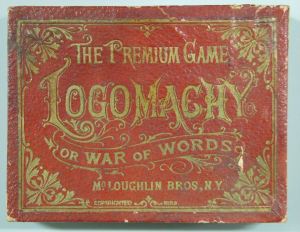
In NRO today, Rick Hess and Sofia Gallo accuse the school choice movement of using “overheated” and “alarmist” rhetoric. They assert that since school choice is the opposite of neighborhood schooling (which all smart people know to be true, since we say it and we’re the smart people), choice advocates need a new, toned-down rhetoric to convince jumpy soccer moms that choice is no big deal and won’t have any big effects on anything.

How is this wrong? Let me count the ways:

1) “School choice advocates are wild-eyed ideological extremists” is a timeworn smear used by the Blob to demonize reformers, and anyone paying attention should have seen through it by now. For Hess and Gallo to resort to this lazy stereotype is offensive. The examples they bring to justify their claim that choice advocates are overheated and alarmist (choice is like Uber for schools!) redefine the whole concept of “weak tea.”

It is Hess and Gallo whose rhetoric is overheated and alarmist, in claiming that choice advocates are overheated and alarmist.

2) Hess and Gallo admit that choice is not only increasingly successful politically, it is growing more popular over time. Their efforts to create the impression that choice has a public perception problem (choice underperforms when compared to pie-in-the-sky hypothetical utopian alternatives in heavily biased survey questions formulated by the servants of the Blob at PDK!) don’t change the basic facts.

By Hess and Gallo’s own showing, choice is winning in statehouses, winning in governors’ mansions, and winning in public opinion polls. No doubt that success will ebb and flow in the future, as it has in the past. But choice has better public perception today than at any time in its history.

3) School choice is not in tension with local control, it is local control. For half a century, governance of district schools has moved further and further out of the local neighborhood and up the bureaucratic ladder, from the building to the district to the state and federal levels. There is no plausible plan for reversing that movement, other than school choice.

The only possible future of “neighborhood schools” is neighborhood schools of choice. Nothing else but choice will return governance of schools to the neighborhood level.

Because guess what neighborhoods are made up of? Parents. And parents who are given school choice exercise that choice as members of their local communities, gathering information and forming relationships in neighborhoods.

4) Parents tend to like their own schools, so Hess and Gallo recommend that choice advocates adopt a message along the lines of “choice won’t change schools.” Because that’s how you sell a reform – argue that it doesn’t matter and won’t change anything.

Or perhaps the message will be, “choice won’t change schools for people like you, it will only change schools for those other people. You know the ones we mean.”

Jay has been pointing out for years that the biggest mistake education reformers have been making is to argue that their policies will benefit a small and relatively powerless portion of the population, and offer no benefits to larger and more powerful constituencies. Hess and Gallo want choice to double down on that strategy.

5) To the extent that choice advocates could do better in framing their rhetoric, the problem is not that choice is percieved as a threat but that choice is percieved as of limited value because it is disconnected from moral imperatives like justice, equal opportunity, diversity and freedom. School choice advocates often assume that when they talk about markets they are affirming those imperatives, but in fact the language of markets does not and will not invoke those commitments for most people. A new language of school accountability through choice is needed to connect school choice to the things that matter most.

We shouldn’t talk as if choice should matter less, but as if it should matter more. Because it does.