Racism in Public Schools

November 28, 2018

ednext_20111_figlio_open

(Guest post by Greg Forster)

OCPA carries my article on racism in public schools:

Robinson’s case attracted wider attention, threatening to make the system look bad. So, Robinson was able to get permission from the guardians of the government school monopoly to transfer her grandchildren out of Edmond North.

But most cases of racism, harassment, and bullying don’t make media headlines. Those families are stuck. They have to keep sending their children to school to be preyed upon, day after day.

Don’t listen to me, listen to Robinson: “The students still there, they feel helpless, they feel like their hands are tied and they just have to tough this out,” she told KFOR. “No kid should have to tough it out.”

This is just one of many reasons all parents ought to have school choice:

America continues the struggle to build a genuinely pluralistic society. That means overthrowing the continuing power of racism, our great national original sin. To pursue the American principles of equality and freedom, we must labor diligently to dismantle the structures of racial oppression.

The government school monopoly was created in the 19th century to consolidate the power of social elites. They wanted to homogenize what was, in their eyes, an unacceptably diverse population. A society where differences are valued can only emerge when the monopoly they built is broken.

Let me know what you think!


Religious Schools and Science

October 30, 2018

imagesF6CRZCR6

(Guest post by Greg Forster)

We interrupt this deluge of Al nominees to bring you . . . something about education! Namely this post at OCPA about why religious private schools can teach science so well. The main reason is that religious people’s beliefs about science are not very different from everyone else’s:

This is partly because the extent to which less-religious people “believe in science” is overrated. Consult your daily horoscope for guidance on whether secular reason and revealed religion are the only belief systems in modern America. Don’t worry, if you can still find a newspaper, you’ll have no trouble finding a horoscope—nearly every U.S. paper has printed them for generations, in spite of unanimous opposition to astrology from the world religions. If you’re a Libra, you can weigh the evidence and find that secular Americans are imperfectly rational. If you’re an Aquarius, you can pour cold water on the illusions of secular rationality. If you’re a Gemini, you can pour it twice.

The more important factor, however, is that ignorant people have vastly understated the extent to which religious people and institutions in the modern world “believe in science.” None of the foundational commitments of science—that nature works regularly, that the human mind is capable of discovering and describing that regularity—are in conflict with religion. That is why all the world religions have embraced modern science; indeed, the Christian assumption that nature and the human mind were made by a rational God was, historically, an essential precondition for the emergence of modern science.

Belief that miracles have sometimes occurred is no hindrance to science. On the contrary, you can’t believe in miracles as exceptions to the ordinary course of nature until you believe that the ordinary course of nature is rational and regular. And you can’t believe miracles serve to demonstrate visibly to their observers that nature is being disrupted—which is what miracles are for in the first place—unless you believe that the human mind is capable of knowing the regularity of nature (and hence knowing when it has been disrupted). Belief in miracles, far from contradicting the view that nature is regular and that we can know its regularity, presuppose this view.

The underlying problem for the way we think about this, unsurprisingly, is that people are more concerned with advancing their view of religion than with getting their facts straight:

These observations force us to recognize that we have to do better at distinguishing two questions. One is whether people ought to “believe in science” given their worldview, and the other is whether those people do in fact “believe in science.” Whatever you think about what people ought to believe, as a point of empirical fact the relationship between people’s beliefs about religion and their beliefs about science simply does not justify the confident assertions made about these beliefs.

Let me know what you think!


For The Al: The Rock of Chickamauga, George Henry Thomas

October 25, 2018

450px-GHThomas

(Guest post by Greg Forster)

As the prospect of civil war loomed in 1860, southern partisans in the U.S. Army began shuffling commands around, to put all the southern-born officers together. That way, they could work and train together, forming relationships, cohesion and teamwork that they could take with them together in the event of secession. And when the break did come, half those southern-born officers did in fact leave together.

Among those who did not was the man with three first names: George Henry Thomas.

Here’s a Civil War story you don’t know and need to: Over 100,000 white southerners, known as Southern Unionists or Southern Loyalists (as well as Yankees, Scalawags and Tories among their detractors, alongside less printable names) served in the Union army during the Civil War. Every southern state except South Carolina contributed at least a full battalion to the Union. Tennessee alone produced 42,000 loyal men to fight for the Stars and Stripes.

If there is ever going to be healing for the still-festering wounds of the Civil War, it will come when we who hail from the South are ready to admit that the Cause was wrong. That will be a hard pill to swallow; clearly we are not yet ready to swallow it. One thing that will make it much easier will be if we learn to tell the stories of the many thousands of southerners who knew better than to be taken in by the Cause.

If you asked the Southern Unionists why they were fighting for the North, they’d have told you they weren’t fighting for the North. They were fighting for the Union.

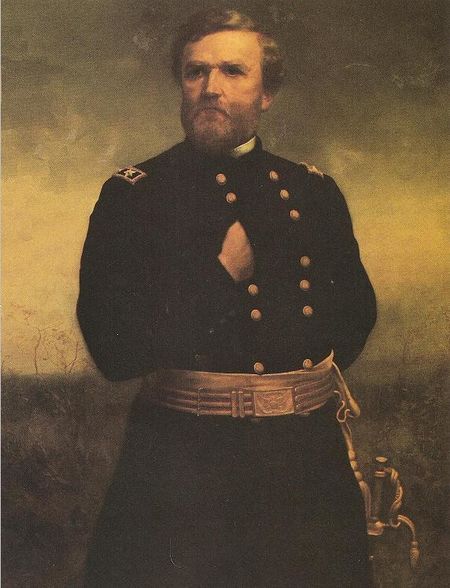
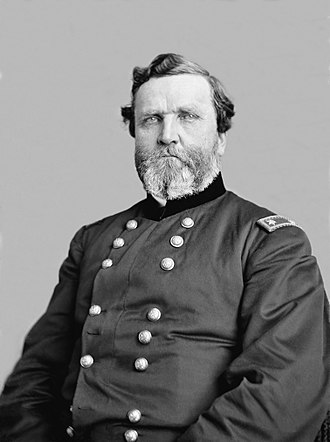
Among that roll of honor, Major General George Henry Thomas – son of Virginia – stands head and shoulders above the rest. “Old George H. Thomas is in command of the cavalry of the enemy,” wrote J.E.B. Stuart to his wife. “I would like to hang, hang him as a traitor to his native state.” The two had studied together at West Point.
330px-George_Henry_Thomas_-_Brady-Handy

Why does Thomas deserve The Al? Let me count the ways:

1. Thomas brought the Union’s disastrous early losing streak to a close by winning its first strategically significant victory, at Mill Springs, Ky. on January 18, 1862. He was in a position to do so because his prowess and natural leadership (his men identified with him as a fellow “soldier’s soldier” yet also looked up to him as “Pap Thomas”) were so much in evidence that between April and August of 1861 he had been promoted to lieutenant colonel, then colonel, then brigadier general. At Mill Springs, he broke the Confederate hold on Kentucky, and – probably even more important in the long run – delivered a much-needed morale boost. It’s hard to overstate how shocking the loss at First Bull Run and the series of subsequent defeats were for the Union. It became an open question whether the Union might make terms and quit. Mill Springs shored up political support to see the war through.

2. At the Battle of Chickamauga, September 18-20, 1863, commanding Union general William Rosecrans – whose commission had been backdated so he could fake seniority and get promoted to that command ahead of Thomas – committed a major tactical blunder, and Union lines collapsed. Confederate troops charged in, and the defeat threatened to turn into a rout from which the campaign might not recover. Thomas held his ground, inspiring his troops to stay and bear the brunt of the attack, in order to provide cover for the rest of the Union forces at Chickamauga to organize a retreat. A message runner (future U.S. President James Garfield) informed Rosecrans that Thomas was “standing like a rock.” The Army of the Cumberland was saved, and Rosecrans was removed from command in favor of Thomas. He led the Cumberland to a dramatic reversal of fortunes, culminating in a decisive Union victory in November in the Chattanooga Campaign. (Ironically, the climactic battle was won in part by dumb luck.) The Union gained permanent control of Tennessee and strategic dominance of the entire western theater, as well as the staging point from which Sherman’s Atlanta campaign would be launched and supported the next year. Thomas was known forever after as The Rock of Chickamauga.

3. After the Chattanooga Campaign, a chaplain asked Thomas if the Confederate dead should be buried separately by state. “No, mix ’em up,” said Thomas. “I’m tired of states’ rights.”
US-$5-TN-1891-Fr.365

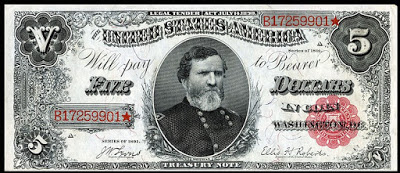
Special $5 Treasury note honoring Thomas, 1890

4. When John Hood found he could not directly stop Sherman’s march to Atlanta, he turned around what was left of his Army of Tennessee and tried to cut off Sherman’s lines of communication to the Union stronghold in Chattanooga, hoping to draw Sherman off to fight him. But when Hood got to Tennessee, he found The Rock of Chickamauga – who was once his teacher at West Point – waiting for him. Thomas smashed the Army of Tennessee so hard that it ceased to exist; its few remaining men dispersed and joined themselves to other Confederate forces. Thomas earned yet another nickname, The Sledge of Nashville, and a very-long-overdue promotion to major general. (“I suppose it is better late than never,” he commented. “I earned this at Chickamauga.”)

5. After the war, with much of the South in desperate, starvation-level poverty, Thomas sent generous financial assistance to his two sisters living there. They sent the money back, declaring that it must have been sent to them by mistake, as they had no brother.

6. One of the main reasons the wounds of the war have not healed is the vast superiority of southerners as storytellers. Our national memory of the war has been disproportionately shaped by the way the South has told its own story, for the simple reason that northerners, in general, can’t tell a story worth a nickel. Thomas saw what was happening early on; he sounded the alarm in 1868:

The greatest efforts made by the defeated insurgents since the close of the war have been to promulgate the idea that the cause of liberty, justice, humanity, equality and all the calendar of the virtues of freedom, suffered violence and wrong when the effort for southern independence failed. This is, of course, intended as a species of political cant, whereby the crime of treason might be covered with a counterfeit varnish of patriotism, so that the precipitators of the rebellion might go down in history hand in hand with the defenders of the government, thus wiping out with their own hands their own stains; a species of self-forgiveness amazing in its effrontery, when it is considered that life and property—justly forfeited by the laws of the country, of war and of nations—through the magnanimity of the government and people was not exacted from them.

Alas, that was one battle with the Confederacy he was destined to lose.

7. Thomas spent the postwar years overseeing the military government of various regions of the South under Reconstruction, and in particular suppressing the Klan. He set up military courts that would enforce labor contracts for black citizens who couldn’t get redress in civilian courts.

8. He retired to upstate New York and was buried there. None of his blood relatives attended his funeral.

For the honor of the Union and the South: The Rock of Chickamauga for The Al.

Image HTs – color, b/w, T-note


For The Al: Adam Butler and Autumn Thomasson

October 24, 2018

(Guest post by Greg Forster)

Those of us interested in markets often use the childhood experience of running a lemonade stand to illustrate how business can be a school of virtue. In recent years, unfortunately, we have been more likely to point to the shutting down of lemonade stands as an example of how overbearing regulation is stifling the entrepreneurial spirit in our culture, destroying this and other traditional rites of passage like teenage summer jobs.

This summer, though, we got a delightful surprise. Under the leadership of Adam Butler, general manager of beverages and nuts for Kraft Heinz, Country Time Lemonade introduced the awesomeness of “Legal-Ade.” It’s a system of financial and legal support, covering permits and fines up to $300, to help kids like Autumn Thomasson keep their lemonade stands open over the summer. They also donated to Alex’s Lemonade Stand Foundation, which helps kids and families run lemonade stands to raise money for cancer research.

It’s also the rockingest advertisement I have seen in a long time. “TASTES LIKE JUSTICE!” Wish I knew that actor’s name, I’d add him to the nomination.

Is it even legal for corporations to get this creative and take a risk standing up to the regulatory state for their customers? Aren’t they required to run to the corner and cower in fear, promising to do whatever the state demands?

Because if they’re not . . . our big corporations are run by cowards.

And they’re probably leaving a lot of money on the table, too. You think this aid program paid for itself in increased sales for Country Time? I’d bet you more than a glass of lemonade it did.

Why do I think so? Here’s one reason. Adam Butler says: “Legal-Ade will be back next year, helping support kids’ rights to run lemonade stands! We look forward to kicking off year two of the program and helping more kids next year.”

Watch out, lemon protection rackets. Autumn has backup.

For bringing lemonade to the world, having a ton of fun mocking PLDD lemon thugs, and making an honest buck doing it all, I nominate Adam Butler and Autumn Thomasson for The Al.


For The Al: Eric Lundgren

October 23, 2018

eric-lundgren__31896

(Guest post by Greg Forster)

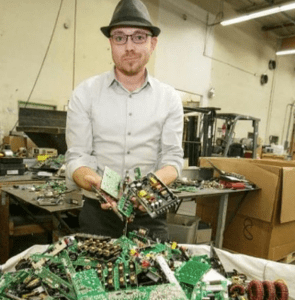
Since June 15, Eric Lundgren has been in prison. His crime: Downloading software onto computer disks for his customers instead of making them do it themselves – which many of them couldn’t do, leading to unnecessary abandonment of perfectly good computers (filled with delightful chemicals) into our landfills. His sentence: 15 months in prison.

In the spirit of honoring noble scofflaws like Al winner Wim Nottroth and UX (who played Valjean to Higgy winner Pascal Monnet’s Javert), I nominate Eric Lundgren for The Al.

This is not Lundgren’s first run-in with the powers. His first arrest was at age 14, when he panicked and fled from a police cruiser trying to pull him over for driving a not-entirely-street-legal go kart he had made with a lawn mower motor and a boombox.

Since then he’s put his ability to repurpose parts to more productive use. He became a millionaire tech entrepreneur finding a variety of ways to reuse electronic devices and components rather than let them rot. Some of these have been lucrative, some charitable, and some both at the same time. He launched the first “electronic hybrid recycling” facility in the United States, turning old cell phones and stuff back into useable devices. This serves the poor (who can get devices cheaper), saves the environment (chemicals in phone batteries are nothing to mess with) and, hey, put a buck into Lundgren’s pocket, too.

He once built an electronic car out of discarded parts that out-distanced Tesla’s car on a single charge. And don’t forget the troops – his company once donated 14,000 cell phones to military personnel deployed overseas, where I bet they were grateful to be able to make a call home.

His trouble with the law – this time – springs from his having manufactured a “restore disk” that you could use to restore your software after a crash. One thing he provided on the disk was a copy of Microsoft software to re-install. He found that many customers either were, or felt (which amounts to the same thing) unable to restore this software themselves, and perfectly restorable computers were being thrown out in favor of new purchases because customers couldn’t get their old ones to work.

Now, let’s be clear about four indisputable facts:

  1. Lundgren was not authorized to download the software, so he did break the law – as he admitted by pleading guilty (though he appealed the jail sentence as excessive).
  2. The disks could not be used on a computer that did not already have a paid-up license for the software, and anyone with a paid-up license is allowed to re-download the software for free, so Lundgren didn’t cost Microsoft a single thin dime that it was ethically entitled to.
  3. Microsoft wanted this case prosecuted because they wanted to collect sales revenue by getting people to dump perfectly good computers in our landfills so they’d have to buy new computers with new software.
  4. Only a coward or idiot of a prosecutor would charge a case like this.

There’s nothing wrong with making a buck as you do good for the world. But there is something wrong with making a buck by not doing good for the world. And there is a whole lot wrong with sending a man to jail for 15 months so a company can make a buck off actively harming its own customers.

I’m proud to nominate Eric Lundgren for The Al.

Image HT


Sending a Message

September 20, 2018

JOKER_burning_money_3_0600

(Guest post by Greg Forster)

As of FY15, school choice had already saved state and local taxpayers a cumulative total of $3.2 billion.

While improving educational outcomes across all metrics.

Pictured above: Marty Lueken, contemplating the government school monopoly.


Teachers Value More than Money

September 18, 2018

classroom-2787754_640

(Guest post by Greg Forster)

I have a new blog post at OCPA reflecting on the fact that private school teachers are more satisfied than public school teachers, even though they get paid less, because on almost every other metric their jobs are better:

There’s a lesson in this for how we improve education. Unionization has raised teacher salaries, benefits, and job protections. But, in schools as in factories, unionization seriously hinders organic cooperation in the workplace, not only between the line workers and their supervisors but also between the line workers themselves. Workplaces begin to run much more by arbitrary rules than by what gets the job done. I remember being in a state legislative committee hearing once where a principal was asked why she quit running a district school to run a charter school. “Because I can hold a meeting” was her reply—union rules had prevented her from asking teachers to attend meetings when needed in her district school.

However, there’s also a lesson for school choice. The choice movement has historically invested far too much in the rhetoric of markets, competition, and material incentives. People are not money-maximizing robots. They care about getting their job done for the sake of the job, not just for the sake of the paycheck or to grow the size of their organization. School choice works because it sets parents, and teachers, free to focus on working together to get the job of education done in the way that works best for them. Yes, incentives matter, and we can say so. But let’s put the emphasis on cooperation, community, and freedom.

Let me know what you think!


New School Holiday: Special Interest Day

August 27, 2018

(Guest post by Greg Forster)

While we’re on the subject of poor political judgment, the Oklahoman just ran my op-ed on schools closing on Election Day for the official, publicly identified purpose of increasing the Blob’s political clout:

Running the schools themselves with institutional policies designed — explicitly — to maximize school employees’ political power at everyone else’s expense is another matter. Now they’re using our tax dollars to create a political machine designed to extract ever-more tax dollars for themselves. The rest of us are allowed to notice this. If you want to create a big and vicious political backlash in an already polarized environment, this is one way to do it.

Let me know what you think!


On Taking Ignorance Seriously

August 16, 2018

IMG_1529

(Guest post by Greg Forster)

I have a post at OCPA on taking ignorance seriously:

Some states managed to have success in some cases—Massachusetts’ standards reforms and Florida’s mix of school choice, exit exams, and incentives to raise test scores across demographic groups are notable examples. But the overall story was failure. We just couldn’t take these good ideas to scale…

Why was school choice the only winner? Because it takes our ignorance seriously. It doesn’t try to generalize the content of education across millions of unique children.

Throwback to my review of the evidence on Pre-K included at no extra charge!


Religious Left Baptizes the Blob

July 5, 2018

classroom-2787754_640

(Guest post by Greg Forster)

In my latest for OCPA, I look at how Oklahoma’s religious left is baptizing the blob, including support for the teacher strike.

It’s not my position that religious leaders should have nothing to say about education policy:

It’s true that America’s great experiment in religious freedom implies our public policy can be based on shared moral commitments even if we disagree about the ultimate cosmic basis of those commitments. But as George Washington rightly pointed out in his farewell address, we can’t talk only about the morals of public policy and ignore the religious foundations of the morality upon which we draw. For if the foundations are neglected, the building collapses.

But if religious leaders are going to speak about education policy, they should make a serious theological argument and not just parrot the political talking points of secular special-interest groups. Otherwise they end up captive to political manipulators. This is exactly what happened to the religious right:

As a matter of fact, I’ve spent almost 10 years speaking out against the ideological captivity of the religious right. I appreciate that the fight for the sanctity of human life and other issues has accomplished some good. But the larger effect of the religious right movement was to push churches to become voter registration offices of the Republican Party. As it became clear what was going on, this did incalculable damage to the religious credibility of the churches involved. We are still living in the disastrous aftermath, as huge portions of our culture have disconnected themselves from faith entirely.

So I’m only playing fair when I say that I see the same dangerous sellout in the efforts of Oklahoma’s religious left to baptize the blob. The pronouncements of Oklahoma’s religious left on education don’t bring any theological light to the public policy questions. They’re not saying anything the secular left isn’t saying. They’re just pasting Bible verses on self-interested interest group politics. Organizing events and statements to support a secular special interest’s demand for money, parroting its secular talking points, doesn’t become a spiritual discipline because you do it with a clerical collar on—quite the reverse.

There are, in fact, serious theological arguments to be made on education policy. I’ve participated in some of them, including my response to theological arguments from the religious left as well as theological arguments from the religious right. So I welcome – though I often disagree on the merits – real theological arguments from the religious left and right. What’s alarming is when religious leaders make themselves tools of secular selfishness in the name of, yet to the detriment of, better schools for kids.